Peter Nealen's Blog, page 20
June 28, 2019
Buying Time With Blood – Holding Action is Out!
Holding Action is live!
Matt Bowen and his team made it out of Slovakia by the skin of their teeth.
But the fight’s not over. And there’s no rest for the weary.
The European Defense Council, desperate to salvage their dream of a Europe reshaped in their image, threaten invasion of Poland.
The Triarii and what is left of American forces in Northern Europe stand by their Polish allies. But they’re outnumbered and outgunned.
And they might well be watching the wrong part of the border.
The brutal series about the next World War continues in a storm of fire and steel!
Today is the day. The battle for Poland has commenced. Those who pre-ordered the Kindle version should have it downloaded by now.
Holding Action is even bigger in scale than Escalation. Parts of it were a real challenge to write. As a reviewer for Escalation pointed out, my forte has long been small-unit, clandestine operations, with some intense, but small-scale combat. This gets into combined arms battle in a big way. Of course, with things proceeding as they are, how long this phase of the Maelstrom Rising series will last is anyone’s guess…
Unfortunately, only the ebook is live. We’ve run into some technical snags with KDP paperback; their cover templates are not fitting the actual dimensions needed, and we’ve been trying to adjust things, but they don’t give precise dimensions for corrections. So, we’re bracketing the target and getting closer, but, long story short, the paperback isn’t ready yet. It will be by the end of next week, though.
Here’s hoping you enjoy Holding Action, and if you do, please consider leaving a review on Amazon.
The post Buying Time With Blood – Holding Action is Out! appeared first on American Praetorians.


June 25, 2019
Holding Action Chapter 2
“Shit,” Phil whispered. “I knew they had a fucking drone up.”
I didn’t answer, but scanned the road carefully. Once again, thanks to the woods, we were far closer than we should have been, but the spotlights weren’t pointed at the woods, not yet, and the rising growl of the helicopter, along with the rumble of the armored cars’ diesels, seemed to have drowned out what little noise we were making. Slowly, carefully, I eased back deeper into the shadows, Phil doing the same.
Looking up and down the road, I didn’t see a good spot to cross. The six armored vehicles were spaced out along the road. They were too close to slip through, and too spread out to find a good spot to go around. At least, not with that helicopter closing in. Two klicks of open country separated us from the border at its nearest point, and that would have entailed going through Leuba.
As urgent as it was that we get the information back to Poland, we weren’t going to do anyone any good if we went charging out there and got killed or captured. And as confident as I was in my team in combat, the numbers out there on the road were telling. Especially with armored vehicles mounting remote-operated machineguns. Doesn’t matter how good you are, bucking a stacked deck like that is just going to get you killed.
“Back into the trees,” I whispered as Phil got close enough. “We’re going to have to lay low and wait.” I knew as well as he did that that could still go very, very wrong. We had maybe three square miles of woods to hide in, and they were crisscrossed with trails and bike paths. And the leaves were falling. We were on the clock, whatever we decided to do.
Whatever I decided to do. We might be a team, but I was still team leader, and democracy in a combat situation is always a bad idea. The buck stops here. I could, and would, take input from the team when possible, but at the end of the day, the decisions were mine.
Don’t think that’s power-tripping. It’s one hell of a responsibility, especially when more than the other eight guys on your team have their lives in your hands.
The two of us moved slowly and carefully back into the trees. We hadn’t overpenetrated into the open field, but the trees were still thin enough that if we moved too quickly, we might well still get spotted. The eye is drawn to movement, which is why stalking is often so slow and painstaking.
So far, they hadn’t turned those spotlights on the treeline. So far. If they were set up on that road, it meant that they suspected that somebody was running around in the woods around Görlitz. If they started actively hunting, I was sure that those lights were going to come into play.
The question was whether they were in place just to watch and wait, or were actively looking for us. I didn’t think we’d done anything to compromise ourselves, so I expected that they were just in place as a tripwire.
Time would tell. I just hoped and prayed that I was right. If they were hunting us, this was going to get real ugly, real fast.
We got back to the rest of the team, and I signaled for everybody to get low and get camouflaged. Nobody asked questions; they had heard the helo. And a recon patrol was rarely the time or place for asking questions about tactical decisions, anyway. Everyone started finding a tree or a bush to hide in or under.
I found Scott, grabbed his shoulder, and whispered into his ear, so close that he could probably feel the heat of my breath. It sounds uncomfortably intimate, but when you’re trying really, really hard to be as silent as possible and still communicate, you don’t have much choice in the matter.
“Border police on the road, with armored vehicles and spotlights,” I whispered. It almost wasn’t a whisper; it was more of a subvocalization, so quiet that I could barely hear myself. “Helo overhead. We’re going firm and seeing if we can wait them out.”
He didn’t reply, but just nodded. I moved back toward Phil, peering through the trees toward the road.
I could see the faint glow of the spotlights, though the trees masked most of the illumination. This was going to have to be good enough for the moment; we were only a few dozen meters back in the woods, but we were in a band of trees that surrounded another open field behind us, ringed by walking paths. With that bird overhead, we would risk detection trying to move around it, never mind crossing it.
I found a spot just to Phil’s left and got down under a fallen birch. It was relatively newly fallen; there were even still leaves on the branches. I got down as low as I could, all but tunneling under the trunk. I carefully started trying to arrange the branches over me to look as natural as possible while keeping most of my profile obscured.
Camouflage is something you do, not something you wear.
The birch was partially propped up against the aspen next to it, giving me a bit of room for not just myself, but my ruck. It also meant I could get behind my rifle, pointed back toward the road. Just in case.
Then I went as still as I could, listening and waiting.
The helo went overhead, the stabbing beam of the spotlight filtering through the limbs of the trees, the growl of its rotors vibrating in my chest. It was flying low, looking for something or someone. But we were half-buried in the forest floor, and there was still enough overhead cover that the light couldn’t reach us, at least not enough of it to identify a man lying in the shadows.
It continued along the line of the woods, sweeping the spotlight back and forth, receding away from us, the snarl of its rotors gradually dying away. Looking over my scope, I watched the treeline just before the road.
The glow of lights remained. Now that we weren’t moving, and the helicopter had passed, I could hear a bit. There was the faint murmur of chatter among the Bundespolizei. Even if I’d spoken more than the bare minimum of German, I couldn’t have made out the words.
But the fact that we could hear them was already a bad sign. With the helicopter’s covering noise gone, we had to stay very, very quiet, or they could hear us, too.
Time passed achingly slowly and horrifyingly quickly at the same time. I lay there, my body stiffening up, as the helicopter went back over, heading back north toward Görlitz. Then it came back again. It seemed to be running racetracks up and down the border, shining that blinding spot at any area that might provide some concealment for a recon team.
And all the while, the forest around us was getting brighter, as dawn came closer and closer by the minute.
I was cussing silently, using words that I was probably going to have to go to Confession for, the longer we lay there. Without comms—and trying to get a comm shot with the German border guards within spitting distance was going to get us compromised, we had no way to get word back about what we’d seen. And given the amount of activity that the Poles were monitoring across the border in Germany, the blow could fall at just about any time.
Provided that it wasn’t all theater, like the fake laager we’d found. In which case, I had little doubt that there wasn’t another attack planned, somewhere else.
But we couldn’t get that information to Hartrick or General Reeves just sitting there in the dirt and the leaves. And the closer that dawn got, the more likely it was that we were going to have to stay there in our impromptu hide site through the whole day.
And that was assuming that the Germans were going to move on once night fell again, rather than get relieved by another group.
Darkness gave way to dim twilight, then to a rosy-tinged glow, and finally to full daylight. The helo had moved away, but we were still stuck in place. There was no way to get across those fields unobserved in daylight.
I wracked my brains as I lay there. It wasn’t as if I had a lot else to do. I had to think of a way to get past those border guards once it got dark. Unfortunately, it was looking more and more like there was no way but to fight, and that was a losing proposition.
Pound for pound, I was confident that we were the deadliest men in eastern Germany at that point. But pound for pound only counts for so much. There comes a point where sheer weight of numbers comes down on your head, and then you’re screwed.
Clouds started to move in, turning the morning light wan and gray. A breeze passed through the woods, stirring the leaves and biting through my sweaty fatigues. There hadn’t been time to pull on the warming layers inside my ruck, nor had it been advisable with the enemy that close. The chill began to get painful, adding to the already unpleasant stiffening of muscles that had been under duress and then had to go still for a long time.
Even so, none of us moved, none of us complained, though I was sure that Phil had a whole pissed-off litany of hate and discontent going through his head. So did Jordan. Phil was a bullshitter who would have an entire speech in his head just because. We’d probably hear it later, if we got out of this alive. Even if we were captured and shuttled off to a German prison, we’d still hear it.
Jordan was just bad-tempered. He made me seem like the soul of niceness. And that’s saying something.
The morning dragged on. Spatters of rain seeped down through the leaves. And I started to get more and more tense.
I hated just lying there, waiting. It’s the hardest part of any combat operation. Recon ops are arguably worse, with the necessity of stealth. Endless, dragging hours of stillness and silence, nothing to do but scan your sector, trapped in your own mind.
As much as I hated to think of it, given the timeline, we were going to have to move back the way we’d come once night fell, and find another way around. It was going to be a long night; we’d have to loop miles out of our way to find another way across the border, but there was no helping it. We couldn’t push across at Leuba while the border guards were holding the road.
I just hoped that they didn’t have detachments strung out all the way along the border. It seemed like it would have been prohibitive from an expense and manpower perspective, but it wasn’t a possibility that I could afford to discount.
Then, as late morning edged toward noon, our options narrowed to zero.
Some of the voices started getting louder. I froze. Not that I was moving much at all, but I even stopped breathing. Some of the Bundespolizei were coming into the woods.
I couldn’t see them yet, but I could sure hear them. They weren’t trying to be stealthy; branches were snapping under their boots and they were chatting. They sounded nonchalant, though with German it can be hard to tell.
I hoped and prayed that they were just stepping into the woods to take a piss, and that we hadn’t given ourselves away.
The first of them appeared through a thinner spot in the trees, and any hopes that they were just moving to the treeline to relieve themselves vanished.
They weren’t dressed for the woods, not really. Dark blue fatigues with black combat gear doesn’t blend in well. While most of the regular EDC military forces had switched to the HK 416 series, these boys and girls were carrying older G36Ks. They were also black, in contrast to our camouflage-painted OBRs.
More Bundespolizei appeared on either flank. They were sweeping the strip of woods alongside the road, spread out with about five meters between them. And one of them was walking straight toward my hiding place.
Damn it, damn it, damn it. We had nowhere to go, and no way out except shooting.
I still held perfectly still, though my rifle was pointed right about at the oncoming German border guard’s midriff. Maybe, just maybe, they might pass us by. It wasn’t likely, but given the odds, I needed to wait until the very last moment before opening the ball.
But that son of a bitch didn’t move to one side or the other, didn’t slow down. He kept walking right toward me, looking around, nonchalant but alert. He wasn’t expecting anyone, but he’d been ordered to be on the lookout, so he was searching the woods, even though his G36 was held with the muzzle pointing at the dirt.
He was less than ten yards away when I couldn’t wait any longer. He wasn’t going to walk on me, since I was halfway under a fallen tree, but if he went around, he was going to stumble onto Greg or Phil. If he went around the tree to my left, he was probably going to trip over Greg. And then it’d be all over.
In a situation like that, it’s better to seize the initiative rather than wait and react. Gunfire at ten yards is unforgiving.
So, I tilted my rifle up, my eye to the scope, which I had dialed back to 1x, put the crosshairs on the bridge of the man’s nose, and squeezed the trigger.
The thunder of the shot was shockingly loud in the quiet of the forest, even given the noise that the Germans were making tramping through the undergrowth and the fallen leaves. Bits of leaves and grit blasted away from my muzzle as the bullet blew his dark blue beret off his head, snapping his skull backward with the impact and spraying a fine red mist behind him as he dropped.
The echoes of the shot hadn’t even started to die away when a ragged volley of 7.62 fire ripped out of our little perimeter, smashing into the bodies of the closest Bundespolizei. I hadn’t been the only one with his finger on the trigger.
I shifted targets quickly, even as the first man hit the loam, rolling halfway onto my left side and shifting my rifle over to target the next man down the line. He was already falling, two of Phil’s bullets in him, and as I quickly moved to the next, Tony got up on a knee and laid down a roaring burst of machinegun fire, sweeping the muzzle of his Mk. 48 across the line to the south. Bodies dropped, either diving for cover or getting cut down by Tony’s fire.
“Up!” I roared, clambering out from under the fallen tree. We had the initiative for a moment, but if we hesitated, we’d lose it. And that meant getting cut to pieces. Our sole advantage at that point was that the woods went right up to the edge of the road, so we’d have some concealment as we attacked the patrolling vehicles.
I just hoped it would be enough. It would get us closer than we could across the fields, but then only speed, surprise, and violence of action would get us close enough to neutralize those mounted machineguns.
I went around the trunk, my rifle in my shoulder, and pivoted to my left far enough to shoot a blue-clad border guard who had lagged behind a bit, and was just coming through the trees. We were right in the middle of their line, with bad guys to our right and left, and they weren’t really prepared for it. Jordan and David were hammering more shots off to the left, and Tony and Scott to the right; I heard a heavy thud off to the right as Scott put a 40mm grenade into the middle of them down the way. Then I was moving and didn’t have time or energy to take note of everything that was happening off to the flanks.
I sprinted past the body, which had stopped twitching, and skidded to a knee behind a tree just beyond it. My chest was heaving; going from staying stock-still for hours to sudden, violent movement, isn’t ever easy, no matter how hard we trained for it. I still kept my rifle up and concentrated on slowing my breathing and my heart rate down as I scanned the woods ahead.
Right then, they were clear. The Bundespolizei had patrolled into the woods on-line, and we had just punched right through that line. If they’d been properly trained at all, they were going to regroup and come at us quickly, but right at that moment, we had nothing between us and the road.
Phil and Greg sprinted past me, Phil moving faster since he didn’t have the radios on his back. More sporadic gunfire was echoing through the woods to right and left, but it was dying away as the shocked Bundespolizei went to ground and tried to figure out just what the hell had just happened.
Then I was up and moving again, dashing forward toward the road, now visible through the trees and bushes ahead.
There was a single, faintly boxy ENOK LAPV sitting right in front of me. A single man in blue was standing behind the hood, a radio held to his face, shouting in German. I could just make him out through the branches in front of me. He didn’t react, so apparently, he couldn’t see me.
I dumped him with a bullet through the eye and he disappeared behind the hood as he dropped.
The remote machinegun turret on top of the LAPV was starting to turn, but I was less than six yards away. With a surge of speed, my legs pumping and my lungs burning, I sprinted the rest of the way to the vehicle, getting under the turret’s arc of fire as I slammed against the door.
I didn’t take the second to catch my breath that I might have. The rest of my team was still out there in the woods, still shooting at the handful of Bundespolizei who weren’t biting the dirt, and so I ripped open the back door. Fortunately, they’d figured they were secure enough, and hadn’t locked the doors once they’d left the vehicle.
The gunner inside looked up at me in shock and reached for her G36K, but it was out of position and I already had my rifle leveled.
The gunner was a short, stocky woman with blond hair pulled back but sticking out under her beret. She stared at me for a second, as I covered her with my rifle.
I’ll admit that I hesitated for almost too long. My parents might have raised me to be a good little progressive drone, but I’d gone another way in my adult life. I’m as old-school as it gets, now. And shooting a woman didn’t sit well with me.
But whoever that German girl was, she didn’t apparently know that or care. She frantically started scrabbling for her rifle, got it loose, and started to bring it up.
So, I shot her.
It wasn’t a hard shot. Mechanically-speaking, anyway. It was quick. I blew her brains across the armored glass behind her and she slumped, held up by the seat.
I felt a little sick. I’ve killed more than a few people. Every one of them was shooting at me or mine, or otherwise presented a clear and immediate threat. That woman was no different. It didn’t keep my stomach from rebelling at killing her.
I reached in, despite the revulsion I felt at what I’d just had to do, and dragged her body out onto the road. There wasn’t time to do anything else; the team was getting to the road, and there was another LAPV within line of sight, just to the northeast. If I didn’t do something, we could still get torn apart.
I got behind the turret’s controls and spun it around. The seat stayed put, but the image on the screen moved as I rotated the remote turret above. I put the crosshairs on the LAPV’s windshield and pressed “fire.”
The MG-5 in the turret rattled and roared, brass cascading down the vehicle’s armored sides, and bullets started to punch starred craters in the armored glass of the other vehicle’s windshield. I knew that 7.62 wasn’t going to penetrate that, but I wasn’t intending to try. Instead, I walked the line of bullet impacts up the front of the LAPV and into the other remote turret.
While remote turrets are somewhat hardened, they aren’t generally as armored as manned turrets, which is kind of the point. And they are reliant on cameras and sensors, which is their biggest weakness.
My burst hammered at the turret, blasting bits of metal spall and smashed paint off. I laid into it, the rounds chewing into not only the framework and the cameras, but also the exposed MG-5 itself and the wires controlling it.
More fire was lashing the vehicle from the woods, keeping the handful of foot-mobile Bundespolizei under cover as the rest of the team came out of the trees. “Get in!” I yelled. “Clown-car it! We’ve got to get some distance!”
It wasn’t the most orthodox of solutions, but it would have to work. Especially since I could already hear the growl of helicopter rotors. That damned EC-135 was coming back.
The LPAV only had seats for four people in the cab, but there was an open cargo compartment in the back, and we’d find a way to squeeze five into the cab.
Phil was the first one to the vehicle, and he clambered behind the wheel, while Jordan got in the passenger seat, keeping the door open and his rifle leveled through the “V” so that he could shoot down the road ahead of us. David got to the door, looking in as Greg closed in behind him, and grimaced.
“Ah, man, I’m gonna have to sit bitch?”
“Shut up and get in!” I snarled, before Greg could helpfully offer to take the middle himself. David did as he was told and clambered in, ruck and all. I was hunched over, myself, my nose far too close to the gun control screen, thanks to my own.
I felt the vehicle’s suspension sag slightly as Tony, Chris, Reuben, and Scott stuffed themselves into the back compartment. “We’re up!” Scott yelled, almost drowned out as Tony fired another long burst up the road. At almost the same time, Jordan blasted off a trio of shots in the other direction.
“Close the doors and get inside!” I roared. “Phil, go!” I was already pivoting the MG-5 in the turret toward the sky, looking for the helo.
Phil hauled his door shut, then threw the vehicle in gear and mashed the accelerator, twisting the wheel to go off the road. Jordan swore loudly, yanking his rifle back inside before his own door rebounded off the strap that kept it from opening all the way against the hinges and slammed shut.
The faint hammering sound of Tony’s Mk. 48 echoed faintly through the armor; he was laying down cover fire to our rear, even as Phil powered us through the trees on the side of the road and set us bouncing out across the barren field between us and Leuba. While the vehicle was heavy, the suspension was pretty stiff, and I bounced off the overhead as Phil went tearing into the field, flooring the accelerator and hitting every single furrow as fast and as hard as possible. The bouncing was horrific, and I hoped that the guys in the back were holding on.
I could barely see what was on the screen. “Slow down, Phil!” I yelled. “I can’t shoot at shit!”
“We’re in the open!” he protested. “If we slow down, we’re sitting ducks!”
“We’re not going to outrun that helo on the ground!” I retorted. “Slow down so I can at least get close!”
He definitely didn’t want to, and I could understand. We were in the middle of a field, with trees to our left and wind turbines ahead of us. There was no cover, and a helo might have rockets. The other LAPVs didn’t have heavy enough weapons to penetrate the armor, but that helicopter might.
He did slew the vehicle halfway around before he slowed, putting the bulk of the armor between the guys in the back and the machineguns up by the road. I slewed the turret around as fast as I could, searching for the dark dot of the EC-135.
There. It was coming south from Görlitz, just above the trees. I set the crosshairs on it, adjusted slightly for range, and fired a burst.
Unlike our weapons, the MG-5 was loaded with the standard NATO 1-4 tracer to ball load, so the path of the bullets was easily seen, as the red streaks reached up into the sky toward the bird.
My range estimate was slightly off; the tracers arced toward the earth, under the helicopter. But that was apparently quite close enough for the pilot; he quickly veered off, dove for the treetops, and raced back north before I could adjust.
“Get us the hell out of here, Phil,” I said. Even before the last syllable had left my lips, he was turning us back toward the border and gunning the engine again. More machinegun fire followed us, but it was wild and wide of the mark, especially as I swiveled the turret gun back toward the rear and joined my own fire to Tony’s. It wasn’t going to be accurate as we plowed across a tilled field, but it was better than nothing.
Greg hadn’t been idle. He’d pulled his ruck off on his way into the back seat, and had it on his lap. “I think I’ve gotten through to Bradshaw,” he reported. “They’re waiting for us.”
I just nodded as we bounced and roared past the white wind turbine, still being chased by tracers. The Bundespolizei seemed content to pursue with fire alone; they weren’t in a hurry to cross that field themselves. They’d gotten a hell of a shock, and hopefully they were keeping their heads down. They hadn’t quite been ready for our counterattack. And Bradshaw and his Triarii infantry section, backed up by Polish Army, were right on the other side of the border, waiting to come get us, along with the pair of Polish Mi-24 Hinds circling menacingly in the east.
Leuba loomed ahead, a small, one-street village dominated by a towering, medieval stone church. As far as we knew, there weren’t any Bundespolizei or Bundeswehr forces in there, but we weren’t going to take chances; Phil was already bearing south to go around. Bradshaw would meet us at the border, just on the Lusatian Niesse River.
Behind us, the gunfire died away. Either they’d given up to lick their wounds, or they just didn’t want to tangle with those Hinds without calling for air support.
As we drove east, I hoped that we could get the hell away from the border before that air support showed up.
Holding Action is currently up for preorder, and coming out in just three more days! And in the lead-up, Escalation is available on Kindle for only $0.99, from now until June 30!
The post Holding Action Chapter 2 appeared first on American Praetorians.
June 18, 2019
Holding Action Chapter 1
On the ground, at night, Germany didn’t look all that different from Slovakia. The differences lay in details that might not have been all that readily apparent to someone without our recent experience.
Aside from a dog barking down by Schönau-Berzdorf, it was deathly quiet. No distant thunder of artillery rumbled. No small arms fire rattled. There weren’t even any aircraft to be heard in the sky.
The lights were still on in Görlitz to the north, casting an orange glow against the low clouds overhead. Unlike the all-too common flickering light of burning towns and villages in Slovakia, it was a steady illumination, adding to the ambient light that our AN-PSQ-20 fusion goggles had to work with. It made navigation through the shadows of the German woods quite a bit easier.
That same quiet was making me suspicious. The entire landscape around us seemed asleep and dead. Given that every indicator that intelligence had gotten in the last few weeks was pointing to Görlitz being the staging point for a major offensive aimed at Poland, there should have been more activity.
Phil Kerr took a knee next to a mostly-bare tree. The fall had been colder than the Poles said was normal, and the leaves were falling fast. It was a bit of a disadvantage for us; we needed that foliage to cover us from the air.
Not that there seemed to be anything in the sky but the owls, that night.
“This is creeping me out, man,” Phil whispered as I knelt next to him. “I can’t even hear any drones. It’s like they’re not even keeping an eye on the border.”
“Oh, they’re keeping an eye on it,” I replied. “They’re just being careful about it.” I glanced up at the sky. If there were drones up there, they were the high-altitude, stealthy variety, that we wouldn’t see or hear until it was too late. And there wasn’t nearly enough overhead concealment to keep us hidden if there was.
The truth was, it was still odd. Most mechanized formations used a swarm of small, low-altitude recon drones in a sort of bubble around them, extending their eyes several hundred meters. The drones were cheap, they were easy to recharge, and they were a lot easier to keep tabs on at a tactical level. The bigger, high-altitude jobs usually piped their feeds back to theater-level control hubs, and then had to be sent to the end-user TOCs. They had their place, but for a battalion-sized mechanized unit to have no close-range drones out was just weird.
I peered through the boles of the trees ahead, but we were still too far back in the patch of woods north of Jauernick to be able to see our first Named Area of Interest, which recon flights on the Polish side of the border had tentatively identified as a mechanized battalion assembly area. It wasn’t a FOB; we’d be able to see it from a mile away if it had been; the Bundeswehr seemed to be lighting their bases up like Christmas trees for security.
Phil’s unease wasn’t misplaced. After all, we were in enemy territory, and when the enemy started acting unpredictably, that was usually bad news.
It had been three weeks since we’d crossed the border from Slovakia. Just shy of four weeks since we’d helped the Slovak Nationalists fight the Loyalist Slovak Army, which had been acting under the orders of the European Defense Council, to a standstill in the city of Nitra.
Five weeks since the EDC had quietly declared war on the United States along with anyone else who would stand in their way. Five weeks since they’d massacred two battalions of American soldiers in their FOBs.
A high price to pay for one platoon interfering in a massacre that the EDC wanted to happen.
Of course, world wars had started for far smaller incidents.
It had been a grueling trek, fighting and running to the Polish border. We’d arrived battered, strung out, and exhausted, and we’d lost Dwight along the way. We could have used a rest. But there’s no rest for the weary. Not when the Poles, the Triarii, and the US Army were worried that the EDC was going to invade Poland next. That was why my Grex Luporum—“Wolfpack”—team had inserted across the border to get eyes on the suspected gathering EDC forces.
We weren’t alone; two more GL teams had landed in Poland in the last ninety-six hours, along with our section leader, Brian Hartrick. Elements of 10th Special Forces Group were playing Recon Ranger farther north, but all the intel weenies were convinced that Görlitz was the place.
Unfortunately, nothing that we’d seen on the ground so far matched up. But that’s what reconnaissance is for; to confirm or deny what command suspects is happening on the ground.
“Let’s keep pushing up,” I said quietly, still scanning what I could see of the sky above us. “No point in turning back now.” We hadn’t actually seen a threat that might compromise us; we just had the heebie-jeebies. And getting the creeps had never been sufficient reason to abort an op.
Of course, sometimes the onset of the heebie-jeebies foretold that something was about to go very, very wrong. Nobody who’s been in a combat situation for long ever discounts the sixth sense. Sometimes the brain puts clues together subconsciously, warning of danger that is still yet to be directly observed.
Given what we’d just gone through in Slovakia, none of us were expecting things to go smoothly.
I looked back at the rest of the team, mostly only visible as faint thermal silhouettes in my fusion goggles. I could still identify each of them, though, even partially obscured by the trees. Some of that was because we’d trained so hard that I knew where each man was supposed to be in the formation, some of it simply came from knowing them as much as you can get to know a man when you’re spending days in a hole in the ground with him.
Jordan Durand was taller than any of us, long-limbed and long-waisted. His ruck was also a bit bulkier than the rest of ours, on account of the extra medical gear he was carrying. Greg Larkin was shorter, thicker, and had an antenna sticking out of his rucksack. Greg was Mr. Friendly and our primary comms guy.
Tony Barnett had moved up in the stack, bringing his quiet bulk and the firepower of his Mk. 48 machinegun more centrally in the team. Dwight’s massive, bearish presence was as missed as his own Mk. 48.
David Reyes was the smallest of us, even smaller than Phil. When stealth wasn’t an issue, he had a bad case of small-man syndrome, coupled with “shit-talking Mexican.” Contrary the usual infantry logic, he wasn’t a machinegunner. He was the secondary comms guy, though, which meant his pack wasn’t light, either.
Reuben Ayala was probably the biggest Mexican—sorry, Texican; he couldn’t stand being called Mexican—I’d ever seen. He was almost as big as Tony. In the light, he looked kind of soft, but that was an extremely deceptive appearance. His ruck was almost just as packed with medical gear as Jordan’s.
Chris Benjamin and Scott Hayes were in the rear. Chris was a former SEAL and our second scout/rifleman. He and Phil were my jacks of all trades. Chris was half a head taller than Scott, my Assistant Team Leader, and noticeably thinner. Scott was watching our six intently, only turning to check that we weren’t moving again.
“We’re going to be out of the woods in another hundred yards,” Phil whispered back.
I nodded. I knew what he meant. I turned back and slipped through the trees to put my hand on Scott’s shoulder.
“We’re running out of forest,” I whispered, “and the objective should be in that field right over there. Keep the rest of the team back here. I’m moving up with Phil. If we take contact, we’ll be coming right back to you with a quickness. If we’re not back in an hour, fall back to the last rally point. If we’re not there in six, get back across the border and report in.” It was all common-sense, standard operating procedure stuff, but when you’re right in the enemy’s backyard, and any friendlies are going to have to actually invade another country to come get you, it doesn’t pay to get complacent. Every detail counted, and any missed detail could get us all dead, or put us in some German version of a black site for the rest of our natural lives.
Scott nodded and quietly repeated back what I’d said, just to make sure nothing got garbled. I gave his shoulder a squeeze to signal that he’d gotten it right, and we were moving out.
As Scott disseminated the plan to the rest of the team, Phil and I dropped our rucks and started out of the little hasty security perimeter that we’d set up.
Leaves crunched under our boots no matter how carefully we stepped. In the eerie quiet of the German night, every noise seemed magnified, and my palms were sweating in my gloves despite the coolness of the autumn darkness. I kept my Larue OBR’s buttstock in my shoulder as I scanned the trees around us, ready to snap it up and put a 7.62mm bullet into the first threat that presented itself.
The trees ahead started to thin out and Phil slowed, placing his feet more carefully, scanning intently between steps. We were in the belly of the beast, looking for the enemy. We did not want to stumble on the bad guys accidentally.
I could see through the trees to some of the fields ahead, backlit by the lights of Görlitz just over the rise. And unless my eyes were playing tricks on me, I was catching glimpses of the dark shapes of vehicles in the narrow, lighter gaps between the tree trunks.
Phil stopped, just inside the treeline, and lowered himself prone. I moved up next to him and did the same, scanning the fields in front of us.
Pfaffendorf lay just off to our north, a handful of lights twinkling in the night. And straight ahead, to the northeast, lay the low, dark silhouettes of armored vehicles. A lot of armored vehicles.
I was counting even before I settled prone in the leaves and ferns. We were right in front of a mechanized infantry company, their twenty-four vehicles arrayed in a circular perimeter. Just past them I could see two more companies on the gentle slope rising up toward Görlitz, arrayed in similar formations, though the entire battalion—I was already pretty sure we were looking at a battalion assembly area—was laagered in a rough ellipse, facing generally toward the east and Poland.
It looked like we’d hit the jackpot. The recon flights had identified this field as a battalion assembly area, along with another five around Görlitz, and what might have been yet another five farther west. Two brigades, it looked like, ready to launch across the border into Poland.
But something was still off. And the more I looked at the formation less than seventy-five yards away, the more it bugged me.
We were way too close. This position was what was generally referred to as “overpenetration” in the reconnaissance profession. We tended to prefer to be closer to a klick away, if possible. The closer you got, the more likely you were going to be detected. The woods and the general lay of the land had required us to get this close, but that didn’t mean I had to like it.
And yet, we should have been able to hear something, see some kind of activity around the assembly area. Security should have been set, even on German soil. This close to the Polish border, particularly after the fight in Vysokà nad Kysucou, only about three weeks before, there should have been radio booms up and regular reports being passed between vehicles. Never mind the absence of the close-in recon drones that Phil had already noticed.
I peered carefully at the vehicles, turning up the thermal overlay in my fusion goggles, and my suspicions increased.
None of the vehicles were running. Not one. They were slightly warmer than the fields around them, just because metal hulls get warmer in the sun during the day, but not one of them was glowing as brightly in the thermal imaging as they would if their diesels were turning over. And as I squinted at the silhouettes, I started to notice something else.
“This isn’t regular Bundeswehr,” I whispered, my voice so low that it was barely audible in my own ears. “Look at the vics.”
“Those aren’t Pumas,” he agreed. “They look like…ah, hell, my AFV identification’s a bit rusty.”
“They’re Marders,” I said after a moment. “Marders and M113s.” The Marder had first been introduced when there had still been two Germanies. It had been phased out in favor of the Puma most of a decade ago. And the M113s, old American armored personnel carriers, were even older. They were Vietnam-vintage.
“Son of a bitch,” Phil whispered. “Marders, M113s, no movement, no engines running…”
“It’s a decoy laager,” I said. “I’ll bet there’s nobody even on the vehicles.” The Bundeswehr peacekeepers and the European Defense Corps forces we’d fought in Slovakia had all been using the newer equipment.
Phil didn’t say anything more, but my mind was going a mile a minute. We needed to get this info back across the border, ASAP. If the EDC was stacking mothballed equipment near Görlitz, it meant they wanted the Poles and the Americans to think that this was the threat. Which meant that the hammer was getting ready to fall somewhere else, while Brigade Combat Team 7 and the Polish 11th Armored Division were staged less than fifty miles from here, waiting.
I stayed where I was, digging the small digital camera out of my chest rig. We Triarii tended to be somewhat suspicious of technology; most of us had been burned by some vital, mission-essential piece of gear taking a dump at the worst possible time. But sometimes, certain things needed to be used regardless. Digital cameras were considerably more compact than film cameras, and could take better pictures with less light.
Of course, nobody made the damned things without screens that lit up like a spotlight when you aimed them. I’d taped this one over and taped a bit of fiber-optic to the top to act as a sight. I’d practiced with it enough to be confident that I could take the pictures I needed without needing to see the screen.
I hastily snapped a dozen shots of the company-sized group of Marders in front of us before stuffing the camera back in its pouch and getting up to a knee. Phil followed suit, without taking his muzzle off the vehicles. Decoy or not, we weren’t going to take chances.
“Let’s go,” I whispered. I was fairly sure that there wasn’t anyone within half a mile who could hear us, but again, good habits keep a recon man alive in bad places.
Slowly and carefully, we moved back into the woods, turning back regularly to check that we weren’t being followed.
Once we were back into the trees, we sped up slightly. We needed to get this info back, and then we needed to extract. I felt a renewed sense of urgency as we moved; with only three Grex Luporum teams in Europe, I suspected that we were going to be hopping soon.
It took minutes to get back to the rest of the team. Phil took up a position next to our rucks, while I moved back to join Greg.
“Got some photos to send,” I whispered. “Get the HF up.” Since the cyber attack that had, apparently, leveled some sixty percent of the US power grid, all satcom had been down, as well. And the less said about trusting any local cell phone networks, the better.
Greg already had his ruck open, half a dozen bits of gear on the ground around him that he’d dug out getting access to the radios, and an antenna up. “I’ve been trying,” he whispered back. “I can’t get a sync with the TOC. Or any other station we’ve got programmed in.”
“Are they down?” I asked, though I figured I already knew the answer.
“One?” he said. “Maybe. Seen it before. Somebody forgot to change batteries and let the PRC-150 die. Nobody could get comms for hours.” I was about to head him off before he got into story mode, but he continued. “All of them? Not a chance. We’re being jammed.” He grinned, his teeth bright beneath the caterpillar of a mustache he insisted on growing. “Raspberry!”
“Well, pack it up,” I told him, before he could quote half of Spaceballs. Ordinarily, I’d join in, but we were in a hide site on the wrong side of the line. “We need to get moving.”
He started pulling the antenna down while I moved back toward Scott. It would take Greg a minute to pack up; he wasn’t the most organized guy in a hide site, but he was good enough at the comms stuff that it kind of offset that particular quirk.
The funny part was, Greg didn’t even especially like being the comms guy. Just goes to show, if you’re good at something you don’t want to do, don’t let your team leader find out.
I filled Scott in quickly. “Well, now,” he said quietly. “I honestly hadn’t expected that. Seems a little sneaky for the EDC.”
“They’ve used jihadi militias out of the Balkans, North Africa, and Syria to do their dirty work,” I pointed out. “They’re not above sneaky.”
“True.” Scott wasn’t shook up about it. He was always calm and level-headed, even when he was being flippant. “And we can’t send the info back, can we?”
“Nope. Greg thinks they’re jamming HF now.”
He nodded. “Still thinking the southern exfil route?”
“Yeah,” I said. “We’re going to have to step it out; it’s almost ten klicks to Leuba.” It meant that we could end up crossing in daylight, but the original contingency plan to stay in place in a hide site was out the window. There was no reason to be jamming comms over decoy positions unless they were planning on moving soon, and didn’t want us knowing that the assembly areas were faked. The jamming was specifically aimed at recon elements. I was increasingly convinced of that.
“Well, Greg better get his crap together, then,” Scott hissed, turning back to whisper over his shoulder so that Greg could hear it. “We’re burning darkness.”
“I’m almost packed up,” Greg replied, slightly too loudly.
“Shut your noise hole, Strawberry,” David hissed, as heads turned toward him.
I moved back to rejoin Phil and shoulder my own ruck again. It wasn’t quite as heavy as the one I’d carried into Slovakia, but none of us were skimping on survival and sustainment gear, never mind ammo, not after that nightmare.
By the time I had the pack settled on my shoulders, Greg was packed up and cinching down his own pack straps. I tapped Phil, and he got up and started moving. We had a long way to go.
***
The park south of Berzdorfer See, or Lake Berzdorf, was a good place to try to slip through at night. During the daytime, it would have been a nightmare; the place was a tourist attraction, even during the current crisis, and there would at least have been locals taking advantage of the many trails and recreational spots throughout the woods. But in the middle of the night, on a long, cloudy, chilly night like that one, the place was deserted. We were able to make good time, even given the meandering route that Phil had picked to keep us in the trees as much as possible. I know I wasn’t confident that there wasn’t a high-altitude drone watching us, especially given the jamming that was cutting us off from our headquarters in Poland, and Phil was clearly thinking along the same lines.
It was still getting close to 0500 by the time we started getting close to the edge of the parkland. We needed to move if we were going to get across the Obere Straẞe before it started getting light.
That sense of urgency was only getting stronger as the growl of helicopter rotors broke the deathly silence of the night so far, off to the north. And we didn’t have to listen for long before it became obvious that the bird was coming our way.
Phil came out of the thicker trees ahead of us, and suddenly froze, throwing up a fist. I followed suit, sinking to a knee next to an aspen.
I didn’t need Phil to tell me what he’d seen. I could see it myself well enough.
There were half a dozen blocky armored trucks, mounting what looked like machineguns, stationed on the road below us, with groups of armed men and women facing the woods. Spotlights were sweeping the treeline. And that helicopter was closing in, another spotlight shedding a cone of brilliant illumination below it.
The EDC might be elsewhere, but the Bundespolizei had apparently been alerted, and were looking for recon troops.
And they were between us and extract.
Holding Action is now available for preorder, coming June 28th!
The post Holding Action Chapter 1 appeared first on American Praetorians.
June 11, 2019
Holding Action Prologue
Three Weeks Later, And Still Few Answers
It has been three weeks since the beginning of the catastrophic blackout that has cut off electrical power to the Pacific Coast, the Southwest, much of the Southeast, and the Eastern Seaboard. Efforts to restore the grid in effected areas have largely met with failure, either due to technical problems or attacks by gangs. This seems to have bolstered theories that the blackout was caused by a terrorist attack. Authorities that this reporter was able to reach have not endorsed this view, however, insisting that there is no solid evidence of such an attack. Nor have the rash of infrastructure attacks been linked by any such authorities. The official, who preferred to remain anonymous, dismissed such links as “conspiracy theories.”
Aid Reaches the Pacific Coast, While Violence Escalates
Reports have begun to come out of the major Pacific Coast cities indicating that Chinese companies have begun to deliver aid supplies to San Diego, Los Angeles, San Francisco, and Seattle. Unfortunately, the arrival of foreign aid seems to have sparked increased levels of violence, as open fighting in the streets has been reported in San Diego and Seattle at the same time.
Aztlan Militia Seizes Control in Wake of Blackout
The militia calling itself “Soldados de Aztlan” has reportedly taken control of large sections of Yuma, Tucson, Chula Vista, and Las Cruces, among other, smaller cities in the Southwest. So far, no reporters have been allowed into these enclaves, having been turned away by armed men. There are rumors of several reporters disappearing in the vicinity, but these are uncorroborated.
China Begins Air Campaign Against Taiwan
Dawn airstrikes hit multiple targets across the island of Taiwan this morning, destroying facilities on Ching Chuan Kang Airbase, as well as at least a dozen other targets across the island. Beijing announced that the strikes were in retaliation for hostile Taiwanese actions around the Spratly Islands and intervention in the “dispute” on Palawan.
Parliament Under Siege
Riots in the UK are now completely out of control. Unconfirmed reports are coming out that entire units of the Royal Army are refusing orders, and rioters now have Buckingham Palace and the Palace of Westminster surrounded. Open street fighting between right-wing British Identity groups and Islamic militias continue throughout London, Birmingham, Leeds, Liverpool, Manchester, and Sheffield. Meanwhile, the European Defense Council has reiterated its demands for British forces to assist in the current unrest in Eastern Europe.
Slovakia Situation Worsens
Little information has come out of Slovakia outside of official European Defense Council channels, but it is apparent that the situation has severely deteriorated. EDC spokesperson Therese Charron said only that a sudden Nationalist attack had caused massive casualties among the peacekeeper units deployed to the small, Eastern European country, most likely with Russian aid. As a result, the French and German governments have found it necessary to intervene more directly. Violence has briefly calmed following the introduction of more French and German forces into the country, but some uncorroborated reports do indicate that unrest continues unabated. We have been unable to confirm rumors of more EDC forces clashing with Polish forces along the Slovakian border.
China and India Now in Open Conflict
Chinese troops attacked Indian forces on the Doklam Plateau yesterday in a devastating strike that appears to have resulted in the destruction of all Indian military vehicles and the deaths of most of the Indian soldiers. Simultaneously, Chinese “contractors” in Kashmir have begun heavily securing energy and transport sites in and around Kargil.
Estonia Secured by Russian Forces
After an exchange of fire across the Estonian border (believed to have been provoked by reconnaissance elements of the 138th Guards Motor Rifle Division deliberately or inadvertently crossing the border), Russian forces pushed into Estonia on 25 September. After two major clashes near Ahtme and Tortu, and naval strikes from the Baltic Fleet on Tallinn itself, the Tallinn government surrendered. Among the terms of surrender was the permanent stationing of elements of the 138th Guards Motor Rifle Division and 6th Combined Arms Army along the Latvian border.
Simultaneously, elements of the 1st Guards Tank Army and 20th Guards Combined Arms Army have moved toward the Ukrainian-Polish border.
Naval Conflict in the South China Sea
Unconfirmed reports indicate that the accident that sank the USS Wayne E. Meyer in the South China Sea might have been, in fact, a torpedo strike from a Chinese nuclear attack submarine. Beijing has not acknowledged the sinking as anything but an accident, but has warned that the waters the Wayne E. Meyer was sailing through are Chinese territorial waters, and that any ships attempting to navigate through them without Chinese permission do so at their own risk.
It’s War!
Despite what the limping remnant of the Mainstream Media says, all is not well in the world. While the blackout and the disruption of Internet services across the US has limited the amount of information available, we at Independent News Daily Report have learned that not only was the blackout an act of cyber-terrorism, but that it was, apparently, conducted at least at the behest or with the cooperation of none other than the European Defense Council! The European, New World Order utopians have finally crossed the line. How do we know? Because the attack happened to coincide with a devastating sneak attack on US peacekeepers in Slovakia. Thousands of Americans are dead, at the hands of the EDC, which has now completely occupied Slovakia, all for the crime of wanting to enforce their own sovereignty. And Washington still doesn’t want to address it. The Brigade Combat Team in Poland has already exchanged fire with German and French forces, but to admit that would be to admit that the entire global order is a house of cards that is coming down around the elites’ ears.
****
Holding Action is now available for preorder on Kindle, coming June 28th!
The post Holding Action Prologue appeared first on American Praetorians.
May 27, 2019
Memorial Day
In Flanders fields the poppies blow
Between the crosses, row on row,
That mark our place: and in the sky
The larks still bravely singing fly
Scarce heard amid the guns below.
We are the dead: Short days ago,
We lived, felt dawn, saw sunset glow,
Loved and were loved: and now we lie
In Flanders fields!
Take up our quarrel with the foe
To you, from failing hands, we throw
The torch: be yours to hold it high
If ye break faith with us who die,
We shall not sleep, though poppies grow
In Flanders fields
Composed at the battlefront on May 3, 1915
during the second battle of Ypres, Belgium by Lt. Col. John McCrae
The ghosts come back a little, today. I realized while at the local Memorial Day ceremony just how long the list has gotten. Men I knew well, men I only knew in passing before they were gone. Men who died in combat. Men who died in training. Men who took their own lives.
Not a lot to say about it, today.
Fair winds and following seas. We have the watch.
The post Memorial Day appeared first on American Praetorians.
May 22, 2019
On “Subverting Expectations”
There’s been a lot of talk lately about “subverting expectations” in storytelling, due to the recent ending of Game of Thrones. So, since I’m a storyteller, let’s take a bit of an aside to discuss it.
Much of the praise that George R. R. Martin’s book series, A Song of Ice and Fire received was about how it didn’t play it safe. It “subverted” the old fantasy tropes (which, admittedly, had been largely done to death by Tolkien copycats who didn’t understand Tolkien). Unexpected things happened. The good guys didn’t win just because they were the good guys. (It was sometimes hard to tell who the good guys were.)
Now, some of this was simply marketing. To listen to some people, you’d think that George Martin invented moral shades of gray in fantasy fiction. David Gemmell, Glen Cook, and a host of others beat him to it by decades.
Full disclosure: I read the first three books, the year that the TV show started. I quit after A Storm of Swords. And a great deal of that decision was based on the nature of this “subverting expectations” model of storytelling.
If a storyteller sets out, not to tell a story, but simply to be unexpected, there are going to be weaknesses in the story told. Because the story isn’t the main thing. The shock value of “subverting expectations” is. And that’s what Martin appeared to be going for: shock value.
It is true that in real life, unexpected deaths happen, and the good guys don’t always win. However, that has to happen organically. It doesn’t in Martin’s writing (and even less so in the TV show, from what I’m hearing).
“But it does! Characters pay the price for their bad decisions!” Except when they don’t; violating the rules of hospitality in a preindustrial culture doesn’t tend to go over well; just look at the old Arab story about a man who abused his host and his family, only to be treated well up until he was back out in the desert. Only then did revenge find him. The Red Wedding had no immediate consequences for those who murdered the guests under their roof.
This brings me to the root problem of this model of storytelling. Many readers’ expectations are based on a general knowledge of human behavior and cause and effect. You might still be able to spring surprises on your reader; in fact, you should try to. But they have to make sense within the internal logic of the story. If they are either contrary to the internal logic, or the internal logic doesn’t make sense, then you’ve failed as a storyteller.
With A Song of Ice and Fire, and Game of Thrones, you have examples of both.
Martin’s internal logic fails because he dismisses an entire segment of human nature and human experience. The thing that I noticed as I read the books, and Larry Correia has pointed out elsewhere, is that he writes two kinds of people: thugs and victims. There is no in-between. There are no heroes. Anyone who tries to act like a hero ultimately fails because of naivete.
This is thinking that’s about as deep as Dark Helmet in Spaceballs:
If your story requires mind-numbing idiocy on the part of major characters to advance the plot, you’ve lost the plot. If it requires it simply to subvert the reader’s expectations, then not only didn’t you ever have a plot beyond “gotcha,” you’re actively insulting your readers’ intelligence along the way.
Now, from what I’ve been hearing about the final season of Game of Thrones, that falls into the latter category, namely violating internal logic.
For a story to be compelling, it has to have some kind of grounding. Characters have to act enough like real people for the reader to be convinced that they could be. This means that their reactions and mindsets have to be consistent with their character and what has happened to them during the story. Having someone do something completely out of established character, just because people won’t expect it, isn’t storytelling. It’s the same “gotcha” tricks as above, only lazier and even more blatant. It’s not storytelling, it’s playing a trick on the reader and then patting oneself on the back for one’s own cleverness.
The post On “Subverting Expectations” appeared first on American Praetorians.
May 13, 2019
Maelstrom Rising Tech – The M5 Powell Infantry Fighting Vehicle
As I’ve written elsewhere, setting a story in the near future sometimes requires some attempt at clairvoyance. Some of the weapons systems that will be used in a future war are still in development. Some might not exist yet, but getting too crazy sci-fi could derail things, so I’ve got to strike a balance. One of those systems that I introduce in Escalation is the M5 Powell Infantry Fighting Vehicle. This is set up as the replacement for the M2 Bradley IFV, which has been in service since 1981.
Now, there is an M2 replacement in the works. The Army calls it the Next Generation Combat Vehicle program, and the Request For Proposals went out in March of this year. Right at the moment, there are three major contenders, the BAE Systems CV90 Mk IV, the Rheinmetall and Raytheon Lynx IFV, and the General Dynamics Griffin III.
It should be pointed out that this isn’t the first attempt that has been made to replace the M2. It might amount to nothing much, just like several recent Defense acquisition programs, such as the AAAV, the Future Combat Systems program, the Ground Combat Vehicle, which was a scaled-back version of FCS, and many more. A lot of these programs go over budget and get canceled.
But from a storytelling point of view, I had to make a decision. Predictions in fiction are fickle things. Eventually, you’ve just got to say, “Thumbs up, let’s do this,” and make the call for the DoD, regardless of what’s really going to happen.
So, I picked the General Dynamics Griffin III as the basis for the M5 Powell. It does seem to be the vehicle in the running to win the NGCV contract.
The Griffin III/M5 Powell is a modular design, that can be configured multiple ways. The Infantry Fighting Vehicle configuration that I described in Escalation is a probable “Bradley Replacement” configuration, with a 50mm cannon and a troop compartment in the rear that can carry four soldiers.
Of course, this is less than the Bradley’s 6-7 passengers, which creates some logistical problems. So, given the costs of replacing vehicles, and the state of the Army’s budget at the beginning of the Maelstrom Rising series, I had to make another decision.
A Bradley platoon is, by TO, usually four vehicles, with three-man crews, a Platoon Leader, and three nine-man squads split between the four vehicles. With only four dismounts per Powell, the math doesn’t add up. So, I decided that the new mechanized infantry platoon would consist of five vehicles: two Powells for firepower and armor, and three older Strykers to carry more soldiers.
Is it what’s actually going to happen if and when the Army gets new vehicles? No idea. But as a storyteller, sometimes you’ve got to make decisions that make some sense and just roll with them. Because none of us have a crystal ball to tell us what exactly is going to happen.
Particularly not when it comes to Pentagon acquisitions and unit-shuffling.
The post Maelstrom Rising Tech – The M5 Powell Infantry Fighting Vehicle appeared first on American Praetorians.
May 2, 2019
Mark Your Calendars – Upcoming Kindle Countdown
I’m running a Kindle Countdown Deal from May 6th to May 13th for the entire American Praetorians series. Kindle Countdown deals are limited-time promos that KDP lets authors conduct, where books can be significantly marked down for no more than a week.
During that week, you’ll be able to get the Kindle versions of the entire series for less than $9. Task Force Desperate will be $0.99, with Hunting in the Shadows, Alone and Unafraid, The Devil You Don’t Know, and Lex Talionis each running for $1.99. I’ve gotten slots on a couple of book promo sites for it, as well.
I’ll be putting it out on the newsletter next Monday as well, but here’s your heads-up.
The American Praetorians series was my first and the one I cut my teeth as an author on. It remains some people’s favorite. If you haven’t had a chance to read it yet, this will be a good way to pick it up.
What started as a rescue mission turns into a bloody shadow war
The primary US base on the Horn of Africa has fallen. America’s overseas assets have been allowed to slip. Now the survivors’ only hope is a group of hard-bitten, veteran contractors, who are willing to go into the hell of East Africa on a rescue mission.
It is Praetorian Security’s baptism of fire. And the first steps they take in a shadow fight against jihadists, pirates, terrorists…and worse.
With little more than grit, determination, and sheer, unadulterated ruthlessness, they wade into the growing conflagration that is the Middle East, hell-bent on taking the fight to enemies that their own country often won’t even acknowledge.
And along the way, they start to draw the curtain back on even darker forces at work…
Now, back to the word mines. Holding Action isn’t going to write itself.
The post Mark Your Calendars – Upcoming Kindle Countdown appeared first on American Praetorians.
April 24, 2019
Maelstrom Rising Tech: Kamikaze Drones
The Maelstrom Rising series already features some “cutting-edge” tech. Some of that tech has already been fielded; some of it is in development. One of these pieces of tech are “kamikaze drones,” which get employed to devastating effect in Escalation. A couple of my readers have commented on how scary they are. But they’re real, and we’re going to see more of them in the years to come.
(Side note: While tech will feature in the Maelstrom Rising series, it will never be depicted as the panacea that you might find in a lot of ’90s techno-thrillers. Anyone who has read my stuff before should already be aware of that. High tech complicates logistics, and logistics are already hampering everybody’s war effort in Maelstrom Rising.)
These kamikaze drones have been in development for some time. The US and Israel appear to have been the primary developers. The US has begun fielding the Switchblade drone several years ago.
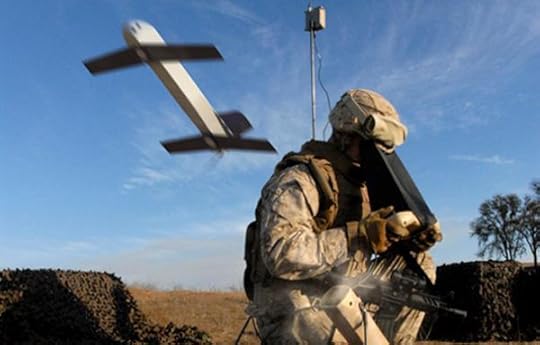 Launch of an Aerovironment Switchblade drone.
The Switchblade was designed for ISR (Intelligence, Surveillance, Reconnaissance), but can also be equipped with a small warhead. This allows a role as a kamikaze drone, for precision strikes with less collateral damage than that from a Hellfire missile launched by a Predator or Reaper. The Switchblade is also controlled by operators on the battlefield, rather than a remote operator sitting in a trailer in Nevada.
Some of the call for kamikaze drones comes from simple economics. As this article from 2012 points out, these robots can now be produced cheaply enough that it makes sense to give them a precision munition capability. That said, nothing’s foolproof, and in a low-intensity conflict, that could backfire. We had a Raven in Faris in 2005 that lost signal and crashed somewhere less than 30 minutes after launch. Randomly losing munitions due to signal loss (which will happen) can be a problem.
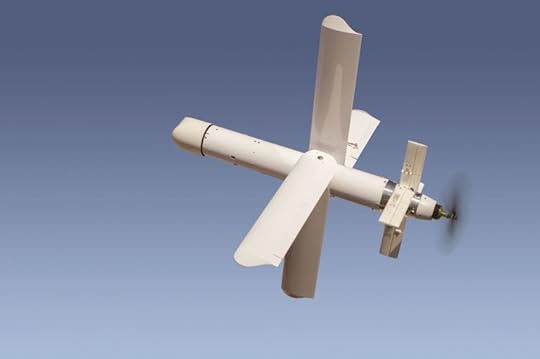 Israeli Hero-30 drone in flight.
Israel’s also been developing these weapons, and is already selling them. The Hero-30 is a 7-pound, remote-operated UAV that has a loiter time of 30 minutes. This allows the operator time to scan for his targets before sending the drone into its terminal dive, detonating it’s 1-lb warhead on impact. While the Israelis are not advertising their clients’ identities, they are already selling the Hero-30 on the open market.
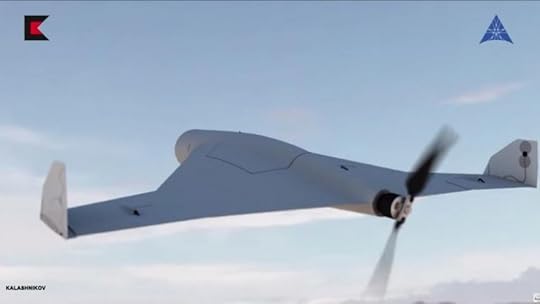 Kalashnikov Concern KUB-BLA drone in flight.
What has really brought people’s attention back to kamikaze drones lately, however, has been the Russian employment of these weapons in Syria. Kalashnikov Concern is now mass-producing weapons along similar lines to the Switchblade. These drones, designated KUB-BLA, have been used against rebel forces in Syria.
Whether or not this is a full-scale deployment, or a test such as the Switchblade deployment in Afghanistan in 2012, remains to be seen. However, whether or not the KUB-BLA is in full use or not, there is a growing demand for similar weapons systems.
SOCOM was apparently asking for the next-generation iteration of the Switchblade in 2017. And there’s still talk about general employment this month, as a reader pointed me toward this article from Army Times (I would caution that most of us took the Marine Corps Times with a large grain of salt, and I don’t expect AT to be any better). However, while Kalashnikov Concern is already reportedly mass-producing the KUB-BLA, the LMAMS is still in development.
Time will tell just how much of an impact this tech has. No single piece of technology ever really revolutionizes warfare, at least not as much as its proponents will insist that it will. And just like the contest between armor and firepower, for every measure there is a countermeasure. Whether drones can keep ahead of counter-drone jamming and similar measures remains to be seen, especially when high-tech powers begin to clash. But they are a weapon that will have to be reckoned with, as they are becoming increasingly common. Even Azerbaijan claims to have them now.
The post Maelstrom Rising Tech: Kamikaze Drones appeared first on American Praetorians.
April 17, 2019
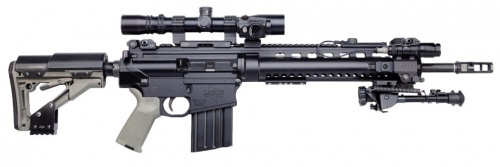
Guns of the Triarii – Larue OBR
⊕ The thunderous report of the 7.62 echoed across the hills around the town, shattering the early morning calm. The dark-clad man with the FAMAS bullpup staggered, staring down at the widening dark stain on his chest for a brief fraction of a second before he crumpled, crashing to the deck with a thump and a muffled clatter as he landed on top of his rifle.
I was already up and moving as he hit the floor, sprinting around the side of the guest house and heading for the steps leading up to the deck. A figure loomed in the doorway, and I caught a glimpse of a weapon. I started to slow, bringing my own rifle back up to fire, but a shot cracked past my shoulder and took the man in the chest. He fell backwards, into the house. ⊕
Cover photo