
Frog Jones's Blog, page 4
June 8, 2015
The Streisand Effect
In 2003, Barbara Streisand sued a photographer for posting pictures of her beachfront home on the internet without her permission.
The photo was part of a 12,000 photograph collection, meant for the purpose of detailing shoreline erosion in California. It was small, obscure, and nobody cared about it. Yet in her zealous defense of her privacy, Ms. Streisand took this company to court anyways.
The result? Well, everyone on the internet saw the photograph. As soon as she drew that much attention to it, it became famous, and public record. The very thing she was trying to prevent not only happened, but happened in a much larger and more spectacular way than had she just left it alone.
This gave a name to the phenomenon. The Streisand Effect is now a recognized term. Don’t believe me? Well, it is. I’m not usually one to cite to Wikipedia, but I can at least do that much to prove that this is a thing.
Why in the hell am I talking about this? Well, that has to do with a mistake I see indie authors making far too often.
Dylan Saccoccio didn’t like his review. He then went to the reviewer’s Goodreads page to rant about it. Clearly, the reviewer was out to financially ruin him. It couldn’t be that someone didn’t like his book. So off he went, picking a fight with his reviewer, Amy’s Baking Company-style. The result? Well, it got so preposterous that it’s now linked around the internet. Now Mr. Saccoccio is branded in my head as not only someone whose books I have no interest in picking up, but also as someone who I have no interest in meeting. I don’t want to be on a panel with this guy; I wouldn’t want to talk to him at a con, and if I were a publisher I wouldn’t touch him with a ten-foot pole. He’s radioactive, now, and that’s that.
And all because he didn’t like a review.
If he had let the thing slide, it would have been a single bad review. Not great, but we all get them. Not every person is going to like any given book. If he had let the thing slide, it would have simply sat there. Now that he has fought the thing, put extra effort into showing us all what an ass he truly is, he has managed to do what the review itself could not.
The reviewer was not trying to ruin you, Mr. Saccoccio. You did that to yourself. Time to pick up another pseudonym; this one’s done.


May 6, 2015
In Which Frog Enters Attorney Mode to Talk About Cops
I want to take a moment to honor Sergeant Greg Moore of the Couer d’Alene Police Department.
I didn’t know Sgt. Moore well. He wasn’t a buddy. He was a guy I met a couple of times in the course of business. He seemed nice, and I never had to file a suppression motion on anything he did. That doesn’t seem like much, but frankly there’s no higher praise I can give a cop than that. He did his job well, and he gave his life in the line. A prayer to the deity of your choice for his family would not be amiss.
Ok, that’s done. But, since I’m in the mood, let’s talk about cops.
I’m a criminal defense attorney. When giving legal advice, I tell people that they should never speak to the police, always assert all of their rights, and ask for an attorney immediately. That’s just good legal advice. It doesn’t mean cops are evil for doing what they do; it’s just that you’ve got certain rights and it’s my job to encourage you to, you know, use them.
But that’s different from what I’ve seen lately.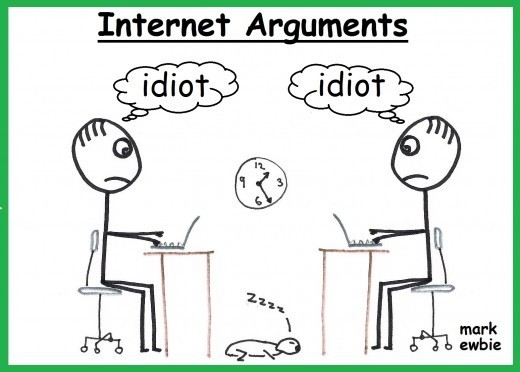
Lately, the internet has taken and issue and, once again, polarized it into its two most moronic extremes. This seems to be a function of our times, where the most extreme assholes are the loudest and most pithy, and therefore get the most out of our rapidly-shrinking attention span.
On the one hand, you’ve got this:
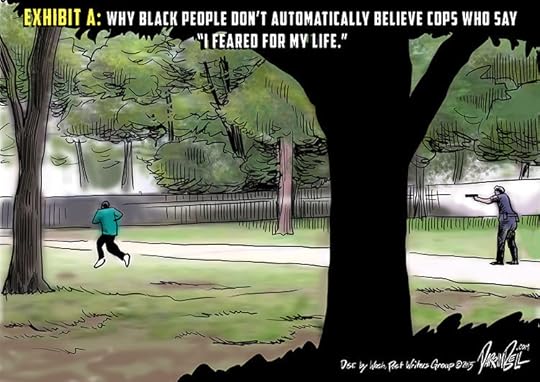
I don’t actually believe that police brutality and racism is on the rise. I think that the public awareness of the brutality that does exist is drastically on the rise. The incident pictured above? Holy crap, was that an illegal shooting. If you don’t think police brutality and racism exists, then read that article and watch that video. Because it does exist.
But wait, I hear you say. You said that this had been taken to an extreme. Wasn’t that a legitimate complaint?
Yes. It was. But here’s the problem: criminals lie about shit. They lie about shit alot.
And that brings us to incidents where people get way out of line over crap. Let’s start with Eric Garner.
Here’s the video of Eric Garner being killed by some cops:
Now, the young man recording the video is talking about what’s happening, but it doesn’t line up with the history. Mr. Garner was committing a relatively minor offense; he was illegally selling cigarettes. The cops approach him and try to talk to him about it, and he loses his shit. He is massive, he is angry, and the cops take him to the ground.
Now, he’s a big fat bastard of a man, and he can’t breathe when he’s on his stomach, so he dies. That’s sad. And the chokehold is definitely wrong. The cops could have done something different, something better here. It was not perfect, but neither can I blame the cops for their actions. This dude was not cooperating, and he was a threat. But, even though I didn’t blame them, people sure did.
Then we get to Freddie Gray. I have no idea what happened during that arrest, but given the charges that seem to be coming down the pipeline, it was effed up. But then you get the response, which is completely unjustified. The cops did something wrong, killed someone. Let’s break everyone’s shit. This makes no sense.
Now, these are incidents that have increased publicity. Since Ferguson, we are ultra-sensitive to police brutality. And we’ve got this movement of people talking about cops like this:
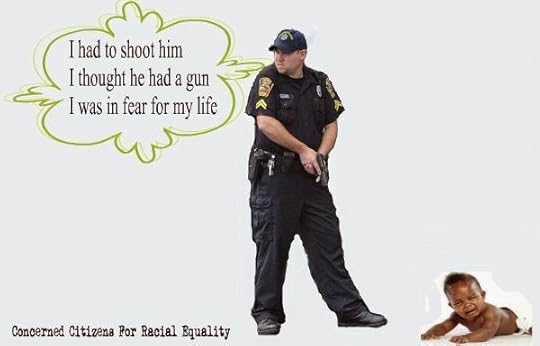
Or this:
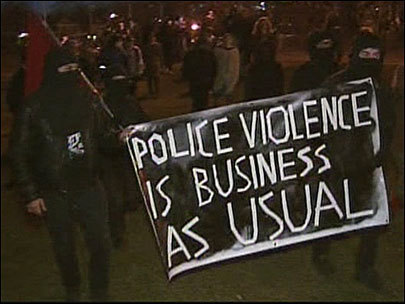
Or this:
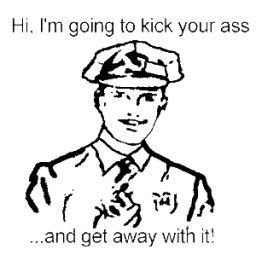
All of which has promoted this idea, this abso-fucking-lutely shit-ass idea, that cop = brutal. “Police Violence is Business as Usual?” What the fuck, people? Do you really believe that?
In the county in which I work, we have just had our 210th fresh felony arrest this year. That’s a small county, and it’s felonies only, which means it’s not the majority of police contacts (they deal with far more misdemeanors). None of those, that I’m aware of, have filed any kind of complaint for police brutality. Business as usual, for the cops I work with, is simply being cops. The goal of most cops is to do their job, not to be violent for the fun of it.
But wait, Frog, didn’t you say that there were two extremes?
Yup. For every internet position, there is an equally extreme optimism. And this one comes from some good ol’ fashioned jingoistic red-white-and-blue bullshit. It looks like this:
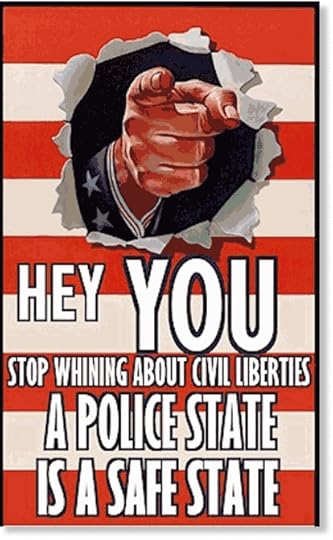
Are you seeing that? Holy shit, people. A police state is a safe state. And in case you think this is a Poe’s Law joke, let’s look at some other memes circulating amongst our far right brethren. Here’s a common slogan:

These are the same people, the same fucking people, that talk about how they hate “big government.” How Americans don’t need government to take care of them, because Americans are good honest people who will take care of each other. But suggest, hint, at the fact that we may need to watch the watchmen, and apeshit we will go.
So, here’s where I come down: cops are not good. Cops are not evil. Cops are…simply human. They have about the same asshole ratio as the rest of society. Some of them are bullies. Some of them are pricks. And some of them are flat-out psychopaths.
But most of them aren’t. I’ve seen cops go out of their way to help their drug addicts. I know cops that try to hook kids up with jobs to get them off the streets. I’ve seen these folks do amazing things, and I know they’re capable of great good as well as great evil.
Police brutality happens. It is a real thing, and it is a heinous abuse of power. As a result, it’s flashy. As a result, it draws a lot of attention.
Back to Sergeant Moore. He got shot. He got shot, in part, because of the attitude that presents a confrontation between cops and the public. Last year, 2014 saw 126 officers give up their lives in the line of duty. There’s not a lot of solid statistics at how many people police killed, and that area gets even greyer when we start talking about whether those kills were justified. Fun fact: some were. And some were because they thought it was a good idea to stand up to the cops, because after all police are just mindless animals, right?
So, here’s the defense attorney take: It is good for you to assert your rights. It is fine for you to remain silent. But “remain silent” doesn’t mean “tell the cop you are going to whup his bitch-ass.” It means “shut the fuck up.” Asserting your rights is a simple, easy process. Going nuts on a cop is a good way to get hurt. There’s a chance the cop will beat the shit out of you anyways, but that chance is pretty remote. I’d play the odds.
As to the rest of us, the ones not in constant confrontation with the cops? Let’s try to look at each incident as its own thing, each officer as an individual person committing an individual act. Right or wrong, the entirety of law enforcement should not be judged by their most visibly evil members. That said, someone should watch the watchmen.
April 17, 2015
The post that treadeth into no-man’s land.
Alright, it’s been a year, and I’m ready to break down the #Gamergate debacle. I shall attempt to do so, and then I shall await the flensing that comes when any blogger touches this, the internet’s third rail.
Let me begin by saying this: I am a gamer. I like video games. I like board games. I like RPGs. And I like the people who play them, regardless of gender. There are some problems inherent in the industry, and some problems inherent in geekdom in general, and those problems need sorting. This happens to be the thing that has brought those problems to a head.
I’m going to break this thing down into phases. I’m going to do that because I think there’s a lesson to be learned in how this thing fell apart, because there is no topic that we bring up that couldn’t do this exact thing. #Gamergate is a horrific example of how things snowball on the internet. Let’s rewind back to the beginning, and watch what happened.
Phase 1: Zoe Quinn gets a lot of attention for Depression Quest
Depression Quest is actually an interesting game that tries to simulate a struggle with depression. It’s pretty dark, not very fun (and not meant to be), and relatively stark. It has no flashy graphics, just static pictures and text overlaid with melancholy music.
In short, it’s not a very fancy video game. Despite its lack of sophistication, it’s powerful. And Quinn was heralded by reviewers as having done an awesome thing.
However, gamers used to sweet graphics and twitch gameplay, half of whom get triggered by Quinn’s game and don’t even know it, could not understand what the hype was about. There’s no cool action, no anything really. It’s a choose-your-own-adventure novel, essentially. Judged by the criteria on which most gamers judge games, Depression Quest sucks.
Phase 2: Conspiracy Theories Begin
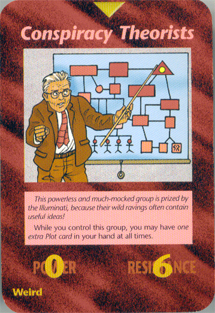
So, the perspective of gamers at this point in time is this: (1)There is a game that sucks, that (2) is getting incredible press. This becomes consensus, and quickly accepted as a given. As a result, the logical conclusion is that something is going on with the press.
This, by the way, is not a new theory. Fact of the matter is, there’s a revolving door between the video game industry and the video game reviewing industry, and the same sites that review the games also advertise them for money, and there’s a lot of issues running around in general.
So it’s natural, even predictable, that the internet went searching for a reason that Depression Quest got a bunch of attention while not being a “good” game (again, by gamer standards). I point this out simply to show that there were people, in the beginning, who did not get into #Gamergate as a gender issue at all.
Phase 3: Someone finds out Zoe Quinn is an adult female

If a man had made Depression Quest, the accusation would have been that the man paid off Kotaku. But Zoe Quinn is not a man; she is, in fact, a relatively attractive woman. What’s more, she’s a relatively attractive woman who had, at one point in time, dated Nathan Grayson, a journalist at Kotaku.
Let me be clear here. Ms. Quinn did nothing wrong. The two reported their relationship to Kotaku, and did all in their power to ensure that Grayson did not work on Ms. Quinn’s stories after that.
Still, there was a concern here, and it’s not an invalid one: Did Mr. Grayson influence the press? I tend to think not, because I’ve played Depression Quest and I get why it has good reviews. But given the tendency of gaming journalism to be skewed, and given the level of frustration about it, it’s not really shocking that this popped off.
Phase 4: Some preteen boys vent their juvenile rage
Adults, when put into this situation, compose clearly thought-out arguments and try to sort through them to find the truth; it has been this way since Socrates.
But not all gamers are adults, or act like it.
Instead, a subset of gamers concerned about journalistic ethics expressed their concern in a wildly inappropriate fashion. Sadly, that subset tends to be one of the most vocal and flamboyant groups, and therefore is the one that draws the most attention. I say “preteen boys,” and I have no doubt that most of these people were. Some weren’t, but they were acting like it.
Death threats, rape threats, publication of documents (“doxing,”) – Quinn got hit with it all. And as the theory about her sleeping her way to good reviews spread, one post to another, the vitriol grew with it. Soon, people are reacting to Quinn having read only the column of some other vitriolic asshole, and they respond in kind.
Phase 5: For every action, there is an equal and opposite reaction

Enter the Social Justice Warriors.
Now, Quinn needed defending. She was being unfairly harassed, and the form that harassment was taking was nasty and misogynistic. There’s no doubt that she was taking more harassment because of her gender. There were evil, misogynist, and juvenile assholes going off the rails, and they were in the wrong. I have no problem with the SJW’s stepping in to back Zoe Quinn.
Gender has long been a huge issue in video game culture. It’s a back-built pressure, and it’s about time someone did something about the misogyny that is undoubtedly present.
But here’s the problem: anyone using the #Gamergate tag was branded an evil, misogynist bastard. The SJW’s didn’t stop at simply condemning the nasty behavior being targeted at Quinn and her supporters. They labelled the entire group as being responsible for the behavior of a few.
From the perspective of the SJW, #Gamergate supporters were doing evil things. Therefore, #Gamergate was evil. Therefore, anyone who wanted to talk about it, even if they too condemned the juvenile behavior of their colleagues, was evil.
Phase 6: #Gamergate supporters react to SJW’s.

So, now we’ve got a group of people who thought they were reacting to press ethics who are now being told that they were never talking about the press, they were just part of a secret, misogynist cult from the beginning. Simply by getting into the discussion, they are brutal, woman-hating pigs who should be ashamed of themselves.
And this group of people? They’re shocked. Offended. And given no leeway at all. They were a part of Gamergate, and so now they are the devil. End of story.
Suddenly, SJW becomes a pejorative. This group starts seeing the posts of the SJWs as irrelevant, becoming more and more disillusioned with the ideas of diversity. To them, the fight is now about their freedom, not about misogyny. From their perspective, the SJW’s attacked an honest argument about journalistic integrity by “playing the gender card.” That makes SJW’s worthless.
Phase 7: Rinse and Repeat
So now the Gamergaters, even the ones who didn’t start out bigoted and nasty, are quickly becoming or have become bigoted and nasty. The SJWs have become more high-handed and judgmental than ever, not stopping to parse the situation but rather judging everyone involved, a much easier course to feeling morally righteous about onesself.
And the more debate happens, the more worthless juveniles on both sides behave inappropriately. So the death threats, and rape threats, and murder threats abound, and both groups are guilty by association with their lesser minds.
It’s not about Quinn anymore. It’s not about Anita Sarkeesian, or Brianna Wu, or any of the other victims. It stopped being about the press long ago. It’s now simply about two groups of people who hate each other. Both of them believe they are justified. The battle lines have been drawn, and there will be no compromise. #Gamergaters turn into Sad Puppies and blow up the Hugo nominations. SJW’s get their revenge by declaring Worldcon to be invalid. The wheel keeps on spinning, around and around, like a modern-day Hatfield-and-McCoy scenario.
So, what do I think about this?

I think people are individuals. I think that there were well-meaning people on both sides of this damned thing that got caught up in a shitstorm and dragged to one side or the other. I think misogyny and the actions of the vocal-asshole #Gamergaters were absolutely wrong. But I also think that the #Gamergaters who tried to keep things en pointe and called out the vocal-asshole contingent were unfairly painted with a brush much wider than it needed to be.
Here’s the thing that scares me: This evolution can happen to any conversation at any point in time. It’s a series of inappropriate overreactions, each one of which is targeted at an ever-growing population, who then get sucked into the vortex of hatred that one of these debates invariably creates. And nobody is going to admit they’re part of the problem, and that is just going to make the problem worse.
Place the blame where it belongs. If you were making a death threat, or a rape threat, or in any way personally harassing someone on the other side of the debate, fuck you. If you knew about that activity and condoned or ignored it, fuck you. But if you argued against that activity and still got called a bigot, then I’m sorry that happened to you. On the other side, if you believe that people should live a life free of harassment, then good on you. If you believe that we need to act with respect towards one another no matter what disagreement we’re having, good on you. But if you condemned the many for the actions of the few, then fuck you. And if you responded to hate with hate, then fuck you. All you did in those situations was make the matter worse.
The internet is an amazing tool. It allows us to share our thoughts like never before, and it allows ideas to travel the world at the speed of light. Sadly, some ideas are bullshit. And it’s much easier to be caught in a web of hatred, stridently arguing your position, than it is to take a step back and acknowledge that the world is a very complicated place, and maybe when it all comes together in one forum there is more than a black-and-white scenario going on.
So, there it is. Blog responsibly, people. In fact, #blogresponsibly. Let there be a voice for moderation, for reasonable discourse, and above all for humanity. Because if we as a society continue to abuse this amazing tool we’ve created, it’s just going to keep abusing us back.
April 13, 2015
Marvel finally irks me, but it’s not in my geek.
I have a rule.
I don’t watch TV shows about lawyers. I just don’t do it. Not that they aren’t perfectly good shows, most of the time. But…I am a lawyer. And the closest I have seen anyone come to showing what it’s really like to do my job is either Benched or Night Court, depending on the episode. So I’ve made this rule for myself: I don’t watch TV shows about lawyers. No good can come from it.
So, I’m watching Daredevil, and I immediately realize that I have made a critical error. I was sitting down to watch a comic book hero show. Hell, I was going to watch a show set in the MCU. Oh, I knew Matt Murdock was a defense attorney. But I always figured we’d see about as much of that as we see Bruce Wayne going over the Q3 reports in Batman. He has to actually do that work, but they’re never going to show it, right? It’s a comic-book movie.
I forgot. In my naivete, I forgot that the rest of the world sees my job as interesting. As fodder for storytelling. I see it as mundane and boring, but the rest of the world looks upon me as, well…as kind of interesting. So of course there’s legal drama mixed in.
And now I’m breaking my rule. I’m watching a show about lawyers. And we hatesss it.
“I told you,” says Murdock. “We’re only going to represent the innocent.”
Oh, good for you asshole. You’re going to just go out there and represent the falsely accused. So, of the total population of criminals, you’re going to take the microtessimal fraction, and only build your client base from that? Good luck eating.
That’s my first reaction. It’s snarky. But reaction #2 comes from a much deeper place of rage.
Because according to this show, I am evil. If you’re a criminal defense attorney that represents the innocent, then you’re a champion of the people. Represent the guilty, and you are just as guilty as them. This is the message Daredevil has for me.
Fuck you, Matt Murdock.
Fuck you, because every drug-addicted house burglar I manage to get into a treatment program has a chance to live a better life because of it. Fuck you, because everyone I help in the Drug Court is absolutely guilty and absolutely trying to make themselves (and, ergo, the world) a better place. Fuck you, because the number one rule of being a defense attorney is that everyone deserves representation. If you save someone, and they lead a better life, they get a better world. And so does everyone around him. Beat a bad guy to a pulp, and you’ve just made a pissed-off bad guy. Extend a helping hand, try to help them to find the correct path in life? Maybe you make the world a better place.
And fuck you, because I’m the only thing keeping the power of the government from flying out of control. You know what happens without defense counsel? Prosecutors are free to convict anyone they point at of whatever. Not every prosecutor in the world is the type to abuse that power, but many are. And without me here, riding shotgun, the government gets essentially bottomless authority to fuck with your world. And I can only serve that very important social function of preventing tyranny by representing whoever comes to me, guilty or innocent.
Besides, have you ever listened to criminals and tried to sort the guilty from the innocent? Good fucking luck. Fun fact: criminals lie. And the primary thing they lie about? Being criminals. The vast majority of my clients have some story about why they are wrongly accused. Ninety-nine times out of a hundred, this turns out to be bologna. But I can’t ignore it, because what about person 100?
So I don’t sort. I don’t even try to figure out whether a person is guilty or not. I try to serve my function, and provide the best representation I can. I make the State do its job. Sometimes, a guilty man walks free. Know why? Because we err on the side of not convicting the innocent. Doesn’t always work, and most of the time it doesn’t work it’s because someone who sat in my chair slacked off.
So fuck you, Matt Murdock. Take some pride in who and what you are. Because without defense attorneys who represent the guilty, that whole justice system will absolutely fail to work. And in the long run, you can do a lot more good in the world helping criminals be not-criminals than you can donning a mask and whooping ass. I like watch you whoop ass. But fuck you for thinking less of me, because I’ve saved a lot of people too, and I’ve done it by doing the very thing you scorn.
Still, I’m going to keep watching. Because its the MCU. And because I love the MCU. But I’ll always think of Matt Murdock as a bad lawyer, and that’s a problem for this show.
April 9, 2015
What the Hell Just Happened to Me? – the side effects of the Grant-Frog style.

So, as of today the Grant-Frog style has existed for an entire week. It has been one of the strangest weeks of my writing career.
Let me start by saying this: the style started as a lark. Grant Riddell and I were getting drunk at the Norwescon Small Press party, having a good ol’ time, and cracking jokes. This style was one of those jokes, a joke so funny that we had to share it with the rest of the world.
It has grown.
People that I have never met are talking about it. The concept is being linked around the net, and it’s starting to become a real thing. And we’ve started noticing a couple of things.
The first thing we noticed was the complaints. Writing in Grant-Frog Style is hard, said the writers who attempted it. And it is. Following the format strictly is ridiculously difficult. We built it based on a common error, but even the bad stories we read didn’t use it all the time. Why, asked the writers, did you make this so god-damned hard?
The answer, interestingly, is that we did none of this with intention. The idea that the Style came from anything other than a manic conversation fueled by Angry Orchard Cider and beer from some local brewery vastly overestimates our level of planning.

That said, it’s something of a happy accident.
I’ve been doing a sentence-of-the-day on Facebook for the last week, punctuated with #grantfrog. Every day, I try to do a little Grant-Frog writing. And the authors who have tried are right; it is damnably hard. Making sure that every noun is immediately preceded by a “the” requires that you parse every damn sentence and make sure you don’t miss a noun buried in there somewhere.
What’s interesting, though, is this: most of the time, when I write, I’m simply typing the words as fast as they come to my head. I’m not sitting down to parse the structure of every sentence, I’m just letting it flow. Revision comes later.
Now that I’m doing these sentences, though, something strange is happening to the rest of my writing. I’ve found myself actively thinking about my words as I lay them down. My exercise in writing terribly has actually improved the quality of my initial drafting.

Grant-Frog has, for me, become something of a stretching exercise. Like getting your forehead as close to your ankle as you possibly can before you go out for a run. It’s uncomfortable, it’s hard, and (fun fact) you are never going to run by kicking your forehead. It simply won’t work. But by doing that, your leg and back limber up. You stretch your muscles to their limit, and suddenly normal motion becomes easier, more fluid.
Now, I write a little Grant-Frog, and it’s uncomfortable. It’s hard. And it’s about as effective in terms of writing as kicking oneself in the forehead would be to a pleasant jog. But I’ve found that it limbers me up. I stretch whatever internal, creative muscles I have, and then writing other things becomes easier, more fluid.
This doesn’t mean I don’t need to revise, but it does feel like things are cranked up a notch in terms of the quality of work I’m producing on the initial go, and when I do revise I’m catching a lot more.
I’m still interested to read the atrocious works of fiction that people are out there busily generating. They’re going to be amazing, and we’re going to have a world of fun with them. But now I’m also thinking that the reactions of people who go out of their way to write one is going to be nearly as interesting. I want to know if other people get as much from this stupid drunken accident of a creative writing practice as I do.
Maybe we’ll make it into an MFA syllabus after all.
April 5, 2015
“On the Hugo Nominations,” or “Giving Zero Poops”
Guess what? There’s a lot of drama surrounding the Hugo nominations.
At first glance, this seems like a big deal. After all, I’m a genre writer. This is kind of the award for us, it’s our Oscars, right? It’s all the recognition from peers that matters to us, to validate our writing. Not only that, but I’m going to Worldcon this year. This August, I actually do get to vote to determine who actually wins this thing. And I will. But I will do so with all the enthusiasm of picking my favorite Christopher Walken movie on Facebook. (Suicide Kings, in case you were wondering).
Because, in the end, it isn’t going to matter.
How can that be? Well, let me ask you a question: when was the last time that you bought a book because it had won a Hugo? Ever? Have you ever looked at a book and said “Oh, well, that premise looks terrible, but it did win a Hugo, so I’ma drop some cash on it?” Conversely, have you ever looked at a book and said “I’m really interested in this book. My friends thought it was good. But it hasn’t won a Hugo, so no sale.”
Never. You have never said either of those things.
Books stand or fall on their own merits. The only vote that truly matters is the one where you go on over to Amazon and buy a book. That’s the one that we really pay attention to. It’s the one that publishers and agents pay attention to. It’s what fans pay attention to, as one fan tells another about this great book they read. It’s not the limited selection of people with Worldcon memberships that are going to cause me to live and die as an author.
It’s you. You and your pocketbook.
So if you’re pissed off about the Hugo nominations, then buy someone else’s books. If you’re really happy about the Hugo nominations, then buy that authors books. Because these are the actions that determine the fate of authors. The awards are just a veneer. Offer me a choice between an award and a loyal fanbase, and I know what I go with.
Fans of the Joneses, I choose you.
April 3, 2015
Win a Kindle by Being A Terrible Writer: The Grant-Frog Style Guide
So, many times at cons, we authors are asked to read things and evaluate them. Most of the time the work needs polishing, but is pretty good. Occasionally, though, we get handed something that makes The Eye of Argon look like frickin’ Tolkein.
But here’s what’s interesting: when we authors talk about it, the unintentional humor of the bad work tends to be the focus of the conversation. We don’t discuss who is fabulous; we revel in the horrific. It’s this amazing catharsis to talk about how bad some things can get.
So, when Grant Theron Riddell and I started talking, we realized we had hit on something big. Something new. Something that will change literary history. All we had to do was create a style in which the writer was forced to write one of these works so bad that it passed through the abyss and came out the other side awesome again.
Remember, the Eye of Argon is still read aloud at cons. Can you say the same for your short story? I can’t.
So here’s what’s up: I am offering a free Kindle, pre-loaded with Grace Under Fire, to the story that makes us laugh the most in its atrociousness. But you need to do it following the strict rules of the Grant-Frog Style, as follows:
1. You are allowed to use pronouns, but if you are using any noun it must be immediately preceded (no intervening adjectives) with the definite article. You don’t take a breath, you take the breath. It is encouraged that your pronouns have indefinite antecedents (read: what the hell does “it” refer to?).
2. Your story must present an interesting genre idea, then completely fail to make use of it. If the question of the story is, say, whether a certain new medical procedure is ethical, the story may not show us anyone receiving such a medical procedure.
3. Be as overly dramatic as possible while following rules #1 and #2. We need some serious ham on these bones.
Here’s some contest submission guidelines:
1. By submitting, you are giving me permission to re-post your work here on this blog. They’re going to be funny, so let’s get others to share in this. In the highly unlikely event that these works are anthologized for profit, I will seek your permission to include your work for a share of that profit.
2. 1000 words maximum. After that, the humor starts to fade and I’m simply left with a desire to tear my eyeballs from my head like Oedipus after clicking the wrong profile on OK Cupid.
3. To submit, send an email to frog@jonestales.com with the subject “Grant-Frog Style Submission.” Place the text of your story into the body of this e-mail, after your contact information. No attachments will be opened.
4. Contest submissions end September 1, 2015. I will then enter a reading period, though I may have reposts from time to time on the blog as submissions come in. A winner will be announced on this blog, December 31, 2015.
5. To receive your Kindle, please include a name and shipping address. To receive a link to your site/blog/other work in the event of a repost, please include that URL.
5. Have fun with this. The point here is to take a break from trying to write well and instead take 1000 words and be God-Awful. Enjoy.
EDIT: We’ve had some questions about the no-intervening-adjectives rule. That simple means that the adjective cannot come between the definite article and the noun. So, “the blue car” violates the Grant-Frog style rules, but “the car of blue” or “blue, the car” is perfectly acceptable.
February 23, 2015
Argh!
Ok, ok. I have tried to be calm. I have tried to deal with the fact that a great many of my people are reacting in a completely irresponsible manner to the problems confronting us. #Gamergate and the bullshit that surrounds it, the 4channers, the trolls; these people are nowhere near in the right.
But then I see the response to it, and it pisses me off.
“We Must Bulldoze What’s Left of the Nerdy White Man’s Internet” is the title of this post. Can I now feel like I am being attacked? Is it finally, at last, politically correct for me to point out that this article is designed to lump together all nerdy white men and call them assholes? Or if I feel offended at that particular title, am I still being selfish? Am I refusing to check my privilege? After all, I am a white, heterosexual male. It’s my job to keep my god damn privileged mouth shut while people talk about how evil people like me are if I can’t join in their hatred of me, right?
I’m calming down. Caalllllming. I am not, and in no way will I ever be, a supporter of the #gamergate bullshit. I think the trolls on the internet basically enjoy being assholes, and I’m not down with their racist, sexist bullshit. Mr. Broderick has every right to point out that this small but vocal portion of nerdy white male culture has issues, and needs to be eliminated. 75% of his article is great, and I agree with it.
Then he says this:
The ‘suffering nerd’ is dead
“Nerds,” as people have come to identify themselves, simply don’t exist anymore. We live in a world where 27 million people gather to watch an international video game tournament, where the third-highest-selling movie of all time is based on The Avengers comic books, and 6 million people tuned in to watch Game of Thrones. The concept of the suffering, ostracized nerd is quickly losing relevance.
Fuck you, Ryan Broderick. I exist.
You want to know why some nerds are angry? Because of bullshit like this. You’re absolutely right that the rest of the world is starting to enjoy the things that my people have enjoyed for so long, and that’s great. But you have to go one step further and say that the universal acceptance of this media means nerds don’t exist anymore. This is exactly the sort of thing that makes nerds angry.
I work in the juvenile justice system, and I am here to tell you that offline, nerds are still getting their asses kicked in our schools. Being a nerd still means you get laughed at in the hallways. Oh, the jokes may not be about you liking comic books, but you’re still a nerd. You still find intellectual pursuits more appealing than physical ones. You would still rather join the Knowledge Bowl team than the one that plays football. That makes other people feel just a little bit stupid when they’re around you, and they find they can improve their self-confidence by beating the shit out of you. All you need to do to realize that nerds are still the subject of ridicule is watch an episode of Big Bang Theory, in which the good-looking worldly-but-average-intelligence woman teaches the four intelligent-but-socially-awkward men the facts of life, and in doing so the audience laughs, not with the nerds, but at them and their pathetic attempts to normalize.
There used to be a safe place for people like this to go. It used to be that we could go find a gaming group, or a sci-fi con, and it would be filled with people like us. People who life has beat the living shit out of, and who can and do empathize with us. Only among such people did we feel safe, and at home. But now that nerd culture has outrun the original nerds, and has embraced people from all walks of life, it becomes very difficult to for someone like me to be a nerd. There’s very little actual bullying that goes on at a con, and it’s still a safe and welcoming environment, but it doesn’t feel that way, because it is no longer populated only by people like me. That’s an emotional reaction on my part, not a realistic one, but it still exists. And it exists as the product of me taking a face-full of urine from the football guys my sophomore year of high school.
On the whole, I am happy that nerd culture is expanding. It has expanded my world, and it has brought me a great many friends I would not otherwise have. But I fear it as well. I fear that people will decide that people like me should no longer be a part of nerd culture. I’ve been excluded from every other social group, and now that this one is filling up with people who are not like me, my reaction is to get nervous that, one day, they’ll decide I shouldn’t be a part of it. Now, rationally I know that’s silly, but it doesn’t mean the traumatic experiences of my youth are just gone. They’re not. Those experiences are a part of who I am.
The very idea that Mr. Broderick puts forth – the one that says the word “nerd” really doesn’t have any meaning any more? That idea terrifies the shit out of me. Because people like me exist. And if I don’t even get to be a nerd anymore, then I don’t know what I am. All I know is, I’m getting kicked out of yet another social group.
I try, very hard, not to take the anger that I have over those things out on other people. There are others like me, obviously, who have little such restraint. But these assholes are a vocal minority of ostracized, suffering nerds. And the response to them should not be to deny my existence. Because, here’s the thing: my traumatic childhood is over. I now get a basically well-balanced life as an adult. But there are teens right now who are going through the hell that I had to go through, and I want to make sure they know that they exist. They matter. And the fact that some of them are going to react very, very poorly to the extraordinarily negative shit they’re going through in no way means I’m going to take the lot of them and chuck them. I’m not throwing the baby out with the bathwater, here.
We don’t need to bulldoze anything. I’m fine if we want to build up a culture around the things we all love, together. But just because the culture is being more inclusive doesn’t mean we should destroy the white, male people who started it. It just means that more than white males need to be added in. After all, I am certain there are both male and female people of all races who are feeling ostracized by the rest of the world. And they exist, too.
Mr. Broderick has good intentions in his piece. He’s right that the vocal minority of nerdy white males are making the rest of us look pretty bad, and maybe the rest of us should do something about that. His basic direction there is good.
But he also refuses to acknowledge that I exist.
January 13, 2015
A Larger Perspective: In response to the response to Scott Aaronsen
Before you read this post, read this.
Let’s put the comment into context, first. Few of the other commenter’s on Dr. Aaronsen’s comment take it in the context of the full conversation, so let me attempt to outline this one. There was an MIT professor, a Prof. Lewin, who committed sexual harassment. Well, was alleged, I don’t know the details, and that’s not the point. The criminal defense attorney in me makes me qualify that, is all. For purposes of this blog, we’re going to assume that Prof. Lewin was the most atrociously horrendous dirty old man who ever existed.
MIT, in response, stripped Prof. Lewin of his emeritus status and removed his videos from their OpenCourseWare site.
Dr. Aaronsen commented thusly: I do not care if Prof. Lewin is evil. He was an amazing teacher of physics. Those videos are very good at instructing physics students. Removing them punishes the students of MIT far more than it does Prof. Lewin. Therefore, MIT should keep the videos.
This, of course, provoked a tizzy, and Dr. Aaronsen was accused of supporting sexual harassment. One particularly vocal commenter, an “Amy,” commented:
Do you have any regular readers who are women? I scrolled through over 50 comments before seeing a woman’s name.
Why do you figure that is?
Dr. Aaronsen, in an effort to expand the discussion, took that not as the barbed rhetorical question it was, but rather as a genuine invite to open dialogue. He responded, speaking of the problems women face getting into the STEM communities, and linking to an article about the failure of STEM classes to incorporate women more broadly, and the possible reasons why. He also stated that he wasn’t trying to support Professor Lewin, but rather didn’t want the things Prof. Lewin had contributed to the students of MIT to go to waste.
What he received in response was more vitriol:
Also, you want credit for not being a supporter of keeping sexual harassers on payroll? Okay, but only if you’re going to give me credit for not being a supporter of brain tumors. I think I agree with the “baseline” comment above. Seriously, this is the kind of thinking that leads to divorces, where a guy wants applause for doing some (though not nearly half) of the house/kid-related work. I mean think about what you’re asking.
Dr. Aaronsen then posted the comment I linked to above, which he has since added clarification for. I get what he’s going for, and he’s giving a very personal account, but it is a personal account from a very narrow perspective, so it hasn’t necessarily gone over well.
Now, as always, the battle lines appear to be drawn between nerds and feminists over whether or not the complaints of one invalidate the complaints of the other. This is, to me, such a weird battle that I feel obliged to offer the larger perspective. To do that, I’m going to thumbnail the two sides of the argument for us:
The perspective of aggressive nerds:
We’ve grown up in a culture that tells us our geekish ways are not sexually appealing. We’ve further grown up watching men who were (a) stupid and (b) aggressive, receive a great deal of attention from women, while we have simmered in our own futile sexual rage. While we do not, on the whole, believe that this justifies assaulting women, the fact is that we, too, feel like victims. This feeling is intensified when the women who have rejected us sexually for our failure to be aggressive attack us for sexually harassing them. We can’t win in this situation, they’ve put us in a corner, so we’re just going to be aggressive, because at least that gives us an outlet for all that rage.
The perspective (as I, a white male understand it), of women:
We’re getting raped out there. The current culture that exists promotes aggression against women. There are a whole bunch of women who are physically victimized. We get that the nerds had it rough growing up, but boo-freaking-hoo. Get over it, because your current aggression is totally childish, and it contributes to our danger levels.
So, here’s the thing: Both of these perspectives are inherently logical. I understand both of them. They make sense.
The nerd perspective is one of inherent depression, lack of self-esteem, and immaturity, but it makes sense. I get why it exists. The more one is accused of contributing to sexual assault when one doesn’t even try to get laid for lack of self esteem, the more resentful one is likely to become.
The feminist perspective is one wherein the crimes of the few are attributable to the culture of the many, painting as many people as responsible for sexual assault as they can, and it makes sense. The more people feel guilty for sexual assault, the more change there will be.
So where, Frog, is that broader perspective you promised? Here it is:
At heart, down deep at its very root, the complaint of the feminist and the complaint of the nerd are the exact same.
Take a moment, because that statement probably pissed off just about everyone who read it. Count to ten, then read on so I can justify myself to you.
The nerd complaint is based on a culture that elevates aggression to attraction. We see, time and time again in the media, that “getting the girl” is a function of being the man of action, not science. Confidence is one of the number-one factors in attracting a woman, a confidence most nerds have been taught not to have, because chicks just don’t dig nerds, right? Men should pursue women, and if you don’t have the skills to do that, then don’t bother. After all, any woman who would pursue a man is a slut, right?
Women are indoctrinated into this same culture, and as a result are, in fact, initially attracted to aggressive bozos more than quiet, bookish types. After all, why can’t he just “be a man?” In my years as a divorce and domestic violence attorney, I see this pattern repeat itself over and over again.
The result of this culture? Well, let me point you to one of the great all-time nerd movies: Revenge of the Nerds. Remember this? 1980s flick, basically the first piece of media to ever celebrate being an awkward headcase. I loved this movie growing up. And at the end of the movie, our hero Lewis finally gets the cheerleader instead of the jock. Romantic, right? Do you remember how it happens?
He fucking rapes her.
That’s right. He puts on a mask, pretends to be her boyfriend, and has sex with her. She doesn’t know she’s boning him. Do that in real life? Rape. But it’s fine, in the movie, because she likes it. She likes being raped so much that she actually leaves that loser of a boyfriend and follows our hero, the nerd-rapist. Why? Because the way to get the girl is to be aggressive. Sack up, nerd boy.
The nerd complaint, at its essence, is that finding a romantic and sexual output is impossible in a culture that (even while celebrating nerds) tells us that no woman should ever go for the quiet guy in the corner reading a D&D manual. The women should go for the guys who take what they want.
The feminist complaint is based on a culture that justifies aggression with attraction. There is a culture, perpetuated by men and women alike, in which men are trained to be aggressive in order to find sexual output. This culture also perceives women as being attracted to such aggression, which in turn justifies the aggression itself.
Is this sounding familiar? It should.
The problem, boiled down, for both parties is that we live in a culture that largely says attraction=aggression. Nerds tell us they feel victimized cause they’re really shitty at being aggressive. Women tell us they’ve victimized because men keep being aggressive. We’ve got the same problem here, people.
But don’t take my word for it! Let’s look to various dating advice sites:
Here’s a great article about what women should be looking for. Let’s see if it says anything that nerds and feminists could unite against?
No woman wants a physical weakling – it’s against her nature. That doesn’t mean she won’t settle for slightly less than Herculean, but you’re a man dammit. She wants to feel that when she’s in your presence. She wants you to be intelligent and to practice self-control simply because you can.
We’re all still animals and women will always be attracted to the stronger men. She wants you to be strong not for the sake of being strong – she wants you to be strong for her. It brings her pleasure, makes her feel safe and turns her on. Do you honestly need more convincing?
How about WikiHow? Surely a wiki site will give us better insite!
Be a guy who is in power.
Shit, ok. Let’s get more scientific, then. Psychology Today, come to the rescue!
During peak levels of fertility, they prefer more masculine and socially dominant men. In the literature these men are known as “cads.” Indeed, they tend to be sexy, with their narrow eyes and strong jaws — but they also tend to be flashy and exploitative of others. Even worse, these masculine men often embody the Dark Triad, a personality constellation that encompasses Machiavellianism, psycopathy, and narcissism. Typically, these men offer only short-term prospects.
Holy fuckballs. Even you, Psychology Today? Even you?
The fact of the matter is, this trend right here? It’s the thing pissing off nerds. Now, nerds fuck up when they blame women for it, and they fuck up again when they then nerdrage at women over it.
It’s not the fault of women that our culture does this indoctrination. It’s not their fault that they were taught, since birth, that Prince Charming is the dude that slays the dragon, not really the dude who tallies the treasury with an abacus. It is not, in short, their fault you can’t get laid. That’s on our basic societal upbringing combined with your lack of maturity.
Women see these sexually frustrated and emotionally immature nerds and, instead of agreeing with their frustration at the underlying mechanisms of sexual aggression, they react only to the juvenile behavior that results from the frustration.
What’s the solution? Well, it’s twofold. My instructions proceed thusly:
1. Nerds: Shut the Fuck Up. Seriously. This whole rage thing? It brings you no closer to actually getting laid, which means it’s a self-replicating problem. A Von Neumman machine of virginity. As soon as you calm down and sign up for an online dating service, you’ll do a hell of a lot better. Those feminists you hate are actually crusading for a culture that will make you more attractive on the whole, not less, so if you’re not joining with them then at least get the hell out of the way. Also, good news: eventually, when your hormones calm down and your checkbook fattens, you are going to be more attractive than the jock, who’s going to either (a) become a nerd, or (b) down a 12-pack of Coors Light a day working the night shift at the fast food joint and inappropriately hitting on high-school girls.
2. Women: I see a lot of targeting at the big problems, but the more insidious, underlying mechanisms of sex and aggression are a more complicated problem. The cultural shift you’re looking for should not only empower women (which it should), but it needs to disempower sexual aggressiveness. Beating up the nerd may no longer be code for getting the girl. Because if it is, that same aggressive trait that led the jock to wail on the nerd is going to tell him to wail on the girl, eventually. We need a way to let both boys and girls that the guy with the abacus is actually much, much sexier. How do we do that? No idea. But solve that problem, and we’ve united both of these factions against the true enemy: douchebags.
January 1, 2015
On the Value of Surrender
On January 1st, 2014, I posted the following to my Facebook:
2011 wasn’t great, so on January 1, 2012 I was all “bring it on, New Year.”
2012 was worse, so on January 1, 2013, I was all “Woo! Done with that!”
2013 has been the worst year of my adult life. This year, my New Years resolution is to figure out how to stop the downward slide.
2013 was absolutely horrendous. I called it the worst year of my adult life, and that’s not an exaggeration. By the end of 2013, I was depressed, panicked, anxious, and stressed. I was a complete wreck. I don’t need to go over the laundry list of problems, but those of you who know me know how bad it got.
2011 wasn’t great. And on New Years of 2012, I resolved to do everything I was doing, but better. Harder. And I doubled-down on everything I’d been doing. Of course, as a result, I got twice the pain and trouble. So in the beginning of 2013, what did I do? I doubled down again. I went at it harder, and by the end of 2013 I was absolutely destroyed. Here’s some other samples of my posts from that point in time:
Last week, our website was DDOS’d into the ground.
This week, our pipes froze, then burst, and left our basement flooded in five inches of standing water.
These days, my job is less about being an attorney and more about being a repairman of some sort or another.
Someone kill me.
Until I read that, I’d forgotten it. In fact, reading these old posts is actually triggering my old anxiety a little bit. Just re-reading them, my heartbeat is accelerating and I’m starting to feel the old fear that my entire life is unravelling.
So that post? The one where I said I was no longer going to declare the New Year a time when I was doubling down again? It got a lot of sympathetic responses. A lot of friends and family, a lot of you who are reading this right now, posted to tell me how they felt bad for me, or that I shouldn’t give up.
But that’s exactly what I did. I gave up. I stopped trying to make it work. I stopped throwing myself into a meat grinder. I stopped bashing that square peg into the round hole with a sledgehammer, desperately hoping to make something fit where it wouldn’t.
And I am so happy I did.
Less than three weeks after I posted that, I accepted this new position in Mason County. I stopped trying to be a businessman (fun fact: I am a shit businessman) and I started being a lawyer again. I remembered that, underneath all the bullshit I was going through trying to breathe life into a dying business, there is something I can do that is worthwhile. That I am good at. As soon as I surrendered, it freed me to find a different life for myself.
2014 has been the biggest year of change since graduating law school. It has changed where I live, it has changed how I work, and it has changed my financial status. It has seen the publication of book 2, my first appearance at four cons in a year. Esther and I have paid off nearly all of what was a stunning credit card debt amassed as a result of 2013. 2014 has seen me become a functioning landlord of my old home, has seen me return to the mountains I used to love in my youth. I’ve taken up camping and hiking again, I’ve lost 80 pounds, and I am not battling depression and anxiety every day.
And now I look back at that post, that shift in my attitude that allowed me to do all this, and the number of people who reacted to it as though what I were saying was negative. It makes me realize this: we as a people do not appreciate the value of surrender. There is a value in walking away from it. Throwing good money after bad is stupid, but throwing time and energy into a bad situation is just as stupid.
There is a value in surrender. And I never realized it until life broke me to the point where I had no choice but to surrender. Within weeks of throwing up my hands my life turned for the better.
So just a thought: if you’re in a bad situation, sometimes it’s better to surrender than to keep fighting. It’s a lesson I learned the hard way.
2014 was a good year. It was a landmark year, a year that forever altered the trajectory of my life. I am sad to see it go. I hope 2015 keeps me on the same path.


