Robin Barefield's Blog, page 18
January 1, 2017
Welcome 2017!

Happy New Year, and welcome 2017! I’ll admit I am sad another year has flown by so quickly. Not everything about 2016 was great, but as I reflect on the year, the good times outweighed the bad. For me, the saddest events of 2016 were the sudden death of my oldest brother and the deaths of three friends. I loved the time I spent with my family in in Kansas in May, though, and I enjoyed seeing high school classmates at my reunion. We had great summer and fall seasons at our lodge, and our yard has been full of deer the past several weeks.
A few years ago, I began making New Year’s resolutions. I had always considered resolutions a joke, like a diet that only lasts two days. I never thought I’d feel bound to a resolution, but to my surprise, I have taken my resolutions seriously, and they are in the back of my mind all year as I struggle to fulfill them. I am not great at following through with resolutions to embrace healthier habits, but I do now exercise an hour a day, and I wear a Fitbit to keep myself honest. I never make a resolution to go on a diet because just the thought of a diet makes me hungry. The resolutions that have worked best for me are those related to writing.
At the start of 2016, I resolved to finish the rough draft of my next novel and the rough draft of my wildlife book by the end of 2016. I remember announcing this resolution and then laughing because I doubted I would come close to achieving either one of those goals. I am proud and amazed, though, to say I almost did it!! I’m not quite done with the wildlife book, but I will finish it in a week or two. I finished the rough draft of my novel in October and am now busy editing it. I know I would never have pushed myself so hard on either manuscript if I hadn’t made that crazy New Year’s resolution on January 1st, 2016.
I’ve given this year’s resolution a great deal of thought. I have several projects in the works, but I don’t want to set impossible goals for myself. I think goals should be lofty but within reach. Here’s what I came up with for a resolution. I want to finish editing the manuscript of my next novel and send it out to an editor by June. I don’t believe I can have the wildlife book ready to send to an editor before the end of 2017, but I want to send it out sometime next winter. I also want to finish the manuscript of my fourth novel by the end of 2017, and since I haven’t even written an outline for this novel yet, this may be a tough goal to reach. I would also like to work with Marcia on the cookbook we are writing and have the rough draft of it done sometime next winter. Finally, I hope to compile my Mystery Newsletters into a book and self-publish that. The e-book of my Mystery Newsletters will be available for free for my newsletter subscribers.
Whew! All those goals sound like a great deal of work, and I’ll let you know next year what I accomplished and what I didn’t. Writing a weekly blog post and a monthly newsletter plus doing my day job takes most of my time, but I’m becoming a faster writer and am getting better at multi-tasking, so I am hopeful and excited. At least I won’t be bored!

None of us can see what the future holds for us, but I wish you all a happy, healthy, successful 2017. Take a minute to tell me some of your resolutions!
If you haven’t signed up for my Mystery Newsletter yet, you can check out my latest edition here. If you want to sign up, you can either click on the sign-up button in the upper left-hand corner of the newsletter or sign up at http://robinbarefield.com.
The next few weeks, I will again concentrate on wildlife profiles, beginning with the fascinating, beautiful, fierce Arctic Tern.
The post Welcome 2017! appeared first on Robin Barefield.


December 25, 2016
Happy Holidays

Happy Holidays from Kodiak Island! For many people, this is a busy time of year filled with holiday events, family gatherings, shopping in crowded stores, and long-distance travel. It’s an exciting season, but it is also very hectic. For many, the holiday season is a happy time, but for others, it is stressful and even depressing. Most of us experience all these emotions to some degree throughout the holiday season.
I won’t say I escape the psychological highs and lows of the season, but I think my holiday experience is unique because I spend it in the middle of the Kodiak Wilderness. I haven’t been to town since early June, and I don’t plan to fly to town until late January when we leave for our vacation. For me, the holidays are quiet! I find myself missing Christmas music and sometimes even the hustle and bustle of stores before Christmas (this is only a fleeting feeling, though). I miss family gatherings, and I’m sad when I remember past Christmases spent with my family. We only get a mail plane once a week in the winter, so we wait each week eagerly for Christmas cards and presents to arrive. We have to ship out our Christmas cards and presents by mid-December, so the first two weeks of December are busy, but then everything slows to a crawl. I take a deep breath and relax.
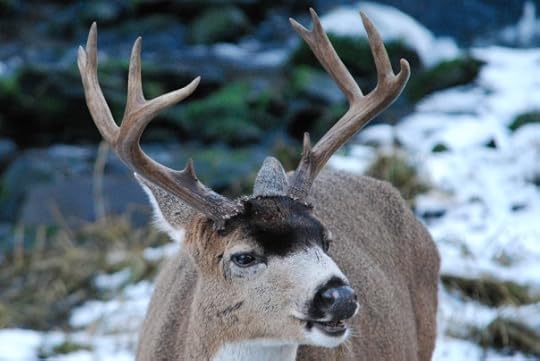
I spent the last two weeks of December and plan to spend the first two weeks of January doing what I want to do. This year I am editing my next novel and finishing the rough draft of my wildlife book. I take the time to fuse glass jewelry in my kiln, weave baskets, and make metal jewelry. I walk on the beach and through the woods with my cats, always with a downcast glance, hoping to spot a recently-shed deer antler. I read, write, watch wildlife, and enjoy the beauty of a Kodiak winter. This may not be the customary way to celebrate the holidays, but I have learned to love it. In a season when we talk about peace on earth, I truly do have two months of peace and quiet in my world, and I remind myself every day how lucky I am.
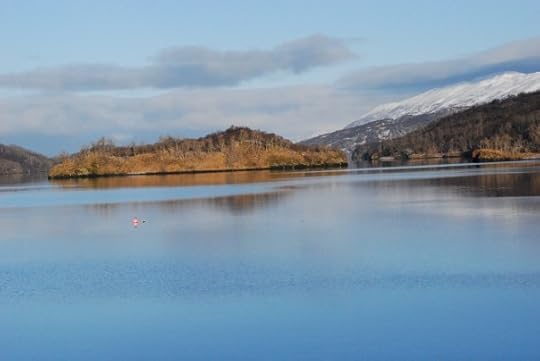
I don’t forgo all the holiday indulgences. We decorate the house, I make candy, we open presents, and we have a special dinner on Christmas day. I have a wonderful friend in Anchorage who sings with the Anchorage Concert Chorus, and he has sent me several CDs of Christmas music performed by the Chorus, so I enjoy those while I remember Christmases past and relish the present holiday.
Wherever you are and whatever holidays you celebrate this time of year, I wish you peace, quiet, and love in your world.
I recently published a new Mystery Newsletter. Check it out here. You can subscribe for my newsletter either in the upper left-hand corner of the link or on my home page. Anyone interested in our summer season at Munsey’s Bear Camp can read that blog post at the Munsey’s Bear Camp website.
The post Happy Holidays appeared first on Robin Barefield.
December 18, 2016
Puffin Biology
 Tufted Puffin
Last week, I posted about the two species of puffins we see in Alaska. These are the horned puffin (Fratercula corniculata) and the tufted puffin (Fratercula cirrhata). This week I’ll describe puffin nesting behavior and other facts about these interesting birds.
On Kodiak, puffins arrive at their breeding colonies in May. Breeding colonies are usually on cliffs along the shoreline or on small islands. The steep nesting areas not only help protect puffins from predators but provide a good take-off perch for these heavy birds with small wings. Horned and tufted puffins may nest in the same colony, and they sometimes also share nesting grounds with other alcids, and with glaucous gulls, glaucous-winged gulls, kittiwakes, and cormorants.
Puffins are monogamous and form pair bonds that last many years. Courtship takes place soon after they arrive at their breeding grounds. Mates sit on the water, and the male lifts his bill straight up while opening and closing his mouth and jerking his head. The female hunches over close to the water while keeping her head and neck close to her body. Then, the two birds face each other, waggle their heads and repeatedly touch bills while opening and closing their mouths.
 Horned Puffin
Puffins nest underground. They have sharp claws on the toes of their webbed feet that they use to scratch out deep burrows, measuring three to four feet (1 m), into the steep hillside. At rocky sites with little soil, puffins nest in rock crevices or on cliff faces. Puffins may line their nests with grass, twigs, feathers, or even manmade materials. Mates often use the same nest year after year and may lengthen the nest each season. A female lays only a single whitish-colored egg, and the male and female take turns incubating the egg for 42 to 47 days. The parents put all their energy into this one offspring, and because of this, the success rate is high for a puffin chick to survive until it fledges. In a study, biologists determined 65% of the tufted chicks and 60% of the horned chicks in the study group survived until they left the nest.]
The chick hatches in July or early August. At birth, it is covered with down and its eyes are open. Parents take turns booding the chick until it can maintain a body temperature of 103.1⁰ F (39.5⁰ C); this usually takes six days. The chick remains in the burrow for the next 45 to 55 days, while the parents take turns watching and feeding it. The parents feed the nestling by catching small fish in their bills and dropping them on the ground in the nest or near the entrance of the burrow. When it is weaned, the chick leaves the nest between dusk and dawn to avoid predators. It cannot fly well at this point, so it either walks or flutters to the ocean where it remains. The parents do not accompany the chick, but they also leave the nest around this time. Young puffins head to the open ocean and remain there through their first summer. When they are two-years-old, they visit the colony during the summer. They are old enough to breed when they are three, but they are not certain to breed until they are four-years-old.
Not much is known about the lifespan of Pacific puffins, but they are believed to live 15 to 20 years in the wild. Tufted puffins have been known to live 25 years in captivity, while an Atlantic puffin survived 39 years in captivity.
 Tufted Puffin
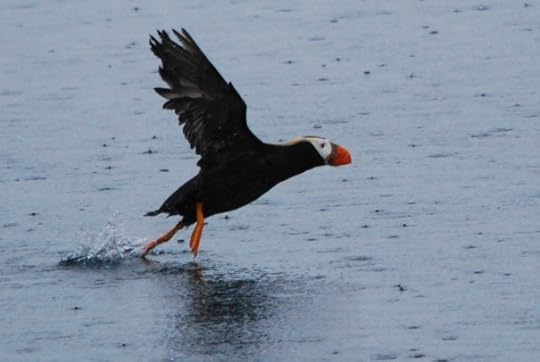
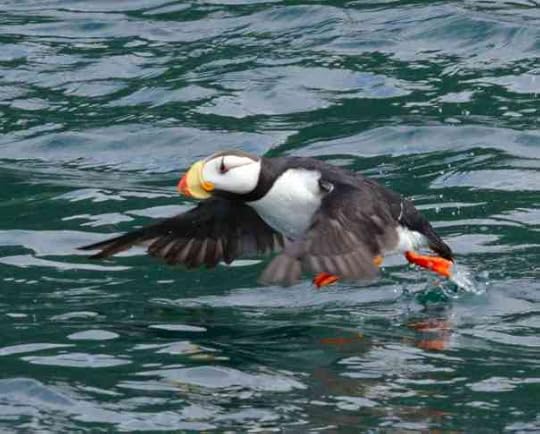
With its heavy body, short wings, and webbed feet, a puffin is built more for swimming than for flying. A tufted puffin is the size of a crow but weighs twice as much and has short stubby wings. It must beat its wings 400 times per minute just to stay aloft. Not only is it difficult for a puffin to take off from the water and gain altitude, but it lacks maneuverability in the air, and crash landings and mid-air collisions between puffins are not uncommon. When a puffin takes off from the water, it usually remains close to the surface for a ways and may even hit the water with its wings and bounce off the waves to gain altitude. When flying, a puffin uses its feet to change direction. A puffin is much more graceful in the water, and when swimming, it uses its wings for propulsion and its feet for steering. On land, puffins walk in an upright position, using their claws to cling to slippery rocks and rough terrain.
Fights between puffins are common and occur when one puffin perceives another is invading its territory. The resident puffin threatens the intruder with an open bill that exposes its brightly colored mouth lining. It also shakes its head, jerks its head upward and back, and rocks its body from side to side.
Puffins feed in small flocks and can dive as deep as 262.4 ft. (80 m) to catch their prey. They feed on lipid-rich fish such as sand lance, capelin, and herring, and they also eat euphausiids (krill). When catching fish to take back to the nest, a puffin can carry a large number of fish crosswise in its bill with the heads and tails dangling from the sides of its mouth. It can hold several fish in its mouth and continue to catch more fish without losing any of them due to spines on its tongue and on the roof of its mouth that act as hooks to hold onto the prey.
 Horned Puffin
Surveys in Prince William Sound suggest the horned puffin population in that area declined 79% from 1972 to 1998. Biologists believe this decline in numbers is due to major changes in the food base as a result of global warming. This fall, the bodies of 217 dead tufted puffins have been recovered on St. Paul Islands in the Pribilofs, and biologists have determined that the puffins starved to death. Their deaths, like the earlier deaths of horned puffins in Prince William Sound, were blamed on a shortage of food linked to higher-than-normal ocean temperatures in the Bering Sea. Biologists believe thousands of tufted puffins may die in this region this winter.
Puffins need a predator-free nesting area and an abundance of food. They are subject to predation by foxes, river otters, rats, eagles and other birds of prey. Ravens may attack nesting chicks. When traveling from the winter feeding area to their nesting grounds, puffins fly in large groups in a pattern that resembles a wheel, making it difficult for an eagle to attack an individual bird. Puffins are susceptible to oil pollution. After the Exxon Valdez oil spill, 162 dead horned puffins and 570 dead tufted puffins were retrieved from the oiled waters, but biologists believe several thousand puffins were killed by the spill. Puffins are also often caught as bycatch by gillnet and driftnet fisheries.
The post Puffin Biology appeared first on Robin Barefield.
December 11, 2016
Horned and Tufted Puffins in Alaska
 Tufted Puffin
Two species of puffins live in Alaskan waters. The horned puffin (Fratercula corniculata) and the tufted puffin (Fratercula cirrhata) belong to the family Alcidae, which also includes guillemots, murres, murrelets, auklets, and auks.
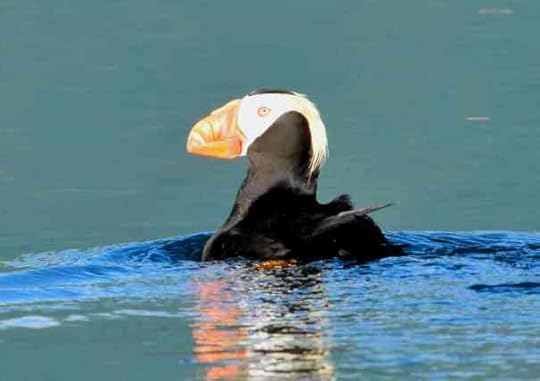
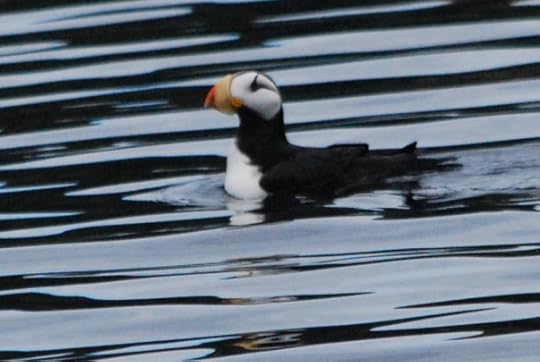
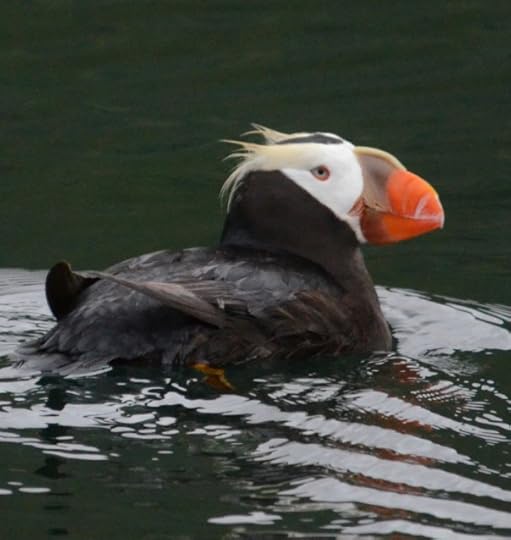
There is no sexual dimorphism between male and female puffins; both sexes are the same color and size. They have stout bodies, short wings, and orange, webbed feet which are located far back on their bodies. From a distance in the spring and summer, the most obvious difference between the two species is that horned puffins have white breasts, while tufted puffins have black breasts and bodies. A horned puffin has a black back and neck and is white on the sides of the head and the breast. Its bright-yellow, oversized beak has a red tip. Its common name is derived from the small, fleshy, dark horn above each eye that is present in the spring and summer. Horned puffins resemble Atlantic (or common) puffins, to which they are closely related, but horned puffins are larger than Atlantic puffins, have slightly different-colored beaks, and have horns, which are lacking in Atlantic puffins. In addition to its black body, a tufted puffin has a white face and a red and yellow bill. Its common name is derived from the long tufts of yellow feathers that curl back from behind the eye on each side of the head. Both adult horned and tufted puffins are about 14 inches (36 cm) long, but tufted puffins are heavier, weighing 1.7 lbs. (771 g), while horned puffins weigh approximately 1.4 lbs. (635 g).
Horned PuffinAt the end of the summer, after adults leave their nests, their plumage fades. The white face patches become smoky-brown in front and silver-gray in back, and the body of the horned puffin fades to blackish-gray above and brownish-gray below, while the body of the tufted puffin fades to a dusky gray. The bills of both species fade and the outer plate sheds, leaving them with a much smaller, duller bill. Their feet fade to a fleshy color, and horned puffins shed their horns, while tufted puffins shed their tufts. In the winter, when puffins are on their wintering grounds offshore in the North Pacific, they undergo a complete molt and are flightless for a period.
Puffins are well-suited to life in the ocean. Their feathers are waterproof, and their short, stiff wings are built more for swimming than for flying. They have strong bones to help them withstand the increased pressure of underwater dives; they can store oxygen in their body tissues, and they use anaerobic respiration to allow them to make long dives.
Tufted puffins nest on the coast and offshore islands from lower California to Alaska and from Japan to the shores of northeastern Asia. In Alaska, tufted puffins nest from Southeast Alaska to the Chukchi Sea coast. Horned puffins range from British Columbia to Alaska and southwest to the Sea of Okhotsk and the Kuril Islands. Their range in Alaska is similar to that of tufted puffins, but horned puffins are more abundant than tufted puffins in the northern part of their ranges.
Puffins are not easy to count because they nest in rock crevices or burrows where they can’t be seen. Also, a few puffin pairs often nest on rookeries dominated by other species, so an observer would have to watch each bird rookery for a long time to know if there were any puffins on the rookery. Population statistics are rough estimates and should not be considered exact counts. The world estimate for horned puffins is 1,088,500 individuals with greater than 85% nesting in North America. It is estimated that there are 608 breeding colonies in Alaska with a population of 921,000 individuals. The world population estimate for tufted puffins is 2,970,000 individuals with greater than 80% nesting in North America. It is estimated that there are 693 breeding colonies for tufted puffins in Alaska with a population of 2,280,000 individuals.
In next week’s post, I will describe puffin mating and nesting behaviors as well as detail more about their biology. As our days here on Kodiak steadily shorten, and we brace for what seems like one winter storm after the next, I enjoy writing about and looking at photos of puffins because they, more than any other bird, make me think of warm summer days.
I hope you are staying warm out there. If you want something to read, sign up for my Free Mystery Newsletter and read about true crime in Alaska. This month I am profiling another serial killer who recently roamed the streets of Anchorage.
The post Horned and Tufted Puffins in Alaska appeared first on Robin Barefield.
December 4, 2016
Bald Eagle (Haliaeetus leucocephalus)
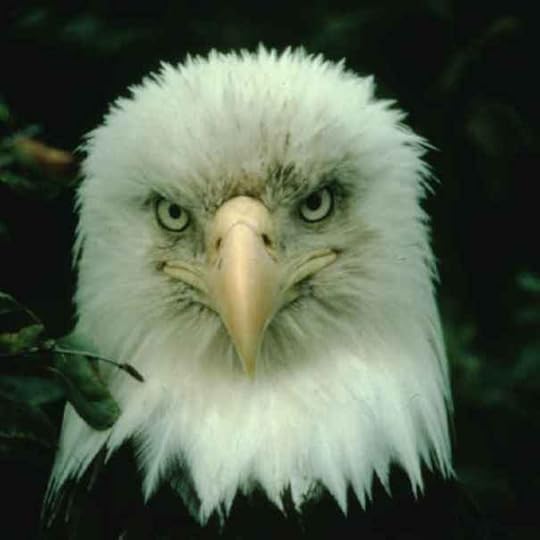
The bald eagle (Haliaeetus leucocephalus) is only found in North America. Its range stretches from northern Mexico to Canada and Alaska and covers all the continental United States. Due to a variety of factors, including the use of the pesticide DDT, bald eagles nearly became extinct in the contiguous United States by the 1950s. The 1940 Bald Eagle Protection Act prohibited commercial trapping and killing of bald and golden eagles, and more significantly, DDT was banned in 1972 when it was proven the pesticide interfered with the eagle’s calcium metabolism, causing either sterility or unhealthy eggs with brittle shells. In 1973, Congress passed the Endangered Species Act, and the bald eagle was listed as an endangered species. In 1995, when eagle populations in the continental U.S. began to rebound, the bald eagle was removed from the endangered species list and transferred to the threatened species list. On June 28, 2007, bald eagles were removed from the List of Endangered and Threatened Wildlife.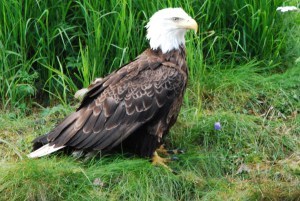
While Alaska’s eagles were never threatened by the use of DDT, Alaska has its own nefarious history with bald eagles. In 1917, commercial salmon fishermen convinced the Alaska Territorial Legislature that eagles killed large numbers of salmon and were competing with the fishermen’s livelihoods. This claim was later shown to be false, but the legislature enacted a bounty system on eagles that paid two dollars to anyone who turned in a pair of eagle legs. This bounty system lasted for thirty-six years and led to the killing of a confirmed 120,195 eagles, plus countless others that were never turned in for a bounty. The bounty system ended in 1953, and when Alaska became a state in 1959, its bald eagles were officially protected under the Federal Bald Eagle Protection Act of 1940. Alaska’s eagle population is now considered healthy, and one-half of the world’s 70,000 bald eagles live in Alaska. Twenty-five-hundred bald eagles reside on the Kodiak National Wildlife Refuge.
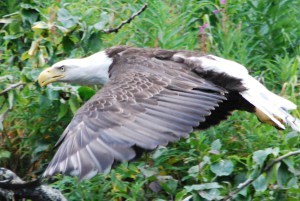
The genus Haliaeetus, the sea eagles (in Latin, hali means salt and aeetus means eagle), includes eight of the sixty species of eagles. The sea eagles live along sea coasts, lakes, and river shores. The species Haliaeetus leucocephalus (leuco means white and cephalus means head) consists of two subspecies. The southern bald eagle, Haliaeetus leucocephalus leucocephalus, is found from Baja California and Texas to South Carolina and Florida, south of 40 degrees north latitude. The northern bald eagle, Haliaeetus leucocephalus alascanus occurs north of 40 degrees north latitude. Northern bald eagles are larger than their southern cousins
Eagles are well-insulated by their feathers and are good at regulating their body temperature. Unlike many birds, they do not need to migrate to warmer areas each winter, but in many parts of the country they do migrate, sometimes long distances, in response to varying food supplies. Due to its abundant year-round food supply, Kodiak has a non-migratory eagle population. Furthermore, hundreds of eagles from the Alaskan mainland migrate to Kodiak for the winter months. Effluent from canneries and fish processing plants in the town of Kodiak provides a consistent source of food for these birds in the winter months, and hundreds of eagles can be seen in town perched in trees, on cannery rooftops, on the edges of dumpsters, and even on pickup trucks. In Uyak Bay and other remote bays on Kodiak, eagles stay near their nests all winter, feeding on fish and winter-killed deer among other things.
Since the ban on DDT and related pesticides in 1972, bald eagle populations around the country have rebounded to some degree. The bald eagle population in Alaska is healthy and stable and has never been listed as endangered or threatened by the Federal Government. Eagles in Alaska never suffered the scourge of DDT poisoning, and even now in most areas, they live in a relatively contaminant-free environment.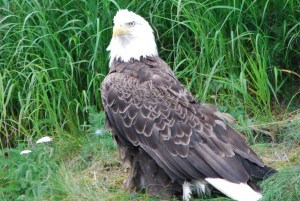
The Bald Eagle Protection Act imposes a fine of $10,000 and two years imprisonment for anyone who harms a bald or golden eagle. It is illegal to even have an eagle feather in your possession without a proper permit. Nevertheless, humans are still responsible for many bald eagle deaths. On Kodiak, Refuge biologists have recovered eagles that have starved to death, been killed by airplanes and cars, caught in traps, and oiled by fish slime or fossil fuels. The Exxon Valdez oil spill killed hundreds of eagles in Alaska. In January 2008, fifty eagles swooped down on a dump truck filled with fish guts outside a Kodiak seafood processing plant. Twenty of the eagles were drowned or crushed, and the rest were so slimed they had to be cleaned. Bait left unattended on a fishing boat can cause a frenzy when eagles land and start fighting over their find. If their feathers become oiled by fish slime, they become less-waterproof, and then if the eagle falls into the water, it is more susceptible to hypothermia.
In 2009, the Kodiak Electric Association (KEA) erected three wind turbines on Pillar Mountain near the town of Kodiak and added an additional three turbines in 2012. Many people worried the turbines would be a danger to eagles since turbines elsewhere in the U.S. kill an estimated 573,000 birds a year. KEA funded a study to address the concerns, and researchers determined that eagles went out of their way to avoid crossing the ridge among the turbines. No eagles were killed during the study, and according to avian biologist, Robin Corcoran, she has never received a report of a dead eagle near the turbines.
Eagles do die from electrocution on Kodiak. Many of the power poles near town are fitted with devices designed to protect eagles, but in January 2011, an eagle was electrocuted when she landed on the lowest of three cross bars on a power pole. That particular crossbar did not have a protective device because utility authorities believed there was not enough room for an eagle to land on it. The dead eagle had been banded years earlier by the Alaska Department of Fish and Game, so biologists knew she was 25 years old, the second-oldest bald eagle documented in Alaska, and one of the oldest-documented eagles in the country.
While these manmade disasters are tragic, they are uncommon and do not appear to be a threat to Alaska’s bald eagle population. A greater and less-obvious threat is the destruction of eagle-nesting habitat by logging and commercial and residential development. Eagles tend to nest in large, old trees that are not easily or quickly replaced once they are removed.
Once an eagle attains its adult plumage, it is impossible to determine its age unless it has been leg-banded by biologists. For this reason, we have limited data on the life span of bald eagles. Biologists believe 50-70% of all juvenile bald eagles die in their first year, and as many as 90% die before they are fully mature. Eagles in captivity may live 40 to 50 years. The oldest documented eagle resided in Stephentown, New York and lived to be 48-years old. On average, eagles live 15 to 20 years in the wild, and the oldest documented wild eagle was a 32-year-old bird from Maine. Alaska’s oldest eagle was a 28-year-old from the Chilkat Valley.
Eagles are fascinating birds and have been studied a great deal. Later this winter, I will dedicate more posts to eagle biology. Please leave a comment if you have a question or anything you would like to share about eagles.
Don’t forget to sign up for my free, monthly newsletter if you would like to read about true crime in Alaska.
The post Bald Eagle (Haliaeetus leucocephalus) appeared first on Robin Barefield.
November 27, 2016
Kodiak Birds
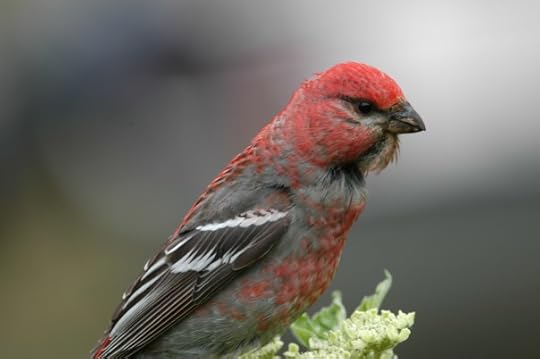 Pine Grosbeak
More than 240 species of birds have been identified in the Kodiak Island Archipelago. Kodiak is not on a major flyway, but many species migrate to Kodiak in either the summer or winter, and many other species are year-round residents. Common species include golden-crowned sparrows, Wilson’s warblers, fox sparrows, black-capped chickadees, hermit thrushes, and winter wrens.
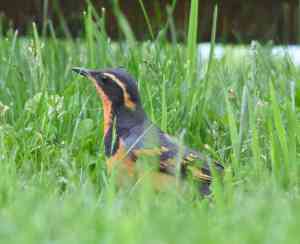 Varied Thrush
Due to its mild maritime climate in the winter, wide variety of habitats, and plentiful food supply, the Kodiak Archipelago is a winter home to more species and numbers of birds than anywhere else in Alaska. Over a million sea ducks and other aquatic migratory birds flock to Kodiak in the winter. Sea ducks commonly seen in the archipelago in the fall and winter include harlequins, surf scoters, buffleheads, Barrow’s Goldeneye, oldsquaws, and mergansers.
In the spring, Arctic terns arrive from as far away as Antarctica, and bank swallows return from South America. Horned and tufted puffins fly from their winter home on the deep North Pacific Ocean to the rocky cliffs of the archipelago where they nest.
 Tufted Puffin
Without question, the bald eagle is Kodiak’s most noticeable bird, and with 600 nesting pairs on the archipelago, biologists believe the nesting real estate is saturated, and many adult eagles here may never mate. In the winter, hundreds of eagles congregate near the town of Kodiak where they feed on cannery effluent and scraps of fish from boats when the fishermen offload their catch. Many of these eagles seen near town in the winter are seasonal migrants from the mainland.
Over the next few weeks, I will cover a few of these bird species in more detail, including bald eagles, tufted and horned puffins, Arctic terns, and oystercatchers.
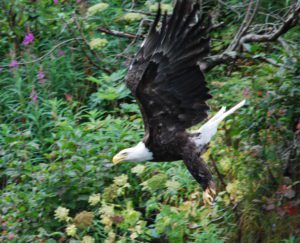 Bald Eagle
If you are interested in reading true crime stories, please sign up for my monthly Mystery Newsletter. Each month I profile a true crime story from Alaska. Did I mention that it’s free, and there’s no catch! If you have already signed up and enjoy the newsletter, please tell your friends, post about it on Facebook, or tweet about it.
The post Kodiak Birds appeared first on Robin Barefield.
November 20, 2016
Snowshoe Hare (Lepus americanus)
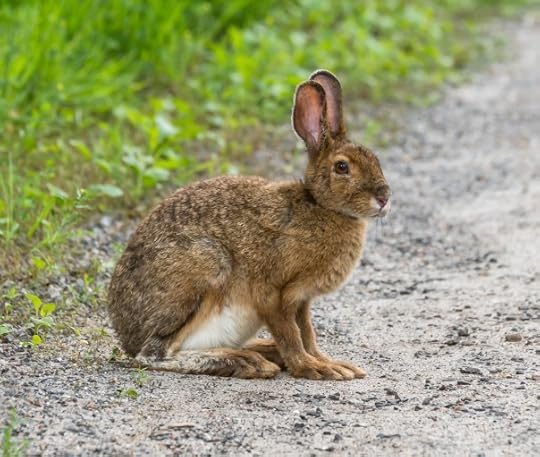
Snowshoe hares (Lepus americanus) are found throughout Canada and in the northernmost United States. Their range extends south to the Sierras, Rockies, and Appalachian mountains.[1] They are common in Alaska and can be found throughout the state except for the lower Kuskokwim Delta, the Alaska Peninsula, and the area north of the Brooks Ranges.[2] They are not native to Kodiak Island but were introduced to Kodiak in 1934.[3]
Snowshoe hares average between 18 and 20 inches (.5 m) in total length and weigh 3 to 4 pounds (1.4– .8 kg).[2] Males are slightly smaller than females.[1] Their summer coat is yellowish to grayish-brown with buff-colored flanks and a white belly. The ears are light brown with black tips and creamy borders, and the face and legs are cinnamon brown. Their winter coat is snowy white, except for their black eyelids and the black tips of their ears.[1,2 ] The start of the molt from their summer to winter coat is regulated by daylength and takes approximately 72 days to complete. Two different sets of hair follicles give rise to the white and brown hairs.[1] Snowshoe hares have large hind feet that are well-furred, allowing them to maneuver on deep snow and giving them their common name.[2]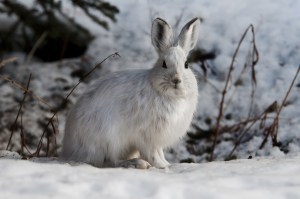
Snowshoes are mostly vegetarians and eat a variety of plant materials, including grasses, buds, twigs, and leaves in the summer and twigs, spruce needles, barks, and buds in the winter.[1] They are also known to cannibalize the remains of other hares that have died, and they will eat fecal pellets to extract more nutrients.[1]
Snowshoe hares breed when they are one year old, and in Alaska, they have two to three litters per year. Breeding takes place from mid-May until August, and both males and females have multiple mates.[2] When the time nears for a pregnant female to give birth, she becomes highly intolerant of and aggressive toward males.[1] The gestation period lasts 36 to 37 days, and the first litter of the year averages four young, called leverets. The second litter of the year often averages six leverets, and there is sometimes a third litter.[2] Research suggests that the female may be able to breed even a day or two before she gives birth to her current litter.[1]
Leverets are born in a natural, unlined depression in the ground. They weigh 2 ounces (57 g) at birth, and they can walk by the time their fur dries. One of the main features that differentiates hares from rabbits is that hares are born with a full coat of fur, while rabbits are born with no fur. Hares also have open eyes and ears at birth, and in less than two weeks after they are born, they are already able to eat green vegetation. They continue to nurse for a month before they leave the nest for good.[2] Young hares reach sexual maturity within a year, but 85% of snowshoe hares live less than one year. Those that do survive may live up to five years in the wild.[1]
Snowshoe-hare density in an area is often high, but hares are solitary animals. They are most active at low light levels, so they are usually seen at dusk and dawn. They are also active at night and on cloudy days.[1] Most of their traveling takes place on well-known, trampled pathways through the vegetation, and these trails make deep grooves in the winter snow.[2] During the day, hares take short naps and spend a large amount of time grooming themselves. They also take dust baths to remove ectoparasites from their fur.[1]
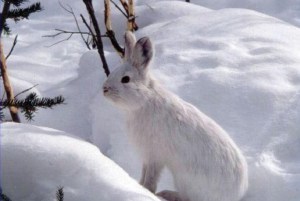
Snowshoes can travel as fast as 27 mph (43.45 km/h) and can jump 10 ft. (3 m) in a single hop. They can change directions quickly and make vertical leaps, and both of these maneuvers aid them in avoiding predators. Hares are also good swimmers and will jump into a lake or a river to flee a predator. Young hares often attempt to escape predation by freezing in their tracks and blending into the background. If the hare remains immobile, the predator may not be able to see him when he is camouflaged.[1]
Snowshoe hares have excellent hearing that helps them identify approaching predators, but they are not very vocal. They make loud, squealing sounds when captured and may hiss and snort when approached by a predator, but hares communicate among themselves by thumping their hind feet on the ground.[1]
Populations of snowshoe hares cycle from periods of high abundance to periods of only a few animals. The population in an area will grow and then suddenly crash to a low level. When the population peaks, there may be as many as 600 hares per square mile (230/km2). Biologists are unsure why hare populations suddenly decline, but they suspect it may be due to a depletion of their food supply, predators, disease due to stress and parasites, or a combination of these causes.[2] It is difficult to determine the size of a hare population, but biologists estimate approximately 100,000 snowshoe hares live on Kodiak Island.[3]
Happy Thanksgiving to my U.S. readers! If you haven’t already signed up for my free Mystery Newsletter, this would be a good time to do that. This month I wrote about Israel Keyes, a monster that experts consider to be one of the top three most organized and intelligent serial killers ever. You can sign up for my newsletter here.
The post Snowshoe Hare (Lepus americanus) appeared first on Robin Barefield.
November 13, 2016
The Common or True Beaver (Castor canadensis)
, True Beaver, Beavers in Alaska, Beavers on Kodiak Island, Wildlife of Kodiak Island, Mammals introduced to Kodiak Island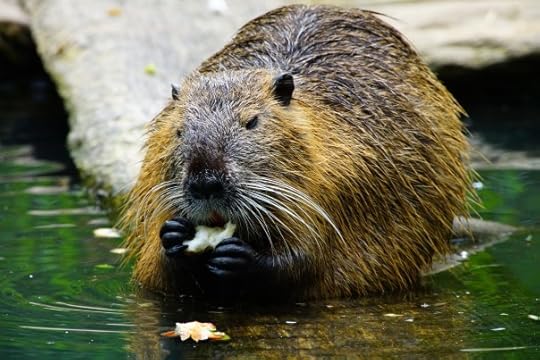
The common beaver or true beaver (Castor canadensis) is native to North America and is found in most areas from the Arctic to northern Mexico. C. canadensis is absent from Southern California, Nevada, most of Florida, and parts of Alaska. Beavers are not native to Kodiak Island but were introduced to Kodiak in 1925.
Description
The true beaver is the largest rodent in North America and the second-largest rodent in the world. The South American capybara is the largest. Beavers continue to grow throughout their lives and may reach a length of 3 to 4 feet (0.9-1.2 m), including the tail. Most adults weigh between 40 and 70 lbs. (17-32 kg), but they can weigh as much as 100 lbs. (45 kg).
A beaver has a heavy, thick, chestnut-brown coat and a warm, soft underfur that keeps it comfortable in all temperatures on land and in the water. This warm, soft fur was in such high demand by humans in the late 1800s and early 1900s that by 1930, beavers had been trapped nearly to extinction in many areas.
The beaver’s scientific name is derived from castoreum, a strong smelling, oily substance secreted by castor glands at the base its tail. A beaver uses its feet to comb this oil through its fur to provide a waterproof barrier that keep its skin dry underwater. It also has a thick layer of fat beneath its skin to insulate it in cold water.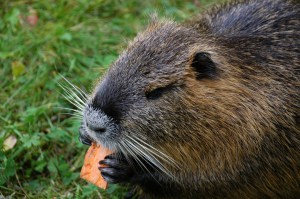
A beaver’s body is adapted to a life spent mostly in the water. In addition to the castoreum which keeps its skin dry underwater, it has nictitating membranes that protect its eyes underwater and nose and ear valves that close when it submerges. It can cut and carry wood underwater without getting water in its mouth by tightly closing its loose lips behind its protruding front teeth. A beaver has large, webbed feet and a broad, black tail that is approximately 10 inches (25 cm) long and 6 inches (15 cm) wide that it uses as a rudder when swimming. It also uses its tail as a warning signal when it slaps it against the water. When it stands on its hind legs to cut down a tree, the tail serves as a fifth leg and helps to balance the animal. A beaver can stay underwater for fifteen minutes, and it can swim up to 5 mph (8 km/h). It propels itself through the water with its webbed hind feet while holding its front feet against its body. When swimming at the surface, only its head is visible above water. On land, a beaver moves with a waddling gait and can run between 6 and 8 mph (9.7-12.9 km/h).
Dams
Beavers are second only to humans in their ability to alter the environment for their own needs. Beavers spend part of their time on land of the rest of their time in the water. They must build their dens in an area that provides 2 to 3 feet (0.6-0.9 m) of water year-round to ensure that ice does not block the underwater entrance to their lodge or den in the winter. In areas where the natural water level is less than 2 ft. (0.6 m), beavers construct dams to increase the height of the water level. The height of an average dam is 6 ft. (1.8 m), producing an average water depth of 4 to 6 ft. (1.2 to 1.8 m). Beavers construct the dam by first diverting the stream to reduce the flow of water at their building site. Next, they drive branches and logs into the mud of the stream bed for the base. They then use whatever they can find, including sticks, bark, rocks, mud, and grasses to build the superstructure of the dam. They even include spillways and passageways in the dam structure to allow excess water to drain off the dam without damaging it. A beaver can move building materials that weigh as much as it does, and it can cut down a tree with a 6-inch-diameter (15.2 cm) trunk in 20 minutes. It may work alone to build a dam, or several family members may work together on the project.
Dens
Beavers build two different styles of dens, depending on the current and water level of the river. Both types of dens have at least one exit to deep water that will remain free of ice in the winter. In a swiftly flowing river with a year-round water level deep enough so that a dam is not required, beavers build simple bank dens into the side of the riverbank. They cover the top of a bank den with sticks, mud, and other debris. Bank dens usually have several entry tunnels. The interior of a bank den has one chamber that is approximately 2 ft. (.61 m) wide by 3 ft. (.9 m) long by 3 ft. (.9 m) high.
The second type of beaver den is called a “lodge.” A lodge is dome-shaped and is about 10 ft. (3 m) high by 19.6 ft. (6 m) wide at the base. Beavers build lodges in slow-moving water and use the same construction techniques they employ when building a dam. The lodge consists of an entry tunnel and two chambers. The entry tunnel is below the water level, and the floor of the first chamber is a few inches above the water line. The first chamber is used as an eating area and a place to dry off after getting out of the water. The floor of the second chamber is above the first chamber, and this area is used for sleeping and caring for the kits. Beavers cover the floor of this chamber with shredded wood or vegetation. A single family group, including an adult pair, this year’s kits, and the young from the previous year, occupy a lodge. The older offspring assist their parents in maintaining the lodge and the dam.
Beavers use the same lodge for many years, and since they add material to the lodge every year, the lodge grows over time. Beavers do no hibernate in the winter but stay active in their lodges. Since the only entrance to the lodge is underwater, they are frozen in the lodge or under the surface of the water if the river develops an ice layer. To prepare for winter, they store enough food to make it until spring. The walls of the lodge freeze in the winter, helping to insulate the interior and protecting them from predators.
Diet
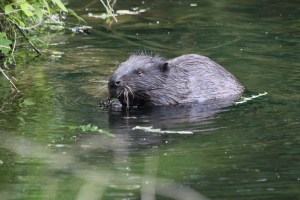
Beavers do not eat wood, they eat the cambium, a soft tissue near the surface of the tree from which new wood and bark grow. They also eat aquatic plants and roots and grasses. During the winter, they mainly depend on woody material such and shrubs and branches, which they plant underwater close to the lodge entrance. When they deplete the food supply near their den, they must forage further from home for food, and this increases their risk from predators. When they no longer have a good supply of food near their den, they migrate to a new home.
Behavior
Beavers are mostly nocturnal. They sleep during the day and forage for food and build their dams and dens at night. They communicate mainly by posturing and scent marking. They use their paddle-like tail to slap the water as a warning and to communicate other emotions. They build small, dome-shaped mounds and rub castoreum, the oily substance secreted by their castor glands, on the mounds to mark their territory. Young beavers make a sound like a quacking duck, and adult beavers sometimes grunt when they work.
Reproduction
There are no separate names for male and female beavers, but babies are called kits. Beavers are monogamous and mate for life, but if one of the mates dies, its partner may find another mate. They breed in January and February, and females give birth to between one and nine (two to four are average) kits between late April to June, after a gestation of 105 days. Kits are covered with a soft fur at birth. They can swim when they are four-days-old, and they can dive by the time they are two-months-old. Young beavers live with their parents until they are two-years-old, and they reach adulthood in their second winter. Beavers survive in the wild for approximately 10 to 12 years, but in captivity, they have been known to live as long as 19 years.
Impact on Environment
When beavers colonize an area, they can impact the environment in both positive and negative ways. When they build a dam on a river or stream, they create ponds by flooding the area near the dam, and this increases the water table in the area and recharges aquifers. Beaver dams can also create wetlands where there were none before, providing a habitat for birds, invertebrates, fish, and mammals. On the negative side, beaver dams can cause flooding of crops and roads, damage dams and roads built by humans, harm forests and landscaping, negatively impact plants and animals, dam irrigation canals and prevent necessary water from flowing to farmlands, and spread diseases such as Giardia to the drinking water supply. In Alaska, beaver dams sometimes cause floods during the spring ice break-up on rivers and streams, and dams that block a stream can disrupt the salmon migrating to spawn in that stream.
The post The Common or True Beaver (Castor canadensis) appeared first on Robin Barefield.
November 6, 2016
Roosevelt Elk (Cervus elaphus roosevelti)
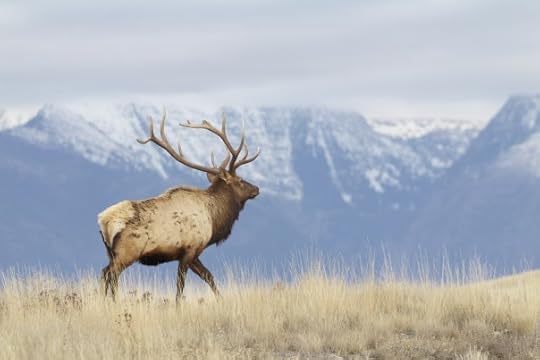
In 1928, eight yearling Roosevelt Elk (Cervus elaphus roosevelti) were introduced from the Ho Valley on the Olympic Peninsula of Washington State to Kodiak Island where they were raised for one year at the Experimental Agricultural Research Station in Kalsin Bay near the town of Kodiak. Biologists originally planned to release the elk on Kodiak Island, but ranchers on the island were concerned the elk would compete with their cattle for the limited winter food supply, so in 1929, biologists instead transplanted the elk to Afognak Island, a large island in the Kodiak Archipelago just north of Kodiak. By 1965, the herd had expanded from the original eight calves to between 1,200 and 1,500 elk, and the population had spread to nearby Raspberry Island. Several harsh winters with heavy snowfalls in the late 1960s and early 1970s caused increased mortality and reduced calf production in the herd, but by the 1980s, the herd had recovered to 1,200 animals. Today in the late 2000s, approximately 900 elk live on Afognak and Raspberry Islands. The only other elk in Alaska are Rocky Mountain Elk (Cervus elaphus nelson) that were introduced from Oregon to Etolin Island in Southeast Alaska in 1987. This herd has now expanded to Zarembo Island.
Elk are members of the deer family. They are larger than deer and caribou but smaller than moose. An elk’s body is gray to brown in color, with dark brown legs and a brown neck. A large, yellow patch covers the rump. Males have antlers that can grow very large. The antlers sweep back over the shoulders, and the spikes point forward. Bulls shed their antlers in the winter and grow new ones the following summer.
Elk give birth in late May or early June, and soon after giving birth, cow elk and their calves band together. Sometimes one cow elk will babysit the calves while the other mothers search for food. By July, the calves are still nursing but begin to eat on their own. In August, bands of elk come together to form herds, consisting of cows, calves, yearlings and sometimes a mature bull. Small bands of bulls form nearby but separate from the herd. In September, the bulls join the main herd for the mating season. During this time, bulls challenge each other by emitting high-pitched whistles or “bugles” and sometimes push and shove each other with their large antlers. By mid-October, once breeding has ended, the herds disperse into smaller bands, and the elk move into their wintering areas in the lower valleys or near the coastline where they search for food.
Elk graze from late spring to early fall when there is more food available, including grasses, forbs, and other leafy vegetation. By late fall, they mainly browse, feeding on sprouts and branches of trees and shrubs. Elk are big animals that require a large amount of food, and since they live in herds, they can quickly over-graze their food supply and decimate the native vegetation.
Biologists estimate 900 elk live in seven herds on Afognak Island and one herd on Raspberry Island. Logging on Afognak Island has impacted elk habitat there, but biologists consider the herd to be healthy. Elk occasionally swim to Kodiak Island, but while individual elk have been seen on Kodiak, no herd has become established there.
For any new visitors to my blog, I would like to invite you to sign. up for my free Mystery Newsletter. Each month I profile a true crime case from Alaska. My November newsletter will be about a monster who experts consider to be one of the most intelligent and successful serial killers in modern history. You can sign up here.
The post Roosevelt Elk (Cervus elaphus roosevelti) appeared first on Robin Barefield.
October 30, 2016
Reindeer/Caribou (Rangifer tarandus)
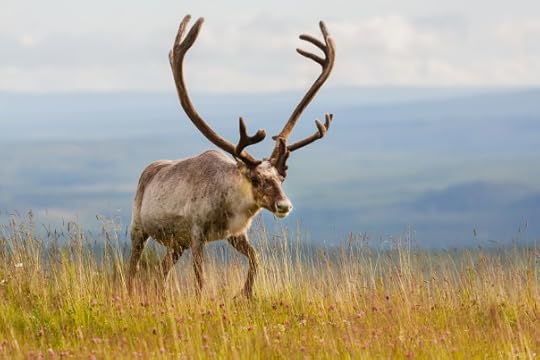
The U.S. State Department introduced thirty-two Siberian reindeer to the south end of Kodiak Island in 1921 when they were granted to the native peoples to herd and raise.
Reindeer and caribou belong to the same genus and species (Rangifer tarandus). Both wild and domesticated animals in this species are referred to as reindeer in Europe and Asia, but in North America, the term reindeer is reserved for semi-domesticated animals, while their wild cousins are called caribou. There are many subspecies of both reindeer and caribou in Alaska.
Reindeer and caribou are members of the deer family, and they are the only species in the deer family in which both males and females grow antlers. The antlers of female reindeer are larger than those of female caribou. This difference, as well as many of the other differences between caribou and reindeer, are probably the result of domestication and breeding. Caribou have longer legs, while reindeer are shorter and rounder. Reindeer bulls are smaller than caribou bulls, but reindeer and caribou cows are about the same size. Reindeer have thicker fur than caribou, and they breed two to four weeks earlier than caribou.
Biologists believe reindeer were one of the first domesticated animals. A 9th-century letter from King Ottar, the king of Norway, to Alfred the Great mentions his herd of over 600 reindeer. Reindeer herding began in Alaska more than a century ago when 1300 reindeer were imported from Siberia. By the 1930s, 600,000 domestic reindeer lived in Alaska, but much of the reindeer industry in the state collapsed during the Great Depression.
After reindeer were introduced to Kodiak in 1921, The Alitak Native Reindeer Corporation was formed, and residents of the village of Ahkiok managed the herd. The herd grew throughout the 1940s and reached approximately 3000 animals by 1950. A wildfire in the early 1950s wiped out much of the reindeer range, and approximately 1200 reindeer escaped into the wild. Active management of the herd ended in 1961, and federal grazing leases expired in 1964. The State of Alaska declared the reindeer to be feral and soon established an open hunting season with no bag limit on reindeer. In 2010, the State of Alaska restricted the reindeer hunting season on Kodiak to six months and limited the annual take to one reindeer per hunter. The state also reclassified reindeer on Kodiak as “caribou.”
A reindeer has a thick coat that is brown in the summer and gray during the winter. Its chest and belly are pale, and it has a white rump and tail. A male’s antlers are larger and more complex than those of a female. A male usually sheds his antlers in the fall after the mating season, while a female keeps her antlers until spring. A reindeer has hooves that adapt to the season and environment. In the summer, its footpads are spongy, providing it with extra traction on the soft, wet tundra. In the winter, the foot pads shrink and tighten, exposing the rim of the hoof which cuts into the ice and snow and prevents the reindeer from slipping and falling.
Reindeer can run as fast as 50 mph (80 km/hr) and are excellent swimmers. They feed on herbs sedges, mosses, and lichens in the summer but mainly feed on lichens in the winter, often digging through the snow with their hooves to expose the lichens.
Reindeer breed in October, and after a gestation of 210 to 240 days, females give birth to a single calf weighing 6.6 to 26.5 lbs. (3-12 kgs). One hour after it is born, a calf can follow its mother, and at one-day old, it can run at fast speeds. Calves are weaned when they are one-month old, and reindeer reach sexual maturity when they are one to three years old.
The caribou population on Kodiak has remained stable over the past several years, and biologists estimate there are 250 to 300 caribou on the island.
The post Reindeer/Caribou (Rangifer tarandus) appeared first on Robin Barefield.