Jeff Miller's Blog, page 11
January 24, 2013
Goodreads is Amazing
I’ve had a Goodreads account for three and a half years. During most of that time, I barely used it, and that’s partly because I didn’t get it. It seemed like a pretty good cataloging system for books I’d read, but I wasn’t sure why I needed a cataloging system for books I’d read. I played around with it a little, and then mostly abandoned it.
Before my book came out, I went back to Goodreads to try it out. I made sure it had The Bubble Gum Thief and loaded information into its page. I wrote a review of Gone Girl. I rated some more books. But I still didn’t get Goodreads.
A couple of months before The Bubble Gum Thief came out, I held an Advance Reader Copy giveaway on Goodreads. Over seven hundred people entered for a chance to win one of five copies. Several hundred of these folks put The Bubble Gum Thief on their to-read list. And then I started to get what Goodreads is.
Reading is a completely solitary exercise, and that can be frustrating. When you read a book, you live in its world, and if it’s a good, or great, or amazing book, you want to talk about it with people. You want to debate it. You want to relive it. You want the book’s world to invade your own. But we generally don’t socialize based primarily on our taste in literature. So even if you love a book, it’s quite likely that your spouse, or parents, or best friends will have no interest in it at all.
There was a time when you could read a great book and go your whole life without anyone to talk to about it.
On Goodreads, you can debate and relive all of your favorite books there because there are tons of people there who want to do the same. And you can find things to read you never would have heard about—things to read that you will love and cherish, that become a part of who you are—and you never would have found them but for Goodreads. That’s why Goodreads is amazing.
It is extra-amazing for an author. At any given time, there is a group of people who have decided to let the world know that they are “currently-reading” my book. It’s not a lot of people. But it’s more than the number of people that I always imagine reading my book, which is zero. And that gives my writing purpose. An actor can go to a theater and watch people see him in a movie. I can’t go to your house and watch you read my book. But with Goodreads, I kind of can. I see people start the book, I see them finish the book, and I can see them rate the book. Because I see people having experience with my book, it makes me want to give them more experiences. It makes me more excited about the next Dagny Gray book. It helps me write even when I’m feeling too tired, or too busy, or too distracted. It’s a big can of jolt when I need it.


January 14, 2013
The Bubble Gum Thief News/Sequel
A couple of cool notes about The Bubble Gum Thief:
Stacey Alesi, aka the BookBitch, named The Bubble Gum Thief as the best crime fiction debut of 2012.
Mystery magazine Deadly Pleasures put The Bubble Gum Thief on their list of best books of 2012.
I’m beyond honored by both of these things.
A lot of people have asked about the status of the sequel to The Bubble Gum Thief. The good news is that the story is outlined and I’ve written close to 40,000 words. The bad news is that it’s just a first draft, and I’m only a third of the way done with it. It took over a dozen drafts to get The Bubble Gum Thief where I wanted it, so I’ve got a long way to go on the sequel. My goal is to make it better than The Bubble Gum Thief, and I’m excited enough by the plot and various character arcs to think I can do it. I’ve been humbled by the number of readers who have expressed affinity for Dagny and her gang, and I’m determined to give them something wonderful.
January 3, 2013
Serials
My publisher, Thomas & Mercer, was kind enough to send me a couple of its new serials: Matador, by Ray Banks, and The Betrayer, by Daniel Judson. I’m eager to give them a look. The notion of a serial fascinates me; the idea of writing one terrifies me. Some writers like to start with a notion and see where it goes.
I outline every scene of a novel before I start writing, and then radically change story elements with each draft, tweaking and twisting things in early chapters so that they will pay off in later ones. You don’t have this luxury with a serial … the early part of the story is “out there” when you’re writing the ending, so you’re stuck with every choice you made. I don’t know that I’d like that. But I can see why this kind of challenge is attractive to a writer.
One of my favorite thing to do is visit New York and watch some of the brightest young comics improvise in the dark, dirty dungeon of the UCB theater. Watching these comics react and pivot inspires me the way some people are inspired by watching Olympic athletes. These comics haven’t rehearsed what they’re doing; they aren’t working from a script. They are creating something as the audience is perceiving it. And the audience is witnessing the agility of their wits and smarts.
Serials are the closest writers come to performing improv. I know the improv comics feel a high when they’re backed into a corner on stage and they come up with a way to get out of it. Similarly, I know it’s thrilling to think of a brilliant solution to the seemingly irresolvable problem that was created back in chapter three.
When I first heard that Amazon was going to try serials, I was skeptical. Why would anyone want to have to wait for another installment of the book their reading? Most people, I figured, want the option of reading through the night. But I think television, strangely, has prepared people for the serial novel. Shows like Breaking Bad, The Sopranos, Mad Men and the like unfold like chapters of a book. People have been trained to wait a week for each chapter. The audience retains their place in the story. Their attention is not diminished by the passage of time; arguably, it’s intensified. So I think it will be fascinating to see if this translates into literature, the way it did so long ago.
December 27, 2012
We authors are a pathetic bunch. We check out Amazon rankings...
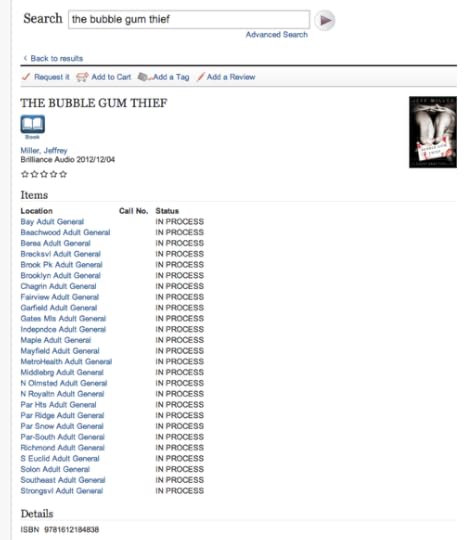
We authors are a pathetic bunch. We check out Amazon rankings 100 times a day. We obsess over every new review. (I got a two star on Goodreads yesterday. The person gave To Kill a Mockingbird three stars, so I feel okay about it.)
One of my most pathetic hobbies is thinking of cities and checking their library catalogs to see if they have ordered copies of The Bubble Gum Thief. For reasons evident in the picture above, Cuyahoga County is my new favorite library system.
December 22, 2012
[Click on the images to see then one-by-one]
Stealing a pack of...


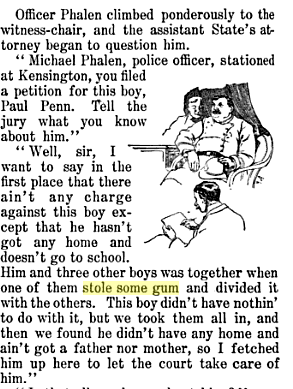



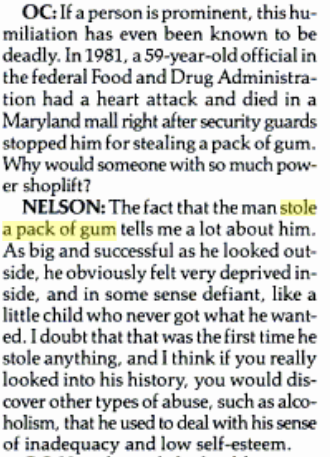
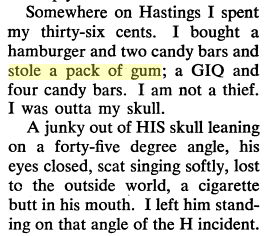
[Click on the images to see then one-by-one]
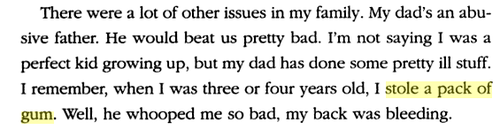
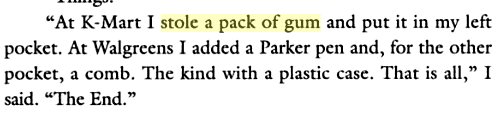
Stealing a pack of gum is the kind of crime that a kid commits when he doesn’t know better. It’s also the kind of crime a kid commits when he does know better. For some, it’s the first and last crime committed. For others, it’s the start of an escalating spree.
If an adult steals gum, it might be an impulsive act completely out of character for the perpetrator—because his life is too ordinary, or he wants to be noticed, or he wants to test moral boundaries that he never challenged before. It could also be completely in character for some adults to steal gum all of the time; any adult who does this is surely a seriously bad person, capable of all kinds of atrocities, I suspect.
Stealing gum is understood to be about as small a crime as you could possibly commit. That means if you draw a line debarking criminal behavior from acceptable behavior, stealing gum is about as close to that line as you can get. And yet no one would argue that it doesn’t belong on the crime side of line. It’s as insignificant as a crime could be, and still everyone knows it’s wrong and that you shouldn’t do it. Gum theft is what makes the line stark and distinct. That’s fascinating to me.
The Bubble Gum Thief is about crime, and the way we deal with it, so it made sense to start with the theft of a pack of gum, and build from there. That’s why the name was so important to me, even though almost any other name would sound more like the adult thriller that it is.
December 17, 2012
I think every writer’s dream is to see someone on an...
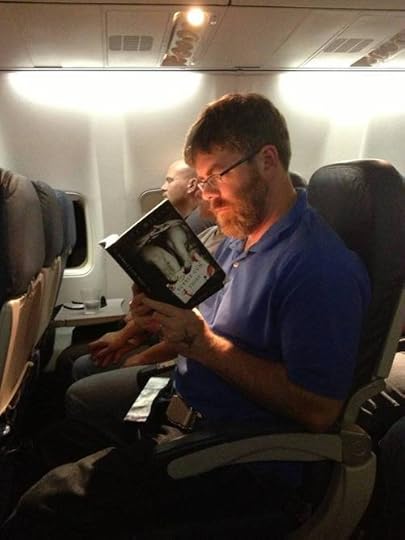
I think every writer’s dream is to see someone on an airplane reading his book.
December 14, 2012
Twenty-seven were killed today at an elementary school,...
Twenty-seven were killed today at an elementary school, according to latest press accounts.
I write novels in which people are killed like this. On days like today, that feels gross and awful.
When I wrote The Bubble Gum Thief, I wanted to challenge readers to think about things like the workings of our criminal justice system, the vortex of public outrage, and the way the media covers terrible tragedies like the one today. But there’s nothing in the book that challenges the culpability, if any, of art in its portrayal of violence. It’s easy to say that books like mine simply reside within and reflect the world as it is. But just because it is easy, doesn’t mean it’s right.
I’m uncomfortable with the kind of violence that I write about, which is why I’ll sometimes cut away from it before it happens. I wish I had some wisdom about it, but I have nothing but despair to offer. Because it’s the smartest thing I know about this kind of violence, here’s Dan Bern’s amazing song, Kids’ Prayer. I’ve posted this many times before, and sadly, I’m sure I’ll post it again.
December 11, 2012
December 9, 2012
I’ve been ridiculously obsessed with this line for the...
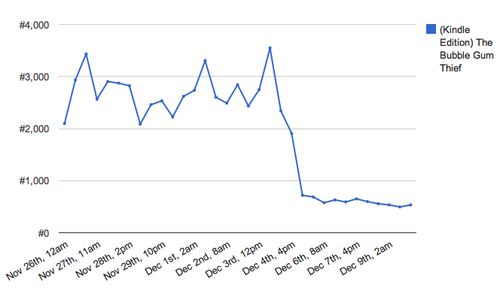
I’ve been ridiculously obsessed with this line for the past few days.
(Note to friends and family: Don’t get too excited … Line is sales rank, not sales)
I’m no economist, but … .
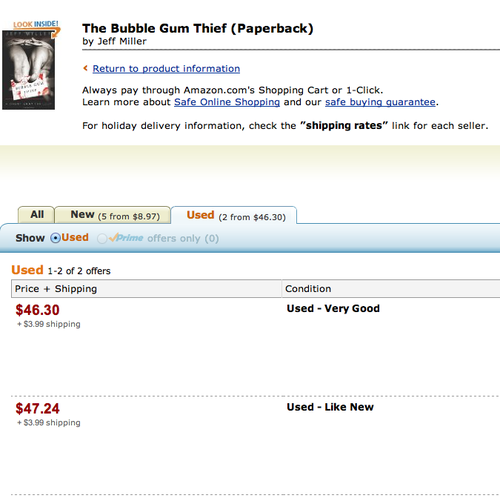
I’m no economist, but … .