
Konn Lavery's Blog: Posts from konnlavery.com, page 54
September 12, 2016
WARNING: Edmonton Comic Expo 2016
Later this month I will be returning to the Edmonton Comic & Entertainment Expo. I am very pleased to be joining it for my third year. Unlike last year, I actually have something new to share – the Seed Me novel and the World Mother: Seed Me Novel Score.


In addition there will be a limited run of Seed Me T-Shirts by SANE Clothing.
Where is the Edmonton Comic Expo?
Edmonton EXPO Centre
7515 118 Ave NW
Edmonton, AB T5B 4X5
Friday, Sept. 23rd 3pm-8pm
Saturday, Sept. 24th 10am-7pm
Sunday, Sept. 25th 10am-5pm
I’ll be at booth L04
See you all then!
The post WARNING: Edmonton Comic Expo 2016 appeared first on Konn Lavery.


September 11, 2016
Want to Write a Fiction Novel? Part 3 – Chapter Outlines
Welcome to the final part of the 3 part miniseries titled Want to Write a Fiction Novel? In the first post, we looked at creating the premise for your novel, thinking from a 5,000 foot view. In the second part we discussed plot outlines, looking at the general direction of the plot on a single page. With each post, we dig a bit deeper into the story, each component complimenting the previous. This post, we will look at developing each chapter outline found within the plot. These chapters reflect the important points we made on our plot outline.
What is a Chapter Outline?
A chapter outline differs from the plot outline, which offered a visual representation of the rise and fall of the story. The chapter outline level of planning is more linear and is intended to point out all major events that happen in the chapter. It is also the last phase of planning before jumping into the writing itself, with the exception of character sheets. These are done before, during and after the plot planning.
Each person has their own process with character sheets. You can find some insight into them from the “Defining a Character” series that I had written previously.
What is included in a Chapter Outline?
Good question, chapter outlines should be about a single page, labeled numerically. Each outline should include four key sections:
Objectives
Characters
Point of View
Summary
Objectives
The objectives section is the most important part on the page. This states the primary focus of the chapter that moves the story forward. Ask yourself if the chapter is developing a character or moving the plot onward. If it is not, what is it doing in the book?
Characters
This is a reference check, exceptionally helpful if your plot has a lot of characters. You’ll want to note who appears in a chapter in case you need to recall when and where they last appeared in the plot. It helps avoid major plot holes by knowing where your characters are.
Point of View
This section may or may not be used, depending on the type of story you are writing. If your plot has multiple narrators, then you will want to make note on whose perspective the story is being told through.
Summary
The guts of the chapter outline, here you will write down each event that happens in this section of the story based on the objectives you previously stated. Noticing a pattern here? Your chapter outlines are like mini premises and plots.
Your Objectives are much like the premise and the Summary is like your plot outline on a smaller scale.
That’s great, so how do I start a chapter outline?
Time to pull out your premise and your plot outline that you made earlier! Take a hard look at them by asking yourself questions about each of the points you made on the plot outline. What are the details of each event? How do they connect from one to the other? Broaden on the protagonist’s and antagonist’s goals. You answer all these questions by jotting them down on chapter outlines.
You do not have to start in a linear fashion.
If you want to work backwards, go right ahead. Sometimes the plot is a story where you need to figure out the details of the ending first, then you can visit the beginning. Some plots might not have the ending flushed out and you won’t know until you figure out the rest of the story first. In this case you will probably start with chapter 1’s outline.
This is your book, write it in any order you want. Trust your intuition.
Example of a Chapter Outline
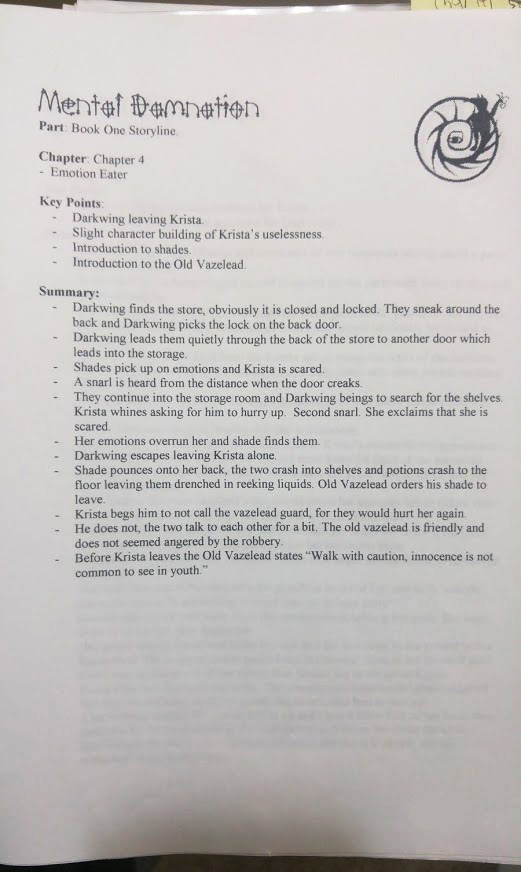
In the photo below (click to enlarge), you can see a printed off chapter outline for the original Chapter 4 – Emotion Eater found in Mental Damnation: Reality. This is an extremely simplified version of a chapter outline. This worked because the chapter itself was short and had only a few key objectives.
Your Exercise
Now that we’ve covered how a chapter outline works, use the template below for your chapter outlines. Copy this into any editor you prefer or print it off:
Chapter title:
Objectives:
–
–
–
Characters:
–
–
Point of View:
Summary:
–
–
–
–
This sums up the 3 part series of writing a novel. There are MANY more topics to cover with writing a book that cannot be covered in 3 blog posts. I hope this does offer some structured direction for writing your novel.
If you have any additional knowledge to how you prefer to plan out a novel, please share in the comments.
The post Want to Write a Fiction Novel? Part 3 – Chapter Outlines appeared first on Konn Lavery.
August 29, 2016
Want To Write A Fiction Novel? Part 2 – Plot Outline
In the previous post, we looked at the premise of a novel. This is a very important step, it doesn’t take a lot of time to do and it can save you a ton of headaches down the road. The post also mentioned to put the brakes on before diving too deep with the writing, wanting you to think broadly. Now, we get to dive a bit deeper and look into the plot outline.
What is a Plot Summary?
Hold on, we’re talking about plot outlines, not plot summaries. Big difference here. You will hear people use this terminology interchangeably but the fact is, they are not the same. The plot outline is a series of points that you make prior to writing the novel. The plot summary is the piece that you write once the book is finished (the synopsis). This should offer you some clarification as to what it is.
Okay, so what is a Plot Outline?
A plot outline is your whole story summarized (ideally in a single page), noting the important plot points in the novel. They come in many shapes and forms. Some are more visual and others are simply bullet lists explaining the storyline in a chronological order. Below is an example of a visual plot outline:
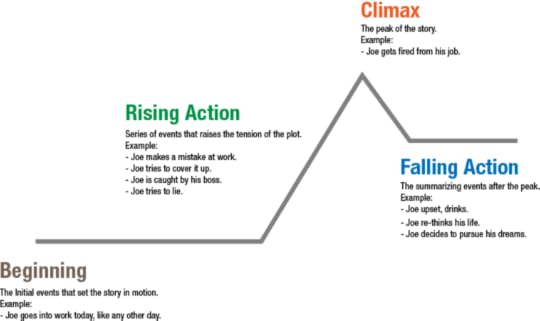
As seen in the diagram above, a plot outline demonstrates the gradual rising action, climax and sudden falling leading to the finalization of the story. This is an extremely simplified example of what a plotline looks like. You can get quite detailed depending on how many sub stories or how complicated your novel is.
Reference Your Premise
Remember that thing you wrote earlier? That comes in handy. Previously we chatted about the one to two sentence statement to summarize your novel and spark new ideas. These ideas might be “who the antagonist is” or “who are the supporting cast in the story”. Now is the time to look at your premise and start asking questions about what it does not answer.
Linear Storyline vs Narrative Storyline
Your story might jump forwards and backwards in time to create mystery or tension. Your story may be told through a limited narrative format making the readings unaware of certain events until later in the book. This creates the differentiation between the linear storyline and the narrative storyline.
Linear Storyline – This is the chronological string of events that happen throughout the story. These events might not be revealed to the reader in the exact format that the narration follows. For example, there may be events A, B, C and D that happens but the reader learns about the events in the order of C, A, B and D. This creates mystery and a wonder of how the events from the beginning lead to the end.
Narrative Storyline – The narrative storyline is the version of the story told to the viewers. As mentioned above, the reader might be place at the end of a series of events and be baffled as to how this outcome came to be. An example would be an opening scene of several characters gunning each other down and not knowing the outcome until they read through the whole story.
How Do I Write a Plot Outline?
Your plot outline should focus on the Narrative Storyline that the novel follows. If you have sub-plots, or a Linear Storyline of events, it would be useful to note them in the Plot Outline but create a separate plot outline sheet about them for further detail.
You want the plot to increase gradually, building suspense for the reader, until the story’s primary climax is reached. What is the grand event that the readers have been waiting for?
The Initial Event and Its Rise
This is the start of the incline. The hook, also the most challenging aspect of a book. After you have defined the set up, you will want the story to gain momentum. What causes the story to be interesting? How does the book draw your readers in?
This is known as the Rising Action.
You could use the method described earlier with Linear Storylines vs Narrative Storylines technique or propose an interesting scenario where the protagonist and the Linear Narrative are in synch, leaving the remainder of the plot a shroud of mystery.
Recall the diagram initially shown? Use this as starting point where the template points note the general direction of a plot with Joe starting a regular day at his job, makes a mistake and tries to cover it up.
Download a blank template for your plot outline to print off.
The Climax
This is the peak of your plot rise. The prime tension of the story that you have been building up to. In the example, Joe is ultimately fired from his job. Oddly enough, you may come up with this point of the story prior to the previous events. That is fine, writing is not a linear format. The creative process jumps from all points and does not follow any set formula.
To summarize the climax, it should be the great conclusion of the overall book’s plot. Sub plots should be concluded at this point (unless you want to leave them open for sequels). The protagonist generally needs to make a daunting decision or has to overcome unbeatable odds to reach their goal. In this case, Joe has to accept the fact he tried to cover up a mistake and move on.
The Decline and Resolution
After the climax there needs to be some closure. A sudden break isn’t fair to the reader (it’s like a text message breakup, not fair). Give the reader some explanation to the peak of the story. In the example, Joe is update but concludes he should follow his dream.
Additional Thought
Plot Outlines come in many forms and this might not be the exact format for you. For my plot outlines, I simply use a bullet list that shows a series of events that leads to the end, it is not quite as visual as the traditional plot outline but that is the method that I have grown to prefer, mostly for its simplicity.
Your Exercise
With the gradual incline, climax and decline method, use the template provided to come up with a plot outline. This may take several iterations and reviewing. Work on it until it shapes into a generic direction of where you want your plot to go. We’re still seeing the story from an overarching view and not focusing too hard on details.
Write your plot outline and keep it for the third part of this series, where we dive deeper into the process by focusing on chapter outlines.
Not sure where to go from here? Or wanting to look for some inspiration? Clarify in the comments and we can chat about it.
The post Want To Write A Fiction Novel? Part 2 – Plot Outline appeared first on Konn Lavery.
August 26, 2016
Seed Me Signing at West Edmonton Mall
Following the events of the August book launch at Happy Harbor Comics, I’ll be heading over to West Edmonton Mall Chapters for a signing of Seed Me. Drop in for a meet & greet the author, artwork, the World Mother score, tshirts, and of course, the books themselves.
When and Where:
Saturday, September 10th from 11:00am – 4:00pm
Chapters – West Edmonton Mall
8882 170th, Edmonton, AB T5T 4M2
Mark your calendars.
The post Seed Me Signing at West Edmonton Mall appeared first on Konn Lavery.
August 24, 2016
A.F. Stewart Discusses Writing Speculative Fiction
This month’s guest author is A.F. Stewart who has a history of writing fantasy, sci-fi and horror novels, along with poetry. Her work has been published in various anthologies such as Beyond the Wail, Legends and Lore and Mechanized Masterpieces from Xchyler Publishing. She has kindly agreed to join us in discussing the broad Speculative Fiction genre and offering some of her insight.
Thanks for joining us A.F. Stewart, to start, tell us a bit about who you are.
I hail from Canada, and lead a very boring life. No great adventures for me unless you count doing the grocery shopping. I split my time between the everyday of life and my sessions of hunt and peck at the computer to write my books. To date, I’ve published several collections of short stories, a few novellas, and four volumes of poetry.
To relax, I like reading (of course), watching TV shows and movies (especially the show Supernatural, action movies, and good sci-fi), and I practice art as a hobby. I love geeky collectables, and have a mild obsession with scarves.
What got you into writing?
I’ve always been writing, since my little fingers could hold a pencil as a child. Stories, poems, even an ill-conceived attempt at songwriting, ideas have been binging about in my head for as long as I can remember (maybe even longer).
Speculative Fiction is an umbrella term for a number of genres, what is your favorite one to write?
My favourite one to write is fantasy, possibly because it’s my favourite genre to read, but I think I may do my best work when I write horror. That’s probably why so many of my stories lean to the dark side, even when they are in other genres. Fantasy though, is where my heart lies, flying with the dragons, conjuring spells, going on quests with your sword at the ready.
What was the first book that you wrote?
A very bad attempt at a Harlequin romance novel, which will stay forever hidden from the world. It was a learning experience, though. It taught me I truly suck at writing romance novels. Magic and mayhem, that’s my specialty.
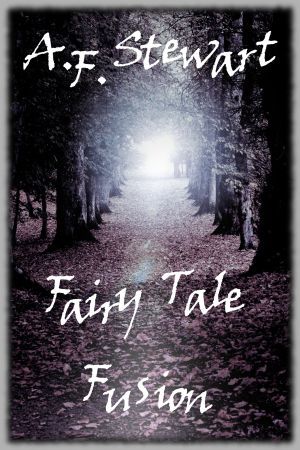
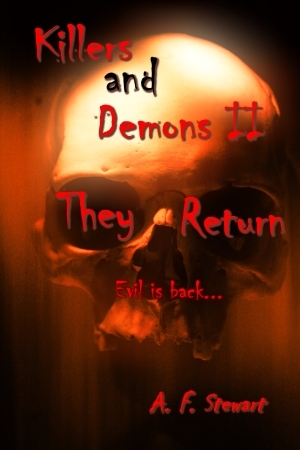
Two of A.F. Stewart’s novels.
Something I always ask authors – what made you choose self-publishing?
I started way, way back at the beginning, when self-publishing was just starting to take off (back even before Createspace and Kindle). It seemed to me a great way to test the waters so to speak, to see if readers liked what I wrote, or if I my work was totally irredeemable. I published my first book of poetry, and a book of short stories to favourable reception, and kept on going.
You’re published in a number of anthologies, what were the first steps you took to be a part of your first anthology publication?
I love short stories, reading and writing them, so getting involved in anthologies had to happen for me. I started with self-publishing collections of my own stories, and did a collaborate anthology freebie with some writer friends. But the first small press, multi-author anthology came about due to my budding interest in steampunk. I had been toying with the idea of writing a steampunk story, and then I saw the call from Xchyler Publishing for Mechanized Masterpieces. They were asking for submissions that combined steampunk and classic literature, a tailor made combo for me. So I took a chance, wrote and submitted Our Man Fred, a clockwork spy tale staring Scrooge’s nephew from A Christmas Carol. To my surprise they accepted it. I’ve since had two more stories published in their anthologies, plus a few in the Christmas Lites series, and some others as well.
Where do you find inspiration for your stories?
I wish I knew. (Then I could bottle it and sell it. Ready-made story inspiration only 2.99.) Really, anything can trigger an idea in my head: something I overhear, an online article, a photo, even a sound. I once got a story idea washing dishes and listening to the noise of a plane flying by. My mind is a strange place.
Do you find writing short stories easier than longer ones (say 60,000 words and up)?
In a word, yes. Short stories have far less plot to figure out. Not to mention no pesky subplots, or dangling loose ends to weave into the storyline. Novels are richer in scope, but definitely harder and more complex to write. And getting a short story just right, twisting it in that perfect way, that is a particularly fine satisfaction. Plus, it’s easier to kill off characters in short stories, as you don’t get so attached.
What do you currently have in the works?
Many, many things. I’m currently compiling a horror poetry book to be published in October for my annual Halloween celebrations. I’m also finishing the first draft of my seafaring fantasy novella, Ghosts of the Sea Moon; that should be done in the next few weeks and ready for publication by the end of the year. Plus, I’m working on The Duke’s Assassin, the first novel in my steampunk horror series, and writing The Prophecy of Seven, the first book in my new epic fantasy series. And I have a steampunk adventure novel, Racing the Hellfire Club, ready to begin editing. Oh, I also have some short story collections kicking around in various stages of completion, and a book series planned to continue the adventures of my Camelot characters from the story Grail Days (found in the Legends and Lore anthology).
Thank you again A.F. for joining us to chat about your experience and the various genres you write in.
You can find A.F. Stewart’s latest updates on her blog at afstewartblog.blogspot.ca. You can also find her work on Amazon.
A.F. Stewart is also active on the following social sites:
The post A.F. Stewart Discusses Writing Speculative Fiction appeared first on Konn Lavery.
August 16, 2016
First Time at When Words Collide
This year I had the opportunity to go to When Words Collide in Calgary, Alberta. For those that do not know, it is a yearly non-profit festival that is all about writing. This means writers, readers, agents, editors and publishers alike come together to share, learn and discover literary for a full weekend.
I had initially learned about the festival a year ago when I was having a book signing at the Sentry Box. They were kind enough to inform me about the festival and as soon as tickets went on sale, I got mine!
The reason for my rush is, to my knowledge, there are very few writing conventions here in Western Canada and I wanted to guarantee the chance to go. The only other convention I am aware of is Star Fest in St. Albert. Please correct me if I am wrong though, I would love to join more.
The Arrival at When Words Collide
While driving down from Edmonton, I kept thinking to myself: What can I expect?
I have gone to a number of comic conventions and could get a rough idea what I’d experience but didn’t fully grasp it fully until I arrived. Once I obtained my badge, program guide and schedule, I was in awe at the amount of options available throughout the day. There were a good 10-11 programs going on at any one time. Unfortunately there was only one of me and I had to pick and choose what to do.
The Objective
The intention for the weekend was to meet fellow authors and learn new techniques on reaching readers. Writing is a very isolated craft and meting people in the industry has been a challenge for me. I also wanted to find ways to broaden my reader base in the online world, eBooks specifically.
These were the primary goals for the weekend and it was not a letdown. I connected with many authors through events like the “Writer’s Speed Mingle” and obtained pages worth of notes from great panels on all three days at the festival.
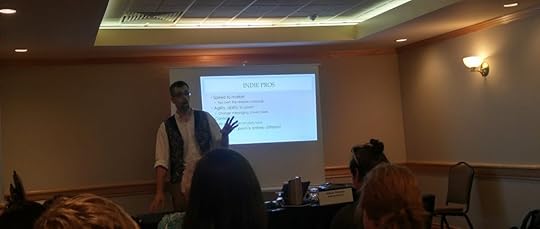 Adam Dreece on Indie Writing
The most valuable information happened to be the theories that I learned from the panels, workshops and in casual conversation from other writers. Every author has had a different experience with their writing, even though we often go through the same struggles and emotions. Hearing their feedback and how they tackle situations was well worth the travel on its own.
The Reading
Another great aspect of When Words Collide was the opportunity I had to share my new novel Seed Me. On the Saturday I partook in a 10 minute live reading of the novel. It was a fantastic opportunity to be able to share the book with a fresh set of ears. The audience and other readers were all supportive of each other and it gave us all a chance to fine-tune our reading skills.
Wrapping Up and Heading Home
Throughout the weekend I was rejuvenated with the writing spirit. The three days flew by and it was over before I knew it. The ability to introduce myself to new authors, connect with previously established relationships, and plan for the future made it an amazing experience. What I enjoyed was the fact it provided an even playing field for all writers, indie or published, new or veteran. It didn’t matter, everyone was thrilled to be there for their passion of writing and talked to one another as peers.
I would recommend anyone who has an interest in writing to join in next year. As I mentioned previously, writing tends to be a very isolated experience and it is incredibly insightful to know there are others out there too. Building a network of like-minded people is highly important for any form of success.
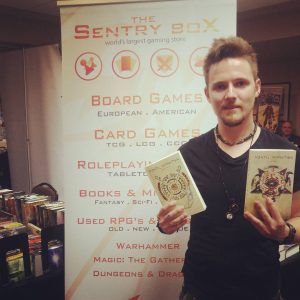
Hanging out at the Sentry Box booth.
The post First Time at When Words Collide appeared first on Konn Lavery.
August 10, 2016
Want To Write A Fiction Novel? Part 1 – The Premise
So you’ve decided that you want to write a book, congratulations! That’s a big commitment. Do you already know what your book is about? If you have this one figured out then you are off to a good start. Or perhaps you have always enjoyed writing but have never been able to piece together the necessary components to make a full manuscript. Maybe you got a great scenario or concept but nothing seems to piece together beyond that. So, that leads us to the big question, where do you begin writing a novel? One words for that:
Premise
The premise should be the very first step when it comes to working on a new novel (or any literary piece for that matter). To summarize it in the simplest terms:
The premise is your novel’s setting, the protagonist and the challenges and or desires that they face.
It is the foundation of your whole book. Ask other writers from any field, it is highly recommended to define a premise before you dive into the writing. Trust me, it will save you a ton of headaches down the road. Even if you hash out a rough version as a guideline that no one else sees.
Already have a premise in mind? Great, then the next thing to do is get it out of your mind and onto some paper (or a digital document). Scribbling the idea down so you have it in reality, it is the first stepping stone of many to come.
If you don’t have a premise in mind, it is time to flesh one out. This is a lot more challenging than it seems and there is a chance your premise will change over time while you develop the plot. Your premise doesn’t need to be overly complicated either, it can be as simple as a couple of sentences or as long as several paragraphs. I wouldn’t recommend going much further than that, if you do, it basically becomes your plot outline or possibly your first chapter. Keep it short and direct.
Your premise is the plot from a 5,000 foot view.
To further support the statement above, your premise can be composed of three main components, The Setting, Protagonist and their desire(s):
The Setting – Where does your novel take place in? Is it modern times? The future? Another dimension with talking roadkill? Another way to look at it is – what type of stories do you like to read? Make that your setting.
The Protagonist – Who is your primary character? Where do they fit into the setting? Why are they here?
The Protagonist’s Desire – What drives your protagonist? Are they seeking revenge? Are they wanting to bring goodness back into the world or perhaps they have a deep rooted lust that they are wanting to fulfil with another character.
The protagonist as a whole is a much larger topic that we will go over in another post. You can find some insight into character development from the “Defining a Character” series that I had written previously. These three components can open a whole can of worms for ideas. The protagonist’s desire can spark the idea of who the antagonist is. The setting can define the protagonist’s supporting cast. However, for the premise, think short and simple. Remember, you want to summarize this in one to two sentences.
Your Exercise
To practice, try creating three different, one to two sentence premises. Don’t worry, you don’t have to write three full novels based on these premises if you don’t want to. The idea behind this exercise is to think big and broad. Make these premises as dramatic, ridiculous or as serious as you’d like.
Share these premises in the comments if you’d like some thoughts on them.
There are many online resources if you want to dive deeper into what a premise is. Some links that may be useful to you are listed below:
The Premise of Your Story
How to structure a premise for stronger stories
Story Concept and Story Premise: Do You Know the Crucial Difference?
Keep watch for part two where we will dive deeper into shaping your story with plot outlines.
The post Want To Write A Fiction Novel? Part 1 – The Premise appeared first on Konn Lavery.
August 2, 2016
Unprocessed Thoughts – August
Summer is here, meaning more time outside is needed. Hence in the month of July I was rather vacant. Plus, with the launch of my new novel Seed Me I haven’t had a lot of time to spend on blogging. A lot of it has been spent on social media promotional posters, contacting media for press releases, novel/eBook reviewers and agents. Yes, the last one is also true, I’ve decided I’d take the next step with my writing and find a literary agent.
Welcome to another edition of Unprocessed Thoughts.
Initially I went on the self-publishing path because I was against finding any outside help in fear of lack of control over my work. It was very D.I.Y. and quite frankly a little naïve. After releasing four books, introducing myself to authors in person and online, I gained enough experiences and feedback within the industry to figure out where I want to go with writing.
“So what is that?” you might be asking. Ultimately I’d like to sell more books to be self-sustaining on just writing as is every author’s dream. To get there, I’ve decided I can’t wear all the hats that are required. The writer, the cover/book formatting designer, the promoter, the salesman, the marketing manager, etc. It’s just too much for one person to be effective at them all. In 2015 I had bought the Literary Guide to Agents and had it collect dust for a good year and a half while I was still writing Seed Me. Now is the time to put it into use. It provided solid advice on building an author platform by having a strong online presence. This can attract agents when you submit queries to them. It makes sense, everyone does background investigation on Google in today’s society. Those initial search results are an important first impression… and that’s where July went.
Oh, also, on the last weekend of the month I attended Western Canada’s only Industrial music festival, Terminus: Gravity. It was a much needed get-away with new friends, old friends and blaring tunes.
A video posted by Konn Lavery (@_konnartist) on Jul 31, 2016 at 1:50pm PDT
The highlights were seeing the bands 16 Volt, Hate Dept. and my home town, Edmonton’s Strvngers.
Moving forward into August, looking like another busy month. I will be attending the When Words Collide. Here’s their official description:

When Words Collide is an annual non-profit festival designed to bring readers and writers together in a celebration of the written word. Up to 10 tracks of programming, beginning at 1 PM on Friday and running through 5 PM Sunday, offer informational, educational, and social activities covering a wide spectrum of literature including Mystery, Science Fiction, Fantasy, Romance, Historical, Literary, Script-writing, Poetry, Comics, and Non-fiction. Roughly 650 readers, writers, editors, publishers, agents, and artists attend with over 200 presenters in our program.
I am very excited to be attending and will be giving a 10 minute pitch reading of Seed Me at the event.
Shortly after When Words Collide I will be having the official launch of Seed Me at Happy Harbor Comics with a live reading and physical copies of the novel and score.
While all of this is going on, somewhere in there, I will be finding time to write the next novel (what could it be?).
The post Unprocessed Thoughts – August appeared first on Konn Lavery.
July 15, 2016
Seed Me Now Available!
I am pleased to say that after two years in the works, Seed Me is finally available for order! The Edmonton-based horror story has gone through a number of revamps and has pushed my creativity to its limits. Glad to finally “close this chapter” is a good figure of speech. Hope you all enjoy it as much as I did working on the book. Please share with your friends and if leave a review if you’d like.
Observe through the eyes of Logan, who is obsessed in trying to uncover who is behind the famous 4-20 Drain Murder after his ex-girlfriend was murdered. He and his friends struggle to find answers while dealing with drug addiction, the living dead and being stalked by cultists.



The post Seed Me Now Available! appeared first on Konn Lavery.
July 5, 2016
Vince Seim epic fantasy author of Heaven, Hell & Humanity
This month’s guest author is Vince Seim, the creator of the Heaven, Hell & Humanity series. Vince and Chance Clark – the illustrator – and I met at the Calgary Comic Expo. I saw their booth covered with prints, bookmarks and the book series themselves. The epic-fantasy novels were an impressive size, the spine had to be about 2 inches thick and around 160,000 words, something that you do not normally see at conventions. We struck up a conversation about our writing practices and the joys and struggles of self-publishing.
Vince, thank you for joining us. Tell us a bit about yourself and the Heaven, Hell & Humanity series.
I am the writer and creator of the H3 Trilogy, and my counterpart, Mr. Chance Clark, is the Visual Merc, the artist who does the covers and prints to bring the characters into being. The trilogy has been the conclusion of six years worth of writing, rewriting, editing, and major revamp. After the endless tweaking, we have begun the epic tale of Heaven, Hell, & Humanity.
The premise of our series is that Earth is a prison world for the High Heavens. Dissident angels are stripped of their powers and immortality, being cast down. Over centuries, two factions form out of the beliefs of redemption and vengeance. The kingdoms of Humanity are trapped within the midst of the conflict.
Our first book, A Mortal Mistake, revolves around the impact of actions and beliefs, upon ourselves, our family & friends, and even those we do not know. Primarily the effect of our mistakes. The sequel, A Fallen Redemption, focuses upon the desire and need for redemption.

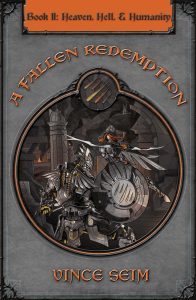
Six years is a long time! How did you first get into writing?
Cliché as it may sound, I have been writing for as long as I can remember, always using my robust little imagination to create stories. The H3 trilogy is the culmination of decades of my story ideas to be utilized into character driven adventures within a complex world. I am a visual person and the book is also my way of painting these characters and environments. As I could not draw the images within my head, not to the level to do them justice, I chose the path of writing the story and leaving the art to Mr. Clark.
You work with illustrator Chance Clark who draws the characters and creatures found within the series, what made you want to include drawings with your writing?
The decision to ask Chance to draw the characters came upon seeing his initial sketches for the first book cover. From my original sketches to Chance’s finished Sven character, with his attention to detail and the thought process that went into the character, I knew I had to convince him to come onboard. With the world and characters we created, we wanted to have an avenue that may appeal to those who do not enjoy reading or enjoy distinct visual reference of the characters they are reading about. The art allows people to appreciate what we are creating and adds a level of depth within the story itself.
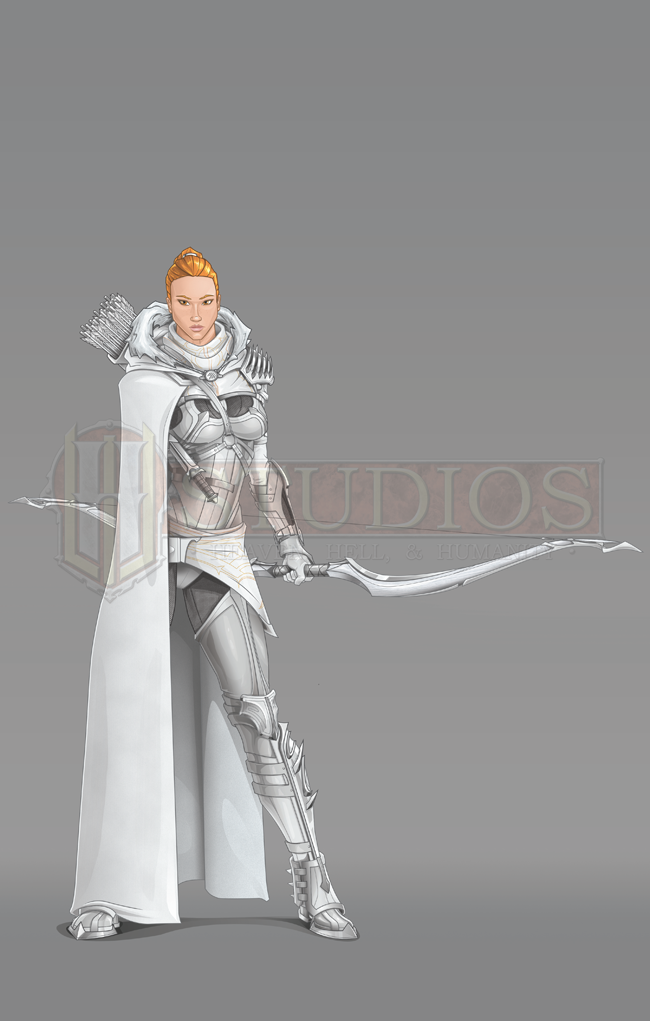
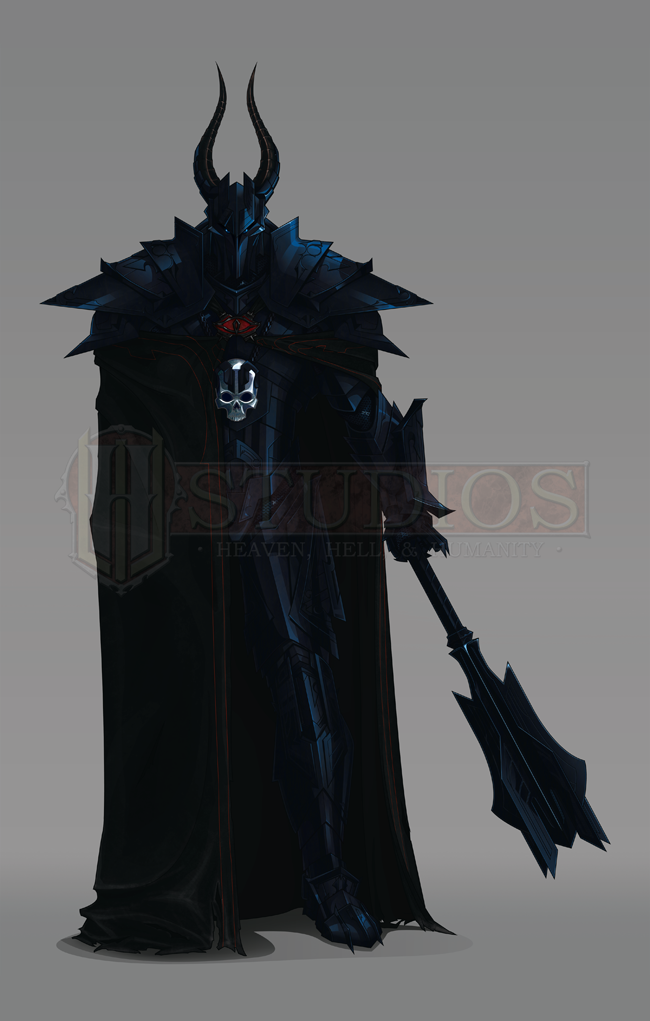
Tell us a bit about the process you and Chance have with coming up with characters and the lore of the story.
While a lot of the characters and story lore were already created, everything has also evolved as the story has progressed. We use each other as sounding boards for ideas and concepts. The ability has allowed stronger ideas and concepts to grow, as well as questioning towards those already implemented. Chance adds a visual strength to everything we do with his extremely high level to detail.
What were your inspirations to get into writing and have you done other types of writing beyond fantasy?
Amongst my wide taste in reading, I have always enjoyed historical novels but sci-fi and fantasy the most. I love them for the creativity that is afforded within the genres. When writing my own, that aspect allowed my imagination to go to whatever depths it desired. As such, we can create something truly unique that is very much our own.
Most new novels tend to be around 60,000 words, the H3 series is well beyond that. What was the thought process behind the sizing?
The size was merely a product of story and character depth. For a first time author, choosing the intensive epic story was ambitious and taxing, but we also write what we enjoy. I enjoy multiple characters and story arcs that add to the complexity of the story. Ultimately, this also adds to the size of the book.
What’s your biggest challenge being an author?
The biggest challenge, is perhaps the marketing and connecting with our audience outside of the obvious finances of self-publishing. While it is a very popular and widely read genre, there are a large number of fantasy novels out there. We believe our use of angels and demons within a fantasy fiction is something unique, but it in itself poses difficulties. Creating something new and different, it can sometimes take quite a bit to pique a person’s interest enough to stray from their norm or expand their area of intrigue.
Do you have any other books planned after the trilogy?
Our story and world is designed to extend far beyond the Heaven, Hell, & Humanity trilogy. In order to provide the depth we desired, the lore has been already created so the overall story aspects of sequel and prequel trilogies are in place. However, we have also discussed the possible writing of standalone character stories. Closer to the 80,000 words instead of our epic 185,000. This is all, of course, success permitting to explore our already established lore.
Any final thoughts to share?
Although very demanding and intensive, I would encourage anyone to pursue their imagination in whatever their medium. Let your passion for creating your own genuine stamp of creativity fuel the journey. We also appreciate you taking the time to visit and look forward to catching you at a future shows!
Thank you Vince for joining us for this month’s blog post! You can find Vince’s work at his website vinceseim.com or on Amazon, Facebook or Twitter.
The post Vince Seim epic fantasy author of Heaven, Hell & Humanity appeared first on Konn Lavery.
Posts from konnlavery.com

- Konn Lavery's profile
- 156 followers

