Michael Brookes's Blog, page 11
December 4, 2016
Tau Ceti Mission - 01.08.2648 - Swing Low
 Image credit: http://point-of-no-23.livejournal.com...
Seb makes a discovery in his latest report from the Venti probe as it travels deeper in to the Epsilon Indi system:
http://www.taucetimission.com/2016/12/01082648-swing-low.html


Cthulhu Chess Set T-shirt from Old Ones Productions
 Insanity is your opening move with this Cthulhu chess set t-shirt from Old Ones Productions.
Available in unisex sizes small to XXXL.
Original artwork by Luciana Nedelea.
https://oldonesproductions.com/collections/frontpage/products/cthulhu-chess-set-t-shirt
November 27, 2016
Book Review - The Mephistophelean House by Benjamin Robert Carrico
I loved the idea for this story, and it's a different take on the Faustian story. It's one of the classic tales of a bargain with hidden dangers, and making it part of the construct of the house worked well. It's told in an immediate and compelling manner, although this isn't even throughout the book.
For certain periods it seems to lose it's way, but that's only for certain parts, it's mostly well written and a solid horror tale. Part of the problem is that the pacing isn't balanced. It starts well, and then dips and rises in an odd fashion. This most notable towards the end.
For me this was the weakest part of the book. The run to the conclusion worked well, with a descent into madness with a dark Alice in Wonderland feel. And then it's over. Without warning it just finishes. The nature of the ending was fine, and made sense in the context of the story. It's handled in such an abrupt manner that it feels hollow.
Which is a shame as it's a decent story, and for the most part well written. A little more development would have elevated it to something much stronger.
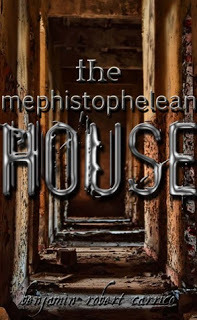
The Mephistophelean House is the sort of House you might miss driving by, nondescript, unremarkable, indistinguishable from all the other houses on the block. At the top of the stairs is a grim little room with a curious double hung window, and inside the room is an abnormal closet that leads to a windowless chamber. But when Matthew and Ben find a hole in the flue, upside-down numbers on the wall, and a porcelain angel missing its eyes, they quickly discover the contract they signed has a clause that can never be broken...
Click here to buy The Mephistophelean House from Amazon
For certain periods it seems to lose it's way, but that's only for certain parts, it's mostly well written and a solid horror tale. Part of the problem is that the pacing isn't balanced. It starts well, and then dips and rises in an odd fashion. This most notable towards the end.
For me this was the weakest part of the book. The run to the conclusion worked well, with a descent into madness with a dark Alice in Wonderland feel. And then it's over. Without warning it just finishes. The nature of the ending was fine, and made sense in the context of the story. It's handled in such an abrupt manner that it feels hollow.
Which is a shame as it's a decent story, and for the most part well written. A little more development would have elevated it to something much stronger.
The Mephistophelean House is the sort of House you might miss driving by, nondescript, unremarkable, indistinguishable from all the other houses on the block. At the top of the stairs is a grim little room with a curious double hung window, and inside the room is an abnormal closet that leads to a windowless chamber. But when Matthew and Ben find a hole in the flue, upside-down numbers on the wall, and a porcelain angel missing its eyes, they quickly discover the contract they signed has a clause that can never be broken...
Click here to buy The Mephistophelean House from Amazon
Currently Reading - World War Cthulhu by Brian M. Sammons and Glynn Owen Barrass
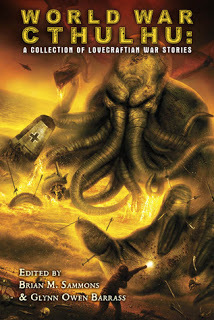
The world is at war against things that slink and gibber in the darkness, and titans that stride from world to world, sewing madness and death. War has existed in one form or another since the dawn of human civilization, and before then, Elder terrors battled it out across this planet and this known universe in ways unimaginable.
It has always been a losing battle for our side since time began. Incidents like the Innsmouth raid, chronicled by H.P. Lovecraft, mere blips of victory against an insurmountable foe. Still we fight, against these incredible odds, in an unending nightmare, we fight, and why? For victory, for land, for a political ideal? No, mankind fights for survival.
Our authors, John Shirley, Mark Rainey, Wilum Pugmire, William Meikle, Tim Curran, Jeffrey Thomas and many others have gathered here to share war stories from the eternal struggle against the darkness. This book chronicles these desperate battles from across the ages, including Roman Britain, The American Civil War, World War Two, The Vietnam Conflict, and even into the far future.
Table of Contents
Loyalty by John Shirley
The Game Changers by Stephen Mark Rainey
White Feather by T.E. Grau
To Hold Ye White Husk by W.H. Pugmire
Sea Nymph’s Son by Robert M. Price
The Boonieman by Edward M. Erdelac
The Turtle by Neil Baker
The Bullet and the Flesh by David Conyers & David Kernot
Broadsword by William Meikle
The Ithiliad by Christine Morgan
The Sinking City by Konstantine Paradias
Shape of a Snake by Cody Goodfellow
Mysterious Ways by C.J. Henderson
Magna Mater by Edward Morris
Dark Cell by Brian M. Sammons and Glynn Owen Barrass
Cold War, Yellow Fever by Pete Rawlik
Stragglers from Carrhae by Darrell Schweitzer
The Procyon Project by Tim Curran
Wunderwaffe by Jeffrey Thomas
A Feast of Death by Lee Clark Zumpe
Long Island Weird by Charles Christian
The Yoth Protocols by Josh Reynolds
Click here to buy World War Cthulhu from Amazon
November 26, 2016
Five to Five Thousand Challenge - Darren Grey

Darren Grey is a writer and computer game designer, and is currently writing for upcoming sci-fi game Jupiter Hell (www.jupiterhell.com). During daylight hours he also works as a Research Programme Manager for the Alan Turing Institute, the UK’s national institute for data science. You can find his games and writing at www.gamesofgrey.com.
In Five Years
In the Information Age the fastest thing that changes is the way we communicate and the tools we use to do so. Many of the apps and programmes we use right now will be extinct, whilst new tools arise and become ubiquitous with tremendous speed.
Automation will increase, with computers being in charge of much more of our lives. Driverless cars will become a widely accepted phenomenon, though still rare, and we’ll start seeing fervent debates when buggy cars kill pedestrians. Digital assistants like Siri and Cortana will become far more intuitive and many will begin to rely on them. Ultimately we will learn to trust the digital controllers of our lives much more than other humans.
The technology giants will grow, manufacturing jobs will become even scarcer, and we will continue to raid every resource on the planet to fuel our digital desires.
In Fifty Years
AIs will become commonplace, but not as the evil automatons depicted in movies. They will be targeted pieces of software, only able to make decisions in specific constraints, such as AI doctors providing medical diagnoses. Every gadget we own will have some form of artificial intelligence at its core, each one far more powerful than the greatest AIs we currently possess. The AIs of 2016 will seem as backwards as the computers of 1966 seem to us now. Future AIs will advise us what to wear, what to eat, inform our movements, our careers, our childraising and every other aspect of our lives, grand and small. Children growing up in this time will see them as indisputable natural forces.
Inequality in society will be rife. Automation across a range of industries will eliminate many labour markets. The middle class will be composed of those in the service industries, or those who can code or design machines. The lower classes will be destitute, heavily reliant on the state to get by. The software corporations will be insanely rich, and will underpin every other industry in operation as software ultimately controls every process in the world.
Inequality will lead to social strife and political upheaval. But the politicians will be powerless to change the haves and have-nots in a world that so perversely rewards those at the top. Some governments will begin turning to AIs to control the economy and other central functions, making politicians increasingly irrelevant. Perhaps eventually democracy will become a form of inputting variables into AI systems that know much better than us about how to run the world.
The developing world will suffer the most, as it always does. In the chaos Africa will be raped of its resources whilst puppet governments oppress the people. No one corporation or country will be responsible, and no one with power will ever be brave enough to try and disrupt a system that is so profitable for so many.
In Five Hundred Years
The Solar System will be awash with activity, yet only a few thousand people will ever have left Earth. Machines mine the asteroids and moons for resources, automatically funnelling back important materials to Earth. Using humans for this would be dangerous and expensive. A few rich people take tourist trips out to some pretty sights, but even that is not popular as it is time-consuming and uncomfortable. There are some permanent domes on Mars, but only a tiny few will choose to live their lives there.
Society will have calmed after the previous tumultuous years following the economic collapse of India and China. AIs have designed more stable systems of rule for us, ensuring we are kept happy and sane. Universal pay keeps the masses content, whilst an enterprising few play with trying to advance humanity further.
For the first time in its history the human race will begin to decline in numbers, after reaching 20 billion. Though there is plentiful food through agricultural advances, and little disease to kill us off, there is also very little motivation to procreate. People take much longer to emotionally mature, and often don’t form lasting relations with partners (if at all) until no longer fertile.
There will be much art and philosophy and science, and some will call it a golden age, but many will also worry for the future of the race as a whole. Climate change, after all the horrendous damage it caused, will be brought under control, yet the risk of other extinction events will still be present. A few exoplanets will have been visited by machines, and with robots now building bases on other planets it will almost be time to send a human expedition.
In Five Thousand Years
Humanity will have spread to the stars, and yet will have barely left a footprint. Machines will always be one step before us, spreading with minimal need of resources and replicating themselves wherever they go. Perhaps a true AI will be born in this time, but I think they will be smart enough to stay unnoticed by humans and will strike out on their own journey through the stars.
Our population will have crashed, with the majority of people no longer choosing to have children. Everything we relied on people to do can now be filled in by machines. We are completely independent from each other.
The human race will have made great scientific advances, and journeying between stars will become easier. Yet it will still be difficult, and the rewards for doing so will feel hollow to all but a few. An empty depression will sink over much of the species, a feeling of both stagnation and impotence - masters of our own world, yet so feeble to truly reach to the galactic scale, and as far as ever from understanding any real meaning to our existence.
Either we will slowly fade into a forgotten people, superseded by the AIs we created, or we will take the drastic step of changing who we are. Through a mix of genetic manipulation and machine augmentation we will stop being human, and in doing so open up vast new potentials for whatever species we become.
Book Review - Saturn's Children by Charles Stross
This was a fantastic read, which came as a bit of a surprise as I didn't get on with the few pieces of his that I'd read before. Now I will need to read more of his work. For me good science fiction involves big ideas, it is more than simply setting or technology. This book takes the idea of humanity's legacy once we no longer exists.
The author takes this premise and develops into a rich world. Before our demise we developed robots in our image and they permeate every part of life. After humanity's extinction they continue to live and operate throughout the solar system. The setting is well thought out and contains some fascinating ideas. There are some familiar ideas here, but they are expressed in a refreshing way.
A book needs more than just a decent setting and the lead character draws you through a fast paced plot. Freya is intricately developed, and her construct as a defunct concubine designed for human interaction, in a non-human world provides an interesting contrast. The concept of the multiple existences through the soul chips also creates some unexpected scenarios.
The story is strong, and evolves in some refreshing ways. There's serious consideration of the science involved, and while this is handled without becoming a major barrier to reading. I prefer my sci-fi reads to have a solid foundation, and that's certainly the case here.
Final mention should also be made about the author's writing. In fairness my issues with previous books weren't down to the quality of his prose, and it was a major factor in enjoying this book. The dialogue in particular stands out, but I also appreciated how easily he tackles complex topics, without getting bogged down. This is a damn fine sci-fi read, and one well worth checking out by any fans of the genre.
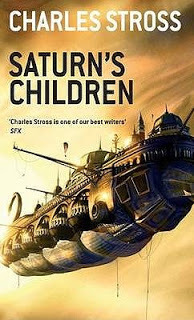
Freya Nakamachi-47 has some major existential issues. She's the perfect concubine, designed to please her human masters - hardwired to become aroused at the mere sight of a human male. There's just one problem: she came off the production line a year after the human species went extinct.
Click here to buy Saturn's Children from Amazon
The author takes this premise and develops into a rich world. Before our demise we developed robots in our image and they permeate every part of life. After humanity's extinction they continue to live and operate throughout the solar system. The setting is well thought out and contains some fascinating ideas. There are some familiar ideas here, but they are expressed in a refreshing way.
A book needs more than just a decent setting and the lead character draws you through a fast paced plot. Freya is intricately developed, and her construct as a defunct concubine designed for human interaction, in a non-human world provides an interesting contrast. The concept of the multiple existences through the soul chips also creates some unexpected scenarios.
The story is strong, and evolves in some refreshing ways. There's serious consideration of the science involved, and while this is handled without becoming a major barrier to reading. I prefer my sci-fi reads to have a solid foundation, and that's certainly the case here.
Final mention should also be made about the author's writing. In fairness my issues with previous books weren't down to the quality of his prose, and it was a major factor in enjoying this book. The dialogue in particular stands out, but I also appreciated how easily he tackles complex topics, without getting bogged down. This is a damn fine sci-fi read, and one well worth checking out by any fans of the genre.
Freya Nakamachi-47 has some major existential issues. She's the perfect concubine, designed to please her human masters - hardwired to become aroused at the mere sight of a human male. There's just one problem: she came off the production line a year after the human species went extinct.
Click here to buy Saturn's Children from Amazon
Currently Reading - Shakespeare vs Cthulhu by Jonathan Green
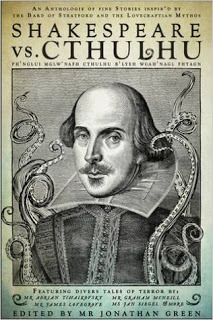
Shakespeare Vs Cthulhu An anthologie of fine stories inspir'd by the Bard of Stratford and the Lovecraftian Mythos Imagine if it had been William Shakespeare, England's greatest playwright, who had discovered the truth about the Great Old Ones and the cosmic entity we know as Cthulhu, rather than the American horror writer H P Lovecraft. Imagine if Stratford's favourite son had been the one to learn of the dangers of seeking after forbidden knowledge and of the war waged between the Elder Gods in the Outer Darkness, and had passed on that message, to those with eyes to see it, through his plays and poetry. Welcome to the world of Shakespearean Cthulhu! To mark the 400th anniversary of the death of William Shakespeare, Snowbooks proudly presents fifteen stories of eldritch horror that blend the Bard's most famous plays with Lovecraft's most terrifying creations. But before you dip into this cursed tome, be warned - that way madness lies...
Click here to buy Shakespeare vs Cthulhu from Amazon
November 21, 2016
Book Review - The Silver Ships by S. H. Jucha
I found this book to be a bit of a contradiction. It starts well with some decent hard sci-fi, showing a well constructed world and some nice ideas. His imagination is the author's biggest strength, in particular he builds a convincing world. That aspect and the technology really shine.
Unfortunately the human side wasn't as strong. The characters are mostly likeable. A bit more depth would have been appreciated to better contrast their origins, and to develop their personalities. However their interactions lack the richness of the technical side. More than that their behaviour is almost always too convenient. There's little personal conflict, and they all seem happy to accept a stranger as their leader with little build up.
This is also reflected in the pacing, and the detail. The science, engineering and space are vividly detailed, but the human interactions zip by without real reflection. It also suffers from the faceless enemy problem. The encounter retains its mystery, although you do learn a taste of what is to come. I'm not quite sure if it's enough to entice me on to the next book in the series.
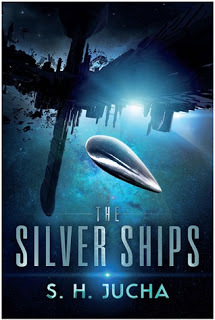
An explorer-tug captain, Alex Racine detects a damaged alien craft drifting into the system. Recognizing a once in a lifetime opportunity to make first contact, Alex pulls off a daring maneuver to latch on to the derelict.
Alex discovers the ship was attacked by an unknown craft, the first of its kind ever encountered. The mysterious silver ship's attack was both instant and deadly.
What enfolds is a story of the descendants of two Earth colony ships, with very different histories, meeting 700 years after their founding and uniting to defend humanity from the silver ships.
Click here to buy The Silver Ships from Amazon
Unfortunately the human side wasn't as strong. The characters are mostly likeable. A bit more depth would have been appreciated to better contrast their origins, and to develop their personalities. However their interactions lack the richness of the technical side. More than that their behaviour is almost always too convenient. There's little personal conflict, and they all seem happy to accept a stranger as their leader with little build up.
This is also reflected in the pacing, and the detail. The science, engineering and space are vividly detailed, but the human interactions zip by without real reflection. It also suffers from the faceless enemy problem. The encounter retains its mystery, although you do learn a taste of what is to come. I'm not quite sure if it's enough to entice me on to the next book in the series.
An explorer-tug captain, Alex Racine detects a damaged alien craft drifting into the system. Recognizing a once in a lifetime opportunity to make first contact, Alex pulls off a daring maneuver to latch on to the derelict.
Alex discovers the ship was attacked by an unknown craft, the first of its kind ever encountered. The mysterious silver ship's attack was both instant and deadly.
What enfolds is a story of the descendants of two Earth colony ships, with very different histories, meeting 700 years after their founding and uniting to defend humanity from the silver ships.
Click here to buy The Silver Ships from Amazon
November 20, 2016
Currently Reading - The Mephistophelean House by Benjamin Carrico
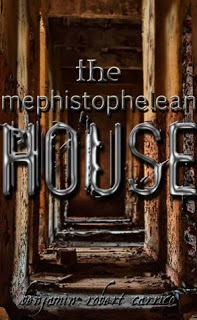
The Mephistophelean House is the sort of House you might miss driving by, nondescript, unremarkable, indistinguishable from all the other houses on the block. At the top of the stairs is a grim little room with a curious double hung window, and inside the room is an abnormal closet that leads to a windowless chamber. But when Matthew and Ben find a hole in the flue, upside-down numbers on the wall, and a porcelain angel missing its eyes, they quickly discover the contract they signed has a clause that can never be broken...
Click here to buy Mephistophelean House from Amazon
November 18, 2016
Currently Reading - Saturn's Children by Charles Stross
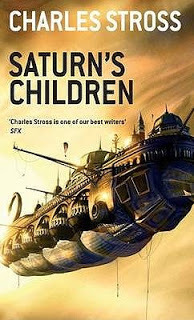
Freya Nakamachi-47 has some major existential issues. She's the perfect concubine, designed to please her human masters - hardwired to become aroused at the mere sight of a human male. There's just one problem: she came off the production line a year after the human species went extinct.
Click here to buy Saturn's Children from Amazon