
A.L. Butcher's Blog, page 127
November 25, 2017
Why I write…
This is my response to post on Mythic Scribes.
The original blogger explained how he would be asked why he bothered to write – it wasn’t his day job, he didn’t make much money from it and it was a lot of effort. It’s a good question.
I get asked similar questions – why do I write? When do I expect to be famous? Wearily I try and explain again. Writing keeps me (fairly) sane, it’s relaxing and because I can’t not write. The stories are there, clamouring to be heard and whether I get them onto paper or the screen that isn’t going to change. I write because I can and I do. It makes me happy, it lets me escape. It lets me create something – and that, as you say, is wonderful. I sell books (not many but I do sell), but I don’t write for the money or I’d have starved long ago.
I’ve always made up stories, worlds and situations. It’s a part of who and what I am. If other people decide to mock it then that’s their problem. I’m not going to stop doing something I love because someone is too foolish or unthinking to think it worthwhile.
I’ve been asked what constitutes ‘success’. I think that’s relative. 6 or so years ago I wrote for myself and a small group of friends, someone convinced me to self-publish and see what happened. I sold a few books, then a few more. It wasn’t the ‘give up the day job’ level but then I never imagined it would be. More importantly whilst I was writing book 1 my mother was suffering from cancer she’d bravely fought for 18 years. It was a long and awful struggle, but she was stoic, courageous and I only heard her complain once. I published book 1 in June 2012 and she died in September of that year. I took a printed copy home to show her, and my disabled father – a man whose world was about to be shattered – and she smiled. Really, really smiled. Mum was pretty much bedbound by then but she got up and went downstairs. She called her mother, my sisters, told the carers, and the neighbours who visited. Despite it all, despite all the pain, and the indignity of her awful illness my book made her happy and proud. That is success.
The comments in the original post disparaging Indie/Self Publishing are interesting. I’ve had that too. Personally, I like self-publishing. It works for me. The deadlines are my own (and thus flexible), I can write what want to write and not what a publisher tells me. OK so all the marketing, editing and cover art is my problem but I know a good editor and several cover artists, plus I am learning some of this aspect.
It’s true there are some shoddy SP books on the market, but there are also some excellent ones. I’ve read plenty of traditionally published books which are crap – badly edited, badly written and should never have seen the light of day! Many self-published authors are extremely meticulous, very talented and dare to write edgier work.
I’d bet that many of the readers who disparage SPAs have read self or indie published work and not realised.
Check out Mythic Scribes.
It’s a very useful resource.
What are your views on this? If you’re a writer – why do you write? If you’re a reader then do you read self-published work.


Reblog – Writing during the holidays

Originally posted on Shannon A Thompson: Most writers aren’t able to write full time. That means we tend to work full time and write full time. Between writing, querying, editing, and marketing, our schedules can quickly feel crushing, especially if you’re working toward a very specific goal, such as a revision deadline. Taking breaks can…
via Balancing Writing During the Holidays — Legends of Windemere


November 21, 2017
Narrator Interview – Danny Letham
*Name: Danny Letham
*Tell us a bit about yourself: Raised on a Scottish moorland farm, I spent much of my adult life in various Scottish and English cities and now live near the North Wales Coast. My work background is software development and systems analysis, specialising in commercial, financial, and manufacturing systems. Born into a musical family whose other stock-in-trade was teaching, I was a mobile deejay in my teens, and these days I can gossip for Britain about many musical genres.
How did you become involved with audiobook narration and production? While I’ve always liked to talk, the impetus came in the form of the usual story: suggestions from friends and relations. I was very aware that merely being the “natural” that those good folks suggested was not enough, and indeed the well-intentioned encouragement might not even have been true. So, from about 2012 onwards I researched and self-trained with the help of Patrick Fraley’s tutorials and a few other sources. Meanwhile, before my wife’s death in 2016 I had gradually withdrawn from the world of I.T. to become her full-time caregiver, and since then I have reinvented myself as a narrator, video maker, and digital artist. I first encountered ACX through Mr. Fraley.
Tell us about some of the titles you’ve narrated. Do you have a favourite amongst these? You’ll have worked out from the foregoing that I have only just taken the plunge. So, for the time being I don’t have much to say here. I have a computer full of material that will never be seen or heard in public, kind of like those early Beatles recordings made in Hamburg. (Dream on, Danny!)
Do you have a preferred genre? Do you have a genre you do not produce? Why is this? I’m a non-fiction kind of a guy really, who aspires to biography, history, the education sector, and corporate reads. I have a high regard for the better fiction narrators and am not averse to characterisation, but not every title is an Agatha Christie mystery and although I have my moments and can run the gamut of SATB timbres (baritone and mezzo are my best) I’m not quite in the same league as David Suchet. What folk tend to overlook, though, is that within the vast tract that is non-fiction there is every bit as much of a need for nuance and sense of scene. Which isn’t to rule out the right novel, of course; never say “never”. That said, I am minded to avoid so-called “Adult” material but I’d not reject an otherwise suitable title just because it had some adult content; however it would have to be very good read. On the other hand, given that I have a well-developed avuncular style for kids’ books there is an obvious conflict, so “Adult” is not a market I would target.
What are you working on at present/Just finished? I have just arrived on Audible as narrator of a kids’ title written by Victoria Zigler, called “Eadweard: a Story of 1066”. That title attracted me partly for its historic interest but significantly also because of its ethic; as a lad who never wanted to be a soldier myself I identified with its busting of the myth. The ten-year-old Danny repulsed by the “It’s a Man’s Life” TV recruitment campaign would have loved that book.
[image error]
Ongoing, from a business perspective I am looking at ethical advertising both in sound and on video more so than audiobooks, but additionally in the medium term I have my eye on a couple of older works which are now in the Public Domain and for which I would assume the role analogous with rights holder as well as that of narrator.
*Tell us about your process for narrating? (Be as elaborate as you like.) Step One is, sample it and improvise reading one or two previously unseen passages. See how it FEELS. That instinct is important, and I try to carry it with me throughout the creative process at the same time as balancing it with self-directing. Next, read the thing end to end; if you don’t do that you can paint yourself into a corner either with a wrong characterisation as the plot unfolds or, in non-fiction, with a compromised counter-argument. Try a few more passages as you go along, and revisit former ones. Note how different the passages you improvised feel when they are re-encountered. Rehearse. Mark the text with cues and emphases while progressing, considering any surprise inflections that might work to keep the audience engaged. Rehearse again. Set milestones. Go on the mic, for no more than half an hour at a time; after that amount of time mistakes will multiply. Avoid becoming a slave to the punctuation, especially if that punctuation is mechanised. Repeat whole sentences or at least clauses where you notice at the time there has been a blooper, without pausing. Then get technical with NR, EQ, and all that stuff. When editing bear in mind that sometimes it’s better to splice than merely to cut. Sometimes there is no option but to overdub, but don’t do that yet. Open a list of overdub requirements. Listen back, repairing any pops or clicks etc, while identifying any more overdubs. Listen again, following the text closely looking for misreads. Rely on it; there will be some, and consequently more overdubs. Each overdub is a miniature run of the “mic NR EQ pop click etc.” cycle. Cry, scream, and yell, when the sound palette of the overdub doesn’t match the main body of your narrative. Rinse and repeat. FINALLY (um, not really finally) submit your Thing Of Beauty. Cry, scream, and yell, some more when the rights holder sends a list of …. overdub requirements! Rinse and repeat. Oh, and that other chap who waves his arms? Me too.
I didn’t mention mixing just now. I always record vox in mono but where music or SFX is involved I will decide based on the specifics of the case whether or not to mix in stereo. If it’s narration only, it stays in mono unless I need to emulate physical activity. However, they never needed a stereo mix in the days of Steam Radio, did they? We have lost a lot these days, with the “live” imperative supplanted by all this tech, and yet I am mindful of babies and bathwater. I prefer to use Adobe Audition. Some freeware is absolutely magnificent, but Audition’s visualisations and its brush and lasso repair tools in particular are all but indispensable. In the end you get what you pay for.
What aspects do you find most enjoyable? In a sentence? I like the sound of my own voice! No, in all seriousness, performing is the buzz; I can’t say that I love the technical aspects. I did discover recently when invited to do a live reading that the dynamic is entirely different from studio work, so now I am looking to add that to the repertoire on a permanent basis.
Do you consider royalty share when looking for books to narrate? If not why is this? I certainly do. I think it unwise to dismiss either royalty share or finished-rate. Every project has its own business case. It depends on what balance you need to strike from time to time between visibility, prestige, and cash flow.
Do you listen to audiobooks? Not very often because in my limited leisure time I tend to read, looking for performance material! I spend more time listening to podcasts online. The audiobook that I have enjoyed the most – ever! – is David Suchet’s reading of “Death on the Nile”. Such characterisation! He is especially able when “doing” the women, and then there is all that over-the-top emoting, and excellent timing resulting from the great sound editing and audio engineering. What’s not to love? It is a lesson in the proper use of tech to give an enhanced performance experience. One of my bugbears is that the unavoidable pauses in “he-said-she-said” dialogue passages go unedited because of production time constraints. And people have been trained to like it, even to consider it best-practice. For me, while it’s fine in a live situation on a recording it just jars.
*With many people owning MP3 players do you think this is the future of storytelling? Yes and no. It’s unfortunate in some respects that the old way is almost extinct, of Wise Old Heads occasionally reading from a book but frequently improvising around a detailed memory. There is nothing quite like a live performance in which the narrator responds to the audience’s cues and maybe interacts with them. The best stories can be retold with near-infinite variation – consider how folk music works. In my dreams at least, I foresee that style of performance returning as ordinary people’s reading comprehension skills continue to diminish – which I believe they are doing regardless of the A-level statistics. For now, though, as a society we are going through a “more of the same” loop in which hearing the same story repeatedly in exactly the same formulaic way is the “four legs good” of our era, and whether we like it or not the playback device is king. Equally, the playback device is an ideal medium for disseminating listen-once material, superior to radio because of its on-demand nature. In that context word-of-mouth, social media ads, and the Infernal MP3 Machine are the narrator’s best friends. Just as the phonograph paved the way for excellence in musical performance we must hope the MP3 does the same for narration, although in my view we aren’t quite there yet.
Why do you think audio books are becoming so popular? The commuter lifestyle has a lot to do with it. The world of the past that I have described has largely been mechanised out of existence, and indeed that is the case even away from the urban cycle – in agriculture, for example, productivity demands shackle us to our tractors and our milking machines more than ever before. Changes in the popular music scene have made recorded music significantly less attractive to many than it has been previously, so the advent of affordable and – importantly – portable technology with which to hear something interesting is bringing the audiobook to the masses just like the Dansette did popular music half a century ago.
Has ACX/Audible fulfilled your expectations? (such as earnings, ease of use, workload etc.?) It’s too early to say as regards earnings, but actually, I think it more realistic in my situation at least to seek prestige and visibility than it is to expect Big Bucks directly. It is an easy platform to use in the technical sense, while in another respect it falls somewhere in between an effective hiring fair and a useful additional networking tool, not so much with peer-to-peer networking (to steal an I.T. term) as in the wider literary community. Having said that, I think the signal-to-noise ratio in terms of networking opportunity is less than ideal.
Have you ever had a negative experience producing a book? Every experience is a learning opportunity. If you don’t see it that way, that is a negative in itself.
Please tell us a silly fact about yourself. People perceive me to be fearless but… while obviously, I wouldn’t choose to do so I would wrestle a Rottweiler (and probably lose), and yet I have an irrational fear of chickens.
Where can we learn more about you?
Website with onward links is here: http://www.thevoiceofdaniel.com/
For repertoire and samples , go straight to soundcloud: https://soundcloud.com/dannyletham
If you want to check out Victoria and Danny’s work – please use the links below.
Audible: https://www.audible.co.uk/pd/Children/Eadweard-A-Story-of-1066-Audiobook/B0778V7XDC/
Smashwords: https://www.smashwords.com/books/view/652726
Barnes & Noble:
https://www.barnesandnoble.com/w/eadweard-victoria-zigler/1124182601
Kobo: https://www.kobo.com/us/en/ebook/eadweard-a-story-of-1066
Chapters-Indigo:
https://www.chapters.indigo.ca/en-ca/books/eadweard-a-story-of-1066/9781370587865-item.html
iBooks: https://itunes.apple.com/us/book/eadweard-a-story-of-1066/id1137551399
iTunes: https://itunes.apple.com/gb/audiobook/eadweard-a-story-of-1066-unabridged/id1313336363
Amazon UK: https://www.amazon.co.uk/Eadweard-Story-1066-Victoria-Zigler/dp/1539534472/
Amazon US: https://www.amazon.com/Eadweard-Story-1066-Victoria-Zigler/dp/1539534472/
Amazon Canada: https://www.amazon.ca/Eadweard-Story-1066-Victoria-Zigler/dp/1539534472/
The Book Depository:
https://www.bookdepository.com/Eadweard-Story-1066-Victoria-Zigler/9781539534471
Goodreads: https://www.goodreads.com/book/show/31199382-eadweard—a-story-of-1066


November 19, 2017
Series Spotlight – The Kero’s World Series
Title: The Kero’s World series
Author: Victoria Zigler
Narrator of audio editions: Giles Miller
Genre: Children’s stories – animals/pets
Main character description (short). Kero is a West Highland White Terrier, which is a little white dog with pointed ears.

Synopsis: This is a seven book series that provides a semi-fictionalized view of the life of the author’s own dog, with events described as they might appear through the dog’s eyes.
Brief Excerpt 250 words:
“Are we going walkies?” Kero asked in his most excited sounding bark. But, of course, the human didn’t understand him and only heard “bark, bark, bark.”
“Hush Kero,” the human said. “You’re coming, but please stop barking.”
“I’m coming? Horray!” Kero barked, jumping up and down excitedly, his tail wagging as fast as it possibly could.
“You have to wear your coat,” his human told him. “It’s cold out.”
That was fine with Kero, just as long as he got to go. Besides, he liked his coat. It was blue and green and made of a soft material that felt good against his fur.
Kero tried very hard to stay still while his human put his coat on him, but he was so excited he just couldn’t stay still for a moment. This meant it took ages to get his coat on him, but they got there in the end.
“You have to calm down so I can put this on you,” the human said, holding Kero’s harness and lead out to him.
Kero tried to calm down. He really did. But he was so excited about going for walkies that he couldn’t stay still. But his human was used to this, and eventually she managed to get his harness on him. Once that was done it took only a few seconds for his lead to be clipped to the metal loops on the harness.
At last, they were ready to go.
Why should readers buy this book (50 words max)? If you want to see the world from the point of view of a little white dog, this book is for you.
Links etc.
Book 1 – Kero Goes Walkies
[image error]
Smashwords: Smashwords
CreateSpace: Createspace
Barnes & Noble: Barnes and Noble
Kobo: Kobo
Chapters-Indigo: Chapters-Indigo
iBooks: Ibooks
iTunes: Audio Itunes
Amazon UK: Amazon UK
Amazon US: Amazon.com
Amazon Canada: Amazon Canada
Book Depository: Book Depository
Book 2 – Kero Celebrates His Birthday
[image error]
Book 3 – Kero Gets Sick
[image error]
Book 4 – Kero Celebrates Halloween
[image error]
Book 5 – Kero Goes To Town
[image error]
Book 6 – Kero Celebrates Christmas
[image error]
Book 7 – Kero Crosses The Rainbow Bridge
[image error]
You can also find the books on Goodreads.
Book 1: https://www.goodreads.com/book/show/17881737-kero-goes-walkies
Book 2: https://www.goodreads.com/book/show/17974626-kero-celebrates-his-birthday
Book 3: https://www.goodreads.com/book/show/18052712-kero-gets-sick
Book 4: https://www.goodreads.com/book/show/18052730-kero-celebrates-halloween
Book 5: https://www.goodreads.com/book/show/18052750-kero-goes-to-town
Book 6: https://www.goodreads.com/book/show/18052768-kero-celebrates-christmas
Book 7: https://www.goodreads.com/book/show/22919083-kero-crosses-the-rainbow-bridge
***~~~***
About the author:
Victoria Zigler is a blind poet and children’s author who was born and raised in the Black Mountains of Wales, UK, and is now living on the South-East coast of England, UK. Victoria – or Tori, if you prefer – has been writing since she knew how, has a very vivid imagination, and spends a lot of time in fictional worlds; some created by her, others created by other authors. When she remembers to spend some time in the real world, it’s mostly to spend time with her hubby and pets, though sometimes to indulge in other interests that capture her attention from time to time. To date she has published 8 poetry books and more than 40 children’s books, with more planned for the near future. She’s also contributed a story to the sci-fi and fantasy anthology Wyrd Worlds II.
Author links:
Website: http://www.zigler.co.uk
Blog: http://ziglernews.blogspot.co.uk
Goodreads: http://www.goodreads.com/toriz
Facebook author page: http://www.facebook.com/pages/Victoria-Zigler/424999294215717
Twitter: http://www.twitter.com/victoriazigler
Google+: https://plus.google.com/106139346484856942827


The Elements of Murder – Book Review and Brief Summary.
This is not your run of the mill true crime book, it’s a good deal more – with scientific analysis of the poisonous elements and interesting chapters on other uses. Each element only has one or two murder cases discussed in detail, and the rest comprises of more scientific information, such as a particular element’s place in the natural world, whether we need it to survive and medical or industrial uses. There are cases discussed dealing with accidental imbibing, including historical hypotheses (such as Napeoleon’s arsenic-laced wallpaper, Roman emperors and lead poisoning, and unsolved cases where poisons may have been involved. Some of these deaths turned the course of history (such as the mental illness and infertility of many of the Roman leaders, the madness of King George III, and the death of Bonaparte.
It’s interesting to trace the history of such elements, some of which were (or are) used in a medical capacity. One such example is Fowlers Solution – a medicinal tonic and treat-all which was arsenic-based; overdoses were a reality and adding a little extra to the mix was not unheard of. This concoction was responsible for more than one end – a helping hand was given or self-inflicted. James Maybrick (who was at one point considered a candidate for Jack the Ripper), was poisoned with arsenic. He was, by many accounts a self-dosing hypochondriac and was using Fowlers Solution, amongst other ‘medicenes’. His wife, Florence, was tried for his murder (after distilling arsenic from flypapers – also a Victorian practice to produce a face wash). Florence had an affair (or a couple) and was mostly tried on this behaviour, proving the hypocrisy of the time as James had a mistress and five illegitimate kids. Did she do it? The jury thought so but many advocates of her cause say she was innocent and the poison was taken by James himself, or planted by family members who didn’t like her. My point is – there were legitimate uses for poisons in the right quantities.
The rising technology and scientific method in the 19th century led to arsenic, antimony and other poisons being more easily traceable. Many of the symptoms of the poisoning would resemble other illness, particularly gastrointestinal disorders, dysentery etc. at a time when food hygiene and personal hygiene were rather lacking.
See links for Marsh Test
https://en.wikipedia.org/wiki/Marsh_test
Mercury based medicine came to be used in the treatment of syphilis, but mercury and mercury vapour are toxic. In many cases the mercury would kill the patient if the syphilis didn’t. Mercury was often seen as a wonder element; it was even thought to prolong life in China and Tibet, and the ancient Egyptians used balms and tonics made from mercury compounds, and the Romans used mercury cosmetics.
This unusual element was at one time thought to be First Matter, from which all other metals derived, and alchemists used it (and were poisoned by it) in the search for transmutation.
Its unusual properties gave an almost mythic status but this dangerous metal caused all sorts of unpleasantness. Mercury usages in industry include use in batteries, dentistry, paper and paint manufacturing, and gold and silver mining. Artists used vermillion paint, which is made from cinnabar (a mercury compound) and it’s thought many of Van Gogh’s mental health illnesses could be linked to mercury poisoning from his paints.
The wiki page for mercury poisoning states: ‘ Common symptoms of mercury poisoning include peripheral neuropathy, presenting as paresthesia or itching, burning, pain, or even a sensation that resembles small insects crawling on or under the skin (formication); skin discoloration (pink cheeks, fingertips and toes); swelling; and desquamation (shedding or peeling of skin).
Mercury irreversibly inhibits selenium-dependent enzymes (see below) and may also inactivate S-adenosyl-methionine, which is necessary for catecholamine catabolism by catechol-O-methyl transferase. Due to the body’s inability to degrade catecholamines (e.g. epinephrine), a person suffering from mercury poisoning may experience profuse sweating, tachycardia (persistently faster-than-normal heart beat), increased salivation, and hypertension (high blood pressure).
Affected children may show red cheeks, nose and lips, loss of hair, teeth, and nails, transient rashes, hypotonia (muscle weakness), and increased sensitivity to light. Other symptoms may include kidney dysfunction (e.g. Fanconi syndrome) or neuropsychiatric symptoms such as emotional lability, memory impairment, or insomnia.
Thus, the clinical presentation may resemble pheochromocytoma or Kawasaki disease. Desquamation (skin peeling) can occur with severe mercury poisoning acquired by handling elemental mercury.’
https://en.wikipedia.org/wiki/Mercury_poisoning
Thallium:
Thallium was used in medicine as a ringworm treatment – one of the effects is hair loss so a patient would be given thallium so any ringworm or other parasites could be treated. It was the standard use for hair removal for 50 years. Thallium is used to make lenses, in smelting, and insecticides. There have been ancient and modern cases of it being used for evil. For me the most interesting case example was the Graham Young case, as the man in question came from a town not far from where I grew up (Bovingdon). I’m familiar with the case from previous books but this account was detailed and complimented the scientific accounts of this metallic poison.
https://en.wikipedia.org/wiki/Graham_Young
The great Agatha Christie used thallium as the murder element in her story The Pale Horse – where she describes the effects of this poison, which was little known at the time. http://www.independent.co.uk/news/science/the-poison-prescribed-by-agatha-christie-thanks-to-the-mystery-writer-the-deadly-properties-of-1534450.html
Overall as a book on poisons and murder this is certainly one of the better offerings. The author clearly has done a good deal of research, and chosen suitable but not always common cases to review. The scientific side of the poisons is rarely put forward in such books. Perhaps not a book for the casual reader, as some knowledge of chemistry would be a help.
Recommended for true-crime buffs, historians, and those who enjoy the science of crime.
5 stars.


November 18, 2017
Winter Warmer Bundle
Winter Warmer Bundle
Tales of the Seasons – volume 1
Winter Warmer on Barnes and Noble
https://www.kobo.com/gb/en/ebook/winter-warmer-2
[image error]
Winter – A time of festivity, of hardship, and cold. Perhaps it remains the most superstitious of seasons and for many the most beloved. Snow, feasting, gifts, religious importance, family and getting together. And of storytelling!
Thirteen tales set in, or about, the harshest season. From witches, winter realms and faery kings, to snowmen who build winter people of meat, to heroes battling to save a friend, and detectives trying to solve wintery crimes and mysteries, to Christmas romance there is something for everyone in this winter warmer.
A 3-month bundle.
Book #1: Sanctuary
Book #2: Snowman’s Chance in Hell
Book #3: Tollard’s Peak
Book #4: Phoenix
Book #5: The Tuxedoed Man
Book #6: Nutball Season
Book #7: The Dreamweaver’s Journey
Book #8: Dark Dancer
Book #9: Coconutty Christmas
Book #10: Nobody’s Child
Book #11: Freak Sanctuary
Book #12: Desperate Housewitches
Book #13: Winter Glory
[image error]


November 11, 2017
Zweihander Interview – Will and Kit
Character Names: William Shakespeare and Christopher Marlowe
Relationship: Roommates; Playwrights; Co-authors
World: New Hell
Books: Rogues in Hell; Dreamers in Hell; Poets in Hell; Pirates in Hell (Heroes in Hell series)
How and where did you meet?
Will Shakespeare: When alive, we met as rival playwrights, Kit holding forth in the ‘Admiral’s Men company’ wheresoever the troupe played, or at the Rose; and I at the Globe, where I owned an interest in the house.
Kit Marlowe: Eyewash, all that. Shakespeare’s a famous liar. My Tamburlaine the Great, Parts I and II, were performed in my lifetime; the rest, posthumously, but for Dido, Queen of Carthage, writ by me and Thomas Nashe, and ‘performed’ by the ‘Children of the Chapel,’ as fair a clutch of boy charmers as ever gamboled on any stage. I met my death not too long after I met Will, a matter of my spying here and lying there, most times with Walsingham, whose wife took umbrage, as women will, when boys and men make love. Still, those plays set a new standard in quality and introduced blank verse. Mine were not, like Will’s, tripe writ for money-grubbery by the uneducated and for the uneducated. I helped Will write his Henry VI, Parts One, Two and Three and got no credit for it. Still, my own four plays performed on Earth after I arrived in Hell did what art should do: shined lights on evils hidden and calumny of the vilest kind.
Will: Kit, let’s not linger on this question, unfortunate as it may be. We were sometime lovers, sometime haters of one another, but always haters of repression and Elizabethan frippery. If your spying got you killed, Kit, your love of controversy sparked it — yea, incited it.
Kit: Incited? Poor choice of words, methinks. Edward the Second was first performed five weeks after my death; so that play, at least, retained its bite.
What is it you like most about the other person?
Kit: Like about Will? His soft white skin, his ample buttocks — his mobile mouth, empowered tongue, and nubile breasts.
Will: Kit means he adores my ear for language, my deeply probing artist’s soul, and my knack of staying out of trouble whilst I slip and slide among the rich and reprehensible at Court. Do recall I’m not the one who ended life with a bodkin thrust deep in that eye so like a doe’s.
What is it you hate most about each other?
Will: We said that. But, since you ask for more: his blasphemy and his need to fill his pages with the ‘vile heretical conceits’ that sent him to trial before the Privy Council.
Kit: We told you that, and, like the Privy Council, you’ll acquit me on the grounds that truth itself can’t be denied — for long.
Will: Christopher Marlowe, like your English Agent in the Massacre at Paris, I hate your overweening pride and lurid need to confess your days of secret agency under so thin a guise as that play. What were you thinking, to warn Elizabeth of agitators, a theme far too dangerous to survive? And how many refugees from the low countries died of your ideas planted in their tiny little heads?
Do you think your partnership will last?
Kit: Henry Sixth answers that, for my part. It’s what Shakey would have writ had he an education or a life made dangerous enough to enjoy. And the rest, you see before you: two souls forever doomed to one another’s company in the bowels of perdition, to count eternity’s every day, and nights more deadly still.
Will: Kit’s a good boy, a young fellow led astray by childish derring-do, and with a taste for the hurly-burly that snuffed his life before its time. But now I have infernity to reform him, and Satan provides the irritant around which we’ll secrete a necklace of pearls while we write as we’ve never writ before.
Describe the other person (max 100 words):
Kit: Will, go ye first, and light our path with your dulcet tones, so like a cello but a string or two short.
Will: Master Marlowe, my thanks for your recital, though it best be delivered later and revisited daily, as the Privy Council sentenced you to come before them every day: every day of the ten you had yet to live . . . Withal, I’ll try to answer the question: this Marlowe creature hungers for adoration and thirsts for justice, both of which were as precious scarce in life as they remain dubious in afterlife. Nevertheless, his talent is wider than the face of Paradise and tempered by a lifetime few would have dared to live — and I love him for his childish heart and indomitable soul.
Kit: My turn, then, to laud the Bard in terms free of spite and full with admiration: such a mind for the human animal has ne’er been seen on the black earth — not before he lived his quick span, or at any time thereafter. Although glorifying humanity may be an empty effort, he’s made them look into themselves, and find there what joy can be had, and give it value.
Describe how you think the other person sees you
Will: I think not, for safety’s bereftest sake.
Kit: As my better half insinuates, ‘twould take a three-part comedy of errors to do that story justice. So I’ll not begin it, lest it never stop till eternity runs out.
Tell us a little about your adventures.
Will: Then or now? Becoming famous in life holds no candle to sustaining afterlife. We’ve written three plays now for Satan, and suffered the attendant woes of those who know true ignominy. We wrote Hell Bent, and died in it every night. We wrote The Witch and the Tyrant, and fell afoul of its graveyard stench. We wrote another, Pirates in Perdition, and found the very sounding of its name an incantation to summon fiends and demons and all manner of unexculpated souls.
Kit: Read our plays writ here, to Abbadon’s order, or don’t. But be warned: you’ll risk your wizened hearts every time you turn our pages and let your eyes rub words too dangerous to speak aloud.
Tell us about your world – and your part of it.
Will: Hell is the Reformation come to grief, with no Third Act to cure it.
Kit: Hell is where the heart is, and seldom beats. But when it does, that heart beats as only love can. We are Satan’s personal poets, and no worse can befall a soul who yet owns an ear for courage or for rhyme.
Where do you see yourselves in five years?
Kit: Right here. Scoffing at evil while we glorify every flaw that makes man human. What else, in hell, is a playwright to do?
Will: Enough, Kit. The last line of this comedy is mine: We’ll be here as long as ghosts roam the world and fools rule it; as long as regrets power penance and singers keen their pain.
You can find Will and Kit in the following:


November 10, 2017
Book Spotlight – Fantasy for Young Readers Bundle #Fantasy
[image error]
Title: Fantasy for Young Readers Bundle
Titles Included:
How to Babysit a Changeling by Anthea Sharp
Chameleon: The Awakening by Maggie Faire
Dolphin Knight by Robert Jeschonek
Thunderbird by Deb Logan
Kissed by Fire by Katharina Gerlach
Hunt: An Urban Faery Tale by Leslie Claire Walker
Thief of Sparks by Eric K. Edstrom
Kelpie Curse by Roz Marshall
The Dead Sister by Leah Cutter
One Bad Wish by Bonnie Elizabeth
A Sudden Outbreak of Magic by Michael Jasper
The Black Opal by Linda Jordan
Curator: Debbie Mumford
Genre: Fantasy
Brief Description: Magic! Mystery! Adventure! What more could a young reader want? Open any of these twelve tales and discover new worlds and potential new realities.
Why should readers buy this book? This bundle is a great deal! A dozen fascinating novels for young readers … all for one low price!
Links etc. – Fantasy For Young Readers
Presale 11th November – On Sale 18th November.


November 2, 2017
Myths, Magic, Mayhem… Mythic Tales Box Set Featuring @LibraryofErana #fantasy #SFF
Here’s a shiny spotlight for Mythic Tales
 POTL: All Things Books, Reading and Publishing
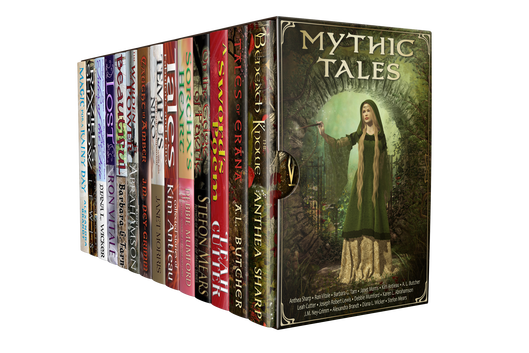
Box Set Title Mythic Tales Bundle
Title and Author
Book #1:
Beneath the Knowe – Anthea Sharp
Book #2:
Tales of Erana – A. L. Butcher
Book #3:
A Sword’s Poem – Leah Cutter
Book #4:
On the Edge of Faerie -Stefon Mears
Book #5:
Sorcha’s Heart – Debbie Mumford
Book #6:
Tales Fabulous and Fairy Volume 1 – Kim Antieau
Book #7:
Tempus – Janet Morris
Book #8:
Caught in Amber – J.M. Ney-Grimm
Book #9:
Warden of Power – Karen L. Abrahamson
Book #10:
Beautiful – Barbara G. Tarn
Book #11
Lost: Cinderella’s Secret Witch Diaries (Book 1) -Ron Vitale
Book #12:
Tales of the Faie: The Beginning of Days – Diana L. Wicker
Book #13
Angels and Djinn, Book 1: Raziel’s Shadow – Joseph Robert Lewis
Book #14:
Magic for a Rainy Day – Alexandra Brandt
Genre Fantasy/Mythic
Publisher Bundlerabbit
Book Blurb
A collection of tales…
View original post 898 more words


November 1, 2017
Dirty Dozen Author Interview J.M. Ney-Grimm
Author: J.M. Ney-Grimm
Please tell us about your publications. I write fantasy in which the intimate and personal intertwine with the great forces of history and culture. Most of my stories are set in my North-lands, a world inspired by the watercolor illustrations of the Danish artist Kay Nielsen. My novels include: Troll-magic, Livli’s Gift, Caught in Amber, Fate’s Door, and The Tally Master. I also have a handful of novellas (plus a few short stories), among them: Sarvet’s Wanderyar, Hunting Wild, and Winter Glory.
What first prompted you to publish your work? In 2007, I re-discovered Maddy Prior’s amazing song ‘The Fabled Hare.’
Listening to her powerful lyrics and expressive voice, I grew suddenly aware that time was passing, I was getting older, and I didn’t have forever.
The imagery of the hunter and hounds closing in on the hare made me feel as though death were snapping at my heels.
If there was something I really wanted to do, something I had not done yet, I’d better get going or I might miss my chance entirely.
I didn’t ‘click the publish button’ in 2007, but that year and that song were the beginning of my publishing journey.
Are you a ‘pantser’ or a ‘plotter’? I do some of each.
I prefer having a skeletal outline at the start of a story. Doing without —pure ‘pantsing’—feels like walking a tightrope over Niagara without a safety net. Very uncomfortable! And yet…I’ve done it.
Once I awoke in the middle of the night, so afire with inspiration that I got up out of my bed to write the first scene of what would become the novel Caught in Amber. I didn’t work out an outline until I was a third of the way through the book!
More usually, I sort out the foundational plot line before I start writing. I need to know what happens, but (oddly) I need to not know how it happens. I discover the how as I write, and that keeps the story feeling fresh to me.
Even when I follow an outline, I always feel free to ‘have a better idea.’ Sometimes my outline writhes like a river in flood!
What piece of advice do you wish you’d had when you started your publishing journey? I’m going to pretend you asked me about my writing journey. 


