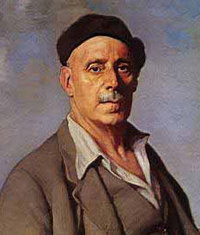
Ignacio Zuloaga y Zabaleta (1870 – 1945) was a Spanish painter, born in Eibar, Guipuzcoa, near the monastery of Loyola. He was the son of metalworker and damascener Plácido Zuloaga and grandson of the director of the royal armoury in Madrid.
At the age of 18 he moved to Paris, settling in Montmartre, to find work and training as a painter. He was nearly destitute, and lived off some meager contributions by his mother and the benevolence of fellow Spaniards. After six months' work he completed his first picture, which was exhibited at the Paris Salon of 1890. Continuing his studies in Paris, where he lived for five years, he was in contact with post-impressionists such as Ramon Casas, Gauguin and Toulouse-Lautrec.
He returned to Spain, settlinIgnacio Zuloaga y Zabaleta (1870 – 1945) was a Spanish painter, born in Eibar, Guipuzcoa, near the monastery of Loyola. He was the son of metalworker and damascener Plácido Zuloaga and grandson of the director of the royal armoury in Madrid.
At the age of 18 he moved to Paris, settling in Montmartre, to find work and training as a painter. He was nearly destitute, and lived off some meager contributions by his mother and the benevolence of fellow Spaniards. After six months' work he completed his first picture, which was exhibited at the Paris Salon of 1890. Continuing his studies in Paris, where he lived for five years, he was in contact with post-impressionists such as Ramon Casas, Gauguin and Toulouse-Lautrec.
He returned to Spain, settling in Seville, then Segovia, and developed a style based on a realist Spanish tradition, recalling Velázquez and Murillo in their earthy colouring and genre themes. He painted portraits of bullfighters and flamenco dancers.
One of the more prominently displayed of his works is Cristo de la Sangre or Hermandad del Cristo Crucificado, on display at the Museo Reina Sofia in Madrid.
Zuloaga was committed to the Nationalist faction during the Spanish Civil War and the Spanish State of the caudillo Franco, whose portrait he painted in 1940. During the war, Zuloaga honored the defenders of the Siege of the Alcázar in 1936, when the building's Nationalist defenders refused to surrender despite the building being in flames. ...more