
Marc Weidenbaum's Blog, page 63
May 2, 2024
Disquiet Junto Project 0644: Event Horizon
Each Thursday in the Disquiet Junto music community, a new compositional challenge is set before the group’s members, who then have five days to record and upload a track in response to the project instructions.
Membership in the Junto is open: just join and participate. (A SoundCloud account is helpful but not required.) There’s no pressure to do every project. The Junto is weekly so that you know it’s there, every Thursday through Monday, when your time and interest align.
Tracks are added to the SoundCloud playlist for the duration of the project. Additional (non-SoundCloud) tracks appear in the lllllll.co discussion thread.
These following instructions went to the group email list (via juntoletter.disquiet.com).
Disquiet Junto Project 0644: Event Horizon
The Assignment: Record music for a party of your choosing.
Step 1: Imagine a party you want to attend.
Step 2: Write some music that would be appropriate as background music for that event.
Tasks Upon Completion:
Label: Include “disquiet0644” (no spaces/quotes) in the name of your track.
Upload: Post your track to a public account (SoundCloud preferred but by no means required). It’s best to focus on one track, but if you post more than one, clarify which is the “main” rendition.
Share: Post your track and a description/explanation at https://llllllll.co/t/disquiet-junto-project-0644-event-horizon/
Discuss: Listen to and comment on the other tracks.
Additional Details:
Length: The length is up to you. The party may never end, but your song will just be one among many.
Deadline: Monday, May 6, 2024, 11:59pm (that is: just before midnight) wherever you are.
About: https://disquiet.com/junto/
Newsletter: https://juntoletter.disquiet.com/
License: It’s preferred (but not required) to set your track as downloadable and allowing for attributed remixing (i.e., an attribution Creative Commons license).
Please Include When Posting Your Track:
More on the 644th weekly Disquiet Junto project, Event Horizon — The Assignment: Record music for a party of your choosing — at https://disquiet.com/0644/


May 1, 2024
A Letter from Paul Auster
When I was an editor at the magazines, primarily Pulse!, published by Tower Records, I occasionally sought out writers other than professional critics to write for us, in particular musicians and novelists. The list of novelists who did wasn’t a long one, but it was a respectable one, including as it did Jonathan Lethem, Richard Kadrey, Geoff Nicholson, and the late David Bowman, among others. One who declined was Paul Auster, and in some ways I’m glad he did. Had he said yes to my invitation, I’d only have had an article. But because Auster said no, back in October 1993, I have this letter, postmarked from Brooklyn:
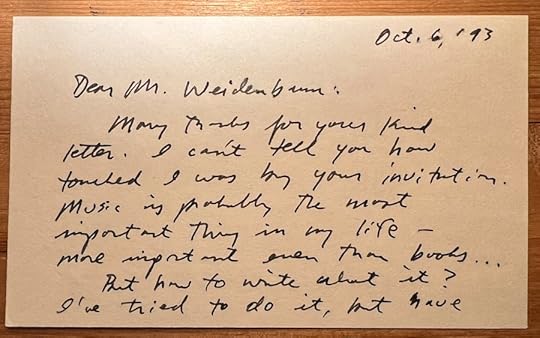
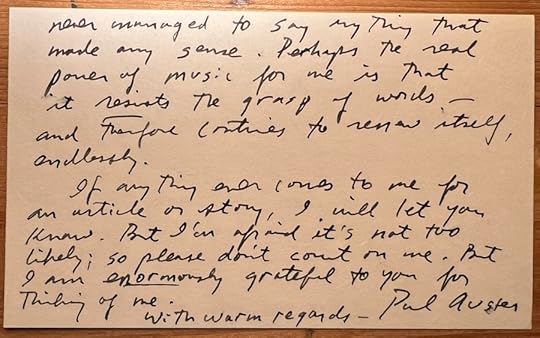
And if the script of his fountain pen is difficult to read, here is the text:
Oct. 6, ’93
Dear Mr. Weidenbaum:
Many thanks for your kind letter. I can’t tell you how touched I was by your invitation. Music is probably the most important thing in my life — more important even than books …
But how to write about it? I’ve tried to do it, but have never managed to say anything that made any sense. Perhaps the real power of music for me is that it resists the grasp of words — and therefore continues to renew itself, endlessly.
If anything ever comes to me for an article or story, I will let you know. But I’m afraid it’s not too likely; so, please don’t count on me. But I am enormously grateful to you for your thinking of me.
With warm regards —
Paul Auster
April 30, 2024
Tasselmyer’s Gestures
Another gorgeous live performance by Andrew Tasselmyer, who here runs four often though not entirely unidentifiable piano samples through various processes, yielding a piece at once cinematic and immediate, at once widescreen and obscure. Watch his hands as he manipulates the source material. Track motions to alterations, finger gestures to sonic morphing. And if you’re familiar with the central instrument, the Octatrack, then you’re no doubt thankful we don’t hear the familiar clack of those plastic buttons, which would be entirely out of place here. I especially appreciate how his index finger ends the performance with a single tap on the laptop’s touchpad. We’re long past the time of rampant doubt about what it is exactly a “laptop musician” is up to (and the associated “are they really performing?”). Here what we see is the same intimacy inherent in expertise that one might expect of a “traditional” (read: “acoustic”) instrument. Manual skills are manual skills, no matter the tools.
April 29, 2024
Taylor Deupree’s Loop of Loops
I love record albums, certainly, but in 2024, as for many years now, there’s nothing for me quite like fragments posted by musicians online as they work toward a finished work. The word “work” appears twice in that previous sentence, eventually as a synonym for a fixed document, but first as the effort it took to get there. You can hear that sort of effort in an untitled track that Taylor Deupree just posted in his newsletter, which is titled The Imperfect. The recording is just under three minutes of looping drones. Per the brief description, there are two loops: “loop a / Arp2600, pitch pipe, wooden abacus → strymon volante → meris mercury x / loop b / kaleidoloop.” If the words aren’t familiar, a quick search online will reveal the instruments being described. What matters is the result, a kind of lush, syrupy stasis, the sonic equivalent of a nearly blank mind that is stuck on something ponderous, but not uncomfortable with the mental obstacle. It’s a beautiful little treat. The audio is only in Deupree’s newsletter, so you’ll need to click through to listen.
April 28, 2024
Where and How I Listen
I have two very small office areas: one at home and one that I rent nearby. Neither has a proper stereo system.
The home office has a small modular synth setup next to my desk. For space-management reasons the speakers (monitors, actually, in music-equipment speak) sit perpendicular to my desk, above the synth. There I usually listen to music on my laptop speakers or headphones. My laptop, a MacBook Pro 14″ (the M1, which is somehow several generations behind but feels quite peppy and looks brand new), has fantastic built-in speakers, but when I really want to listen to something, I walk into the living room, which has proper speakers connected to what once was a proper stereo system and now inspires people point and stare and ask what the heck those big things are beneath the television and why don’t I just have a Bluetooth something or other. I have a Plex system running on a Mac Mini attached to the home stereo, so I can easily collate my digital music files (notably: inbound material I’m considering for review), listen to them in the living room, and access them elsewhere with my phone, iPad, or laptop.
The rental office is self-enclosed but in a shared building with an active hallway, so I only listen to music there on headphones and earbuds, so as not to bug anyone. My main extravagance is I bought a second guitar when I got the rental office, so I can be a terrible guitarist in two places rather than just one, and to avoid looking like an oddly clean-cut itinerant musician were I to walk back and forth with the guitar between home and office regularly.
That is where and how I listen.
April 27, 2024
Scratch Pad: PIs, Journaling, Polostan
I do this manually at the end of each week: collating (and sometimes lightly editing) most of the recent little comments I’ve made on social media, which I think of as my public scratch pad. Some end up on Disquiet.com earlier, sometimes in expanded form. These days I mostly hang out on Mastodon (at post.lurk.org/@disquiet), and I’m also trying out a few others. I take weekends and evenings off social media.
▰ The trope of a modern LA detective/PI who’s into throwback jazz (and/or the score is jazz-inflected) is widespread, epitomized lately by Bosch. I like how in Sugar, with Colin Farrell, the self-awareness connects to the PI’s love for classic films, and how snippets from such films are interspersed.
▰ If you have trouble keeping a journal, you might consider whether writing by hand or typing is best for you. I’m a typer, have been since far too young an age, thanks to my parents’ electric typewriter. I also like (i.e., depend on) the search-ability of text files. But that’s just one approach.
▰ I caught Bill Frisell & Hank Roberts (musicians I saw often around NYC in the late ’80s/early ’90s) as part of a sextet Frisell led at Berkeley’s Freight & Salvage, bonding the chamber-Americana of his 858 Quartet and his current jazz trio (Thomas Morgan, Rudy Royston).
▰ My Telecaster stays in tune like my Nintendo DSi holds a battery charge, just incredible staying power
▰ Guitar practice remains focused on the old Robin/Rainger tune “Easy Living,” which isn’t easy at all if you’re coming up to speed on 7th chords, so I’m just cycling through A+7 / D9 / G+7 / C9 (which involves muting strings on the augmented chords, and muting kinda eludes me) until it sounds natural
▰ Neal Stephenson’s newly announced novel, Polostan, due out October 15, is only 320 pages long, and it is apparently the first third of a trilogy called Bomb Light. Its relative brevity leads me to wonder if he turned in a 1,000-page book and was encouraged to subdivide it.
▰ Modern curses:
May you lose your place in your audiobookMay your cloud sync fail across your devicesMay your phone initiate an upgrade just before an important call▰ I finished reading one novel and one graphic novel this week. First there’s Babel: Or the Necessity of Violence: An Arcane History of the Oxford Translators’ Revolution by R. F. Kuang: Can’t say I loved it. For a story founded on magic, there is little of it present here. For a book about the world, we spend little time outside of two cities. I will say, if an author notes Jonathan Swift as a guide, then readers should consider themselves warned about an impending meagerness of subtlety. And then Ultimate Invasion by writer Jonathan Hickman and illustrator Bryan Hitch. On the one hand — and I also read the first two issues of the new Ultimate Spider-Man, also written by Hickman, drawn by Marco Checchetto, which ties in with Ultimate Invasion — it’s a fun dissection and rearrangement of the Marvel pantheon. But on the other hand, it feels like it will end up reinforcing the pantheon by just building back up to the status quo. We’ll see. For now, I’m along for the ride.
April 26, 2024
Listening with Rebecca West (1892-1983)
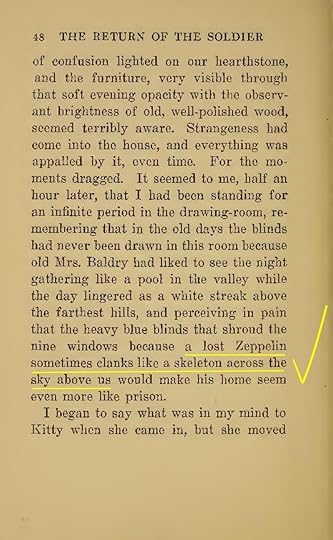
Yes, I am enjoying, greatly, Rebecca West’s 1918 novel The Return of the Soldier. I don’t think I’ve read previously a contemporaneous account of what zeppelins sounded like to those for whom an appearance overhead was a not uncommon occurrence. (West is the pen name of the late Dame Cicily Isabel Fairfield. She and H.G. Wells were the parents of author Anthony West.)
Liner Notes I Wrote for Lucchi & Meierkord
I really enjoy writing liner notes. I only write them for albums I like enormously, the most recent of which came out today: Lieder Ohne Worte by Marco Lucchi and Henrik Meierkord. It was released by Chitra Records, which is based in Oxford, Mississippi. The title means “songs without words” in German.
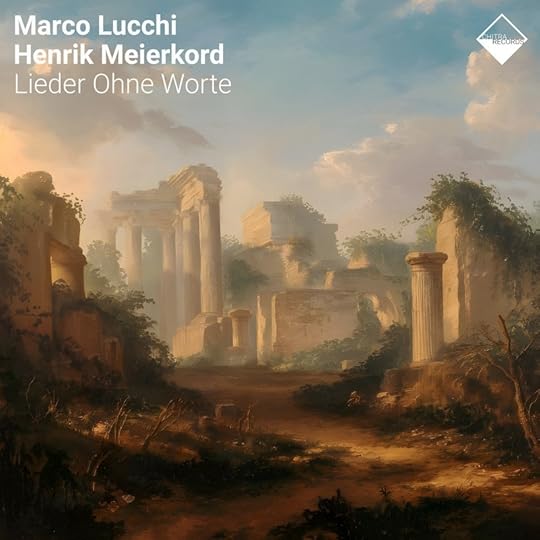
Marco Lucchi, based in Modena, Italy, and Henrik Meierkord, based in Stockholm, Sweden, have a lengthy collaboration to their reciprocal credit, and they accomplish it far and near alike. A testament to the interplay of their work together is that a listener might be hard-pressed to discern which of their recordings are the result of long-distance file-trading, and which occurred when the two managed to be in the same place at the same time.
Several aspects of their respective music-making serve them well as creative partners. First of all, both tend toward the ambient, given as they are generally to a slow pace and to a sensibility that manages to be at once radiant and intimate. Secondly, while both are multi-instrumentalists, there is a complementary nature to their specialties, Lucchi being more of a keyboardist, Meierkord more of a string player. Thirdly, and perhaps most importantly, they are both immersed in techniques drawn from electronic music.
In particular, both men are experienced with live multitrack recording, in which they process and layer their own performances in real time. Meierkord is fond of layering sinuous tones to create scenarios of unique dimensions. It becomes uncertain — even unimportant — to the listener what preceded what, so intricate is his deployment of interplay. Lucchi likewise finds parallels between classical orchestration and the opportunity for drones lent by modern synthesizers; in a small room he can create a vast space. There is often an oceanic depth to such efforts, part composed and part improvisatory, in which playing is a tool toward composition, rather than the other way around.
Throughout their new record, there is an underlying melancholy, a nostalgic beauty, and a reflective consideration — a virtue that is foundational to their ongoing collaboration. The result is particularly rich in plaintive scene setting, as on the glacially paced “La bestia umana,” which emerges from a neighborly field recording of a dog barking, and “Kosmisk Strålning II,” which maintains a dream-like quietude, more shadow than light. On “Like tears in rain,” what sounds like a synthesizer is, in fact, a piano, a recording of which has been stretched beyond the point of it being readily identifiable.
On first listen, their leaning toward unimpeachable steadiness can seem uniform, but listen more closely and you’ll recognize how explicitly they emote on a track like “The Third Stage,” due not just to the reaching melodic surges (which, in turn, match the sampled recordings of bird calls) but to the slight discordances that suggest trouble and tension. In a different manner, there is “A warm and golden October,” which balances breaking-dawn hush with piercing overtones. That track features a motif at the end, played on a celesta; those bell-like tones edge the piece out of dreaminess without entirely breaking the spell.
The greatest outlier — dog barking notwithstanding — may be on “Oändlig,” not just for its fierce pulse, but because of its more immediately electronic vibe. “Oändlig” is an exceptional piece, bringing to mind the minimalism of Terry Riley and the rave classics of Underworld.
Listen at chitrarecords.bandcamp.com.
April 25, 2024
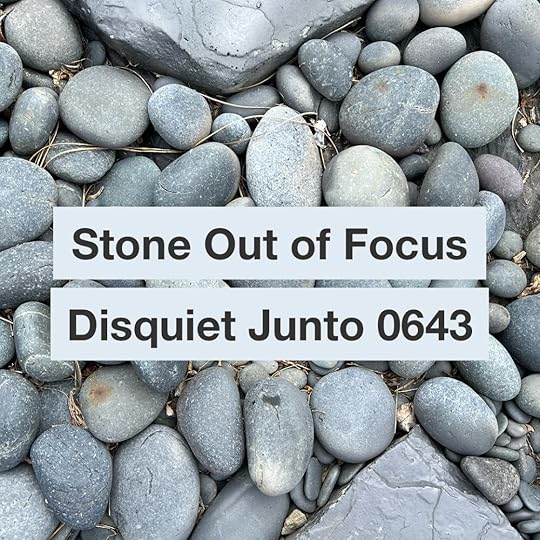
Disquiet Junto Project 0643: Stone Out of Focus
Each Thursday in the Disquiet Junto music community, a new compositional challenge is set before the group’s members, who then have five days to record and upload a track in response to the project instructions.
Membership in the Junto is open: just join and participate. (A SoundCloud account is helpful but not required.) There’s no pressure to do every project. The Junto is weekly so that you know it’s there, every Thursday through Monday, when your time and interest align.
Tracks are added to the SoundCloud playlist for the duration of the project. Additional (non-SoundCloud) tracks appear in the lllllll.co discussion thread.
These following instructions went to the group email list (via juntoletter.disquiet.com).
Disquiet Junto Project 0643: Stone Out of Focus
The Assignment: Make music inspired by a poem.
Step 1: This project is inspired by a brief poem by Yoko Ono, in which she wrote, “Take the sound of the stone aging.” Consider that sound.
Step 2: Record your impression of the sound of stone aging.
Background: This week’s project is based on a text by Yoko Ono, originally published in her book Grapefruit 60 years ago, back in 1964.
Tasks Upon Completion:
Label: Include “disquiet0643” (no spaces/quotes) in the name of your track.
Upload: Post your track to a public account (SoundCloud preferred but by no means required). It’s best to focus on one track, but if you post more than one, clarify which is the “main” rendition.
Share: Post your track and a description/explanation at https://llllllll.co/t/disquiet-junto-project-0643-stone-out-of-focus/
Discuss: Listen to and comment on the other tracks.
Additional Details:
Length: The length is up to you.
Deadline: Monday, April 29, 2024, 11:59pm (that is: just before midnight) wherever you are.
About: https://disquiet.com/junto/
Newsletter: https://juntoletter.disquiet.com/
License: It’s preferred (but not required) to set your track as downloadable and allowing for attributed remixing (i.e., an attribution Creative Commons license).
Please Include When Posting Your Track:
More on the 643rd weekly Disquiet Junto project, Stone Out of Focus — The Assignment: Make music inspired by a poem — at https://disquiet.com/0643/
This week’s project is based on a text by Yoko Ono, originally published in her book Grapefruit 60 years ago, back in 1964.
April 24, 2024
Doorbell to the Past
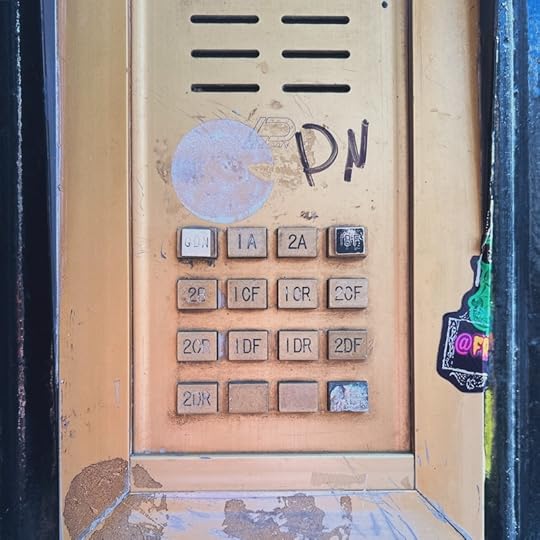
The doorbell a few doors down from the apartment on 9th Street where I happened to be couch-surfing the night that the Tompkins Square Riot started in early August 1988, a few days after my birthday, the summer after I graduated from college. A doorbell to the past.


