
Marc Weidenbaum's Blog, page 439
December 10, 2013
100th Podcast, 20 Field Recordings

The Touch Radio series of podcasts, an offshoot of the esteemed Touch Editions label, has reached its momentous 100th episode, and it is marking the occasion with just the sort of low-impact gesture that would be expected of an enterprise that traffics in the everyday. See, much of the Touch output is field recordings: expertly recorded, lovingly sourced, casually framed documents of the sonic quotidian. The 100th episode features a montage, a medley as it were, of recordings from the archives of BJNilsen.
Download audio file (Demona.mp3)
The sources range from ports to cemetaries, industrial factories to fishmarkets. The full list is as follows: Beachy Head, Eastbourne, England; Karl Marx Tomb, Highgate Cemetery, London, England; Whitstable Bay, Kent, England; CleanCar Berlin, Mitte, Germany; Temple Gas Works, Glasgow, Scotland; Fruitmarket City Hall, Glasgow, Scotland; Port of Montreal, Quebec, Canada; Carlsberg Brewery, Copenhagen, Denmark; Unknown Music School, Naples, Italy; Galleria Umberto, Naples, Italy; Barbed Wire, Todmorden, England; Side Street, Lisbon, Portugal; Tempelhof Airfield, Berlin, Germany; Cave, Durness, Scotland; Fishmarket, Via Tribunali, Naples, Italy; Hatún, Reykjavik, Iceland; the Jacobite Steam Train, Armadale, Scotland; London Olympic Rehearsal, Islington, London, England; Boleskine Cemetery, Scotland; Train Bridge, Nijmegen, Netherlands (MP3). The sensory overload is titled “Bottomless Perfume.”
Track originally posted for free download at touchradio.org.uk. More on Nilsen, who also did the very first Touch Radio podacast, at bjnilsen.com.


December 9, 2013
Drum Solos Revisited

The drum solo has long been synonymous with extravagant posturing, with the worst excesses of rock’n'roll virtuoso exhibitionism. The reputation is unfortunate, but whatever one thinks of drum solos, the forthcoming album of solo drum work by Machinefabriek is something entirely apart from the usual associations. The source audio for Machinefabriek’s album — its bland title, Drum Solos, putting to rest concerns of showmanship — is all analog drum equipment, yet as evidenced by a six and a half minute preview track posted to his soundcloud.com account, it has nothing to do with the crowd-rousing arena epics of yore.
It is, instead, a patient, occasionally irritant-exuding, and all around thoughtfully considered endeavor. The equipment is used more for textural than percussive effect, and the extent to which there is anything akin to a rhythm or a beat is how the gong-like cymbals take the form of slow, undulating sine waves. The music is processed this way and that, at times deeply removed from the original audio, including what appears to be a backwards effect.
Here’s Machinefabriek on the project:
Driven by my love for solo albums by drummers and percussionists like Jon Mueller, Wil Guthrie, Nick Hennies and Burkhard Beins, I’ve made Drum Solos. It’s my take on a solo drum record, despite the fact that I lack the talent to hit a steady beat or a play a drum roll. Instead, I used the sounds of a drum kit as a sounce for further processing.
I booked a rehearsel room with a drum kit, and recorded as much sounds as I could in one afternoon. Hitting, bowing, stroking, whatever ways I could find to create sounds, I recorded. And these soundfiles were chopped and screwed til it sounded like what you hear on the album.
Each track focusses on one part of the drum kit. I like to think that purposefully employed limitations like that make me more creative, and my work more focussed. It’s part of the aim to make my music as minimalistic and ‘pure’ (whatever that may be) as possible. In this case it resulted in a short but varried and at times meditative album that might not have any virtuoso drum acrobatics on it, but shows its quality on a more subtle level.
Track originally posted for free download at soundcloud.com/machinefabriek. Machinefabriek is Rutger Zuydervelt of Rotterdam in the Netherlands. More from him at machinefabriek.nu.
December 8, 2013
Music from What Ails You

Alison Doyle has not posted a new track to her SoundCloud account in nine months. The last one was less than a minute in length, a field recording of the sound of the Arts Music Building at Cornish College. What is heard is someone’s piano practice, routine stuff, from a distance. The music, the performance, is but a portion of the overall audio, however — the remainder is wind noise and bird song and a significant amount of otherwise everyday ambience. The second most recent Doyle track is also nine months old, and it tells a specific story, in firm contrast to the field recording, which is willfully and expressly quotidian. This other piece, “Bloodwork,” is a slow, steady, explorative piano piece. It takes its time, rarely moving beyond its rudimentary, and yet thoroughly engaging, melodic line.
The rhythm is the thing here. If it sounds like martial music, solemn in its own way, that seems fitting as Doyle wrote at the time that it came out of her experience of damaging one of the core parts of her toolset: her left hand:
Mostly improvised, this piece was written one week after stabbing a knife through my hand. My apologies for the seriously flawed mastering and wonky recording; a work in progress and so thankful I didn’t permanently damage my hand.
As such, the work brings to mind other musicians’ response to injury, such as Brian Eno’s sick bed revelation, as he recounted in his liner notes to his Discreet Music album in 1975, which laid the groundwork for his ideas about ambient music, as well as Nils Frahm’s 2012 album Screws, which took its title from the items in his hand after he damaged it. Frahm, like Doyle, is a pianist. The Disquiet Junto, shortly after the release of Screws, did a collection of reworkings of his recording, essentially adding our collective figures in the temporary absence of his out-of-commission one.. It is difficult to listen to the Arts Music Building field recording after listening to Doyle’s “Bloodwork” and not imagine her sitting there, patiently waiting — well, perhaps not patiently — to heal enough to get back at it.
Track originally posted at soundcloud.com/alliedee.
December 7, 2013
Modular Jazz

The musician who goes by mudlogger, aka Ubon Ratchathani of Thailand, has been uploading modular synthesizer experiments. Among them is this piece, “OrLo,” which he describes as “modular jazz.” No doubt it gets that description because the white noise percussion suggests a robotic trap set, and the intransigent pneumatic piping sounds like a European free jazz saxophone solo. Or perhaps it’s some source material surfacing through heavy manipulation.
Track originally posted for free download at soundcloud.com/mudlogger. More from mudlogger at twitter.com/bitchhands.
You can get a glimpse of (and short listen to) his modular setup in this Vine video:
Video located at Vine video.
Past Week at Twitter.com/Disquiet
In honor of 78th anniversary of Pessoa's death, experiments with color-coded alternate translations I did years back: http://t.co/36DxzRLT2Y ->
Playgrounds that accustom kids to playing with sound. http://t.co/wZGcfwV9jk ->
The upgrade from iPad 2 to iPad Mini 2 is not insignificant. #samplr #rjdj #reactable #air #bloom #bmachine ->
The term "Cyber Monday" sounds like the sales are for 28.8k modems, flight-simulation CD-ROMs, and AOL membership. ->
iPad Mini Air 2 with Retina 4K Project Red S C ->
There's a lot of beauty in iOS music interfaces, and even by that high standard, Samplr's loveliness continues to impress. ->
This, by the way, is the iOS app @Samplr that I mentioned earlier: https://t.co/zxHhc8MIXm. More here: http://t.co/5ZlrfWZus0. Cc @vuzhmusic in reply to vuzhmusic ->
28 musicians so far in the 100th weekly Disquiet Junto: making music from the sound of water boiling: http://t.co/TUvzNUMOHl ->
iOS and Android are great. My daily ("productivity") emphasis on Android rests on 3 simple things: widgets, notification light, file system. ->
Took one for the cause. MT @ioflow: boiled my mic tonight. now to see if i can get any worthwhile audio for the current @djunto project. ->
#protip: RT @ioflow: note to self: use a real hydrophone for water-based @djunto projects. and buy new mic. ->
Safe to say joining up with @gizmodo increases listenership for @djunto projects. One Xbox track has over 5,000: http://t.co/BRwEQeEmHY ->
My kingdom for a lighter, more compact laptop power cord. ->
Tuesday noon siren in San Francisco: http://t.co/FrVmKgO1Mx ->
Tuesday burger at Rosamunde. Somehow totally didn't hear the noon siren today. #415 ->
RIP, Junior Murvin, 64, whose "Police and Thieves," produced by Lee Scratch Perry, was covered on the first Clash album. ->
Music to listen to music to proof copy to. ->
Lowering the volume on the Pete Rock I'm listening to so it'll meld with the Miles Davis playing on this cafe's stereo system. ->
Another day, another article posted for free on open-source blog software about problem of posting music for free using Creative Commons. ->
Today in sound class, the 13th of 15 weeks: online communities, digital music retail, mapping cultural connections. ->
15,625: Number of listens thus far on SoundCloud to the 99th weekly Disquiet Junto project, nearly 1,000 per track: https://t.co/YKbk0gF4u0 ->
Yo, Hive Mind: Places in San Francisco to get simple (brand-less, pocket-less) felt sleeve for iPad Mini? ->
Read article this week with 13 tips on not misusing @SoundCloud account. Now can't find it. Anyone recall? Advised against works-in-progress ->
A soundwalk is a docent tour of a museum called daily reality. ->
Trancing out to how out of sync are the several dozen TVs in this electronics store. ->
"Sometimes I think of you as Mom and other times just as this interesting person who lives in our house." The Good Wife is really something. ->
Background music while working: playing vinyl surface noise in granular Borderlands app (few voices, long duration). It's like a fireplace. ->
Today will be the 101st weekly @djunto project. Expect binary. ->
#analog #binary The 101st weekly @djunto project begins. Four days to make phase-shift music http://t.co/SXDDv6k2hJ + http://t.co/j3kkfdGpfz ->
RIP, noise musician Aube (Akifumi Nakajima, 中嶋昭文), born 1959. ->
Twitter kept removing the Japanese characters from my Aube tweet and moving the parenthetical to the front. But now it looks fine. #weird ->
Assumes all avatars with numbers in theirs names are spambots — unless those numbers correlate with antiquated drum machines. ->
December 6, 2013
Life After Nintendo
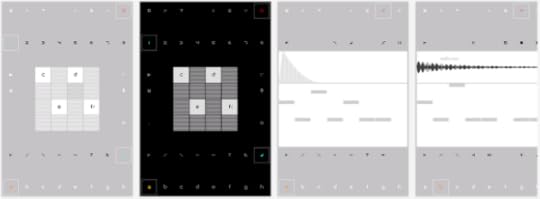
There are several dozen tracks thus far in the “sound diary” credited on SoundCloud to Corruption, who gives as a residence Funabashi, Japan. Many are noisy escapades, tagged simply as “sound diary,” while the one dated “2013.11.19″ and given the subtitle “like a moth to a candle” bears a second tag: Nanoloop. That’s the name of a popular piece of electronic music software that originated on the Nintendo Gameboy and has been since ported to iOS and Android. What was, back in 1998, an esoteric dream of handheld music-making has become pop culture, an everyday activity. In Corruption’s hands, Nanoloop makes sequences of shiny chiming jangles that ebb and flow like a low-resolution tide. There’s a glitchy quality to it at times, lending the work a welcome complexity, a dark undercurrent to its slow pace. Corruption does not identify which edition of Nanoloop is employed.
Track originally posted for free download at soundcloud.com/corrption. More on Nanoloop at nanoloop.com. The above screenshots are from the Android version.
December 5, 2013
Disquiet Junto Project 0101: Analog Binary

Each Thursday at the Disquiet Junto group on SoundCloud.com a new compositional challenge is set before the group’s members, who then have just over four days to upload a track in response to the assignment. Membership in the Junto is open: just join and participate.
This project was published in the evening, California time, on Thursday, December 5, with 11:59pm on the following Monday, December 9, 2013, as the deadline.
Tracks by participants will be added to this playlist as the project proceeds:
These are the instructions that went out to the group’s email list (at tinyletter.com/disquiet-junto):
Disquiet Junto Project 0101: Analog Binary
Record the audio of three objects in your home or workplace that have on/off switches. Capture the unique sound of them being turned on and off. For each of the switches, record several seconds of this on/off action so you can create loops of a steady pace. Then create an original piece of music that employs phase shifts — that is, in which the tiny distinctions between loops create noticeable patterning as time progresses. You can use some light processing, but the sense of “switch-ness” of the source audio should never be lost.
Deadline: Monday, December 9, 2013, at 11:59pm wherever you are.
Length: Your track’s length should be between two and five minutes.
Information: Please when posting your track on SoundCloud, include a description of your process in planning, composing, and recording it. This description is an essential element of the communicative process inherent in the Disquiet Junto.
Title/Tag: Include the term “disquiet0101-analogbinary” in the title of your track, and as a tag for your track.
Download: Please consider employing a license that allows for attributed, commerce-free remixing (i.e., a Creative Commons license permitting non-commercial sharing with attribution).
Linking: When posting the track, be sure to include this information:
More on this 101st Disquiet Junto project (Make a phase composition based on the sounds of three switches) at:
http://disquiet.com/2013/12/05/disqui...
More details on the Disquiet Junto at:
http://soundcloud.com/groups/disquiet...
Associated image found via:
December 4, 2013
Sound of Commerce

John Kannenberg is a sound artist with a particular interest in place. Much of his work is raw or lightly edited recordings of physical environments, notably art museums. He has, in the past, reversed the idea of sound art by making sound art of places that house art. He travels with his audio recording equipment as others might with a camera or a sketch book. What follows is his audio of a shopping mall in the U.K. It is the sound of commerce, of activity and inactivity, of daily life: a barker, passing conversation, thick local accents, even the squeak of shoes against the floor. Framing lends the mundane a sense of drama. Repetition lends structure, narrative.
Track posted for free download at soundcloud.com/johnkannenberg. More from Kannenberg at johnkannenberg.com.
December 3, 2013
Sound by Fire

That is how Ernest Gonzales sums up his grief, and his way through grief: “Sound by fire.” He reports in the liner note to his new, 11:13-long piece “Cremation” that after the passing on a single day last month of his grandmother and of the man he describes as the closest thing he had to a grandfather, Gonzales took the electric guitar he received in fifth grade and ceremoniously burned it to ashes. The source audio of that destruction yielded this music.
He writes:
“It was with this instrument that I learned how to make music. There’s a lot of sentimental value with that guitar … that’s what made it really difficult for me as I plugged it in and placed it on the fire. I recorded the electrical signal the guitar made as I cremated it. I recorded the ambient sounds of the fire and my backyard as well and then took all of it into Ableton for some final touches. … The song is 11 minutes and 13 seconds. 11/13 for the day both my grandparents left earth.”
The result is an extended rumination, like a bell struck once and left to ring on and on, a full-throated and yet world-weary drone that simultaneously signals sadness and fortitude. It’s a tuned thing, this drone. On first listen, it seems singular in its capacity for bleak, systemic, sonic consumption, but in fact the pitch varies as it proceeds, like a song too slow to recognize as a song.
Track originally posted for free download at soundcloud.com/exprecords. More from Gonzales at twitter.com/ernestgonzales and whileonsaturnsrings.wordpress.com. Gonzales, also known as Mexicans with Guns, earlier this year released the excellent Atonement album with Diego Bernal. Both men are based in San Antonio, Texas, where Bernal represents District 1 on the City Council. Here’s a stream of that Atonement record:
Atonement by Diego Bernal & Ernest Gonzales
December 2, 2013
Music for (and by) Software Testers

“This is music I make to listen to while at work,” says Mark Rushton of Iowa City, Iowa, at the start of the 60th episode of his Ambient Podcast. For some two decades, Rushton has worked as a software tester, and in his off hours he is a prolific maker of electronic music. As he explains in the episode, “I create my own soundtracks.” The podcast episode is under a quarter of an hour in length and it features Rushton introducing three tracks from his most recent album, titled Machines. The pieces are all rhythmically ambiguous, including a shuddering thrum that takes its name, “Crandic,” from the Cedar Rapids and Iowa City Railway. The third, “Hello Friends,” was recorded in front of an audience and is an example of what he describes as “live hyper-micing,” about which I’m looking forward to learning more.
The full Machines album, from which these tracks are excerpted, is at markrushton.bandcamp.com. More about Rushton’s podcast at markrushton.com. Image from flickr.com.


