
Marc Weidenbaum's Blog, page 158
February 23, 2022
Let’s Get Lost

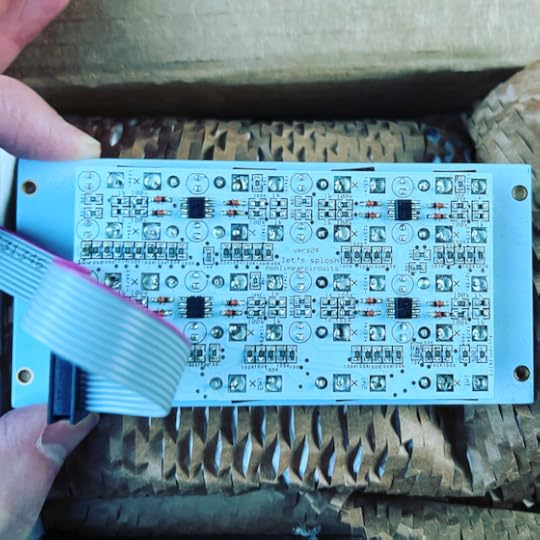
I really need a glass-bottom rack. It’s unfortunate the flip side of synthesizer modules end up inside a box and out of view. Printed circuit boards are beautiful, or at least can be.


February 22, 2022
Hail Fell Earlier
Hail fell earlier and unexpectedly, the small, tight drops pinging like a cellphone alert, like a nap had come to an end and a pre-selected digital signal was looping, looping in a way that the brain, still at best halfway out of that nap, could not quite process. On a walk afterward, not even a mile, the hail just a stain on concrete: an unusual quiet, as if more people than normal for the hour, not long after dark, had elected to stay home. The sense of decreased population was not confirmed but at least acknoledged at the burrito shop, where the three-person crew huddled near the counter, the tone of their chat suggesting they were deep into a conversation, that not only was no one else here presently, but that no one had been for some time. On the walk back: very few cars passed, and the few that did seemed to register that fresh rain following so many weeks (months?) of drought made for unsafe streets. Stop signs, newly reflective thanks to the brief shower, accepted the careful pause made by each vehicle, all electric, all emitting at most a low level hum. The hail had provided a moment to marvel; the afterward, a time for communal caution. Back home: the rush of the dishwasher, the creak of a house settling in for the evening, the TV making that crackling, torque-like noise as it cooled once turned off. No dialog from pedestrians outside, and the self-imposed moratorium on cars largely still in effect. When an engine is heard many homes away, it is less a disturbance than an echo that charts just how empty, how vast, the area is — the exception that lends scale to the rule. There is a major avenue a couple blocks away, lined with businesses. In another direction there is a rapid thoroughfare, its lights timed for maximum traffic flow. And yet the neighborhood is a hush. Even the gearheads have stuck to their garages tonight, rather than risk their beloved machines on the still slick ashalt.
This Week in Sound: Emit Acoustic Waste
These sound-studies highlights of the week are lightly adapted from the February 21, 2022, issue of the free Disquiet.com weekly email newsletter This Week in Sound (tinyletter.com/disquiet).
As always, if you find sonic news of interest, please share it with me, and (except with the most widespread of news items) I’ll credit you should I mention it here.
▰ “Much of the resentment traces back to film composing’s biggest open secret: Many of its brightest stars do not, in fact, write the music they are celebrated and remunerated for.” Mark Rozzo of Vanity Fair on the underpaid and often anonymous toilers who make music for film and TV. (Some have a moniker. Hans Zimmers’ go, apparently, by “Zimlings.”)
➔ vanityfair.com
(Via Michael Upton)
▰ ScanSoft and Nuance Communications, pioneer companies in speech recognition software, serve as examples of how Big Tech slows innovation:
➔ technologyreview.com
▰ The horror sound effects of radio dramatist Arch Oboler (1909-1987) are the subject of fascinating academic research by Amy Skjerseth.
➔ uchicago.edu
▰ “The LRAD is device that can put out a highly directional ‘beam’ of incredibly loud sound, up to 160 decibels (dB).” Lawrence English explains how Long-Range Acoustic Devices function. “Until very recently, the use of the LRAD in public settings in Australia has been largely nonexistent. Most use by police forces in Australia has been limited to disaster communication and for communication during events such as hostage situations. In 2020, however, this pattern of usage began to shift.”
➔ theconversation.com
▰ “Data centers emit acoustic waste, what environmentalists call ‘noise pollution,'” writes Steven Gonzalez Monserrate. He explains how the hum of data centers is quiet enough to not violate the law, even if its persistent presence is an experienced issue for those living nearby: “upon closer interrogation of the sound, some residents reported that the monotonal drone, a frequency hovering within the range of human speech, is particularly disturbing, given the attuned sensitivity of human ears to discern such frequencies above others.”
➔ mit.edu
▰ “To build his library of sounds, Stewart has trekked to more than 40 countries, often lugging audio equipment through rugged landscapes to reach remote locations or animals.” Corryn Wetzel profiles field recorgist Martyn Stewart, whose collected work is in the realm of 30,000 hours of recordings. “To capture a few minutes of a frog’s chirp or a dolphin’s clicks can take hours of work because of nearly constant interruptions from noise pollution. ‘Twenty or twenty-five years ago, if I wanted to record one pristine hour of sound it would take about three or four hours to get that one hour. It was a brilliant world.’ Today, Stewart notes that it would take around 2,000 hours to get a recording of similar quality.”
➔ smithsonianmag.com
▰ “Alexa’s wake sound … is based on the ubiquitous and very human ‘uh-huh.’” Chris Seifert, Senior Design Manager at Amazon, is profiled by J. Trew about the development of the sounds of Amazon’s Echo.
➔ engadget.com
▰ If you haven’t watched the TV series Archive 81, then you might want to wait until after before reading this helpful explainer by Sarah Shachat on how it employs sound. It’s an interview with supervising sound editor Mark Relyea.
➔ indiewire.com
▰ Spiders employ webs as surveillance technology, using their creations as an “auditory sensor.” Read the research paper:
biorxiv.org
➔ twitter.com/crawlycreepy
(Via Bruce Sterling)
▰ Trevor Mallard, Speaker of the New Zealand House of Representatives, played selections from a list of “The 25 Most Annoying Songs in the World” to break up an anti-vaccine protest, reports Megan LaPierre. On the playlist: Barry Manilow’s “Copacabana” and Los del Río’s “Macarena.”
➔ exclaim.ca
▰ Sony’s latest earbuds use a low-tech way to make sure you can hear what’s happening around you: there’s “a 12-millimeter driver in the shape of a ring with a hole in the middle,” writes Andrew Liszewski.
➔ gizmodo.com
▰ “By bringing together existing libraries of fish, frogs and other marine species, it is hoped the library will help identify the lullabies, chants and anthems of aquatic ecosystems.” There’s a massive project afoot to collect and collate underwater sonic communication.
➔ theguardian.com
▰ “Hoon. The sound of a foghorn lowing in the distance, warning of approaching menace.” Warren Ellis finds sonic portent in the surname of novelist JD Kirk’s protagonist, former Police Scotland Detective Superintendent Bob Hoon.
➔ warrenellis.ltd
▰ Randall Roberts looked into the claims of sonic wellness and found “bonkers numerology” (per Robin James) and “a total mishmash of metaphysics” (per Matt Marble), among other things.
➔ latimes.com
February 21, 2022
Sound Ledger¹ (Fish, AI, Krause)
21: Number of species of fish that depend on hearing
29: Percentage of of executives who have observed AI bias in voice technologies
5,000: Number of hours of audio culled to achieve the material in Bernie Krause’s current exhibit at Peabody Essex Museum in Salem, Massachusetts
________
¹Footnotes: Fish: theguardian.com. AI: venturebeat.com. Exhibit: townandcountrymag.com.
Originally published in the February 21, 2022, edition of the This Week in Sound email newsletter tinyletter.com/disquiet.
February 20, 2022
February 19, 2022
RIYL
RIYL the Dark Noise setting on iOS’ Background Sounds feature, motel HVAC, rinse cycle
RIYL distant sirens, your neighbor’s smoke alarm, the pneumatic brakes of public buses
RIYL recently doused campfire, failing muffler, skateboard on fresh tarmac
RIYL parade noise from a dozen stories down through double pane glass, collegial honks between delivery van drivers, house music heard via the sonic bleed of nearby headphones
RIYL unseen wind chimes, metronomic alert of a truck backing up, thunderous applause following a performance you didn’t particularly appreciate
RIYL low grade tinnitus, vinyl surface noise, an orchestra tuning up for the first concert of the season
RIYL the way your brain loops fragments of an otherwise forgotten song, the ringing of bells attached to the front door of your favorite Chinese restaurant, laptop fan noise
RIYL the jingle at the end of the New York Times online crossword when muted quickly because you’re at the library, the polite yet urgent knock on a restroom door, skis crossing stone and dirt beneath the final vestiges of melting snow
RIYL rain pummeling so hard you hear it from inside the movie theater, a voice on a public address system so ancient that you know it’d be unintelligible even if you spoke the language, rumble of the hallway floor being waxed just outside the doctor’s waiting room
twitter.com/disquiet: Halftime, Vinyl, Hexagons
I do this manually each Saturday, collating most of the tweets I made the past week at twitter.com/disquiet, which I think of as my public notebook. Some tweets pop up in expanded form or otherwise on Disquiet.com sooner. It’s personally informative to revisit the previous week of thinking out loud. This isn’t a full accounting. Often there are, for example, conversations on Twitter that don’t really make as much sense out of the context of Twitter itself.
▰ Me a chapter into Maggie O’Farrell’s Hamnet: Oh yeah, “literary fiction” means lots of description where other books would have, you know, plots.
Me halfway through Maggie O’Farrell’s Hamnet: I’m reading this more and more slowly to absorb every single tiny little detail.
There’s an entire chapter narrated essentially from the perspective of a flea that inadvertently helps carry the plague to England. (Structured a bit like the end of Rogue One, come to think of it.)
▰ You want glitch? Watch YouTube’s auto captions try to keep up with the rapping during the halftime show.
▰ Finished watching Mr. In-between last night, and besides enjoying it very much, I now have a third favorite final moment in a TV series’ final episode (two others that come to mind: The Shield and Damages).
▰ Today: writing, phone, reading, Zoom, sorting, seventh chords, writing
▰ The Batman makes sense when I think of it as a sequel to Cosmopolis. (Likewise: Batman Begins as a sequel to American Psycho.)
▰ There are two dawns: the one outside the living room window, and the one when my laptop turns off Dark Mode.
▰ I truly don’t always think I’m gonna hold onto my vinyl. I look at that space along the wall and think: a proper piano could fit there.
▰ It’s been weird getting the Disquiet Junto projects out shortly after midnight, rather than late in the day. I have a ghost pain, where it’s 4pm or 5pm on Thursday and I … have nothing to do on the Junto, ’cause it’s already out. I like it, but I still need to get used to it. It’s vaguely related to how I usually just carry a backpack with me, ’cause if I don’t, I spent half the time I’m away from home wondering where my backpack is. Better an empty backpack than a ghost backpack.
▰ When I was a kid and I’d get on a plane, I’d look down from the sky and mentally project hexagons across the landscape.
▰ This week #DisquietJunto participants make music by exploring the number 23. This has meant:
-23/x rhythms
-toying with Psalm 23
-Tarot divination
-23-bar beats
-23% probability
-529-second (23²) tracks
-and more
▰ Playlist-in-progress here:
▰ And that covers it. Some proposed weekend diversions:
-Play a video game by ear.
-Watch a favorite movie action sequence with the sound off.
-Watch the same movie sequence with the sound off, and with a favorite song played very very loud.
February 18, 2022
The Sonic Set Design of Kimi
Cliff Martinez, one of the essential soundtrack collaborators of movie director Steven Soderbergh (ever since Sex, Lies, and Videotape back in 1989), has scored Kimi, Soderbergh’s most recent film. In it, Zoë Kravitz plays a remote tech worker who stumbles on what appears to be a violent assault while doing her desk job, which involves listening to audio recorded by domestic digital assistants. Kimi is not the name of Kravitz’ character. She is Angela. Kimi is the feminized brand of devices — à la Alexa, Cortana, and, of course, Siri — that drives the film’s plot.
Kimi is very much inspired by classic Alfred Hitchcock thrillers, notably Rear Window (1954), though rather than a physical injury, it’s a kind of agoraphobia that keeps Angela stuck at home in Seattle. (The name Kimi seems like a nod to Kim Novak, the actress who appeared alongside Rear Window star Jimmy Stewart in 1958’s Vertigo.) Angela’s home is a brick-walled industrial loft from which she keeps a wary eye on the pandemic-era outside world. Soderbergh explores the physicality of the residential space throughout the movie, right up to almost the very last minute. Angela’s loft resembles the workshop of Harry Caul, the investigator played by Gene Hackman in Francis Ford Coppola’s 1974 film The Conversation, which was also obsessed with technological eavesdropping. (It’s almost a joke that a building that felt low-rent in 1974 feels downright enviable today.) The camera guides us through the open plan while Martinez’s music alternates between narrative tool, window into the emotional state of Kravitz’s character, and pure sonic set design.
This is one of Martinez’s best scores. It beautifully merges a chamber orchestral palette (actively engaging with the legacy of Bernard Herrmann’s famed Hitchcock cues) with synthesized lines, making the most of the quietude allowed by modern digital production — the same digital realm that allows a device like Kimi to exist in the first place.
My favorite cue from Kimi is “Watch the Spray,” in which what at first seems to be a violin solo quickly reveals itself as a synthesized melody, one that remains expertly intertwined with the underlying symphonic bed. If there’s something eerie to that combination of strings and synthesizer, it’s arguably because the machine-made sounds of Martinez’s score serve as a parallel to how the Kimi devices are insinuated into people’s everyday lives.
February 17, 2022
Disquiet Junto Project 0529: Squared Off

Each Thursday in the Disquiet Junto group, a new compositional challenge is set before the group’s members, who then have just over four days to upload a track in response to the assignment. Membership in the Junto is open: just join and participate. (A SoundCloud account is helpful but not required.) There’s no pressure to do every project. It’s weekly so that you know it’s there, every Thursday through Monday, when you have the time.
Deadline: This project’s deadline is the end of the day Monday, February 21, 2022, at 11:59pm (that is, just before midnight) wherever you are. It was posted on Thursday, February 17, 2022.
These are the instructions that went out to the group’s email list (at tinyletter.com/disquiet-junto):
Disquiet Junto Project 0529: Squared Off
The Assignment: Explore the number 23.
Major thanks to Eanna Butler for helping come up with this project:
Step 1: This is the 529th consecutive weekly Disquiet Junto project. The number 529 is what happens when you take the number 23 and multiply it by itself. Consider various interesting aspects of the number 23. For example: Humans have 23 pairs of chromosomes. It’s the number from the Birthday Paradox (read up!). Also, 529 is an “octagonal number” (read up some more!). The earth’s axis tilts at 23° (rounded down). Anyhow, have fun exploring.
Step 2: Make a piece of music that engages with the number 23.
Eight Important Steps When Your Track Is Done:
Step 1: Include “disquiet0529” (no spaces or quotation marks) in the name of your tracks.
Step 2: If your audio-hosting platform allows for tags, be sure to also include the project tag “disquiet0529” (no spaces or quotation marks). If you’re posting on SoundCloud in particular, this is essential to subsequent location of tracks for the creation of a project playlist.
Step 3: Upload your tracks. It is helpful but not essential that you use SoundCloud to host your tracks.
Step 4: Post your track in the following discussion thread at llllllll.co:
https://llllllll.co/t/disquiet-junto-project-0529-squared-off/
Step 5: Annotate your track with a brief explanation of your approach and process.
Step 6: If posting on social media, please consider using the hashtag #DisquietJunto so fellow participants are more likely to locate your communication.
Step 7: Then listen to and comment on tracks uploaded by your fellow Disquiet Junto participants.
Step 8: Also join in the discussion on the Disquiet Junto Slack. Send your email address to marc@disquiet.com for Slack inclusion.
Note: Please post one track for this weekly Junto project. If you choose to post more than one, and do so on SoundCloud, please let me know which you’d like added to the playlist. Thanks.
Additional Details:
Deadline: This project’s deadline is the end of the day Monday, February 21, 2022, at 11:59pm (that is, just before midnight) wherever you are. It was posted on Thursday, February 17, 2022.
Length: The length is up to you. Some variation on the number 23 might be in order.
Title/Tag: When posting your tracks, please include “disquiet0529” in the title of the tracks, and where applicable (on SoundCloud, for example) as a tag.
Upload: When participating in this project, be sure to include a description of your process in planning, composing, and recording it. This description is an essential element of the communicative process inherent in the Disquiet Junto. Photos, video, and lists of equipment are always appreciated.
Download: It is always best to set your track as downloadable and allowing for attributed remixing (i.e., a Creative Commons license permitting non-commercial sharing with attribution, allowing for derivatives).
For context, when posting the track online, please be sure to include this following information:
Major thanks to Eanna Butler for helping come up with this project:
More on this 529th weekly Disquiet Junto project — Squared Off (The Assignment: Explore the number 23) — at: https://disquiet.com/0529/
More on the Disquiet Junto at: https://disquiet.com/junto/
Subscribe to project announcements here: https://tinyletter.com/disquiet-junto/
Project discussion takes place on llllllll.co: https://llllllll.co/t/disquiet-junto-project-0529-squared-off/
February 16, 2022
For F’s Sake
Been working through my LPs, alphabetizing the majority, culling a bit, as well. Been in the Fs, clearly.
This excellent Funki Porcini 12″, Carwreck, features remixes by both Wagon Christ and Squarepusher. It came out the year I left Tower Records’ Pulse! magazines, and in a way, that wasn’t a coincidence. I’d long thought I’d be a Tower lifer (I didn’t know at the time that less than a decade later the company would close in bankruptcy), but labels like Ninja Tune, which released this EP, along with Mo’ Wax and Warp, just to name a few, focused my imagination on technologically mediated sound. Something about that newly felt sense of concentrated interest was freeing to me.

I can’t believe that a full 10 years have passed since this Marcus Fischer and the OO-ray (aka Ted Laderas) collaboration, Tesselations, came out. Absolutely beautiful, halfway between naturalist ambient and post-classical:

The debut Force MDs album, Love Letters, was released on Tommy Boy Records the year I graduated from high school, 1984. The production team and backing musicians include Keith LeBlanc, Doug Wimbish, and Skip McDonald, which is to say I was in the mood for some Tackhead when this was done spinning, a trio that allows you to draw a straight line from Grandmaster Flash through Nine Inch Nails and the early industrial act Tackhead.

For the longest time, I thought the title of the first song on the second side of Love Letters was “Bitchin’ for a Scratch” until I realized the B was for B-side:


