
Jennifer McQuiston's Blog, page 3
February 24, 2013
Wordle Pic for What Happens in Scotland

Just playing around today, having fun. Seeing the synopsis for What Happens in Scotland splashed up on a Wordle picture is silly fun!


February 20, 2013
Let’s Get Personal with Author Sarah MacLean
*This interview was originally posted with the Dashing Duchesses, and is cross-posted with permissions.
 I still remember the day I first started stalking… er…. learned about Sarah MacLean. I was perusing Dear Author, trying to figure out which books I wanted to read next when I came across an outstanding review for Eleven Scandals to Start to Win a Duke’s Heart. Now, an A ranking on Dear Author doesn’t come along every day of the week. In fact, the thought of actually having one of my books reviewed on Dear Author makes me want to dive into a bottle of Jim Beam.
A really big bottle of Jim Beam.
With one of those ginormous straws that McDonalds serves that you can fit 10 Wendy’s straws through.
But at the time, all I could think was, “I want to be this woman when I grow up.” So I promptly read Eleven Scandals, and chased them with the two others in the series (her smashing debut historical Nine Rules to Break When Romancing a Rake and its mathematically predictable but equally stunning Ten Ways to be Adored When Landing a Lord). And I studied them. Admired them. Despaired of ever being able to write anything half so yummy.
And then came the moment that changed my life. No, not the book deal that would finally place me among the exalted ranks of published authors… I am talking about THE moment. An unsolicited email from Sarah MacLean. Apologetically introducing herself, saying my editor had sent her an advance copy of my book, and that she would love to provide a cover blurb. And all I could think was ohmygodohmygodohmygod… THE Sarah MacLean emailed me. Not because she had to, but because she is an incredibly nice person. And then came her blurb and I thought ohdearlordohdearlordohdearlord she really did like it. And she has continued to say such lovely things about me, I am beginning to wonder if she might not be a little touched in the head.
 So, in the spirit of paying it forward, I am so pleased to introduce you to the Sarah MacLean I have come to know over the past few months, the one with a wicked sense of humor, the ready, expert advice, the very large dog in the not-so-large New York City apartment, and the musician husband who puts up with all of that.
One Good Earl Deserves a Lover is the 2nd book in her newest series, the follow-up to A Rogue by Any Other Name. It is the story of Pippa, a well-bred girl who is self-admittedly odd. And it isn’t just her spectacles – it’s the way she sees the world, with or without them. Pippa is about to get married to a perfectly boring but pleasant peer, and has precious little experience to know if she is bringing everything she ought to the contract. So, she sets out (like any good scientist!) to discover what is missing in her understanding of matters between a husband and wife. The man she propositions to be her “research associate” is Cross, is a darkly dangerous earl with a dark past. He is also ginger-haired (le sigh!) and the close friend of Pippa’s new brother-in-law. Cross is not going to give the lady what she seeks, but he can’t quite convince himself to leave well enough alone when she might move on to get her information somewhere else.
1) Sarah, Your newest historical series is a grittier reality than your first 3 books, based around co-owners of a gaming hell: London’s fabulous (and fictitious) The Fallen Angel. I predict readers who have grown bored with the average Regency ballroom scenes will love this—I know I found it a refreshing change! Within the walls of the Angel, there is a lot of gambling, a little whoring, and more than a little true love to be found. What prompted you to choose this setting as a backdrop for all four books, and did you count a trip to Vegas among your tax deductions in 2012?
 When I conceived of the Rules of Scoundrels series in early 2010, I knew that I was going to go a little darker than where I had left the Love By Numbers series. I mean, I’m Sarah MacLean, so I’m betting I’ll never actually write really dark . . . my heroines are too quirky and my sensibilities lean too far toward funny. That said, I love me some heist moves. And Ocean’s Eleven? Yes, please.
I started researching Regency-era casinos, and discovered a remarkable man named William Crockford, who was basically the grandfather of the modern casino. The history on the man himself is hazy, and he’s more myth than fact these days, but it’s generally accepted that he grew up the son of a fishmonger in Temple Bar and pulled himself up by his bootstraps, first running dice games in the slums of London, then running his own small hell, and finally trading up for an enormous casino on St. James’s, just across the street from White’s gentlemen’s club.
By all accounts, there was nothing sexy about William Crockford – he was ham-fisted, pasty faced, foul-mouthed and fouler-smelling, with a penchant for prostitutes from his childhood neighborhood that could hot have helped matters. But the seed of the idea was already planted . . . Crockford’s casino became The Fallen Angel, and Crockford himself became four fallen aristocrats—scoundrels, no doubt, but clean, handsome, charming (when they want to be), and desperately in need of love.
And, yes, actually, a trip to Vegas is part of my 2012 tax expenses. With another (and a visit to the Clark County Public Library with Julia Quinn!!!) coming March 3rd! Vegasites! Please join us!
2) No disrespect to your husband Eric, of course, but you must be the most sexually frustrated woman in the world to write this key element of romance so beautifully in your scenes! The drawn-out frustration between Pippa and Cross in One Good Earl Deserves a Lover is a most perfect example of this art form at its finest. Can you give us some tips for how to maintain that all-too-important degree of frustration and angst in our own lives?
I read this question out loud to Eric, and he said “most people think we have an amazing sex life.” To wit, I replied, “Jenni is not most people.” To wit, he replied, “I gathered that. Most people also wouldn’t ask you that question in public.”
My own sexual satisfaction aside, Jennifer, I’ve always thought that the most important part of a romance is the frustration and angst. Sex should never be used to reward characters in romance—it should always be used to complicate matters. Don’t believe me? Go reread your favorite romance. I don’t care who wrote it or when . . . the sex bit makes everything worse before it gets better. Go read. I’ll wait here.
Back? I was right, wasn’t I? Even if the sex is stunning and beautiful and earthshattering, by the cold, harsh light of day, it’s changed everything. And you can’t take it back. And that’s the part I love most about writing romance.
3) I noticed in One Good Earl Deserves a Lover a lovely (and laudable) fixation on hounds. The boring fiance for example, offers to let Pippa name the dog he is buying and that is one of the things that prompts a little freak-out moment for the usually level-headed heroine (as in, Oh my word, this thing is going to be permanent!) Trotula, Pippa’s spaniel, tries to jump in a carriage in one memorable scene that made me think, “Yup. MacLean knows dogs, all right”. Tell us about your own dog, and whether you would ever write a heroine that didn’t like dogs…
 Thank you! What a lovely compliment. I like hounds. Very much . . . and I don’t entirely trust people who are not dog people (so, probably not on the heroine who doesn’t like dogs). Dogs are handsome and loyal and willing to cuddle anytime you like, and they do not leave socks on the bedroom floor. They’re like the perfect hero.
My own hound, Baxter, is a rescue dog who chose us. We were in Union Square and he approached us and climbed right into Eric’s lap. We were (of course) totally smitten, so we kept him. He now spends his day sleeping on numerous beds (dog and human), following the sunshine across the floor of the house, and snoring.
His likes include: long walks in the park, toys that squeak and fortune cookies
His dislikes include: baths, vacuums and weather.
(I’m attaching a picture of his sweet face.)
4) One of the things that makes Pippa so odd is her fixation on scientific matters. The girl can name every bone in the human body (although really, in my opinion, that’s less odd than remarkable). What is your favorite bone and why? And no, no, the obvious answer will not suffice.
I assume by “the obvious answer,” you mean the funny bone. Har har.
My favorite bone is the mandible—the lower jaw bone. Aside from being one of the strongest bones in the body and the strongest of the facial bones, it’s the only bone in the head that moves and one of the few bones in the body that develops with two right angles. Pippa would be very impressed.
I prefer it to other bones because jaws are super sexy. I like them big and square. And set in irritation. Or randiness.
5) The intimate scenes in your books are… how shall I put this… remarkably sensual. I don’t just mean hot, I mean lush and decadent and emotionally jarring, the kind of intercourse every woman should have, every single time. I remember writing a scene for one of my earlier books and when I was through I shook my head and told myself, “Do it again. And this time think, ‘How would Sarah MacLean write this?’” What key elements are necessary for intimacy in Regency Romance?
Well, first . . . thank you so much for your kind words about the naughty bits. I say that because I find them to be the hardest parts of a book to write. They slow me down like mad—I can write 10 pages of normal book in a few hours, but then it takes me a week to write 10 pages of sex. There’s so much to think about—pacing and staying true to characters and making sure the sex matters and drives the story forward—and it’s just not there for sex’s sake.
In some of my books – One Good Earl Deserves A Lover and Eleven Scandals to Start to Win a Duke’s heart, for example—sex actually doesn’t even happen until three-quarters of the way into the book. Sometimes, in order to remain true to your characters, that’s how it has to be. So, my advice is—make sure you’re using intimacy to get your characters closer together and to bring your readers closer to the characters.
And don’t worry so much about “the rules.”
6) On your website, you have the following quote: “I write books. There’s smooching in them.” I love this, because it’s like you are giving the middle finger to critics of the genre, and proudly embracing everything I love about Romance. In my opinion, part of your success in touching readers is that your stories perfectly straddle the all-important line between serious matters and a fun romp. How important is humor in your own life, and what impact has this outlook had on your characters?
Well . . . my favorite bone is the funny bone, so . . .
Humor is essential to my world. Life is sometimes painful and sometimes unexpected and always weird. And the only way to live it is to face that pain and surprise and oddness with a laugh. In my experience, humor can disarm enemies, reverse opinions and charm the pants off of people (sometimes literally).
I imagine that, because I feel this way, my books tend to be rompy rather than dark and brooding—though I do love a black moment as much as the next girl. But I can’t have heroes who aren’t clever and I can’t have heroines who aren’t funny. This is why they eventually all border on screwball comedy with a twist of sexy pain—but is that so bad?
Thank you so much for joining us today, Sarah!
Thank you, Jennifer! And may I just add . . . this interview was one of the most fun I’ve ever experienced!
(To wit Jennifer blushes and figures she must not have offended Ms. MacLean too much!)
Jennifer McQuiston writes laugh-out-loud Victorians when she isn’t stalking author Sarah MacLean. Her first book, What Happens in Scotland, will be published with Avon February 26, 2013.
February 13, 2013
What Happens in Scotland Book Trailer: A Valentine’s Day Debut!
 In honor of Valentine’s Day, I bring you the smoking hot book trailer for my debut historical romance, What Happens in Scotland. As much fun as this is to watch, it was even more fun working with my amazing husband John to cobble it together.
A very happy Valentine’s Day, indeed!
WHAT HAPPENS IN SCOTLAND Book Trailer
Jennifer McQuiston
February 2, 2013
Confessions of a Debut Author
 I wish someone had warned me.
You know, about the being nervous part, about the part where those supposed butterflies in your stomach actually feel more like a hamster.
On a lopsided wheel.
Trying to gnaw its way out.
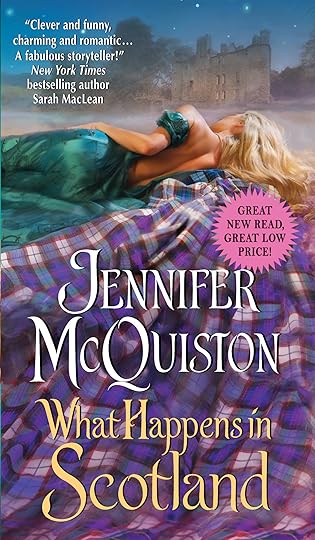
Why, you ask? My debut historical romance What Happens in Scotland is almost here!!! February 26th is the day, which means I have just under a month to bite my nails down past the quick (given they are already hovering in the vicinity).
The month before a debut author’s book release (at least, the month before my book release) is interesting, terrifying, and beautiful. After all, I’ve been waiting ten months for this, ever since I got that amazing call from Esi Sogah at Avon. And reaching even further back, I’ve been working toward this for four years, ever since I started writing my very first novel. In the writing world, both of those are shockingly brief amounts of time. But start to finish, four years is still longer than it took me to find, charm, and marry my husband. And ten months is longer than it took to cook to perfection and deliver my children.
More significantly, as my husband will calmly inform you, I am the sort of person who can graciously tolerate—at most—about two weeks of waiting.
Which means I am not feeling very gracious right now.
I am reaching for distractions like they are a tether to my sanity. My writing time for the past few weeks has been spent working on quirky blog posts that will populate the blogosphere and showcase (I hope) my sense of humor. Of course, there’s the inevitable backdrop of worry that when you guys actually read them and get to know me a little better you will realize I am just weird. I try to stay away from the Goodreads early reviews that are starting to pop up and not agonize over them, but given that they are the most tangible link I have to the fact I am about to be published, such discipline is proving elusive.
But am I excited, somewhere in the middle of all these nerves? Oh yes, there is more than a bit of that percolating. I welcome the excitement. It means I am not taking a single moment of this for granted.
 So now I am going do something important, given that I imagine those weeks around P-date are going to be a big blur. You see, I am not sure anyone other than authors ever read the acknowledgements page of books, especially e-books. So I am going to put my debut acknowledgements page out there now.
So we both have something to read while we are waiting for February 26th.
And before everyone figures out that I really am weird.
Without further ado, here are the people that I really need to thank, or at the very least, buy a round:
Like many debut authors, I owe an amazing debt of gratitude to an entire herd of people. Not just those who helped me with this, my first published book, but those who have helped me on the entire journey, which spanned three years and five completed manuscripts. First and foremost, I want to thank my supportive family, without whose love and support I could have never conceived of writing a book, much less completed one. My husband John deserves a special thank-you and probably a three week vacation for everything the spouse of an obsessed writer must endure. I am grateful for my mom, who made that all-important parenting decision that if I was old enough to sneak her historical romances under the covers, I was old enough to read them. Thanks to my sister Julie Hensley, who provided early critical feedback as I sorted out the business of being a writer, and who isn’t afraid to tell her literary genre colleagues I write “those books.” Thank-you to my beautiful girls for bringing me such joy. I love you dearly, but don’t assume every book deal = another new pony.
I owe a very loud shout-out (more of a shriek, really) to Georgia Romance Writers. I value every one of the friendships I have formed in this wonderful writing community, and cannot say enough good things about how much they support emerging authors. Thank-you to early beta readers Stacy Heilman, Allyson Reeves, Angie Stout, Colleen Wolpert, Anna Steffl, Laura Disque, Kristina McElroy, Daphne Ross, Terry Brock Poca, Noelle Pierce, Helene B. Chandler Rosencrantz, and Emery Lee, who read some truly awful stuff. Thank-you, as well, to published authors Meredith Duran, Courtney Milan, and Vanessa Kelly, who offered charity critiques I was lucky enough to win and smart enough to study.
No writer can succeed without amazing critique partners, and I owe a huge thank-you to Romily Bernard, Sally Kilpatrick, Tracy Brogan, Kimberly Kincaid, and Alyssa Alexander. These ladies always tell me when I get it right and never fail to point out when I write something too stupid for words. Thank you to Tony Bernard (a.k.a. Boy Genius) for the gift of my beautiful website. To Sarah MacLean, who gave me the loveliest cover blurb on the planet: thank you for your wild excitement, and your heartfelt advice; it means the world to me.
Finally, I want to express my sincere appreciation to the most patient agent on the face of the planet, Kevan Lyon, and to the amazing Esi Sogah and the entire team at Avon for making me feel wonderfully welcome. Here’s hoping I fulfill your faith in me!
That’s quite a list, isn’t it?
Imagine how long it SHOULD have been. I am sure I forgot someone, and if I did, I can only offer an apology and promise them TWO drinks.
For those of you who are interested in those two drinks and local to the Atlanta area, I would love to have you come out to my debut book signing. I will be at Eagle Eye book store in Decatur, GA from 7-8pm on Thursday, February 28th (signing alongside the fabulous Sophia Nash), and I promise I will have brandy-filled chocolates as giveaways. And then one week later, I will be signing at Mac McGees in Decatur, GA on Thursday March 7th from 7-8pm, and that all-important keg of Scottish ale will be tapped.
I even bought pens.
Until then, I’ll just keep dealing with this hamster in my stomach, and figure out how to feed him.
Something tells me he’s going to like those chocolates.
January 15, 2013
The Idiot’s Q&A on Horses in Historical Romance
This post appeared on the Dashing Duchesses on January 14, 2013. Guest poster Alyssa Alexander is one of my awesome critique partners.
Duchess Alyssa (a.k.a. The HORSE IDIOT): I must confess, horses terrify me. Big eyes, big teeth. Big hooves. Those hooves are scary. I have ridden a horse only once in my life, which resulted in significant bruises in places one should not have bruises. Therefore, I have stayed away from everything horse-related for many, many years, and don’t know a bit from a bridle from a forelock (fetlock?).
But Duchess Alyssa, you say. You write historical romance, where everyone rides a horse. Yes, indeed I do. And I have to research every single fact about horses and their various parts, saddles and their various parts, and how to ride and hold the reins. Clearly, I have no experience in that area (see above regarding bruises — I wish someone had told me what stirrups were for.) But even better than researching is asking an expert. It just so happens one of my critique partners is not only a veterinarian, but she has been riding horses for years and even recently adopted one, Mr. Beaux Regard. Isn’t he a handsome devil?
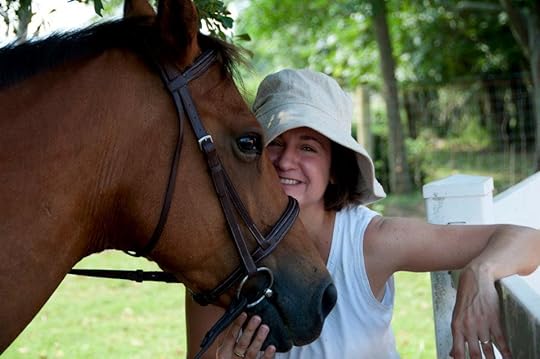
Duchess Jenni (a.k.a. The HORSE EXPERT): I must confess, authors terrify me. Big ideas, quick fingers. Big egos. But then you get to meet them and discover they are human! Just like… er… horses. As you might have surmised, I love horses… their intelligence, their wit (yes, a horse can be witty), even their smell. I am going to blame my love of historical romance on horses, too. I can’t imagine writing about any time period other than one in which dates occurred on horseback. In fact, I love horses so much that my debut book, the upcoming What Happens in Scotland, features a lovable stallion named Caesar as a prominent character. The only problem is the hero, James MacKenzie, had a rather wild night, and now can’t remember where he’s misplaced his trusted steed!
James pulled up in astonishment as the young groom emerged from the dark alley dragging a saddled horse behind him. The oddity of the morning’s exchange fell into place as the boy dodged a near miss of clicking teeth and dancing hooves.
The moment called for something dramatic, but James was at a loss for what a proper reaction should be. Beside him, his brother William started laughing, hearty guffaws that made the groom pink up in ignorant embarrassment and the anger churn red in James’s stomach. Of course this horse kicked down a stable wall. Of course James had left it here in a state of dim remembrance. It fit perfectly with the ridiculousness of the rest of his evening’s activities.
“Take it, sir.” The groom was practically begging now, handing over the snorting black horse as one would a lighted fuse.
James reluctantly reached out his hand and closed it over stiff leather reins that felt foreign in his hand. He gave voice to the thought tripping around in his head, though he doubted the question would win him any friends or do him any good.
“What is this?” He gestured toward the horse, earning a flattening of the animal’s ears for his trouble. “Is this some sort of joke?” He twisted around, expecting to see William bent over in laughter, having concocted this elaborate ruse merely for entertainment value.
The groom’s eyes widened in confusion. “It’s your horse, sir.”
“This is not my horse.” As if agreeing with him, the horse reached out and nipped at James’s waistcoat, ripping the fabric and taking a bit of skin, to boot. “My horse is chestnut.” He rubbed a hand over his newest injury and eyed the beast with irritation. “And male.”
So what does this idiot do when faced with a horse-related question? Execute a perfect Google-Fu dive into research, and then contact my horse expert to verify.
HORSE IDIOT: During my single, ill-fated attempt to ride, we primarily ambled along single file on a lovely forest trail (not that I saw much of it, as I was too busy trying to keep my horse from eating leaves and bushes as we walked by). But then the instructor said we were going to do something exciting – canter! Oh, joy! Except I didn’t know what that meant until my horse took off down the trail with me bouncing around in the saddle. Turns out cantering is painful. Later, I discovered there are four types of movement. Walk, trot, canter, gallop.
HORSE EXPERT: Oh, very nice! These are, indeed, the four basic gaits (and the term “gait” is the correct one to describe the various horse movements). To the novice, the gaits appear to roughly correspond with varying rates of speed (think of it as a car going from first gear all the way to fourth), with the gallop as the fastest speed. In truth, the gait of the horse has nothing to do with speed at all… it’s all in the position of the horse’s legs in relation to the ground and each other.
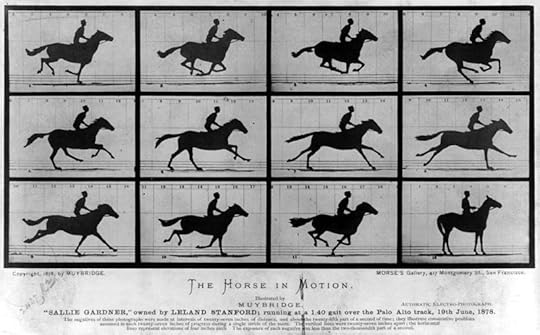
A walk has a distinctive four-beat pattern, with each hoof making separate contact with the ground. A trot has a front and back limb moving in tandem for a two-beat rhythm; the English rider usually bobs up and down in a motion known as “posting” to keep time with the horse’s trot. Otherwise… bruises (although, really, I would argue a good raucous wedding night could cause far more bruising than a ride on a horse!) A canter is a three-beat gait with one of the horse’s front limbs stretching out in front; even more confusing, there are different “leads” a horse can take, depending on which front limb (i.e. right or left) stretches out first). In a gallop, the fastest gait, only one of the horse’s legs makes contact with the ground at a time for a distinctive four-beat rhythm (see ye old historic rendering for reference).
Beyond these four basic gaits, there are a series of additional gaits that horses can be trained to learn. For example, there are different ways a horse can trot depending on the rhythm/sequence of their legs. A true trot has front/back limbs on opposite sides moving in tandem, whereas a pace has front/back limbs on the same side of the body moving together. Carriage horses are termed “trotters” or “pacers” depending on how their legs are trained to move. Then there are the so-called “gaited” horses like Saddlebreds, Paso Finos, and Walking Horses that are trained for big/flashy steps that make them almost seem as if they are rearing (going up on two back legs) as they move. Alas, I must divest the mantle of expert for “gaited” horses, as I have never ridden one.
HORSE IDIOT: One of the toughest parts of writing horse scenes is the time it takes to for characters to get from one place to another! If the hero gallops to the heroine’s rescue (or vice versa), how long will it take to get there? I had to look it up, of course. Wikipedia says the speeds are: 4mph for a walk, 8 mph for a trot, 10-17 mph for a canter, and 25-30 mph for a gallop.
HORSE EXPERT: The thing to keep in mind is that those are considered average speeds. You can have horses that are very fast trotters, making them move even faster than the “average” canter. There are horses that race using this gait while pulling a little carts called a sulky, and it is freaky-fast to watch. In contrast, you can also have very slow trotters. Looking at Western-trained horses as the example, a jog is a Western-style type of gentle trot. Head-to-head, my pony Beaux can probably walk faster than a horse at a jog. Also keep in mind that a horse cannot sustain a canter or a gallop for extremely long periods of time – those are “brief burst” gaits that cannot take a horse all the way from London to Edinburgh, in case you were planning to use these estimates to calculate time for travel.
HORSE IDIOT: Well, shoot. Guess I’m going to have to rewrite that scene. But now that I know how fast horses can move, what about size and age? Is a pony just a baby horse?
HORSE EXPERT: No, although it is easy to see why people might think that. A pony is just a horse that is shorter than most. A horse is measured in “hands” which is the equivalent of four inches. A fully grown pony is 14.2 hands or less from the ground to the top of the withers, whereas a horse reaches more than 14.2 hands at its full-grown height. Most folks think Mr. Beaux Regard looks like a horse, but he is actually 14.2 hands, which means he is technically classified as a pony. A baby horse or pony is called a foal (and a girl foal is called a filly, whereas a boy foal is called a colt). A “teenager” horse 1-2 years old is called a yearling. While we are on the topic of terminology, a female horse is called a mare. An intact (i.e. non-castrated) male horse is called a stallion, and a castrated male is called a gelding.
HORSE IDIOT: I once wrote a scene where the hero patted his horse’s neck and I had to look up whether or not horses had necks, or if it was called something else. Turns out it is actually called a neck, but what about that forelock (fetlock?) And what the heck is a hock?
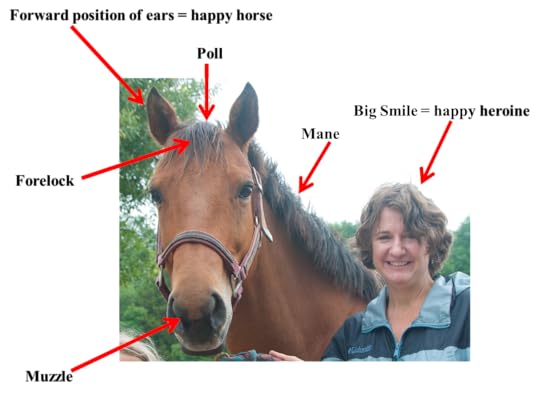
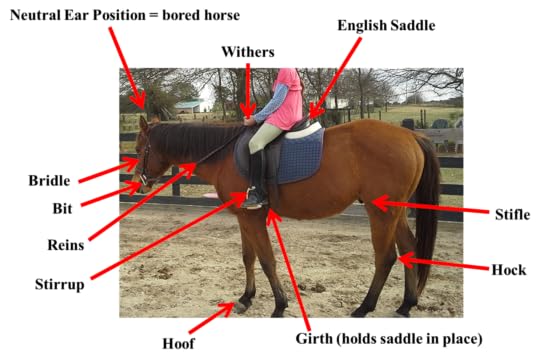
HORSE EXPERT: I am snorting with laughter about the neck. Neck, back, shoulder, tail are all pretty much as expected, but there are some oddities in the mix. From front to back, ten parts of the horse than a romance writer might need to know:
1) Muzzle- the nose. (Smooth and velvety – perfect for purple prose)
2) Forelock- the bit of hair that spills over between the horse’s eyes. (Could be likened to a hero’s rakish, windswept hair)
3) Poll – the rounded part of the skull just behind the ears. (Nothing sexy about this.)
4) Mane – the hair that runs along the horse’s neck. (Easy to compare to a heroine’s luscious, flowing locks. Although, you can pull on a horse’s mane and it won’t hurt them. I don’t recommend you try that with your heroine.)
5) Withers – the highest point of a horse’s back, rounded area just in front of where the saddle goes. A horse is measured by the distance from the ground to the top of the withers. (Not to be confused with what happens to the hero in cold water…)
6) Fetlock – the bottom rounded joint of the horse’s legs. Think: ankle. (Do not confuse this with forelock, or much reader hilarity will ensue.)
7) Stifle – the equivalent of the human knee, but visually higher than you expect, with the front curve starting the horse’s rear leg. (Not to be confused with the state of women’s rights in the Victorian era.)
8) Hock – the pronounced curve at the back of the rear leg. (Do not have the hero compare this to any part of the heroine. Trust me – it doesn’t work)
9) Hoof – the hard foot of the horse. A bit like our fingernail, it needs to be trimmed regularly by a strapping gent called a farrier. (Someone really ought to make a romance hero out of one of them… they have delicious muscles and spend the day bending over.)
10) Sheath – part of a male horse that would bring a distinctive flush to a well-bred lady. (Enough said.)
HORSE IDIOT: Snicker. You might laugh about the neck, but I’m laughing about a hero pushing back his rakish forelock while admiring the shapely stifle and pronounced hock of the heroine. But going back to the fact that I find horses scary (remember those big teeth and sharp hooves!), why are horses bad-tempered sometimes?
HORSE EXPERT: Well, why are you bad-tempered sometimes? Tired, hungry, in pain, misunderstood… that time of the month? All of those same things can throw a usually well-tempered horse into a tailspin. Horses need regular rest, attention, love. They are herd animals, and if they are deprived of contact with other horses and kept in a stall except to work they can become very annoyed with the world. Female horses are also hormonally influenced, and when they are in season they can want nothing to do with work or play or you.
HORSE IDIOT: So how can I tell whether the horse is in a good mood, or whether I should start dodging hooves?
HORSE EXPERT: While it is true that a horse’s feet will probably pose the most immediate danger to you (and the hind limbs can do the most damage because they can kick powerfully backwards), what you really want to be watching is their ears. The horse’s ears are the window to their soul. A horse rarely strikes out without first giving an indication it is really not happy with you. When a horse is miffed, it sweeps its ears backward until they lie almost flat against its head. This is a sign that may as well flash “Danger, Horse Idiot!” It is somewhat analogous to a dog growling, which most do before they bite. In general, this is an excellent cue to get the hell out of the way. A happy horse has its ears perked forward, exposing the open surface toward whatever is interesting it. A neutral-eared horse is also usually fine to be around.
HORSE IDIOT: So now I have to watch teeth, hooves and ears? Because I can guarantee I’m still going to be keeping those hooves in my sight. But at least now when my heroine’s horse kicks the villain, I can add the detail about flattened ears. Thanks, Duchess Jenni, for sharing your horse knowledge with this idiot!
HORSE IDIOT Alyssa Alexander writes historical romantic suspense and attempts to include accurate horse-related details. She lives in Michigan, where her domesticated household animals include a husband, a small boy and a very stupid cat. She does not own a horse. Or a pony. Or even a picture of a pony.
HORSE EXPERT Jennifer McQuiston writes stories that have been called “fairly unrealistic, but still a ton of fun to read” by at least one well-meaning reviewer. Her debut historical romance, What Happens in Scotland, will be released February 26th. She lives in Atlanta with handsome Mr. Beaux Regard, the pony she promised to buy her little girls with her first book deal. Be careful the deals you make with the devil, my friends: fairy tales do come true.
December 19, 2012
Lady Georgette’s Brandy Chocolate Truffles
This post first appeared as a December 10th, 2012 feature on Avon Romance.
“Though she would never admit it to polite Society, Lady Georgette Thorold hated brandy almost as much as she hated husbands. So it was the cruelest of jokes when she awoke with nary a clue to her surroundings, smelling like one and pressed up against the other.”
So begins my upcoming debut novel, the Victorian-set What Happens in Scotland, which will be released February 26, 2013. A bottle of brandy and a handsome Scotsman lead our widowed heroine, Lady Georgette Thorold, to do some very interesting things.
Even if she can’t precisely remember them.
To celebrate Lady Georgette’s forgotten night of debauchery, I present to you my own personal take on Brandy Chocolate Truffles. Any well-bred lady—even one lacking basic culinary skills or a personal chef—could make these easy mouthfuls of sin! They are worth a go, especially if you can find a handsome Scotsman to share them with.
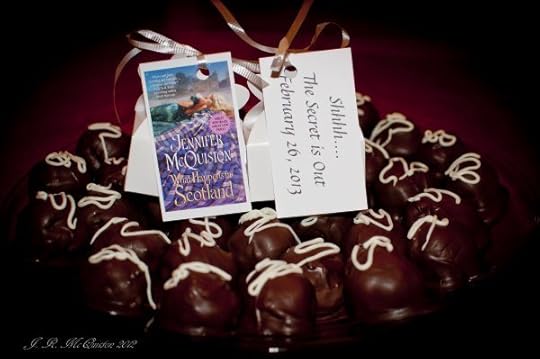
· The recipe begins with a batch of brownies made according to box instructions. (Gasp! So easy! Your snobbish friends won’t know if you don’t tell them!) I admit some partiality to Ghirardelli Chocolate Supreme Brownie mix. These brownies are rich and decadent, and almost (but not quite) a dark chocolate.
· Once the brownies have cooled, I take a fork and vent my frustration about not actually being able to afford a personal chef by poking small holes all over the top. Next I take a good French brandy (say, about a quarter cup per batch. Feel free to use more if you are having one of “those” days). I sprinkle the brandy by scant spoonfuls evenly over the brownies, then place the brownie-brandy mixture in the refrigerator to chill completely (overnight works best).
· Once the mixture has chilled, I roll a spoonful into ¾ to 1 inch balls with my hands. I usually roll the entire batch before beginning the next step, and chill them again.
· Melt your favorite chocolate candy coating by whichever method you prefer. I use Kroger Brand Candy Coating Chocolate (found in the baking aisle). This comes in an oh-so-convenient microwavable tray that makes melting a snap. Er…that is, if proper ladies actually used microwaves. Once melted, I keep the warmed chocolate in a fondue pot so it stays at the right temperature. I dip the chilled brownie balls in the heated chocolate, and then cool them on waxed paper.
· Once the truffles have hardened, I put a whimsical bit of white chocolate candy on the top. I buy the tubes that just require you to heat and squeeze (I get these from my local candy-making shop, or you can buy them here.)
· 2 boxes of brownies, 3 trays of candy coating, and 1 white chocolate writing tube make 60 truffles.
I almost feel as if I should apologize for revealing such a simple secret recipe, but then, a lady never apologizes if she can help it. These delicious truffles will have people thinking you are either a culinary genius or retain one on staff.
That is, if you choose to share them. These are so good you might just decide they are the perfect accompaniment to your own night of debauchery.
September 18, 2012
Not So Fun in the Sun: A History of Women’s Swimsuits
This blog post appeared on the Dashing Duchesses September 17, 2012
As summer winds to a close, I always breathe a sigh of relief at being excused from public viewing. It isn’t that I don’t love the beach – it is my chosen vacation spot, and I count a beautiful beach on St. John as my favorite place in the entire world. But why can’t I swim in shorts and a T-shirt, as I suspect would be not only more comfortable, but also more functional? Why must what I wear while swimming be dictated by fashion standards that reward youth and beauty over skill and experience?
Because let’s face it… if given the choice, I would always rather be able to swim to shore than look cute while drowning.
Whether you are of the modest variety of sea bather or a more daring sort of sun worshiper, a glimpse at what defined “swimwear” in bygone days is an interesting topic of study. I developed an interest in historical women’s swimwear when I was researching my current work-in-progress, a Victorian-era romance set in the British seaside resort of Brighton. I found the topic and the visual examples I uncovered both fascinating and cringe-worthy.
 Some people are of the mistaken opinion that prior to the twentieth century, women didn’t swim. In truth, female swimming was popular during the height of Greek and Roman influence. Artwork surviving from this time suggests that women of this era did swim, and sometimes in the nude. Some artwork also displays women wearing bathing costumes, including 2-piece ensembles that could be argued to resemble some bathing suits of today.
 There is little in the research record to describe the options available to women in the intervening years between the fall of the Roman Empire and emergence of true women’s swimwear in the early twentieth century, and society did not embrace the idea of women swimming in either Britain or America until the beginning of the 20th century. While the rising popularity of the British seaside holiday is well-documented even in the 1700’s (with Bath and Brighton quickly rising in prominence as the destination to visit), the Victorian notion of an idyllic seaside holiday required gender-separated beaches. In addition, at most British sea resorts, bathing machines on wheels were constructed so the modest woman could splash about in privacy and not risk being seen in a state of dishabille.
 Of course, women in this time period weren’t really “swimming.” They were partaking of a sea bath under controlled circumstances, namely being wheeled out to the breakers in bathing machines and then being tossed into the water for a quick dip before being hauled back to safety by an attendant. In this time period, women’s swimming costumes were designed with one purpose in mind: to disguise the contours of the body, presumably to prevent the men onshore from going berserk with carnal desire. Women of this era didn’t really swim, and was it any wonder? They were in danger of being dragged under by twenty yards of sodden wool the moment they set foot in the water. And then, of course, there was the imagined danger of being accosted by the poor, lustful fellows if they showed up on shore in anything less than a corset and crinoline.
Swimwear during this time usually consisted of robes or large, shapeless dresses with the hem sometimes weighted down to prevent the garment from floating up immodestly. Woolen fabrics and flannel were preferred because they were felt to be warmer to the body, and therefore more suited to a woman’s delicate constitution (apparently they were unconcerned with the actual weight of the thing while wet, as long as it didn’t give a chill). Later in the 19th century some women adopted a two-piece ensemble of top and pantaloons, but it still offered the advantage of disguising a women’s shape, and limbs were kept very properly covered.
 It may have continued in this very unpromising vein if not for a daring woman named Annette Kellerman. This Australian-born swimmer shocked the prurient world when in 1907 she showed up at a swimming demonstration showing her arms and her legs in a custom-made one piece bathing ensemble. Oh the horror! Presumably Miss Kellerman understood that the key to effective acrobatic swimming was some freedom of movement. She was arrested for her audacity, but she had effectively challenged the notion that women could not bare their limbs while swimming, and the notion of the modern female swimsuit was born.
 At the turn of the 20th century, swimsuits still resembled more actual clothing than specialized swimwear. But fashion began to play a more important role in women’s choices, and being seen, rather than hiding, became the object of the game.
While the first two piece, called a “bikini”, was introduced in 1946, alas, Society was not yet ready to bare the navel. The bikini had to wait until the free, fun-loving 60’s to make its next regular appearance on the bodies of brave young women everywhere. And then, finally, the men could legitimately go berserk with carnal desire.
I believed I mentioned that functionality was my main concern? Er… yes. My suit of choice is a skirted tankini, mainly because I can excuse myself to use the water closet without a ladies’ maid in tow. So, gentle readers, I ask you: if you COULD cover a bit more of yourself, would you choose to do it? Or is there truly no such thing as peer-worthy swimwear?
June 7, 2012
An Interview With Historical Romance Author Cecilia Grant
This interview first appeared at the Dashing Duchesses blogsite.
I am so pleased today to bring you this interview with new historical romance author Cecilia Grant. I discovered the lovely Lady Cecilia when she commented on a blog posting I had made describing my penchant for unusual plotlines. In point of fact, I was beginning to wonder if I just didn’t fit in, either as an author who tended to write romantic plotlines that revolved around such things as a “syphilis misunderstanding”, or as a reader who yearned for more than the average Regency ballroom scene. Cecilia was so enthusiastic about some of my described works in progress that I sat up and took notice. Maybe there was an audience out there for odd ducks like me. Thus, when her debut came out in January, I snatched it up to see what was skittering about Cecilia’s head.
If you missed Cecilia Grant’s incredible debut A Lady Awakened, you quite simply need to be boxed about the ears. Rectify that travesty immediately, please. Prepare yourself, though. Your expectations of romance and courtship are about to be turned upside down. The first half of the book has some of the most gut-wrenchingly awkward intercourse you are ever going to read. And it is going to make you howl with laughter, even as you cringe for the train wreck unfolding masterfully before your eyes.
 Jennifer’s summary for A Lady Awakened: Mrs. Martha Russell is a most pragmatic sort of female whose husband has just kicked off without an heir, leaving the country estate to Mr. Russell’s philandering, servant-abusing brother. Martha feels responsible for protecting the people she holds in her charge, and realizes she and her currently empty womb are the remedy to the problem. If she produces an heir in a timely fashion, said smarmy brother will be held at bay and the virtue of the servants and the farmers’ wives will be safe. Enter Theo Mirkwood, a young rake who has been cut off and banished to the country for frivolous excess (a.k.a. the stud who agrees to fill said empty womb. For pay.) Theo’s willing to take on the needs of the pretty widow, and concludes this will be a pleasurable interlude for his country penance. Only, Theo quickly discovers Mrs. Russell isn’t interested in anything close to pleasure.
With this setup, one’s interest is definitely piqued. However, what makes A Lady Awakened such an incredible story is how deeply the characters are drawn, how sympathetic they seem despite their truly horrific choices. Ms. Grant’s voice is stellar, perfectly capturing the humor and disgust of the necessary intimacy that must occur, with horrifying frequency, to a woman who is absolutely convinced of her martyrdom and determined to not enjoy the process of getting there. And Theo’s character evolution from a man used to taking his own pleasure, to a man determined to deliver hers, is subtle yet stunning.
 Cecilia’s next book in the series, A Gentleman Undone, was just released yesterday, May 29th 2012, and is available wherever books are sold. I have been waiting for more Cecilia Grant to read for four long months now, so I cannot tell you how happy I am about this. Without any further chattering on my part, I give you the lovely Lady Cecilia!
1) Cecilia, tell us a little more about your newest release, “A Gentleman Undone”. Does it follow any characters to whom we were introduced in your debut?
Thank you for inviting me to visit with the Dashing Duchesses, and I love that you made me Lady Cecilia instead of Her Grace Someone-or-Other! I will assume I’m an earl’s daughter, like Lady Catherine de Bourgh. If I’d only learned to play the piano, I’m sure I would have been a great proficient. No one can have a finer natural taste in music than I.
A Gentleman Undone follows the one Blackshear sibling we didn’t meet in A Lady Awakened: Martha’s brother Will, second-youngest of the family, who was away in the Napoleonic wars during that book. It’s the spring of 1816 now, he’s back in London, and, armed with a somewhat overdeveloped sense of duty (runs in the family), he’s determined to fulfill a promise to a fallen comrade by providing for the man’s widow.
This will take money, so he ventures into a semi-respectable gaming club and tangles with unscrupulous cardsharp Lydia Slaughter. She’s fifty shades of wrong for him (to begin with, she’s another man’s mistress) and therefore, of course, she’s exactly what he needs.
Readers have asked me whether Martha and Theo appear in this book; yes, they do. Martha’s and Will’s other siblings – Andrew, Kitty, and Nick – appear as well. And there’s actually a supporting character here who had a single passing mention in A Lady Awakened, though that’s something I did mostly for my own amusement and I’m not expecting people to notice it!
2) That sounds amazing, and almost the opposite sort of story to your first. I love it that you are exploring many types of stories and moral dilemmas. Please, please, please tell me there is an unusual plotline in your new release!
Honestly, I don’t think there’s a whole lot unusual in the plot (I’m not a very plot-oriented writer to begin with), but I did try to twist the core relationship dynamic as much as I could. “Wounded man/healing woman” is such a prevalent dynamic in romance; I wanted to explore the question of what happens if the wounded man meets an adamantly un-healing, wounded-in-her-own-right woman.
There’s this thought Will has, when the two finally go to bed together:
Maybe this was what he’d needed all along. Not a pure-hearted woman who could lift him out of darkness, but one who dwelt there herself. Already corrupted to such a degree that nothing remained to ruin. Incorruptible, now, more incorruptible than the most virtuous maiden.
That’s sort of a recurring theme, that “eye of the hurricane” notion that the way to redemption might be by walking straight into the heart of one’s darkness or corruption, instead of trying to run the other way.
Apart from that, I’d say the book is probably unusual in its amount of sheer detail about blackjack strategy. (It gave them something to talk about while stealth-flirting.) Also, this may be the only romance out there that contains an explanation of the Game Show Paradox 
3) Blackjack… my favorite Vegas game! Ahem. Not that this lady err…. gambles. Aside from describing such gentlemanly pursuits as gaming, most romance authors are praised for their ability to write a lovely, soul-touching sex scene. Your brilliance, in my humble opinion, is that you can also write an inept one that is every bit as memorable. What was your inspiration for Martha and Theo’s initial awkwardness in “A Lady Awakened”?
Oh, I just love bad sex. It gives a writer the opportunity to explore so many compelling emotions: disappointment, awkward self-consciousness, that lonely sense of distance from the other person, maybe even shame and anger. Also, I think – I hope? – it’s just as universal an experience as good sex, so readers can relate to it with that special sort of sympathy with which we relate to others’ humiliations. To me, that’s maybe even more soul-touching than the good stuff.
In general I don’t believe romance novels necessarily have to function as fantasy, and I like the idea that a relationship can transcend an ungainly beginning to become something lasting and worthwhile.
4) Speaking of reality versus fantasy, one of the things I enjoyed about “A Lady Awakened” was that it painted a beautifully honest picture of English country life, including the immense responsibilities of estate management. How did you research such things?
I had a few books, although those tend to concentrate on the big historical/political picture rather than the day-to-day human angle. My favorite research source for those details is small “hobby” blogs. When I needed to set scenes in a church, I found some guy’s blog where he was cataloguing all the rural churches of Sussex, with helpful photos. When I needed to have some grain go through a mill, I found someone’s explanation of different kinds of historical mills and how they worked. When I had a farm family doing laundry, I found documentation of how it was done back then.
None of these were big official educational blogs; they were just labors of love by people who found the subjects interesting enough to want to put up what they knew online. That’s the internet at its best, if you ask me.
5) In “A Lady Awakened”, both the hero and the heroine make some early moral mistakes that would tempt some readers to condemn them, but which are deftly enough executed to render the characters sympathetic. Is there anything you could never bring yourself to allow a character to do?
This is a great question, because as soon as I think of an answer, I think, “But I should try that because it would be such a challenge!”
Well, the thing that immediately jumps to mind is rape. I don’t see how you redeem a guy who’s done that. (No, I haven’t read To Have and to Hold. People keep telling me to, but it’s hard to find a copy!) Really, anything that involves taking pleasure in someone else’s terror is just overwhelmingly difficult for a hero or heroine to come back from, in my opinion.
Romance is a great genre for exploring questions of morality, though (actually, now that I think of it, most genre fiction is great for that – look at detective noir or sci-fi), and so I think I’ll always be drawn to heroes and heroines whose character flaws lead them into shady actions or moral mistakes.
6) What’s on tap next after “A Gentleman Undone”, and when can we expect it?
A Woman Entangled is scheduled for next spring. It’s sort of a “one generation after the fairy-tale ending” premise: heroine Kate Westbrook is the daughter of a society-defying true-love match between an earl’s son and an actress. Embarrassed by her eccentric family and sick to death of living in a social no-man’s-land, she’s determined to find a way to claim all the consequence that ought to belong to the stunningly beautiful granddaughter of an earl.
Sometimes abetting her and sometimes thwarting her schemes is her father’s young barrister colleague Nick Blackshear (brother of A Lady Awakened’s Martha and A Gentleman Undone’s Will), who’s dealing with his own family shame because his brother just married a courtesan. And as Kate gets closer to realizing her ambitions, she begins to recognize an inconvenient attraction to Mr. Blackshear… just as he’s finally getting over his own long-standing crush on her. Complications ensue!
That sounds amazing too. I am currently writing about a long-standing crush myself, and they have so much potential for mayhem. Thank you so much for joining us today Lady Cecilia! It has been lovely discovering the woman behind the voice.
May 13, 2012
Hero Material
 Historical Romance 101 would tell you that every hero needs a horse. In my case, the heroine needed the horse. And against all odds, my hero just came through. Big Time.
I grew up with horses, and as a girl I was never so happy as when I was riding hell-bent and bareback across the pasture on my pony. There was a time I couldn’t imagine living without a horse. But then I grew up and life took over. While I certainly found a hero in my wonderful husband, horses haven’t exactly been part of our Happily Ever After. I took lessons for a while just to breathe that horsey smell, but when kids came and life got complicated, horses were the first thing to go. I promised my husband that I would not burden our family with the enormous responsibility of an animal that more or less qualified as a third child. But I never stopped dreaming.
And then I got backup. My two little girls have turned out as horse-crazy as I had once been.
And so I asked my hero, “What would it take to get a pony?”
“A million dollars,” came his answer. Which was hard to refute, because horses are ridiculously expensive to keep in Atlanta.
“What about a book deal?” I asked, tossing out the one crumb that *might* be more likely to come true than winning the lottery.
“It would have to be one hell of a book deal,” he said emphatically. Because after a year of solid rejections, I had finally been rather honest with my husband about my little hobby: chances were I would never recoup the money I had already spent on writing contest entries and business cards. But he agreed on an amount (which I suspect seemed unlikely at the time), and we more or less shook hands on the dream.
And then my fairy godmothers (a.k.a. Esi Sogah at Harper Collins Avon and my agent Kevan Lyon) came to the rescue, whipping out the book deal we had been dreaming of. My girls were thrilled, my husband wide-eyed. Holy crap. The McQuistons were getting a pony. My husband had promised. And he didn’t balk, though I suspect the idea terrified him a little.
Our new horse arrived today in a torrential downpour, looking bedraggled and confused but happy to be fawned over. Beaux Regard is an 8 year old registered paint pony (although he is a solid color, his parents were both paints). He is officially a pony, coming in at a sharp 14.2 hands. I pretend he’s for the girls, but I don’t deny I am as excited as they are. And my hero was there snapping pictures, every step of the way. My husband commented a moment ago about how smiley I looked in the pictures. Happier than even the kids, perhaps the happiest he’s seen me in a long time. And I just smiled some more.
Thank you honey. Now it’s a Happily Ever After.


