Kaitlin Bevis's Blog, page 2
June 17, 2025
Creative Writing: World building Camp
Today we started Creative Writing World Building Camp! After a what-if creative writing technology, where we imagined the ripple effects from a physical change, social change, magical change, and technology change (pulled from current events) and how they’ll impact the future 50, 100, 500 years from now, we went over some basic terms of Speculative Fiction. Then we discussed the continuum of hard systems to soft systems. Mostly, you’ll hear about this in terms of hard magic and soft magic, but the same rules apply to technology and real world skills. Think medical dramas. The real life hard rules of medicine matter a lot in some fiction and in others, there’s a softer system of medicine in play where really, the hospital is more of a setting that contributes to the atmosphere of the show rather than a medical mystery to be solved.
After lunch, we broke talked about how climate and weather can be used to intentionally set the mood and tone of a story, so the campers started creating the climate of their worlds (or realistic settings) and what weather may be occurring during key scenes.
Check in tomorrow to see what learn on day two of world building!


June 13, 2025
Day 5 of Plot and Structure Creative Writing Camp
Today was the last day in plot and structure camp. We reviewed The Snowflake Method, the Pixar Story Spine, the three act structure, and other plot structures. We also reviewed some world building, characterization, description writing, and scene building. Most of today was dedicated to finishing up our writing anthology, and we closed with an author signing.
Did you enjoy this creative writing camp? Be sure to check in Monday for the beginning of Creative Writing: World Building Camp to learn about creating new worlds, designing magic systems, and more.
June 12, 2025
Creative Writing Camp Day 4 plot and structure
Today, in plot and structure camp, we reviewed The Snowflake Method, the Pixar Story Spine, and the three act structure. Then we broke down the movie Lilo and Stitch into the three act structure. We saw the live action one, but this link to the animated version will mostly match.
For additional resources on endings, click here and here where I break down Lilo and Stitch (which is what we saw for our field trip the second half of the day). Then we talked a little bit about world building and the ripple effect of making changes to a world. Take a look at the slideshow to see what happens when you make a seemingly small change.
Want to follow along with my creative writing camp? Tune in tomorrow to see what we learn next.
Creative Writing Plot and Structure Camp Day 3
Today, in plot and structure camp, we reviewed The Snowflake Method, the Pixar Story Spine, the first act and the second act of the three act structure. We also reviewed try fail cycles, the darkest night, and character goals.
We also went over Act 3, which includes The Road Back, the climax, and the ending. For more details, click the links to view my other posts on this topic.
For additional resources on endings, click here and here where I break down Lilo and Stitch (which is what we saw for our field trip the second half of the day).
Want to follow along with my creative writing camp? Tune in tomorrow to see what we learn next.
June 10, 2025
Plot and Structure Creative Writing Camp: Day 2
Today, in plot and structure camp, we reviewed The Snowflake Method, the Pixar Story Spine, and the first act of the three act structure. We also went over the second act of the three act structure which includes try fail cycles, the midpoint, fun and games, and the darkest night. We also discussed character goals and how they add tension when they conflict with each other. For more details, click the links to view my other posts on this topic.
Want to follow along with my creative writing camp? Tune in tomorrow to see what we learn next.
June 9, 2025
Plot and Structure Camp: Day 1
Today, in plot and structure camp, we went over The Snowflake Method,the Pixar Story Spine, and the first act of the three act structure. For more details, click the links to view my other posts on this topic.
Want to follow along with my creative writing camp? Tune in tomorrow to see what we learn next.
June 4, 2025
It’s almost time for summer academy

Next week, I’ll be teaching Creative Writing 1 at UGA’s Summer Academy. Creative Writing 1 primarily focuses on plot and structure. Space is still available if you check out UGA’s website, but if you can’t make it in person, I’ll be posting a daily breakdown of the topics covered here on this blog! Tune in Monday for Creative Writing 1: Plot and Structure.
March 11, 2025
Ask Me anything: Mirja

Using my Ask Me Anything page, Mirja said,
My name is Mirja, and I am currently writing a research paper for school on “The Modern Adaptation of the Hades and Persephone Myth in Contemporary Literature.”
I admit your Persephone Trilogy is something I just picked up about a year ago, a teacher of mine told me about it, but it became one of my favourite Hades and Persephone retelling books, and I fell so in love with it that, along with other books I read over time, it inspired me to write my research paper on this topic.
In my paper, I explore how and why this myth is reinterpreted, transformed, and often romanticized in modern literature. Specifically, I aim to analyze how the myth of Hades and Persephone is received and potentially reinterpreted, why this particular myth has been chosen as the foundation for a modern novel, and what factors or reasons contribute to its transformation.
I would be incredibly grateful if you could answer a few questions about your approach:
Thank you for your interest! I’m glad you enjoyed the books, and I’m pretty excited that your professor recommended them! I’d love to answer your questions
First up:
“What made you choose the Hades and Persephone myth as the foundation for your novel?
To me the Persephone myth always felt unfinished. Every version I heard growing up told the story from Demeter and Hades’s perspective. We’d get cameos from random humans suffering the unexpected winter, bits of Zeus and Hermes, and from the goddess herself, pretty much nothing. No motivations, no feelings, just the facts. She ate six seeds. She didn’t pass the sexy lamp test. Even her name, which prior to being abducted was the Greek word for “girl” didn’t give her an identity. She was entirely defined by her importance to everyone else. I wanted to know her story, so I wrote it.
“How do you interpret the original myth? Many people see it as a story of abduction and a toxic relationship between Hades and Persephone, what are your thoughts on that? “
As told now, the myth of Hades and Persephone is a horror story. A woman is kidnapped, raped, and forced to live with her rapist for a portion of every year. Toxic isn’t a loaded enough word to describe that. It’s no surprise she goes from the whimsical girl picking wildflowers in the field to the terrifying Iron Queen Orpheus describes. But it’s not just willful ignorance of those facts that leads to the many romanticized versions of the myth. The version we’d consider the “original” is a conglomeration of oral retellings from multiple regions of Greece, which was almost certainly adapted from an even more ancient legend. Each region had their own twist, their own customs, and their own interpretations. Demeter and Persephone actually predate the vast majority of the Greek pantheon, and were reinterpreted to fit into what became the classic myths once they came around later. A great source to trace the various spin offs that became the myth we’re more familiar is the book, Life’s Daughter, Death’s Bride by Kathie Carlson.
Why did you choose to alter certain aspects of the story?
I chose a route that allowed me to honor as many version of the myth as possible without taking Persephone to a darker place than I was prepared to write. I introduced Boreas as the villain because his myth is strikingly similar and allowed me to use the entire structure and threat of rape/abduction/winter and to make it very, very clear that there’s nothing romantic about that version of the story. With Boreas as the villain, Hades could rescue Persephone rather than abduct her, but rather than rescuing a willing bride from an overbearing mother as some versions of the myth suggest, he’s rescuing her from the most toxic version of his myth. Though he does help her see some of her mom’s protective tendencies are a bit problematic, so there’s shades of that version in there as well.
Why do you think modern audiences are so drawn to these new versions of the myth?
I think there’s something vital missing from the conglomeration of the different versions of this myth into the one told today, and that when something is missing from a story, our narrative driven brains can’t help but try to finish it, whether that happens through reading or writing or painting or any other artistic expression, I think the Persephone myth is everywhere because we’re all trying to fix it.
What factors have contributed to its growing popularity?
Social media. Persephone is not a newly popular myth among writers, audiences are just much more visible and connected now. As someone who was reading YA lit, romance, fantasy, sci-fi, and horror in the 90’s, I can promise you that references, thinly disguised retellings, or outright retellings were everywhere. I read enough stuff that predated me to find it there as well. Heck, the myth even had a “revival” in Hellenistic Greece. Something about that myth resonates, and it’s never stopped being popular.
Do you believe contemporary pop culture—particularly trends like Dark Romance and platforms such as BookTok—has influenced the way the myth is perceived today?
Short answer: Yes. Long answer: I’m a big believer in reader’s response theory, which is the idea that a reader brings meaning, intended or otherwise, to the text with them. Every reader/viewer/listener/participant in any form of media brings their own experiences, beliefs, emotions, and culture to any story they’re exposed to. Separating out that response to the author’s intent requires a lot of contextual knowledge about the author, the society they grew up in, trends, polarizing issues, and a great deal of conscious effort. Even then, the consumer can’t perfectly separate their personal interpretations and biases from that media.
Retellings occupy a pretty fascinating space in media because they’re almost always a response to the original myth from a person in an entirely different context than the first version originated from, and any reader reading a response is going to respond with their own context in mind, creating this crazy layering effect. Stack a few centuries of retellings on that (and keep in mind, no one alive has actually interacted with the original because the first Persephone myth was an oral retelling, and even the region that originated in is a pretty intense debate), and in one tiny myth, we have what might be the world’s longest conversation.
In what ways do you think the Hades and Persephone myth continues to shape literature and popular culture?
Persephone is at its core a cautionary tale full of universal roles I can’t see going anywhere as long as people are people. As long as there are overprotective parents who are willing to scorch the earth to shelter their children from a terrifying world, Persephone is going to echo in popular culture. As long as there are children who want to be freed from the very constraints they take comfort in, there’s going to be debate about whether or not she was a willing participant in her abduction. As long as people who feel more at home in the solitude of shadows can look at someone completely their opposite and feel like its their first time seeing the sun, there’s going to be sympathy for Hades, and as long as there are monsters who prey on innocents, there’s going to be condemnation for him. The Persephone myth is going to be referenced, alluded to, and outright retold as long as there are stories.
I hope this helps with your research! Good luck!
March 9, 2025
Ask me Anything: Scott
Using my Ask Me Anything page, Scott asked, “When are you continuing the daughters of Zeus series? I’ve been dying to read more of it.”
Scott, I’m so glad to hear that you enjoyed the series! There is an Artemis series outlined and (very) roughly drafted. It took a back seat so I could pursue a different project, which I just finished yesterday. So, I’ll be turning my attention back to the Daughters of Zeus while that other project makes its way through the publishing world.
I never intended to go so long between series. I wanted to get one or two more books out that weren’t under the Daughters of Zeus umbrella as a bit of a palette cleanser between series, and to explore some other interests. The first of those books came out in April of 2019. I made pretty good progress through 2019 and 2020 before the world ground to a halt due to covid, which you would think would be great for writers, but surprise homeschooling my daughter for two years took a lot of my creative energy and time. Then when she went back to in person school, I got an amazing opportunity in my day job to shift from teaching to school librarian. I’ve absolutely loved every second of my new job, but it was also a huge investment of time and creative energy while I found my footing. There were also the typical personal obstacles in that span of time that compounded the delay. Some illnesses, some losses. Some major transitions.
But my daughter is now a thriving high school student, far beyond my ability to homeschool, I’ve had enough time at my new job to settle into a routine and not reinvent the wheel for every lesson and event, and while life always has fun curve balls ready to throw your way, with my working day finally stabilized, I’ve *finally* made my way back into a healthy writing routine. I’m super excited for my new project to make its rounds, and I’m ready to go back to the familiar world of the Daughter’s of Zeus.
In addition to Artemis, my daughter has recently become obsessed with Epic the Musical (which is amazing, and you should definitely check out if you haven’t yet.) and has been *begging* me to write a prequel series about the Trojan War with Cassandra, Helen, and Athena that she very much wants to lead into Athena’s point of view on The Odyssey. I absolutely love all the lore around the Trojan War, and I grew up on The Odyssey, but the amount of research that would have to go into that to do it justice is daunting, so for now, I plan to stick to modern day.
But who knows what the future will bring.
January 8, 2025
Persephone is on sale for .99 cents
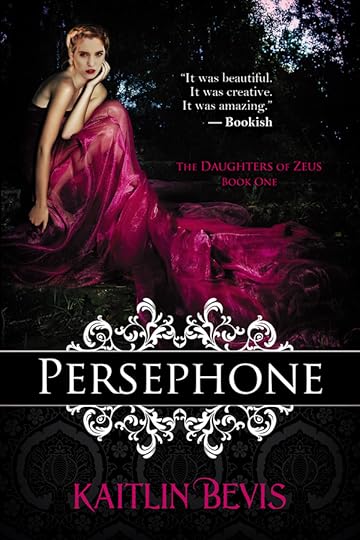
Brr, it’s cold. Boreas is hyper active this winter, even here in Athens, Georgia. It’s the perfect weather to curl up with a good book. Check Persephone out while this sale lasts.