Amanda Cockrell's Blog, page 3
October 8, 2014
The Day of the Dead
It’s October again, and I start to think of the Ancestors, and those more recently lost, still beloved, still remembered.
The Day of the Dead is near, and I start thinking what they would like. Chocolate and gin for my mother. Bourbon for my father, and a good poker game with old pals. For my daughter, maybe the fourth pug we just adopted. The pugs are her fault, sort of. She longed for one and we finally gave in. We still have that one, elderly and imperious, and a bit deaf. The other three accreted somehow, so I’ll put their pictures and some dog biscuits on the altar for her, beside the miniature purse I bought at Target.
Time to bake, for the dead and for our friends, and the annual party we throw to remember our dead and theirs. Tamales, and empanadas, and Pan de Muertos and chocolate skulls, because the Day of the Dead isn’t a timid holiday. It’s the day we remember that we are all bones under the skin, all dancing into the next world.
The leaves are turning, scuttering across the yard with the wind behind them, and the borders between the worlds are transparent at this hinge point of the year. The kitchen is full of chilies, and beer to go with it while we stir. Coriander for healing, and cinnamon for love and lust. Chilies are a charm against spells, important when the doors stand open to other worlds, but also for fidelity.
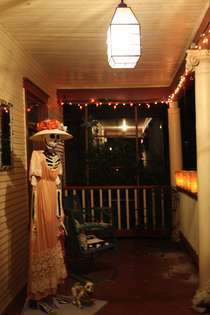
We’ll fill vases with marigolds, little bright flowers of the dead, and calla lilies for the Virgin and for rebirth. We’ll unpack the sugar skulls and art accumulated through the years; put the skeletons on the porch, satin finery over their papier maché bones so the spirits know they’re welcome. No one is sure when the dead arrive at the party, but they do, unseen, in a breath of ginger cologne, a rustle of silk, a small warm wind.
Read More
The Day of the Dead is near, and I start thinking what they would like. Chocolate and gin for my mother. Bourbon for my father, and a good poker game with old pals. For my daughter, maybe the fourth pug we just adopted. The pugs are her fault, sort of. She longed for one and we finally gave in. We still have that one, elderly and imperious, and a bit deaf. The other three accreted somehow, so I’ll put their pictures and some dog biscuits on the altar for her, beside the miniature purse I bought at Target.
Time to bake, for the dead and for our friends, and the annual party we throw to remember our dead and theirs. Tamales, and empanadas, and Pan de Muertos and chocolate skulls, because the Day of the Dead isn’t a timid holiday. It’s the day we remember that we are all bones under the skin, all dancing into the next world.
The leaves are turning, scuttering across the yard with the wind behind them, and the borders between the worlds are transparent at this hinge point of the year. The kitchen is full of chilies, and beer to go with it while we stir. Coriander for healing, and cinnamon for love and lust. Chilies are a charm against spells, important when the doors stand open to other worlds, but also for fidelity.
We’ll fill vases with marigolds, little bright flowers of the dead, and calla lilies for the Virgin and for rebirth. We’ll unpack the sugar skulls and art accumulated through the years; put the skeletons on the porch, satin finery over their papier maché bones so the spirits know they’re welcome. No one is sure when the dead arrive at the party, but they do, unseen, in a breath of ginger cologne, a rustle of silk, a small warm wind.
Read More


The Day of the Dead
It�s October again, and I start to think of the Ancestors, and those more recently lost, still beloved, still remembered.
The Day of the Dead is near, and I start thinking what they would like. Chocolate and gin for my mother. Bourbon for my father, and a good poker game with old pals. For my daughter, maybe the fourth pug we just adopted. The pugs are her fault, sort of. She longed for one and we finally gave in. We still have that one, elderly and imperious, and a bit deaf. The other three accreted somehow, so I�ll put their pictures and some dog biscuits on the altar for her, beside the miniature purse I bought at Target.
Time to bake, for the dead and for our friends, and the annual party we throw to remember our dead and theirs. Tamales, and empanadas, and Pan de Muertos and chocolate skulls, because the Day of the Dead isn�t a timid holiday. It�s the day we remember that we are all bones under the skin, all dancing into the next world.
The leaves are turning, scuttering across the yard with the wind behind them, and the borders between the worlds are transparent at this hinge point of the year. The kitchen is full of chilies, and beer to go with it while we stir. Coriander for healing, and cinnamon for love and lust. Chilies are a charm against spells, important when the doors stand open to other worlds, but also for fidelity.
We�ll fill vases with marigolds, little bright flowers of the dead, and calla lilies for the Virgin and for rebirth. We�ll unpack the sugar skulls and art accumulated through the years; put the skeletons on the porch, satin finery over their papier mach� bones so the spirits know they�re welcome. No one is sure when the dead arrive at the party, but they do, unseen, in a breath of ginger cologne, a rustle of silk, a small warm wind.
The Day of the Dead is near, and I start thinking what they would like. Chocolate and gin for my mother. Bourbon for my father, and a good poker game with old pals. For my daughter, maybe the fourth pug we just adopted. The pugs are her fault, sort of. She longed for one and we finally gave in. We still have that one, elderly and imperious, and a bit deaf. The other three accreted somehow, so I�ll put their pictures and some dog biscuits on the altar for her, beside the miniature purse I bought at Target.
Time to bake, for the dead and for our friends, and the annual party we throw to remember our dead and theirs. Tamales, and empanadas, and Pan de Muertos and chocolate skulls, because the Day of the Dead isn�t a timid holiday. It�s the day we remember that we are all bones under the skin, all dancing into the next world.
The leaves are turning, scuttering across the yard with the wind behind them, and the borders between the worlds are transparent at this hinge point of the year. The kitchen is full of chilies, and beer to go with it while we stir. Coriander for healing, and cinnamon for love and lust. Chilies are a charm against spells, important when the doors stand open to other worlds, but also for fidelity.
We�ll fill vases with marigolds, little bright flowers of the dead, and calla lilies for the Virgin and for rebirth. We�ll unpack the sugar skulls and art accumulated through the years; put the skeletons on the porch, satin finery over their papier mach� bones so the spirits know they�re welcome. No one is sure when the dead arrive at the party, but they do, unseen, in a breath of ginger cologne, a rustle of silk, a small warm wind.
September 8, 2014
When I Was a Dog
Last week we met our creative writing tutorial students, always a dicey proposition: will they decide I am nuts, incompetent, otherwise peculiar? I never ask if they will be normal. They never are; writers just aren’t. And as always they prove to be a charming bunch, frighteningly talented, and seem to find me acceptable.
We began the evening with introductions: all grad students and tutorial faculty were instructed to tell one thing about themselves that no one knew. Well, that’s an invitation to...something. I cast about for something not too intimate, not likely to get anyone arrested, not too braggy. Free association led to the student from last summer whose daughter claimed to have been a rabbit, and then I remembered that I was once a dog.
I was four or thereabouts and my role model was our Dalmatian. I had my own collar, and a tail made from a ribbon. I had a leash too, which I insisted on wearing when my mother took us shopping. That got her yelled at in public a lot, but she was an indulgent mother and just smiled sweetly at the horrified shoppers. “She likes being a dog,” she said in that disarming Birmingham accent. I would pant happily and they would edge away.
I don’t remember how long I was a dog, but I do remember that there was enormous satisfaction in the companionship of our Dalmatian. I would nap on the living room rug curled against his warm flank, listening to his breath rise and fall. I was an only child and I think I sensed the need of a pack.
It wasn’t until I got to college and fell in with the students in my first creative writing class that I found a pack again. At Opening Convocation last week, the president quoted Oscar Wilde in her address to the newest students: “Be yourself,” Wilde is supposed to have said. “Everyone else is taken.” The academic in me can’t keep from noting that he probably didn’t say that, but it’s a fine sentiment anyway, if difficult to do. I think that until I was around forty, the strongest sense of being myself that I had was when I was a dog, except for those hours in writing workshop when we could come at it sideways, be ourselves by being someone else. To this day my writer friends are all a little mad. I have one who says her spirit animal is a buzzard. When we write we are allowed to be dogs and we will wear our tails proudly. Read More
We began the evening with introductions: all grad students and tutorial faculty were instructed to tell one thing about themselves that no one knew. Well, that’s an invitation to...something. I cast about for something not too intimate, not likely to get anyone arrested, not too braggy. Free association led to the student from last summer whose daughter claimed to have been a rabbit, and then I remembered that I was once a dog.
I was four or thereabouts and my role model was our Dalmatian. I had my own collar, and a tail made from a ribbon. I had a leash too, which I insisted on wearing when my mother took us shopping. That got her yelled at in public a lot, but she was an indulgent mother and just smiled sweetly at the horrified shoppers. “She likes being a dog,” she said in that disarming Birmingham accent. I would pant happily and they would edge away.
I don’t remember how long I was a dog, but I do remember that there was enormous satisfaction in the companionship of our Dalmatian. I would nap on the living room rug curled against his warm flank, listening to his breath rise and fall. I was an only child and I think I sensed the need of a pack.
It wasn’t until I got to college and fell in with the students in my first creative writing class that I found a pack again. At Opening Convocation last week, the president quoted Oscar Wilde in her address to the newest students: “Be yourself,” Wilde is supposed to have said. “Everyone else is taken.” The academic in me can’t keep from noting that he probably didn’t say that, but it’s a fine sentiment anyway, if difficult to do. I think that until I was around forty, the strongest sense of being myself that I had was when I was a dog, except for those hours in writing workshop when we could come at it sideways, be ourselves by being someone else. To this day my writer friends are all a little mad. I have one who says her spirit animal is a buzzard. When we write we are allowed to be dogs and we will wear our tails proudly. Read More
When I Was a Dog
Last week we met our creative writing tutorial students, always a dicey proposition: will they decide I am nuts, incompetent, otherwise peculiar? I never ask if they will be normal. They never are; writers just aren�t. And as always they prove to be a charming bunch, frighteningly talented, and seem to find me acceptable.
We began the evening with introductions: all grad students and tutorial faculty were instructed to tell one thing about themselves that no one knew. Well, that�s an invitation to...something. I cast about for something not too intimate, not likely to get anyone arrested, not too braggy. Free association led to the student from last summer whose daughter claimed to have been a rabbit, and then I remembered that I was once a dog.
I was four or thereabouts and my role model was our Dalmatian. I had my own collar, and a tail made from a ribbon. I has a leash too, which I insisted on wearing when my mother took us shopping. That got her yelled at in public a lot, but she was an indulgent mother and just smiled sweetly at the horrified shoppers. �She likes being a dog,� she said in that disarming Birmingham accent. I would pant happily and they would edge away.
I don�t remember how long I was a dog, but I do remember that there was enormous satisfaction in the companionship of our Dalmatian. I would nap on the living room rug curled against his warm flank, listening to his breath rise and fall. I was an only child and I think I sensed the need of a pack.
It wasn�t until I got to college and fell in with the students in my first creative writing class that I found a pack again. At Opening Convocation last week, the president quoted Oscar Wilde in her address to the newest students: �Be yourself,� Wilde is supposed to have said. �Everyone else is taken.� The academic in me can�t keep from noting that he probably didn�t say that, but it�s a fine sentiment anyway, if difficult to do. I think that until I was around forty, the strongest sense of being myself that I had was when I was a dog, except for those hours in writing workshop when we could come at it sideways, be ourselves by being someone else. To this day my writer friends are all a little mad. I have one who says her spirit animal is a buzzard. When we write we are allowed to be dogs and we will wear our tails proudly.
We began the evening with introductions: all grad students and tutorial faculty were instructed to tell one thing about themselves that no one knew. Well, that�s an invitation to...something. I cast about for something not too intimate, not likely to get anyone arrested, not too braggy. Free association led to the student from last summer whose daughter claimed to have been a rabbit, and then I remembered that I was once a dog.
I was four or thereabouts and my role model was our Dalmatian. I had my own collar, and a tail made from a ribbon. I has a leash too, which I insisted on wearing when my mother took us shopping. That got her yelled at in public a lot, but she was an indulgent mother and just smiled sweetly at the horrified shoppers. �She likes being a dog,� she said in that disarming Birmingham accent. I would pant happily and they would edge away.
I don�t remember how long I was a dog, but I do remember that there was enormous satisfaction in the companionship of our Dalmatian. I would nap on the living room rug curled against his warm flank, listening to his breath rise and fall. I was an only child and I think I sensed the need of a pack.
It wasn�t until I got to college and fell in with the students in my first creative writing class that I found a pack again. At Opening Convocation last week, the president quoted Oscar Wilde in her address to the newest students: �Be yourself,� Wilde is supposed to have said. �Everyone else is taken.� The academic in me can�t keep from noting that he probably didn�t say that, but it�s a fine sentiment anyway, if difficult to do. I think that until I was around forty, the strongest sense of being myself that I had was when I was a dog, except for those hours in writing workshop when we could come at it sideways, be ourselves by being someone else. To this day my writer friends are all a little mad. I have one who says her spirit animal is a buzzard. When we write we are allowed to be dogs and we will wear our tails proudly.
August 10, 2014
In a manner of speaking...
Every so often there’s this voice you hear. It’s your mother, it’s your aunt, it’s your cousin, the one from Little Rock. It never really is, but you could swear…
Once I thought I heard my mother (who was in California at the time) outside a Roanoke, Virginia, shoe store. Even my children thought it was her. They looked up at me from the pile of sensible shoes they had been firmly rejecting, wide-eyed. “Is that Mama Mouse?” It wasn’t of course, it was an enormous woman in a lavender velour track suit, but when she opened her mouth to ask the clerk for support stockings, out came my mother’s voice.
It’s the accent really, the one I didn’t sufficiently absorb because I didn’t grow up in Birmingham like my mother, or Arkansas like my cousins, or the Delta like my grandmother, ancestress of us all. A touch of it and I am 12 years old again, climbing down tree wells in my grandmother’s front yard to retrieve the badminton bird that we have knocked down there again, or flopping out of the country club swimming pool when the afternoon thundershower rolls in, or sleeping five cousins to a room on an 80-degree night with all the windows open, while the parents and aunts and uncles drink bourbon and branch water downstairs and laugh hysterically over things they won’t tell us about.
It showed up this summer in my Magical Realism class, appropriately enough. I have read that spirits respond to certain harmonics, and mine like a Delta accent. We did cold reads the first class, and when she spoke she hit the note square on the head. I could swear the ancestors (mine and maybe hers) stopped by to listen. It happens often enough that my students give me stories, but this one gave me something else, something I have heard only infrequently from cousins since Mama died, and the aunts and uncles. A voice that moves with the shape-shifting ability of the South itself from humor to tragedy, and is the language to tell them both in. Read More
Once I thought I heard my mother (who was in California at the time) outside a Roanoke, Virginia, shoe store. Even my children thought it was her. They looked up at me from the pile of sensible shoes they had been firmly rejecting, wide-eyed. “Is that Mama Mouse?” It wasn’t of course, it was an enormous woman in a lavender velour track suit, but when she opened her mouth to ask the clerk for support stockings, out came my mother’s voice.
It’s the accent really, the one I didn’t sufficiently absorb because I didn’t grow up in Birmingham like my mother, or Arkansas like my cousins, or the Delta like my grandmother, ancestress of us all. A touch of it and I am 12 years old again, climbing down tree wells in my grandmother’s front yard to retrieve the badminton bird that we have knocked down there again, or flopping out of the country club swimming pool when the afternoon thundershower rolls in, or sleeping five cousins to a room on an 80-degree night with all the windows open, while the parents and aunts and uncles drink bourbon and branch water downstairs and laugh hysterically over things they won’t tell us about.
It showed up this summer in my Magical Realism class, appropriately enough. I have read that spirits respond to certain harmonics, and mine like a Delta accent. We did cold reads the first class, and when she spoke she hit the note square on the head. I could swear the ancestors (mine and maybe hers) stopped by to listen. It happens often enough that my students give me stories, but this one gave me something else, something I have heard only infrequently from cousins since Mama died, and the aunts and uncles. A voice that moves with the shape-shifting ability of the South itself from humor to tragedy, and is the language to tell them both in. Read More
In a manner of speaking...
Every so often there�s this voice you hear. It�s your mother, it�s your aunt, it�s your cousin, the one from Little Rock. It never really is, but you could swear�
Once I thought I heard my mother (who was in California at the time) outside a Roanoke, Virginia, shoe store. Even my children thought it was her. They looked up at me from the pile of sensible shoes they had been firmly rejecting, wide-eyed. �Is that Mama Mouse?� It wasn�t of course, it was an enormous woman in a lavender velour track suit, but when she opened her mouth to ask the clerk for support stockings, out came my mother�s voice.
It�s the accent really, the one I didn�t sufficiently absorb because I didn�t grow up in Birmingham like my mother, or Arkansas like my cousins, or the Delta like my grandmother, ancestress of us all. A touch of it and I am 12 years old again, climbing down tree wells in my grandmother�s front yard to retrieve the badminton bird that we have knocked down there again, or flopping out of the country club swimming pool when the afternoon thundershower rolls in, or sleeping five cousins to a room on an 80-degree night with all the windows open, while the parents and aunts and uncles drink bourbon and branch water downstairs and laugh hysterically over things they won�t tell us about.
It showed up this summer in my Magical Realism class, appropriately enough. I have read that spirits respond to certain harmonics, and mine like a Delta accent. We did cold reads the first class, and when she spoke she hit the note square on the head. I could swear the ancestors (mine and maybe hers) stopped by to listen. It happens often enough that my students give me stories, but this one gave me something else, something I have heard only infrequently from cousins since Mama died, and the aunts and uncles. A voice that moves with the shape-shifting ability of the South itself from humor to tragedy, and is the language to tell them both in.
Once I thought I heard my mother (who was in California at the time) outside a Roanoke, Virginia, shoe store. Even my children thought it was her. They looked up at me from the pile of sensible shoes they had been firmly rejecting, wide-eyed. �Is that Mama Mouse?� It wasn�t of course, it was an enormous woman in a lavender velour track suit, but when she opened her mouth to ask the clerk for support stockings, out came my mother�s voice.
It�s the accent really, the one I didn�t sufficiently absorb because I didn�t grow up in Birmingham like my mother, or Arkansas like my cousins, or the Delta like my grandmother, ancestress of us all. A touch of it and I am 12 years old again, climbing down tree wells in my grandmother�s front yard to retrieve the badminton bird that we have knocked down there again, or flopping out of the country club swimming pool when the afternoon thundershower rolls in, or sleeping five cousins to a room on an 80-degree night with all the windows open, while the parents and aunts and uncles drink bourbon and branch water downstairs and laugh hysterically over things they won�t tell us about.
It showed up this summer in my Magical Realism class, appropriately enough. I have read that spirits respond to certain harmonics, and mine like a Delta accent. We did cold reads the first class, and when she spoke she hit the note square on the head. I could swear the ancestors (mine and maybe hers) stopped by to listen. It happens often enough that my students give me stories, but this one gave me something else, something I have heard only infrequently from cousins since Mama died, and the aunts and uncles. A voice that moves with the shape-shifting ability of the South itself from humor to tragedy, and is the language to tell them both in.
April 9, 2014
That Old Academic Feeling
Spring is here, the daffodils are up, and my college class is having its 45th reunion next month. So naturally I am re-reading Gaudy Night in preparation.
One of my favorite books about the joys (and occasional ghastliness) of the academic life, it’s set at a women’s college in Oxford and is the only one of Dorothy Sayers’ mystery novels that doesn’t have a corpse. Instead it has a seriously creepy somebody with a grudge against women dons. Or maybe a woman don herself. That’s the trick, because it’s not that easy to figure out.
It’s an excellent book for those pondering whether you can have a life of the heart and a life of the mind. To write well must one be an alcoholic/drug addicted male with serial wives or a depressed female with head in the oven? Or is it possible to balance, if only precariously, on that angelic pinhead and have both work that matters and a love life that matters, without one being the servant of the other?
An awful lot of people have said no, or otherwise proven its impossibility through bad behavior, neuroses, psychoses, depression, and generally going up in flames. And it may be that one has less to write about, or make art from, lacking the flaming rows and institutionalizations of the notorious. But Gaudy Night is such a sensible and convincing blueprint, and Sayers herself was reputed to have achieved it. Read More
One of my favorite books about the joys (and occasional ghastliness) of the academic life, it’s set at a women’s college in Oxford and is the only one of Dorothy Sayers’ mystery novels that doesn’t have a corpse. Instead it has a seriously creepy somebody with a grudge against women dons. Or maybe a woman don herself. That’s the trick, because it’s not that easy to figure out.
It’s an excellent book for those pondering whether you can have a life of the heart and a life of the mind. To write well must one be an alcoholic/drug addicted male with serial wives or a depressed female with head in the oven? Or is it possible to balance, if only precariously, on that angelic pinhead and have both work that matters and a love life that matters, without one being the servant of the other?
An awful lot of people have said no, or otherwise proven its impossibility through bad behavior, neuroses, psychoses, depression, and generally going up in flames. And it may be that one has less to write about, or make art from, lacking the flaming rows and institutionalizations of the notorious. But Gaudy Night is such a sensible and convincing blueprint, and Sayers herself was reputed to have achieved it. Read More
That Old Academic Feeling
Spring is here, the daffodils are up, and my college class is having its 45th reunion next month. So naturally I am re-reading Gaudy Night in preparation.
One of my favorite books about the joys (and occasional ghastliness) of the academic life, it�s set at a women�s college in Oxford and is the only one of Dorothy Sayers� mystery novels that doesn�t have a corpse. Instead it has a seriously creepy somebody with a grudge against women dons. Or maybe a woman don herself. That�s the trick, because it�s not that easy to figure out.
It�s an excellent book for those pondering whether you can have a life of the heart and a life of the mind. To write well must one be an alcoholic/drug addicted male with serial wives or a depressed female with head in the oven? Or is it possible to balance, if only precariously, on that angelic pinhead and have both work that matters and a love life that matters, without one being the servant of the other?
An awful lot of people have said no, or otherwise proven its impossibility through bad behavior, neuroses, psychoses, depression, and generally going up in flames. And it may be that one has less to write about, or make art from, lacking the flaming rows and institutionalizations of the notorious. But Gaudy Night is such a sensible and convincing blueprint, and Sayers herself was reputed to have achieved it.
One of my favorite books about the joys (and occasional ghastliness) of the academic life, it�s set at a women�s college in Oxford and is the only one of Dorothy Sayers� mystery novels that doesn�t have a corpse. Instead it has a seriously creepy somebody with a grudge against women dons. Or maybe a woman don herself. That�s the trick, because it�s not that easy to figure out.
It�s an excellent book for those pondering whether you can have a life of the heart and a life of the mind. To write well must one be an alcoholic/drug addicted male with serial wives or a depressed female with head in the oven? Or is it possible to balance, if only precariously, on that angelic pinhead and have both work that matters and a love life that matters, without one being the servant of the other?
An awful lot of people have said no, or otherwise proven its impossibility through bad behavior, neuroses, psychoses, depression, and generally going up in flames. And it may be that one has less to write about, or make art from, lacking the flaming rows and institutionalizations of the notorious. But Gaudy Night is such a sensible and convincing blueprint, and Sayers herself was reputed to have achieved it.
March 3, 2014
Snowy day...
Classes are cancelled so I am at a loose end, and ought to be industriously writing. I am not. I am watching robins out the window. They have arrived from whatever southern clime they winter in, little suitcases in hand, ready for spring in Virginia, and it has snowed on them. They look disgruntled rummaging around in the snow and I feel as if I should put out a bowl of worms.
The dogs are reluctant to go outside, preferring to line up on the sofa and wait for me to come sit with them, where we can bark at the mailman together. I don�t even have to cook tonight since I made two dinners last night in anticipation of my Monday night class.
So why am I not writing? The farthest I have got is to re-read (for the twentieth time) a short story that needs something. I discover upon re-reading that I still don�t know what it needs. It has dogs in it. Perhaps I should consult the pugs. Alas, they will just assure me that they like it very much, the best thing I have ever done, and how about a dog biscuit since they are worn out with literary criticism.
It should be so easy to write just now. No need to leave the house, a handy computer, a story that needs work. And so easy to revise � just delete, insert, cut and paste, move the first scene to the middle, drag and drop. Like magic. No retyping, no correcting with white-out, no renumbering pages. Technology at my fingertips.
Instead, I start making a list of things that technology has made it impossible to do. Person-to-person calls on the telephone, for instance. When I was growing up, my family developed an excellent system for not paying for long distance calls at all. If you called person-to-person and the person wasn�t there, you didn�t have to pay for the call. But you could hear everything the operator said to whoever answered the phone, and they could hear you. When I was in college, a person-to-person call home for myself meant that I had made my standby flight. When I missed it, I called for Mr. Charleston DeLay or Mr. L. A. Sunday, and told the operator that I would try again about 6:00, thus announcing my new arrival time. My favorite was a call made by my father to a friend who was hosting that week�s poker game, just outside the local rate area. The friend was notorious for forgetting to take the chicken meant for the the players� dinner out of the freezer until they arrived and reminded her to. Thus a person-to-person call for Mme. Poulet deFrost.
You can�t kite a check anymore either. When banks did their business by mail, a check for $50 from Person A to Person B could be deposited and used before it cleared. All Person B had to do was mail a check in return to Person A, who deposited it to cover the first check. You kept that up until someone actually laid their hands on $50 and put a stop to the whole thing. I learned that from my father too. Lest I seem to have come from criminal stock, someone always did eventually cover the check. And he considered a poke in the eye to the phone company (there was just one, and it otherwise did pretty much what it pleased) to be a noble goal.
He was a working writer all his life, but there were days when he said it just wasn�t there and went out to prune the pear trees instead. I miss him dreadfully. I think I will take a page from his book and watch robins.
The dogs are reluctant to go outside, preferring to line up on the sofa and wait for me to come sit with them, where we can bark at the mailman together. I don�t even have to cook tonight since I made two dinners last night in anticipation of my Monday night class.
So why am I not writing? The farthest I have got is to re-read (for the twentieth time) a short story that needs something. I discover upon re-reading that I still don�t know what it needs. It has dogs in it. Perhaps I should consult the pugs. Alas, they will just assure me that they like it very much, the best thing I have ever done, and how about a dog biscuit since they are worn out with literary criticism.
It should be so easy to write just now. No need to leave the house, a handy computer, a story that needs work. And so easy to revise � just delete, insert, cut and paste, move the first scene to the middle, drag and drop. Like magic. No retyping, no correcting with white-out, no renumbering pages. Technology at my fingertips.
Instead, I start making a list of things that technology has made it impossible to do. Person-to-person calls on the telephone, for instance. When I was growing up, my family developed an excellent system for not paying for long distance calls at all. If you called person-to-person and the person wasn�t there, you didn�t have to pay for the call. But you could hear everything the operator said to whoever answered the phone, and they could hear you. When I was in college, a person-to-person call home for myself meant that I had made my standby flight. When I missed it, I called for Mr. Charleston DeLay or Mr. L. A. Sunday, and told the operator that I would try again about 6:00, thus announcing my new arrival time. My favorite was a call made by my father to a friend who was hosting that week�s poker game, just outside the local rate area. The friend was notorious for forgetting to take the chicken meant for the the players� dinner out of the freezer until they arrived and reminded her to. Thus a person-to-person call for Mme. Poulet deFrost.
You can�t kite a check anymore either. When banks did their business by mail, a check for $50 from Person A to Person B could be deposited and used before it cleared. All Person B had to do was mail a check in return to Person A, who deposited it to cover the first check. You kept that up until someone actually laid their hands on $50 and put a stop to the whole thing. I learned that from my father too. Lest I seem to have come from criminal stock, someone always did eventually cover the check. And he considered a poke in the eye to the phone company (there was just one, and it otherwise did pretty much what it pleased) to be a noble goal.
He was a working writer all his life, but there were days when he said it just wasn�t there and went out to prune the pear trees instead. I miss him dreadfully. I think I will take a page from his book and watch robins.
February 24, 2014
The Workers in Words
Today�s mystery question: Who is Etaoin Shrdlu?
If you know without googling it, chances are you can read upside down and backwards.
I worked for a newspaper years ago in the days of hot type, cast from molten lead on the Linotype, and spent a lot of time in the backshop staring at mirror-image copy in the forms from which the paper was printed. I had to read it upside down as well, because the backshop guy was always standing at the bottom of the page asking why he couldn�t just cut the last paragraph of the flippin� story, which was too long � again. It took delicate negotiation to convince him to take out a less vital sentence in the middle of the third paragraph instead.
The backshop smelled like hot lead (and cigars) and the linotype machines fascinated me. They were monstrous and noisy, full of clanking wheels and levers and mysterious gears. They spat out slugs of metal type, an entire line at a time, properly spaced for the column width. etaoin shrdlu was what you got if you ran your fingers down the first two rows of lowercase keys, and often appeared as a placeholder for type still to be set, or as a test line when the machine was fired up. Occasionally it got left in by mistake, giving the phrase a certain mythic quality, like a reappearing ghost. It wouldn�t have surprised me if there were ghosts in the backshop anyway, with so many accounts of political skullduggery, double murders, and body counts from Vietnam, cast in hot lead, here for one edition, melted down tomorrow for another gruesome tale.
The men who ran them were inclined to call me Hon and tell me dirty jokes, and occasionally came to work drunk, but they knew their craft. They were, to paraphrase Leonard Cohen, the workers in words, as much as I was, and with a lot more experience. I think of those machines, and of peering over a form at lead type, now as I effortlessly move paragraphs around on a Word document or change a character�s name with global search and replace. You had to know what you wanted to say with those machines because revision was not allowed for anything other than misspellings or mislaid facts.
Goodnight, Mr. Shrdlu. I learned a lot from you.
If you know without googling it, chances are you can read upside down and backwards.
I worked for a newspaper years ago in the days of hot type, cast from molten lead on the Linotype, and spent a lot of time in the backshop staring at mirror-image copy in the forms from which the paper was printed. I had to read it upside down as well, because the backshop guy was always standing at the bottom of the page asking why he couldn�t just cut the last paragraph of the flippin� story, which was too long � again. It took delicate negotiation to convince him to take out a less vital sentence in the middle of the third paragraph instead.
The backshop smelled like hot lead (and cigars) and the linotype machines fascinated me. They were monstrous and noisy, full of clanking wheels and levers and mysterious gears. They spat out slugs of metal type, an entire line at a time, properly spaced for the column width. etaoin shrdlu was what you got if you ran your fingers down the first two rows of lowercase keys, and often appeared as a placeholder for type still to be set, or as a test line when the machine was fired up. Occasionally it got left in by mistake, giving the phrase a certain mythic quality, like a reappearing ghost. It wouldn�t have surprised me if there were ghosts in the backshop anyway, with so many accounts of political skullduggery, double murders, and body counts from Vietnam, cast in hot lead, here for one edition, melted down tomorrow for another gruesome tale.
The men who ran them were inclined to call me Hon and tell me dirty jokes, and occasionally came to work drunk, but they knew their craft. They were, to paraphrase Leonard Cohen, the workers in words, as much as I was, and with a lot more experience. I think of those machines, and of peering over a form at lead type, now as I effortlessly move paragraphs around on a Word document or change a character�s name with global search and replace. You had to know what you wanted to say with those machines because revision was not allowed for anything other than misspellings or mislaid facts.
Goodnight, Mr. Shrdlu. I learned a lot from you.