Paul David Adkin's Blog, page 16
February 27, 2020
Human Resurrection (2)
[image error]
One of the reasons why we do not believe in humanity is that we believe in the economic plan of the world above and beyond humanity itself. It is as if we think: “In the beginning God created the dollar. On the second day he created Adam and Eve and said, ‘Share this dollar between you, I’ll leave it up to Adam to decide how.’”
Humanity has suffered an anti-human historical process of segregation that has been inspired and fuelled by economies of exchange that have always been equally decisive. But, what must we do in order to turn this around? What must we do to be able to look out onto a truly human landscape for once?
Firstly, it must be accepted that not everyone has something all the time to exchange and/or not everyone who does have something to sell will be able to find another person willing or capable of paying the cost of what is fairly calculated for that exchange.
Once we consider this fact, it is easy to see how the free market is not ‘free’ enough. If it were sufficiently-free then we would also be liberated from the economic condition on survival that forces us to always be exchanging whether we actually have anything to give or not.
In order for the ‘free-market’ to take care of itself, as the neoliberal economists maintain, a large part of humanity will have to surrender to the dictatorship of the self-regulation of markets. This system is neither free, nor just, nor human – and nor is it necessary. From the point-of-view of humanity we are immersed in an economic system that is neither desirable for humanity, because it does not fulfil the needs of all of humanity, and neither is it necessary. So, if it is neither good nor necessary, why do we maintain it?
We maintain it because we cannot see a viable alternative. This is because the economy we have is also the ‘reality’ we have. To see the solution, we will need to look out of the fish-bowl we are swimming in – and there is nothing harder to do than that.
However, we do have a clue. If the problem is the economy and the economy is money, then the solution probably lies in imagining a society free from money. This seems impossible at first, but if we think about automation and start to imagine the development of that automation on an enormous scale (which is an inevitable evolutionary step in civilisation’s progress with or without money) then it is logical that all production will eventually be automated with a minimal requirement of human labour.
Even though this automation will result in a loss of jobs, from a human perspective, this evolution has to be encouraged, although it can only be a positive step forward if it is accompanied by the abolition of money. With money eradicated from the picture, unemployment is no longer an issue. Each will find his or her own way of making their life fulfilling.
The key therefore to changing the economy and allowing humanity to become something, is to abolish money. This idea sounds horrifying at first. What would we do without money? After all, money is the only real incentive we have for making any exchanges: without it, all exchange, and, consequently, all progress would cease … Wouldn’t it?
Despite what most economists proclaim, the economy has not evolved with the progress of technology. In fact, in many cases, it retards technological progress. Scientific progress should be spiking more sharply than it is, and the reasons why it isn’t is quite simple, and has a lot to do with the way our economy works.
For example: the economy has not been able to implement the clean-energy alternatives that are needed on massive scale to kerb the climate emergency, quite simply because it is more interested in the profits to be squeezed out of the extracting and burning of carbon-based fuels. Despite the overwhelming consensus that a switch to clean energy is essential for the survival of civilisation as we know it, corporate powers are milking what they’ve got to the last drop. Even though their tactic of squeezing the last cent out of their business may cause a complete collapse of the biosphere that supports life on earth, the market does not adjust to the needs and desires of the general public. Rather it is a dictatorship that controls the status-quo and will do whatever it can to ensure it remains the main benefactor of what that status-quo has to offer.
If the economy worked properly and well for human interests and human progress then we would not be facing this existential crisis.
Our current economic status quo is impossible to maintain. The free-market has been an immensely dangerous experiment that is failing humanity like no other experiment ever has before.
The alternative lies in facing the reality (the beautiful truth) that technology will liberate humanity from labour and completely revolutionise the way that we look at exchange. Personal fulfilment, and our fulfilment as human beings, does not rest on what we as individuals can receive from others in exchange for what we can give them in return, but rather in the act of giving itself. In order to give, our needs must be guaranteed and every human being should have his or her basic survival needs guaranteed by the paradigm that structures the whole of humanity. That is the first step to human justice and the first step to the great revolution that will amount in a human resurrection.
GO TO PART ONE: https://pauladkin.wordpress.com/2020/02/26/human-resurrection-1/


February 26, 2020
Human Resurrection (1)
[image error]
In our previous post, Humanity (nothing or something?), we discussed the non-existence of humanity and the interest that the System has in perpetuating that void. The System knows that once societies perceive humanity as a liberating potential, the foundation of their carefully constructed paradigm begins to crumble. Once we understand the advantages reaped by the System through its ability to belittle humanity, civilisation itself starts to be seen as something insidious. The truth is that our civilisations have been constructed with their backs turned to human fulfilment in favour of the greed of its elite castes and classes. Nevertheless, a mere knowledge of human perdition does open a door to a revelation: an awareness that inspires a need for revolutionary action on a complete, global, human scale.
To make humanity something real, we have to turn everything around so that our doors and windows can open onto an authentically human vista.
The most significant area that needs to be overturned in this great revaluation of Humanity, needs to be the economy – our anti-human economy.
The economy, and its life-blood, money, is a system of facilitating and controlling exchange and a means of measuring the worth of the commodities that are being moved around in that exchange. This is fair enough, for things to happen and progress to be made, exchange of goods and skills are necessary. But the biggest drawback of the economy is not this mechanism of exchange in itself, but the fact that the mechanism has become a life-support system for societies. Only by being within the system called the Economy will you be allowed to find fulfilment. In fact, stepping out of the system is practically a death sentence. We need to be in the system to survive. This is because the economy-concept is based on a premise that all of us should have something to exchange that others will want to receive, and that this something to exchange is readily available to be exchanged every day. Of course, not everyone has the means for manufacturing sellable goods, but everyone does have basic labour skills, and so, those who cannot manufacture can only survive by doing the actual manufacturing for those who have the technologies to do it. What this system does is oblige those who do not have readily available goods to barter, to barter their time and labour.
It is not a new system, it has worked over millennia, becoming more and more complex and creating societies all over the planet in which a few benefit enormously from the exchange whilst the vast majority must struggle to make enough to survive. For the vast majority of human beings, life-fulfilment is measured in the fact that they are surviving and little else. The System, seen from a human point-of-view, is a segregating one, creating dissensions and antagonisms; exploitation and war. Exchange has become a fundamental ingredient for survival. But, does it have to be like this?
February 20, 2020
On Greatness
[image error]
If we want to measure an individual’s greatness, such a judgement has to be carried out not according to what he or she has achieved for him or herself, but what that person has achieved for humanity. In this way, we see that Aristotle was more magnanimous than Alexander; Beethoven was far greater than Napoleon; Einstein was more altruistic than any US President, or Henry Ford Steve; and Greta Thunberg is more important than Steve Jobs. Likewise, any individual who commits no crime against humanity is ethically better than anyone who does. This is quite straightforward and easy to understand, and yet the current status quo always tends to look for heroism in individual actions carried out for their own advantage. Our civilisation is a star-system paradigm that creates idols and fan clubs, even though most of these idols do almost nothing for the furthering of human progress. Our society’s obsession for sports is a prime example of this: The relegation of a football team to the second division can be perceived by “fans” as a far more existential problem than the climate emergency.
Psychology tells us that hero worship contains important cognitive and emotional needs. Hero narratives fulfil both epistemic and energizing functions, inspiring meaning, hope, and growth – so greatness is an important concept for humanity if humanity is ever to become anything great itself. This tautological statement is self-explanatory and obvious, but what also needs to be made apparent is the negative effect on greatness the idolatry of secondary human figures can bring about.
If we need to worship heroes, let us look for authentic human-heroes: the ones who energise humanity with knowledge; who show us what is truly meaningful on the human rather than individual or nationalistic level; who can show us the hope inherent in the idea of human-greatness and motivate positive growth above materialistic accumulation.
Decadence arises out of individuals wielding power for themselves and for their own, in a way that is not concordant with human fulfilment. Whilst Rome is Rome and not Humanity, it is destined to fall in decadence and ruin.
February 8, 2020
Humanity (nothing or something?)
[image error]
Given the current unfolding of the Climate Emergency, the mesh of nation states making up the political fabric of the world is proving at the best to be an ineffectual apparatus for tackling the problems and, in the most part, states are impediments to any real solutions to our global predicament. To tackle this crisis, the idea of the State has to be transcended in favour of a unifying, universal concept like Humanity.
Nevertheless, in the present, humanity is nothing. There is no human culture; there are no human rights; there is no human history. For these things to exist, their defining element, humanity itself, has to become something. While humanity remains nothing, we are nothing. Instead of being something we are all sorts of things and we will only ever be something when we stop being all sorts of things. At the moment, humanity is merely a very meagre will, scarcely a hope, and definitely not a tangible desire. In short, it is nothing at all what it should be.
It should be a final cause, something to will for: something that will motivate us. It should be a matter of will, of work, of discipline as will-as-a-matter-of-un-will. It should be a fundamental desire, of being the essential something we desperately lack because we missed it.
Because of its absence it causes discomfort and bitterness. Humanity desires something for ourselves that has not yet been desired from us, ignoring the fact that what we desire for ourselves must come from us. We desire to be something more: something tangible and real rather than a merely abstract generalisation.
As for final causes: the real final cause will only be apparent when humanity has become something. For humanity to begin to fulfil itself and find purposiveness, it must first be something – be the thing that should be humanity.
December 29, 2019
Art & our Digital World
[image error]
The crisis caused by the digitalisation of music, cinema and books, and the ease this creates for the pirating or free distribution of the artist’s work, should be accepted for what it is and what it indicates.
What it tells us is that the facilities offered to artists by the new technologies and the amount of people (artists, would-be artists, or even pseudo-artists) seduced into using these technologies to produce things, makes the traditional marketplace of the arts obsolete.
This is because there are too many works being produced to make them all profitable. And, in fact, the huge majority are not profitable at all.
Many artists are asking how this can be changed. But the truth is, it can’t be changed. What has to change is not the technological advancement, but the economic perception of artistic production.
If we look at this economy, we see that there is an abundance of artists creating abundant work that is released into the marketplace even though there are not enough potential consumers who could be expected to purchase this kind of work, at least not to the level that would enable the majority of artists to receive a life-supporting income from the sales. But this is not because of any restricting effects of technology, in fact it’s quite the opposite: technology has liberated artists and made artistic production more democratic. The problem is rather that the economy hasn’t been able to adjust itself in a way that can ensure that creators will be given proper compensation for their efforts.
The technological revolution has sparked a great wealth of work that is being produced for next to nothing in return. Art for art’s sake (some of it), but really, it’s material that is created for the pleasure of doing it, and because the one, artist or not, who creates it can.
Obviously, a civilisation, if it is worthy of being called a civilisation, needs to nurture this creative spirit, but: How can this production be measured? Although there are not enough paying customers to recompense creative work in the way it should be compensated for, production continues. This creates a glut of work that threatens the stability of the entire art industry, and the industry says that this is unsustainable, yet in fact, what makes a glut of art unfeasible economically is not the abundance of art, but the lack of creativity in the economy.
The industry throws out warnings to the glut of unpaid artists that threaten its economy: “Why waste your time, you fools?” it says. And yet, the production continues. And it should do, and it should be encouraged to. But the only way to do that is to restructure the reward-system – restructure the economy. If the marketplace can’t offer the rewards that artists deserve for their work, then a different kind of reward system has to be implemented for artists.
What we are seeing here is the real evolutionary impact of technology on our economy. The traditional scheme of labour being rewarded by money is challenged by technology. What the idea of technology implies is that that formula no longer has to be the case. Technology is, in fact, a human evolution away from money.
Of course, it is not in the interests of some to let this happen, but it is in the interests of the majority.
The digitalisation of the arts is only a first step. The digitalisation and mechanisation of the whole of society is technologically within our grasp and the only thing standing between us and that change is … money.
Nietszche and Nihilism
[image error]
Nietzsche made nihilism acceptable and reasonable, even respectable, for the neoliberal, capitalist society evolving: firstly, by exalting the selfish instincts of the desire to dominate he made heroes of the exploiter class of capitalists; and secondly, by ranting against decadence and equating it with a lack of instinct to dominate, he offered a moral justification (ironically enough) for the economies of continual growth.
December 28, 2019
Humanity and Nature

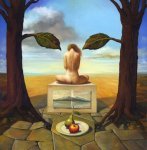
Humanity has been moving away from nature since the beginning of the Neolithic era. This moving away is essentially dangerous and it has brought us to the brink of emergency; an emergency that could very soon blow up in our faces.
Nevertheless, our alienation from nature has allowed us to gain a deep understanding of nature that could be used to bring us back, closer to nature again.
Like a married couple on the brink of divorce, there needs to be a lot of soul searching to rekindle the broken partnership, but also a certain amount of distancing from the all-encompassing relationship to be able to appreciate its relevance and worth, perhaps its beauty, again.
To gain this objectivity, marriage counsellors are often brought in. As for our relationship with the world, our marriage counsellor is science.
Nine short notes concerning Wealth
[image error]
Wealth is evil, it preys on its own.
Only when it is also benevolent can Wealth be logical.
Justice, and freedom, can only be achieved if Wealth is benevolent.
Wealth needs to be recreated in order to make generosity an essential ingredient of it.
Wealth can only be truly generous when it has no enemies.
Wealth needs to learn how not to be greedy and selfish.
The wealthy need to learn how to overcome envy.
Envy can only be overcome when there is no need to be envious.
Wealth can only be good if it creates admiration rather than envy.
December 21, 2019
Our Centuries
[image error]
The 20th Century
Nietzsche summarised the modern world by looking for the essence of each century and attributing a philosopher to each one: The 17th century is aristocratic and ruled by Descartes; the 18th is feminine and dominated by Rousseau; and the 19th is animalistic and under the sway of Schopenhauer.
Following the same line of thought we could call the 20th century nihilistic and Nietzschean. The spirit of the 20th century is, above all, one of a paradoxical dominance: individualism rules, but so does the herd, and both are motivated by a dictatorial will. Because of this paradox, the 20th century is Nietzschean but also anti-Nietzschean: the Last Man has an ubiquitous presence whilst the Übermensch is a dangerous illusion that only appears in a form that has been perverted by the Last Man (Nazism). It is adolescent in spirit, greedy and neurotic.
But while the 20th century is Nietzschean, it is also Marxist and Capitalist and it is the century of economy more than anything else, one that is dominated by the god of money.
[image error]
The 21st Century
This century is yet to have begun for we are still immersed in the nihilist, plutocratic century of Nietzsche. Nevertheless, we can imagine what it needs to be like if we are ever to survive the internecine forces driving our lives at the moment.
If civilisation is to survive the 21st century, it must be a period of responsibility: ecological duties are pending, and these responsibilities are also linked to human rights and justice.
The philosophical will need to generate awareness and the transformation will only come about through the communication of that awareness. In that sense, the 21st century will have to be a new era of enlightenment. Likewise, it will be a time of maturing: the adolescent 20th century needs to become an adult. It will need to be forward looking, even teleological, and imbued with far-reaching teleological purposiveness. Everything must change, and it will be the most revolutionary era since the Neolithic.
The 21st century will see the emergence of a more consistent humanity that will start to identify itself as humanity instead of as a nation, religion, or race. Human nature will start to be perceived as the nature of the species – homo sapiens; homo habilis – rather than the manifestations of activity by the many kinds of social animal or the homo economicus.
[image error]
See f. Nietszche, THE WILL TO POWER, #95 – The Three Centuries
December 14, 2019
Our Big Brother
[image error]
It seems easy enough to see the difference between the totalitarianism of a Stalinist or Gestapo political regime and the freedom-loving airs of the way-of-life enjoyed in Western democracies. Nevertheless, it would be pure naivety to assume that the liberal or social democratic systems are devoid of controls, and the fact that we don’t feel the sense that we are being brainwashed in a democratic system probably indicates that we are more ideologically driven than we dare to suspect. Big Brother doesn’t need dictatorships to imprint its pernicious ideology into the souls of its slaves, in fact it functions better under the veil of a seemingly democratic environment. In fact, our world of left-right politics is just another stage for Big Brother to perform in; a perfect stage perhaps to achieve its fundamentally oligarchical, plutocratic and megalomaniacal objectives.
Let’s look at this from the perspective of what is today’s biggest political, economic and ethical issue: the climate emergency. Because of its existential significance, disputing the veracity of climate change predictions is, at least potentially, deeply divisive in society and consensus needs to be reached, not only at the nation-state level but also globally, if an ecological disaster is to be avoided.
Given the high-stakes at risk here, reaching such a consensus would be the most logical outcome, especially in the democratic world where power is supposedly controlled by the popular mandates decided on polling days. Nevertheless, despite decades of warnings from scientists of the catastrophic future that is unfolding if radical action is not taken, political and economic change has been slow to come about, if at all, even in, if not especially in, the world’s largest and most solid democracies like the USA, Great Britain or Australia. In may cases it seems that the vast majority of franchised people are voting contrary to their own interests. But how can that be?
Because of this, it must be assumed that democracy itself is not functioning as it should. The divide between believers and non-believers in the climate emergency is to a great extent ideological, with most denial coming from the right-wing of the spectrum. Some of this is economy-ideology driven, with denialists tending to be libertarian opponents to state-interventions, who have little sympathy for the poor and an aversion to welfare. Another part of it, though, is found buried in evangelistic communities where beliefs and desires for the End of Days and its promise of spiritual salvation for believers, make the idea of an ecosystem collapse irrelevant, if not desirable. For both of these groups, the climate emergency scenario is a left-wing conspiracy, despite the fact that is ratified by objective scientific data.
The thought-control; the turning of a blind eye to the scientific facts in order to only believe the more comfortable counter arguments, may be laziness or a need to maintain one’s sanity by staying in the ideological zone, or it might be the result of a certain kind of brainwashing that is more usually attributed to totalitarian systems rather than democracies. Climate denialists’ construction of an alternative reality by cutting and pasting fragments of the whole picture, is a very similar practice to those carried out by the perverted logic of the followers of Stalin and Hitler, or Kim Jong-un. Of course, the Western democracies are not the same as totalitarian states. In democracy, different ideological angles are made visible, and the ruling ideology makes allowances for the other side of the argument to be expressed. But if we examine the bubble on each side of the spectrum, there are Stalinist tendencies on both sides. Through the power of ideology, democracy simply becomes a bicephalous Big Brother, even if the only thing it really hides is its own Big Brother nature. And this is because, to properly function and be effective, Big Brother has no need to hide anything else.