Jay Sherer's Blog, page 2
June 30, 2021
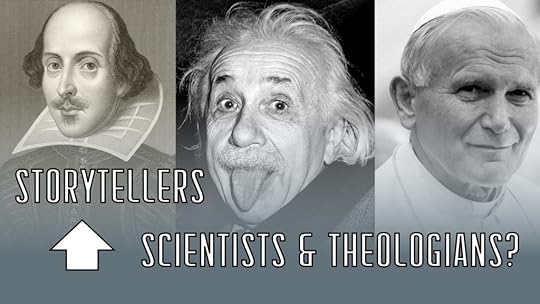
GREAT STORYTELLERS > (SCIENTISTS + THEOLOGIANS)?
Part 2 in a continuing conversation about storytellers and storytelling started (unwittingly) by Brett Weinstein and Jordan Peterson.
In an era of fake news and misinformation, how does storytelling play a role in society and culture? And what responsibility does the storyteller have? I’ll challenge readers with this: I think storytellers have a responsibility to communicate the Divine. That’s a big statement. Let’s dig into it.
 Jordan Peterson and Brett Weinstein: “Metaphorically true, but literally false.”
In my last article I broke down a conversation between Jordan Peterson and Brett Weinstein that focused on the evolutionary benefit of religion and storytelling for humanity. To quickly recap that logic:
Human beings (uniquely) can delay gratification.Because we can delay gratification, we form beliefs about the potential for an afterlife.Belief in an afterlife is an example of delayed gratification meant to improve our communities and the lives of our offspring yet is, “metaphorically true, but literally false.” [Brett’s quote, which contextually refers to an afterlife not being real (“literally false”), but because belief in an afterlife alters the behavior (delayed gratification) of an individual or even a tribe during their time on earth, it can improve the lives of everyone in the community and the lives of all their offspring (which makes a belief in an afterlife that improves the human species, “metaphorically true”).]Faith in and adherence to metaphor and fantasy may present us with a higher form of truth than does belief in cold, hard facts. (Which was a question posed by Jordan Peterson.)That last point hits on the focus of my last article. If that’s accurate — if we can improve humanity by convincing ourselves that the bigger metaphor or the meaningful fantasy is more important than provable facts — then the storyteller’s role in a given community may not only be critical, it might even be paramount to the community’s ability to survive and thrive over the course of generations.
The Critical Importance of StorytellingI think storytellers have a responsibility to communicate the Divine.
Paramount? Yikes. That’s a lot. Now, there are undoubtedly numerous ways to push back on these ideas and the conclusions reached by both Weinstein and Peterson (on their podcast) or even my analysis of their podcast in my last article. But even if their philosophical framework contains flaws, the importance of the storyteller (or, perhaps more accurately, the stories they’re telling) in a given community remains incredibly high.
To showcase how high, consider this: when Brett Weinstein used the phrase, “metaphorically true, but literally false,” that presented Jordan Peterson with an opportunity to suggest that the highest form of truth may not be factual, but rather metaphorical or fantastical. And using that logic, he wondered aloud whether or not the highest form of metaphorical truth could be considered Divine.
The Definition of DivineDivine. An interesting word choice for many reasons. Let’s consider the definition of that word, Divine:
1 “Having the nature of or being a deity.”
2 “Of, relating to, emanating from, or being the expression of a deity.”*
*(Source: The American Heritage® Dictionary of the English Language, 5th Edition)
In a future article, we’ll focus more on the concept of the Divine and the idea that the most truthful stories emanate from a deity. That topic requires a totally different line of reasoning.
But the point to be made here, particularly for storytellers, is that Jordan Peterson is hinting at the possibility that the supreme truth equates to the Divine, and that the Divine may not even be literal.
*(Source: The American Heritage® Dictionary of the English Language, 5th Edition)
Storytelling and the Divine MessageLet’s consider the resounding implications of Jordan Peterson’s question. Here’s that question reworded by me:
If humanity survives and thrives by adhering to supreme truth — whether that truth is metaphorical or literal — does that imply that supreme truth itself is:
The goal of the storyteller’s artistry?A means to understanding the Divine?A means by which to communicate the message of the Divine to humanity?If supreme truth is Divine, and if the message of the Divine results in the survival and growth of the human species, the question becomes, “Who will communicate supreme truth to humanity?”
Circling back one more time to Brett and Jordan’s conversation: if supreme truth might be metaphorical, not literal, then that points to the need for art to communicate that truth. Which means that storytellers become the messengers of the Divine (which we’ll break down even further in another article).
If society chooses to view storytellers as the messengers of the Divine — those seeking to deliver the supreme truth — what are the implications for the storytellers themselves? It would seem to me, that storytellers must then take on two roles (neither one often associated with the term “storyteller”).
The dual roles the storyteller must take on are: scientist and theologian.
How Storytellers = ScientistsThe definition of science:
1 “The observation, identification, description, experimental investigation, and theoretical explanation of phenomena.”**
Storytellers become scientists by repeating the process of observing, testing, and learning over and over. Storytellers observe the world in an effort to form a hypothesis about the truth. Then, they test that hypothesis by placing a cast of characters into various settings or environments and monitoring how those characters might interact. Each draft of the story might present different variables into the equation, and those variables either work (i.e., ring true) or fail (i.e., ring false). How characters interact, make choices, and behave creates cause and effect outcomes. Those outcomes impact the individual characters, their tribes, and even the world at large.
The resolution of the story reveals whether or not the storyteller’s hypothesis has been proven true or false. Those hypotheses could start out as basic questions, like: What effect does hubris have on humanity (e.g., Jurassic Park, Stranger Things, Avengers: Infinity War)? Should we pursue justice for the less fortunate or let inequity reign (e.g., Just Mercy, Glory)? What limits (if any) should we place on ambition (e.g., There Will Be Blood)?
Every story starts with a question that becomes a hypothesis, and that hypothesis transforms into characters, arcs, plots, and a resolution. The tellers of those stories behave like scientists: observing, testing, and learning what rings true.
One caveat before we jump into the next section: Is it possible to tell a story that doesn’t seek truth or seek to ring true? Of course. Those stories are pervasive, and storytellers have become rich and famous by telling them. But those storytellers are scientists of a different sort. They’re not using stories to explore truth, they’re using stories to promote themselves. The science they employ poses this hypothesis: What can I tell society (or any given tribe) in order to experience personal gain? Which is more the question of the ruthless mogul than the artist…
The dual roles the storyteller must take on are: scientist and theologian.
**(Source: The American Heritage® Dictionary of the English Language, 5th Edition)
How Storytellers = TheologiansThe definition of theology:
1 “The study of the nature of God and religious truth; rational inquiry into religious questions.”
2 “A system or school of opinions concerning God and religious questions.”***
As storytellers test truth, they move beyond just observation, testing, and learning. They must, because the purpose of storytelling (the “telling” part) involves communicating the results of the test (the hypothesis conveyed through story) to an audience. And in doing so, storytellers have an opportunity to delve into something deeper, just as Jordan Peterson suggested they might.
They have the ability to become a messenger of the Divine.
If the storyteller’s tests show fruitful results (e.g., a resolution to the hypothesis that resonates with truth), then telling of the story to others reveals that truth to the audience. And even if — to Brett Weinstein’s point — that truth is “metaphorically true, but literally false,” the end result may still confirm supreme truth, which may even be considered Divine.
And therefore, storytellers who delve deeper into truth, explore it, discover it, and then communicate it to others via their stories, have become akin to theologians: students and messengers of Divine truth.
***(Source: The American Heritage® Dictionary of the English Language, 5th Edition)
Questions for ConsiderationScientists, theologians, and conveyors of Divine truth… Is that what storytellers are? Let’s pause here to reflect and consider the following questions:
Is supreme truth — even when conveyed in metaphor — Divine?What implications does that have on stories and storytellers? Should we act, think, or feel differently?What arguments exist that would contradict these assumptions and theories?If storytellers do convey the Divine, what does that mean for society?Should storytellers behave as both scientists and theologians or should they behave in some other way that I postulated here? And if so, how?Leave your responses to these questions (and/or your general feedback on my musings) in the comments down below. I’d love to hear your thoughts!
In my next article, a continuation of this series reflecting on the conversation between Jordan Peterson and Brett Weinstein and what it might mean for storytellers, we’ll analyze how closely “the Divine” may or may not represent a given deity. I hope you’ll show up and share your thoughts.


June 23, 2021
Evolution vs. Religion vs. Storytelling — A Writer’s Take on Jordan Peterson’s Theory
Should we believe in something that’s “metaphorically true, but literally false”?
Maybe? In a recent discussion that’s of critical importance to storytellers, the ever-controversial Bret Weinstein invited the equally polemical Jordan Peterson onto his podcast. Of interest to me (and hopefully most storytellers), Brett called a belief in an afterlife, “metaphorically true, but literally false.” But while that’s sure to cause a stir with some folks, Jordan Peterson’s response proved even more fascinating…
And if you’re a storyteller, it’s worth digging deeper into this philosophical conversation about storytelling and the nature of truth.
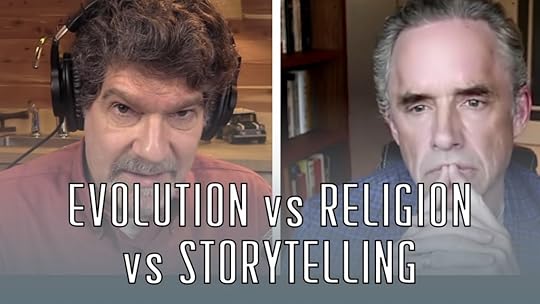
WHAT DO EVOLUTION AND RELIGION HAVE TO DO WITH STORYTELLING?
The YouTube algorithm recommended that I watch a conversation between evolutionary biologist Bret Weinstein and psychologist Jordan Peterson — both controversial, thought-provoking philosophers (or, if you have a strong distaste for them, “old, white guy podcasters”).
But whether you like them or hate them, this discussion has important implications for storytellers, because they delve into human evolution, religion, and the power of storytelling.
So… what do evolution and religion have to do with storytelling?
Maybe everything?
DELAYED GRATIFICATION IN HUMANS
Weinstein and Peterson’s full conversation covers a variety of topics, but I’m going to focus in on their thoughts about storytelling. In order to do that effectively (without you having to listen to their entire show), I do need to set up their conversation.
From the jump, Jordan and Bret launch into their theories on evolution and consciousness, which leads them down a path of noting the differences between humans and animals. The key takeaway here is that they agree on the first discussion point:
One of the notable attributes that separates humans from the rest of the animal kingdom is the unique way in which humans are able to delay gratification.
[CLIP: Starts at 26:00 and ends at 27:03]
https://medium.com/media/59636adc18bcb91081b8a24f5c85c3cc/hrefIn other words, when given the choice between instant gratification — let’s say, the taste bud satisfaction and sugar rush of eating a Twinkie — or delayed gratification — having six-pack abs this summer — humans are capable of making a value judgment and delaying their gratification in order to achieve a bigger goal. (That’s my example, by the way, not theirs.)
Eating a Twinkie is easy. Washboard abs are hard — in this case, metaphorically and literally (which is a joke that will pay off later — though the payoff really isn’t that great so don’t get your hopes up).
I swear there’s a storytelling connection coming here, but I have to set up a bit more of their argument first…
DELAYED GRATIFICATION AND THE AFTERLIFE
So, Bret Weinstein and Jordan Peterson agree: Delayed gratification separates human beings from animals. Which brings Bret to his next, more controversial point: The human capability to delay gratification is the reason why humans form beliefs in an afterlife.
[CLIP: Starts at 30:55 and ends at 31:47]
https://medium.com/media/573c919680cff5429b5410f7daf95769/hrefBecause you can say no to Twinkies and get washboard abs, you can also delay instant gratification while you’re living so that you can attain a superior afterlife. In other words, your religion is based entirely on evolutionary biology. Religion — most notably religious belief in an afterlife — is an extreme form of our unique, human ability to delay gratification. As an example, if religious people choose not to commit sins (i.e., instant, earthly gratification) while they’re alive, they’ll receive something far better when they die: a better afterlife (i.e., delayed, heavenly gratification).
Bret Weinstein and Jordan Peterson have now presented two points:
Human beings are unique in that they can delay gratification.Because humans can delay gratification, they form beliefs about the potential for an afterlife.Note the significance here of why religions are formed given an evolutionary framework for human understanding. Said differently, from an evolutionary perspective, it makes sense that humans would form religious beliefs. But there’s one more building block to cover here, and then we get to the discussion about storytelling…
METAPHORICALLY TRUE, BUT LITERALLY FALSE
Let’s unpack Bret’s sense-making exercise about why it makes sense, from an evolutionary biologist’s viewpoint, that human beings would form religious beliefs in an afterlife. Why would human beings do that? What benefit does that form of delayed gratification have for an evolved species?
Bret’s theory goes as follows:
Humans create religions — which are, according to Bret, a form of mythology — in order to benefit future generations of the species. (Re-worded more bluntly by me: humans tell themselves lies about the existence of an afterlife so that they’ll avoid committing sins, which in turn benefits their offspring.) Resisting the instant gratification of sin means setting up future generations to inherit a better planet.
The lie you tell yourself about an afterlife is a helpful lie. It tricks you into doing things that help future generations.
Bret describes belief in an afterlife as, “metaphorically true, but literally false.”
[CLIP: starts at 32:12 and ends at 32:16]
https://medium.com/media/8b871a11aa0fbc5e25c68eae590496f8/hrefTo recap the building blocks of this discussion again:
Human beings are unique in that they can delay gratification.Because humans can delay gratification, they form beliefs about the potential for an afterlife.Belief in an afterlife is an example of delayed gratification meant to impact the lives of our offspring and is, “metaphorically true, but literally false.”Now, we can finally transition into our discussion about storytelling…
STORYTELLING: METAPHORICALLY TRUE, BUT LITERALLY FALSE?
Here it is, the connective tissue binding evolution, religion, and storytelling together: most works of fiction strive to be, “metaphorically true, but literally false.”
Jordan Peterson picks up on that point here by asking a critical question: What contains the greater truth, the metaphor that benefits humanity or the cold, hard facts that may cause humanity harm? My paraphrase, but his actual words can be heard here:
[CLIP: starts at 32:07 and ends at 32:41]
https://medium.com/media/3bb02ae47c7df7e57e6580e0ae5daf3f/hrefStorytellers should not miss this point or the implications of it. Jordan Peterson is asking an important question: Is it better to believe in the fantasy that improves your life and the lives of those around you, or is it better to face the grim reality of the dreadful scenario that lies before you? Which belief is better for humanity?
Which begs a deeper question that must be considered: What is truth?
Do facts that offer nothing more than cold comfort — a better knowledge of reality, perhaps — but that paint a bleak, despairing future… do those facts contain more truth than a belief in a fantasy world that furthers the species? Which truth is superior?
The implication for storytellers is striking. How do we approach the art of storytelling given the implication that storytelling itself could be a higher form of truth? Let that sink in for a moment… Is storytelling a higher form of truth?
While Bret and Jordan go on to compare religious belief to scientific belief (in which Bret makes some fascinating comparisons), I’ll skip ahead a bit because I want to keep the focus on storytelling.
IS THE ESSENCE OF STORYTELLING A QUEST FOR TRUTH?
There’s a lot to unpack here. And for the record, I’ve never heard Jordan Peterson or Bret Weinstein claim to be a storyteller. But, Jordan Peterson, as a psychologist, does spend a lot of time talking about personal responsibility and comparing that ideal to the Hero’s Journey (as outlined by Joseph Campbell), which he talks about here on this podcast as well.
If metaphor and fantasy can convey higher forms of truth, then the implications for storytellers are enormous. Storytellers have an incredible responsibility to humanity. In fact, Jordan Peterson absently wonders if storytelling can give us a picture of the Divine, or stated differently: the highest form of truth.
I’m going to respond to that question separately, because as a Christ-follower, I have thoughts. But for now, I’ll stick to the implications this theory has for storytellers. If we assume the points made here are valid and have some level of meaning (which is optional, to be sure), then we are left with these building blocks:
Human beings are unique in that they can delay gratification.Because humans can delay gratification, they form beliefs about the potential for an afterlife.Belief in an afterlife is an example of delayed gratification meant to impact the lives of our offspring and is, “metaphorically true, but literally false.”Belief in and adherence to metaphor and fantasy may present us with a higher form of truth than does belief in cold, hard facts.If you ever listen to the videos and podcasts we produce for The Art of Storytelling YouTube channel or The Story Geeks podcast or even my articles here on Medium, then you know we care passionately about that last point. The implications of the last point are striking, and they present storytellers with important questions to consider:
What beliefs will I, the storyteller, form in the minds of those who engage with my stories?Do I have a responsibility to tap into a higher form of truth?Is storytelling a quest for truth and perhaps even a quest to understand the Divine?Those who know me will know that I answer the second and third questions with a resounding, “yes!” Which means that the answer to the first question must be consciously and ardently worked out if storytellers are to tap into something that changes lives.
Many storytellers may respond with, “I’m not trying to change lives. I just want to entertain!” That’s all fine and good, but I would argue that the question still must be considered, maybe in less detail, but at least pondered momentarily. Why? Because if the storyteller ignores the implications of the story’s impact on their audience, what if the storyteller drives people in an opposing direction to the truth? What if the storyteller’s audience begins to believe in outright lies?
Jordan Peterson and Bret Weinstein are suggesting that the human mind is shaped by stories. Stories drive belief. What stories are feeding your belief system? And are those stories improving your life and the lives of those around you or are they causing harm?
If you’re a storyteller, would you accept driving your audience in a direction that causes harm, either to the individual or to the community at large? It’s a heavy question. And it’s the reason we always encourage both storytellers and the audiences engaging with their stories to, “Question everything in your favorite stories and always seek the Truth.”
I’ll close out this article by posing the root of these questions back to you. Whether you’re a storyteller or someone who loves to engage with stories, consider this the next time you find yourself engaging in a story:
What is Truth?

June 15, 2021
My New, 2022 Strategy for Building an Audience and Selling Books

One of the biggest questions for storytellers in the modern day goes something like this:
How do I get more people to engage with my stories?
The question can be reworded in multiple ways depending on where the focus of the storyteller lies, but the essence of the question revolves around building an audience and inspiring the audience to take some form of action. Just to show you what some of those questions might look like, here are a few more of them worded in different ways:
Beginners:
Who do I know who will read my book?How do I reach people I don’t know personally?What are the best ways to let people know I wrote something?Should I self-publish or go the traditional route by selling to a major publisher?Intermediate:
How do I get more reader reviews?Where should I promote my work?How should I promote my work?What should my PR plan look like?What’s the best way to pitch my book to audiences?What techniques will take my marketing plan to the next level?What relationships do I need to develop to grow my business?Advanced:
Now that my book is published, how do I increase sales?How do I sell my book to new audiences and break into the mainstream market?How do I convert my book into another revenue channel (e.g., movies, TV, etc.)?What do I need to do to hit bestseller lists?That’s a sampling of the vast number of questions writers ask themselves, but all those questions fall under the bigger banner of engagement. And whether a given writer wants to reach millions or just a small circle of friends, engagement sits rooted at the core of most storytellers’ desires. Nathan (my co-writer) and I ask ourselves questions like these all the time.
I’ve studied this question from multiple angles. I’ve looked at how other industries tackle engagement and growth. We’ve done experiments (and continue to do so) to see what works and what doesn’t. I’ve even earned a marketing degree and an MBA, mostly because I wanted to learn more about how to build engagement and reach more people.
It’s a very challenging question. And while there are general principles to follow, the exact equation storytellers are seeking to solve for looks a bit different depending on the large number of variables at play.
For context, Nathan and I have self-published (under our small press) two novels, Timeslingers (an unconventional serial story) and Death of a Bounty Hunter. Both have been fairly well-received (Timeslingers is a bit unconventional, so the reviews vary widely based on preference). And that’s important because there is one question that precedes engagement, which is: Is my story compelling? Once the storyteller can assuredly say “yes,” that’s when all the other questions come rolling in.
For context, I would put Nathan and I in the “intermediate” category. We’ve done this for over a decade, but we still don’t have what I’d call a “repeatable process” that defines success for us. Here’s a quick synopsis of how we’ve tried to build an audience:
Facebook ads (limited success)Google ads (little-to-zero impact)Starting a podcast (decent success)Similar works giveaway (little-to-zero success)Launch parties (limited success)Contest entries (limited success)Free promotion (little-to-zero success)Guest spots on other podcasts (little-to-zero success)We’ll be trying a Goodreads giveaway soon. And we’re considering attempting to sell Death of a Bounty Hunter to a publisher (more on that in another post). But as you can see from what we’ve tried thus far… building an audience and selling books is difficult. And selling to a major publisher solves some problems, but not all of them, because major publishers won’t necessarily provide the author with a ton of marketing support.
Earlier this year, my wife and I decided to leave the crowded streets of Southern California and move to a much smaller city. And that got me reflecting on some of the research I’ve done on building an engaged audience. Now, I’m asking myself: How will this change my approach to building an audience?
In pondering this question, it occurred to me that there’s one strategy that’s used frequently across industries and has withstood the test of time: hyper-local, geographically-based, relationship-building. I’ve seen tech startups (including popular ones like Facebook and Uber), comedians, and franchisers use this strategy successfully numerous times.
Focus on those in your immediate vicinity, learn what works as you engage with them, and then expand your geographic reach.
That strategy has worked for thousands of years, but I’ve never tried it, partially because the geographic location I was in (Southern California) just seemed so overwhelming. How would one even begin to approach it?
So, that’s my 2022 goal, to pursue a local audience, engage with them, and then expand from there. Will it work? I’m not sure. But it’s a tried and true methodology that I have yet to try. Southern California felt overwhelming, because it was so big and there were so many competitors in the surrounding area. Every time you turn a corner there’s another human peddling a screenplay. But that doesn’t mean the strategy wouldn’t work, it just means I wasn’t confident that I could execute the strategy effectively. The variable that didn’t work was me.
As 2022 rolls around, we’ll see how this new strategy works. It will mean building new relationships in a new region. It will also mean figuring out how to convert those relationships into sales. And then, once that process has a proven track record, it’ll mean expanding the geographic region and seeing if the same processes can be repeated.
What do you think of this strategy? Will it work or will it crash and burn? Have you tried a geographically-based engagement plan? How did it work for you? And, if you’ve got some extra time, let me know what strategies have been most effective for you!
Thanks for reading! Keep writing, keep grinding, and stay tuned for more musings.

June 9, 2021
Loki Does THE SAME THING Marvel’s Other Shows Did… And Gets Away With It.
I’m not going to review Disney+’s latest gem, Loki, because: read this.
But I do want to express my gratitude to Marvel Studios for the following aspect that has been true of all three Disney+ original Marvel offerings thus far (WandaVision, The Falcon and The Winter Soldier, and now Loki):
Each show has a deep, emotionally-relevant theme at its core.
WandaVision dealt with grief and the trauma caused by hurt people hurting other people in an attempt to control their world.
The Falcon and The Winter Soldier tackled minority and immigrant struggles, but became particularly poignant when Isaiah and Sam got real with how the black community should engage with identifying as Americans given the black experience in the U.S.
And now, we get Loki, which could have presented itself as a fun show about time, but has already gone deeper by showcasing that Loki just might be his own biggest enemy. It’s not just a fun time travel romp, it asks Loki to consider his own psyche in the very first episode.
Bravo, Marvel Studios, for going beyond a simple play to appease the fandom. Thank you for developing relevant character dramas that push the genre forward!

My Running List of Article Ideas…
Which one should I work on next? Comment and let me know!
Here’s the list I’ve currently been working on (with some directional notes):
(Keep in mind, I’d approach each of these topics from a storytelling/storyteller’s frame of reference, not just social commentary…)
A New Strategy for Selling Books — Hyper Local
I’m in the process of moving to a new state. And one of the things I’d like to try is going far more “old school” in my attempts to gain a larger audience for my books. My idea? Become hyper-targeted to the local market. I can reference some of my ideas here in this article.
Why Nathan and I are now considering hiring a literary agent…
I would just explain our thought process of going from self-published/small press published authors to more of a mainstream approach, and why we’ve changed our thought process on it.
Why profitability is so difficult for self-published authors and small press publishers
This is a fascinating topic, and I’ve learned a lot about it over the last decade!
The problem of evil in storytelling
I’ll get philosophical in this one…
Why Christian movies are often terrible… it’s not what you think
Yeah, they’re not terrible in the way you might think I’m going to say they are. And actually, I think it’s even WORSE that you might think!

June 8, 2021
How Social Media May Be Reshaping The Creative Process
And why that title should give you pause.
I don’t like the word “hate.” But I’m starting to hate social media and how it’s subtly changing the way we tell and share creative works, particularly stories. In this article, I’ll share some thoughts on how social media “reviews” and how the mass distribution of opinions might shape creativity. And while it’s not all bad, it does pose significant challenges for artists of all types, most especially storytellers.
Let’s dig a little deeper, and then I’ll throw out some thoughts about subtle changes we might be able to make to turn the tide of the onrushing “mob mentality.”
Reviews, Opinions, and Nonsense
Opinions and “reviews” used to be — and often still are — incredibly valuable for decision-making. I’ll read through dozens of Amazon customer reviews before buying a product. But as social media transforms the way we make decisions, how can we prevent public outrage or cultural adoration from influencing the way we tell stories?
First off, though, let me describe what I’m seeing…
Great Scott, Marty! It’s time to hop in our Delorean and travel back to the early 90s. Back then, information was harder to obtain, and people with expertise or experience gave us valuable opinions and insights that we used to make better decisions. For example, when I was a kid I watched Siskel and Ebert to see what new movies I might be interested in watching. Their opinions shaped how I spent money on movies. My dad would also purchase thick books full of movie reviews, and I would read those books like they were novels to try and discover movies I’d never seen before.
That’s because, prior to Al Gore inventing the Internet (apologies for the 90s humor), we had a limited number of sources for information-gathering. Another profound example: we rarely knew how our friends felt about the movies they’d seen. Why? Because in order to find out, we’d have to talk to them in person or over the phone. Twitter and Facebook didn’t exist and weren’t shoving opinions at us yet.
[Side note: it was also WAY easier to avoid spoilers…]
But in 2021, opinions are prevalent, pervasive, and even profitable. Anyone can express their opinion at any time, publicly, with as little nuance or critical thought as they desire.
On one hand, that’s not a terrible thing. I might trust my friend’s opinion more than I trust a complete stranger’s, and I appreciate knowing what my friend thinks. Except, there’s also a dark underbelly of rampant opinion-sharing, and I believe it impacts creators and storytellers. And I think it might pose a significant threat to artists, creators, and storytellers.
What if “reviews” (particularly public opinions about creative works) have gone beyond helping us make better decisions? What if these “reviews” (i.e., the shared opinions of the masses) are being used for something far more insidious.
Here’s my take: “reviews” and opinions are being used less for decision-making and far more often for tribe-building.
The Last Jedi and Tribal Warfare
Let’s take The Last Jedi as a prime example: Were most of the social media posts being shared about that film trying to help others decide whether or not they should see it? Of course not. Instead, The Last Jedi nearly broke the Star Wars fandom by creating two factions: those who loved it, and those who hated it. Those who loved it often cited how well it broke the Star Wars mold and added layers to the saga (even spawning a sub-tribe of “Reylos”). Those who hated it focused on how it didn’t feel like classic Star Wars (with some sub-tribes even calling it too “woke” and declaring that it proved Star Wars was being led by a Leftist agenda). Even Ben Shapiro — a political commentator — used The Last Jedi controversy to help build his tribe.
Were these “reviews” and opinions being shared as a critical response to a creative work? No, of course not. They were being shared to get follows and likes. They were being shared to build tribes that could band together to fight a common enemy: those who disagreed with them about the given creative work.
But hey, so what? Humans have always formed tribes. What’s the big deal?
For me personally, as a storyteller, those tribes represent the potential for a rift in the basic creative process itself.
The Good and the Bad of the Rampant Tribalism Found on Social Media
It should be noted that tribes and power structures have always existed relative to the production of creative works. And the breakdown of those tribes can also be a welcome change. Without the breakdown and re-building of power structures in Hollywood, we may never have made strides for improved diversity and representation in our stories (and we still have plenty of room to grow). My point isn’t that I’d like to go back to something that was broken. Not at all. My goal is to identify potential issues and try to find ways to solve them or work around them as we look to the future.
If society has turned “reviews” and opinions into tribe-building exercises, what does that do to the creative process?
Before I turn to the negative and express my concerns, let me acknowledge two positives (I’m sure there are more, but these two stand out):
New creators and artists have a chance to shine. This can be amazing. If a producer/publisher refused to resource an artist’s work, the artist could find their tribe and use that to sell their work and build an audience. That’s awesome, and far easier to do in 2021 than in 1991 or earlier when social media platforms were not available.Bypassing the gatekeeper is easier than ever. Systems always have gatekeepers. They used to be actual human beings. And those human beings had preferences. Now, gatekeeping has been democratized, which means that artists can find a tribe and let them “vote” on whether or not they like the creative work.Those two positives shine. They’re great. Maybe they occasionally even outweigh the negatives. But in some cases they don’t. Let’s take a look at those negatives:
Societal pressure.
Previously, gatekeepers formed bonds within the production system. When a gatekeeper accepted the creative work, it meant something. Producers then brought experts in to guide the creative work to completion. That generally resulted in changes to the creative work that weren’t always welcome by those involved. Editors, directors, and producers changed the writer’s intent, for example. But they also took the brunt of the audience’s eventual reaction. The risk, so to speak, was diluted and shared across the team. The original vision of the artist (in this example, the writer) was altered, but not during the creation of the work. In other words, the writer’s intent was pure when he or she was putting words on the page. It was only altered after the work was sold.
Now, producers aren’t just looking at the opinions of gatekeepers. They’re looking to see whether or not artists and creators have integrated themselves into tribes. Have a tribe? Perfect. That means you might have something worth producing.
What effect does that have on the creator? It means the creator must create for the tribe. Now, as someone who has started several businesses and coached dozens of startup founders, this is a foundational principle of business. It’s often stated in some pithy saying, like: “the customer is always right” or “give the people what they want.” And despite the simplistic nature of those sayings, there’s a lot of truth to them for someone looking to make money by meeting customer needs and wants.
But that leads us to the core issue: do we want artists to just “give people what they want”? Wherein lies the case for creativity? What if the audience doesn’t want a tragic ending that the writer feels is necessary? What if the audience doesn’t want to be challenged by an alternative viewpoint that the writer feels needs to be expressed?
At what point does the artist look more like the YouTube algorithm than he or she resembles someone who’s really attempting to portray truth?
Monetary pressure.
My second concern is a natural progression that comes out of my first concern, because what follows attention? Money. As much as journalists decried the actions of Donald Trump in his quest to paint many of them as “fake news,” guess who benefitted from that? The producers of media, both the mainstream media (each outlet its own tribe) and all the additional tribes that rose up to combat the mainstream media tribes. And guess what, where eyeballs go, so do advertisers. Despite Donald Trump declaring war on mainstream media, he created demand for it (as well as the smaller outlets).
What’s the point? Creative outlets are no different. Attention drives revenue. And now, as tribes demand content, storytellers have to pause. Do they produce content the tribe will love and take the payday more eyeballs offer? Or do they pursue the best possible story, even if it means the tribe itself might reject them?
Monetary rewards or societal rejection? That’s quite a carrot and quite a stick.
Rejection from a lone gatekeeper was a hit to the artist’s self esteem, but it was just one person. Caleb Monroe, my co-host on the Impactful Writing Podcast (part of The Story Geeks Network of shows) and fellow writer of things, said (in relation to gatekeepers): “If you write something terrible, that person probably won’t even remember it.” He’s right. Being rejected by a gatekeeper sucks, but it’s not being rejected by an entire tribe.
Being rejected by a tribe is something else entirely. It threatens the very nature of the artist’s ability to achieve future success. It means being ostracized by a collective group of people who had formerly helped the artist build a foundation for their career.
Combine societal and monetary pressure and… well, that’s a lot to overcome to stay true to the creative art.
My Encouragement to Artists and Creators
Temptation abounds! Fame and money sit at the feet of the artist like potential Holy Grails at the fingertips of Indiana Jones. But unlike in The Last Crusade, the shiny object sitting in front of artists may provide actual success — the tribe’s adoration and worship. And money may follow.
And maybe that’s the goal for some artists. Maybe they would engage with my thoughts and say: “Why not give the tribe what it wants? Why challenge their thinking or their emotional state when I could just appease them as my worshippers and reap the benefit of their adoration? That sounds pretty good to me.”
Why indeed. My question back to the artist is simply: What is the point of art if not to reflect the human condition? What is the point of art if not to encourage conviction or inspire the audience to change? Entertainment has a place, but it’s a pretty shallow place upon which to build a legacy.
I’m not of the opinion that fan service is a bad thing. Fan service can be a thrilling audience experience. I love The Mandalorian and it’s full of fan service. But I don’t want pure fan service. I want to be surprised. I want to see artists take risks. I want to see creators swing for the fences. But most of all, I want to engage in stories that force me to consider the truth. Not the lies I’d like to tell myself, but the actual, sometimes painful truth of being a human.
So, fellow audience members and creative geniuses… what shall we do in response to this challenge?
I’ve got a couple ideas. One, I think it’s imperative that artists and storytellers should find ways to address the truth in ways that the audience can still be receptive to. In other words, rather than avoiding tough subjects, artists and storytellers can approach the truth with nuance and care. Still challenging the audience, but not attempting to create a rift. I used Donald Trump and the media as an example earlier. Don’t be a Donald Trump by declaring war on a tribe. Rather, maybe take an approach that’s more similar to Barack Obama (careful and winsome) or even George W. Bush (endearing and humble) in addressing a topic that may put a tribe on the defensive. (In the other example I used, The Last Jedi, I think the old guard Star Wars tribe was put on the defensive because the movie almost assumed that what they liked about Star Wars was “stupid” or “bad.”)
Take care to challenge the values of a given tribe, but do it with love, care, and humility.
Secondly, we have to address the way we elevate conversations about art and stories on social media. That goes for artists and storytellers and their audiences. What if, before we share our strongly held belief about a creative work on social media, we stop to consider these questions…
How did this story impact me?What did I find uncomfortable about it?What did the work make me feel?How did it change or challenge my perceptions? And how did I respond to that change or challenge?Answer those questions, and then write the social media post. Because those questions may just lead to more meaningful discussions. They might break down tribal structures as opposed to building them up. And they most certainly will encourage creators to produce better, more meaningful stories, not just stories meant to give the tribe what it wants, but stories that truly attempt to find the shared human experience.
Oh, and we probably also need to ignore the trolls who don’t want to mentally engage in more complex conversations. If we identify a person who has transformed into a troll, we can make one attempt at trying to bring them back into a healthy discussion, but if they refuse the invitation, we can probably just ignore them.
What do you think? Am I onto something or have I gone completely off the rails? Leave me a comment down below. Let me know if you’ve already experienced the concerns I’ve put out there, or even if you’ve reaped the benefits of this new norm. I’d love to hear about your lived experience! Thanks for reading!