Rick Falkvinge's Blog, page 38
August 23, 2012
Temporary Fever-based Outage

Metaposts: Due to a nasty bug and fever, there is a small interruption in the article flow here.
I’ve been knocked out cold for the past week – just as I came back from vacations – and am just barely getting back on my feet after five days on heavy antibiotics. Expect a few more days before regular article flow resumes.
I apologize for the interruption in service.


August 13, 2012
How We Won ACTA

Infopolicy – Christian Engström: As the European Parliament voted to reject the ACTA agreement on July 4, 2012, it was a huge victory. What did we do right, and how can we do that again?
These are questions we need to discuss, because we will need to do it again. The ACTA agreement as such is dead, but the ACTA proponents have not surrendered. They will try to pass ACTA’s substantial content under other acronyms. And besides ACTA, there are plenty of other issues that also carry a direct imapct on net liberty and on liberty in society at large. Therefore, it is not just important that we can win, but also how we can win.
We won the ACTA battle because there was pressure from two sides at once – both from the inside of parliament and from the outside.

It took simultaneous pressure from both sides to win.
It’s a bit like squeezing toothpaste from a tube. It’s not enough to apply pressure on one side. Without the activist pressure from the outside of parliament, we would never have won this match. But without from the work from the Pirate Party and others on the inside, there would never have been a match at all.
But let’s take it from the start.
In the 2009 European Election campaign, the Pirate Party mentioned ACTA mostly in passing, but it was on our radar. I blogged about ACTA the first time in October 2008, due to both the Green Party and the Honorary Pirate and Moderate MP Karl Sigfrid had written one motion about ACTA to Swedish Parliament. At that time, the issue was already on activists’ radars, and others had blogged about ACTA earlier.
The first thing I did when I had gotten elected to the European Parliament was to make sure that Erik Josefsson was hired as political secretary for the Green group in the European Parliament. (In practice, this was my only demand for joining the Green group as an independent MEP.) As many know, Erik is a veteran for the fight for a free internet, and one of the most knowledgeable and energetic net liberty activists in Brussels.
Through Erik’s efforts, the Green group commissioned a working group on ACTA (where I was one of the people involved), and made sure to coordinate with net activists, using mailing lists and the newly-started site Act-On-Acta.eu among other methods.
The Green group would all too surely have opposed ACTA under any and all circumstances, but thanks to the Pirate Party and Erik, this Parliament has given issues of information policy a lot more attention. ACTA is one example of this.
This is important, for there is a chasm of difference between a political group working actively in a political area instead of just having opinions in general but not doing anything much. In this regard, the Pirate Party’s accession to the European Parliament has made a clear difference.
After this, a long series of partial ACTA battles took turns in Parliament. Do take a look at the list of events and links at Act-On-Acta, or browse the ACTA-related articles on my blog. Politics is always a marathon, and nothing happens by itself overnight (well, nothing good, at least).
So we grinded on, together with activists outside of Parliament who were also tracking the issue. We lost some partial battles and won some others, but honestly, the prospect of stopping ACTA never looked particularly promising. We always fought uphill.
The three largest groups in the European Parliament – the conservative EPP, the Social Democrats, and the Liberals – had not formally taken a position on ACTA, but all three of them were practically in favor of it. Together, they wield a crushing majority, and if they’re in agreement, it doesn’t matter what anybody else thinks, nor does it matter if there are scattered dissidents within those groups.
This was the battle map as late as January 2012, half a year before the vote. The Green group (where the Pirate Party resides) was against ACTA, together with the Left group and the British Eurosceptic party UKIP. In total, maybe 15% of the Parliament votes, quite a far cry from the 51% you need to win in politics. We kept grinding, but found it hard to feel particularly hopeful.
But then, something happened. Tens of thousands of ordinary citizens took to the streets and protested ACTA, in Poland at first, and then all over Europe. Mail poured in to the Members of European Parliament from citizens who asked them to vote against ACTA. This changed the playing field in the European Parliament completely.
First, the Social Democrat group turned, and took a position against ACTA.
Even though I’m sure they used more sophisticated language in internal discussions, I think their gut feeling was “Look, they’re staging protests in a demonstration, that’s what we do! This may be our kind of people, we must try making friends with them!”.
No matter what the internal discussions sounded like, it is for sure that it was the rallies and the pressure from citizens who mailed that made the Social Democrats decide to be against ACTA. Otherwise, the Social Democrats would almost surely have done as the European Commission asked, and voted in favor of the agreement.
But once they knew what they wanted to be against, it was easy for them to assume that position. The arguments against ACTA were already written in-house, and were known in all political groups after the discussions with us, who had been against ACTA from the get-go. Now, all the hard work we had done paid off, all the hard work we grinded with while the battle map looked hopeless.
As for the Liberal group, I don’t think it were the rallies as such that was the triggering factor, but more likely, it was the Pirate Party’s ongoing successes in Germany that was the key reason for their deciding to vote against ACTA. This may require a bit of explaining.
The Liberal group is the third largest in the European Parliament, with about 85 MEPs. It is considerably smaller than the two large groups (the conservative EPP and the Social Democrats), but to paraphrase a Wikileaks cable, they are “a medium-sized group with big-group attitude”.
To retain this image of themselves after the next European Elections, they must have a strong German delegation in the group. Germany is Europe’s most important country, and if there would be only some single German MEP in the Liberal group, it would be obvious to everybody that the Liberals would only be a minor group like everyone else, and don’t play in the same league as the EPP and the Social Democrats.
Exactly this scenario can play out if no action is taken, since the liberal German party FDP is currently doing terribly, and it is being at risk of being more or less erased.
On the other hand, a party that is doing very well in Germany is the Pirate Party, which has gained entry into four state-level parliaments and continues to poll at 7-8%, Germany-wide. In the European Elections of 2014, the German pirates will send MEPs to Brussels with certainty. The group leaders of the Liberal group has noted this, and would very much like to attract the German pirates to join the Liberal group instead of the Green one. That way, they would keep a large German delegation even if FDP makes an election disaster.
I’m convinced this was the reason for the leadership of the Liberal group putting its authority behind a group-wide vote against ACTA. The Liberals were (and are still) divided on net liberty issues: from MEPs like Marietje Schaake, who are as much pirate in her soul and being as Amelia and myself, ranging to nightstick liberals who have the exact opposite opinion. But this time, most of them toed the party line and voted against ACTA, once the mass protest had put the issue in the spotlight.
In the final vote in the European Parliament, the numbers were 39 votes in favor of ACTA, 478 against, with 165 abstentions. Those are brilliant numbers, even if you take into account that most of the 165 abstaining were ACTA proponents who would have wanted to vote in favor, but abstained for tactical reasons as they knew they’d lose anyway.
So if you only look at the numbers from the final vote, you’d be tempted to believe that Parliament’s no to ACTA was a given since a long time a go. But as I have explained, this was not the case at all.
The victory over ACTA was the result of activism and long-term work from a huge lot of people, both on the inside and outside of the European Parliament. Pressure from both sides of the tube at the same time, in a reasonably coordinated fashion, and without hinder from party borders. That’s when we won.
We will do that again.
This post originally appeared in Swedish at MEP Christian Engström’s blog. Translated into English by Rick Falkvinge.

Offline For Days: An Analysis Of The Door-Slam Sensor

Metaposts: On August 7, 18:21 CET, this blog went offline. Unfortunately, I was on vacation in a remote cabin at the time, again proving the efficiency of the door-slam sensor built into every server and network.
The door-slam sensor is the mythical sensor that registers when your front door closes in the definitive way that forebodes a longer absence – in this case, a gig trip to Brazil (where the Brazilian Pirate Party was also founded) followed by two weeks in a remote cabin on the islands. Mail sorting stopped working first, completely clogging up my inbox (this is done client-side on my main workstation, rather than server-side using sieve…), but that was at least manageable to some degree for a limited time.
However, on August 7 at 18:21 my network stopped responding entirely – all servers stopped responding, not just the blog server. On coming home in the morning on August 13, it turned out to be due to my oldest and weakest link in the network: an old D-Link semi-consumergrade firewall. Resetting it powered everything back up like fresh dilithium crystals.
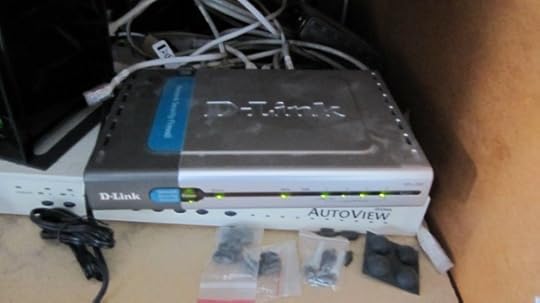
My current first node on the network. Once acquired as it was (then) the minimum box that could route inbound PPTP (IP protocol 47 – different from TCP and UDP). Now, mostly outdated. Sometimes hangs. Like now.
It’s not the first time this has happened, but it’s the first time while I’m away on a longer trip.
Given some economic surplus, I would love to replace it with this kind of box, giving me the ability to have two lines in and some redundancy:

A dual pfSense 100Mbit firewall (from ApplianceShop.EU). Redundant. Open source, free software. Much preferable to an old D-link. Did I mention it’s dual? And redundant?
But as usual, that’s not going to happen in the near term (see “as long as I’m dreaming, I’d like a pony“).
In either case, we can observe that as a whole, the network’s door-slam sensor triggered well for my longest absence in years. As you probably have understood by now, I’m running this site from a server at home, for legal jurisdiction reasons (if it were running in a colo, other people could make decisions about who can access it). Therefore, I choose to live with the daily maintenance of keeping a server park alive, including striving to beat the mythical door-slam sensor.
(A related electromechanical component is the embedded magic smoke that is required for all computers to run. If the magic smoke escapes the computer, it won’t run any longer.)
With me back in the saddle (tanned and rested) and the network back up, we’re back to our regular schedule.

July 30, 2012
Guns Don’t Kill People, Guns Kill Productive Debate About Complex Societal Issues

It’s a sad state of affairs when we can say the US has had “yet another” mass shooting. It’s also a sad state of affairs when the obligatory resulting debate about gun control — yet again — achieves absolutely nothing besides a short-term media frenzy filled with vitriol. Every time, it’s hot air about whether we should keep guns out of people’s hands, with no mention of whether we can, nor the underlying social conditions that actually cause mass murder. Enough already.
For those unfamiliar with what happened, a psychologically disturbed man dressed in tactical gear walked into a movie theater in Aurora, Colorado, armed with tear gas grenades and multiple firearms. He shot 70 people at random, killing 12 of them. The tactical gear didn’t raise eyebrows at first because it was the opening night of The Dark Knight Rises, and everyone thought he was wearing a costume. This is, unfortunately, not a particularly strange thing to happen in the United States.
“Enough already” seems to be everyone’s rallying cry this time around. It was after last year’s big shooting when the headline “Mass shootings are a fact of American life” appeared. So the anti-gun crowd says, enough already, let’s pass a bunch of gun bans and put an end to these tragedies. The pro-gun crowd says, enough already, stop politicizing tragedies, and oh by the way if everyone had a gun then people could defend themselves against trigger-happy madmen.
Meanwhile, my brain overdoses on epic fail and I nearly fall into a coma.
The Right of the People to Blow Holes In Stuff for Recreational Purposes
I used to be one of the stereotypical anti-gun people, ignorantly calling for a repeal of the Second Amendment and decrying anyone who’d want a gun as a backwards barbarian. Then two things happened. First, I started dating a national champion competition target shooter. Second, I read the part of Makers where people started building AK-47s with 3D printers. These things made me realize that even though I don’t particularly want a gun, I still ought to stand up for people’s freedom to have them.
Why is the right to bear arms important? “Guns are used for hunting, for self-defense, and as a last line of defense against tyranny,” says the upper middle class white male who just drove from his well-paying job to his nice, safe neighborhood (which is located hundreds of miles from any hunting ground) in the gas-guzzling, heavy-duty pickup truck that he bought in case he ever needs to tow the boat he’ll never own.
See, most gun owners I’ve met will never, ever use their guns to go hunting, to shoot an intruder, or to violently revolt against an oppressive government. The vast majority of people have guns for the same reason many people have ridiculous trucks: because they’re fun. And believe me, having shot an absurd four-barrel magnum which produces a muzzle flash longer than the gun itself (and it can fire underwater!), I know how fun it is to make these things go bang. There is nothing wrong with fun. But because the terrified anti-gun crowd won’t accept the legitimacy of fun, law-abiding gun owners have to come up with ridiculous, flimsy justifications for why they should be allowed to have their toys.
But no, I don’t stand for the right to bear arms because of the sanctity of human fun. I stand for the right to bear arms because taking it away would be like putting a band-aid on a brain tumor.
You Wouldn’t Download an Assault Weapon
In this NPR interview about the Aurora shooting, Washington Post columnist E.J. Dionne had this to say:
There are some very simple things that we know through common sense would make a difference if a shooter did not have a magazine with 100 rounds in it. He’d have to reload. If assault weapons were illegal, you would at least take an event like this and make it less lethal and we ought to at least try to do that.
Yes, it’s true that the illegality of assault weapons might make it less likely for a lone disturbed gunman to acquire them. Not so much for organized criminals (which is why Mexico’s famously strict gun control doesn’t do much of anything to curb its gun violence problem), but a ban on — for example — high-capacity magazines could have saved a few lives in Aurora.
This benefit would last only so long as it’s impossible to make high-capacity magazines on your Makerbot. Any kind of weapons ban would be effective for maybe 10 or 15 years before 3D printing becomes advanced, inexpensive, and widespread enough to render it completely moot.
In the near future, it will be even easier for a lone mentally ill person to get their hands on a dangerous assault weapon. We ought to be rehearsing for that reality, not pretending that it’s never going to happen.
So How Do We Get People To Stop Shooting Each Other?
Here’s the challenge we face: how do we stop gun violence if we can’t stop people from getting guns? Our only choice is to focus on why a person might want to commit senseless mass murder.
Obviously, you’d have to be seriously mentally ill to go through with a mass shooting. Therefore, it’s no surprise that a country as mass shooting-plagued as the US also leads the developed world in untreated mental illness. If we deal with our mental illness problem, we deal with our murder problem. If we eradicate mental instability, we no longer have to worry about whom we can trust with firearms. Plain and simple.
Well, it’s simple to identify that the problem is mental illness. Actually helping mentally ill people is a much more difficult topic. It’s not as simple as throwing money at the problem in a vague attempt to “improve our healthcare system”. You have to consider which treatment options are effective. You have to consider whether treatment even is the option, as some mental illnesses may be a symptom of another societal problem; as Bruce Levine said, “just how unjust does a society have to become before helping people adjust to it with behavior modification and medication is immoral?”
And let’s not forget that those same societal injustices cause poverty, which creates fertile ground for smaller-scale, non-mass murder gun violence. Countries that ban handguns see their poverty-generated gun violence replaced by similar levels of knife violence.
Perhaps the Christopher Nolan film which best complements this mass shooting problem isn’t The Dark Knight Rises. It’s Inception: these mass shootings are caused by problems within problems within problems; gun violence caused by mental illness caused by poor healthcare caused by income inequality and political corruption and so on and so on and so on.
Conclusion
I wish that horrible mass shootings like these could give us an opportunity to discuss the complex problems that cause them. A nuanced discussion about mental illness, and how it can be not only treated but also prevented, is what we ought to be getting out of this tragedy. It’s not that the American people are too stupid to hear about complex problems, it’s that nobody with a microphone ever brings them up. We’re all tired of this same old, dead end debate about whether we should ban all guns or arm every man, woman and child. But the media, for whatever reason, seems to believe that the same old idiocy gets more readers and viewers, which generates more profits.
Humor us, pundits. Just try something smarter, deeper, less cynical. Give nuance a shot. Give intelligence a chance. I think you’d be surprised at how little of your audience you lose. Maybe, just maybe, a little bit of intelligence and sensibility will prepare us to prevent the next mass murder. And perhaps fix a few other things too.

July 28, 2012
Stratfor Thinks the CIA Is Incompetent, Yet They Can Lock You Up Forever?

Civil Liberties – Travis McCrea: An Exclusive Wikileaks GI File leak : A serious provision contained within the National Defence Authorization Act allows the US Governement to lock up someone forever without trial. Intelligence Agency Stratfor finds its friends (CIA, military, etc…) are too inexperienced, turning this precaution into a threat.
It’s a scary thought when the US Global Intelligence agency Stratfor tells us that the same groups of people (military, CIA, etc) who have the ability to lock a person up forever are inexperienced and cannot even interrogate prisoners properly. One stratfor employee said there have been over 350 military/intelligence deaths in Iraq, not because of surprise attacks or unavoidable scenarios, but because they don’t have the training or knowledge to do basic things like check suspected terrorists for bombs (something they make every law abiding American do at Airports).
These CIA operatives/analysts are failing to protect their own lives, which is a basic human instinct, so how can we trust they are going to follow proper procedure in actually finding terrorists and being able to competently find evidence to be used against them? Of course, without a trial, it doesn’t matter how the evidence was obtained or how valid it may be. With NDAA the accused has no ability to defend themselves. Even if a lawyer was able to represent an accused client, this information would have been held from them.
It may be noted this email exchange is talking about analysts versus operations agents, analysts are usually people who sit behind desks, and operations people are usually your “James Bond” people (to romanticize it a bit), however, it should not take away from the general message of this exchange which is: The United States intelligence community is understaffed by people who don’t have enough experience. These are the same people who can make the call to have someone locked away forever, without a trial. That’s scary.
The Email Exchange
Date 2010-01-05 03:48:06
From marko.papic@stratfor.com
To analysts@stratfor.com
friedman@att.blackberry.net
leaving the middle and upper management in the hands of people trained in
the 1990s–a very different world and very different training missions.
That really seems to me as an intrinsic problem… not just for the
intelligence community, but also for the State, the military, etc.
—– Original Message —–
From: “George Friedman”
To: “Analyst List”
Cc: friedman@att.blackberry.net
Sent: Monday, January 4, 2010 8:45:44 PM GMT -06:00 US/Canada Central
Subject: Re: Insight – CIA Killings ** pls do not forward **
There is a good and a bad reason for doing this. The bad reason is that
you either don’t understand the difference or you don’t have enough
trained staff. That’s DIA’s problem–both of them.
But there is no inherent reason why an analyst can’t learn the operators
craft and vice versa. Granted there are profound issues of personality
type, but there are those who can bridge that. However, to bridge that
requires time, training, mentoring and maturing. It also requires time in
both roles for the person to learn where analysis stops and operations.
And it requires training by people who understand and accept both sides.
This is very hard to do in a war where many of the senior people have
left. Over the past ten years a stunning number of people in the IC have
retired, leaving the middle and upper management in the hands of people
trained in the 1990s–a very different world and very different training
missions. Their numbers and skill are missing and limits their mentoring
ability. People are happy if they get baseline capable analysts and
operators, let alone cross-breeding them.
Reva Bhalla wrote:
i had heard a while back how in Iraq especially they would allow a lot
more analysts in DIA and other agencies to interact more directly with
sources… sounds like a trend that grew out of limited resources
On Jan 4, 2010, at 8:34 PM, Fred Burton wrote:
The spooks told me tonight that DOD have lost 350 soldiers in similar
events but it has never made the press.
———————————————————————-
From: analysts-bounces@stratfor.com [mailto:analysts-bounces@stratfor.com] On
Behalf Of George Friedman
Sent: Monday, January 04, 2010 8:31 PM
To: Analysts
Subject: Re: Insight – CIA Killings ** pls do not forward **
At the age of 25 or so an analyst or an ops officer are about equally
skilled in the field. The training prepares you to start learning. The
problem is that they haven’t got enough experience out there. Twenty
years in do as opposed to di makes a big difference. In my view
getting trained at the farm and spending a year in camaroon prepares
you for squat. The problem isn’t the directorate but that both
directirates have kids playing way abobe their pay grade.
Sent via BlackBerry by AT&T
———————————————————————-
From: “Fred Burton”
Date: Mon, 4 Jan 2010 20:28:29 -0600
To: ‘Analyst List’
Subject: RE: Insight – CIA Killings ** pls do not forward **
An OPS officer is in the field from the DO, the clandestine service.
He/she is specifically trained in HUMINT collection, asset
development and asset operation. They run the assets and work out the
commo bwt the source and OPS officer. Ops officers are also called
case officers.
An analyst (the DI) reads the reports collected by the OPS officer and
very rarely meets w/a HUMINT source, unless its an intelligence
liaison source.
Training and skillset are apples and oranges.
———————————————————————-
From: analysts-bounces@stratfor.com [mailto:analysts-bounces@stratfor.com] On
Behalf Of Sean Noonan
Sent: Monday, January 04, 2010 8:18 PM
To: Analyst List
Subject: Re: Insight – CIA Killings ** pls do not forward **
Fred, can you clarify what exactly a “analyst vice clandestine
operational officer” position is?
Fred Burton wrote:
Fiasco
When balls are dropped in this business, they are usually fatal.
The call from an operational asset for an emergency meeting should
have sent off the alarm bells.
The only rational explanation is the call went to the Jordanian GID
handler first, than the Jordanian spook caused the CIA meeting.
Very Arab like. (lesson learned: Never, ever let an operational
asset control the meeting site, especially in Injun Country.)
Obviously, the double agent told his terrorist handlers that he
would not be checked for bombs or weapons. This operation has been
in the works for a long time.
My hats off to aQ. Job well done.
———————————————————————-
From: analysts-bounces@stratfor.com [mailto:analysts-bounces@stratfor.com] On
Behalf Of Reva Bhalla
Sent: Monday, January 04, 2010 8:04 PM
To: Analyst List
Subject: Re: Insight – CIA Killings ** pls do not forward **
wow, there are all kinds of lessons built into this
On Jan 4, 2010, at 8:02 PM, Fred Burton wrote:
Politics and CIA political correctness.
Since 9-11, analysts (like John Brennan, who was COS Riyadh w/zero
ops training) are placed in operational management jobs.
This analyst believed their source. First mistake in agent
handling. Source was running the analyst. Lesson learned.
Inexperience field personnel pushed out due to the scope of duties
that surpass CIA’s bandwidth.
———————————————————————-
From: analysts-bounces@stratfor.com [mailto:analysts-bounces@stratfor.com] On
Behalf Of Reva Bhalla
Sent: Monday, January 04, 2010 7:58 PM
To: Analyst List
Subject: Re: Insight – CIA Killings ** pls do not forward **
why was an analyst handling the source?
On Jan 4, 2010, at 7:56 PM, Fred Burton wrote:
** Note — This cannot be sourced to the CIA. Pls do not
forward **
According to a CIA source, there are several factors that caused
the catastrophic incident. Preliminary assessment follows:
1) Inexperienced analyst vice clandestine operational officer
brought the asset into the secure setting.
2) The gathering of approx. 13 CIA staff should never have
occurred.
3) Failure to screen the source for weapons or bombs. Asset
handling 101.
4) COS Amman and COS Afghanistan have been recalled for
“consultations.”
5) Jordanian spooks arrived Langley today.
–
Sean Noonan
Research Intern
Strategic Forecasting, Inc.
www.stratfor.com
–
George Friedman
Founder and CEO
Stratfor
700 Lavaca Street
Suite 900
Austin, Texas 78701
Phone 512-744-4319
Fax 512-744-4334
From The Wikileaks GI Files courtesy of Wikileaks
DocumentID: 1094236
Document Link: http://wikileaks.org/gifiles/docs/1094236_re-insight-cia-killings-pls-do-not-forward-.html
Section of NDAA
Subtitle D—Counterterrorism, Section 1021 (a), it states, “In General – Congress affirms that the authority of the President to use all necessary and appropriate force pursuant to the Authorization for Use of Military Force includes the authority for the Armed Forces of the United States to detain covered persons (as defined in subsection (b)) pending disposition under the law of war.
(b) Covered Persons – A covered person under this section is any person as follows:
(1) A person who planned, authorized, committed, or aided the terrorist attacks that occurred on September 11, 2001, or harbored those responsible for those attacks.
(2) A person who was a part of or substantially supported al-Qaeda, the Taliban, or associated forces that are engaged in hostilities against the United States or its coalition partners, including any person who has committed a belligerent act or has directly supported such hostilities in aid of such enemy forces.”

Welcome To The Community, Partido Pirata Do Brasil
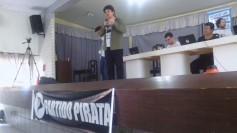
Latin America: Today, the Brazilian Pirate Party is formally founded. I’ve spent the past few days traveling around Brazil, speaking at conferences and meeting activists, and I’m left with a very positive impression of the movement and culture.
As I write this, the ritual of formally founding the party is being carried out – the party program is being read aloud to the assembled activists and to-be-chartering-members, and the statutes of Partido Pirata do Brasil will follow, after which 101 chartering members from nine Brazilian states will sign the charter.
I started this trip to Brazil by visiting the FISL convention (Forum International de Software Livre) in Porto Alegre, speaking there, and flying up to Recife, where I met more activists and spoke at Campus Party Recife. My impression that Brazil has the ability and capacity to dropkick the current dominant economies remains, and has been strengthened somewhat.
The net makes it possible to perform many tasks with the same output at a tenth, or even a hundredth, of the previous cost. (Just look at how the Swedish Pirate Party became the largest below-30 party in the European Elections with one-hundredth the campaign budget of our competition.) The United States and the European Union seems hellbent on resisting and rejecting this radical improvement in productivity in the name of “saving jobs”, which is completely counterproductive in anything but the very short term, which leaves the field open for any other power that wants to leapfrog the US and the EU by rejecting monopolies that brake and hold back these efficiency improvements of magnitude.
Enter the BRIC(S) countries, which have been in my spotlight for a while. The so-called emerging economies. Brazil, Russia, India, China, and some also include South Africa in the collection. I don’t really believe in China’s ascent beyond the mid-term – two decades or so – based on how they treat the net. China actively prevents free speech in order to silence domestic dissent, and so, they also prevent people and ideas from rising to their full potential. Russia has regrettably chosen the same route.
I had high hopes for India for quite a while, seeing its burgeoning generic pharma industry and an assumed understanding that more copyright and patent monopolies were not necessarily in India’s national interest, but in the past year, it would seem India is starting to crack down on free speech and the net increasingly at the request of the usual lobbies. That leaves a stronger need for an Indian Pirate Party, but also sets an uphill battle there.
That leaves Brazil, which appears to go in the completely opposite direction. For example, there is currently a law proposal in Brazil called the Marco Civil which establishes a firm charter of rights online – it establishes net neutrality, it establishes that net access is a precondition for the ability to exercise citizenship, and it establishes that carriers are never responsible for carried traffic. If enacted, this would establish a firm world leadership in seeing the net as a fundamentally positive force of change.
Any country that starts having tenfold or hundredfold the output for the same invested time and resources is going to just dropkick the current dominant geopolitical powers, sending them spinning so fast they didn’t see it coming. Brazil is in a position to do exactly that, and the US and EU are being disastrously stupid in rejecting and postponing these structural changes in order to appease the sunk costs of Hollywood, Louis Vitton, and Vivendi Universal.
In this environment, the Partido Pirata do Brasil has a significant head start, in terms of hearts and minds before many other countries. People have seen the net, seen the advantages it brings, and reject the US-dominated monopoly industries. It starts out with a significantly larger program than most PPs have had on day one, a program that includes social diversity, a secular state, and net access. Running the numbers, it would appear that once registered as a party, they have an excellent shot at making it in the elections two years out.
Like many other countries, Brazil is overcome with political fatigue and apathy. People are yearning – no, screaming – for the very concept of a politician that doesn’t… well, behave like one. In speaking with people, the “we’re not politicians, we’re civil rights activists that you can vote for” message appears to chime a stronger resonance here than in most places, further increasing the PPBR’s potential.
The next step after today will be to collect 500,000 signatures (yes, that’s five hundred thousand) supporting the party’s registration. That’s the highest number I’ve seen anywhere in the world – but I am certain that it can be done.
Bem-vindo to the community, Partido Pirata do Brasil!

July 19, 2012
Debunking The Dangerous “If You Have Nothing To Hide, You Have Nothing To Fear”

Privacy: Every so often, you hear the argument “If you have nothing to hide, you have nothing to fear”, in order to justify increased and invasive surveillance. This argument is not only dangerous, but dishonest and cowardly, too.
In the comments to yesterday’s post about Sweden’s DNA register, some expressed the “nothing to hide” argument – that efficiency of law enforcement should always be an overriding factor in any society-building, usually expressed as “if you have nothing to hide, you have nothing to fear”. This is a very dangerous mindset. The argument is frequently raised in debates by pro-big brother hawks, and doing so is dangerous, cowardly, and dishonest.
There are at least four good reasons to reject this argument solidly and uncompromisingly: The rules may change, it’s not you who determine if you’re guilty, laws must be broken for society to progress, and privacy is a basic human need.
Let’s look at these in detail. They go from the less important and more obvious, to the less obvious and more important.
One – The rules may change: Once the invasive surveillance is in place to enforce rules that you agree with, the ruleset that is being enforced could change in ways that you don’t agree with at all – but then, it is too late to protest the surveillance. For example, you may agree to cameras in every home to prevent domestic violence (“and domestic violence only”) – but the next day, a new political force in power could decide that homosexuality will again be illegal, and they will use the existing home cameras to enforce their new rules. Any surveillance must be regarded in terms of how it can be abused by a worse power than today’s.
Two – It’s not you who determine if you have something to fear: You may consider yourself law-abidingly white as snow, and it won’t matter a bit. What does matter is whether you set off the red flags in the mostly-automated surveillance, where bureaucrats look at your life in microscopic detail through a long paper tube to search for patterns. When you stop your car at the main prostitution street for two hours every Friday night, the Social Services Authority will draw certain conclusions from that data point, and won’t care about the fact that you help your elderly grandmother – who lives there – with her weekly groceries. When you frequently stop at a certain bar on your way driving home from work, the Department of Driving Licenses will draw certain conclusions as to your eligibility for future driving licenses – regardless of the fact that you think they serve the world’s best reindeer meatballs in that bar, and never had had a single beer there. People will stop thinking in terms of what is legal, and start acting in self-censorship to avoid being red-flagged, out of pure self-preservation. (It doesn’t matter that somebody in the right might possibly and eventually be cleared – after having been investigated for six months, you will have lost both custody of your children, your job, and possibly your home.)
Two and a half – Point two assumes that the surveillance even has correct data, which it has been proven time and again to frequently not have.
Three – Laws must be broken for society to progress: A society which can enforce all of its laws will stop dead in its tracks. The mindset of “rounding up criminals is good for society” is a very dangerous one, for in hindsight, it may turn out that the criminals were the ones in the moral right. Less than a human lifetime ago, if you were born a homosexual, you were criminal from birth. If today’s surveillance level had existed in the 1950s and 60s, the lobby groups for sexual equality could never have formed; it would have been just a matter of rounding up the organized criminals (“and who could possibly object to fighting organized crime?”). If today’s surveillance level had existed in the 1950s and 60s, homosexuality would still be illegal and homosexual people would be criminals by birth. It is an absolute necessity to be able to break unjust laws for society to progress and question its own values, in order to learn from mistakes and move on as a society.
Four – Privacy is a basic human need: Implying that only the dishonest people have need of any privacy ignores a basic property of the human psyche, and sends a creepy message of strong discomfort. We have a fundamental need for privacy. I lock the door when I go to the men’s room, despite the fact that nothing secret happens in there: I just want to keep that activity to myself, I have a fundamental need to do so, and any society must respect that fundamental need for privacy. In every society that doesn’t, citizens have responded with subterfuge and created their own private areas out of reach of the governmental surveillance, not because they are criminal, but because doing so is a fundamental human need.
Finally, it could be noted that this argument is also commonly used by the authorities themselves to promote surveillance and censorship, while rejecting transparency and free speech. Those who want to have a little fun can play the reverse card as illustrated by Saturday Morning Breakfast Cereal.
The next time you hear anybody say “if you have nothing to fear, you have nothing to hide”, tell them that’s an absolutely false and dangerous argument, and point them at this article.

July 18, 2012
Sweden, Paradise Lost: Part 3 – Sweden Holds DNA Database Of Everybody Under 38

Privacy: In our series showcasing Sweden as a country that likes to pretend it’s a white knight in shining armor for civil liberties while actually doing the exact opposite, we’ve arrived at the so-called PKU register. It’s a DNA database of the entire population born after 1975, used – among other things – for criminal investigations.
It sounded good. Starting in 1975, all hospitals would take a blood sample of every newborn baby to store in a vault for medical research, specifically to test for and track Phenylketonuria (PKU), which is an inability to metabolize phenylanaline (an indirect component of almost all diet sodas, among other things).
Medical research is good, right?
Following the high-profile murder of Anna Lindh in 2003, something odd surfaced with how the police confirmed the suspect killer. It turned out that police investigation laws, the laws that determine how police can walk in and seize evidence deemed relevant to an investigation, had overridden the medical secrecy for the PKU samples – and police had just walked in and seized the suspect’s blood sample, taken when he was born for medical purposes, to do a forensic DNA match. This was not the first time the medical blood sample database had been used as an investigative DNA register; it had been going on for a long time under the radar, at least since 1998.
So… going from being an archive for advanced medical research under consent, the vault had been repurposed by reinterpreting existing laws: the Swedish police now has a DNA database of the entire population born after 1975 at their disposal. No other country that I’m aware of has that comprehensive a DNA database of practically the entire sub-middle-aged civilian population.
It also highlights the dangers of database mission creep, when something collected for one purpose gets repurposed for something else – and that every piece of data collected by governments must be viewed in the light of its worst possible abuse.
Next in series: TBD (so much to choose from).
Previous: Private police forces.

July 16, 2012
Swedish Govt Greenlights Database Over Transgendered, Jews, Medically Weak, Gypsies, Trade Unionists. What Could Possibly Go Wrong?

Privacy: Every once in a while, a law appears that you have no idea how to relate to. You’re not sure how to tell the world about it: you will not just appear alarmist, but quite stark raving mad. Roswell Chemtrail Bilderberg Brainlaser van Roaming Loonie. And yet, there it is.
A new law was just proposed in Sweden, that would create a cross-referenced database over some of the most sensitive personal information of Swedish people: health issues, medical records, ethnic background, and trade union membership. That may not sound too bad, until you realize it’s a database over transgendered and medically weak (health issues / medical records), jews and gypsies* (ethnic background) and, well, trade union membership. It’s going to be about much more as well, surely, which doesn’t make it better in the slightest.
The law in question was just sent to the Legislative Council (lagrådet) for constitutional approval, before it is sent to Parliament for ratification. There have already been several op-eds speaking out about it – from youth wings of the political parties, not from the political parties themselves. The Swedish Data Inspection Board (Datainspektionen), which is the privacy watchdog authority, has been very critical: it says that it cannot approve such a database without the law even specifying any reason for the privacy violation, nor sees it as desirable to build it in the first place (which is very harsh words from an authority).
Unfortunately, the Swedish Data Inspection Board is routinely ignored in matters concerning privacy (which is its primary watchdog function).
I find it flabbergasting to see the naïveté with which such a law is proposed. The law and database is supposed to assist in employment policy research, but it’s not like any single database – once in place – has ever been confined to its original intention. Which reminds me – tomorrow, I’ll have an article about how every citizen of Sweden born after 1975 is in the world’s largest DNA register. The entire civilian population below 37 years of age.
When I see a law like this being proposed, I tend to just glance at history, shake my head in disbelief, and think “do we really have to go through all of this again?“.
*I do know the contemporary correct term for gypsies would probably be Roma or Romani, but pretty much nobody understands that word.

July 13, 2012
New Japanese Copyright Law Doesn’t Seem To Make Any Sense

Copyright Monopoly – Avery Morrow: Beginning this October Japan will experience a totally new copyright regime. Piracy in Japan has always been especially dangerous. The police monitor file sharing networks, and pirates will occasionally be raided by cops and have their computers displayed on the evening news. From 2012 on, though, violators can face two years in prison for criminal downloading.
But what exactly makes a download criminal? The Agency for Cultural Affairs, which oversees the law, is having a hard time defining what, exactly, constitutes criminal piracy under the new law.
First, let’s address the definition of the word “download”. With this new law, you have a blanket permission to stream any and all pirated YouTube videos, but saving permanent copies of these videos will be a big no-no. However, saving comic strips from websites will be fine, and you can copy and paste all the text you like, because the Agency for Cultural Affairs has interpreted the word “download” as implying an audiovisual recording and not any other type of binary data. There is no stated logic behind this, and there has not yet been any ruling on, say, converting a video into a picture of a film strip.
Next, the Agency for Cultural Affairs gives us a rather inspired ruling of “illegal download”: it claims that TV shows which have been broadcast and are not yet available on DVD or Blu-Ray may be downloaded freely, because they were broadcast for free! However, you can still be sued for piracy as a civil offense. Furthermore, there are existing criminal charges for people who upload such videos.
Let’s move along to recordings of unknown provenance, which curious readers often find on the Internet. Most of the law requires that you have an intent to acquire works illegally when you download, which does not appear to be easily provable. In fact, there does not appear to be anyone in Japan who believes that intent can be proven if there is some doubt at work. One lawyer guesses that “it’s hard to imagine that songs have been officially allowed to go on peer-to-peer networks,” so making Gnutella your tool of choice for finding those great Jonathan Coulton songs will apparently make you a suspicious character.
How does an artist make it clear that his material is safe to download? The Agency for Cultural Affairs asks Internet users to look for a recording industry trademark called the L Mark, but this trademark can’t be used by just anyone; artists must join the Recording Industry Association of Japan and pay money to use the mark, which is currently employed by no more than 300 websites. There is no word on whether a Creative Commons mark or public domain declaration can serve as a defense against inappropriate claims of criminal copyright violation.

Once you have your legally acquired music and movies, you mustn’t pirate them, but feel free to e-mail them to others. E-mailing MP3s or videos to a specific friend remains legal in Japan, assuming you are not offering them as a service to pirates. You can even e-mail entire CDs that you ripped, within some reasonable limit. However, you are not allowed to circumvent the copyright protection on the few CDs that have it, so keep your hands off that Shift key.
This is not legal advice, but the law is so vague that it would be surprising if it had a large impact on the number of prosecutions. Most legal cases in Japan are dropped before trial if guilt cannot be established, and plea bargained by the Kensatsu before they go to court, which is why there is an almost 100% conviction rate. Past cases suggest that only the most serious violators, like people who upload TV shows to file-sharing networks, will face prosecution.
Source: Agency for Cultural Affairs (Japanese)

Rick Falkvinge's Blog

- Rick Falkvinge's profile
- 17 followers