Rain Trueax's Blog, page 43
April 7, 2013
Finishing and starting

It's kind of funny (funny odd not hilarious) or was for a bit. For over a year, I had two unfinished historical manuscripts. I just do not do that. When I write something, I finish it. The first incomplete tied into the Oregon stories. I put it off when I realized more editing was required before submitting my contemporary romances to ePublishing. In the midst of that I got the idea for a story to follow my Arizona historical (confused yet?) and began that. The world interfered as well with the need for better covers. So, I let them both set.
When we drove to Tucson in November, instead of finishing either, I got the idea for a Christmas novella which I wrote while there and got out barely in time for Christmas. It also had characters from another book.
Back in Oregon in January, I was determined to get both of those unfinished novels into the rough draft category. I did the Arizona one first as it has been my intention to see the Arizona historicals ePubbed before the Oregon ones.
As soon as I got that one done, I started on what was required to finish the Oregon historical. It was finished the last week of March. By finished, I mean rough draft as no book is done until it's been edited, edited and edited again. Still it was a good feeling when I got it to that stage as it meant I suddenly had nothing on my plate.
That was until I got the idea for a fourth Oregon historical. The hero for it was already in two of the other books as a secondary character. I realized, with the youngest of the Stevens sisters, I had the leads for a new story set during the Snake Indian War and involving the history of the John Day country. This is beautiful country, full of fossil beds, interesting rock formations, and a wide variety of terrains.
On the history end, with all the gold mining, the rapid growth, rampant crime, the Chinese population, there was a lot to research even if I didn't include the main purpose for the story-- the Snake Conflict, 1864-68.

Canyon City, bigger than Portland at that time (10,000 population) had some fascinating characters, not the least of whom was one of Oregon's most colorful poets, Cincinnatus Miller who wrote under the name Joaquin Miller. He led an interesting life in terms of women and experiences. Basing more of my story in Canyon City and Camp Watson, he could add some color because he was a judge there during those years-- before he ambled on for adventures elsewhere.

The hero was a cavalry officer in two earlier books and having him stick with that lets him be more involved in the actual Indian conflict. My idea for the heroine (the youngest of three sisters) would have her being a governess which was how I would get her to this unlikely place after a college education and travel to Europe all helped along by wealthy friends who took her under their wing. What if the wealthy family headed for Canyon City and the gold wealth to be had and brought her reluctantly along? Definite potential there.
Sometime I might write more in a blog about the process behind historical romances, but generally speaking I like to research a geographic area, time span, understand what was going on in the big picture, what could be possible personally (that is, of course, fictionally), and then set my characters into it.
The one thing I know for sure, interesting though this all is to me, I should wait a couple of months to get started on it as writing original novels makes for long, long days at the computer. Emotionally I've had enough burying myself in other people's problems-- for awhile.
When I do put out the first historical, I am thinking of doing paperback as well as eReader. That means I will need to design a backcover and probably an inside leaf. The eBook covers I have been creating are good enough for paper covers. I wouldn't use any system that forced the paper version to be over $10 (if you aren't careful, it can go way over, and you would never sell a single book), but CreateSpace seems to be good method as it appears it keeps the costs down. The books are printed only as you sell them through Amazon; or if you decide to take them to a store, as you buy them to put out on consignment. I am still thinking about the ramifications of this and reading other writers' experiences with CreateSpace.

All photos from the John Day country. Writing another book based there is a wonderful excuse to spend a lot of time absorbing the energy of the place as it's one of those areas I've come to love very much.


April 4, 2013
finding inspiration from nature
Often, my own writing inspires ideas for this blog. Although I'll be researching/tweaking/editing, I am finished with another rough draft and for a bit might have to depend on my own life for topics-- do I have an 'own life' right now?
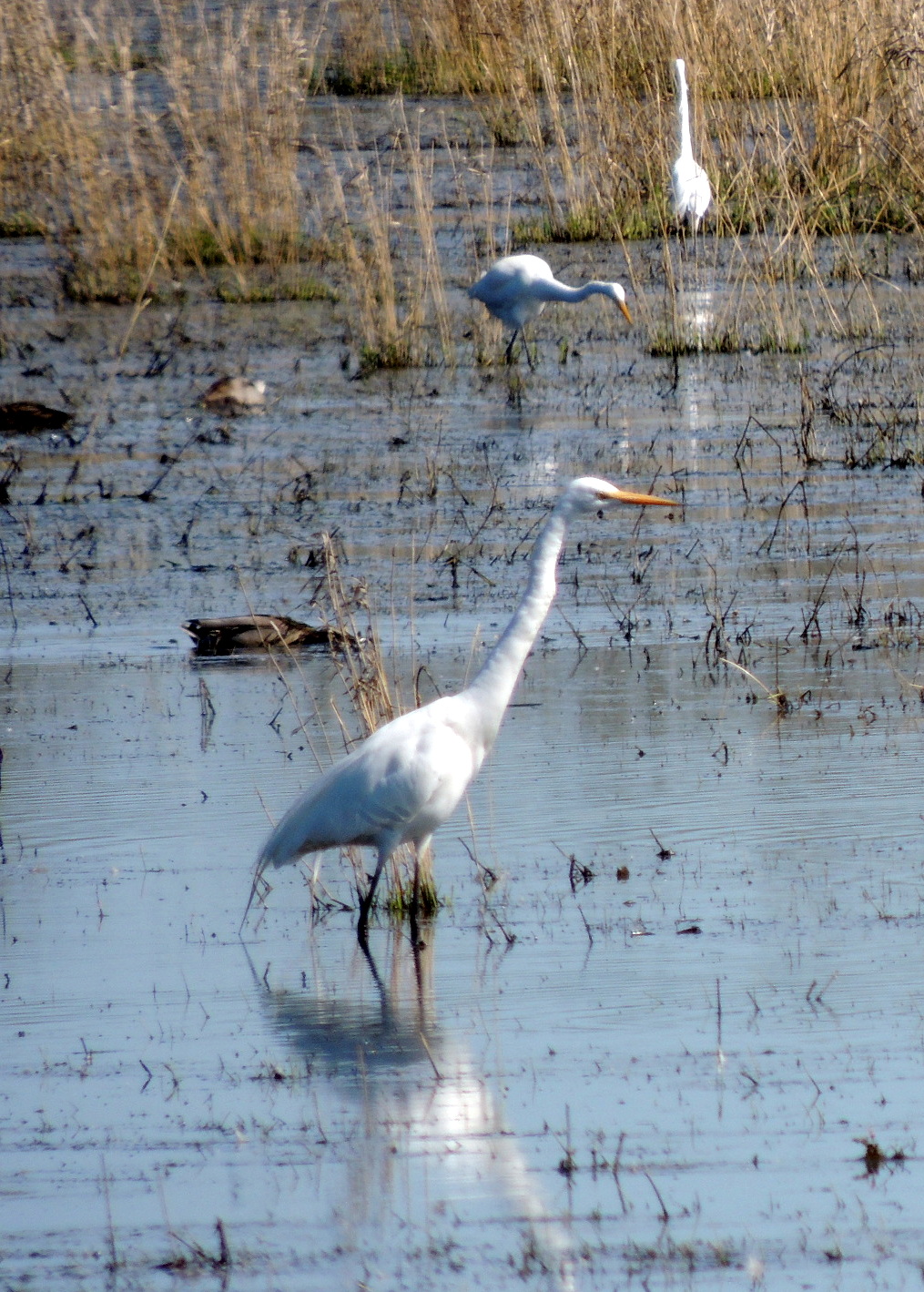
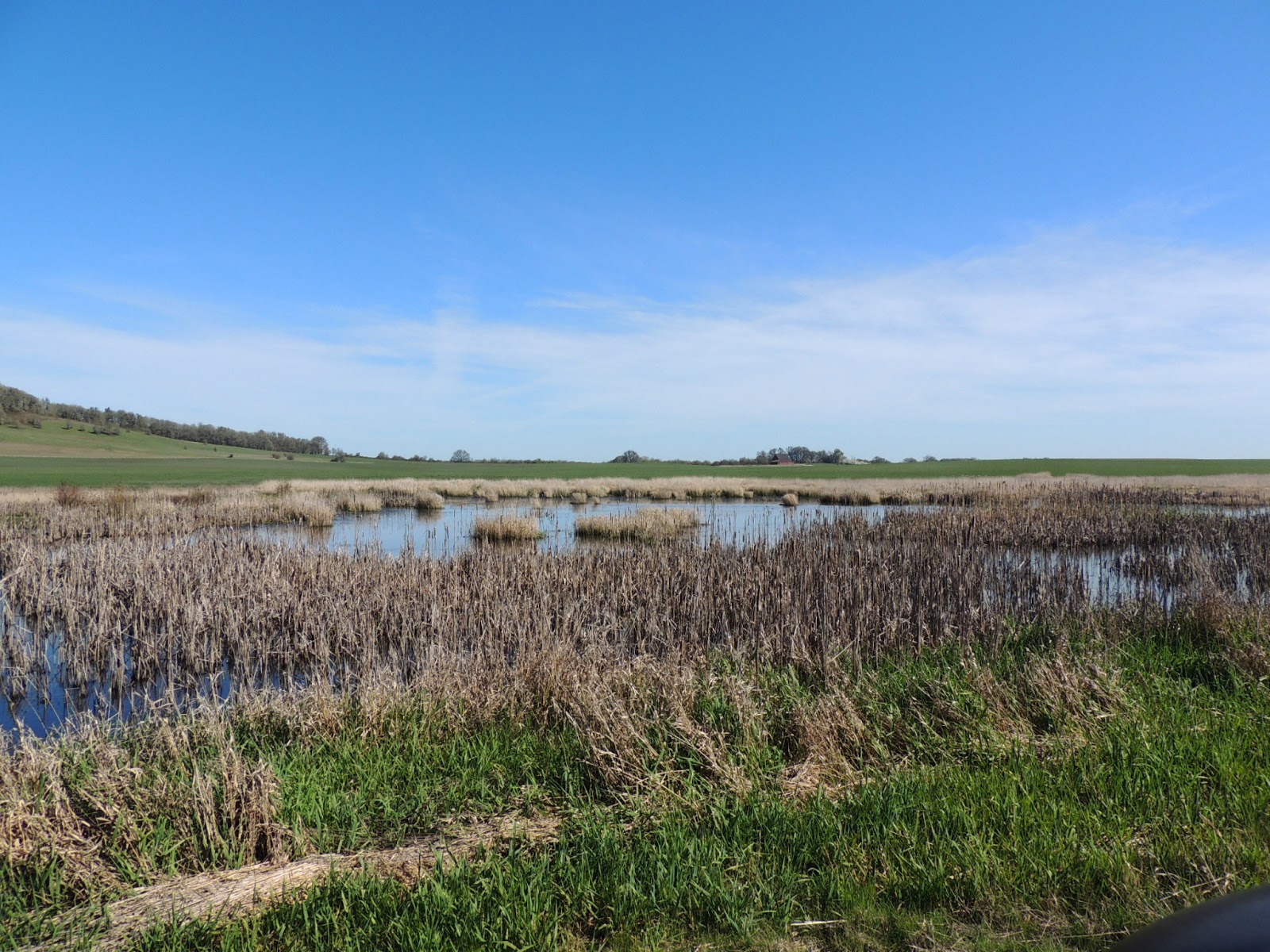
In order to be sure I still did, Sunday I was out at Finley, a nature preserve about twenty miles or so from our place. The birds were in high excitement with thousands of geese flying, landing and taking off. I don't know but many may be on their way north. What an exciting season.
In Finley, there are some regular residents. To just sit and listen to all the birds, to watch for the one moment something happens, that's why it's wonderful to go to such natural sites. And why it's so important they remain available for wild and migrating birds. It is a creative space that inspires me every time I am there.


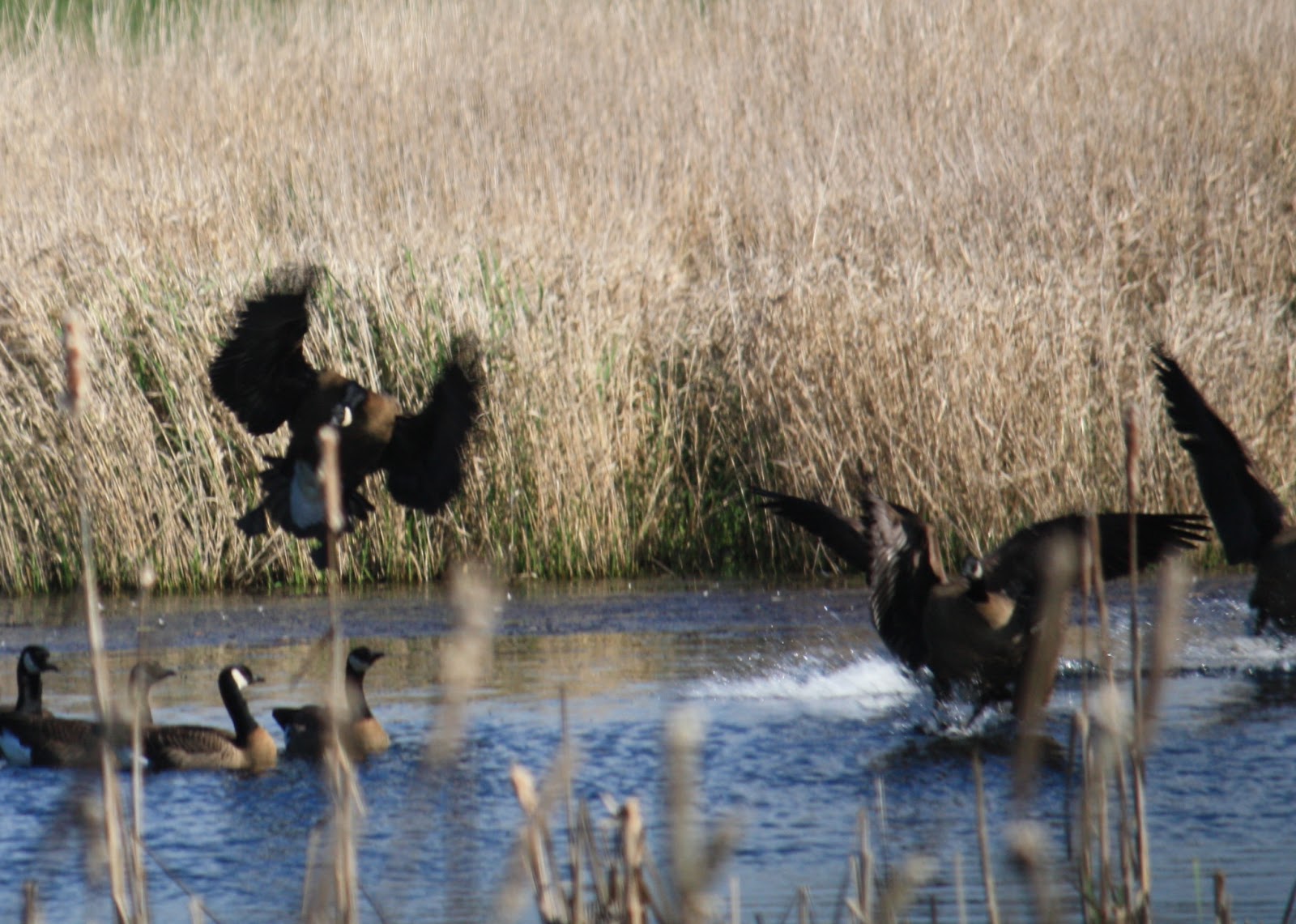
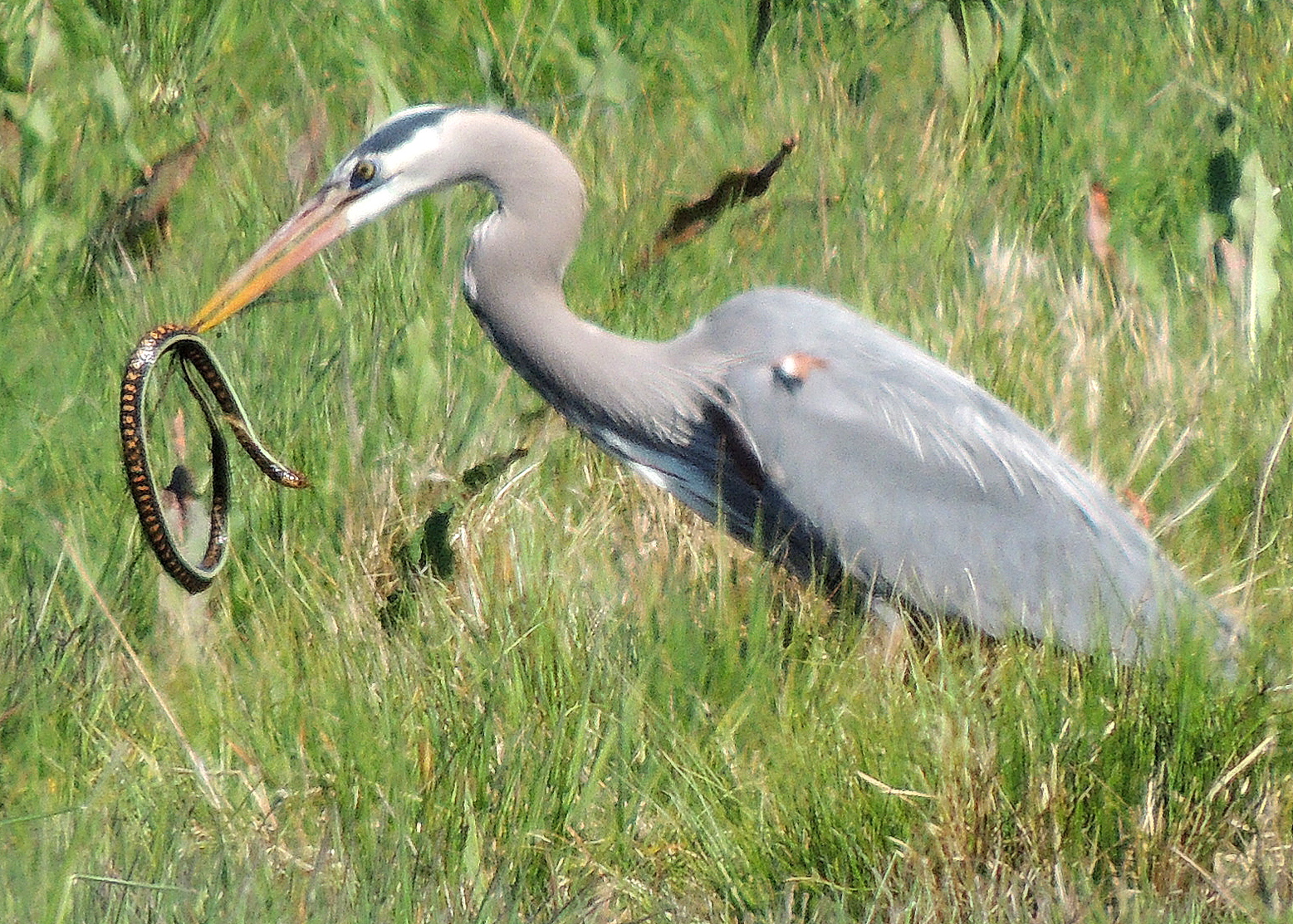
The sounds of hundreds of birds landing and lifting off from the water, their wings beating the surface as they call cannot be duplicated. It has to be experienced. It must be thrilling for them also as they act together on some unheard (by us) signal.

We took quite a few videos and can't say any totally told the story of what it's like to be there. The following link is to a piece of that feeling:
March 31 at Finley .
April 2, 2013
I am a writer

from Vintage Anchor
When you think about what being a writer means, the above (which I got from Facebook) says a lot of it. Because for the last couple of years my main writing of fiction involved editing and rewriting, I had forgotten how all encompassing writing an original novel actually is. This winter I did a novella, followed it with the Arizona historical (which ended up 117,000 some words give or take when final editing is finished this summer) and now am into the Oregon one with it nearing its rough draft's completion.
Perhaps if one stops at the minimum length for a novel, which is 60,000 words, this total absorption would be less so. You'd live with these characters less time and have less complexity to the novel. But if you go for the longer lengths or into what are considered epic lengths of over 100,000 words, you live with them and their problems in a way that takes over your own life. That's just my warning to be prepared to any author who has yet to write something that long and complex.
 image from CanStock
I've shown these statistics before but basically here are averages for lengths of books:
Novel-- over 40,000 wordsnovella 17,500 to 40,000 wordsnovelette 7500 to 17,500 wordsshort story -- under 7500 words
Some would say that a novel must be 80,000-95,000 words and an epic or saga is over 100,000. It seems it's all a bit subjective but, one this is true, where novellas and short stories can be looser in form, novels not so much. There are expectations for what the reader will find in the novel- which I wrote about in an earlier blog.
The first full length, historical romance novel I ever wrote was140,000 words. It's the one I spent over a thousand dollars (and that was over fifteen years ago) working with a consulting writer on editing. Recently it got another look by me and it's still at 135,000 words and yes, that's epic, a length that most editors (at least back in the years when I submitted manuscripts) wouldn't even bother to read from an unpublished writer. The thing is it's a story not only of love but the trip west on a wagon train. Even though it centers on one couple and one family, that still makes for a lot of story.
Anyway the work currently sucking me in is set in Oregon and involves the history of the state in 1865. While writing it, once in awhile I come up for air and realize there is no me. Instead of my life, I am fretting over if my hero is reacting logically, would my heroine really do that, what about that villain, is he acting and reacting consistently to his character (yes, even villains should)? And on it goes. It's especially bad in the middle of the night when it's all I can think about.
When I finish the rough draft of this book, I really need a break from writing (although I already have an idea for the book that would follow this one). I need to get back into my own life and find out what's going on. It turns out that my husband has been pulled into a technology project right now to the point he's not really here either. We are going through the paces of looking after the livestock and our place, but our imaginations are elsewhere. Possibly bad timing as it might be best if we staggered our obsessions.
March 31, 2013
What resolves a novel?
In writing a novel, or really any fictional work, you've been writing along and feel the story is getting there-- or is it? Where a good beginning to a story is essential in attracting a reader's interest-- a good ending is maybe even more important. That reader has put time into your story. They need to feel it was worth it when they reach the end. I've read a lot of reviews (not of mine but others) who liked a book right up until they felt cheated at the end.
The ending, when it's a romance, can be when the couple are ready to fully commit to each other. That might mean a wedding-- or not. Writers sometimes throw themselves into contortions trying to keep those two from getting together too soon. That is really unnecessary. The novel does not have to end with their coming together but might have another problem they must resolve before the happily ever after. That something else could be an emotional issue that suddenly arises or something threatening from outside them.
Generally the ending to my novels has been pretty easy for me to determine. There have seemed enough barriers to keep it happily/or unhappily moving along until the problem with the bad guy or outside issue has been resolved. That can mean, in the body of the story, the lovers get together, fight over a very real issue, leave each other, work it out and go through that a couple of times-- very much like it happens in a lot of real life relationships (yes, I speak from experience).
When reading someone else's work or writing my own, what I don't like is using a bogus issue to keep lovers apart. I want it to be some real problem in their personalities that makes them question whether a life together will work. Sometimes an outside issue can interfere making the happily ever after take awhile. But whatever it might be, my goal is always to make it feel as though-- yeah that's how mature people would handle it. I suppose if I was writing about immature people, it'd be otherwise, but as I mentioned before, I like to write about people I could respect if I knew them in real life.
When writing, I enjoy putting real life, small moments into my romances because they are fun to write. I suppose some readers might consider that makes them slow reads if they believe exciting action has to be happening all the time. My own favorite reads mix action with the kinds of happenings that revolve around maybe cooking a meal or weeding a garden. Those are things I like in what I read and likewise what matters to me in my own books.
The other night, we again watched Murphy's Romance, starring James Garner and Sally Fields. If you haven't seen it, it's a love story about a much younger woman and an older man. As I have thought before, this would probably be a book that a lot or romance readers wouldn't like as it develops slowly, and there are a lot of real life feeling moments not filled with action but part of developing the characters, building the mood and celebrating the pace of life. Then, by The End, the end seemed right. I am not sure writing romances like that works with today's readers, but it works for me when I find such a book.
What has led me to consider this question comes out of my own WIP as I began to ask-- where am I at in the resolution? Have I missed a bigger problem that originally I didn't see? For a little bit I was feeling worried. It seemed it was all working out too smoothly. That was only until I stepped back and saw the whole situation for what it really was and the writing resumed on track.
This particular story, which is set in an historical time period, appears to not tell as much of that historic time in Oregon as I had originally anticipated. That likely will mean a fourth book as I won't stretch this one beyond what feels right for these characters and their original dilemmas. If I do write a fourth book about that period in Oregon history, I'll use a third sister from the family, it's something I won't decide until I get this one to The End.
One thing I like about writing this blog is my writing always seems to give me topics that I can turn out pretty fast and get back to the problems in the novel. In terms of my own life and how it's going or the country as a whole, that's where I am stymied for what I want to say. I read, observe, have opinions, but not many I want to write about.
The ending, when it's a romance, can be when the couple are ready to fully commit to each other. That might mean a wedding-- or not. Writers sometimes throw themselves into contortions trying to keep those two from getting together too soon. That is really unnecessary. The novel does not have to end with their coming together but might have another problem they must resolve before the happily ever after. That something else could be an emotional issue that suddenly arises or something threatening from outside them.

Generally the ending to my novels has been pretty easy for me to determine. There have seemed enough barriers to keep it happily/or unhappily moving along until the problem with the bad guy or outside issue has been resolved. That can mean, in the body of the story, the lovers get together, fight over a very real issue, leave each other, work it out and go through that a couple of times-- very much like it happens in a lot of real life relationships (yes, I speak from experience).
When reading someone else's work or writing my own, what I don't like is using a bogus issue to keep lovers apart. I want it to be some real problem in their personalities that makes them question whether a life together will work. Sometimes an outside issue can interfere making the happily ever after take awhile. But whatever it might be, my goal is always to make it feel as though-- yeah that's how mature people would handle it. I suppose if I was writing about immature people, it'd be otherwise, but as I mentioned before, I like to write about people I could respect if I knew them in real life.
When writing, I enjoy putting real life, small moments into my romances because they are fun to write. I suppose some readers might consider that makes them slow reads if they believe exciting action has to be happening all the time. My own favorite reads mix action with the kinds of happenings that revolve around maybe cooking a meal or weeding a garden. Those are things I like in what I read and likewise what matters to me in my own books.
The other night, we again watched Murphy's Romance, starring James Garner and Sally Fields. If you haven't seen it, it's a love story about a much younger woman and an older man. As I have thought before, this would probably be a book that a lot or romance readers wouldn't like as it develops slowly, and there are a lot of real life feeling moments not filled with action but part of developing the characters, building the mood and celebrating the pace of life. Then, by The End, the end seemed right. I am not sure writing romances like that works with today's readers, but it works for me when I find such a book.
What has led me to consider this question comes out of my own WIP as I began to ask-- where am I at in the resolution? Have I missed a bigger problem that originally I didn't see? For a little bit I was feeling worried. It seemed it was all working out too smoothly. That was only until I stepped back and saw the whole situation for what it really was and the writing resumed on track.
This particular story, which is set in an historical time period, appears to not tell as much of that historic time in Oregon as I had originally anticipated. That likely will mean a fourth book as I won't stretch this one beyond what feels right for these characters and their original dilemmas. If I do write a fourth book about that period in Oregon history, I'll use a third sister from the family, it's something I won't decide until I get this one to The End.
One thing I like about writing this blog is my writing always seems to give me topics that I can turn out pretty fast and get back to the problems in the novel. In terms of my own life and how it's going or the country as a whole, that's where I am stymied for what I want to say. I read, observe, have opinions, but not many I want to write about.
March 28, 2013
Title by muse
While I have been writing on the Oregon historical, third in its series, I was listening to some music that had wonderful imagery. I gave up my (much beloved) working titles for ones that came to me with the music, titles with more emotion and imagery to suit each story. The change (even with reluctance at giving up my original idea) was serendipitous.
Their change, however, left me dissatisfied with the two Arizona historical titles. Although they had seemed okay, they had no emotion. I spent probably a couple of weeks thinking, whenever I wasn't doing something else-- what could I use instead? Since they are the two I plan to bring out first, their titles were pressuring me.
Finally, frustrated with running possible names through my head, I said to myself-- If I really have a muse, get me a title. I need your help because I am not getting it.
I woke up the next morning with the first of the titles (the second came right after the first). I was happy and gave full credit to the muse, whatever a muse might be.
Then I thought of something that stopped me cold. I had something that would work very well with this title and its book. It was one of my own dreams from probably fifteen years ago. The dream had been so vivid that I even created a digital painting from it. I always took the dream to have symbolism for my own life, and it has; but I never once thought I'd use it in any of my books.
For a moment I thought-- but that was my dream. Not sure I wanted it to belong to this story. But I knew it did belong. It fit perfectly.
That next morning I wrote it into the story. It might be that readers will think what an unbelievable dream, couldn't be real. Except I had that dream exactly as I wrote it for my heroine. Others might think I am writing an historical about shape-shifters. It's not. The dream is symbolic for how we can or cannot heal others.
The other irony about this is that the time I dreamed it was probably not far off from when I was writing the original draft of the book. Perhaps the meaning in that dream was always intended for that book, but it took until now for me to see it. I try to be open to creative inspirations. Sometimes I can be pretty dense.
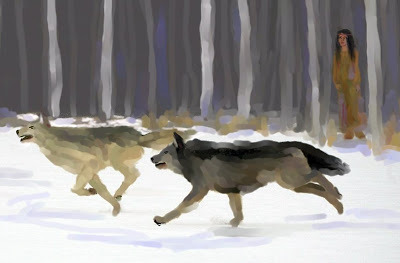
An excerpt showing where it fit into the book follows:
Getting ready for bed, Abigail felt restless, as though something was coming but she could not put her fingers on what. She lay awake longer than usual trying to blank images from her mind before she finally fell into a deep sleep.
She had heard talk that men and women had the power to do this changing of their form. There was the fear talk that witches did it regularly. That didn't appear to be the message of this dream. It all felt symbolic not real but a symbolic of what?
Dressing for church, she tried to put the questions aside. Silly dream. Hardly worth wondering at deeper meanings for such things. That’s what her father always said-- what the pastor would say. She would tell no one of it. Symbolically vivid-- it had no meaning.
Their change, however, left me dissatisfied with the two Arizona historical titles. Although they had seemed okay, they had no emotion. I spent probably a couple of weeks thinking, whenever I wasn't doing something else-- what could I use instead? Since they are the two I plan to bring out first, their titles were pressuring me.
Finally, frustrated with running possible names through my head, I said to myself-- If I really have a muse, get me a title. I need your help because I am not getting it.
I woke up the next morning with the first of the titles (the second came right after the first). I was happy and gave full credit to the muse, whatever a muse might be.
Then I thought of something that stopped me cold. I had something that would work very well with this title and its book. It was one of my own dreams from probably fifteen years ago. The dream had been so vivid that I even created a digital painting from it. I always took the dream to have symbolism for my own life, and it has; but I never once thought I'd use it in any of my books.
For a moment I thought-- but that was my dream. Not sure I wanted it to belong to this story. But I knew it did belong. It fit perfectly.
That next morning I wrote it into the story. It might be that readers will think what an unbelievable dream, couldn't be real. Except I had that dream exactly as I wrote it for my heroine. Others might think I am writing an historical about shape-shifters. It's not. The dream is symbolic for how we can or cannot heal others.
The other irony about this is that the time I dreamed it was probably not far off from when I was writing the original draft of the book. Perhaps the meaning in that dream was always intended for that book, but it took until now for me to see it. I try to be open to creative inspirations. Sometimes I can be pretty dense.

An excerpt showing where it fit into the book follows:
Getting ready for bed, Abigail felt restless, as though something was coming but she could not put her fingers on what. She lay awake longer than usual trying to blank images from her mind before she finally fell into a deep sleep.
An Indian woman stood back in the shadows in a grove of aspen trees. Snow was on the ground. She was watching men of her tribe as they advanced with bows in their hands, arrows at the ready. Beyond a pack of wolves was running but one stopped and approached the men, standing as though waiting. The men drew back their bows and two arrows struck the wolf, one in the chest, the other the loins. It fell. The men walked toward it. Satisfied, they left the clearing.
The woman walked to the wolf's body. She understood it had been killed to protect the tribe, that the village needed this ritual for its safety. Perhaps the wolf had agreed to be the sacrifice. Then she saw the wolf was not dead. She made a decision to tend its wounds. As she applied the poultices and remedies she knew, she understood she was going against the good of her tribe.
When Abigail woke, she lay in bed remembering the dream, trying to understand the message. It had been so vivid, as though she was the woman. She had never dreamed such a thing before, never even imagined it though her dreams were often vivid and fanciful.
It was a shock when the body of the wolf morphed into that of a man. He was not appreciative of her efforts on his behalf but lay still as she tended him. Finally she realized she had done all she could but her efforts were not enough to heal him. He had the power to heal himself but she was unsure he wanted to do so. The dream ended before she had the answer to whether he would.
She had heard talk that men and women had the power to do this changing of their form. There was the fear talk that witches did it regularly. That didn't appear to be the message of this dream. It all felt symbolic not real but a symbolic of what?
Dressing for church, she tried to put the questions aside. Silly dream. Hardly worth wondering at deeper meanings for such things. That’s what her father always said-- what the pastor would say. She would tell no one of it. Symbolically vivid-- it had no meaning.
March 26, 2013
Do you see the title first?
It occurred to me that I haven't written much (if any) on the process of creating titles. They are important to blogs, books and pretty much any creative effort of writing. A title can turn a reader on or off. It can leave the reader disappointed or feeling very satisfied. I love titles, both creating and reading them.
Usually creating titles has come pretty easily for me. I write a lot of them because of the blogs and then there are the eleven ePublished contemporary romances with five historicals which likely will also be available eventually. Whether anyone else likes them, I always like my titles. I look for imagery and some aspect of what I've written. My goal is to have a title go to the deeper meaning within the book.
In writing a blog sometimes my titles are pretty prosaic, just the facts ma'am, and sometimes flighty. I think they always deal with what the reader will find when they get to the text. And this is what I hope for with my books.
Most books, when a work in progress, have a working title. Sometimes that can last years if that book doesn't immediately get finished or is finished but not yet published. Sometimes I know they are not permanent. Other times I stubbornly want them but finally accept they aren't best for the books.
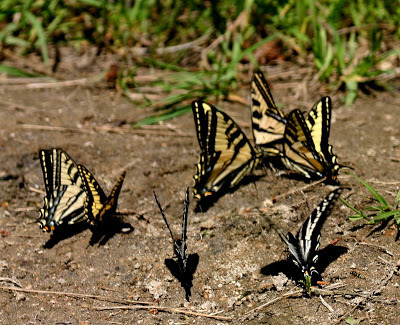
Only once did I put out a book and change the title after it had been published. Basically whether they draw in readers or not, they have a reason for being what they are. I thought I'd describe a few and their reason for being as examples of how readers might come up with their own titles.
The one I changed goes first. I called it Golden Chains because it's about love, art, mythology and I saw love as a binding sort of chain, something that is valuable, lovely but harder to break than we think. The story of Prometheus is both in the book and woven into one of the character's personality. Golden Chains-- what could go wrong?
Well to start people assumed it was erotica. It's not-- although it does have sex in the book and nude modeling in art classes. Neither qualified it for erotica except to people who see all nudity as suspicious unless its confined to a bedroom-- or maybe a strip joint. After a few months of having this book out and realizing, through comments, that the title wasn't fair to it, I changed it to Bannister's Way (mentioning the change in its blurb so people didn't buy it twice).
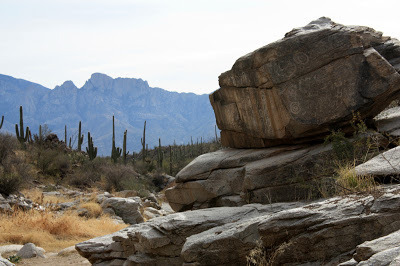
Bannister's Way was a good title also as one of the issues is the way David Bannister gets things done which seem manipulative and underhanded to some. He is a detective. He has though gotten into a situation where he's trying to win back his ex-wife, dealing with a world where he's out of his league, and instead of feeling totally in charge, he's having to learn what it's like to feel blocked and out of control which impacts his work as well as his life. Bannister's Way is about our way and how it might not always be the best. Can we learn new ways?
Another title that might confuse readers but it's staying where it is would be Moon Dust. I suppose a reader might wonder what the heck that means; but if they read the book, they will receive the answer. I personally like titles like that and think a reader would also as a way to consider discovery part of a good read. The title, Moon Dust, is not depicting romantic love. It is a fairy tale in the book; but the fairy tale, as they all do, has a deeper meaning. It's how we actually can make change in others and our world.
I could write about mine all day because its fun to describe how they got to be. They are created by connecting with the energy of the work, finding a few words, very few, that relay that energy to a person passing by. I like words with imagery, sometimes some mystery, words connected to the book (sometimes a piece of text within), but mostly indicating the energy of the book.
One last example is another title that likely wouldn't seem obvious for its meaning. Hidden Pearl is about a world of cults and people searching for meaning to their lives and finding it in dangerous places. It is a Biblical concept in one of Jesus' parables (Matt 13:44-46) where something of great value might be hidden but when it's found, it is of greater value than anything else.
In my story, the hero is not looking for anything until he is sent on a quest by his Navajo mother. Being born of two cultures, he has mostly denied any connection to his heritage. He has believed in what is in front of him, but when he begins to try and find what happened to his sister, he finds himself also on a quest into himself.
The reason people get into cults is because they want that thing of great value, the meaning of life. They think they have found it but often find instead it is a trap. I suppose the title might confuse potential readers, but I figure that if people ever get into my books, they will find those titles are often keys to the deeper something in them.
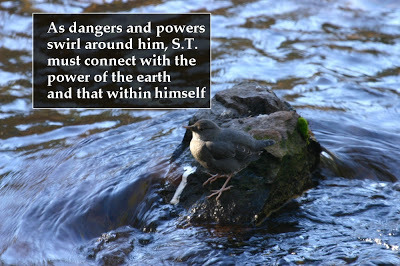
There are a lot of titles out there; many are only designed to attract. One popular author uses single words like reckless, breathless, etc. Several mystery writers use the alphabet with the readers knowing the next title will fall in line. Some create words that will become part of our lexicon. I guess whatever comes to us is what we will build upon.
Titles are rewarding, not always easy. I had an experience recently that brought this all to my attention-- coming next blog.
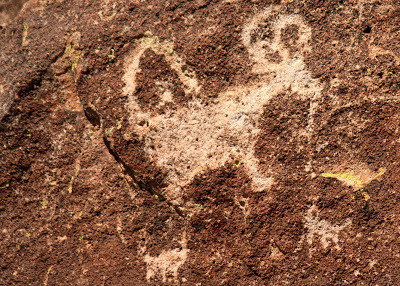
The images I chose for here are all mine from a variety of sources and I chose them just because...
t
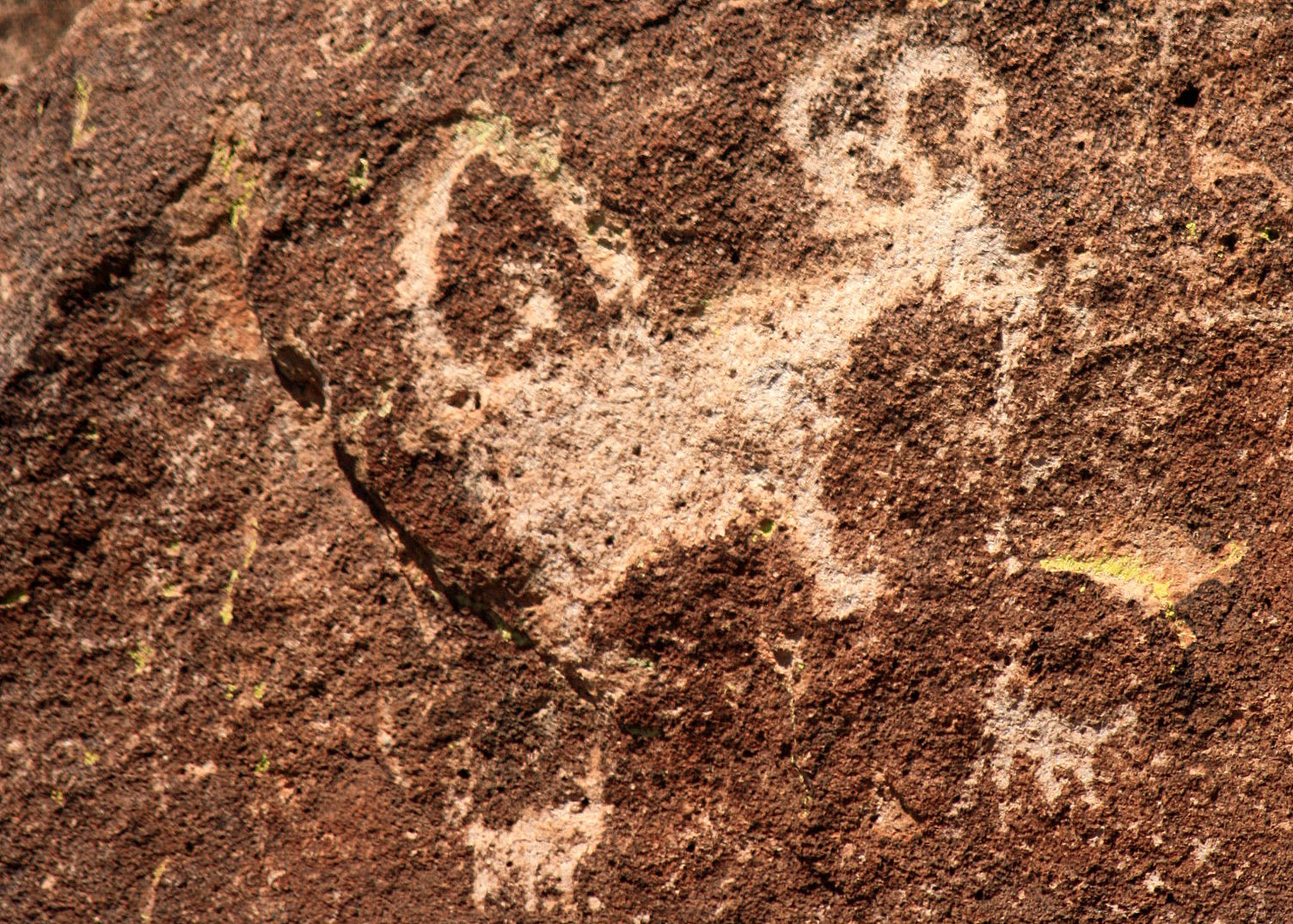
Usually creating titles has come pretty easily for me. I write a lot of them because of the blogs and then there are the eleven ePublished contemporary romances with five historicals which likely will also be available eventually. Whether anyone else likes them, I always like my titles. I look for imagery and some aspect of what I've written. My goal is to have a title go to the deeper meaning within the book.
In writing a blog sometimes my titles are pretty prosaic, just the facts ma'am, and sometimes flighty. I think they always deal with what the reader will find when they get to the text. And this is what I hope for with my books.
Most books, when a work in progress, have a working title. Sometimes that can last years if that book doesn't immediately get finished or is finished but not yet published. Sometimes I know they are not permanent. Other times I stubbornly want them but finally accept they aren't best for the books.

Only once did I put out a book and change the title after it had been published. Basically whether they draw in readers or not, they have a reason for being what they are. I thought I'd describe a few and their reason for being as examples of how readers might come up with their own titles.
The one I changed goes first. I called it Golden Chains because it's about love, art, mythology and I saw love as a binding sort of chain, something that is valuable, lovely but harder to break than we think. The story of Prometheus is both in the book and woven into one of the character's personality. Golden Chains-- what could go wrong?
Well to start people assumed it was erotica. It's not-- although it does have sex in the book and nude modeling in art classes. Neither qualified it for erotica except to people who see all nudity as suspicious unless its confined to a bedroom-- or maybe a strip joint. After a few months of having this book out and realizing, through comments, that the title wasn't fair to it, I changed it to Bannister's Way (mentioning the change in its blurb so people didn't buy it twice).

Bannister's Way was a good title also as one of the issues is the way David Bannister gets things done which seem manipulative and underhanded to some. He is a detective. He has though gotten into a situation where he's trying to win back his ex-wife, dealing with a world where he's out of his league, and instead of feeling totally in charge, he's having to learn what it's like to feel blocked and out of control which impacts his work as well as his life. Bannister's Way is about our way and how it might not always be the best. Can we learn new ways?
Another title that might confuse readers but it's staying where it is would be Moon Dust. I suppose a reader might wonder what the heck that means; but if they read the book, they will receive the answer. I personally like titles like that and think a reader would also as a way to consider discovery part of a good read. The title, Moon Dust, is not depicting romantic love. It is a fairy tale in the book; but the fairy tale, as they all do, has a deeper meaning. It's how we actually can make change in others and our world.
I could write about mine all day because its fun to describe how they got to be. They are created by connecting with the energy of the work, finding a few words, very few, that relay that energy to a person passing by. I like words with imagery, sometimes some mystery, words connected to the book (sometimes a piece of text within), but mostly indicating the energy of the book.
One last example is another title that likely wouldn't seem obvious for its meaning. Hidden Pearl is about a world of cults and people searching for meaning to their lives and finding it in dangerous places. It is a Biblical concept in one of Jesus' parables (Matt 13:44-46) where something of great value might be hidden but when it's found, it is of greater value than anything else.
In my story, the hero is not looking for anything until he is sent on a quest by his Navajo mother. Being born of two cultures, he has mostly denied any connection to his heritage. He has believed in what is in front of him, but when he begins to try and find what happened to his sister, he finds himself also on a quest into himself.
The reason people get into cults is because they want that thing of great value, the meaning of life. They think they have found it but often find instead it is a trap. I suppose the title might confuse potential readers, but I figure that if people ever get into my books, they will find those titles are often keys to the deeper something in them.
There are a lot of titles out there; many are only designed to attract. One popular author uses single words like reckless, breathless, etc. Several mystery writers use the alphabet with the readers knowing the next title will fall in line. Some create words that will become part of our lexicon. I guess whatever comes to us is what we will build upon.
Titles are rewarding, not always easy. I had an experience recently that brought this all to my attention-- coming next blog.
The images I chose for here are all mine from a variety of sources and I chose them just because...
t
March 24, 2013
Books on the process of writing
As I have mentioned many times, I believe creativity comes when someone is involved in creative work. Do it and it will come. That doesn't mean I don't think there has to be craft behind the doing. Mine came through assorted ways from classes in college, writing essays, from extensive work with a consulting writer, discussions, and reading a LOT of books. Recently someone was asking for books that others had considered helpful for writers. It led to my thinking which ones had been part of my stable.
If a book helps you unlock your own creativity whether that is painting, sculpture, writing, cooking or whatever, then you're likely to find it helpful in other ways. Creativity is letting loose that inner voice. I think ideas for creative work come from what we see, read, observe, and remember of our dreams. Don't discount the power of dreams if you can learn to remember yours.
One of my favorite books on releasing your creative spirit is not on writing at all but on painting by Robert Henri. Like so many of my books on creativity, it's not a recent publication. The Art Spirit was published in 1923. I have no idea what year I bought it, but it's yellowed with age. It also is the most marked up book I own.
"One of the curses of art is "Art." This filling up of things with "decorations," with by-play, to make them "Beautiful."
"Technique becomes a tool, not an objective."
"There are many who go through their whole lives without ever knowing when they have liked or what they have liked."
"Real students go out of beaten paths, whether beaten by themselves or by others, and have adventures with the unknown."I could fill up this blog and more with highlighted quotes from this book, many about painting but they fit writing and life so well.

Books that encourage connecting to your own creativity:
Julia Cameron's The Artist's Way isn't so much on a type of art but on loosening up and letting the juices flow. Her books which include The Vein of Gold, The Sound of Paper and The Right to Write are very good for getting you to write something-- anything and not judge it. Morning papers are getting someone in the habit of writing every day with whatever comes to mind.
Another along this same line is Writing Down the Bones by Natalie Goldberg who is writing about writing. Just get it down. Block the internal censor. Timed exercises are one of her techniques. She has a chapter called The Action of a Sentence where she suggests you list ten nouns down the left side of a piece of paper and then fifteen verbs on the right half that go with a certain profession. Then try joining the nouns to the verbs.
Brenda Ueland's If You Want to Write, a Book about Art, Independence and Spirit is also on my shelf as an encouragement to connect with the inner voice. She says something at the beginning which I also believe, "...everybody is talented, original and has something important to say." The ones who are writers are those who have believed in themselves and kept at it despite discouragements.
One of the important points she makes is something I also believe-- write truth. It will be your truth; and it is what has made classic writers still current to future times. If you write truth, you are putting out something worth having. That truth might be in a romance, sci fi, horror, chick lit, but it will be relevant to life and it will be truth as you know it.
Of all my favorite books of all times, Annie Dillard wrote one of them. Pilgrim at Tinker Creek is not only a great example of naturalist writing but on observing. Observe the small things of life and you will find they often relate to the big things. When I had read she had a book on writing, The Writing Life, of course, I had to have it. It is about what the writing life is like, how it feels.
"It should surprise no one that the life of a writer-- such as it is-- is colorless to the point of sensory deprivation. Many writers do little else but sit in small rooms recalling the real world. That explains why so many books describe the author's childhood. A writer's childhood may well have been the occasion of his only firsthand experience." Annie DillardAnnie Dillard, like many of my favorite writers, flows her words onto a page as she paints a word picture. I don't write like her. I can't even say I want to write like her. I just want to read her books now and again. And this one on the writing life is very honest and full of her mastery of words as inspiration.
I could go on with these kinds of books because I have a lot of them on my shelves but there are other books that I considered very important when I began crafting stories. They aren't by names you may ever have heard. These are on the craft of writing.
Of course there are the basics, thesaurus, dictionary, Chicago Manual of Style, and a plastic cheat sheet of basic punctuation. I grew up in the time where teaching us to write in school included diagramming sentences. Basically I still understand that but once in awhile it's good to have a manual where I can double check something.
These days instead of grabbing my dictionary all the time, I go to the Internet and do a search for meanings, etymology, and usage of words. Do kids today even learn to find and use the tools, that at one time we all had to master, if we wanted to write legibly and cogently on any subject?
Today, while I am writing, my Word program hits me with underlines when a sentence seems unwieldy or has misplaced a comma. Sometimes I admit I want to argue with it over some of its opinions; but to be honest, I miss that when I am writing something here in blogger.
Books on my shelf regarding the craft of writing:
The Writing Room by Eve Shelnutt; Beyond Style Mastering the Finer Points of Writing Form,tone, subtlety, pacing, tension, metaphor, theme, viewpoint, slant, flashbacks, etc. by Gary Provost; On Writing Well by William Zinsser which is on non-fiction but writing well is writing well;Self-Editing for Fiction Writers by Renni Browne and Dave King;Writing the Natural Way by Gabriele Lusser Rico;The Writer's Journey Mythic structure for storytellers and screenwriters by Christopher Vogler;The Hero with a Thousand Faces by Joseph Campbell
Most of these books I bought years back and read, absorbing the lessons I needed and I haven't looked at them in years. Even though I have never had what some call writer's block, I like reading ways to expand my mind and options, to loosen up, to let go of preconceptions.
Likely part of why I don't feel blocked is because with creativity as a part of my life, from as far back as I can remember, I have many ways to express it. When one form isn't working for me, I switch to another for awhile.
Where it comes to the craft of writing, I don't always agree with the experts. Don't use adverbs is one of the things I've read. Except, I like adverbs. There is an encouragement always is to use active verbs, not passive and with that I mostly agree. Whether it's a passive verb or adverb, anything can get in the way of the action. Anything can be used too much or wrongly and become awkward or even become laughable. When I am reading someone else's book, I want whatever takes me into the scene to truly feel what's going on. That's the goal when I write also.
This winter I had two novels to finish (one based in Arizona, the other in Oregon) when I headed for Arizona to get work done on the Tucson house before rental season kicked into gear. On the way down was when I got the idea for a novella, talked out what it would be about, and let myself be diverted from my original plan to write it as soon as I got there.
It wasn't until I got back to Oregon that I finished the Arizona historical. Between research, art work, and family life, I've not quite got the Oregon one finished, but it's on its way.
Then for the first time in quite a long while I won't have anything to edit or finish. I will have a chance to begin something new. I am excited for what that might be with several possibilities. I listen to the news (or these days mostly read the news) and it is full of ideas for contemporary stories. Either the Arizona or Oregon historicals did have some characters that could have a story of their own.
Writing for me is not the problem. Marketing, now that's another story.
 All photos from Sabino Canyon in Arizona-- flowing water and stone. Great metaphors for the process of creating.
 March 21, 2013
marketing tools
When I began this, I knew that Amazon was not the main way to get books seen because logically they will first emphasize those from big publishers or already best selling authors. The question was-- then what would be? I read someone suggesting T-shirts with the book cover or author's name to give away at doors to a movie theater when similar genre films are playing. That idea sounds more like it'd work for fantasy, sci fi but not so much romances. It could also find the writer being told to move on by the theater. Another suggestion there sounded more feasible-- bookmarks.
My husband, who publishes my books, often mentions to people that I write. They are always curious (especially once they find out the books are romances), and I had been thinking creating a card would be a good idea even before I was asked in an art gallery last week if I had one. It was time to create one and be sure I always had it with me whenever there is interest.
The bookmarks seem like a good addition. The most obviously appropriate place to find readers, bookstores, is doubtless out since they likely consider eBooks to be competition. If I make print copies of some of my historicals, something I am considering through CreateSpace, then bookstores might be more open to it-- if they are the type of store to carry romances.
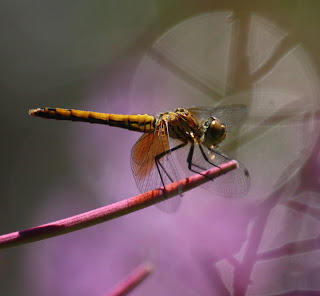
For cards or bookmarks, I thought the best idea was find a symbol apropos for romances. The image I had from a 2012 photo on Klamath Lake seemed perfect.
A dragonfly is an apt totem for romance. They spend most of their life in a creek, lake or pond where they consistently must break out of shells as they grow for several years. At a certain point, they break their last shell and emerge a changed insect, dry their wings and fly off. What could be more apropos as an image for a romance novel. A glorious moment full of the reminders of what is possible, the energy of which can carry us through times that aren't so pleasant.
When I was looking for a few key words to describe the type of books, I thought of a phrase I liked for how I see my books-- where dreams live.
I still don't know where I will be able to place the bookmarks but one possibility would be small, independent gift shops and hotels. Such businesses might regard it as advertising and say no but nothing ventured nothing gained.
It was fun creating them, and maybe this will be a way to get my name and books beyond Amazon. I've heard advertising on Google or Facebook doesn't really pay off and I believe it because I never read ads there. Indie writers, without corporate power behind them, can now get their ideas and books published. The next step is having them seen by those most likely to enjoy them.
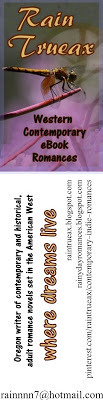
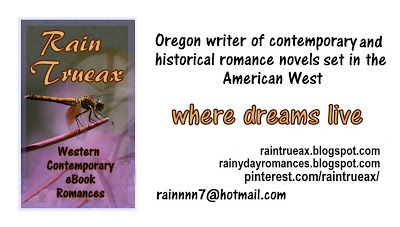 Whatever your creative endeavor might be, I think bookmarks are a possible tool. I love to get them whenever I come across an interesting one. Other than the ink, this looks pretty economical. Of course, like all advertising, will it lead to sales? The bad part is I might never know as it's hard to tell from where sales come.
When I finish the book I am currently writing, I'll find out what kinds of places might consider having them beside their cash register or on a nearby rack. If it turns out none, I'll let readers know that it didn't work. Although if I do Createspace later for the historicals, then bookstores become possible.
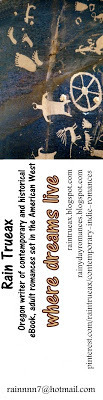
After I did the first, it seemed to me images of petroglyphs, which are earlier human's attempts to communicate, would be apropos. I have so many great photos that this will be hard to narrow down to just a few (bees landing on a saguaro, sunset at the beach, cow licking newborn calf) because so many do speak to love and communication.
.
My husband, who publishes my books, often mentions to people that I write. They are always curious (especially once they find out the books are romances), and I had been thinking creating a card would be a good idea even before I was asked in an art gallery last week if I had one. It was time to create one and be sure I always had it with me whenever there is interest.
The bookmarks seem like a good addition. The most obviously appropriate place to find readers, bookstores, is doubtless out since they likely consider eBooks to be competition. If I make print copies of some of my historicals, something I am considering through CreateSpace, then bookstores might be more open to it-- if they are the type of store to carry romances.
For cards or bookmarks, I thought the best idea was find a symbol apropos for romances. The image I had from a 2012 photo on Klamath Lake seemed perfect.
A dragonfly is an apt totem for romance. They spend most of their life in a creek, lake or pond where they consistently must break out of shells as they grow for several years. At a certain point, they break their last shell and emerge a changed insect, dry their wings and fly off. What could be more apropos as an image for a romance novel. A glorious moment full of the reminders of what is possible, the energy of which can carry us through times that aren't so pleasant.
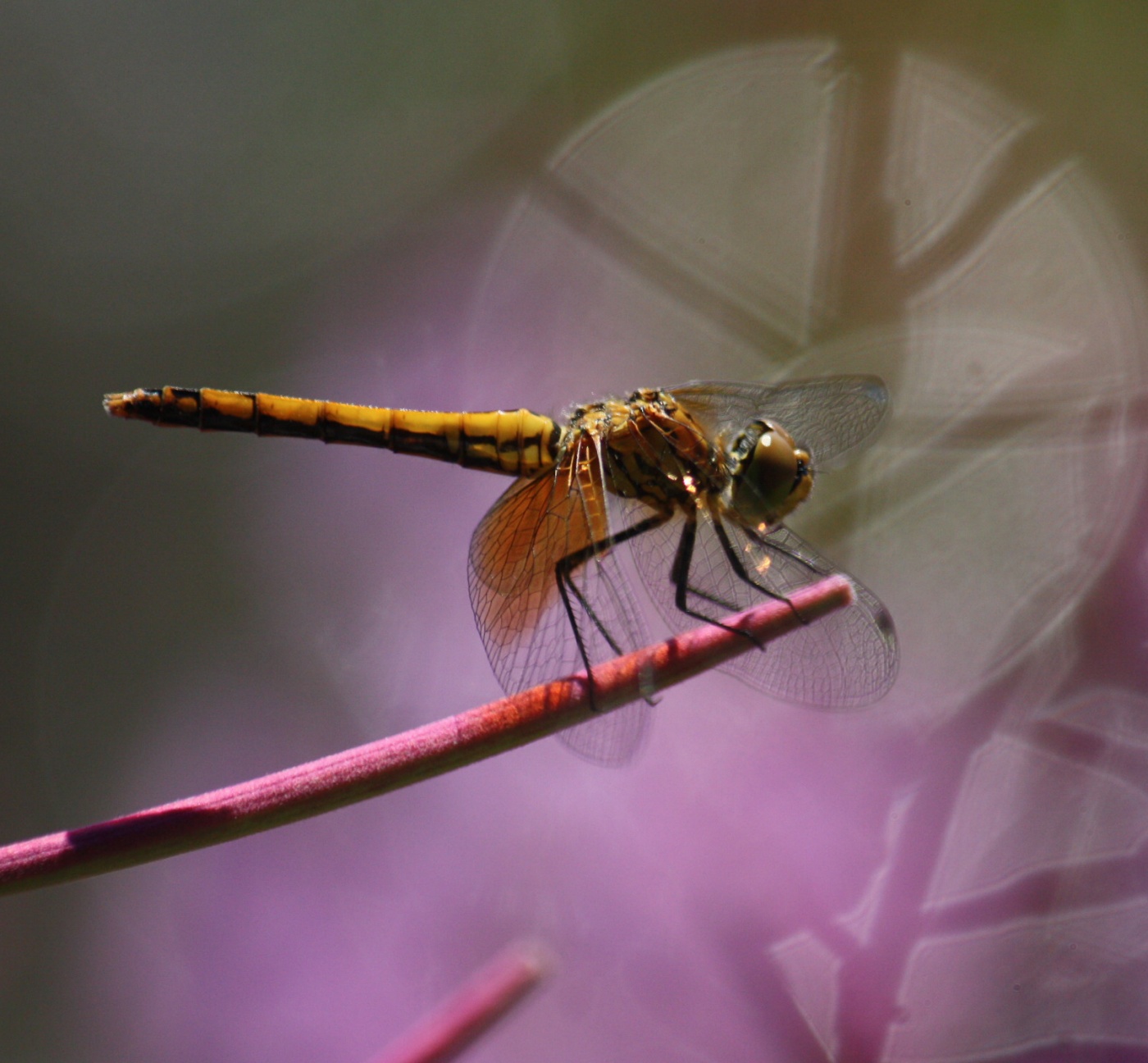
When I was looking for a few key words to describe the type of books, I thought of a phrase I liked for how I see my books-- where dreams live.
I still don't know where I will be able to place the bookmarks but one possibility would be small, independent gift shops and hotels. Such businesses might regard it as advertising and say no but nothing ventured nothing gained.
It was fun creating them, and maybe this will be a way to get my name and books beyond Amazon. I've heard advertising on Google or Facebook doesn't really pay off and I believe it because I never read ads there. Indie writers, without corporate power behind them, can now get their ideas and books published. The next step is having them seen by those most likely to enjoy them.

 Whatever your creative endeavor might be, I think bookmarks are a possible tool. I love to get them whenever I come across an interesting one. Other than the ink, this looks pretty economical. Of course, like all advertising, will it lead to sales? The bad part is I might never know as it's hard to tell from where sales come.
 When I finish the book I am currently writing, I'll find out what kinds of places might consider having them beside their cash register or on a nearby rack. If it turns out none, I'll let readers know that it didn't work. Although if I do Createspace later for the historicals, then bookstores become possible.
After I did the first, it seemed to me images of petroglyphs, which are earlier human's attempts to communicate, would be apropos. I have so many great photos that this will be hard to narrow down to just a few (bees landing on a saguaro, sunset at the beach, cow licking newborn calf) because so many do speak to love and communication.

.
March 19, 2013
Structure or not -- Belle Isle
While I am in the midst of writing the Oregon historical story, I thought I'd put out a few tips on structure that I've gathered through the years. It's the kind of thing I don't think about much unless I suddenly wonder whether I am still on track.
Now some would say structure must be the same in all books but I disagree. I think there are always exceptions; but with any of the creative arts, it's good to know why something is done before you break a rule.
Nigel Watts in his book, Writing a Novel and Getting Published, called this beginning period stasis. It is basically everyday life before a gatekeeper experience changes everything. Call it gatekeeper or trigger, something has to happen to take this person from their life as they have known it.
The something is the point of the novel whether that is an idea, an event, a quirk in their personality. This is where the character takes off on the quest, which might happen right in their own backyard or take them to a fantasy land.
Here is where things happen that cannot be expected by the character or the reader-- the surprises, the uncertainties, the twists, turns, obstacles, conflicts. Here is where the WwW is brought into action, with mini-climaxes. These happenings may relate to the initial quest or not. These events may come out of the setting, other people or the character's own development.
In a love story this could be personalities, events, goals, or outside competition. Sometimes the characters have a common goal that until it's been resolved, they cannot work things out to be together. The action usually comes out of the nature of the problem or their character although once in awhile something comes along which can be unexpected with no foreshadowing-- sort of like a tsunami in life.
At some point, nearly the climax, the characters must make an important, life changing choice. If they make the wrong choice, it can turn tragic. Villains make these choices also.
The final climax is where it plays out in a way rewarding to readers and characters. Rewards and final battles are fought. Ideally the last battle, as in Lord of the Rings, relates to the original quest.
Finally there is the return home where the character has been changed by the experience, is wiser, and whether the character leaves their original home or returns, this is where it make sense to leave the story.
Nigel Watts, in the book mentioned above, referred to these eight points as: stasis; trigger; quest; surprise; critical choice; climax; reversal; resolution. Whatever they are called, they are the structure of most novels.
One thing I like in my writing is have something that appears to be the problem, the thing that throws the protagonist from their world, but it's usually not all it really seems. The story is actually told on two levels. One might be obvious-- bad guy versus good guy, good fighting evil.
The second is not obvious and my hope is readers will get this one eventually if not when they read the book. It's the deeper meaning that matters most to me. Not to say it won't be linked to the surface issue, but it's not the real essence. Understanding this deeper level is not needed to enjoy my books or favorite stories, but when it is understood, I think it leaves a satisfying life lesson.
We recently watched The Magic of Belle Isle starring Morgan Freeman as a writer who has lost the excitement of writing. I had seen it before and loved it but forgotten how well it illustrates these dual levels. It is a good example of how the surface isn't all a story is about. As to what are the two levels in that film, watch it and I think you will find it obvious.
Now some would say structure must be the same in all books but I disagree. I think there are always exceptions; but with any of the creative arts, it's good to know why something is done before you break a rule.
A novel is like a symphony in that its closing movement echoes and resounds with all that has gone before. . . . Toward the close of a novel. . . . unexpected connections begin to surface; hidden causes become plain; life becomes, however briefly and unstably, organized; the universe reveals itself, if only for the moment, as inexorably moral; the outcome of the various characters' actions is at last manifest; and we see the responsibility of free will. John GardnerJoseph Campbell spoke of a gatekeeper experience as the point from which a story takes off. He felt, and I use it pretty much for my romances, that you ground a character in where they are, how they live and maybe their frustrations before you send them off on an adventure.
Nigel Watts in his book, Writing a Novel and Getting Published, called this beginning period stasis. It is basically everyday life before a gatekeeper experience changes everything. Call it gatekeeper or trigger, something has to happen to take this person from their life as they have known it.
The something is the point of the novel whether that is an idea, an event, a quirk in their personality. This is where the character takes off on the quest, which might happen right in their own backyard or take them to a fantasy land.
Here is where things happen that cannot be expected by the character or the reader-- the surprises, the uncertainties, the twists, turns, obstacles, conflicts. Here is where the WwW is brought into action, with mini-climaxes. These happenings may relate to the initial quest or not. These events may come out of the setting, other people or the character's own development.
In a love story this could be personalities, events, goals, or outside competition. Sometimes the characters have a common goal that until it's been resolved, they cannot work things out to be together. The action usually comes out of the nature of the problem or their character although once in awhile something comes along which can be unexpected with no foreshadowing-- sort of like a tsunami in life.
At some point, nearly the climax, the characters must make an important, life changing choice. If they make the wrong choice, it can turn tragic. Villains make these choices also.
The final climax is where it plays out in a way rewarding to readers and characters. Rewards and final battles are fought. Ideally the last battle, as in Lord of the Rings, relates to the original quest.
Finally there is the return home where the character has been changed by the experience, is wiser, and whether the character leaves their original home or returns, this is where it make sense to leave the story.
Nigel Watts, in the book mentioned above, referred to these eight points as: stasis; trigger; quest; surprise; critical choice; climax; reversal; resolution. Whatever they are called, they are the structure of most novels.
One thing I like in my writing is have something that appears to be the problem, the thing that throws the protagonist from their world, but it's usually not all it really seems. The story is actually told on two levels. One might be obvious-- bad guy versus good guy, good fighting evil.
The second is not obvious and my hope is readers will get this one eventually if not when they read the book. It's the deeper meaning that matters most to me. Not to say it won't be linked to the surface issue, but it's not the real essence. Understanding this deeper level is not needed to enjoy my books or favorite stories, but when it is understood, I think it leaves a satisfying life lesson.
We recently watched The Magic of Belle Isle starring Morgan Freeman as a writer who has lost the excitement of writing. I had seen it before and loved it but forgotten how well it illustrates these dual levels. It is a good example of how the surface isn't all a story is about. As to what are the two levels in that film, watch it and I think you will find it obvious.
March 17, 2013
Ghost of the forest
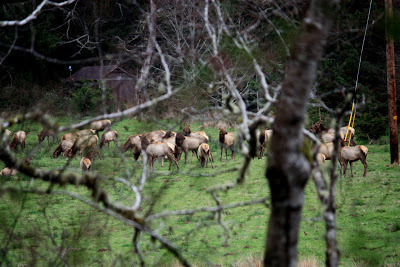
One of the things that always brings me joy is when I come across the ghosts of the forest, our Oregon Coast Range Roosevelt elk, in a herd grazing and interacting with each other. When I am in areas I know they could be, I watch for them, can often tell where they have been (they cut a wide track) but to catch a herd grazing as we did last week, that's not so common an experience for me that it has yet to get old.
We have elk at the back of our land here. Regularly they tear down a fence as they have a route they are familiar with and if a fence is in their way, well it's not like they don't know how to fix that. Back there, I've watched them gambol far below me, jumping in and out of pools of water, but only when I didn't have a camera with me.
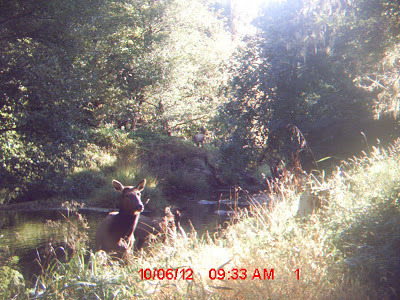
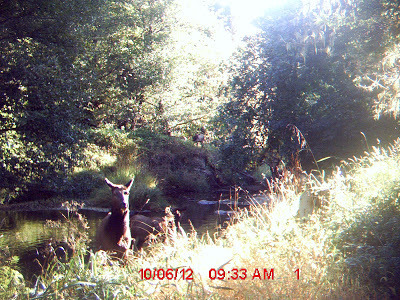 there are three visible in this photo if you enlarge and look carefully
The only time we have gotten photos of them on our land is when we left a wildlife camera back on one of their trails. After they saw the camera, it looks as though they licked the lens as all the rest of the images were very fuzzy and we have one with a nose right in front of the camera. Too smart by half.
I had a friend in college who had grown up in the Coast Range and told of being treed by the elk. They are big animals and definitely do have the ability to hurt a person if they were so inclined. Generally they run.
The photos below were taken March 13th of a good sized herd we lucked upon while in Cascade Head Preserve down on the Coast. These animals are not fenced; they are wild. This was in a mountain and riparian zone being restored to a natural wetland, much of which is now owned by Nature Conservancy, not that this elk herd probably ever paid much attention to that. This is their home range, and they know who the intruders are. This is the season where the bulls will have dropped their antlers; so you can only tell the males by body type-- that is unless you get a lot closer than we were (all photos taken with telephoto).
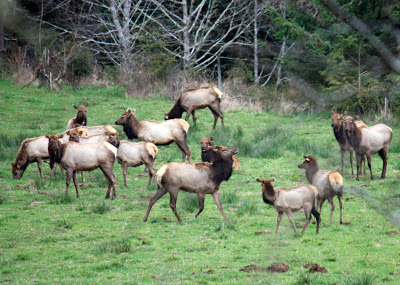
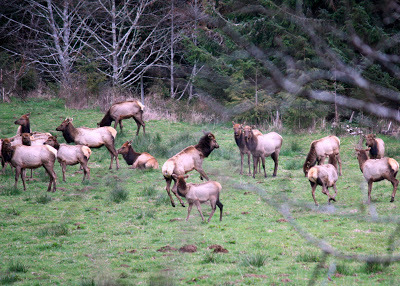
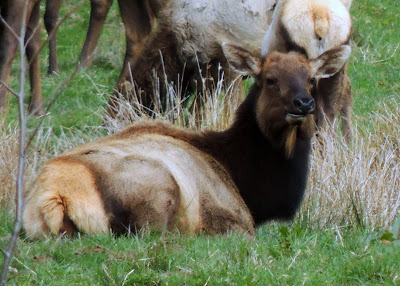
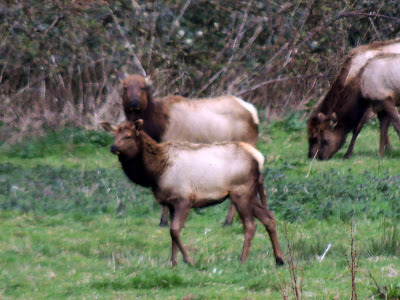
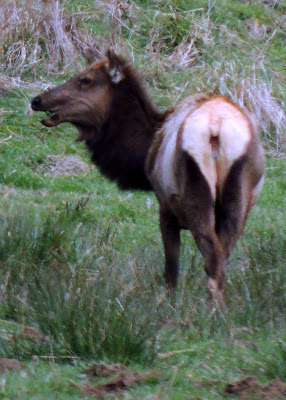
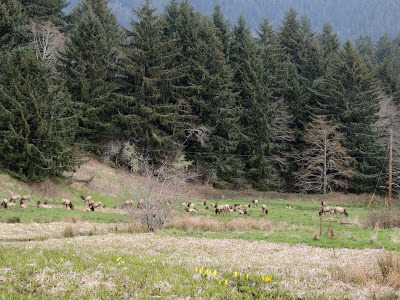
I didn't count but I think this time we took over fifty photos of what looked like fifty elk. Someday I should put my elk photos into an album so that other elk lovers can enjoy them all. Someday is a long way off as I have work to do from being gone.
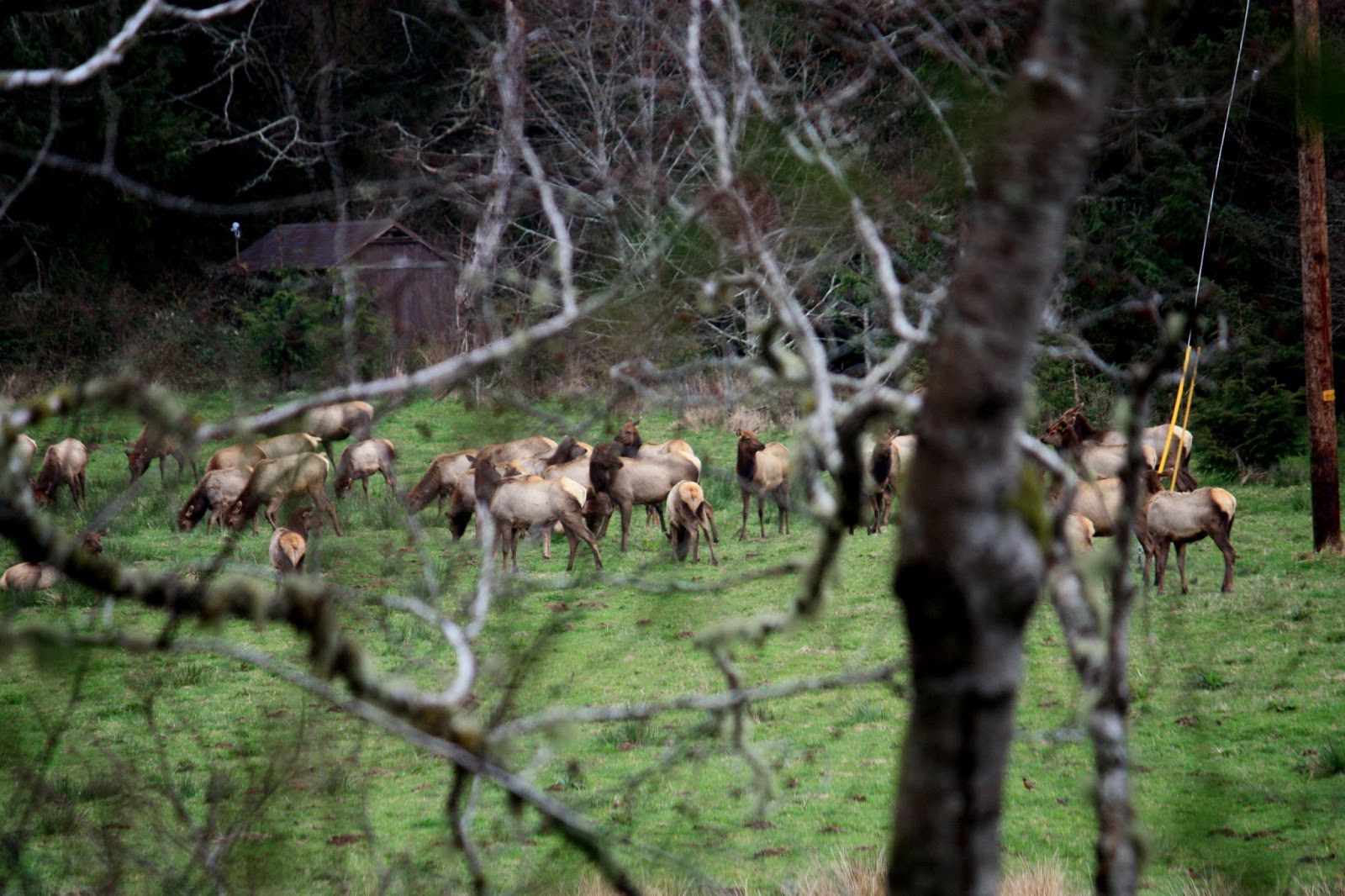
We have elk at the back of our land here. Regularly they tear down a fence as they have a route they are familiar with and if a fence is in their way, well it's not like they don't know how to fix that. Back there, I've watched them gambol far below me, jumping in and out of pools of water, but only when I didn't have a camera with me.

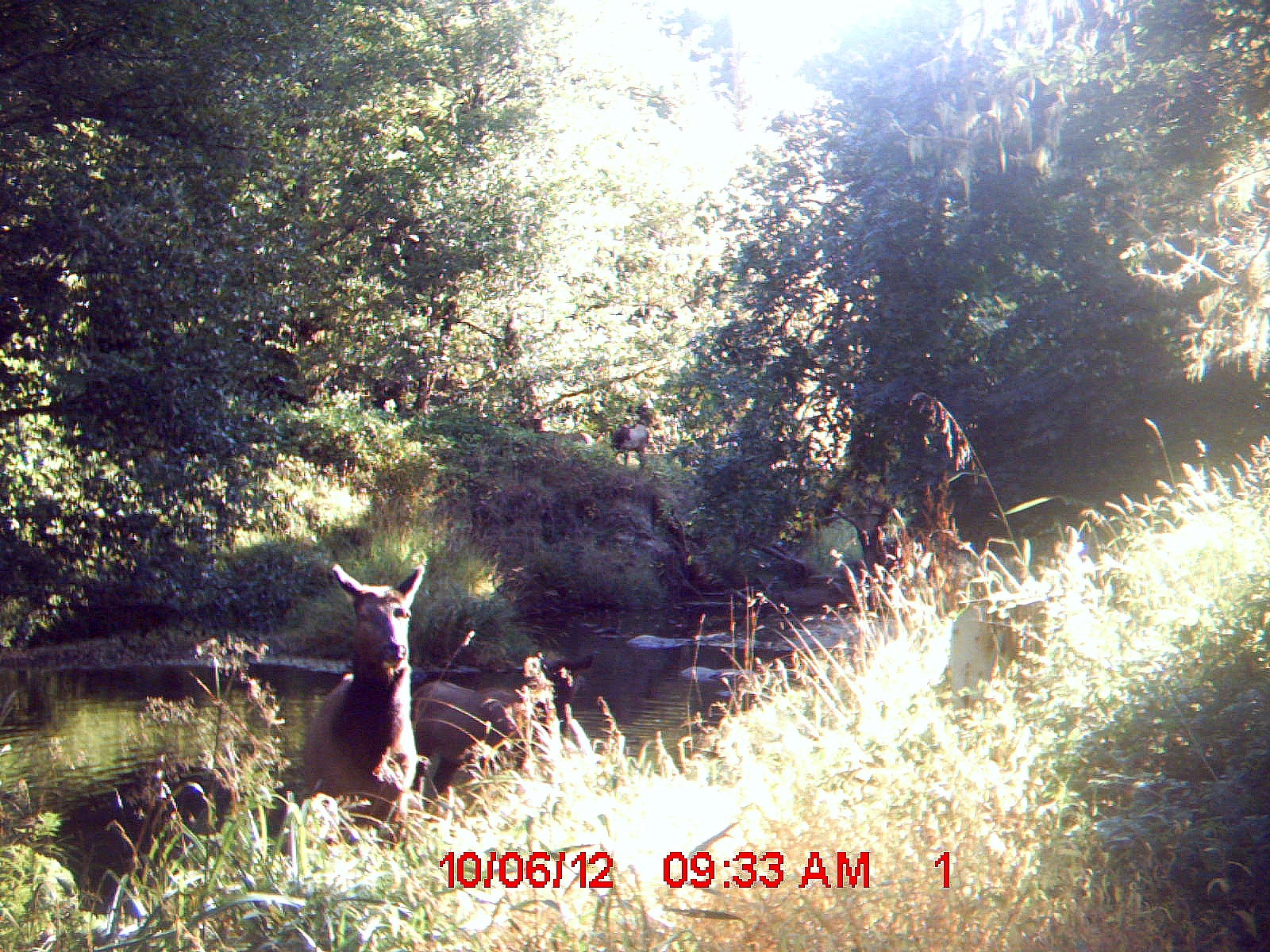 there are three visible in this photo if you enlarge and look carefully
The only time we have gotten photos of them on our land is when we left a wildlife camera back on one of their trails. After they saw the camera, it looks as though they licked the lens as all the rest of the images were very fuzzy and we have one with a nose right in front of the camera. Too smart by half.
I had a friend in college who had grown up in the Coast Range and told of being treed by the elk. They are big animals and definitely do have the ability to hurt a person if they were so inclined. Generally they run.
The photos below were taken March 13th of a good sized herd we lucked upon while in Cascade Head Preserve down on the Coast. These animals are not fenced; they are wild. This was in a mountain and riparian zone being restored to a natural wetland, much of which is now owned by Nature Conservancy, not that this elk herd probably ever paid much attention to that. This is their home range, and they know who the intruders are. This is the season where the bulls will have dropped their antlers; so you can only tell the males by body type-- that is unless you get a lot closer than we were (all photos taken with telephoto).
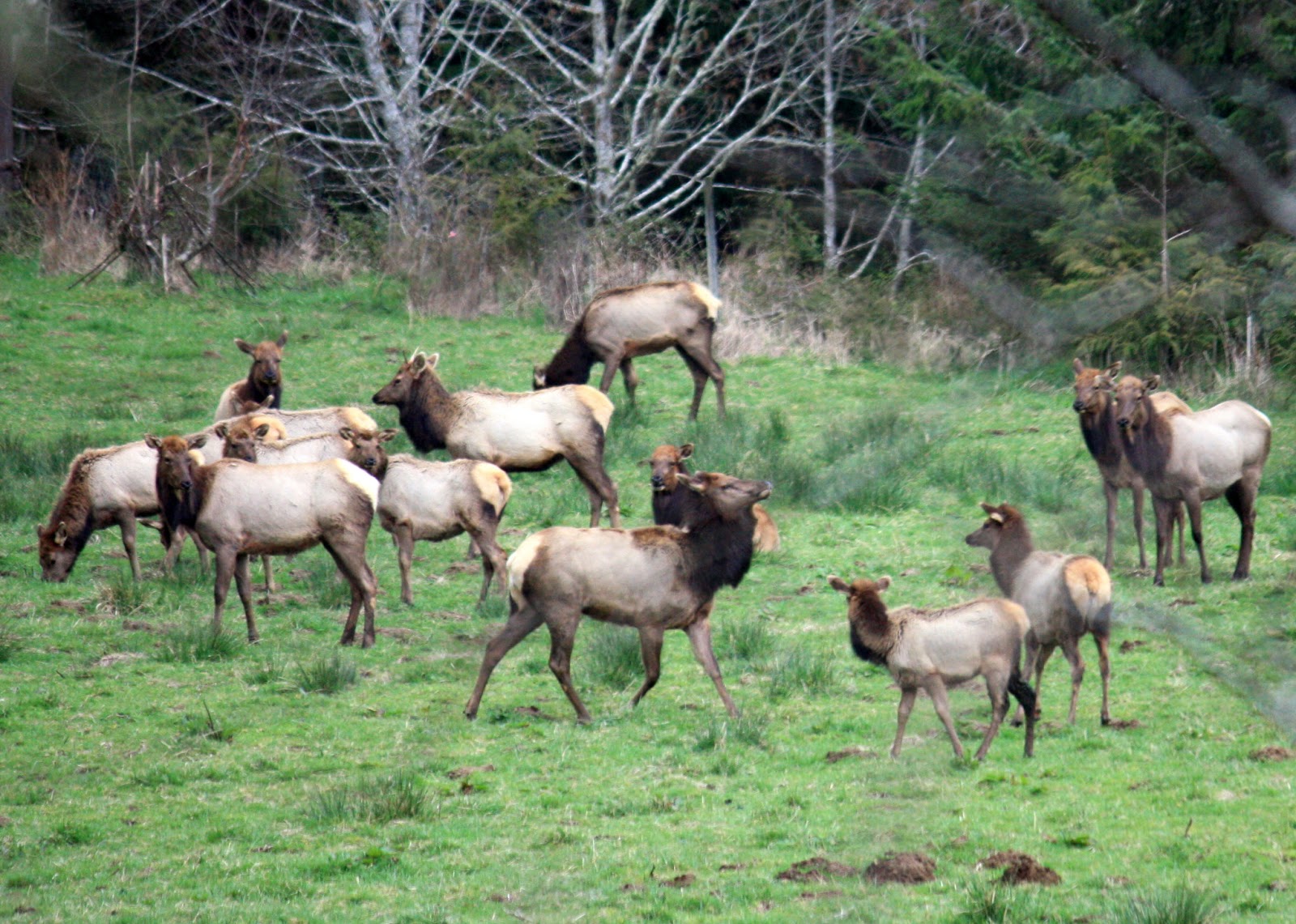
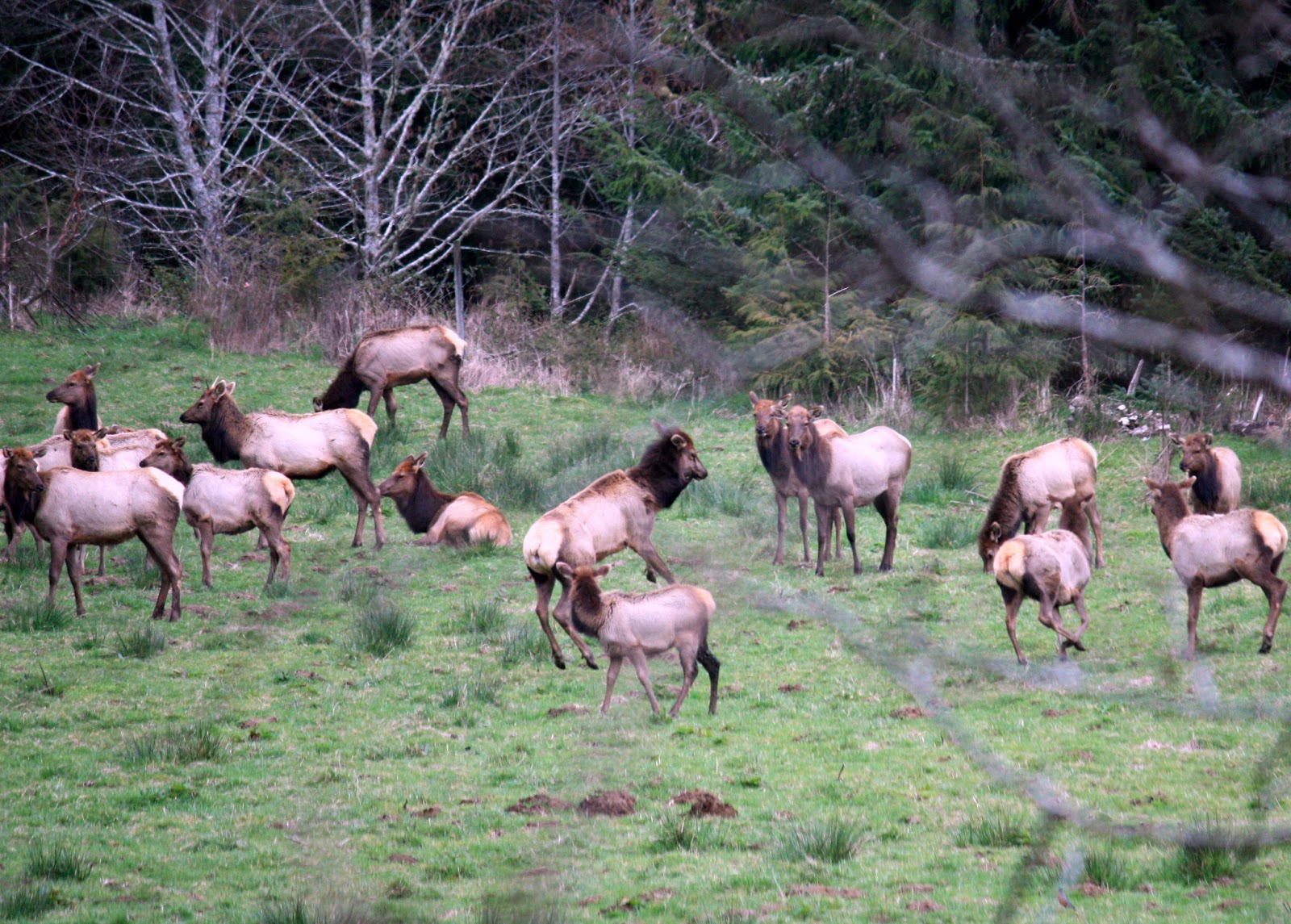
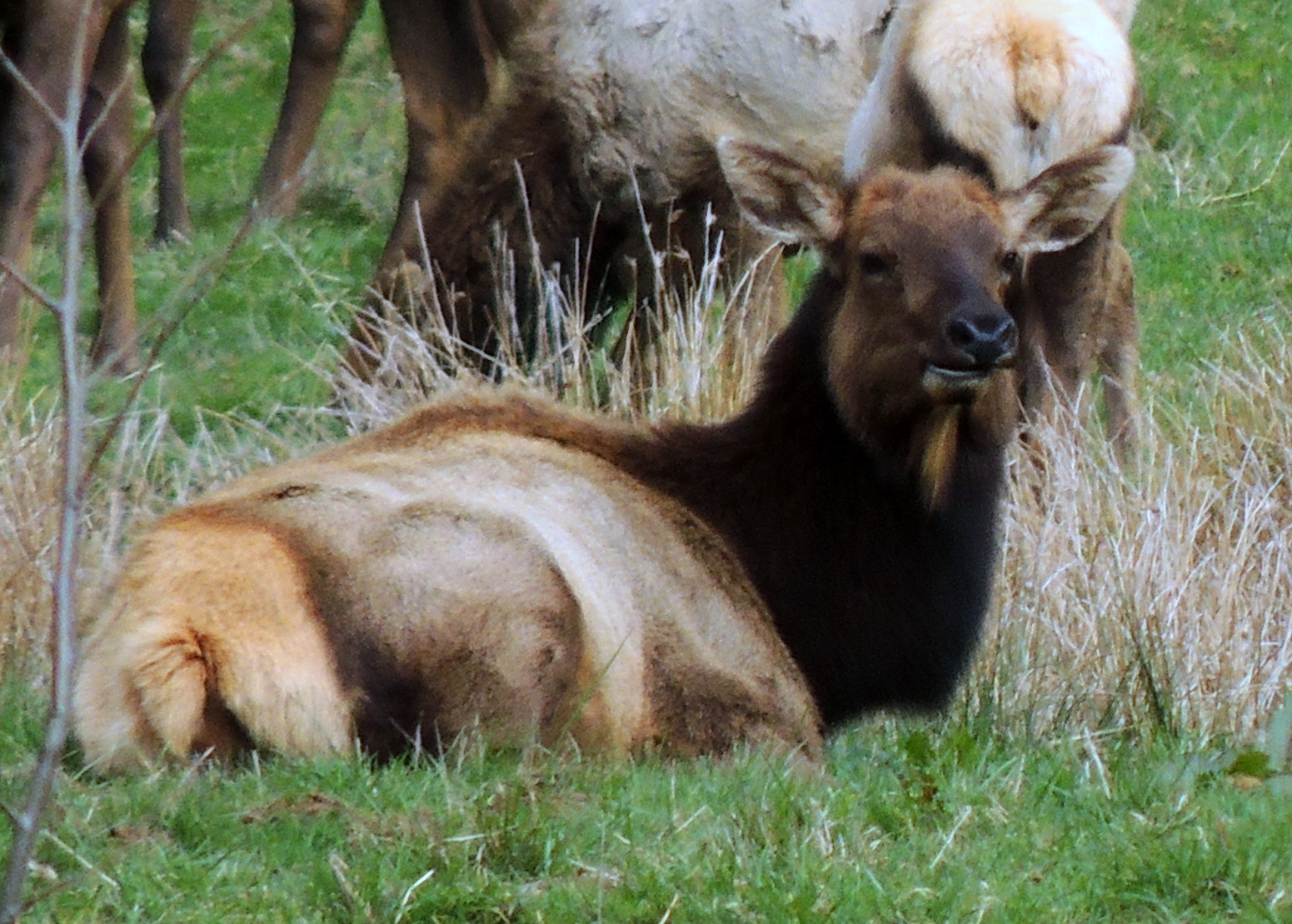
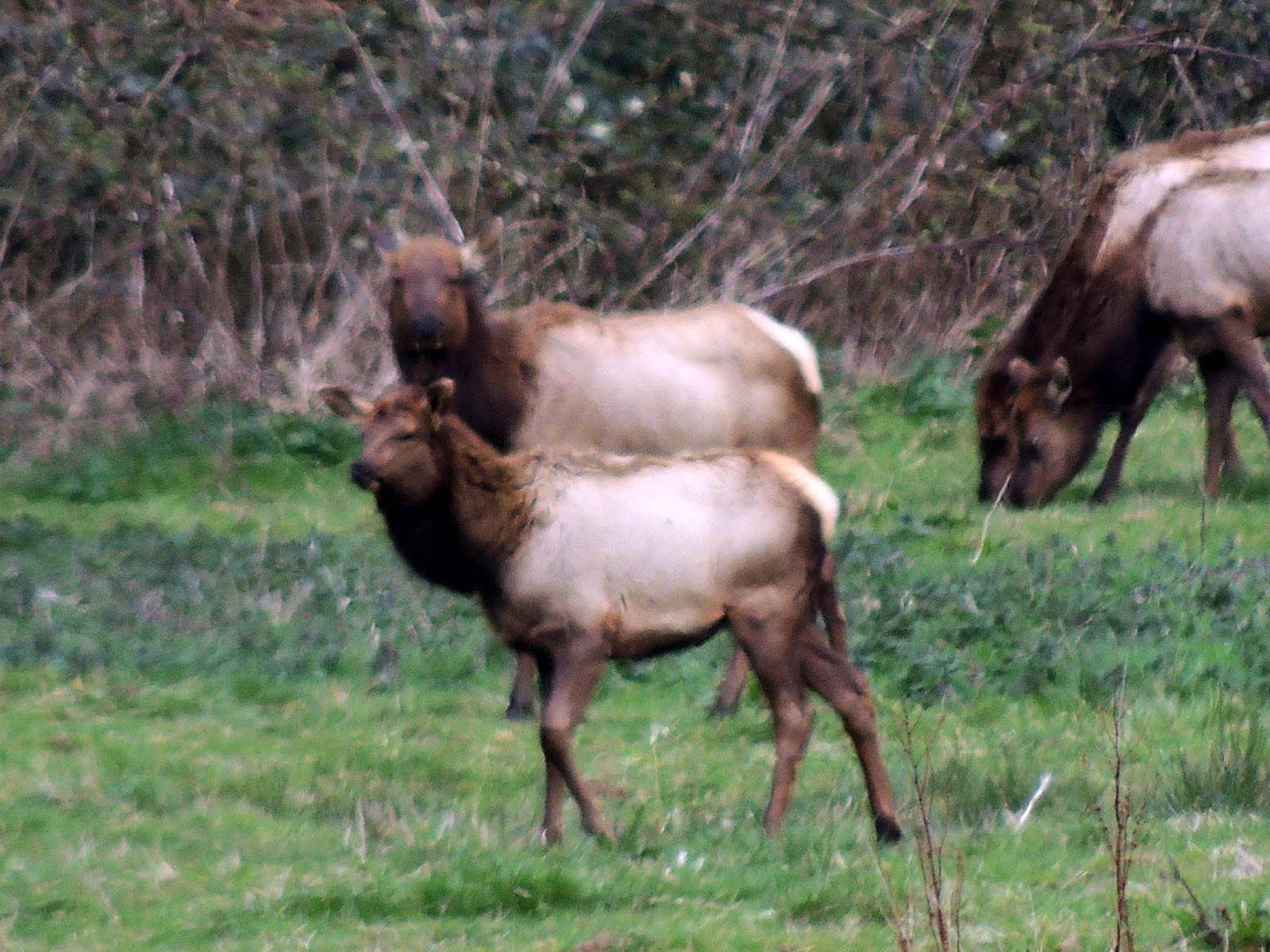
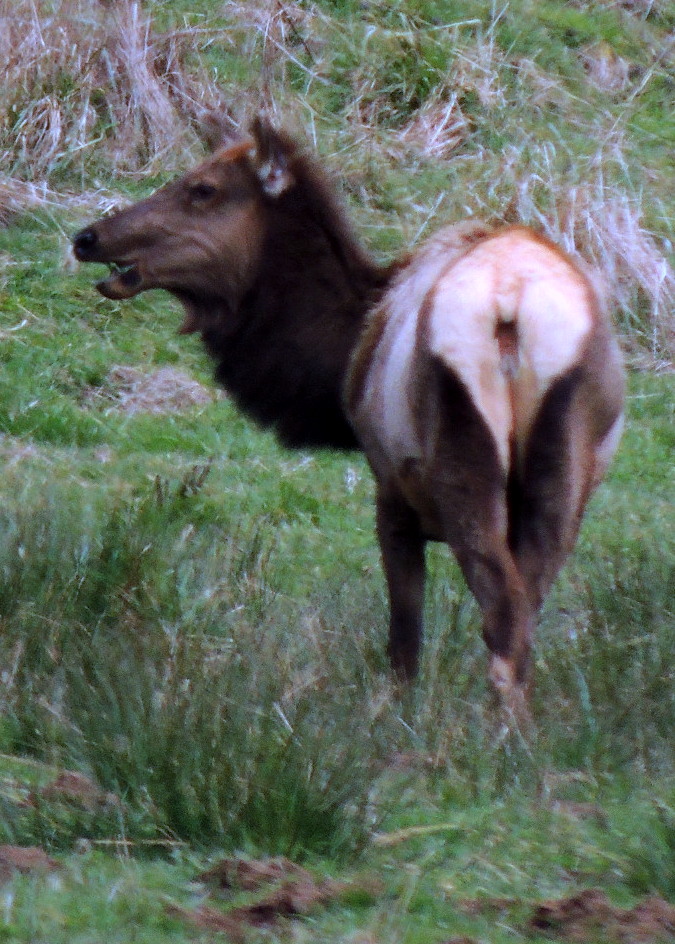

I didn't count but I think this time we took over fifty photos of what looked like fifty elk. Someday I should put my elk photos into an album so that other elk lovers can enjoy them all. Someday is a long way off as I have work to do from being gone.