Rae Roadley's Blog, page 2
December 4, 2013
Zana Bell – NZ author
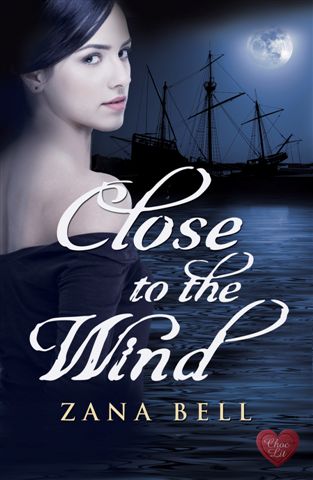
Close to the Wind by Zana Bell.
Zana Bell’s latest novel Close to the Wind is a playful romp that takes its characters across the world, from Britain to New Zealand. It’s fun, funny and meticulously researched – I know this because a while back Zana was querying how long it would take to travel by horseback from Christchurch to Dunedin, in New Zealand’s South Island.
She’s giving away a copy of her book to one of the lucky people who drop by and make a comment. Do that by the 16th December and you’ll be in to win.
Zana is the first and only Kiwi author to be published by UK-based ChocLit. And you don’t need me to tell you Zana writes well – that this is her fifth novel by an international publisher is proof of that.
Hi Zana – thanks for agreeing to be part of my blog.
Hello Rae – many thanks for hosting me.
M y first burning question is this: what made you pitch your novel to UK-based publisher ChocLit? I hadn’t heard of them till I read your book – how did you learn about them?
My Scottish friend sent me a book published by ChocLit and I was immediately taken by the fact that it was an historical set in Japan. So many publishers will only consider Britain or America as settings for historicals – as I found to my cost when trying to pitch two NZ historicals I’d written. When I emailed them to ask if they’d consider a book from the Antipodes they responded very warmly.
Your characters traipse across the world – what inspired you to make them do that – or were they in charge and did you just go along for the ride? (This is also a question about how you write – although you’ve surely noticed that.)
Again it comes back to the unusual setting. One historical writer had set most of her book in France but the opening chapter was set in England. Her advice was that if you start a book in Britain and hook your readers in the first pages, they’ll follow you anywhere. Of course, it is far quicker to get a character to France than NZ so it turned into a sort of historical road trip. I loved writing about the different settings, having visited Madeira when I was five and having been to university in Cape Town, it was a glorious way of revisiting them – albeit in the virtual sense.

Multi-published author Zana Bell writes historical novels set in NZ.
And yes, I was very much along for the ride. It was the first time I’d tried writing a romantic adventure and it turned out to be tremendous fun – and harder than I thought. I have a profound admiration for PD James, Anne Perry etc. now. It’s tricky to lay clues, make motives convincing etc.
The cover tells us to expect ‘love, passion and adventure in 1860s New Zealand’. But while some readers might be anticipating, say, hot sex, the passion in Close to the Wind is of a different flavour. Tell us more.
Oh well spotted. Reader warning: adventures focus on swashbuckling action rather than bedroom antics. I would hate to set up false expectations. I can assure you no bodices were ripped in the writing of this book.
I know you’re from Zimbabwe , but what brought you to New Zealand ?
My sister and brother-in-law had immigrated to New Zealand and when I was twenty
I came over to visit them. Keen to explore, I hitch-hiked from Auckland to Invercargill and back and during this time I fell in love with both the land and the people. A few years later, I landed up immigrating too.
Where do the ideas for books come from?
New Zealand is always my inspiration, particularly its history. As an immigrant, I use the research as a way to weave myself into the land.
Where can people can buy the book – is it available in hard copy and as an ebook?
Whitcoulls, The Warehouse and PaperPlus all stock the book and yes it’s also available as an ebook from Amazon and Fishpond. Links are on my website http://www.zanabell.com/
If you had a word of advice for a writer, what would it be? And what about for someone who wants to have their work published?
The road is long; never give up. Don’t keep your book in the bottom drawer. Send it off. You never know what might happen. And if it returns, send it off again. And again. And again.
Those other novels – a word or two about them?
I wrote two Harlequin contemporary novels set in Northland. They were fun to write as Northland has a hold on my heart and in Tempting the Negotiator (again, not nearly as ‘hot’ as the title would suggest!) I was able to explore Northland themes like the endangered fairy tern and overseas land ownership and development.
My historical Forbidden Frontier is based on the life and times of Charlotte Badger; convict, pirate and NZ’s first known English woman migrant. She stole a ship and sailed to the Bay of Islands in 1806. Ah, those were the days!
And what’s next on your agenda?
I have another NZ historical adventure coming out towards the end of next year set in Hokitika and Christchurch. Thank you Eleanor Catton for putting Hokitika on the world’s radar.
I’m guessing you’re an avid reader – who’s your favourite author and why?
Oh, isn’t that the hardest question. I’ve loved Penelope Lively’s writing for many years – I think Moontiger is one of the finest books I’ve read. I love the way she weaves notions of history into her books and her characters are sharply drawn.
Many thanks for hosting me today, Rae.
Pleasure – and I knew Zana would steer us towards a great read. And remember – comment and you’ll be in to win a copy of Zana’s fabulous book.


November 18, 2013
Freedom campers need to play by the rules
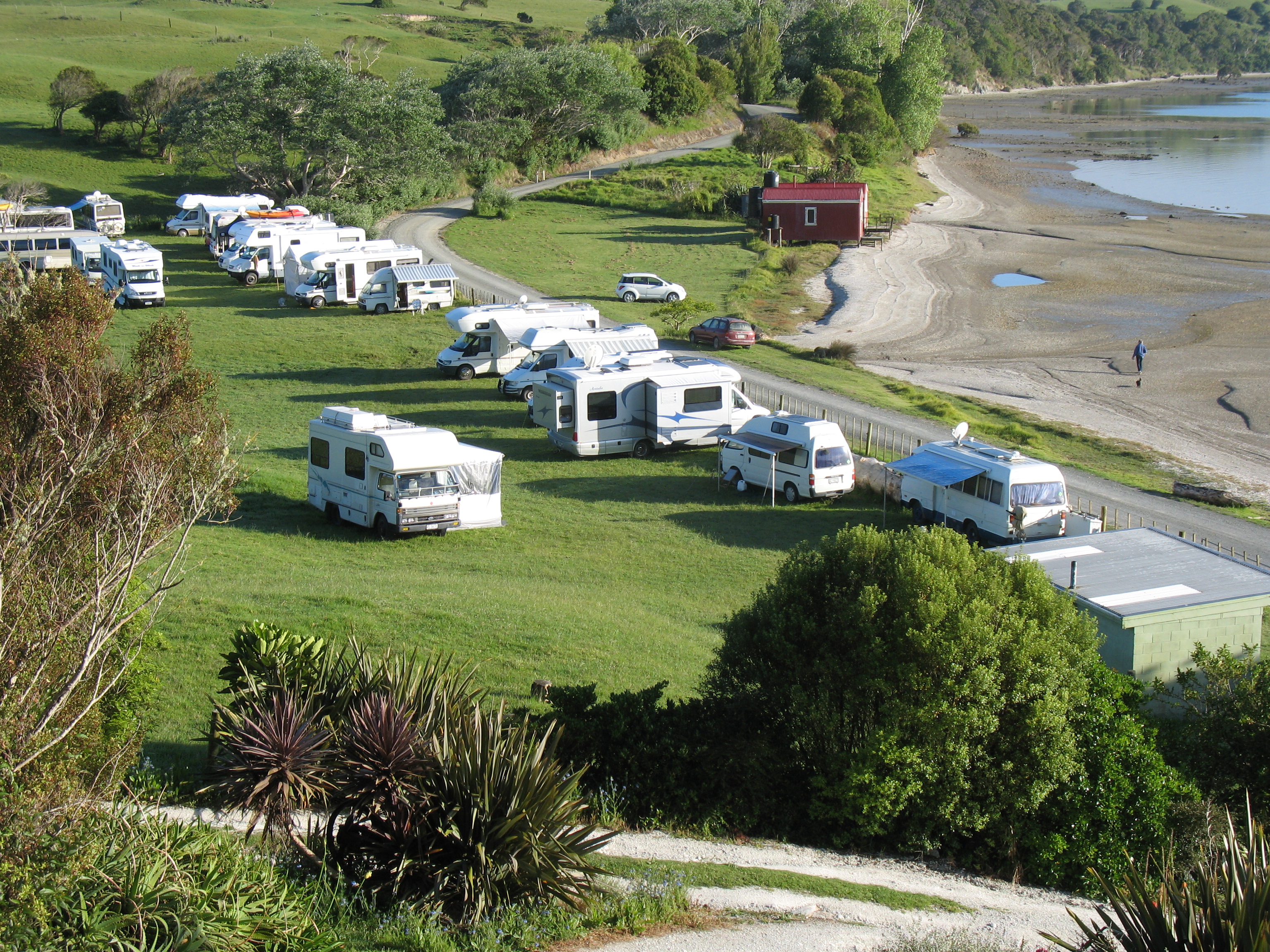
Campervans in a paddock where it’s legal to park because thei owners have kindly asked.
I hadn’t thought ‘lightly’ and ‘politely’ could be interchangeable until a letter from a rental vehicle company proved that, indeed, this is so.
We share a Kaipara beach with ‘no camping’ signs which were ignored by some freedom campers I met during a preprandial wander. The couple, whose van had been parked all day, were relaxing on deck chairs on the beach. The man acknowledged me, but the stiff set of the couple’s backs indicated they had no wish to chat.
I walked past their van, past a fire on the beach and . . . .urghhh!!! . . . past dirty pieces of tissue paper near the boat ramp. Yick!!!
As if by karma, a clean plastic bag lay at my feet. I used it to gather the toilet paper then approached the stiff-backed couple who told me they were from Europe and that this was their third New Zealand holiday.
I politely mentioned the no camping rule and offered a camping spot in a nearby paddock. The declined and looked surprised when I said the beach was popular with boaties and families and that there was a nearby toilet.
“Some naughty people used the grass as a toilet,” I said, indicating the ‘treasures’ in the plastic bag.
They left the next day leaving wood on a fire that smouldered near dry kikuyu.
What would you do? I wrote to the vehicle hire company and days later received a prickly reply informing me I’d made incorrect assumptions. The writer also asked why I hadn’t lightly pointed out that camping wasn’t permitted.
Confused, I checked my letter and found I’d made no assumptions, incorrect or otherwise – I hadn’t accused the company of not educating campers, but said I’d been unable to find this info on their website. And in the circumstances, was the tone of our interaction relevant? Now I felt prickly.
I replied saying that, in fact, they had made an incorrect assumption as I had spoken “lightly” to the campers when I offered them a legal camp site.
A few days later, glancing at the grouchy letter, I realised I’d misread it. I don’t mean to make fun of the writer’s spelling ability – we all have different strengths and weaknesses – but I’d been asked to speak “per lightly” to the campers, i.e. “politely”.
In my chummy reply, I’d agreed with the writer’s idea that, if a similar thing happened again, I should contact the relevant car hire company. I didn’t mention that he’d incorrectly assumed I was a bloke.
October 28, 2013
Passersby get bearings wrong

The suspected lamb whose bloody birth was seen by a passerby who assumed the sheep had ‘sprung a bearing’.
Spring has sprung, the grass has ris’, daffodils are blooming and lambs have bloomin’ popped out everywhere.
But unfortunately it’s not always a lamb that pops out but what farmers call a ring or bearing. In fact, it’s a prolapsed vagina.
The farmer reckons about three of his sheep a year suffer this misfortune which, generally, can happen just prior to lambing, often if a sheep is fat, has a full rumen, a full bladder and the lambs are about grown. The sheep’s internal accommodation is packed to the max – then some. Pop!
The Ministry of Primary Industries begins its webpage on the subject, thus: “Bearings (prolapses of the vagina) in ewes can be a problem every year as lambing approaches, even on the best-managed farms.”
There’s a delicate balance – insufficient feed in the weeks before to lambing can also be a culprit. Scanning can determine which sheep are expecting multiple lambs and need more food – but not too much.
In basic terms, the solutions for a prolapse are: clean it, let the bladder empty, shove everything back inside the sheep and hope it stays there – or euthanasia.
In the two cases I’ve seen the vagina didn’t stay put, despite the use of a special contraption and both had to be killed.
Case number on was a pregnant ewe and case two was Ashley, a too-fat former pet lamb. I made very sure no bits of little Ashley ended up in our freezer.
The worker’s grand-daughter had named her two pet lambs after the Olsen twins. After weaning, Mary-Kate joined the flock while Ashley hung around our garden gate and scoffed.
Last week at nine pm, the farmer took a call from someone who’d driven past earlier that day. She said she’d seen a sheep with its ring out, had left a note in our letterbox and asked whether the situation had been handled.
The caller was off a farm, she said, and she and her friends were appalled. Plus, she insisted, she saw the farmer drive past the suffering sheep without stopping, and she’d be in touch with the newspaper and SPCA if the sheep wasn’t taken care of.
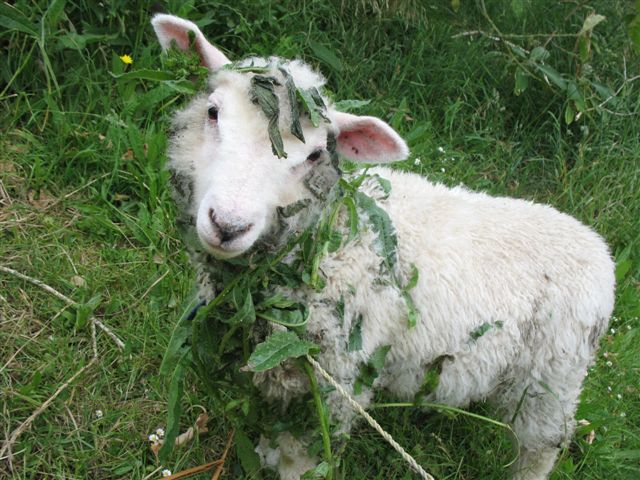
Ashley’s friend Mary Kate sometimes got tangled in weeds.
As I said in Love at the End of the Road, farming is a high-vis business, and it’s Murphy’s Law that the day an animal dies/gets caught in a fence/breaks a leg/springs a ring is the day you’re off the farm or busy elsewhere.
The caller got so worked up, the farmer found no air time in which to say he wasn’t driving the ute she’d seen. The wife of a former farm worker who’d been to visit was at the wheel, and other visiting farmers hadn’t spotted the troubled sheep either.
The farmer’s next question, after the indignant caller hung up on him, was to me. Had I seen the note she’d left, given I’d just cleared the mailbox – after dark and during a TV commercial break?
Nope, sorry. As I love after-dark missions, we headed off with headlamps to see if we could spot the sheep and check the other farm mail boxes. We failed on all counts.
The farmer and farm manager scored another epic fail the next morning. But while they didn’t find a suffering sheep, a ewe with newborn lambs was in about the spot of the perceived crime. It had been a bloody birth and the ewe was still trailing the ripped amniotic sac.
The farmer concluded the appalled group might have seen a ewe giving birth – when the placenta appears first it can look like a prolapse.
Farmers appreciate passersby who take the time to report problems – when they’re kind, well mannered and don’t jump to conclusions or act like know-it-alls – even if they’re right.
I can confirm living on a farm doesn’t qualify anyone to be a farmer. Once while driving from the farm, I was politeness itself when I phoned the farmer to report a suspected dead bull. There it was, lying on its side and still as a rock with birds hopping about on its bulbous tummy. When the farmer checked it out soon afterwards it was standing up and eating grass.