Heather Holleman's Blog, page 95
June 5, 2021
When the Sun Shines
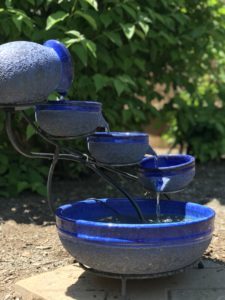
My solar-powered bird bath requires full sun to operate. Even one little cloud that might obscure the solar panel disrupts the flow of water.
Each morning, I eagerly await the sun. When the sun shines in the morning–and the fountain begins its work–the birds come and fill each bowl with happy splashes as they bathe. It’s adorable and joyful. They dip their heads and wings into the water’s flow, and I love to watch it all. Fluffy robins actually sit in those little bowls as if they’ve made them their own personal hot tubs.
And this morning, I finally see evidence of the sun’s great work in the vegetable garden: little green beans!

I know this: when the sun shines, things grow. When the sun shines, things fill up and overflow to bless others. I think about my time basking in God’s love and letting the light of His truth and wisdom fill my soul. I am a fountain; I am a green bean. And the sun and subsequent growth is never just for me. We enjoy God’s nourishing light in order to feed others and provide places of cool refreshment.
I want nothing to obscure that sun. I want no blocking clouds in my heart. May we flow like joyful fountains and grow heartily like the green bean.


June 4, 2021
When the Goal is Weakness
My great friend and mentor tells me I’ve got the wrong goal. When I claim I’m trying to be stronger or better in order to overcome something, she reminds me of a different goal: weakness.
Weakness means I depend upon God and draw upon His unlimited resources. Weakness means I stay humble. Weakness means I remain in a position of reliance upon Jesus and not myself.
When she asked, “What if the goal is weakness instead?” I felt a fresh breeze of freedom in heart. I remember Paul’s words from the Lord. he says, “My grace is sufficient for you, for my power is made perfect in weakness.” Paul writes, “Therefore I will boast all the more gladly of my weaknesses, so that the power of Christ may rest upon me.”
All day long, I’ve thought about a new goal: weakness.
June 3, 2021
A Quote I Love on Writing
I receive a newsletter from author James Clear with great advice. He shares this gem from writer Jorge Luis Borges on transforming every experience into a resource:
“A writer — and, I believe, generally all persons — must think that whatever happens to him or her is a resource. All things have been given to us for a purpose, and an artist must feel this more intensely. All that happens to us, including our humiliations, our misfortunes, our embarrassments, all is given to us as raw material, as clay, so that we may shape our art.”
Source: Twenty-Four Conversations with Borges: Including a Selection of Poems
If you like weekly advice on productivity or inspiration, you can sign up for James Clear’s newsletter, too. He’s the author of Atomic Habits, and I like his advice. https://jamesclear.com/3-2-1/june-3-2021?rh_ref=10fd2e7e
June 2, 2021

June 1, 2021
Learning New Things
When you take the embarrassment away, you can actually learn so many new things. Don’t worry if you don’t understand something. You can learn! You can really learn!
I’m learning to fight any fear or shame if I don’t know something because it’s so much fun to learn. Who cares that you don’t know everything?
For example, I’m currently designing writing curriculum for the Penn State honors students who come from STEM backgrounds (Science, Technology, Engineering, and Math). Technically, this is an advanced technical writing course. I’ve been spending the past few weeks learning all I can to adapt my normal writing courses to teach technical document design, proposals, and research papers in technical fields. At first, I felt overwhelmed, but each day I learn more and more.
I don’t know the language. I don’t know the landscape of an engineer’s brain.
Since I want to understand my students, I find myself researching their fields. In my humanities course, I don’t need to research “film student” or “poet” or “history major” to understand them. But in STEM? I’m researching things like “What’s the difference between a computer scientist and a computer engineer? What does a nuclear engineer do? What’s a day in the life of an aerospace engineer actually like? What kind of writing would a chemical engineer do or a mathematician? What writing instruction best serves an architectural engineer or a future surgeon?
Some of you are laughing because you know me. You know I’m all poetry and verbs and emotions. How will I survive with these students?
Well, I’ll learn.
I’ve read textbooks. I’ve read research articles. I’ve interviewed engineers and scientists and doctors. And now? I’m becoming an expert in technical writing. I’m holding my own in debates between the use of passive voice or active verbs in research articles and lab reports. I’m creating beautiful little worksheets on topic and stress positions in technical writing to make the most complicated engineering article digestible. I’m even learning the lingo of UX (user experience) and things I never knew (like PDF stands for portable document format). Who knew? Maybe I’ll learn some computer programming even.
The bottom line: learn something new this summer. Your brain will love it.
And now? I’m off to design a presentation on how to tell a better research story (yup–I stand by my belief that even scientists need to know how to tell a good story!). I’m calling that unit “Technical Narratives” that helps readers (general public, donors, legislators) care about and understand STEM research. In the end, I wonder if my storytelling aids for scientific minds might just become the best thing they learn.
May 31, 2021
It’s Called “Puddling”
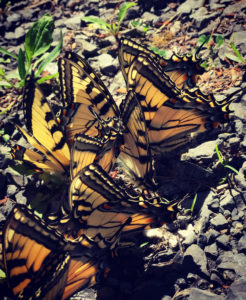
Today I learn that when butterflies gather together in a pile on the ground like this, it’s called “puddling.” It’s a puddle of butterflies! I love it. They do this because they have found a mineral rich area. They sit to absorb the salt and other nutrients they need. I love learning new verbs!
May 30, 2021
Another Beautiful Biblical Verb
This morning, I note the verb “prepared” in 1 Corinthians 2:9.
But, as it is written, “What no eye has seen, nor ear heard, nor the heart of man imagined, what God has prepared for those who love him”—
It’s so wonderful to consider God’s work of preparation for us. We cannot even fathom the blessing of it. We cannot even imagine it, even if we tried. We don’t know how to think of these kinds of marvelous, supernatural, eternal, diving things. They elude us.
I think about that verb and God’s work to prepare something for us, and I remember other times I’ve read that verb in the Bible. This about this: Jesus tells us not to have troubled hearts because of a special kind of preparation.
He writes in John 14, “Let not your hearts be troubled. Believe in God; believe also in me. In my Father’s house are many rooms. If it were not so, would I have told you that I go to prepare a place for you? And if I go and prepare a place for you, I will come again and will take you to myself, that where I am you may be also.”
I love considering how God prepares a place for us. It’s a great way to keep my eternal perspective, but what about right now? What about today? Then I remember another use of the verb prepare. Can you remember it? What is coming to your mind about something God can do and is doing for you?
It’s in Psalm 23–the famous psalm about the Lord as our shepherd! And this is what David tells us God does:
You prepare a table before me
in the presence of my enemies;
you anoint my head with oil;
my cup overflows.
Surely goodness and mercy shall follow me
all the days of my life,
and I shall dwell in the house of the Lord
forever.
God prepares a table. Of course I think of how we’re seated with Christ (Ephesians 2:6) and the way God prepared for us a Savior. I also think of a table symbolizing feasting, fellowship, and joy.
Don’t you love thinking of God preparing a table for you today? I do. And it’s better than you can even imagine, both now and in eternity.
I also like thinking of God as beckoning us in to His presence: Come close. I’ve prepared something special.
Who wouldn’t drop everything and run to Jesus?
May 29, 2021
Another Joyful Practice
Besides writing this summer, consider the practice of close observation, especially through photography. You can try a picture a day.
I often think about A.R. Ammons (my favorite poet) and his famous quote: “Anything looked at closely becomes wonderful.”
Back in the early days of Live with Flair, I found so much delight in taking pictures of acorns, snowflakes, flowers, and even grass. I looked closely at pinecones and bird nests and clouds. Everything started to feel wonderful. Close observation became an enormous part of the day and a way to build well-being.
Today, I venture out to check on my ground cherry. What a marvelous plant! It grows these lantern-like pods that house a tiny cherry that will grow about the size of a small grape. The lantern will turn yellow, dry out, and drop to the ground, and that’s when you can eat the delicious berry (technically more like a tomato) inside. They are sweet like pineapple but also taste like tomatoes. This makes them great in salsa, on pizza, or just as a snack. I keep a bowlful in the kitchen always.
(Sometimes I’m impatient, and I shake the branches to urge an early dropping of the cherries.)
What I love about this plant is how I grew it from the seed of a ground cherry last year that I carefully isolated, dried, and stored.

It’s a glorious world when you think about the fact that ground cherries are here for our nourishment and delight. Thank you, God.
May 28, 2021
Summer Writing Dreams
As you know, I love encouraging writers. As June 1st approaches, I wondered if you had a writing dream in your heart for the summer. What if you wrote a novel or a devotional book? What if you wrote an article for a magazine? What if you wrote down some of your favorite memories or lessons learned to share with your grandchildren? A film script? A children’s book? A recipe book? A How-To book in the area of your expertise?
Think about a summer writing project. Writing is so great for mental health, and it’s such a joyful and meaningful practice. Living with flair means writing something, anything!
I’m working on a non-fiction book and a film script! I’m also writing course material for technical writers wanting to improve their skills. Normally, I teach students in the humanities, but this coming academic year, I’m focusing on helping the scientists, engineers, and mathematicians become excellent writers in their fields.
What about you?
May 27, 2021
The Garden So Far
Normally in Pennsylvania, you’d want to plant your garden at the very end of May; I planted too soon because I started my seedlings too soon. This means I had to protect the plants from frost by covering them at night.
My tomatoes are “leggy,” but my beans, chives, and cilantro all look great. Cilantro does better in the ground than in a pot.
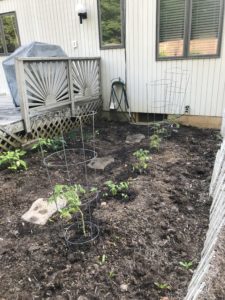
The ground cherry seems to double in size every day. In the background, you’ll see my plumcot tree happily growing tall. I might prune this tree each year and let it stay happy in a pot. You can grow plum trees in a pot! I needed a few more plum trees to pollinate with my first plum tree that will blossom next year.

My lavender and basil seem happy in these pots.
 It’s a simple backyard garden that brings the perfect amount of joy each day. A storm came through last night and poured down rain, so I won’t need to water the garden for a few days. I still go out and inspect the plants to ward off anything that might harm them. I still go out and see what’s new with each plant. It feels like a spiritual practice, like something God does with us.
I love how living with flair means you don’t need extravagant, expensive, or fancy things to build a joyful life. If you have some dirt, some seeds, and some water and sunshine, you have everything you need.
I’m also learning that older people like myself love to talk about their gardens. If you want to know how to enter in a conversation with someone this summer, ask if they are growing a garden. See the way they light up. In my last three conversations with relative strangers, I asked about their gardens. 45 minutes later, they were each still lit up with happiness as they shared about their plants.