Heather Holleman's Blog, page 193
September 22, 2018
First Day of Autumn Here
What a wonderful new season! I grab a sweater to warm me from the chill of a 60 degree afternoon. I keep the windows open and know we’ll sleep so well as the evening cools down to 50 degrees.
We talk our walk and crunch hundreds of acorns. On our street, we rake acorns into great piles like leaves. I remember that year I made bread from acorn flour. We won’t starve if something happens to our food supply; the acorns will feed us!
I attempt a new soup in my crockpot (mushroom, sweet potato, kale, cauliflower, and quinoa), and as it simmers, I crunch an apple that signifies a new harvest down at the fruit farm.
We put the garden to sleep and gather the last of the tomatoes. We leave the green peppers to continue their ripening. We water the mums we’ve planted. They’ll bloom this week.
Sweaters and slippers. Apples and soups. Acorns underfoot. It’s autumn in Pennsylvania!


September 21, 2018
What God is Really Like
In my Bible, written in tiny print under Psalm 103, I read this commentary: “What God does for us tells us what he is really like.”
What is He really like?
What does He do for us?
I find I’m so happy to read once again the action of God on our behalf. God is really a God who forgives all your sins (not some of them), who heals you (if not now, in eternity), who redeems your life and covers you with love and compassion, and who “satisfies your desires with good things so that your youth is renewed like the eagle’s.”
He satisfies our desires with good things! Good things!
What a beautiful psalm to remind us what God is really like. His love is so great, His forgiveness so vast, and His goodness so perfectly matched to our desires.
September 20, 2018
A Fun Video About Verbs
Sometimes I show my students little instructional videos that make us feel like children learning grammar for the first time. I do this because, believe it or not, students often don’t learn grammar anymore. They’ll often ask me, after I talk about my love of vivid verbs, what a verb is.
It’s not too late! It’s never too late to learn! So, enjoy this video that features Muggs the Dog. It’s called, “Strong Verbs.” Enjoy!
September 19, 2018
When a Good Thing is Bad for You
This morning, yellowjackets descend upon the raspberry patch. Perhaps they’ve nested down below the stalks in the ground. I see so many of them greedily clinging to the ripe raspberries, and I back off, bowl in hand, and run back to the house.
I think of those sweet berries with all those yellowjackets on their backs.
I know these insects. I know all about them. Yellowjackets sting repeatedly and aggressively; they target and pursue. A yellowjacket attack brings the worst kind of pain. It lingers and swells.
Years ago, at Camp Greystone, my campers and I walked through a yellowjacket nest hidden in the mulch. As they ran for safety–and I stayed to ensure they all made it far away–I endured six stings up my leg. The pain nearly knocked me out. That summer, I learned of my allergy to yellowjackets: the hives, the labored breathing, the epi-pen that I’d now carry for my whole life, wherever I go.
Someone else can pick my luscious raspberries. Someone else can enjoy that harvest.
Sometimes, a good thing isn’t good for you. It’s not where you should be; it’s not going to bring you life or peace. In fact, that good thing might carry with it something toxic, something that just might kill you.
I remember this when it seems like God withholds some kind of good thing. It might not be good me.
September 18, 2018
Join the Launch Team!
It’s time! It’s time! I would like to invite you to join my Launch Team for Chosen for Christ! You’ll join a private Facebook book with a link to sign up for your FREE BOOK, beautiful sharable images, and Facebook Live event with me 

September 17, 2018
Strength in Helplessness
I loved reading Hannah Whitall Smith’s words today in God is Enough. She describes us as instruments to be used in the hands of God. I love her analysis of that imagery because, as she says, “the moment resistance is felt in any tool, the moment it refuses to move just as the master wants, that moment, it becomes unfit for use.” She further writes this beautiful sentence about tools and instruments:
The strength of an instrument lies in its helplessness.
How wonderful to see ourselves helpless and pliable in the hands of God, flopping down into that great palm with nothing to give and nothing to contribute to the work God wants to do–except our surrender. We’re like a hammer or a saw that only works as intended when picked up and animated by the craftsman who made the tool and knows how to use it. He also knows the best use for a particular instrument, just like a musician who plays the right notes, in the right way, at the right time.
We stay helpless and pliable; He plays the tune and uses us in the manner for which we were made.
September 16, 2018
All Your Tomatoes: Oven-Dried Tomatoes All Winter
I return from my speaking event and realize it’s one of my favorite times in the garden: the tomato harvest.
I slice the tomatoes, mix them with garlic, a drizzle of olive oil, and all the chopped herbs still in the garden (oregano, thyme, and basil). I spread them in a pan and sprinkle them with salt and pepper.
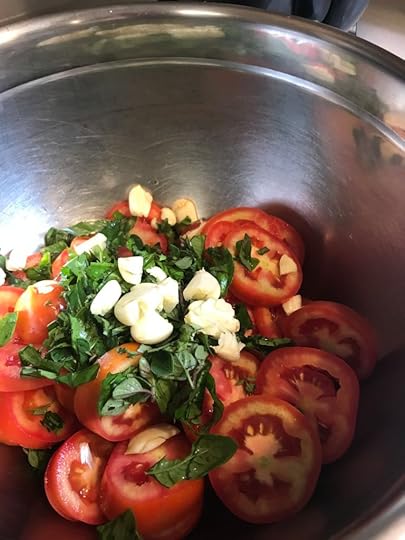
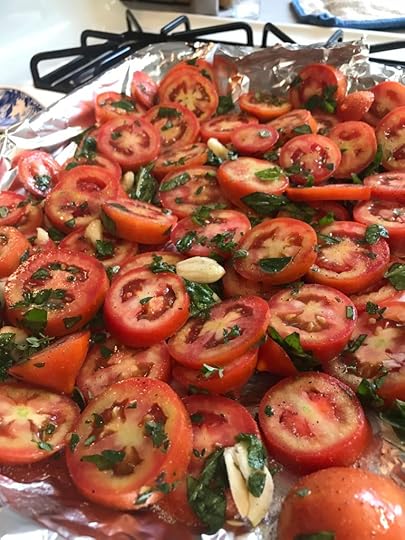
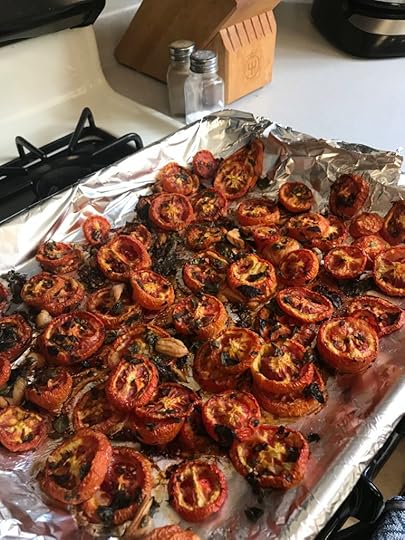
Then, you slowly dry them in a 275 degree oven for 3-5 hours depending on how dried you want them.
Afterwards, store them in the freezer for whenever you want wonderful tomatoes concentrated with amazing flavor. We defrost them for chili, a pizza topping, lasagna, spaghetti, and for delicious Italian sandwiches. Dried tomatoes also make great after school snacks in the winter if you serve them with Italian bread, cheese, and olive oil.
I love storing for the winter and bringing a little summer out during the snowy cold season.
September 15, 2018
A Wonderful Event
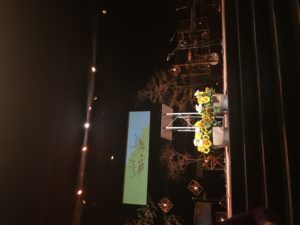
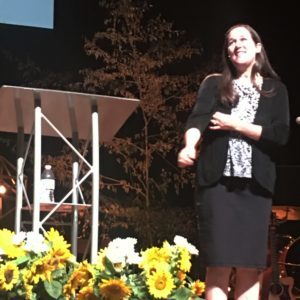
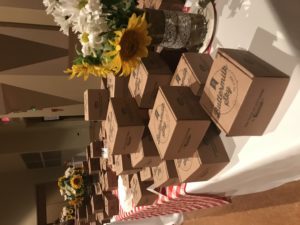
I loved my time speaking to the women of Grace Fellowship Church in Johnson City, TN. It’s always amazing to see people respond to God’s word. It’s incedible to see the Holy Spirit at work. It’s real.
Here are some photos of the event! 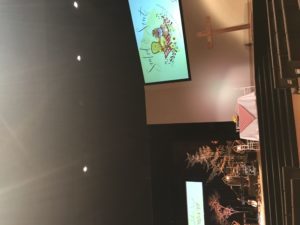
September 14, 2018
The Verb I’m Thinking About
Today a friend I haven’t seen in a while asked me, “So what’s your favorite verb these days?”
I love that I have friends that ask such questions.
And I love that God made me the kind of person who actually has an answer to such questions.
I tell him that I read a sentence with a new verb I’ve never used before and how I’d been thinking about this one sentence all week. It’s when Robert Coleman writes this in The Master Plan of Evangelism:
Jesus proportioned his life to those he wanted to train.
Proportioned!
When I read this verb proportioned, I picture a pie chart. I picture Jesus doling out his time and attention to His priorities each day. He doesn’t waste time or give too much attention in the wrong places. He worked, ate, rested, taught, prayed. He moved about His day in a proportioned way.
I wondered if my life’s pie chart of time and attention would represent my key priorities. Even more, do I even know how to define my key priorities?
What great personal development questions:
What are your key priorities?
How will you proportion your life to match the time and attention you want to give to these priorities?
September 13, 2018
A Peek Into the Classroom
I loved today! What a great day for teaching. I turned on some music of students volunteering their favorite songs. Today, we listened to Van Halen’s Jump and then Jimmy Eat World’s, The Middle. We began class with a name game: your current breakfast obsession. The majority of the class announced their love of breakfast sandwiches–bagel, egg, bacon, avocado, cheese–and coffee. I tried to convert them to my newfound love of refrigerator oats; I only won over a few sympathetic souls. (Every name game relates to a skill we’re building, and this time, it’s precise characterization: you as a character who eats breakfast.)
Next, I asked for five volunteers to read their “I Am From” poems that we composed as a pre-writing activity to mine our lives for settings, characters, and events that might shape the professional signature story we write. We learned about the sights, sounds, smells, tastes and textures of hometowns like Brooklyn, Pittsburg, Philly, and New Jersey. We clapped and cheered for all the excellent poems.
We watched a video on what makes a great story from the advice of leading filmmakers and producers, and we discussed authenticity, conflict, audience, vulnerability, education, and transformation. We talked about how to tell a life story of transformation that transforms others by teaching them something and inviting them to somehow change.
We then looked at a presentation on five ways to create complexity in a story by using examples of key signature stories from students in the past who grappled with anything from challenging stereotypes, undergoing some kind of conversion experience, or simply making a connection between two otherwise seemingly unrelated things.
By now, we needed a break to sit back and talk about our possible stories. We worked through a planning sheet. A few brave students announced their story ideas and allowed the class to weigh in on whether we’d want to hear a story like that.
And then, my favorite moment arrived: a grammar lesson on using strong verbs in narrative. We looked at before and after examples of dull writing that turned into something magical with vivid verbs and advanced grammar.
As class wrapped up, I introduced the homework assignment: to read more of our book Writing to Change the World (the chapters on the author’s own signature stories) and Russell Brand’s article in the Guardian called, “My Life Without Drugs.” We viewed a few video clips of Brand discussing his personal mission to help others understand a life of addiction.
Time’s up. They stream by, pausing to tell me about this or that possible story or to wonder why their grade wasn’t as high on their professional packet. I lean in and tell them what I’ll say all semester:
Your verbs. Your verbs make all the difference.