
Mark Fine's Blog: AUTHOR 2 AUTHOR INTERVIEW: Authors Mark Fine & Pamela Crane Reveal their Lives in Pursuit of the Art of Writing., page 9
March 27, 2015
INTERVIEW by Dave Adair ~ The Zebra Affaire: A Bold and Emotional Look at Interracial Romance in 1970s South Africa
The Zebra Affaire: A Bold and Emotional Look at Interracial Dating in 1970s South Africa.
Curious about author Mark Fine‘s motivations when writing “The Zebra Affaire”? This new interview conducted by Dave Adair, the author of the stunning litrary thriller, “Random Ludicity” shines further light on South Africa’s apartheid years, the impetus behind Fine’s desire to write the novel, and his first impressions when immigrating to the United States.
CLICK THIS LINK FOR THE FULL INTERVIEW


March 23, 2015
“One for All, All for One” In the spirit of enlightened self-interest, all authors must share a generosity of spirit.
We are neither competitors  nor rivals; we must set aside these preconceived notions, happily in fact we are colleagues. And by working together, collaborating together, we will all enjoy better chances of success. In a stripped down, basic vision, I see us as a kind of loose knit creative Co-op, a Kibbutz of self-publishing zeal where we all have talents, skills, influence, connections and chutzpah to contribute to this common (and admittedly sometimes self-serving) mission.
SIMILAR MOTIVATIONS IN AN EVER CHANGING WORLD
Why do I have confidence in this notion? First, we know one another, virtually. We have similar motivations. We share a similar respect for the written word (and hopefully for each other).  We are thinkers, we are mindful, and we are all pioneers on this great adventure in the publishing world. A publishing world that’s experiencing a paradigm shift not seen since William Caxton established a printing press in 1476 in England, and printed Chaucer’s Canterbury Tales.
Okay I admit there’s a tad bit of hyperbole there, but the fact is Self-publishing has arrived with gusto, Amazon has changed the landscape of retail, and we are now reading reams of books off tablets, kindles and the like. And as such we all share a similar challenge: how to build a plane while trying to simultaneously fly the damn thing!!
VIRTUAL SPIRIT OF GENEROSITY
And second, this spirit of generosity already exists in 2015…believe it or not, on the Internet. I know at times it feels perilous, somewhat akin to the Wild West. But I have personally experienced extraordinary generosity of spirit from total strangers; Some of you may have already experienced this yourselves…
For example, when close to concluding my historical themed novel, The Zebra Affaire I struggled to write my own book’s blurb. I guess I had gotten too close to it. In desperation I resorted to posting my predicament to the vast world of strangers on the World Wide Web. A mysterious creature from a far off land (I think Australia) volunteered to help. It was a thrill to wake up the next morning—the time difference allowed this mystery sprite to work away as I slept—to find a perfectly cogent piece of prose awaiting me. There were no strings attached, no demands for payment or credit. Then one day “Kiss the Sky”, the euphemistic name of my Good Samaritan sprite, mysteriously disappeared….I guess that’s the kismet of the internet!
PAST EXPERIENCES AND CAREERS AN ASSET
Look around you, virtually in social media forums and Facebook groups, or your local writers workshops and associations (such as the Surfwriters and Southwest Manuscripters that I attend) there is so much potential for cross-promotion and collaboration. All writers have a legend, a valuable past profession or career experiences that enable one to contribute in some way. In other words, whatever you once did, or are currently doing in your “civilian life” outside writing is an asset. Heck, even my history in the record business and cause-marketing world may prove useful to somebody out there.
IT ALL BEGINS WITH A REVIEW
How can we help each other? Reviews: And let’s not kid ourselves; Reviews are the coin of the realm for us writers. This is great news for all of us in this literary community! We are erudite. We love to write. In fact we are perfectly equipped to write reviews. Let’s start reading, then reviewing, the work of our colleagues.
SOLIDARITY IN COLLABORATION
Writing is a supposedly a solitary endeavor, but I would dearly like to collaborate creatively with others. Talking in terms of collaborations; I know this is a direct result of my passion for the music business: Art Garfunkel was better for having Paul Simon in his life,  consider how mediocre The Beatles may have been if Lennon never knew McCartney, Rodgers needed his Hart to compose “My Funny Valentine”, and I guess Jay Z needed his Queen B, Beyonce!—it has been well established that the creative process is often enhanced by collaboration, indeed ‘the whole is greater than the sum of the parts.’ Ergo, when I write my next book I would be tempted to look to this bookish community for insights. For me this is potentially heady, fun stuff!
BOUND BY A COMMON CAUSE
I’m grateful to be a part of this community of authors and writers. Whether one writes fiction or a memoir, erotica or poetry, Historical fiction or children stories, we are all bound by a common cause—the sanctity of the written word. Remember that, and let us support each other. As creative folks, we are keenly aware that “all boats rise with the tide” and something that benefits one, in time, will benefit ALL. Please let us all review each other’s books on Amazon and Goodreads, volunteer to Beta read a manuscript, “comment” “share” and “retweet” as often as possible, “Like” a Facebook Author Page, guest blog, and conduct fascinating author interviews…these are all inexpensive ways draw pride in our collective work, and enjoy shared success.


February 25, 2015
A MOST UNEXPECTED REVIEW THAT BLEW ME AWAY

The Joy of Receiving Reviews
I’ve been fortunate. My novel, The Zebra Affaire has thankfully enjoyed wonderful early reviews. Unlike a record album that consumes maybe 50 – 60 minutes of a listener’s time, and quick to formulate an opinion, a book such as mine may take several hours, or more, for a reader to complete. For that reader to then take the additional time to reward my work with a review, well I am both grateful and honored.
Touched a Similar Chord in Most Readers
Not surprisingly, as I wrote the book with the clear intent of shining a light on the inhumanity of racism in apartheid South Africa, most readers responded in a similar  fashion. They were appalled at the plight of the mixed race couple at the heart of the story, a woman and a man caught in a desperate life-or-death struggle against their bigoted government. Their only crime was that they were in love. But a romance such as theirs–across the color divide, was unacceptable according to apartheid’s twisted ideology. Yes, my intention was to tell a hauntingly poignant love story as a reminder that intolerance cannot, and should not, ever be acceptable in the future. Most of the reviewers, as seen by the beautifully expressed quotes shown below, clearly understood my book’s purpose. Most gratifying.
“Using fine strokes, Mark Fine paints a masterful portrait of the trials of blended romance during a period tense with racial discrimination.”
“Elsa and Stanwell play the star-crossed lovers, brought together by circumstance and fallen in love by choice. So many things that lovers take for granted, Elsa and Stanwell long for. Their love story is a strong defiance against the apartheid.”
“You have two characters, from two different worlds, and despite the systems in place to keep them apart, they find each other, their forbidden love blossoming into something truly remarkable.”
The Animals as Support Characters
Not surprisingly then, The Zebra Affaire is about Africa and humans behaving  badly. But it’s also about animals. Be it a personal indulgence (I’ve never felt more vital than on a camera safari in the Southern African bush) and an affinity for the animal kingdom, but the novel is laced with creatures great and small. Some are bush fables illustrating the foibles of men, and at other moments I’m providing eye-witness testimony on the wonder and majesty of the wild game trails.
I confess as I wrote the novel, constructing these animal scenes was second nature to me. I rendered them as authentically as I had experienced them–my memories as a child visiting the Kruger National Park to my last Londolozi safari during the summer of 2006. And as these animals are secondary “characters” in the story, it wasn’t a surprise to me they were overshadowed by the engaging couple, Elsa and Stanwell, and the vile villain Zander in the minds of readers—and as such, seldom mentioned in reviews.
That Unexpected Review: A Game Changer
Then review “number 56″ appeared on Amazon. Sure, it was emblazoned with five stars, but in content it was like no other. It was a well-considered rant. Mind you, not against the book. But the writer credits The Zebra Affaire for provoking in her mind a call-to-action on what may well be Africa’s greatest challenge in the 21st Century (and mankind’s most pathetic failing)—the scourge of modern poaching! Let me step aside and let you “listen” to these frustrated words:
“Zebra Affaire got me thinking….
Though apartheid is over, Africa is still in a genocidal struggle~the disgusting slaughter of its precious animals, by poachers! This sickens me. The senseless butchery, all for an ivory trinket or some coward’s libido, ego.
This is a threat way beyond the pain of never seeing a live rhino or majestic elephant walk the earth ever again. These evil thugs, these poachers are destroying us… They gun down the courageous game rangers struggling to protect our animal kingdom.
The blood-money they get from this atrocity only feeds greater atrocities– against humans, because the poachers are cohorts of terrorists, who use ivory to finance their murderous campaigns of fear.”
Then the reviewer proposed an activist remedy:
“This brings me back to “THE ZEBRA AFFAIRE” and why this book is important. It reminded me of the sins of apartheid; but more significant it reminded me how civilized societies destroyed apartheid~by boycotts, sanctions and public protests.
The Anti-Poaching movement must do the same, and in protest march on Chinese embassies everywhere. The greedy financiers and corrupt officials, facilitating this rape of our natural birthright, must be boycotted and shamed!” [See the full Amazon review here]
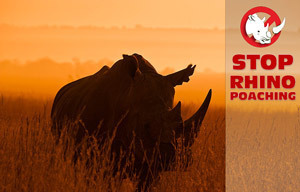
Pictures of mutilated Rhinos are far too distressing, so I’ve resorted to using this “STOP RHINO POACHING” image as a Call-To-Action!

I believe we can all agree that this reviewer has an excellent point! Let us fully engage, and choose to wield similar tools that were used to dismantle apartheid: protests, boycotts and sanctions in order to terminate the poaching threat…before it’s too late.


December 12, 2014
Vanessa Wester: Mark Fine discusses his novel, "The Zebra Affaire"...
Please click on this heading for the full article: Vanessa Wester: Mark Fine discusses his novel, "The Zebra Affaire"...
December 5, 2014
NELSON MANDELA ~ Africa’s Last Statesman

But rather than dwell on the bleak let us be hopeful that in remembering Mandela's death, the South African people will honor his life and legacy by electing future leaders, based on merit, not cronyism. (How about a woman? It would make a unique, and welcome change in the societal hierarchy.) In doing so the honor, the hope, and the desire for all equality that was Mandela's life's work would finally be achieved.
One year ago I was finishing the final chapter of my South African themed novel, “The Zebra Affaire”. When I heard the sad news of Mandela's death I felt compelled to add a tribute as a coda to my book; here is an excerpt:
As I sit in my study writing these words the television is on in the background, keeping me company. It is December 5, 2013, a Thursday, a day I will now always remember: a news alert, immediately distressing but inevitable, as the reporter has just announced the death, at age ninety-five, of Nelson Mandela. We are fortunate to have lived at a time when a person of such extraordinary wisdom, mercy, and humanity walked among us. On reflection, the only disappointment in Mandela's ascendancy to power was that it was so late in his life—he grasped the reins of responsibility at an age most men retire. This allowed us only a single-term presidency. But former prisoner Nelson Rolihlahla Mandela had no desire to become a sovereign: he relinquished the power voluntarily—so refreshing on a continent where provincial tyrants strive to rule forever. But here I remain fearful (though I dearly hope to be proven wrong). Mandela was the nation’s talisman—his very presence held the various peoples of South Africa on a rainbow path of dignity and equality, and by his noble example all tribal rivalries were set aside and all were welcomed at the table.But now he’s gone, I fear the quiet vow of loyalty to his vision of a united South Africa will be abrogated. With Mandela no longer living, lesser mortals will not feel bound by any allegiance to the “Father of the Nation”; instead, in a lust for power, they will once again unleash the tribal tensions that have forever plagued the continent. But a man is fragile, limited by the term of his life. His ideals, however, if merited deserve to remain in the consciousness of those left behind for all eternity. And Nelson Mandela’s ideals were supreme. So as Tata takes his well-deserved rest with the ancients, it is hoped those who succeed him learn from his enlightened example, and avoid the pitfalls found on the dark path of the tribal divide.However, for now we remain both hopeful and grateful. Nelson Mandela gave the nation he so revered one final gift. After forty years in the wilderness as a pariah among nations, South Africans now hold their heads up high due to the shining beacon of Tata’s grace. We in turn are in his debt, and have a job to do to ensure his legacy lives on, by holding future leaders to the fine standards he set—to embrace all, and shun partisanship.
I would think the most fitting tribute to Nelson Mandela would be to ensure that he was not destined to remain Africa's last great statesman.
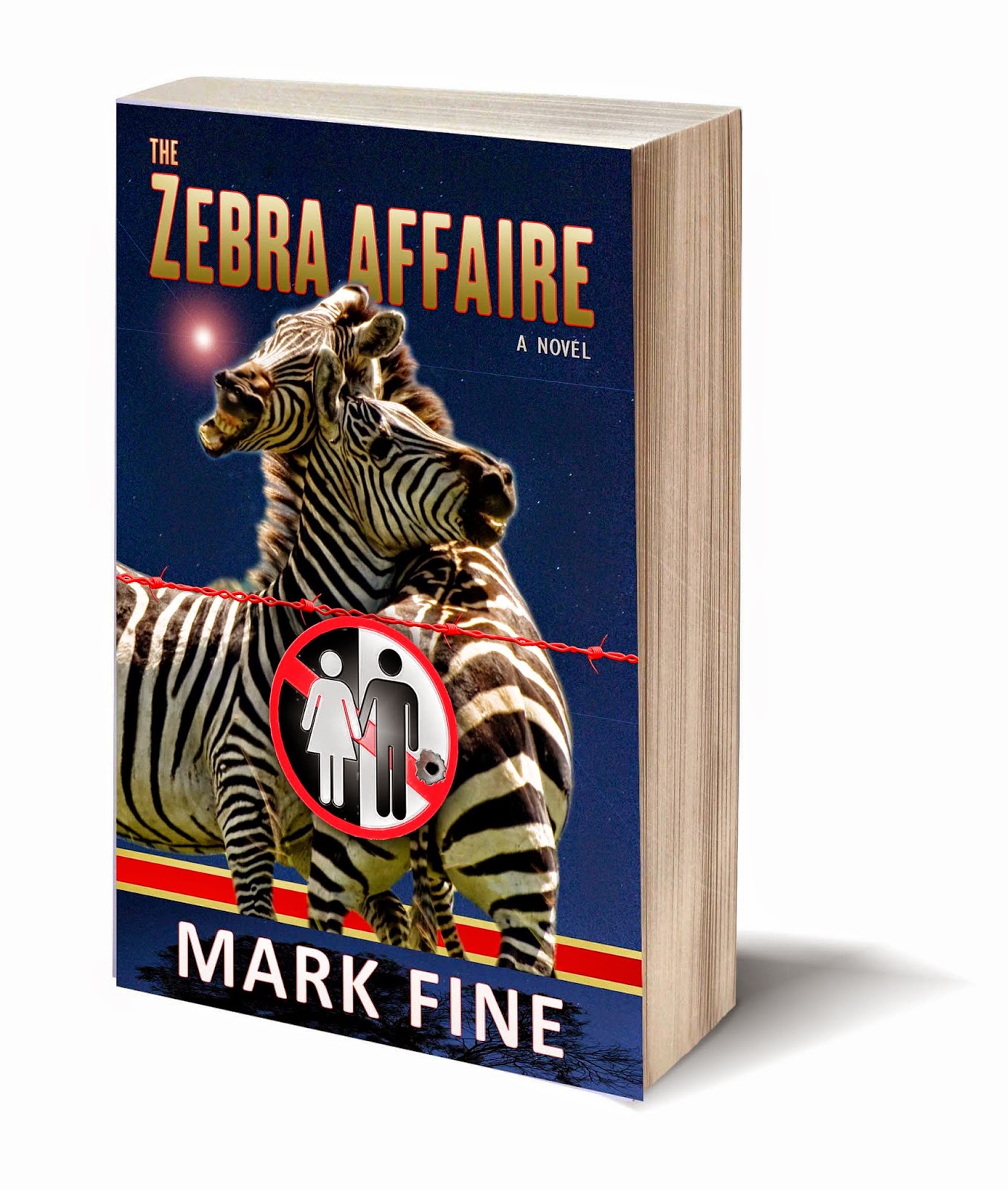 [Mark Fine is the author of “The Zebra Affaire” available in paperback and Kindle editions on Amazon.]
December 2, 2014
5 Book Reviews of Works by 5 Extraordinary Women [Part 2 of 5]
Hiding in a Cave of TrunksEster Benjamin Shifren
 From Ester Shifren's remarkably detailed work you will re-visit an extraordinary family history.A fascinating family saga of occidentals in the Orient, as war clouds loomed over Shanghai, and then the family's subsequent POW deprivations at the hands of the Japanese during World War II. From Ester Shifren's remarkably detailed work you sense her great affection for Shanghai, and in her telling both the vitality and tragedy of its fascinating people are clearly voiced. And in a way this echoes the travails experienced by Ester and her family. They were happy there, and prospered. Then the Japanese invaded.
You must read Hiding in a Cave of Trunks to truly appreciate the unique and unkind path the Benjamin family were subjected to during those troubled times, and to admire the indomitable creative spirit of the author--who was at the time a very young, but plucky little girl. To me, this is what makes this book so unique and appealing: Ms. Shifren tells the story from two perspectives; that of a wide-eyed child (with all the immediacy, exuberance, naivety, and confusion that youth offers) and then of a wise, sophisticated, well-travelled woman (who has done her research, including recorded testimonials from those that were there). It is such a fresh, inspired way to re-visit history.
My final thought when I finished reading Ms. Shifren's compelling book was wonderment at the fascinating lives "lived" by ordinary people like you and me. And, how fortunate we are that Ester Benjamin Shifren took the time to tell us her story.
Available at Amazon.
A Dream FulfilledAmb. Thandi Lujabe-Rankoe

A Riviting Personal Story of Sacrifice for the Idea of Human Freedom and Dignity.
In a time when we see ambassadorships cavalierly handed out as rewards to those who merely "bundled" the most money for a presidential election, it is gratifying to see that in the tip of Africa a diplomat received her High Commissioner appointment to represent her nation based solely on merit. And boy, did she earn it: The Hard Way! In reading Ambassador Lujabe-Rankoe's harrowing story, it becomes evident how difficult her journey was; the personal cost was awful. But in telling her story, the ambassador deservedly indicts the brutal apartheid regime. But she displays generous grace and humor to those that were kind.
Thandi was always destined to serve, but her early ambitions to be a nurse in South Africa were crushed by early activism protesting the apartheid laws. As she became immersed in the freedom struggle, she found herself in danger, and fled her native land. With the threat of death a constant, due to the apartheid regime's sustained efforts to assassinate the ANC leadership, Thandi (often with a child in tow) was constantly on the move to various destinations in Africa, and even Norway. I was amazed at this formidable woman's ability to adapt to these new communities, cultures, and societies--yet, at the same time successfully championing all humanities cause.
And that is what finally makes the reading of this book so satisfying: Redemption. After 33 years in exile (and after Mandela's 27 years of imprisonment), both their dreams were finally fulfilled with Nelson Mandela's 1994 ascendency to the presidency. And as a fitting reward for her profound contribution to the freedom struggle (not merely based on gratuitous political favors) Ambassador Thandi Lujabe-Rankoe was appointed High Commissioner, with the mandate of representing her first-time free nation to the world. And as ambassador, and knowing so well the countries she was posted (due to her past travels) she served her nation brilliantly.
I strongly recommend this book those who appreciate autobiographies and memoirs, African studies, political science, 20th Century world history, women empowerment, stories of personal courage and sacrifice, and compelling tales of inspiration.
Available at Amazon.
[Review by Mark Fine, author of "The Zebra Affaire"]
November 18, 2014
The Writers' Lens: Fine's THE ZEBRA AFFAIRE explores forbidden romanc...
Fine's THE ZEBRA AFFAIRE explores forbidden romance in apartheid society
Print.jpg) Welcome to author Mark Fine, who was born in Johannesburg, South Africa. New York, Minneapolis and Los Angeles have been home since 1979. Through global music giant PolyGram, Mark founded Hammer & Lace Records. His label had a unique mandate: to be the industry’s only imprint dedicated to highlighting specific social or health issues by creating benefit albums that promoted life-saving awareness campaigns. For a decade Fine proved adept at uniting non-profit organizations, corporate and media sponsors, and world-class musicians such as Sheryl Crow, Sting, Melissa Etheridge, Bryan Adams and Boyz ll Men in aid of breast cancer research and wildlife conservation. For his work Fine received several awards from both the music and oncology communities. Now he lives in the South Bay—where he wrote The Zebra Affaire—with his two sons and a neighborhood dog that drops in from time to time.
Welcome to author Mark Fine, who was born in Johannesburg, South Africa. New York, Minneapolis and Los Angeles have been home since 1979. Through global music giant PolyGram, Mark founded Hammer & Lace Records. His label had a unique mandate: to be the industry’s only imprint dedicated to highlighting specific social or health issues by creating benefit albums that promoted life-saving awareness campaigns. For a decade Fine proved adept at uniting non-profit organizations, corporate and media sponsors, and world-class musicians such as Sheryl Crow, Sting, Melissa Etheridge, Bryan Adams and Boyz ll Men in aid of breast cancer research and wildlife conservation. For his work Fine received several awards from both the music and oncology communities. Now he lives in the South Bay—where he wrote The Zebra Affaire—with his two sons and a neighborhood dog that drops in from time to time.What brings your writing into focus-- the characters, the stories, and the love of words? It's a real love for Historical Fiction that provides the window into the world I'm creating; and having the fictional narrative bound by actual facts and real people--and documented events and circumstances--brings an automatic focus to my writing. Historical fiction has always intrigued me; it’s a wonderful way to be entertained and at the same gain priceless knowledge such valuable insights in other societies and bygone periods.
I personally found that by reading powerful storytelling within the context of a factual background made the process of learning painless—and I devoured works by, for example, Herman Wouk, Leon Uris, Ken Follett, Colleen McCullough, Alice Walker, Irving Stone, and anything by my current favorite, Alan Furst. And let's not forget South African masters such as Wilbur Smith, Andre Brink and playwright Athol Fugard.
Some of my readers of The Zebra Affaire admitted they played a game as they read my novel; verifying the facts on Google as they progressed through the story, happily my research proved sound. But it is undeniable that the rubric of truth provides a solid foundation in my work-leaving me with the challenge of layering a fictional story, that's both emotional and compelling, over this structured historical foundation.
What inspired your latest book? Or, Why did you write The Zebra Affaire? Having the benefit of time and space, I wanted to explore the circumstances that led to my emigration—I was then in my early 20’s—from South Africa during the late 70's. What I discovered fascinated me because with distance I now found I had a better perspective of events.
This brought clarity to the confusion, corruption and callousness I saw growing up in South Africa. But along with the unfair and disparate ways in which people lived, I was also reminded of the country’s beauty; both its natural splendor—for example the thrilling wildlife, and the kindness and courage of individuals—who did take personal risks for the greater good.
The elevation of racial tensions in the United States has troubled me, and I felt a timely spotlight on the South African apartheid years could provide a cautionary tale.
Another motivation to write the book is the plight of Southern Africa today. Despite the seismic changes in South African society since its 1994 liberation, it unfortunately remains an unhappy nation. I believe there are still systemic problems that need to be addressed—specifically the corrosive role of tribalism in this multicultural society. This is an issue that continues to be sadly ignored.
Additionally, I wanted to write a love story. But it needed to be significant—far more than just a couple quibbling over “who left the toilet seat up." And through the eyes of my fictional lovers, I wanted to tell the factual story of South African life in 1976 as the backdrop to my story. So in my mind the adversity the romantic couple faces in The Zebra Affaire, being persecuted by their government for being in love, is about as harsh as it gets; and so the mixed race story of Elsa and Stanwell breaks new ground for me.
What's your favorite way to interact with fans/readers? No doubt it's the Book Clubs, whether in person...wine, coffee, snacks, and an immersive three hour conversation. Or, if need be virtually through Skype and Google Hangouts. I've really come to appreciate the level of engagement enjoyed by both myself and the book club members, when they have read my novel, are beyond curious, and pepper me with relevant questions. And at times reveal a part of themselves in the two-way exchange.
For me a profound moment was discovering how uniquely my words resonated with some readers based on their life experiences. My book is about racism in 1976 apartheid South Africa; but hearing from one reader how my African story surfaced suppressed memories from her childhood in the American South, specifically Georgia, was quite a revelation.Also, and I'm not sure other author's see it this way, but I'm humbled by meeting one-on-one those that have taken the time to read my book. I've come to realize the price of purchasing my book is not the real cost; it is the time these men and women have taken...several hours out of their lives, to read my words...and that is truly rewarding.
So unabashedly I'm ready and willing to make myself available for book clubs (be it real or virtual) and welcome any invitation via markfine@illovobooks.com.
What do you think readers will like about your book? First the time period: the late 70's with rich descriptions on the fashion, music, morals and history of the time.
Second an exploration of surprising human behavior in the face of brutal laws. How was it possible in a nation with such a small minority, that they controlled the large majority so cruelly, for so long? The black population seemed so accepting. It begs the questions, “Why? How was it possible?”
Three, the terrible repercussions ordinary people face when doing routine things; it should challenge the reader to consider what would he or she do if faced with similar circumstances. Especially if your elected government is behaving badly and at your core you know its edicts are morally wrong.
Four, there are fascinating "locations" in the novel, from a mile underground the earth’s surface in the dark depths of a goldmine to the thrill tracking lion, rhino and zebra on a photo-safari in the African wilds. My hope is that readers will immerse themselves in an exotic journey within the book.
Finally, as I lived in SA during this period, I believe readers will detect a certain authenticity in the narrative. This brings a sense of immediacy and first-hand knowledge to anyone reading the book.
What about your career outside writing and how did it influence your work? I was a music executive in both South Africa and the United States for four decades. This gave me the opportunity to be creative, and work with super artistic men and women throughout my work life. And as such, I learned to trust the creative process. By witnessing so many recording artists work their craft, even under the stress of release deadlines, I was innately confident and never felt creativity would desert me— even during those inevitable challenging moments during the writing process.
I also had the opportunity to launch my own record label through the PolyGram group—Hammer & Lace Records; it had a rather inventive mandate to produce benefit albums for a variety of causes, such as breast cancer awareness, the blind, at-risk children, and wildlife conservation. In the course of these projects I had the privilege of collaborating with Sheryl Crow, Sting, Bon Jovi, Boys II Men, Bryan Adams and many others
My only regret: I never once tried to write a song with any of them! I so admire the songwriter’s craft; the ability to reduce a big idea down to a pithy three minute song… Instead, I finally wrote this novel solo—by myself, and needed 85,000 plus words to tell my Zebra Affaire story.
%2BPrint.jpg) THE ZEBRA AFFAIRE: It’s SPRING 1976. In apartheid-torn South Africa, a black man from Malawi and a white woman of Afrikaner heritage made an unlikely union that shocks the nation. No government has the right to interfere in the love between two people, but that’s not the case in apartheid South Africa. Elsa and Stanwell’s illicit romance threatens the strictly controlled racist doctrines of the regime, and orders are given to stop them. Harried by the brutal Security Branch eager to destroy them, the desperate couple fights a sometimes lonely battle against the forces of segregation and tribal mistrust.
THE ZEBRA AFFAIRE: It’s SPRING 1976. In apartheid-torn South Africa, a black man from Malawi and a white woman of Afrikaner heritage made an unlikely union that shocks the nation. No government has the right to interfere in the love between two people, but that’s not the case in apartheid South Africa. Elsa and Stanwell’s illicit romance threatens the strictly controlled racist doctrines of the regime, and orders are given to stop them. Harried by the brutal Security Branch eager to destroy them, the desperate couple fights a sometimes lonely battle against the forces of segregation and tribal mistrust.
All sides across the color-divide are represented in a great canvas embodying the South African experience; from the Anglo-Boer War at the turn of the last century to the bloody 1976 Soweto Riots, and from a mine one-mile deep beneath the City of Gold to the harsh wilds of the African bush. In this compelling and vivid story of an interracial couple’s painful journey in an unaccepting world, the guilt, cruelty, and hypocrisy of their fellow citizens are exposed; as the nation wages a deadly struggle for freedom . . . and eventual redemption in the guise of prisoner 46664, Nelson Mandela.
Find his books and more about Mark at: http://www.amazon.com/Zebra-Affaire-Mark-Fine/dp/1494762609/ http://www.amazon.com/Zebra-Affaire-Mark-Fine-ebook/dp/B00KD2S5R0/ http://www.finewrites.blogspot.com/p/main-page.html http://www.illovobooks.com/2.html
November 11, 2014
BAD KNEES GOOD BOOK
.jpeg)
Would you like this bionic cyborg device in your body?
I was terrified. Knee replacement surgery seemed akin to gross amputation. Why the necessity for this traumatic procedure, twice—on each knee, I wondered? Surely this is a simple patch job; the biological equivalent of filling in a pothole?
With certainty I knew this was something I wouldn’t do, but as I searched for an alternative solution the pain persisted and my universe shrunk. No more tennis, no more walks on the beach, no more soccer games, no more travelling, and even obligatory visits to the grocery store became too taxing. In fact, only vanity prevented me from applying for a disabled placard to allow me to park my car a few yards from my destination. Inevitably I resigned myself to a future marooned on my bum. At least my bum didn’t hurt…at least not yet.
 No! This is NOT a picture of MY bum.
 So, what’s a poor guy to do stranded all day on his butt? Watch TV? Tried and done that. And then an absurd notion entered my head, “Why not write a book…” Now I am not a Luddite. I’m well aware that the earth is round and technology is crazy cool. My resistance to bionic knees was not a foolish quest to invalidate the wonders of modern medicine. Quite to the contrary, I admire medicine. But in this instance, to me, “the punishment did not fit crime” and the recommended remedy was far too draconian. Hence I began the first tentative steps into ‘authordom.’ With computer in hand (or hand on mouse) I now used the wonders of modern technology as my primary research tool. Bound to a chair I travelled through the universe and the ages; and visited the arcane and cruel laws of South Africa’s apartheid regime (the topic of my book)—without ever leaving my desk. Google and Bing replaced the library and index card system of yore, and brought all knowledge to my desk seemingly at my bidding. And from this foundation of dedicated research, my historical novel “The Zebra Affaire” began to take form and reveal its true shape.

Here’s the obligatory plug of my novel. You are welcome to buy it at Amazon.com and other fine retail outlets. Thank you :)
Now we’ve reached the heart of this story; a “circle of life” thing—that still fills me with wonder—kind of happened. You see the book owed its very existence to the plight of my poor knees, and seemingly in a selfless act of gratitude this same book chose to show pity on my knees and reciprocated in kind. One day when researching the specifics of the bloody massacre of black school children during 1976 Soweto Riots—I was suddenly transfixed by the search engine’s seemingly arbitrary highlight of something called stem cell regeneration of knee cartilage. And so I followed these crumbs of information that my grateful book had offered me. Apparently I had finally found the asphalt patch I’d been seeking for my potholed knees. An innovative medical group, a modest two hour drive from my home, was pioneering the procedure. They instructed me to bring my MRI (which I then pried from the grasp of the protesting orthopedic surgeon) to the initial appointment. Anxiety skyrocketed. It was vital I qualified for the program. Fortunately both knees did; I experienced a similar euphoria as if my two knees had graduated college magna cum laude. Now I will spare you the gory details (as there were none: no scalpel, no chainsaws, no staples, and no sutures). But there were lots and lots of needles. It would be fair to describe my needle-sprouting knees as living pin cushions during the stem cell “seeding” procedure.
 An intimate portrait of my prickly knee. And yes, it did hurt. Eighteen months have come and gone since stem cells harvested from my own body were carefully inserted beneath each knee cap. I used the time well, finishing off my novel, and designing both the front cover and the book’s interior. And as I labored the stem cells did their share of the work. All now is well! “The Zebra Affaire” is receiving splendid reviews for which I'm grateful: “I see Pulitizer Prize material here,” stated a kind Jeanne Mary Allen, “Engaging! Authentic! Beautiful! Horrifying! Mesmerizing!” wrote a well informed Randy Penn. Clearly my pen is well indebted to my long suffering knees! As for my ability to walk—it is now a joy to be fully engaged, zooming about, speaking at book clubs and book signings—with barely a twinge in either knee.
 www.finewrites.blogspot.com
October 4, 2014
“THE ZEBRA AFFAIRE” is a novel about HUMANS and ANIMALS too.
But other creatures inhabit Africa. They are not constrained by boundaries. They wander the great savannahs in search of food, water, shelter…and a mate. There is death, but just brief skirmishes for sustenance and survival. They have no Napoleonic ambitions to conquer great swathes of dusty soil for the sake of empire building. And in this regard they are far wiser than us Homosapians. These are the animals. They have no interest whether their domicile is South Africa, Botswana, Zimbabwe, or Ghana, Uganda, and Zambia. They merely wander wherever grazing and water takes them. And because of their sense of freedom, we humans envy them...and so we hunt them, poach them, trap them, corral them, and tame them.
I would prefer if we just let them be....
In writing and researching my historical novel “The ZebraAffaire” I had the privilege of viewing these creatures in their natural habitat (Oh how I wish their habitat was mine!).

Me, Mark Fine--the author in what he wishes was his natural habitat. This image was taken in 2006.
 Here are some of the animals I met along the way, and a description or two excerpted from The Zebra Affaire.
 "....the stately waterbuck drank its fill, only to leave a surprise when it turned, revealing a white ring resembling a toilet seat marked on its rump."
"Soon a shy kudu took a bow, its magnificent spiraled horns almost inconsequential in comparison to its comically large ears. The kudu’s wonderful hearing detected Elsa shuffling in her seat and the animal froze, momentarily threatened. Then its eyes found Elsa’s, and for many seconds they stared at each other. When Elsa blinked first, the now reassured kudu began to cautiously drink."

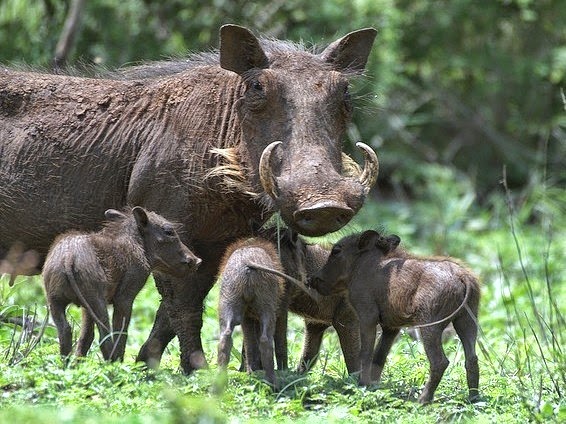
"Chomping, snorting grunts woke her. A family of warthogs grazed on grass tufts next to her, and she watched as they shuffled along on their front elbows with their tails straight high like radio antenna. Their tusks looked fearsome, razor-sharp..."
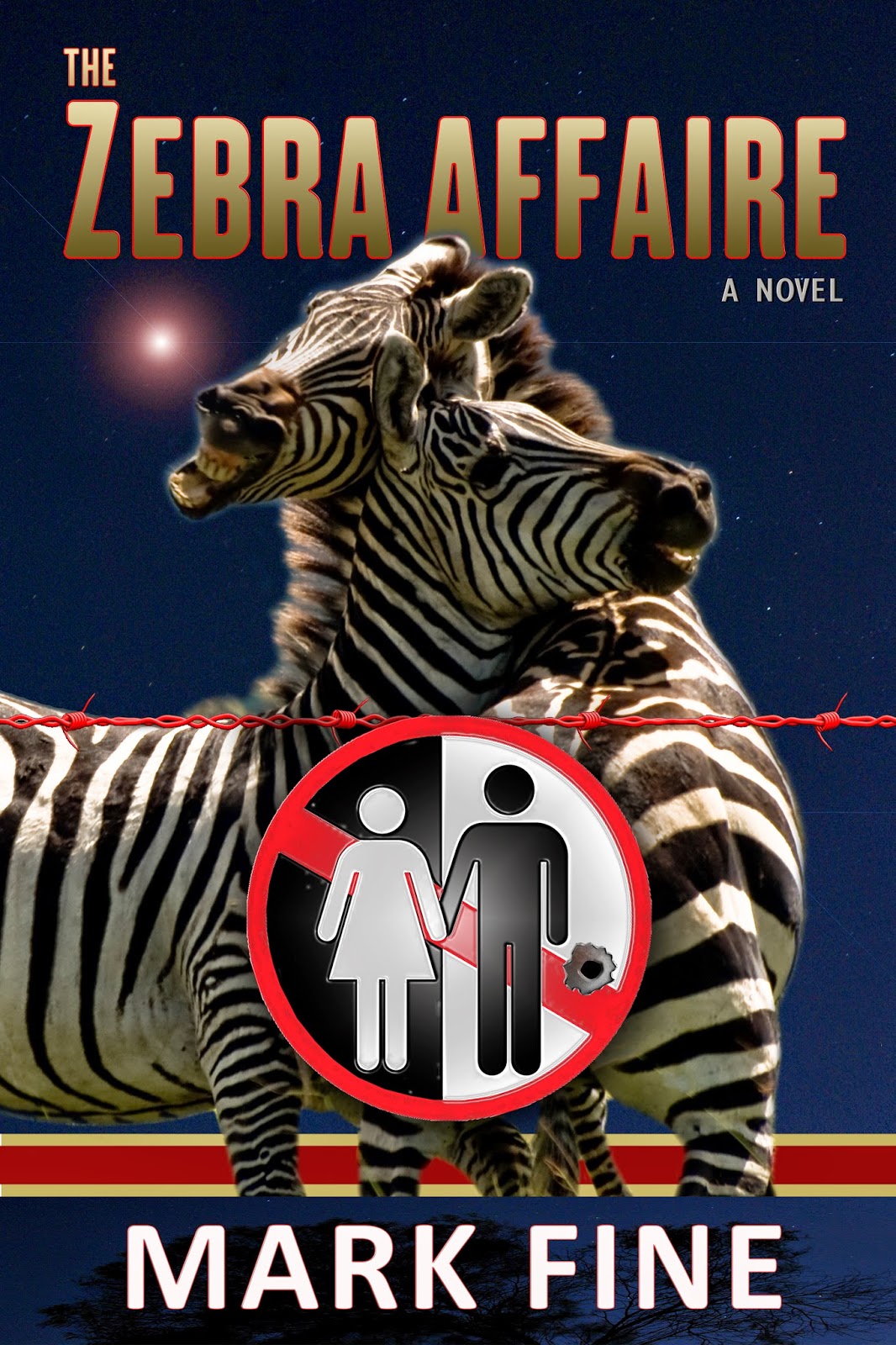
 "Two zebra at that moment appeared, clearly a mating pair. Typical of the animal kingdom, it was he who was the most splendid. His stripes were jet black on a field of white, while hers faded to brown at the edges. At first the stallion and mare faced each other, nostril to nostril, inhaling the other’s breath. They then moved forward a pace and rested their muzzles on each other’s backs. They stood there, quietly, framed by the blue sky daubed with puffs of clouds. Even the cackle of a hyena in the near distance didn’t deter them."
September 15, 2014
4 MONTH ANNIVERSARY TODAY (since "The Zebra Affaire" was published)
 4 MONTH Anniversary TODAY!!!..since the release of my novel #TheZebraAffaire. My publisher sent me a GOOFY CARD to commemorate the HAPPY event!! Thank you IBC Pub.
AUTHOR 2 AUTHOR INTERVIEW: Authors Mark Fine & Pamela Crane Reveal their Lives in Pursuit of the Art of Writing.

Find out what secrets each author reveals in this author-on-author interview between Mark Fine, author of the romantic historical drama The Zebra Affaire, and Pam ...more
- Mark Fine's profile
- 131 followers

