Nicholas Trandahl's Blog, page 3
July 5, 2019
WHISKEY AND A GRAVE
WHISKEY AND A GRAVE
It was early October, and in the northern American backcountry where I live, that means the air was cool and crisp and the trees were a symphony of yellow, orange, and brown. The grasslands were a sea of copper.
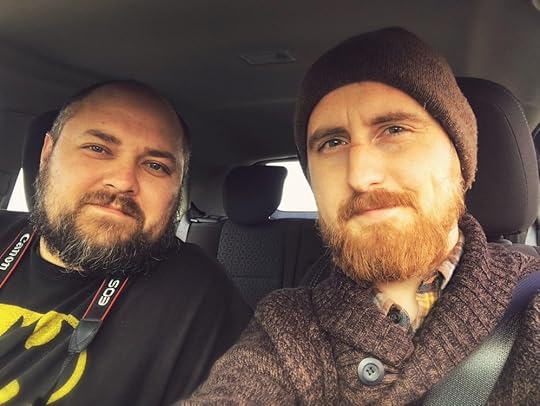
I was going on a quick two-day road trip with my best friend Craig, a fellow poet and writer, to the Wood River Valley of Idaho’s Smoky Mountains. Our journey was a pilgrimage of sorts with but one goal: to pay our respects at the grave of the almighty Ernest Hemingway, my own personal deity in the realms of literature.
Craig and I live in separate little hamlets in eastern Wyoming so the drive, including a side trip to pick up Craig, was about 12 hours to reach Ketchum, ID, a place Hemingway lived and loved and ultimately took his own life with his favorite shotgun on a July morning in 1961.
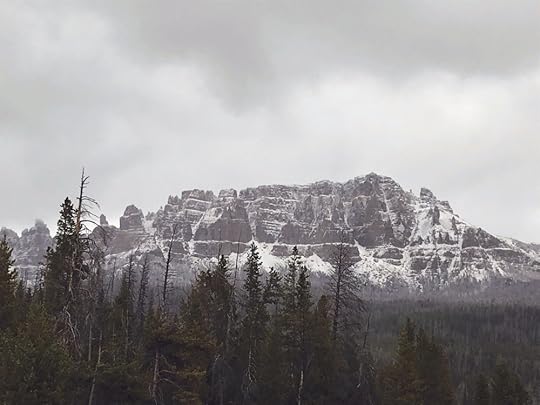
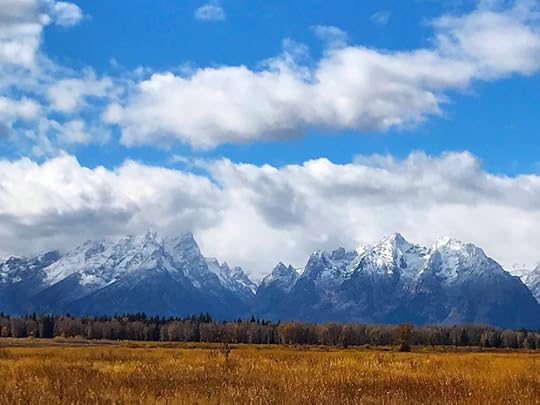
A drive across the vast rugged landscape of my home state of Wyoming, with its high snowcapped ranges, shimmering plains and deserts, and might pine forests, was a breathtaking adventure in itself, but that’s not what this story is about.
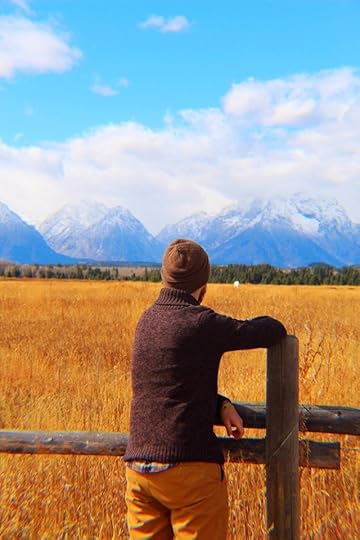
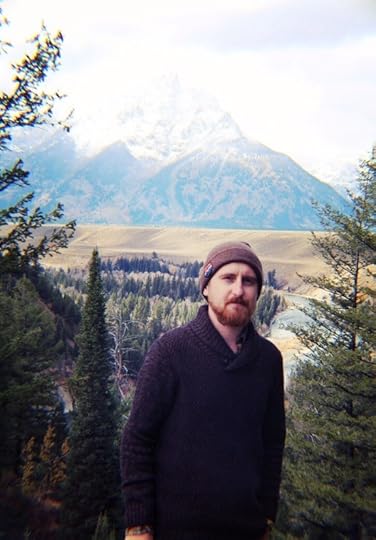
We eventually made our way around the majestic Tetons and crossed over into Idaho. Racing across that state, at dusk we finally turned north up into the Smoky Mountains. The sky was a swell of pink, lavender, and buttery yellow, all fading to the violets and blues of nightfall, when we finally rolled into the small mountain town of Ketchum, racing to the local cemetery to visit Hemingway’s grave while there was still some light. We didn’t want to wait until morning. In our wrinkled flannels, sweaters, and jeans, grimy with an entire day of driving, smoking, and eating gas station food, we had a singular focus — to visit Hemingway.
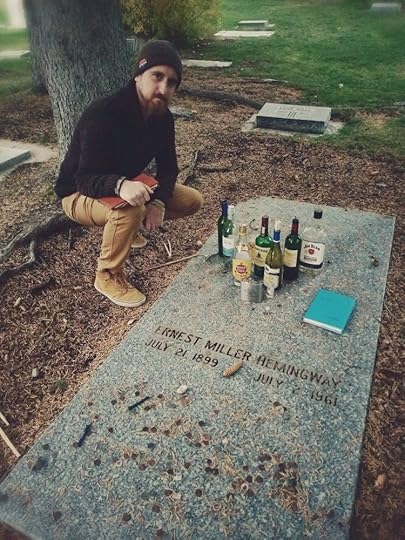
Ketchum’s cemetery was small and it didn’t take us long to spot Hemingway’s grave between two old pines, a long flat stone adorned with coins, notebooks, and various bottles of wine and liquor left of fellow literary pilgrims.
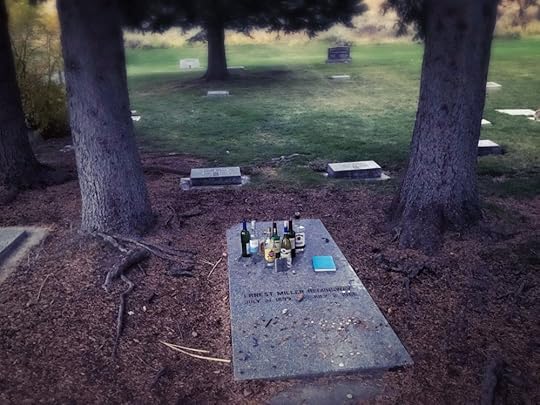
We stood for a moment before it, looking down at that powerful name that had meant so much to me. I’d been in Hemingway’s house in Key West, Florida, but he didn’t feel as present there. He’d felt like a ghost or a shadow, long since departed. But there, standing at his heavy grave in the last of the autumn light, his bones beneath my feet with the roots and dark earth, Hemingway felt more real than anything else in the world.
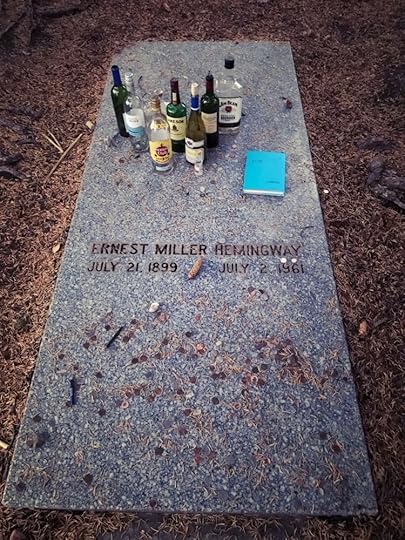
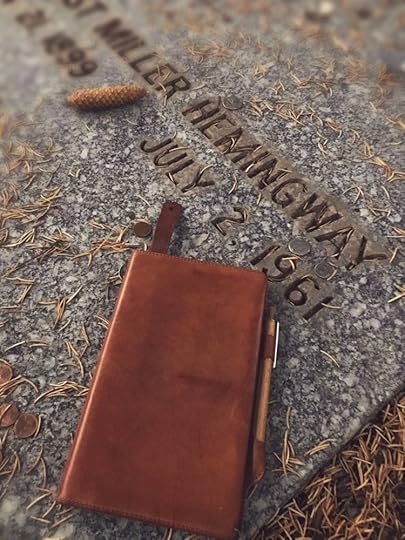
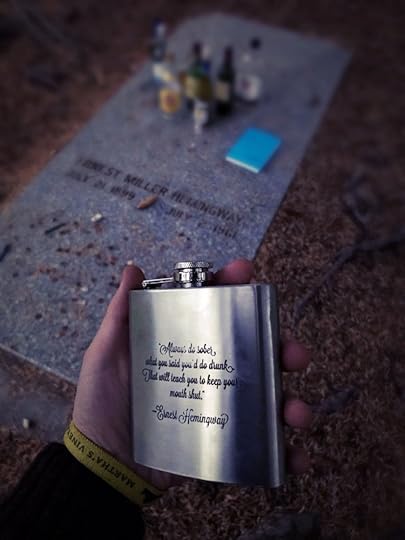
I knelt down and ran my hands over the name that was carved into the stone. “Thank you, Papa,” I whispered. “Thank you for everything.”
I stood then, pulled a metal flask of honey whiskey from my back pocket, took a drink, and passed it to Craig. My friend took a swallow, passed it back to me, and I took another long pull of the whiskey. The flask had an inscription of a very fitting Hemingway quote to be emblazoned on a flask: “Always do sober what you said you’d do drunk. That will teach you to keep your mouth shut.”
After taking a final drink, I poured a long stream of the honey whiskey into the pine needle-shrouded earth next to the heavy stone slab. A final drink for Hemingway.
Then I placed the flask, half-full, on the grave with the other bottles. It was a gift or an offering, a symbol of respect and gratitude for the man that wrote the words that would completely change the course of my life.
At that, Craig and I shared a hug, ambled back to my car, and made our way to our hotel for the night. We were hungry and weary, and a belly full of cooked trout and white wine sounded like the perfect way to end the day.


July 4, 2019
Absolutely!
Absolutely! In fact, this is why I started writing poetry that’s largely observational, quiet, honest, and simple. Embellishments and fabrications are too overdone in poetry. Let’s get down to the truth if things and get our damn hands dirty.

June 2, 2019
A Writer’s Homework
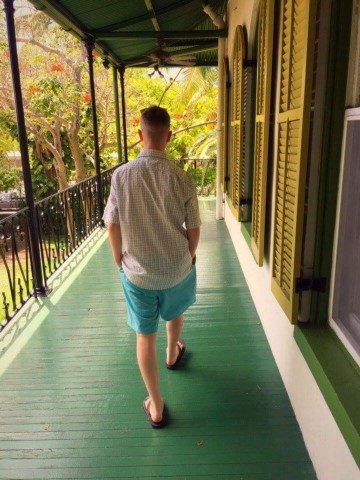
I’d made it. I was in Ernest Hemingway’s house on Whitehead Street in Key West, Florida. I was in the sanctum of my literary hero, where most of his body of work was written. There were his books, his typewriters, his photographs, his fishing rod, his bed, his war medals, the six-toed cats he was fond of (many generations later), and everything else that comprised his life when he lived in Key West during the Great Depression.
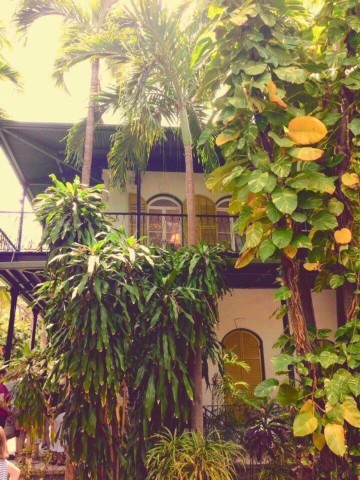
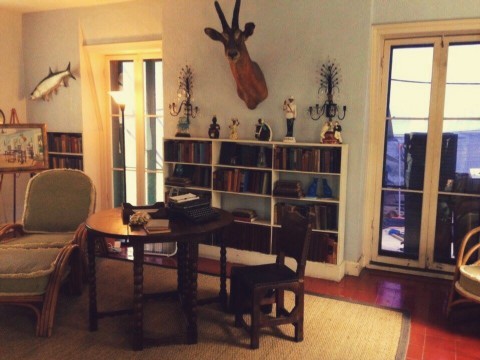
I’d walked the beaches of Martha’s Vineyard with my wife in an October breeze, beheld a massive herd of elk graze way above the tree line in the Colorado Rockies, and flown over the glittering lights of Baghdad in a March night. But stepping through the rooms of the Hemingway House in Key West was an entirely new type of experience. It was when I realized that great writers, perhaps the greatest, were mere men and women, no different than you or I. They were anxious and shamed. They were embarrassed. They suffered the same struggles that all of us contemporary writers struggle with concerning our literary craft.

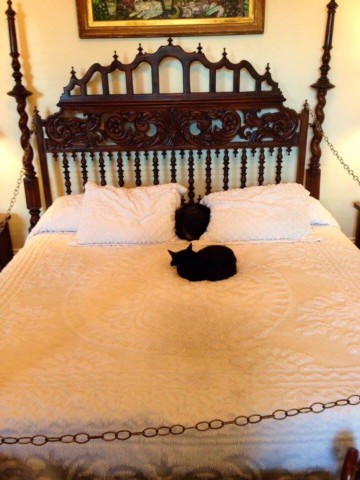
I imagine even Hemingway would feel some humility at having folks like me gawking at his bathroom and his bed, six-toed cats of course slumbering on it as they probably did when Hemingway walked those very rooms.
But I was not there for sightseeing and not even necessarily to have a life-changing moment or epiphany as a writer. I was there as a collector of experiences, i.e., writing material.
When I write poetry, I pull words from the things that I see and the places that I go. I write about my life. When someone tells me that they don’t know what to write about, I like to reply, “If you’re breathing, there’s always something to write about.”
And it’s the truth. This world we live in and all the people that inhabit it are pure unfiltered inspiration for poems, stories, art, and lyrics. It’s all just begging for someone creative and observant to pay attention to it.
I’ve written my whole life, but things didn’t get serious for me until I was serving in the Middle East as a soldier in the U.S. Army. I started writing poetry over there as way to cope with the things I was feeling and the stresses I was experiencing. However, over the years, my poetry has become observational as opposed to introspective. I’ve plumbed the depths of my internal demeanor enough, and as a resident of this planet, there’ll never be a shortage of new material for me or anyone else. It’s limitless.
How do you become inspired? There’s nothing simpler or cheaper than inspiration. You stand outside for a moment or two and watch the colorful artwork as the sun falls away into the west, or you watch the primal strength of a coming storm, or the snow drifting down like pale ashes through the boughs of an old pine, or the stars flickering like chips of diamond in the vast vault of the night.
In fact, you don’t even need to go outside. Sit at your writing desk or at the kitchen table. Lay in your bed even! If you can watch the light fall through a window and paint the ice in your drink or the color of your lover’s eyes, then your capacity as a writer will never be diminished.
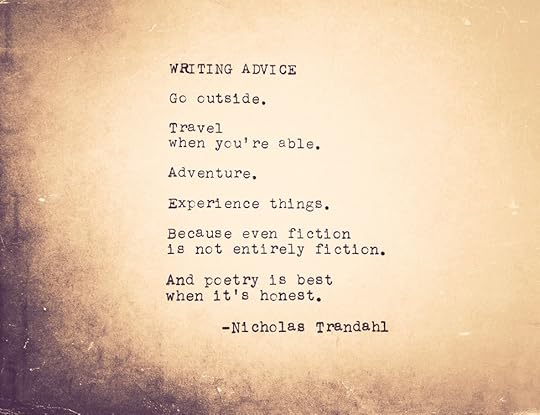
Go outside. Travel when you’re able. Adventure. Experience things. Because even fiction is not entirely fiction. And poetry is best when it’s honest.
And now you may be saying to yourself that inspiration doesn’t entirely cut it. Well, you’re right. You might have loads of ideas: barely-started stories or errant lines of poetry that mark notes on your desk like half-remembered dreams. You’re overflowing with ideas; that’s not the issue. The issue is completing your idea, seeing it come to fruition in publication.
There’s no easy answer to this, no poetic answer. Despite what non-writers may think, writing is indeed actual work. A story, a poem, a novel, or a collection of poems will not write itself, no matter how marvelous you think your ideas are nor how outstanding and poetic your experiences may be.
Writing is hard. It takes a commitment. People that have spoken with me about their multitude of ideas but their lack of finished work lament their predicament. And so do I.
It’s a problem we all suffer from. But there’s hope; it can be controlled. It takes a single-minded devotion to your work that borders on obsessiveness. Finish it! Work on nothing else when it comes to your writing. Pound away on those keys until the final word is reached. Write every day. Set aside writing time, early in the morning or in the evening when things are quietest.
Remember, your story and its characters depend entirely on you. They came to your mind, and are counting on you to reveal them to the world. Without you telling their story, it will never be told. Think about how tragic that would be. Without you to write it out, your story, poem, or novel is no more than a quickly-forgotten dream. There’s so much responsibility in being a writer. It’s no wonder we’re all a little crazy.
As you’re writing your current piece and ideas for a new story come to you, don’t fret! But also, don’t ignore it. That idea may not be coming back if you ignore it. Don’t, under any circumstances, ignore your inspiration and imagination. But how do you do this without neglecting your important work-in-progress?
Don’t worry. It’s easy, as easy as jotting down a note. Write some brief sentences about your idea that came from out of the blue. Take notes until you think it’s all written down. Then put the note away and get back to work on whatever it was that you’re devoting your writing time to. The idea won’t be forgotten as you complete your work-in-progress. In fact, in the time it takes for the current work to be completed, your idea may bloom into something even better, or you may even realize when you look again at your note that it wasn’t really that good of an idea anyway.
So, there’s my writing advice in a nutshell. Get inspired. Seek out inspiration in the honesty and simplicity of the beautiful world around you. Also, devote yourself to your single work-in-progress until the rough draft is finished. It’s counting on you, and only you, to bring it into being.
Hemingway himself said it best when he wrote in a letter to F. Scott Fitzgerald, “You just have to go on when it is worst and most helpless — there is only one thing to do with a novel and that is to go straight on through to the end of the damn thing.”

My Introduction
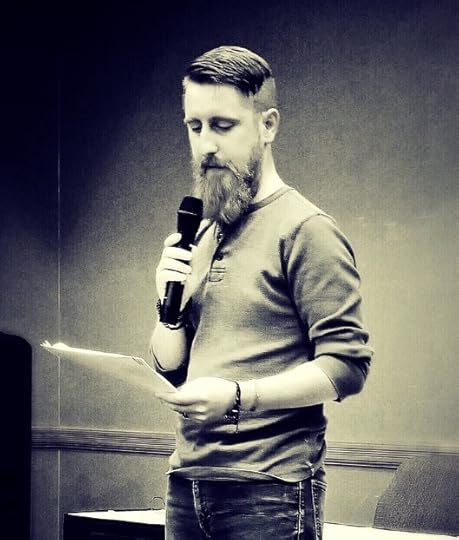
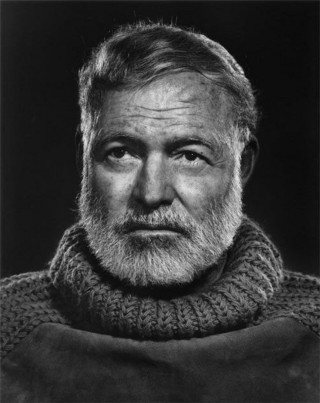
I suppose an introduction is in order. I’m Nicholas Trandahl, and I’m in my mid-thirties. I’m many things — a husband and father, the assistant publisher/editor of a newspaper, an Army veteran, a traveler, an outdoorsman, and a writer.
From my home in northeastern Wyoming, where the pine-cloaked rugged terrain of the Black Hills National Forest meets that rolling sagebrush-strewn prairie of the Thunder Basin National Grassland, I live a life that is both busy and quiet.
I thrive in stillness and quietude. I take note of it in my trusty writing journal. I produce best in stillness, as is common I suppose. Thus my poetry and other writings are reflective and earthy, suffused with simplicity and nature and memory.
I enjoy camping, hiking, fly fishing, and road trips. I’m a collector and user of pipe tobacco and tobacco pipes. A voracious writer and reader, my favorite writers are Ernest Hemingway, Raymond Carver, Jim Harrison, Ted Kooser, Connie Wanek, Henry David Thoreau, John Muir, Walt Whitman, Mary Oliver, Leo Tolstoy, and Gary Snyder. These are the writers that have most inspired me throughout the years and who I continue to read and re-read.
Well, that’s enough of an introduction. I look forward to writing about … well, writing.
Stay tuned.

May 24, 2018
The Last Time We Saw Strangers
[image error]With “The Last Time We Saw Strangers”, published by Clare Songbirds Publishing House, poet Christopher Hopkins has crafted a chapbook of great, sweeping imagery that blends with lyricism and poignancy. Each and every poem expresses definite thoughtfulness and sensitivity to the world around us and the flashes of the inner storm we carry within us.
This poetry is cerebral and precise, lines comprised of words that you, as a reader, know were carefully placed.[image error]
This is a small chapbook of 24 p...
March 21, 2018
Shedding Skin

I don’t find snakeskins anymore,
but I used to as a child-
shed here and there
by some shiny sleek friend
that had already made his way
to a warm and quiet place-
a place rife with primal orders.
Each time I found a snakeskin,
it was like finding a treasure.
Nowadays, I’m in the wild
more than ever,
but there are no snakeskins.
Where have all the snakes gone-
all the treasures?
Have all the wonderful beasts
fallen further into the green-
into the sylvan whorl
that we can only whispe...
March 20, 2018
My thoughts on Pulling Words by Nicholas Trandahl. One of the best Contemporary Poets around today. @PoetTrandahl

Genre: Poetry
Publisher: Winter Goose Publishing
Release Date: April Twenty-Sixth 2017
Average Rating: 5/5 
September 2, 2017
Saturday’s Poem. This isn’t a Poem.
https://pixabay.com/en/smoking-lighter-dark-cigarette-918884/

Things are just quietly existing
like the stars in the night sky
and the leaves in the trees-
always aloof of plots.
There’s my typewriter-
quiet and heavy on my desk.
There’s a tumbler-
empty but for the lemon slices
that rest in the bottom
in a shallow slick of fluid.
There’s the smell of trout
sautéed in my favorite pan-
lemon pepper and sea salt to season.
There’s the taste of a cigar
still acrid on my t...
July 24, 2017



July 9, 2017
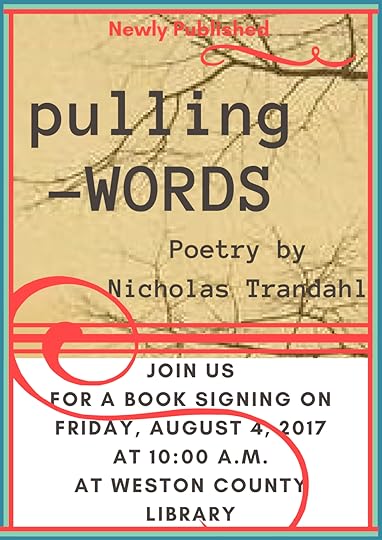
Book Review of Pulling Words by Nicholas Trandahl
An amazing review of my new poetry collection by the poet Christina Strigas!

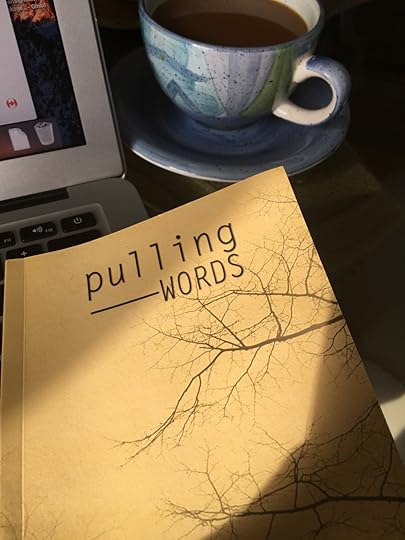
Nicholas Trandahl is one of my favorite contemporary poetic voices. I have read his poetry books before and every time I am amazed at the simple brilliance. His approach is methodical, reflective, environmental and brutally honest. Trandahl’s new poetry book published by Winter Goose Publishing is his best yet....