Cecily Anne Paterson's Blog, page 2
January 24, 2015
Why seagulls are finally in fashion

For a while I've been noticing young girls walking around with half blond and half brown hair. "Messy," I've thought to myself. "Why can't they just recolour like everyone else instead of growing out their roots - and so far!?"
It was then that my 15 year old pointed out to me that this type of hair colour is a Thing. With a Name. The gradual change from one colour to another is called an Ombre.
(It is very useful to have a 15 year old. Without her I would not be aware of the word 'drack' meaning 'rubbish'. Or the acronym 'bae', as in, 'you are my bae', or 'before anyone else'. She can also tell me if clothes match because apparently I am totally unaware of what t-shirt goes with what pants these days. In fact, I have to ask her if something is in fashion because I just can't pick it anymore. I am relieved that because of my child spacing techniques (11 years between daughters) I am going to be in fashion for at least another 10 years or so, soon to be getting my tips from the now four year old. After she leaves home, it's going to be anyone's guess what I end up wearing.)
But back to the Ombres. It turns out that all these girls who I thought didn't care less about their scrappy hair had actually paid vast sums of money to have it dyed gradually from one shade of dark blonde to another shade of dark blonde. There's art involved in this, apparently.
I spent last week at the beach on holidays, enjoying the surf and the sand and pretty much only bothering to think about myself. It was great, especially because my husband did each and every load of washing (thank you sweetie!). We also got to go on walks together in the cool of the evening, our favourite time of day, which was when I noticed how incredibly fashionable seagulls have suddenly become.
I've always liked the subtle greys of seagull feathers but I was struck by the amazing gradation of white to dark grey as the feathers go from head to wing. These birds have a serious, gorgeous Ombre 'do' going on. It's nearly as good as the ombre going on in the sky at sunset. Truly beautiful. And all done by the master hair colourist himself. I felt very thankful.


January 5, 2015
My pain isn't in my head. It's in my subconscious.
The very first book I bought for my Christmas Kindle was The Divided Mind by Dr John Sarno. I've been reading it over the last week and, once again, Dr Sarno is going to change my life.

If you've been reading here for a while, you may know that I have suffered quite a lot from shoulder and neck pain associated with my writing and computer work. It's pain that's been around for a while, despite the fact that I have just about the most ergonomically friendly office setup you can get (weird mouse, dropped keyboard, large computer screen, good chair, blah blah blah).
You may also know that just after my first baby was born, nearly sixteen years ago, I suffered from another pain. It was a chronic RSI pain which went from my finger joints all the way to my elbows. It lasted for an entire year. (I wrote about it here.)
After exhausting myself with physio, doctors, specialists and even an Alexander Technique practitioner who lay me on a table, dabbed my ears with lavender oil and made me relax so much I was practically a jellyfish, I was no closer to finding a reason or a cure for my pain. It was going to have to be something I'd have to learn to manage, apparently.
It's just I don't like 'managing'.
I like fixes and magic bullets. That sort of thing.
Incredibly, I did actually find my magic bullet. And the gun that shot it was nothing more than a book. This one was the 'Mindbody Connection' by Dr John Sarno. Looking back, I can't believe that I actually ummed and aaahed about whether I'd spend the $30 on it. I was so glad I did.
Sarno's theory, backed up by a vast number of success stories over 30 years, not only in his practice, but in the practices of several other doctors who use his protocols, is this.
First, your pain is real.
Second, your brain is causing it.
With me so far? Many of us run away when we hear the words 'psychosomatic' and 'illness' put together. We think that the doctor means we are making it up. This is so far from the truth, I can't say it enough. The pain is real. It's where it comes from and what's causing it that is the psychosomatic bit.
Sarno argues that we all have a 'reservoir of rage' bubbling away in our unconscious. (Obviously, because it's in our unconscious, it's not something we're necessarily aware of. But make no mistake, 'nice' people are angry too.) The problem comes when the reservoir gets overfilled and the rage starts to bubble up to the surface. At this point, the brain steps in and says, "Hey, that's not going to be so great. I need to protect my person from feeling that bad. I'm going to turn it into pain instead."
In other words, the unconscious rage is diverted to become a chronic pain of some kind. Dr Sarno called it Tension Myositis Syndrome or TMS.
Really? you say. How can my emotions that I'm not even aware of have such an effect on my physical body? Well, it happens when you blush because you're embarrassed. Or when you get sweaty hands or a stomach ache or butterflies because you're nervous. Is it such a stretch to think that in one, united, complex system of mind-body, one part might affect the other? (By the way, the pain is caused simply by the brain witholding oxygen from the muscle. It's not harmful in the long run, which is good to know.)
Anyway, getting back to magic bullets and my chronic arm pain problem. I had literally nothing to lose except perhaps half an hour a day for six weeks or a month, which I spent journalling and thinking (according to Sarno's instructions) about what might be contributing to my unconscious rage. That's it. Nothing else. No treatments. No psychotherapy. Just simply thinking and acknowledging that I have unconscious rage for a bit of time every day.
Did I get better? Yes.
Really? Yes, really. I was fully functional within a month. My chronic pain problem was history.
Did the pain ever come back? It pops back a couple times of a year in one particular section of my right arm, as a signal that I am upset - usually about a particular topic. Once I deal with it, it goes away again.
Anyway, once I was better, I figured that all that part of my life was over with. I had acknowledged my unconscious rage, written and thought about it. For a while I talked a lot about it and lent out my book to people I thought might be interested but mostly people weren't interested because, really, who wants to be told that your pain is psychosomatic? I gave thanks for my own healing and let other people deal with their own stuff.
Five or six years later, I used the technique again for getting rid of a pain flare up in another area of my body. It wasn't nearly as bad, and it cleared up pretty quickly. And then I lent the book out once more and never got it back. Out of sight, out of mind.
Turns out I'm a bit of a slow learner though. Over the last six years, I've had, on and off, pretty bad pain in my shoulders and neck. Because it wasn't in the same spot as the original chronic disaster, though, and because it seemed so connected to my computer work, I figured it had an actual, physical cause. And because it didn't bother me all the time, I did 'manage' my life around it.
After a massive, out of the blue pain flare up just after Christmas just gone, however (and this was after being pain free for a long time), for some random reason I suddenly thought of Sarno and TMS again. And because someone I will not name still has my first book, I decided to make use of the seasonal $2.38 special price on the Kindle version of one of Sarno's new books, The Divided Mind.
This time I learned a few more things about brains and rage and unconscious pain diversion. First, most of my symptoms, current and into the future, are going to be TMS-related. I'm a typical candidate for TMS, being a perfectionistic, 'goodist' high achiever with unreachable standards. I tend to both suppress and repress angry feelings. Although my childhood was great, it was also pretty hard at times and unresolved child-rages can disappear into the reservoir too. I also have quite a few high pressure circumstances I have to live with (my son's autism counts, as does the fussy eating/difficult food situation in our family), all of which help fill up that rage reservoir. And as long as that happens, my brain is going to keep trying to protect me from feeling bad, especially if I'm not aware of what's going on, or I've forgotten how it works.
Second, my brain is sneaky and will move the symptoms around. It knows that I know about my arms so it's going to move things to my feet or my legs or wherever. I'm going to have to keep on top of this stuff forever.
Third, TMS doesn't just show up as pain. Sarno says that things like headaches, fibromyalgia, excema, allergies and gastrointestinal symptoms can be part of it. Also, depression and anxiety, both of which can serve as distractions from feeling the rage. (In fact, the list of possible symptoms is too long to reproduce. And he's not just theorizing. He has seen people with all of these issues cured. If you have a chronic, unexplained symptom that you just have to 'manage', it would be worth looking here to see if TMS is responsible.)
For myself, looking back, I can see so many unexplained symptoms that could definitely be related to TMS: losing my voice for three months ten years ago and having tight vocal cords ever since, various outbreaks of excema and nose allergies, various days spent flat on my back in bed with fatigue and, of course, So. Much. Pain. (By the way, I am pretty sure that my post-Christmas pain flare up and the excema that came with it are pretty much directly related to a particular circumstance that I've found hard to deal with recently. Additional rage into the bubbling cauldron, if you like.)
So I'm back to journalling and being entirely honest in acknowledging my various levels of rage and anger, even though of course, I'd rather not admit to them at all. Fifteen years ago it took a month to get rid of my chronic arm pain. This time it took ten minutes, and, ironically, it went while I was working on my computer.
"My brain is tricking me," I told myself. "There's nothing wrong with my shoulder at all." And that was that.
The excema is taking longer to shift, but I'm really working on the thoughts around it. I'm hoping a month might move it. And then I'm going to focus on getting my voice working properly after years of mild, annoying discomfort.
So, Dr John Sarno, you are a life-changer once again. I can't believe I forgot about TMS and how it works and let myself suffer through all that extra pain, but whatever. I'm not going to forget again. And I'm extremely grateful.
Note: *You may find this blog post controversial and confronting. Please know that I haven't set out to rub anyone else's pain in their face or to tell anyone what to do. I am simply writing what has worked for me. If it helps you, fantastic. If it doesn't, please don't come back at me about it until you've read one of Sarno's books and tried his protocol for three months yourself. I recommend the Mindbody Connection or this site.*
January 1, 2015
Book reviews 2015: 'The 100 Year Old Man Who Climbed Out of the Window and Disappeared' and 'The Fat Years'

I read two very different but very similar books over the Christmas and New Year period, quite without knowing it. I pick books up randomly from the library truck shelves and make my selections mostly based on their covers. Both of these looked interesting for different reasons, and because I wanted something lighthearted I thought I'd begin with the lengthily-titled 'The 100 Year Old Man Who Climbed Out of the Window and Disappeared.'
The story follows a 100 year old man, Allan Karlson, who decided to make himself scarce from his nursing home (he didn't like the director much) just hours before his big birthday party. He shuffles to the nearest bus station, randomly steals a suitcase from a tough looking youth who is in the loo and heads off on a 'lets see what happens' adventure.
Quite a lot happens, including the old man being partially responsible for two deaths, both of which verge on murder, if not manslaughter. The suitcase has $50 million in cash and along the way our hero teams up with a small time crook, a perpetual student/hotdog vendor and a woman who owns an elephant. Yep, you read it right. An elephant. Of course, the police are looking for Karlson, as are the big time crooks who own the $50 mill and the race is on to see who can find him first.
At the same time, we are given a running narrative of our centenarian's life, who turns out to have played a large if inadvertent part in most of the politics and world events of the last 70 or so years. Turns out he was the one who figured out how to get the atom bomb to work properly. Also, he had dinner with Mao. Oh, and President Truman, the guy who won the Spanish civil war and the first leader of North Korea. He was a spy and a political prisoner in the gulags, he learned Spanish, Chinese, Russian and Indonesian and he crossed the Himalayas by camel. He was also chemically castrated and blew up his own house. Twice. And, most notably, he did all of this and achieved detente in the Cold War without having any interest in politics. The only thing he really cared about was getting his next square meal and a drink. Of vodka, preferably.
At first I liked this book a lot. It's quirky and the language and construction is amusing and lightly done. The plot was intriguing too. Would they find him? Who would get the money? Why was he doing any of this at all?
And then I started to get annoyed with it. By the time I'd reached the two thirds mark I was only continuing so that I knew what happened, but it wasn't a satisfying read.
Basically, I didn't like Allan. Sure, it's amusing that a guy who has no interest in the greater good ends up working for it. It's ironic that a person who firmly declines to talk about any political stance whatsoever should end up affecting global politics in such world-changing ways. If it happens once, that's interesting. Twice, amusing. Six or seven or eight or nine times? Pfft. Whatever.
In a way, Allan Karlson is this decade's Forrest Gump, the innocent bystander who has a bigger part to play in world affairs than anyone could ever possibly imagine. The difference is that I liked Forrest. At least he had an ideal to strive for - his love for Jenny. At least he was trying to do the right thing.
Karlson, on the other hand, is a two dimensional character. He doesn't love anyone, he hardly mourns the multiple friends who get blown up in front of him and he is as calm as a sociopath in the multitude of near-death situations he finds himself in. As long as he gets his dinner and his vodka, he's good. But to me, that's shallow. I don't believe him as a character, and I don't want to believe in him as an 'everyman' for our generation. Sure, he has good points. He's adventurous and unconcerned and smart, but for me his negatives vastly outweigh the positives. I find Allan Karlson trivial, uncaring and materialistic.
It's hard to say what Jonas Jonasson was really writing in this book. An amusing story? Definitely. But on a deeper level he is criticising people who take politics and religion - or any type of world view - seriously. The one guy who doesn't care ends up changing the world.
It's a middle finger up to all the politicians of the world. "See? You think you're so smart. But Allan Karlson beat you at your own game."
But I think we need to care. Because if we don't, our ending is like Allan Karlson's ending, where he and his friends take money that never belonged to them, at the expense of two lives nobody at all seems to care about (they're bad guys, you see... they deserved it), and by concocting a vast web of lies to get out of any legal trouble they end up. All this so they can go and lie on a beach in Bali with their elephant for the rest of their lives. Even the policeman ends up looking the other way - because he's been promised a cut of the cash.
In the end, Allan Karlson, the 100 year old everyman of our recent history is amoral. Funny, yes. Quirky, definitely. Clever and entertaining, certainly. But amoral nonetheless.

And that brings me to 'The Fat Years', written in 2009 by Chan Koonchung. This is apparently an incredibly controversial book amongst Chinese speakers. In fact, it was banned in China (and probably still is) because of its critique of the Communist Party and the Chinese government. Again, it's a really well written novel (although I read the translation by Michael Duke) with the same amount of tension and mystery (and humour, I have to say) as The 100 Year Old Man.
This time, the story is set in the near future and follows a Taiwanese writer, Old Chen, who lives in Beijing, who, when the story opens, is so happy to be living in China's Age of Ascendency, which, according to popular belief, began the same day of the 2009 Global Financial Crisis. Old Chen nearly has tears in his eyes as he thinks about how great life is and how happy he is. So he can't understand it when he meets some old friends of his, Little Xi and Fang Caodi, both of whom don't seem to 'get' that they are lucky enough to live in China, the great leader of the world.
Why are they unhappy? And how come a whole month - and not a very happy month - has disappeared from the collective memory of China's population? In fact, how come no one ever talks about the bad things of Chinese recent history any more? Everyone is richer and living the 'fat' life, but everyone's just a little bit less 'free'.
Chen and his friends end up kidnapping a Chinese government secretary and asking him what's going on. His political discourse is extensive and astounding, but even more extraordinary is the fact that the Chen and Little Xi find out why everyone has been so extraordinarily happy. It's been the drinking water. Literally. The Chinese government, for the sake of stability and general well-being, decided to put very small quantities of the drug Ecstasy in the water supplies. It's a win-win situation. The populace feels happy and content and the government doesn't have to deal with any disturbances.
In contrast with the 100 Year Old Man, here we have three ordinary people who do have an interest in politics and in bettering their society, but who have absolutely no power or influence whatsoever. Not only do they not have power or influence, they also have very limited information and restrictions on what they can say and what they can't. And it's tragic.
The Chinese government in this novel is amoral as well - and the result is apparent contentment but an underlying lack of agency and freedom. Which would you rather have, the novel argues: a fake paradise or a good hell? China in The Fat Years is the fake paradise, but I'm not so sure that Allan Karlson and his friends and their elephant didn't end up in one as well.
December 30, 2014
And here comes 2015

Seriously? I still think its the 1990s. This life is whisking by just a little too quickly for me. But seeing as we're on the dawn of 2015 and everyone's doing the dreaded NYE Resolutions, let me add mine to the mix.
Here it is: _______________________________ .
That's right. I have no resolutions. No big things to change. No 'I'm going to be a better person' thoughts. I just want to keep going with the way I'm living.
Telling the truth.
Learning to love people.
Honouring God.
No specifics have jumped into my head apart from those. I suppose, if you pressed me, my resolution would be to just keep going.
HOWEVER, I have a few big dreams for 2015. I'm not sure dreams are the same thing as resolutions, to be honest. These are things I'd like to achieve (and if you know anything about me at all, you know that achievement is close to my heart.
When my husband asked me what my dreams were just now, I said these two things.
Write two books.
Get to the end of 3rd grade on the cello.
"Sounds good," he said, and then I had to come clean.
"Actually, my dreams are much bigger than that. I just gave you the small version because I don't want to look silly if I can't achieve them. In reality, it's three books and the fourth grade in cello. But I'm embarrassed to say it."
What about you? Got any resolutions, or any dreams for 2015? Big or small, I'd love to hear them.
December 6, 2014
Take an author out for coffee

Who would you pick to take out for coffee if you could choose any writer you wanted?
I think Alexander McCall Smith, author of the No. 1 Ladies Detective Agency would be entertaining, erudite and good for a high-brow chuckle. I'm guessing he's an Earl Grey Tea man. And maybe a piece of lemon meringue pie. With icecream.
High on my list as well would be Cathy Cassidy, loved by tween and young teen girls everywhere. She'd drink a decaf cappucino, we'd share a slice of mud cake and I'd ask her questions about how she got her audience. (I want them, you see...)
While I'd like to drink chai with Lee Child, author of high-octane thriller novels featuring ex-military loner Jack Reacher, I think our conversation would be short and unsatisfying. Everything's fast paced with him. He'd be in and out of the cafe, chiding the wait staff and looking at his watch.
Of course, I'd never say no to drinking coffee with Anna Funder, Malala Yousefsi or David Rock. Actually, I'd probably never say no to heading to a cafe with any living author. (Dead ones, not so much... but only because of the maggot factor.)
Imagine taking your favourite author out for coffee and telling them, "I love your books and I support you." They'd get a kick out of it.
Just as good, though, is buying your favourite author's book. Most e-books are less than the price of a cup of coffee. Most print books are the same as the bill for tea and cake for two people at a classy cafe. And a book may even provide you with a better conversation with the author than you could have in a noisy cafe with traffic noise outside.
Want to support your favourite author? Purchase their book and then write them a letter thanking them for a great virtual morning out.
December 4, 2014
The longest post you'll ever read about being a patient parent
[I wrote this a while ago, back when I was considering writing a book about parenting. Ha ha. What a total joke. I have fallen on my face more times than I can count since then and I can't quite imagine pitching it to a publisher.
"So, what's your expertise in writing this book?"
"Um, well, I've failed a lot. I'm pretty hot stuff at telling people what not to do..."
Yeah.
Anyway, the good thing that came out of the whole disastrous book-thinking-about episode was that I really actually thought a lot about patience... and came up with this. Which you will definitely need patience to read. It is long. But thorough, and fairly complete.]
How, as a parent, to get patience
It's a rule of childhood that at some stage you'll come across an impatient teacher. We've all had them. We probably remember them very clearly. (Ahem. Mrs Mirza.) At one point or another we were on the receiving end of an outburst. We remember how we used to tiptoe around in fear, trying not to trigger the anger – or perhaps we took the opposite approach and deliberately tried to press their buttons and watch the explosions occur.
Think back to an experience you've had with an adult who was impatient with you. It's unlikely that with hindsight you would be saying, "yes, I was at fault there. I deserved to be yelled at." It is more likely that you would say, "I was scared of that person and they were unfair to me. I felt hurt, afraid and misunderstood. I didn't like them then and I wouldn't like them now."
The response children give to an impatient teacher or adult is a mixture of fear, distrust resentment or detached amusement. It's not respect, appreciation or love.
It's interesting that patience is the first thing that is mentioned in the Bible's definition of love. I struggle with it. I'm not good at it. And I know I'm not alone. In every playgroup I've ever attended, every week someone has talked about patience.
"If I have more patience I know I will be a better parent," I have said myself. "I just need more of it." Everyone has nodded knowingly with slightly bitter giggles.
"We know," they say. "Us too," and then somebody begins a story about how the car broke down and the baby vomited and then the two-year-old spilled dirt all over the floor and they completely lost it and screamed at everybody for half an hour and looking around you can see that everyone else has their own version of the same story and we all know exactly what the other people are talking about.
What is patience really? And how do you get it?
A friend of mine defined patience as 'waiting without complaining' and while to some extent she is right, to me it sounds passive and negative. I want a positive, enjoyable experience of patience. I want to be able to look forward to being patient rather than approaching it with dread or discomfort.
What is patience? It's more than just tolerating, it's more than waiting without complaining and it is more than just trying harder to be nicer.
I think patience is when you are fully present for the time that something takes, when you are able to wait joyfully without even a seed of resentment, when you can expand and blossom so that you can give what needs to be given, when you can put your own desires to one side knowing that it is just for a time, and when you are able to give a genuine smile and an answer without anger to the three-year-old who has asked you "why?" for the fifth time. Patience is having the grace to let other people learn what you already know. It's appreciating something that's different from what you wanted. It's seeing yourself as one part of a bigger situation and holding a bigger perspective in your mind.
How do you get it? I used to pray for it fervently. "Oh God, please give me patience, please! I really really really need it. Right now." (Ha! Irony!)
Sometimes it seemed to work. I would approach the day in a good mood, full of smiles and a determination to be patient and kind but by about the second or third hour of trying to be perfect I would find it all falling down again. I would put the TV on for the children (something good mothers are not supposed to do), make myself a cup of tea and sit on the couch feeling like a failure. I wouldn't pray again for patience for another couple of weeks because I was so disillusioned.
I think I expected patience to be poured into me supernaturally and overnight. When it didn't happen I got cranky with myself and with God, who obviously wasn't fulfilling his part of the bargain.
But I forgot that patience is called a fruit of the spirit. Perhaps always buying my fruit from the supermarket, shiny and glossy and all piled up neatly has allowed me to ignore the fact that fruit has to grow. It takes time. And it only grows well on a healthy tree.

It struck me one day while I was sulking on the couch, that perhaps I was attempting to manufacture the fruit instead of preparing the conditions for it to grow naturally. I was focusing on the fruit itself rather than looking more closely at the life in which it was growing.
I think it's fair to say that most parents get impatient around the same things. Getting my four children up, fed and dressed neatly, with bags packed, notes signed and library books in their hands to send them off to school is a pretty stressful part of the day and I have yelled at them more times that I would like to admit. But love is patient and I don't want it to be that way so I need to look at what is actually going on.
There are lots of aspects to daily life. Most obvious are the circumstances themselves. These are what we tend to focus on. When my son loses his shoes and I yell at him it's easy to blame my outburst on his carelessness. But lost shoes are simply lost shoes. It's quite likely that they are in the house somewhere and can be found pretty easily within three minutes. The truth is that the circumstances are not usually the cause of the impatience. It's much more important to look at my thoughts about the lost shoes. These might be:
"I worked so hard to keep this house tidy and he is not doing his part. I feel angry and unappreciated."
“We are going to be late because of this. I will be embarrassed if we are late and my day will be ruined."
"I need to get lots of stuff done today and this is wasting my time. I feel anxious and inconvenienced."
"Why does this always happen to me? I bet Kylie down the street never has this problem with her children. I feel like a failure as a parent. Poor me. I can't cope."
“My head feels terrible because I hardly slept last night. Why can't anyone show me some sympathy?"
“I am really angry with my sister for being mean to me on the phone yesterday. Everyone had better get out of my way."
“These shoes were really expensive. I don't know how I am going to be able to replace them if they are lost."
Of course most of these thoughts flash through our heads so quickly that we are not even aware that they’re there. It takes time, a deliberate effort and practice to be able to identify what we are really thinking when we get impatient. But this is part of preparing the tree for the fruit to grow.
Change the thinking
To be more patient, we need to examine what really goes on in our heads and in our hearts. We need to know what we are actually thinking and feeling and then we need to examine those thoughts and feelings.
For example, if I am worried about being late, I need to take some time to think about why that is such a problem for me. Maybe I feel embarrassed when I'm late because I think people will look down on me for not being organised or I will get a reputation for being slack.
After that I can ask myself if these things are true? Am I really not organised? And am I really that concerned about what other people think of me? And what does God think about all of this? Is organisation one of the supreme virtues in the end? And what about the fact that I think my day will be ruined if we are late? Is that really true? Sure, I might feel bad for about 20 minutes, but that is only a small part of the day. If I am really truthful I will be able to say that being late one time is not the end of the world and I am pretty shortsighted if I let it ruin a whole day.
Patience grows as we tell the truth and as we really examine our thoughts and feelings.
But don't be fooled. This may be a harder exercise than we think. It can be confronting to challenge ourselves to be honest. It may be painful and raw. But I have never seen growth in patience without pain, and this is the kind of pain which, like surgery, has a useful and a healing purpose.

Change the pace
I needed to do more work on examining the place where this fruit of patience was supposed to be growing and so I decided to look in detail at the times and places where I needed it. I wrote down this sentence, filled in the blanks and was surprised by what I found.
I find it hard to be patient when.....
I'm rushingI have expectations of other people that they don't shareI am focused on the things I 'need to do' or I'm trying to do too muchI have a lot in my head at onceI forget about the real goal purpose of my lifeI have not slept or eaten properlyI am not rested sufficientlyI am angry and have not told the truth about my feelingsI am worriedWhen I looked at this list closely it became really clear that in order to get more patience, I needed to slow down. I'm talking about slowing down both physically and emotionally, and it made me scared.
I'm the sort of person who has always done four things at once while at the same time thinking about the fifth and sixth things to do as soon as I have finished. I like achievement. I like efficiency. I like competence. I like not wasting time. I finish people’s sentences for them. I get impatient when I have to wait… for anything. I don't relax and I find it really hard to go on holiday.
Slow down? The idea terrified me. Rushing through life makes me feel important. Having lots of things to do gives me a sense of purpose. Being busy is a badge I wear to show off to others. See how much I can do? See how clever I am?
I found myself facing what felt like a terrible dilemma: Was I willing to give up my sense of importance, purpose and status in order to gain patience? Previously when I had prayed for patience I hadn’t realised that so much in my own life would have to change. Now I was facing being stripped of the false walls of pride that I had built up over many years and it hurt to let it all go.
Slowing down is essential to growing patience. Most of us today live with no margins in our lives and no spaces for rest. We have high levels of stress. We get a buzz from achievement and we feel alive when we are surrounded by activity.
But I'm sorry to say, this pace doesn't work with children. Children haven't learnt to rush or hurry. They come out of the womb unaware of time, but very aware of life. They care less about achievement than about discovery and less about deadlines than about cuddles and sunshine. If we want to be patient with our children we need to slow down the pace.
Getting rid of clutter
It's a fact that my brain can only really hold three or four things it at one time. If I'm cooking dinner while at the same time making cupcakes for a child's birthday the next day as well as checking Facebook (yes, it's true – I often burn things for this reason) I will snap at my husband when he comes in and wants my opinion about which car he should take to tennis later that night.
The more things in my brain and the more interruptions I get, the more impatient I am.
When you have children you can guarantee that there will be about 50 million more distractions in your day than before you had them. And when you have more children the interruptions grow exponentially! Your brain will be busy. So you need to get rid of unimportant stuff in your life.
Prioritise. Declutter. Whatever. Just make more space in your life to process the important things. You might find this means you go through your house and physically remove objects which are taking up space or energy or emotion. Or you might need to de-clutter some emotional stuff from your past.
There are many things which take space in our brain but which are really not important. Making space allows patience to flourish.
Planning better
This is really about taking a pre-emptive approach to patience. If you are losing it because the house is chaos, it may be more appropriate to think about fixing the chaos rather than trying to get more patience.
I am generally a good planner (it kind of goes with the efficiency thing) so this area of growing patience has never been difficult for me, but I know that planning is not everyone’s strength. The simple fact is, however, that if you have a place to leave the shoes every night, it is less likely that they will be lost in the morning. If you write a list of jobs that every child needs to do, it is more likely they will be done before everyone gets in the car. If you plan to allow five extra minutes before you need to load everyone in, your stress levels will be lower and you will probably not be late, and you will probably not get impatient and lose it and yell at everyone.
(Someone once told us that we needed to allow five extra minutes per child to get ready to go out. It was some of the most valuable advice I ever received. I know how long it takes me to get ready so I simply add 20 extra minutes if I'm taking everyone with me! Of course, this may not be right for your family. You will need to think things through according to your own strengths and weaknesses.)
A good plan starts with evaluation. What are the problems your family faces every day? Write them down and look at them for a few days. Are there some simple things you can do immediately to iron out some of the challenges? If the whole idea overwhelms you, it might be a good idea to ask for help either from a trusted friend or a professional.
Scaffolding more
Sometimes we get impatient because our children can't or won't do what we expect of them. It's easy to assume immediately that the child is lazy, naughty or defiant. It takes a little bit more thinking to work out if there really is something else going on.
I once saw a book with a list of household chores according to a child's age. At age 6, the ideal child should have been able to make his bed and tidy his room without help, set the table and wash up, scrub walls and even clean toilets. He should have been able to organise his things, pack his lunch and drive himself to school. (No sorry, I'm kidding. But only about the driving to school part.)
Some six-year-olds, certainly, are able to do many of those jobs. But not all. Children are different. And while it is a good thing to have high expectations of your children – after all, they do rise to expectations – it is also wise to be aware that sometimes they simply are not capable of doing all that you want them to do.
This is where scaffolding comes in. Where we build a house, we use scaffolding to support the brickwork as the structure gets higher. We don't expect the scaffolding to be there once the job is done. It is only support.
In the same way we parents can support our children doing their tasks and learning competence by ‘scaffolding’ them. It can be by doing the job with them at first, then by breaking the task down for them and then by simply giving small reminders to stay on task later on as they develop competence.
Being clear about your feelings and wants
Part of being patient is being able to put your own needs on the sideline for a while while you attend to the needs of someone else. However it is not unreasonable or impatient for you to say clearly and calmly what it is that you want.
My most stressful time of day is the period that is known as "the witching hour”. You might know it as the manic panic or cyanide hour. It's that period when everyone is hungry and needy and there is homework to be done and dinner to be cooked and more often than not a toddler to be placated. I cannot do it without screaming at people unless I set some boundaries.
"Please don't talk to me right now, I need to concentrate on not burning your food."
"I need the table set in 5 minutes, otherwise we will not be eating."
"Please ask me that later when I have time to answer you properly."
Finding other ways to get what you need
I get impatient when I want something but for some reason other things are getting in the way and I can't get what I want. I notice this most when I have a really good book to read. I am the kind of person who likes to dive into a book headfirst and not come out until the last page is turned.
This works well if I have 24 of 48 hours to myself. The problem is that I have not had 24 to 48 hours to myself for a good 15 years or so. Almost every time I have enjoyed a good book in the last decade I have been frustrated and impatient because somebody (usually somebody small) has come along needing something that only I can give them.
I have had to practice thinking to myself, "it's okay. I can get a two-hour uninterrupted stretch tonight after 8.30. Then I can enjoy the book."
Sometimes if things are really rough, I think to myself, "it's okay. In about 10 years I really will have the time to put into reading. Right now it's a bit difficult, that's true, but there will be time in the future."
Emotional needs that don't get net can also be a trigger for impatience. One night our 12 year old daughter was sitting up with us, waiting for her bedtime.
"Is this, like, what you do at night?" she said. "Don't you do anything interesting?"
My feelings were hurt immediately and I wanted to snap at her. Doesn't she realise that I’ve spent the day doing her washing, cleaning and cooking? I thought. Does she think I really enjoy spending my energy taking her to the dentist? Can't she understand that, having met everyone else's needs all day long, I might just need to sit on the couch and "do nothing"? Doesn't she understand the sacrifices that I have made for her?
In the cold light of day, of course I know that the answer is no to all of the questions I asked myself. She doesn't know, and she can't possibly understand until she is either 25 years old or a mother herself.
Our children can never meet our emotional needs. Yes, it's nice when they make us feel good, but that is not what parenting is about. We need to find other ways to get our needs for appreciation of validation or importance met.
So, where can I get my need for appreciation met? I am finding that in the end, only God is able to meet my needs. He reminds me of his love and compassion and respect and enjoyment for me in the Bible.
When I ask the question, "what do I need?" I have not had an instance yet in which I find that God can't meet the need.
Being present
When my thoughts are scurrying around my head and I'm writing my mental to do list at the same time as doing the dishes and answering questions and packing lunches I seem to lose it a lot more often.
When I take a deep breath and feel my physical self being present in the room it is a lot easier to keep patience.
This is what people talk about when they say they need to 'live in the moment'. It is something that you need to practice, preferably when you are not in the middle of your busiest patch. Practising deep, calm breathing, being still and relaxing your brain will help you train your body to be more present more often. And patience will grow.

Gratitude
Impatience flourishes when we focus on what we don't have. We think I want to go faster, I don't want to deal with this, I just want to get there.
But patience flourishes when we are grateful for what we do have. It may sound cheesy and Pollyanna-esque, but verbalising the tiny, beautiful details of everything you do have right here, right now helps you see that things are actually better than you think.
I have walked a lot of children to school in my time and I wish that instead of yelling, "walk quicker! We are going to be late!" I had said quietly to myself, "I am so thankful that my children have legs and feet that work. And shoes that they can wear so they can walk. I am thankful for the sunshine today. I am thankful for the hours ahead in my day. "
I don't normally do very well on holidays. I find myself getting almost grumpier than I do at home. The best holiday I have ever had was the one where I decided to practice thankfulness. Every day I took a walk along the path next to the beach and under my breath I spoke about the beautiful things I was thankful for. Things like the colour blue, the angle of grass bending under the wind, the arrogant hopping of seagulls waiting for a fish, the miniscule grainy particles of sand, cloud shapes, grandparents helping children on scooters, the quiet zoom of skateboards and bikes on concrete, the warmth of sun on skin. I came home from each walk feeling elated and rich.
Since that time I have found that practising gratitude and speaking words of thankfulness every day helps me to slow down and really live in the moment. It actually makes me happier.
And a slow, happy life is always going to be more patient than a fast paced, discontented existence that is always wanting more.
December 1, 2014
A ship in a harbour is safe...
When I was a child our family lived overseas and in houses that belonged to other people so we didn't go in for interior decorating in a big way. One particular picture, however, was a constant. It was a poster with a quotation on it, done in nifty seventies' yellow tones, and it said this:
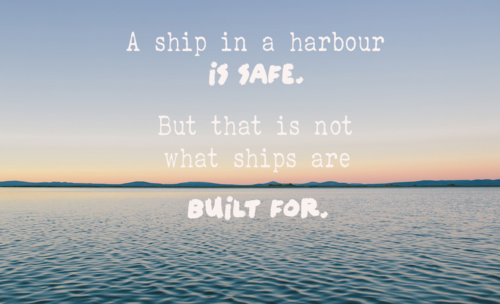
"A ship in a harbour is safe. But that is not what ships are built for."
Being a kid who read everything, all the time, I ran through the words on that poster a few times a day. "A ship in a harbour. Ship in a harbour. In a harbour. Safe. Safe. Safe."
It intrigued me. What did it mean? When I asked my Dad he told me it was about not just living life being comfortable and happy. It meant stretching, taking risks, going places that might not be easy.
Being children of the coast, both in our adopted homeland and also back in Australia, we knew about ships and boats. We holidayed on a beach. Our grandparents lived on waterfront and owned an outboard run around. We sailed.
I understood harbours too. The little rock-walled inlet down from our favourite beach was filled with boats of all shapes and sizes, safely inside, hidden from the storms and the swell. When we went down there, we'd look at them, compare features and dream about which one we'd have, if we could. Those boats were just waiting to go out, through the heads, past the markers, into the ocean.
But some of them waited forever.
Some boats were never used. Never boarded. Never started up. Never sailed. They bobbed, tied to their buoys, in still water for their entire lives. Barnacles attached to their undersides, slowly but surely. Paint peeled and flaked over time in the sun. Occasionally we'd go past the harbour and see a boat half full of water, sinking to a slow, watery disintegration.
"Not what ships are built for."
My parents showed us that life is for being stretched, for being challenged, for serving, not taking, for loving and forgiving even when it feels like it might not be safe. They showed us that you can always do a little more, even when you think you can't. You can always go a little further, even when your feet are sore. They showed us the value of staying the course, going through the storms and doing what we are built to do as children of God.
I loved that yellow poster on our wall. It comes from a quote published and possibly written by John A Shedd in 1928, by the way, (the origins are a little sketchy...) As a child it was meaningful and as an adult it has been life-shaping. (It is also the basis for my recent novel Invincible. When I was trying to plot out what might happen to Jazmine and her friends, I realised that she was going to have to step out of her safe place once again and take even more risks. The quote sprang immediately to mind, so I built the metaphor into the story line and hung the quotation on the wall of Jazmine's Grandma's house.)
Harbours are safe, but they are only meant for short periods. We can't stay in them for too long or we begin a long, slow, dull disintegration.
November 26, 2014
We should say nice things to people

This morning I woke up with a warm fuzzy feeling in my heart. It started last night and lasted all the way to this morning. It's still around, half a day later, and I think it won't go away for a while.
You see, I received a compliment. It started a little hot flame of joy in my heart last night and it has been the fuel for happiness today.
Three years ago, our playgroup community of young parents was blessed to have a new addition in the form of L, a vivacious, generous and oh-so-glamorous Latin woman, the mother of a child similar in age to my youngest. The day she pushed open the doors of the hall with her toddler in tow, we Aussie mums gasped in admiration. The hair! The outfit! The... well, everything.
The best thing was, she wasn't a snot. L turned out to be a fun-loving, kind and thoughtful friend to many of us. Rather than get bitter about how her hair always looked glossy (she says it's down to Pantene but I think it's probably down to the fact that she takes a bit more care than most of us do) we enjoyed seeing her heels and her frocks and her quirky, artistic decor and her amazingly wrapped children's birthday presents.
Anyway, dear L is leaving us. And to say goodbye, a little group of us headed out for dinner. It was pleasant and friendly and we enjoyed the food and the conversation, but at the end, just as I was about to go, she stood up to speak to me on the side.
"I just have to say this to you," she said. And she proceeded to say two or three of the kindest, most heartfelt things ever. I won't repeat them to you, because, bragging. But I so appreciated them.
I have had a few compliments in my time. The ones that I brush off are the 'oh, wow, so amazing' ones, usually from people who can't sew who think that the little things I make come from some sort of Paris studio. (Not True. At All.) The ones I really, really appreciate are the ones that are specific, personal and from the heart of the compliment giver - that is, when something I have done has impacted that person's life. I also appreciate it when the compliment confirms something that I've been working on at being better at, which is what L's compliment did. It said to me, "Don't give up at this thing you find hard. It's worthwhile doing the work. Other people are benefiting."
The point of this blog post is not to say, "Hey, I got a compliment." The point of this blog post is to remind myself that compliments are a good thing in the world and there should be more of them. Imagine if we said kind, affirming things to each other every day, instead of just at farewell dinners?
Over the last little while I've written about gratitude and speaking thankfulness openly, even when I don't feel like it. Perhaps I could add in to that speaking affirmative and grateful words to others.
Why is it so hard to do? Is it because we feel that by saying something that lifts up another person, we're inadvertently putting ourselves in a lower position? Is it because we'd rather concentrate on our niggles and whinges, giving ourselves that little sense of self-justification and self-righteousness?
Genuine compliments require an emptying of self but a strong sense of where we're grounded. They require an enjoyment of others and the courage to speak truthfully from the heart to another person. We don't all have those qualities, and when we have some of them, we don't have them all the time. (It also goes against the grain. and feels awkward in our mildly cynical 'she'll be roight' Aussie culture. Basically, we look weird.)
What a difference it could make to someone's life, however, and to our wider society if we all affirmed each other whenever we could.
Happy travels L. It's been a real pleasure, and I hope we'll meet again. x
November 25, 2014
And today, another of my babies comes to life

I have a photo somewhere of me with my very first book in one hand - and a three week old baby in the other. Both were conceived, nourished and birthed in about the time frame and both were about as painful as the other to bring to life.
Actually, no. That's not true. Nothing, NOTHING, I tell you, will ever beat the pain in my hip caused by a certain child's massive head during an emergency caesarean delivery, but that is beside the point. The point, dear, lovely, reader, is that books are like babies. They both take a lot of time, nausea and energy to bring into existence. But you love them both like your life, you dream and worry about them, you feel totally inadequate to be their parent most of the time and you'd do anything to help them succeed.
This is why I've been a little preoccupied lately.
My third novel, Invincible, is coming out today (TODAY!) on Amazon and I've had very little else in my head except 'how am I going to get people to read this?' and 'Crumbs, this trying to be an author gig is so tricky. If I read one more article about How to Promote your Book and Build a Readership of Thousands in only 30 days I think I'm going to cry.'
Regardless of the pressures around trying to market and promote and create platform (a buzz word all aspiring authors should know) I actually think my novel is pretty good. (So does this reviewer, thank goodness.) I'm proud to have it out there. I think my writing has improved since I wrote the first book in the series, Invisible and I'm excited to be able to give my readers what they've been asking for since Invisible was published - a sequel.
Have I told you how much I love writing fiction? I love it. I totally, totally love it. (If I told you how much I loved it, really, you'd be bored and stop reading here, so I'll keep it short). It's hard, it's delightful and it's a challenge. One of the greatest pleasures in my life is finding a book in which I can lose myself and characters I can cheer for. It's an even greater pleasure to provide the same experience for someone else.
I'm really, truly lucky that lots of my readers write to me and tell me how much they've enjoyed the stories, or loved Jazmine, the main character in Invisible and Invincible. It's humbling and a total privilege at the same time. (Again, just like having a child.)
In the country I grew up in, people give away sweets when a baby is born. So I thought I'd do the same thing. I've got a giveaway going for the next few days. You can win an autographed copy of Invincible and/or a book of your choice. Have fun entering and I hope you win.
a Rafflecopter giveawaylso, just for fun, I did a few little graphic quotes with some pithy phrases from the book. You might like them.
null
November 16, 2014
Help. I'm fourteen and my parents read my emails

If I had to choose an alternative career path from novelist and house-hold dogsbody, it would probably be 'Agony Aunt'. I just love to give advice. Love it, love it, love it. And when I get a letter like this from a fourteen year old whose parents are reading her emails, there's no way I'm not going to answer.
"Dear Cecily
Just today, I found out my parents occasionally check my texts and emails. I understand that when I get a skype request from a guy at 10pm, it makes my dad suspicious and worried, but there is really nothing to be worried about. But what really bugs me is the fact that I don't have any privacy. What should I do? - Me."
Dear You,
When I read your letter I responded both as a 14 year old (I can remember it pretty clearly) and also a mother of an ex-14 year old. So I can see both sides.
You have a pretty clear handle on what you want from your parents, which is privacy and trust. You feel that you’re not doing anything dodgy or wrong, so you don’t see why they can’t just let you handle this part of your life.
Let me now try to explain the parents’ side of things so you can understand what they’re thinking. Once you have your head in both sides, you’ll be able to find some good solutions.
Basically, any parent of a teenager (and here I’m talking about parents who care and who aren’t just loser deadbeats who don’t give a fig what their kids do) - any parent is scared. There’s a lot of fear in having a teenage child, especially your first one. (I'm betting you're the oldest.) We parents have the benefit of a lot of hindsight and a lot of knowledge about the world. We can see the dangers and the pitfalls and the possible disasters that kids can find themselves in. And there are a lot of them too. We love our kids SO SO SO much that all we want for them is to get to adulthood without being hurt or killed or bullied or abused or kidnapped or drugged or murdered. (I’m going a little bit extreme here, but you get the idea!)
Also, we can see just how young 14 year olds still are. Sorry about this. I don’t mean to imply you’re not mature. I’m sure you are. It’s just that physically, your brain as a teenager is not able to assess risk in the same way that an adult brain can. There are studies on this – it’s scientifically proven. So a 14 year old who thinks she can handle a situation may often be way out of her depth. Or she may be fine. But there’s no real way of knowing. Maturity comes with experience, and teenagers of this age simply don’t have the experience.
So parents are basically terrified (and when I say terrified, I really do mean that) of bad things happening to you guys. Often the way our terror shows itself is in trying to stay in control of a situation, or over-checking, or checking up on, or saying ‘no’ with no arguments allowed, or getting mad.
When you put the two different sides of the argument together, you’ve got the teenage side saying, “I’m fine and trust me because nothing’s going to happen!” and the parents saying, “YOU ARE NOT FINE AND EVERYTHING MIGHT HAPPEN AND HOW CAN WE POSSIBLY TRUST YOU? YOU’RE ONLY FOURTEEN SO YOU JUST HAVE TO STOP DOING WHATEVER YOU’RE DOING!!!”
Which kind of seems insolvable, wouldn’t you agree?
Well, I think there is a way forward.
It comes down to three things: trust building, good communication and compromise.
Let me explain trust building. Basically your parents will trust you more, the more you show you are trustworthy and responsible. Every time you do something that appears mature, you earn trust points. Every time you do something that’s immature, irresponsible, mean, silly or selfish, you lose trust points. It’s just the way it works. It doesn’t mean you have to be perfect all the time, it just means that if it’s your habit to be responsible and ‘all about others’, you will be trusted more than if it’s your habit to be irresponsible and ‘all about you’.
Trust points can be built by: helping out happily around the house, not fighting any rules or restrictions (don’t worry… keep reading… I’m not saying that all you have to do is knuckle under), doing your homework, getting the best marks you can, looking after your younger siblings, taking a genuine interest in other people, cleaning up after yourself, showing initiative and caring for others.
Trust points are lost by: having to be told more than once things that you should be doing anyway, forgetting about things you’ve been asked to deliver or do, not trying at schoolwork, forgetting to do homework, staying in a mess, only thinking about what you want to do at any given time.
As I said before, the more trust points you earn, the more your parents see you as trustworthy, responsible and mature. And the more freedom they give you because they really do know you can ‘handle’ it.
Then there’s good communication. This requires understanding someone else’s point of view, showing you understand what they want and expect, listening respectfully, taking your turn to answer, proposing solutions and seeing if you can both work together to find a workable solution. If your parents are terrible communicators, this will be hard. But it’s not impossible if you have patience and love and don’t give up too quickly or yell or sulk or cry. (By the way, part of good communication is choosing the right time to talk to your parents too – if they are super stressed and worried about something else, you won’t get a good hearing. You need to wait until they are relaxed and have time to talk about something.)
And then there’s compromise, which means both sides have to agree to give something up so that you can both be happy.
So… here we go.
I suggest that you spend a few weeks seriously earning trust points. But not just doing it in a fake way. Actually think to yourself, “How can I turn things around so that I am more trusted in the long term? What can I give my parents so that we can have a better, more open, more realistic relationship?” And spend some time doing it. This stuff takes time because parents have long memories and take a while to convince.
You’ll notice that things are getting better with your parents when you start earning trust points. At that stage, ask your parents if you can have a serious conversation.
You then explain that you understand that they are worried about social media and the way you’ve been using it. You know that often kids can get caught up in unhealthy relationships or dangerous situations on the internet. Your desire is to have good relationships with friends, that’s all and you feel like a little kid when your email and things are read. Like you’re not trusted.
Then you propose some limits around your social media use. This is the compromise bit. Maybe you stop at 9pm or 8pm or something. Or you use it in the public area of the house only. Something that lets your parents know you understand their fears, and that you’re responsible. If you hold to this, they don’t get to read your email. If you don’t, then it’s free for all. Also, you promise to tell them the minute you start to get bullied, or you think someone says something inappropriate, or whatever it is they are worried about. Make them a partner in your problems so they don’t feel you’re just freezing them out. (Also, you're going to need them at some stage in the future... keep the friendship going.)
Then, listen to what they say. Really listen. Try to understand their point of view. Agree with as much as you possibly can. Really, really try not to yell or scream. Hopefully, you’ll all be able to come to some agreement whereby you get the privacy you want and they get the reassurance they need that you’re not about to get sucked into some terrible online relationship that’s going to scar you for life. (Because some things will do that and you don't want to be dealing with the aftermath of trauma for a long time to come, believe me.)
All the very best, Cecily x