Erick Burgess's Blog, page 4
September 24, 2012
If you want to make a million dollars writing books . . .
If you want to make a million dollars writing books, start with two million dollars. That was one of the pearls of wisdom I learned from screenwriter, Randell Nall, at my first writer’s workshop.

Writer’s Workshop 2012
Regretfully, I arrived late and only caught the tail end of the screenwriting session. Thankfully, Mr. Nall provided an extensive outline detailing the structure of a screenplay, a flow chart diagraming the flow of a screenplay, 40 plot points and an example of a screenplay. He also recommend the book Killer Instinct by Jane Hamsher for the inside scope about the Hollywood character and the roadblocks they cause to prevent your movie from being being made. He also recommended using the screenwriting software Final Draft if you want to be taken seriously by industry professionals. He was smart, funny, and entertaining as well as informative. After another session, he even returned and informed the group that he would contact the organizer of the workshop and invite us the next time he would have a “table read” so we could have a chance to watch the process of actors reading a script in front of the screenwriter and the director.

Kathy Mayeaux
The next presenter was the organizer of the workshop, Kathy Mayeux. Due to time constraints, she gave a brief presentation on writing Sci Fi, Fantasy and Horror. Even though I haven’t written in any of these genres, she spoke about how they are all under the same umbrella of mystery writing. Her most most poignant advice was: Don’t stop writing. Don’t stop reading. Don’t quit your day job. She also gave the link to the submission department for Analog – Science Fact and Fiction magazine. For reading, she suggest the work of Dr. June Pulliam Instructor of English and Women’s and Gender Studies at LSU, author of Hooked on Horror III: A Guide to Reading Interests in the Genre and Read On . . . Horror Fiction editor of Dead Reckonings: A Review Magazine for the Horror Field. As much as I’ve enjoyed watching sci-fi and horror movies over the years, I’m surprised that I’ve never tried my hand at it. I’m looking forward to reading more sci-fi and I may even try penning a story here or there.

Katie Wainwright
The next session was by Katie Wainwright on writing Memoirs. I’d never thought about the difference before, but a memoir chronicles a period of your life while an autobiography is more of a chronology of your entire life. Her book, Cuba on my Mind, is about her growing in pre-Castro Cuba. This project started as a series of short stories. A publisher told her they would considering publishing her if she combined all of the stories into a book. From there, she linked the stories but having a grandmother (her mother) relating the stories to her grandson. Cuba on my Mind was the result and it was published in 2010.
As far as advice, she recommended:
1. Start with an great attentions getting first line.
2.Paint a picture with words, makes the people feel and see what you felt and saw. Here she suggested reading the first page of the Robert Penn Warren’s All the King’s Men.
3. Study the great authors on how to give your story depth and motion. Pay attention to how the greats move a story along.
4. Read and reread.
5. Make an outline of main events you want to address.
6. Connect first sentence to what is going on at that time historically.
7. Have a hook at the end of each chapter to keep the reader going.
She has two more book in the works. The next will be about a young girl adjust to life after the revolution with the final book being about the main character fleeing Cuba to the U.S. Wainwright said that she plans to only write those books, but she did tell an interesting story of how one of her former teachers, who was in her 90s, had copies of poetry written by her father all those years ago in Cuba. Another workshop attendee suggested that project could be a another book. As her time ended, almost as an afterthought, she threw out a prime clunk of information, “Fidel married my next door neighbor.”
Now THAT would be an interesting book!
Wainwright was followed by Adult Inspirational Authors Catherine Clifford and Gladys Ford.
Clifford is the author of The Journey Begins and Journey to Redemption. She advises beginning writers to:

Catherine Clifford
1. Constantly grow as a writer by reading and writing.
2. Read outside of your genre and don’t put yourself in box.
3. Get involved in a writer’s group. It’s good to go back and forth with ideas as you brainstorming with someone else. Listen and accept criticism with an open mind.
4. Read your manuscript out loud.
5. Write everyday. – SOMETHING. Practice does make you better.
One thing I didn’t realize was that when quoting bible scriptures, you can use NIV, NKJV, KJV – without permission. With all other translations, you need to check their websites to find out how much you can use or pay for. She also spoke on the importance of research in making your project more believable. Also, as writers, others aren’t going be as excited about ours books so we need to let the offenses roll of you and have fun writing. As I am, she is a proponent of the Marshall Plan of Novel Writing. For better or worse, that book made me the writer I am today. She further stressed the importance of patience by saying, “When you plant the seed, you won’t have fruit the next day. You have to do the work – water it, fertilize it, let it grow.”
She ended that part of her with a quote from the great C.S. Lewis – “Imagination is heaven’s whispered messages.” In closing, she talked about what I feel is the worse part of being a writer – the marketing. She recommended going to the big writing conferences and be prepare with a good fifteen minute pitch and a three minutes elevator pitch to grab the attention of prospective agents.

78 Inspirational Testimonies
Clifford was followed in the session by Gladys Ford. Ford’s book, Along the Pilgrim Pathway is a treasury of Christian testimonies and Bible expositions written, compiled, and published for the betterment of fellow believers and contains 78 testimonies of real people.
She started and ended her session with powerful and inspirational stories of faith, read from her book.
As far as writing advice, she tells the writers:
1. Begin with a hook and draw in the reader’s interest.
2. Make sure to use spell check because typos happen. And it’s not always spelling errors that you need to be wary of. As an example, she used a newspaper article touting the greatness of a newly discovered self author that used “sail” instead of “sale”. Not taking herself too seriously, she cited an example in own writing where she had a solider marching chin deep snow instead of shin deep snow.
3. Always keep your audience in mind.
4. When she has brain freeze, her antidote is a list of 430 words and phrases that she can pick from to inspire her.
5. Use shorter paragraphs.
6. Donate copy of your memoirs to local libraries. That the really the only way to leave your history for future generations.
7. Eliminate the excess and avoid too much description. Be concise.
8. Don’t expect the people who you expect to like your book to like your book. They will never understand all the work you put into it.
Her work is self published and uses Instantpublisher.com and Bookbaby.com. She advises if you chose to publish with Amazon, the retail price has to be printed on the ISBN. She stated her new favor bible verse was taken from the King James Version of Psalms 68:11:
The Lord gave the word: great was the company of those that published it.

Gladys Ford
For me, her most powerful quote was, “The book is not supporting me, I’m supporting the book.”
Surprisingly, one of my favorite sessions was with former military man and former homicide detective Michael Verrett.

Michael Verrett
It’s only a surprise the session guided by Verrett, President of Livingston Parish Arts Council, was on writing and illustrating for Children. He is the author and illustrator of fifteen books. He describes dealing with with online publishing companies was like dealing with a relative who doesn’t have a job. In writing for children, you have to ask your one big question. Everything is shaped by the question: Who is my audience? You have to show what age group you are targeting because the same thing that appeals to a five year old is not going to appeal to a twelve year old. The characters are what make the story engaging. He then talked about the process of creating a children’s book as far as pictures, words and page layout.Because of the printing process, children’s books are 32 pages. Every thing needs to be divisible by 8. With his work, he likes to add a little humor to his copyright page. Also in working with pictures, the digital images need to saved at 300 dpi.
As far as printing, he recommended working with Lulu because they can print soft and hardcover (Amazon will only sell the paperback). He advised the writers of the workshop, “To get that one book done.You never know where your books will get to – but it won’t happen if you don’t write it. Don’t turn your back on your talent – you don’t know when it will be needed. ” He also said, “Don’t worry about writing the next great American novel. Write something short and get it out of the way. Writing is going to be difficult and at particularly tough times, he looks back at a quote by his former partner when faced with a crime scene with little to no evidence.
“I love it when they make it hard – gets the juices flowing.”

Deborah Lynne
The final session, and most anticipated for me, was mystery and romantic suspense by Deborah Lynne. As a writer, she explained the importance of reading the same type of material that you write. She suggests getting story ideas from the newspaper or watching the evening news.
In her opinion, the storyline or plot is the most important thing. With plotting, the writer has to be mindful of the external plot as well as the internal plot. How does the character change during the course of the book? Your mystery should also include convict, tension and proper pacing tension. She cited author T. MacDonald Skillman to says, “Pacing is like water flowing downstream. It starts slow, get faster and had times when it slows down then builds again.” One of most important things is building up toward a satisfying climax and tying up all of the loose ends. She warned against having too many red herrings. If they have nothing to do with the story, it’s not believable. Your suspects should have a clear means, motive and opportunity. For research, she mostly uses books from the Howdunit series released by Writer’s Digest. Though sometimes a bit too technical, she also uses an FBI manual. She believes the first thing a writer should do is create believable characters. You should know your hero, killer and victim before you start writing. Weave a thread through each book – your theme, be it forgiveness, waiting on God, etc, should be weaved throughout the entire book. Her ending advice was:
1. Don’t quit.
2. Let creative juices flow – get the whole things written before tearing it apart.
3. Get a couple of good critique partners, and be a good critique partner to them.
4. Join a good writers group.
5. Attend writer’s conferences.
6. Have fun while you’re doing it.
The day was filled with great contacts and information. I plan to follow up with the writers who attended and provided their time and energies to making the writer’s conference at great success.


September 8, 2012
Erick & Rena at the Movies: The Words

Erick & Rena at the Movies is a new series featuring movie reviews from our individual perspectives. From time to time we will pick a movie to attend and write blog posts with our thoughts about the movie. At the end of each post is a link to the other person’s review. Be on the lookout for occasional video reviews as well.
 Movie: The Words
Time: 1hr 36min
Rating: PG-13
Cast: Olivia Wilde, Bradley Cooper, Zoe Saldana, Jeremy Irons, Dennis Quaid
Struggling writer Rory Johnson (Bradley Cooper) rockets to fame after passing off a brilliant found manuscript as his own, but experiences an acute crisis of conscience after his stint in the spotlight changes him in ways he never expected.
The synopsis made me think of the late 90’s Cuba Gooding Jr. thriller, A Murder of Crows. Thankfully, this movie was a lot better. As a struggling writer, I felt like I could truly relate to Rory’s woes. He completely devoted himself to being a writer, but was rejected at every turn. At one point, he even had to go to his parents for money. His father suggested that he “become a man and get a job.” Ouch!
After discovering this brilliant manuscript, he is tortured because he knows that he will never, ever write anything that good. One of the lines that really stuck with me was when he told his wife, “I’m not who I thought I was, and I’m terrified I never will be!” I totally understood where he was coming from.
The movie lags a bit in the middle when Rory is confronted by the original author of the manuscript and he tells the story behind the brilliant book. Jeremy Irons gave a great performance as a man who genuinely and completely lost himself when he lost his book. The movie touches on many moral and social issues, without being “preachy.”
With the recent revelation of John Locke buying reviews and RJ Ellroy, giving himself good reviews while panning his competition, the timing of this release couldn’t have been better. I was initially put off by the way the story was told, but it comes together in the end and leaves the viewer wondering about the line writers dance around between real life and writing fiction.
I enjoyed the movie and gladly give it 5 stars.
Click here to read Rena’s review.
August 20, 2012
Erick & Rena at the Movies: The Expendables 2
Erick & Rena at the Movies is a new series featuring movie reviews from our individual perspectives. Each week we will pick a movie to attend and write blog posts with our thoughts about the movie. At the end of each post is a link to the other person’s review. Be on the lookout for occasional video reviews as well.
 Movie: The Expendables 2
Time: 1hr 42min
Rating: R
Cast: Sylvester Stallone, Jason Statham, Jet Li, Dolph Lundgren, Chuck Norris, Jean-Claude Van Damme, Bruce Willis, and Arnold Schwarzenegger
Let me start off by saying that I really enjoyed this movie. The Expendables 2 was what the Expendables should have been. Instead of brief cameos from Willis and Schwarzenegger, they are actually deep in the fray this time around. The acting and storyline are better and the action delivers more punch than any of the other Summer Blockbusters. The movie follows the typical action movie formula like algebra, but that’s the reason to see a movie like this. It’s not trying to be anything that it’s not. It’s an action movie for an action movie’s sake. For fans of the genre, each star has a chance to deliver his signature tagline along with a heavy dose of gunfire. From the film’s music, to it’s not so subtle nods to the stars’ prior films, it’s an action film buff’s dream. The addition of Chuck Norris and Jean Claude Van Damme gives fans a chance to see some of the biggest actions star of the 70s, 80s and 90s on the same screen at the same time. It worked so well in fact, you hardly noticed the absent of Steven Seagal. I must say that I was pleasantly surprised at how well Van Damme performed in the role of the villain. The climax between Stallone and Van Damme was something I’d been waiting for since both stars were in their heydays. It didn’t disappoint. If this had been the first movie, I would have been happy to see it begin and end here, but with the amount of money Expendables 2 is sure to generate, there will surely be a part three to hopefully end the trilogy (Seagal as a villain, maybe?). This movie will appeal to all fans of the action movie genre. The language was a bit too colorful for my eleven and thirteen year old boys, but older teens will love the action and the older fans will enjoy seeing their childhood heroes for one last hurrah.
My Rating: 4 out of 5
Click here to read Rena’s review.
August 10, 2012
Detective Carter Williams – Biography

Hometown: Baton Rouge, LA
Family: Carter Williams is the son of Ernest “Slide” Williams, a retired truck driver and jazz musician who once played with Miles Davis. His mother is a retired nurse. Carter is married to Hawaiian beauty, Kisa, and they have a son, Shawn.
Education: After attending high school in Baton Rouge, Carter earned a Bachelor’s Degree in Criminal Justice and a Master’s Degree in Psychology from Louisiana State University. He received a Doctorate in Criminal Justice from the John Jay College of Criminal Justice.
Career: While obtaining his Doctorate, Carter worked as a truck driver. He then worked as a professor at Southeastern Louisiana University, during which time he met his future partner, Ray Newsome. At Newsome’s urging, he decided to become a policeman and quickly rose in the ranks as a detective for the Baton Rouge Police Department. He never expected to like the job, but he is totally engrossed in solving crimes himself rather than teaching others how to solve the crimes. During his career, Carter has helped catch two especially heinous killers. He has difficulties separating his home life from the darkness of the crimes he solves. In spite of trying his best to be a good husband and father, the job always comes first.
August 5, 2012
Be wise as serpents . . .

Now the serpent was more subtle than any beast of the field which the LORD God had made. And he said unto the woman, Yea, has God said, you shall not eat of every tree of the garden? And the woman said unto the serpent, We may eat of the fruit of the trees of the garden: But of the fruit of the tree which is in the midst of the garden, God has said, You shall not eat of it, neither shall you touch it, lest you die. And the serpent said unto the woman, You shall not surely die: For God does know that in the day you eat thereof, then your eyes shall be opened, and you shall be as gods, knowing good and evil. And when the woman saw that the tree was good for food, and that it was pleasant to the eyes, and a tree to be desired to make one wise, she took of the fruit thereof, and did eat, and gave also unto her husband with her; and he did eat.
Genesis 3:1-6
We’ve all heard the story from as far back as Sunday school. It was that snake that tempted Eve and caused the fall of man. What type of creature could make you turn your back on paradise? If you read the scripture carefully, it clearly states, “The serpent was more subtle than any beast of the field.” What is the meaning of the word subtle? It is defined as making use of clever and indirect methods to achieve something. So this creature was more clever than man? It’s very interesting when you realize that the serpent did exactly what GOD created him to do. Now look at it like this – what if the serpent was actually the hero of the story? What if someone took this passage to heart and decided to make himself the serpent? He would change himself into someone who is subtle and clever enough to even deceive his maker.
What if that man was a hired killer?
What if you were his next victim?
I come from a place darker than night . . .
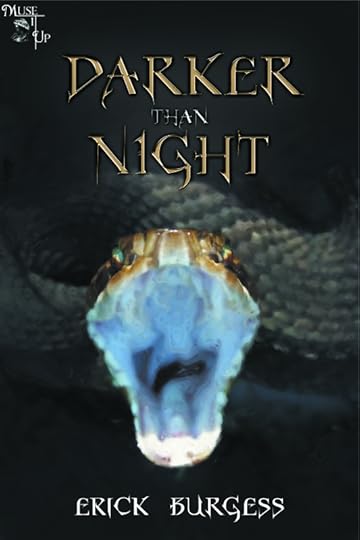
Welcome to your nightmare.
July 24, 2012
Darker Than Night – Preorder

You Save 20%
$4.76
*NEW* You can now PRE-ORDER our upcoming releases and save 20%. Available only in North America currently until system is updated to accept pre-orders from around the world. If interested to purchase from outside North America, please email publisher.
Chapter One
To most people, the best aspect of the Mall of Louisiana started with its central location in
the fastest growing, most affluent area of Baton Rouge. However, to Dwayne Bentley, it meant
something entirely different, prime hunting ground. Along with the one hundred and sixty stores,
four full-service restaurants and food court, the antique carousel ground out tinkling tunes
hearkening to simpler times. The old merry-go-round featured thirty-six jumper horses, twelve
stander horses, and two chariots, all carved by hand.
The carousel also drew Dwayne to the mall. He smiled to himself and thought, “What is a
monster?” No, not the fictional creatures invading the dreams of youngsters, but monsters like
Dahmer, Gacy, or Ramirez ran through his thoughts. For that matter, they never even captured
the Zodiac. What did these men have in common? They all preyed on the innocent. Dwayne had
more in common with the victims than those monsters. After all, in 1968 the DSM-IV officially
recognized his problem as a legitimate psychological condition.
Often, he would bring a newspaper to hide his eyes as he stared at the scores of children
parading about the mall. If any shoppers even looked in his direction, they would take him for an
average doting father allowing his child one last ride on the carousel before going home. He
knew from experience that with parents, all too concerned with the new handbag they had just
purchased or the newest models of plasma-screen televisions, no one would be concerned with
him.
“It’s time to play,” he said to himself as he folded his newspaper and placed it under his
arm. He walked over to the carousel as it began to slow down. He stared at a young girl who
could not have been over nine years old. She had shoulder-length blond hair and bright blue
eyes, and she wore a sunflower-covered dress.
The young girl tried to get her mother’s attention, but the self-absorbed woman continued
with her cell phone conversation.
“Hi. Can you help me with something?” he asked the young girl as he held out a snapshot of
a golden retriever puppy. “I lost my puppy, and I need some help finding him.” Even though
cliché, the approach always worked. “I talked to your mom, and she said it was okay. She is
going to make a few more calls, and I promised it would only take a few minutes. Please,” he
pleaded, with honest eyes.
“Okay.” She answered without hesitation as she smiled. After glancing one more time at the
picture, she began walking with him toward the exit doors. With a quick look over his shoulder,
Dwayne put his hand on her back and guided her toward the exit. Her mother had yet to notice
she had gotten off the carousel. He didn’t run or even walk fast. With his slightly graying brown
hair and cerulean blue eyes, he could have easily passed for her father.
A rush of adrenaline, powerful enough to make his hands shake, signified to him the most
difficult part of his task was complete. The recent reports of men who shared his particular
predilection blanketed the evening news every night. Back in the eighties, when children only
guarded themselves against the dark, scary stranger, Dwayne had thrived. However, the nineties
brought about a new awareness. The friendly, fair-haired gentleman who could be a deacon or
scoutmaster became the focus of the media’s attention. None of it mattered at that moment,
though, as Dwayne led the little girl toward the mall’s exit.
He thought about his plan. Once he reached his car, he would go to the trunk to retrieve the
dog’s leash. Being the sweet child she was, the little girl wouldn’t think it strange for him to ask
her for help, and when she stepped closer, he would shove her in and close the trunk. The extra
padding would prevent anyone from hearing her screams. He lived only a few miles away in a
discreet subdivision off Perkins Road.
There it was. The exit door. The point of no return. With the line of demarcation only a few
feet away, he took another step toward the door. He breathed a deep sigh a relief when a
powerful hand grabbed his shoulder. Even before he turned, Dwayne readied himself with his
usual pretext.
“Where do you think you’re going?” the man asked.
Dwayne relied on his usual pretext. He would say he was returning the lost little girl to her
parents, but the man who stopped him wasn’t a cop or even mall security. Dwayne recognized
and feared something in his eyes. The strange man smiled and continued, “I come from a place
darker than night. Welcome to your nightmare.”
Dwayne’s heart sank.
Don’t stop there -

A Novel by Erick D. Burgess
Genre: Thriller
Release: July 27, 2012
Words: 82856
ISBN: 978-1-77127-105-9
Price: $5.95
In Darker Than Night, secrets and scandals are served up daily in a world where no one is safe, neither sinner nor saint. The brutal predator whispers his chilling signature line to each victim before he strikes: “I come from a place darker than night.”
Reluctantly reinstated to the force, seasoned yet troubled homicide detective Carter Williams is assigned to investigate the death of a reputed child molester and murderer. The gruesome murder upsets no one, but as the killer goes on to torture and slay numerous victims, he surprisingly wins favor with the public. As the case becomes more and more personal, Williams’ own reputation is threatened as he deals with department politics, a young partner, and a fragile home life. Williams struggles to unravel the gruesome mystery while trying to hold onto everything he has so carefully strived to protect.
July 16, 2012
Reader’s Favorite Bronze Medal Winner 2011

Award Winning Thriller
Rating:5 StarsDarker Than Night
Reviewed by Paul J. for ReadersFavorite.com
Baton Rouge Police Detective Carter Williams has a problem, actually a couple of problems. He’s still on suspension for accidentally shooting his partner under questionable circumstances, and he’s desperately trying to hold his failing marriage together.
Suddenly he’s reinstated and given the case of the city’s newest string of murders. However, to add insult to injury, he is not assigned as the primary; rather, he is to work behind his new partner, a rookie being groomed for bigger things. The first thing they must decide is, are the deaths the work of a serial killer or vigilante? For some, it’s simply a matter of opinion.
Bodies begin to pile up, and Carter and his partner can’t seem to catch a break. But, after some time, things begin to fall into place, and he begins to think the killings are not just random but part of a very big conspiracy. But just how high does it go? Then it gets personal, very personal…
Impressive; that’s all I can say about this book. The author’s depiction of his main characters is superb. The suspense is constantly high. For a rather large book, I couldn’t find any place that the plot dragged.
All in all, Darker than Night is a very well written tale with stirring action scenes, realistic dialog, and outstanding characterization. An engaging plot and the strong characters made for a compelling read showing a well-developed description of the fascinating and often dangerous side of police work and beyond. I was caught up in the story very quickly and found that I couldn’t put this book down after I started reading.”
July 12, 2012
Rewrite or not to rewrite? That is the question.
 I’m in a bit of a dilemma. First off, I have to admit it is a dilemma that most writers would probably welcome. When my first book, Under Abnormal Conditions, was published in 2003, I was on top of the world. I was waiting for Oprah to call and checking the New York Times Bestsellers List every Sunday Okay, I was a bit delusional, but I was excited. I had reached my goal of becoming a published author by my 30th birthday so I figured the rest would be easy.
Not so fast.
Blinded by hubris, I was taken advantage of by unnamed Publish On Demand Publishing company and my book fell completely flat. The fact of the matter was that all the agents and publishers that turned me down were right. I wasn’t ready and I pressed the issue. As anyone in publishing knows, having a book that doesn’t sell is worse than not having a book published at all. The whole time I was also under the impression that I had signed with a reputable publisher. I did not. Whenever I did query other agents and publisher seeking placement for my next book, I’m sure I wasn’t taken seriously at all.
The more I learned about the industry, the more I knew about the mistakes I had made and not to repeat them. Flash forward to 2012. Including Under Abnormal Conditions, I’ll have four books in print by the end of July. Each book has been better than the last, and now that I am writing full-time, I have the time, energy, connections and resources to continue to grow as a writer.
So what is my great dilemma?
After the rights to Under Abnormal Conditions reverted back to me in 2010, I rereleased it as a self published book. Again, the sales went nowhere. After a lot a hard work, I found a publisher that believed in me enough to sign my second novel, Mask of Shadows. To help with marketing and promotion, I added a preview of the new book at the end of Under Abnormal Conditions, and made it a free download. On the surface, it was a smart move. I gave away something in hopes of building a fan base who would want to actually buy the next book. There was one question I didn’t ask myself:
What if the fan base I am trying to connect with doesn’t like the free book?
I am not one of those people who believes that just because something is free, it doesn’t have to be up to par with the items you pay for. I respect myself and my readers more than that. I want my first book to read just as good as my latest work. My reviews for Under Abnormal Conditions average about three stars. It’s not terrible, and I know that I’ll never please everyone, but it can be better. Knowing what I know now, should I take the time to review, revise and rerelease my beloved first book? While I will always love that book in its current form, I know I can make it better. Do I take the time, make the improvements and attempt to reconnect with the readers that may have been turned off by the unpolished, and maybe even unprofessional, version of the book, or do I leave it in the past and continue with my newer material?
Having the print rights to my first two books, gives me the opportunity to ensure continuity (book covers, tying up and connecting any loose ends between them). It will also help when I decide to release the third book in that series; otherwise, I wouldn’t necessarily worry about the issues with the first book. I am leaning toward joining a writing group at my local library and workshopping it before moving on to a professional editor. The problem is, the more time I take to work on this old project, I’m not producing any new material. The whole point of building a fan base is to give them new material. See the problem?
Rewrite it, or let it stand?
I’m asking for comments and opinions.
July 4, 2012
Tyler Perry is the new Alex Cross. Really?
There is quote by Samuel Johnson that says, “A writer only begins a book. A reader finishes it.”
When the film adaptation of Kiss the Girls was released in 1997, I wasn’t pleased with the casting of Morgan Freeman as Alex Cross. I had always envisioned someone like Denzel Washington in the Cross role, especially after 1995, when he brilliantly brought “Easy” Rawlins to the screen in Devil in a Blue Dress. So brilliant in fact, his voice continues to serve as the narrator in my head when I am writing my own books. Later in 1999, Washington also portrayed quadriplegic detective, Lincoln Rhyme in The Bone Collector. So in a few short years, three of my favorite modern literary characters could have possibly been played by the same actor.
No good, especially if the movies spawn multiple sequels. So we go back to Morgan Freeman. Let me start by saying, I love Morgan Freeman. If I need someone to play God or be the sagely old man dispensing advise, he’s my man. He ain’t Alex Cross. Maybe thirty years ago, he could have been Alex Cross, but Morgan Freeman with his hair dyed black was still too old to play the part. I saw the movie and I didn’t hate it. In fact, he was one of only good things in the movie. He should have been name John, Charlie or Ben, but he wasn’t Alex Cross. Flash forward to 2001 and Along Came a Spider, the first Alex Cross novel. Again, Freeman did the best he could with material that would have felled a lesser talent. Still, Freeman is not Alex Cross.
As a writer, I know what my characters look like to me and I hope I make that clear to my readers. I start each book with certain aspects in my mind and its up to each individual to fill in the proper blanks. When we release books, we make a gift of our characters. As a fan, I want to see Nathan Fillion as Green Lantern and not comic book character ruining Ryan Reynolds (see Blade: Trinity, Wolverine: Origins, Green Lantern). But I also realize I may be at the mercy of a studio executive if I want to see my creation on the big screen.
That being said-
I NEVER EVER WANT TYLER PERRY CAST IF ANY OF MY BOOKS BECOME MOVIES!!!!!
I realize I am probably the only black person in the world, apart from Spike Lee, who does not worship at the temple of Perry and Madea, and I am perfectly fine with that. As long as he wants to make movies with one dimensional characters who show no development until the film’s resolution, that’s fine with me. If he wants to write movies filled with stereotypes and produce “message” movies that are a subtle as an 800 pound gorilla, go right ahead. If it makes him happy to make movies with plot holes big enough to drive his enormous ego through, go ahead. Black folk will line up in droves to see it. I’ll ever give you the next title, Tyler Perry presents – Madea: I’m back for more Cash.
I’m sure Perry is not a bad guy. In fact, I admire his story and the hardships he overcame. That does not get him a pass for producing bad material. That bad material is one reason why he shouldn’t have been allowed to even be in the same room when they were casting for the new Alex Cross movie. The second reason?
Alex Cross does not wear a dress!
Many actors have found success dressing in drag (see Dustin Hoffman, Martin Lawrence, Flip Wilson, Jamie Foxx, Patrick Swayze, Wesley Snipes). The thing that sets these actors apart is that they were successful BEFORE they donned dresses, not BECAUSE of it. Even if these actors may have used their female alter egos as springboards, they had the skill and perseverance and good sense to leave them in the past.
Can you mention Tyler Perry’s name without thinking of or mentioning Madea? I didn’t like the idea when I first heard about it, but I was willing to give it a chance. As with the previous Cross movies, maybe Perry could shine, even though it seems that whenever the roles don’t require him to wear a dress, he still seems to fall short (Good Deeds, Why Did I Get Married 1& 2). My feelings were cemented when I saw the trailer for the Alex Cross movie. He doesn’t look like Alex Cross. He doesn’t sound like Alex Cross. He doesn’t even look right holding a gun. Every few seconds, I was waiting for one of his Madea catch phrases. Oh hell-to-the-no! Was James Patterson too busy counting his money to have any say about the casting? Did they consult Tom Cruise about playing a role outside of your range (see Jack Reecher movie)? Finally was Rupaul too busy filming the next season of Drag Race to be up for the part?
Can you please ask Morgan Freeman to come back? I changed my mind. Maybe he wasn’t so bad. Maybe he can be Alex Cross.
Where is Idris Elba when I need him?
June 25, 2012
Have a teen? We need to talk.
We need to talk.
These are words that usually elicit one of two responses: fight or flight. What about when the talk is about your relationship with one of your children? While your first reaction may be the same, as a responsible parent, you know you have to face the problem head on, no matter what is it. When that child is a teenager, it can present an in entirely different and off-putting set of circumstances.
In the 2011 movie, We need to talk about Kevin (http://www.imdb.com/title/tt1242460) Kevin’s mother struggles to love her strange child, despite the increasingly vicious things he says and does as he grows up. But Kevin is just getting started, and his final act will be beyond anything anyone imagined.
This is a parent’s biggest fear. What did I miss? Did I do enough? How did I screw things up?
These are questions my own parents asked about my sister and myself at some point in time throughout our teenagers years. Thankfully, we both turned the corner and became two successful, reasonably adjusted adults with children of our own.
What happens to those kids who don’t seem to get better? After having some problems with my teenage daughter last year, I wrote a tongue in cheek blog about telling the difference between a teenager and a sociopath. According to the DSMR-IV, the common characteristics and personality traits of sociopaths are their grandiose sense of self and entitlement. They also often display a lack of remorse and most have a very manipulative personality covered by superficial charm. Sociopaths often use people as a means to getting what they want. Friendships and romantic partners are often frequently disregarded and replaced when the relationship no longer suits their self-centered needs.
Now replace the word sociopath with teenager and tell me if that sounds familiar?
I thought the same thing and continued down the path of uninformed bliss that is parenthood. I looked at my children as the same as when my sister and myself grew up. With the advancement of electronic devices and outer media outlets, 2012 is a far cry from 1986 when it comes to being sneaky. In fact, a child can plan a clandestine late night meeting in your presence and you don’t have a clue. I was fooled many times by the pleas of innocence through crocodile tears.
Then something changed.
While watching the trial of former Penn State assistant football coach, Jerry Sandusky, I heard his defense team say he suffered from a condition called Histrionic personality disorder. According to U.S. National Library of Medicine (http://www.ncbi.nlm.nih.gov/pubmedhea...), the symptoms include:
❑ Acting or looking overly seductive
❑ Being easily influenced by other people
❑ Being overly concerned with their looks
❑ Being overly dramatic and emotional
❑ Being overly sensitive to criticism or disapproval
❑ Believing that relationships are more intimate than they actually are
❑ Blaming failure or disappointment on others
❑ Constantly seeking reassurance or approval
❑ Having a low tolerance for frustration or delayed gratification
❑ Needing to be the center of attention (self-centeredness)
❑ Quickly changing emotions, which may seem shallow to others
Histrionic personality disorder usually begins in early adulthood, so again, to most parents of teens these behaviors are pretty familiar. So how do you tell the difference? Under normal circumstances, you can consider the causes, incidence and risk factors.
While the cause of this disorder is unknown, both genes and early childhood events (death, moving, graduating) are thought to contribute. It seems to occur more often in women than in men. People with this disorder are usually able to function at a high level and can be successful socially at work or school.
Is your teen depressed? People with this condition often seek treatment when they experience depression or anxiety from failed romantic relationships or other conflicts with people.
Is your teen acting out sexually? Because they tend to crave new things and excitement, they may put themselves in risky situations. It may be diagnosed more often in women because attention-seeking and sexual forwardness are less socially acceptable for women.
If you feel that you or someone you love may have this condition, contact your health care provider. This disorder can affect the victim’s sense of well-being, relationships, or ability to keep a job. If left untreated, it can cause conflict in people’s personal life and prevent them from reaching their potential in their work life. Medication may help the symptoms, but talk therapy is usually the best treatment for the condition itself.
As far as being a parent, there are no easy answers and hopefully your teen will grow up and out of these issues without medication or treatment. While most parents would be willing to take a bullet for their children, some are resistant to seek mental health treatment because of the stigma they feel goes along with it. Our first job as parents is to protect out children and sometimes that means protecting them from themselves. If there are dealing with these are similar issues, they and not equipped to handle it and are probably unsure as to why they are acting out. In response, we try to discipline the behavior without knowing its root cause and no one wins.