Heather Wright's Blog, page 13
July 24, 2013
7 Editing Questions – Reprise

First Draft
I revisited this blog post from 2010 as I was thinking about the next phase of my current writing project. I still have a few thousand words to go and a major plot point to figure out, but I’m eagerly awaiting typing “The End” and finally getting to the fun stuff. I love revising and editing my work. It means the tough part is over, and now I get to create the story I had in mind when I started. My first hurl of words onto the page is always a struggle. I feel set free once the words are finally down, and I get to play. Below are some self-editing questions that I will ask myself as I go through my work. Maybe some of them will help you, too.
1. Where does the story really begin?
Reread the first two to three pages of your story very carefully. When does the action really start? A major fault with many first drafts (mine, included!) is too much background material at the beginning before the conflict is introduced and the characters finally take over the story. In my case, I can almost bet that my story doesn’t really begin until about half-way down page three, so out go the first two pages. If the material I have cut is essential for the reader to know, I find ways later, through dialogue or thoughts of my characters, to get the information to the reader. My later insertions are never as long as those original two and a half pages and the pace of the story gains needed speed.
2. Is this adverb necessary?
Chances are, if you are using a lot of adverbs, you are telling and not showing. Think about the character that has just won the lottery. Rather than have her yell hurray ‘joyfully’, why not have her jump up and down screaming so loudly that her cat runs under the bed in terror and it takes her twenty minutes to get it out. Maybe she runs to her closet and throws all of her old clothes in the garbage while “If I Had a Million Dollars” blasts in her iPod. Both of those pictures show how the character reacts instead of telling and are certainly livelier than the word ‘joyfully’.
3. Is this adjective doing its job?
Look for those empty adjectives and replace them. ‘Amazing’, ‘interesting’, ‘exciting’, ‘awful’, ‘ugly’, ‘beautiful’, ‘nice’, ‘scary’, and other adjectives like them need to be replaced with sensory details that bring to life what you are describing. Find places to get the readers’ senses working; it means you are making the story real for them.
4. Whose problem is it?
Your main character has the problem; the main character needs to solve it. Make sure that your protagonist remains the chief actor in the story and doesn’t become solely the reactor to another character’s influence. Sometimes in longer pieces, characters other than your lead can start to steal your attention and your imagination; this can be especially true of villains and ‘comic sidekicks’. Be careful that these characters don’t become so charming that they threaten to steal the book from your hero or heroine. (I speak from some experience here. I created a villain in an historical romance that I liked so much, he eventually got his own book!)
5. Are the grammar and spelling perfect?
Yes, I mean perfect. The most that an editor needs to read of a short story in order to make a decision is approximately three paragraphs; a novel might get three pages. If that’s the only chance you have, don’t blow it by showing your lack of ability in spelling and grammar. Of course, publishers have people whose job it is to make sure that the copy they publish is correct in every way, but there’s no way they’re going to waste that person’s time on writers who haven’t bothered to do their best the first time. If you are self-publishing, correct grammar and spelling are key to your work being thought of as professional and being recommended by readers.
6. Have I read my story out loud?
One of your best proofreading tools is the sound of your own voice. Reading your story aloud is a great way to find awkward or incomplete sentences, clumsy phrasing, and inconsistencies in verb tenses and pronoun agreement. If you hesitate when you are reading or if you have to reread a sentence or phrase, then that’s a section of your story that needs a rewrite.
7. Have I applied the Stephen King rule?
Stephen King concludes his autobiography, On Writing: A Memoir of the Craft, with an editing exercise. He shows you the first draft of a story he has written and then shows it again full of his cross-outs, inserts and editing marks. He explains his edits and why he makes the choices he does. King’s revision rule is: “2nd Draft = 1st Draft – 10%.” We have a tendency, as writers, to believe that every word we write is precious and are very reluctant to cut our material–after all, we remember how hard it as to get it down on paper the first time. However, editing is about making our prose lean, and exciting, and compelling the reader to turn the page. See what you can do with ten per cent fewer words.
Consider revision a reward. Remember that if you are revising, you have finished a project–and how neat is that? Try these seven questions to kick-start your editing and begin your pursuit of a great final product. I can’t wait to start!
Tagged: adjectives, adverbs, characters, editing, first drafts, Heather Wright, revising, Stephen King, story beginnings, writing


July 17, 2013
Heat Wave and Changes Made
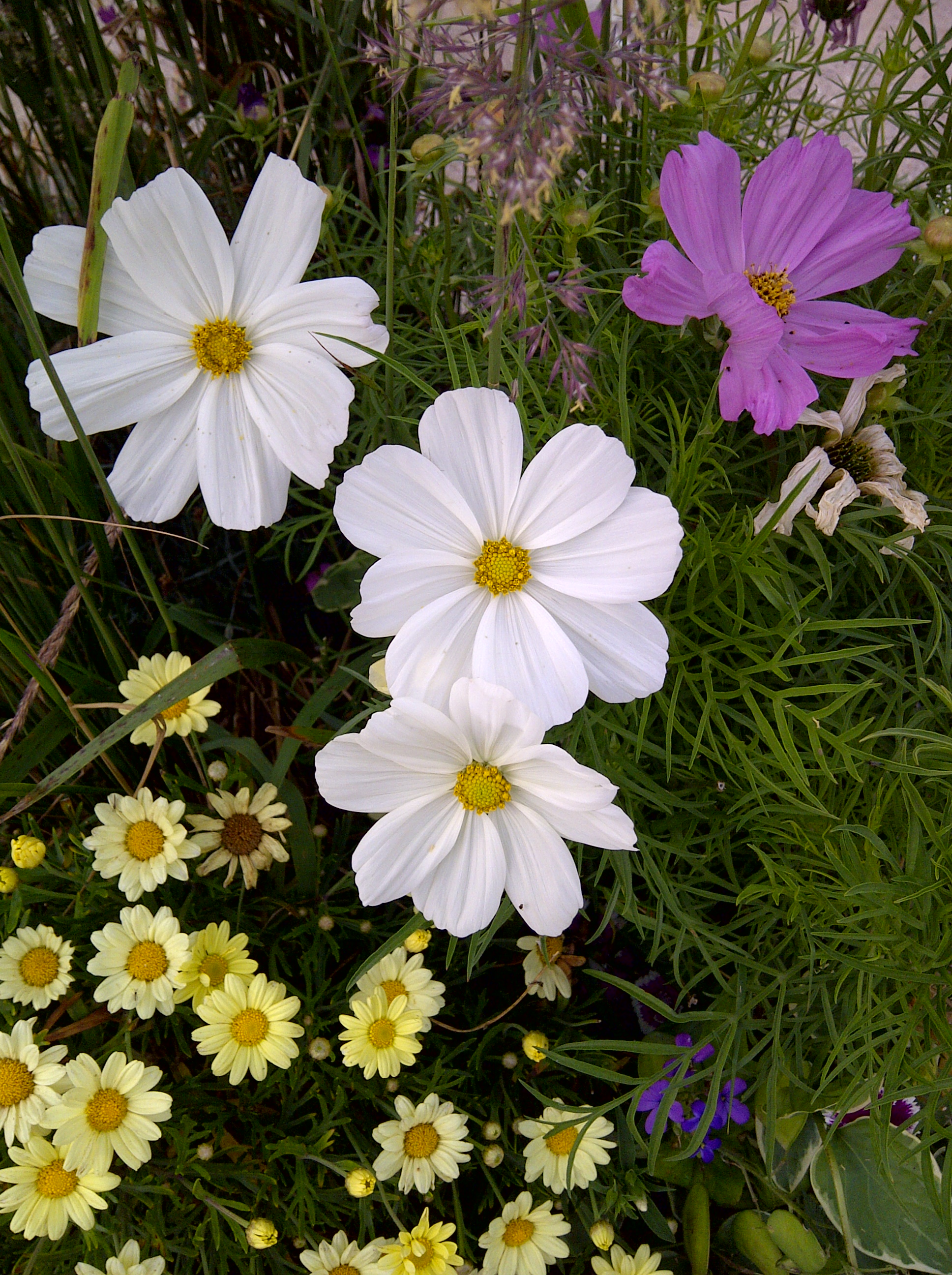
My Neighbour’s Flowers
The cicadas are singing outside my window as I write and the fan is full in my face. Today, thankfully, there is a breeze, too–something that was sadly missing as I ran errands yesterday (in a none AC car) and caught up with a house and garden from which I’d been absent for ten days. In between, I spent chunks of time in front of the fan doing basically nothing or soaking my feet in cool water in an effort to feel more human. My son and his friend kept cool recording music in the basement. In the evening, I went to my last PWAC meeting—for a year.
I’ve been a member of the Professional Writers’ Association of Canada for over eight years now. I’ve served on local executives and was president when a few of us started our own branch in Kitchener. I’ve met amazing people and been able to grow my freelance business with their help and inspiration, but I’m taking a year off. This wasn’t an easy decision to make. Our monthly meetings are always energizing and the people in the group are just plain fun to hang out with. It was tough to say good-bye, but—
I’ve set some writing/publishing goals for myself this coming year, and I also want to take some time to do another thing that I love (take singing lessons) and, well, something had to go–for a year. I’ve set a time limit in order to keep pressure on the other things I want to do. I have one self-published middle readers book, and I know, from my reading, that for self-publishing to work you need several books out there. So, I need to finish the sequel to The Dragon’s Pearl and get back to work on a series of medieval mysteries for middle readers that I’ve been playing with for several years. Also, this fall, I will have three new courses to teach—-a lot of challenges ahead and lots of time needed to make everything work.
And I’m looking forward to all of it. I stewed about leaving PWAC for a long time, but once I made the decision, I knew it was the right one. So onward to lots of writing, lots of school work—and hopefully a break in the weather very soon!
Wherever you are, I hope you are having a cool and creative day!
Tagged: decisions, freelancing, heat wave, Heather Wright, middle readers, mysteries, PWAC, writing


July 12, 2013
Friday–and still writing!

A Quiet Sunset
Well, my strategy for leaving the laptop shut in order to get some writing done paid off. I’m over 2500 words further into the book today than I was when I wrote my blog on Wednesday. On top of that my journal now has several brainstormed plot notes that will keep me writing for a while. Whew! Now 2500 words in 3 days might not seem like a lot to some, but it’s a lot for me–especially considering my previous pace of glacial.
I was in one of those places where I was beginning to wonder whether anything would get me back to feeling like a writer again. Then, this morning I woke up with a scene in my head that I quickly wrote down before I went for my morning walk. I haven’t had that happen for a long time. So, yay! Feeling writerly.
Onward into the weekend, and some more writing (and some golf, too). Hope your next few days are creative and relaxing and full of reasons for you to feel like a writer.
Tagged: brainstorming, inspiration, plotting, writer's block, writing


July 10, 2013
Pen in Hand
 Yesterday at Kristen Lamb’s Blog, Kristen listed 5 traits of the successful writer: passion, self-discipline, humility, healthy relationship with failure, and persistence. She states, “We can have all the talent in the world, but without these five ingredients, we will be hard-pressed to ever reach our dreams.”
Each of the five traits on the list can be a challenge for me at one time or another, but the most consistent challenge is self-discipline. I am constantly distracted by my laptop life: Facebook, email, checking my blog stats, Free Cell and Spider Solitaire, Ravelry (looking for my next knitting project), reading other people’s blog posts, etc.. The writing/working time slips away as I roam from one distraction to another. I’m not alone. People are actually writing about this phenomenon. Here are two links to articles about what is being called Internet ADD: http://zenhabits.net/8-practical-tips-to-cure-your-internet-add-attention-deficit-disorder/ and http://kristiholl.net/writers-blog/2013/01/internet-based-add-do-you-have-it/
I’ve decided that the only cure is abstinence. I have the luxury of a lot of writing time this week, and finally, yesterday, I figured out what I had to do to get anything accomplished–and did it. I closed the laptop, got out my journal, and worked my way through the next chapter of my book. Today I’m going to type up my notes–on my NEO (no internet, just a nice clicky keyboard and a small screen.) I have three more days to myself this week and a lot to accomplish. I’ll let you know how this strategy works.
Do you get distracted by your online life? How do you switch off and get the work done? What’s your biggest challenge among Kristen’s 5 traits? Love to hear your thoughts and solutions.
Hope you have a creative week and find your own way to carve out some creative time and make progress toward your writing goals.
Tagged: Alex Brie, creating, distraction, Facebook, Heather Wright, internet ADD, journal, Kristen Lamb, Kristi Holl, Neo, procrastination, solitaire, writing


July 6, 2013
Other People’s Gardens

From my neighbour’s garden.
I’m grabbing a few days away in Southampton–a town that inspires walking and stopping to smell the roses. Though I still have some work to do on a paid gig, I plan to commit a lot of time to working on the sequel to The Dragon’s Pearl–and walking.
I love looking at other people’s gardens. I’m no gardener myself, so it’s not envy, just simple admiration at the time people commit to creating beauty around them. I’m strictly a 1-large-pot-by-the-front-porch kind of person, and a lot of hostas, day lilies, and (sorry) goutweed to fill in the bits I don’t want to weed.
I hear that gardening is relaxing, but to me it’s just a battle that I wage with weeds when they’ve taken over too much of my turf. Last year was easy. We had no rain for months, so things stayed pretty tidy. This year, however, we have been blessed with lots of rain, and my weeds are in their happy place.
When I get back from my break, I’ll be digging and yanking and spraying (only the eco-friendly stuff, I promise) and then be able to relax for a while. That, of course, is the problem. I don’t go out there every day and do a little bit. I wait until I’m facing a weeding marathon. Not the best approach, I know.

In a Southampton garden
With my writing, I do a little better. Since March I’ve been trying to be a better gardener for my creative side–doing a little bit of writing every day instead of putting a lot of pressure on myself to clear a big chunk of time and then do a big push through a project. Even a few words a day means I’m making progress, and that’s my happy place.
How do you nurture your writing projects? A little bit every day or a massive write-a-thon?
Tagged: creativity, daily writing, gardening, gardens, weeding, writing


July 3, 2013
A Little Encouragement Goes a Long Way
I’ve found the perfect way to bring my writing to a complete halt. Lose confidence.

It was the right time to hear the right words.
I was working on the sequel to The Dragon’s Pearl, and I was about half way through the first draft when the gloom began. I started worrying about the first book. Was it really any good? Am I wasting my time writing another? And of course, those questions led to … Is anything that I’ve ever written any good? Can I even call myself a writer? Where is the chocolate? Is it time for a nap?
Yeah, well, you get the idea.
So, last week I passed the manuscript along to a friend who has children the same ages for which the book was written. Her son “liked it a lot.” She said a couple of other nice things, too, but I was so thrilled to read just those four words, I didn’t really need any more. A child liked my book. Wow. Could it get any better? Not for me. Not right now.
I’ve been working on some paid gigs this week, but this afternoon is set aside to get back to the manuscript. I hope that you find some creative time today, too, and that the right person at exactly the right time says that they like what you wrote.
Tagged: confidence, creativity, getting started, inspiration, overcoming writer's block, The Dragon's Pearl, writer's block, writing, writing fiction


June 28, 2013
Friday Wrap-Up and July 2013 Writing Prompts

A Tagxedo view of my website.
It’s a long weekend here, and I don’t expect to be spending a lot of time with the laptop, so I thought I’d publish the July prompts a bit early.
The week’s been full of interviews for articles, very hot weather, lots of errands, and a draft of a short story for middle readers. Looking back there was a lot of sitting in front of a fan with a cold drink, too. We’re looking forward to a barbeque with family on the weekend, and maybe a game of golf, along with celebrating my mom’s 85th birthday. She gets teased that the main reason she immigrated to Canada was to get a holiday on her birthday.
Hope those of you who have some special holidays and events over the coming week have a fabulous time with family and friends.
Here are the July prompts.
1. Use one, some or all of the following words in a story, scene or poem:
Coffee, star, pen, match, envy
Park, window, fear, strand, frame
2. Try one of these sentences to begin a story.
a) Mud bubbled and spat.
b) Matt fell against the bars.
c) “Table for thirteeeen, please.”
d) Our call ended with a bang.
e) I loved flying.
f) Pat straightened another picture frame.
3. See what scenes these lines of dialogue suggest to you.
Do all dragons breathe fire?
Not all.
What about this one?
Why do you suppose we’re all here?
I only know what I’ve been told.
And what’s that?
Don’t ask questions.
The hard drive crashed.
I warned you.
It’s not like it is on TV is it?
Not much is, kid.
That’s not how you do that.
And you know better?
Yes.
Show me.
4. Create a story to go with one of these titles: Peter Piper Picked Me, Left Over, Wheel of Misfortune, On the Shelf, Search and Rescue, Call Me Never, Book Room, Full Plate, Brush-Off, Keeping Casey.
5. Do you ever want to write down your dreams so you can remember them, or are they the kind of dreams that you want to forget as soon as possible? How does your character feel about his or her dreams? Describe a nightmare that your character might have. Think about what that nightmare says about your character and his or her past or present.
Have a great weekend!
Tagged: interviews, long weekend, short story, writing prompts, writing starters


June 27, 2013
Writing Links: From Outlines to Submissions to Cursive Writing

A Shoreline View
I’ve found some interesting links in the past few days that I want to pass along.
The first is a blog by one of my favourite writers/bloggers Elizabeth S. Craig. In her post, “Chalk One Up for Outlining,” Craig explains that she is not an outliner by nature. “I despise outlining and I hate following outlines.” If you feel the same way, you might like to read how she found a way to make it work for her.
I loved Darcy Pattison’s blog post, “6 Ways Out of Writing Slump.” I could really identify with her reasons for letting writing fiction slide, and I could also see how her suggestions could make a difference.
If you’re getting a project ready to submit to a publisher, read about what seven agents say can stop editors and agents reading: “Seven Agents Talk About the Most Common Submission Mistakes.” Their comments cover the synopsis, the query and your first pages.
Finally if you love writing in journals or with pen/pencil and paper, you might be interested in this opinion piece by Andrew Coyne that was written in response to a report about the lack of teaching of cursive writing in school. “Words on paper – how we write affects what we write.”
I’d love to hear your feedback on any of these links. Who do you follow for great writing advice?
Tagged: Adventures in YA & Children's Publishing, Andrew Coyne, creating, cursive writing, daily writing, Darcy Pattison, Elizabeth S. Craig, Heather Wright, outlining, overcoming writer's block, planning writing, setting goals, writing, writing fiction, Writing Slump, writing tips


June 22, 2013
Friday Wrap-Up (on Saturday)
 Clearly it’s been one of those weeks. I seemed to have been playing catch up every day. I’m hoping that the weekend is just what I need to get organized for the projects ahead with some time, too, for family and a little work on one of my ongoing fiction projects.
One of the toughest things this week was negotiating a price for a large project with a local editor. It worked out well, but it was stressful, nonetheless. I said ‘no’ to the first price and the second, and then he called and a third price was chosen that I was happy with. I never expected the phone call after the second ‘no thanks,’ but it was a real morale boost when it happened. My work was valued, and he was willing to pay a price I was happy with to keep my skills in his writers’ stable.
That’s the mystery of freelancing. You never really know whether what you have done has made an impression on the person who has commissioned your work, or whether it’s just another project they can tick off on their list and move on. Have you been contacted because you’re at the bottom of their writers’ list (and everyone ahead of you can’t take the job,) or are you the first person contacted because the editor thinks you are the best match s/he knows for the project? Um, did I mention that a bit of insecurity comes with being a freelancer?
I also believe that work attracts work. As soon as I committed to this large project, I got a call about another job for someone I worked with last year. It was a much shorter project, but still, it’s a cheque, and it was a fun creative piece that I enjoyed working on. I’ll find out how his client liked it next week.
So the weekend will be spent with my calendar, blocking out work times for the several things I’m juggling over the next few weeks, including freelancing, wrestling with the new intranet program at the college to set up my fall courses, prepping said courses, and, I hope, carving out time for the fun, creative writing that’s just for me. I love calendars, and coloured markers, and getting organized. I know I’ll feel a lot better going into Monday, once I get it done.
How do you organize your writing, work time, and family time to make sure that there is room for all in your life? Love to hear some tips on the balancing act.
Tagged: calendars, contracts, freelancing, Heather Wright, negotiations, scheduling, writing, writing time


June 19, 2013
A Good Walk/Book Spoiled
 I photographed these irises while on the golf course on Saturday. It was the one sunny day when we could actually be outdoors out of a long stretch of rainy and cool, breezy days. The flowers also distracted me from my first golf game of the year, which is filled with moments of great hope (sinking a chip and a very long put and a few great drives) balanced by the realities of my actual level of play (3-putt anyone?) Golf is just that kind of game, and, in my case, it always makes sure that I come back by letting me play like I know what I’m doing on the last hole.
Mark Twain is credited with saying that “Golf is a good walk spoiled.” But apparently that’s not likely. Here’s the scoop from Quote Investigator:
“In 1904 the saying was attributed to a popular novelist named Harry Leon Wilson who used a cleverly expanded version of the jape. Wilson employed a rhetorical device called reversibility to augment the humor [HW1]: Some of his friends have been trying to induce him to play golf, but he refused. He makes the following unique definition of golf: ‘Golf has too much walking to be a good game, and just enough game to spoil a good walk.’”
Writing has as many challenges as a golf game. The equipment often needs improving, you need to practise, you need to experiment and try new techniques to succeed, you need patience, and mental and physical discipline, and it can take a long time to get to the level that makes you feel confident when you approach that first tee. But like golf can spoil a good walk, can writing spoil a good read? As a writer, how do you approach your reading? Does a good book get spoiled because you are busy analyzing how the author built the plot, or developed characters, or used symbolism or theme? Or can you put your writing brain on hold and just enjoy reading?
I’m lucky enough that I can still be swept away by story and enjoy a good book. But … there are times that being a writer can make me very critical of a novel. And that can be good. As I try to figure out what isn’t working for me in a particular story, I can store that as a cautionary piece of advice when I start to edit my own work. I’d love to know when you turn off or turn on your writer’s brain when you’re reading. Are their books that you would suggest to be read with the writer’s brain on because they have good writing lessons to teach?
Love to hear from you.
Tagged: flowers, golf, Mark Twain, photography, QuoteInvestogator.com, reading, reading critically, writing, writing lessons