
Alexandra Sokoloff's Blog, page 37
June 27, 2011
Twisted Love?
This isn't so much a blog as a request for help that might lead to a blog.
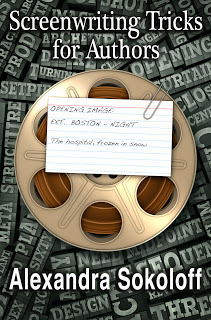
At the request of oh-so-many of my readers and workshop students, I've been revising and expanding the first Screenwriting Tricks For Authors workbook into a new volume of the book that is much more romance-friendly. It should be available mid-July, barring the Rapture or some similar cool distraction.
All the way along the writing of this new book has been a natural and enjoyable process. But there's a chapter that is presently giving me grief, and I thought I'd throw it open to you all in case I'm totally missing something.
The chapter that is stymieing me (don't you love it when I make up words?) is the chapter on The Big Twist. When I first wrote the blog on the subject and the chapter based on it, I came up with a list of my favorite twist endings, and of course it was dark and twisty, just like my own writing, and I was assuming that the first couple dozen dark examples I came up with were from thriller and horror stories just because that's the way my mind works.
But now that I've been dwelling on romance and love stories for months, I am having an incredibly difficult time coming up with examples of big twists in love stories. Not only that, but when I Google "great twists" and "twist endings" - there aren't any romances or romantic comedies listed. I mean, NONE.
I'm able to list tons of reversals in different love story storylines – not huge revelations, mind you, but nice enough surprises, usually in the form of well-planted plants and subsequent payoffs, like the tapioca saving the day in New in Town, and some more emotionally devastating revelations, like the wrenching Midpoint Climax in Sense and Sensibility when Elinor learns that Edward has been secretly engaged to someone else while he's been courting her.
But big climactic twists? The best I personally can come up with is the climax of Tootsie, which, even though it seems like it should be perfectly obvious that Dorothy would unmask herself as Michael during a live broadcast, is still the most surprising and exhilarating climax I've ever seen in a romantic comedy, maybe ever.
So – am I and all of these other bloggers and film reviewers out there overlooking the obvious? Or is it just the nature of romance and romantic comedy not to want to turn things totally upside down in the same way that the more adrenaline-driven genres strive to do?
Can anyone give us some good examples of love story twists? Or explain why love stories never make the Top Ten or Top Fifty lists of Great Twist Endings?
I'd be most grateful!
(It's hot here. Is it hot where you are?)
- Alex
At the request of oh-so-many of my readers and workshop students, I've been revising and expanding the first Screenwriting Tricks For Authors workbook into a new volume of the book that is much more romance-friendly. It should be available mid-July, barring the Rapture or some similar cool distraction.
All the way along the writing of this new book has been a natural and enjoyable process. But there's a chapter that is presently giving me grief, and I thought I'd throw it open to you all in case I'm totally missing something.
The chapter that is stymieing me (don't you love it when I make up words?) is the chapter on The Big Twist. When I first wrote the blog on the subject and the chapter based on it, I came up with a list of my favorite twist endings, and of course it was dark and twisty, just like my own writing, and I was assuming that the first couple dozen dark examples I came up with were from thriller and horror stories just because that's the way my mind works.
But now that I've been dwelling on romance and love stories for months, I am having an incredibly difficult time coming up with examples of big twists in love stories. Not only that, but when I Google "great twists" and "twist endings" - there aren't any romances or romantic comedies listed. I mean, NONE.
I'm able to list tons of reversals in different love story storylines – not huge revelations, mind you, but nice enough surprises, usually in the form of well-planted plants and subsequent payoffs, like the tapioca saving the day in New in Town, and some more emotionally devastating revelations, like the wrenching Midpoint Climax in Sense and Sensibility when Elinor learns that Edward has been secretly engaged to someone else while he's been courting her.
But big climactic twists? The best I personally can come up with is the climax of Tootsie, which, even though it seems like it should be perfectly obvious that Dorothy would unmask herself as Michael during a live broadcast, is still the most surprising and exhilarating climax I've ever seen in a romantic comedy, maybe ever.
So – am I and all of these other bloggers and film reviewers out there overlooking the obvious? Or is it just the nature of romance and romantic comedy not to want to turn things totally upside down in the same way that the more adrenaline-driven genres strive to do?
Can anyone give us some good examples of love story twists? Or explain why love stories never make the Top Ten or Top Fifty lists of Great Twist Endings?
I'd be most grateful!
(It's hot here. Is it hot where you are?)
- Alex


June 15, 2011
What KIND of story is it?
I have been working, working, working on the new book, which means a lot of revising, revising, revising,
It gives me a lot of time to think about the concepts I most want to get across. And it strikes me that as soon as you have any grasp of the 3-Act, 8-Sequence structure at all, the very next important thing is to get, really get, the idea of KINDS of stories (I guess I should say "story types", but that somehow seems to mean something slightly different than what I want to say.)
I think that the best thing that you can do to help yourself with story structure is to look at and compare in depth 5-10 (ten being best!) stories – films, novels, and plays - that are similar in kind (or structural pattern) to yours. Because different kinds of stories have different and very specific structural arcs, and those structures have their own unique and essential elements which are incredibly useful to be aware of so you can use them for yourself.
The KIND of story a story is does not always have anything to do with genre. Let me use a couple of recent movie examples to illustrate this.
- What genre would you call Inception? Something like a sci-fi thriller, right? It's futuristic, it uses dream technology, it has thriller elements and action… but what really drives Inception is that it's a caper story (you could also say a heist, or reverse heist), like The Sting, Ocean's 11, Armageddon, The Hot Rock, and Topkapi. The structure of Inception is a professional dream burglar gathering a team of professionals to pull off a big job, then training for and executing that job. That's the action of the story. And that's what made Inception stand out: it crosses a caper story with a sci-fi thriller.
- The Hangover (the brilliant first one, I mean) is a guy comedy. But the structure of the story is a traditional mystery: the groom has gone missing during a wild blackout night of a bachelor party, and his friends have to follow the clues to piece together what happened that night and get the groom back (before the wedding!). The action of the story is unraveling that mystery. So if you're writing a story like The Hangover, you want to be looking at how mysteries are put together just as much as you want to be learning from comedies.
- Leap Year is a romantic comedy, but the structure of the story is a road trip: the action of the story is a journey across Ireland. And if you're writing a road trip story you can learn a lot from taking a look at road trip stories in all genres: Planes, Trains and Automobiles, It Happened One Night, Thelma and Louise, even Natural Born Killers.
So while it's important to know the general, Three-Act, Eight-Sequence structure, and it's important to know the patterns of the particular genre you're writing in, it's sometimes even more useful to identify the KIND of story you're writing within that genre.
Once you know the kind of story you're writing, you can look at examples of that particular story pattern and get a sense of the structural elements and tricks common to that story pattern – the key scenes a reader wants and expects to see in these stories. A Mistaken Identity story, for example, will almost always have threat of discovery, a confidante who knows the score, numerous tests of the hero/ine's story, scenes of trapping the hero/ine into the role, scenes of the role starting to backfire, and of course, a big unmasking scene, usually at the climax of Act III. Identifying these expected scenes and taking a look at how other storytellers have handled them is a great way of brainstorming unique and fun scenes of your own (See Tootsie, While You Were Sleeping, Roman Holiday).
So what are these story types?
The late and much-missed Blake Snyder said that all film stories break down into just ten patterns that he outlined in his Save The Cat! books. Dramatist Georges Polti claimed there are Thirty-Six Dramatic Situations and outlined those in his classic book.
I think those books on the subject are truly useful; as I say often, I think you should read everything. But I believe you also have to get much more specific than ten plots or even thirty-six.
(I also think it's plainly lazy to use someone else's analysis of a story pattern instead of identifying your own. Relying on anyone else's analysis, and that for sure includes mine, is not going to make you the writer you want to be.)
Personally, I think there are hundreds of story types and kinds.
For example, in a workshop I taught recently, there was a reluctant witness story, a wartime romance story, an ensemble mystery plot, a mentor plot, a heroine in disguise plot, a high school sleuth story. And others.
Each of those stories has a story pattern that you could force into one of ten general overall patterns – I guess – but they also have unique qualities that would get completely lost in such a generalization. And all of those stories could also be categorized in other ways besides "reluctant witness" or "hero in disguise".
Harry Potter is what you could call a King Arthur story – the Chosen One coming into his or her own (also see Star Wars, The Matrix…) but it is told as a traditional mystery, with clues and red herrings and the three kids playing detectives (high school sleuth). It's also got strong fairy tale elements. So if you're writing a story that combines those three (and more) types of stories, looking at examples of any of those types of stories is going to help you brainstorm and structure your own story.
If you find you're writing a "reluctant witness" story, whether it's a detective story, a sci-fi setting, a period piece, or a romance, it's extremely useful to look at other stories you like that fall into that "reluctant witness" category – like Witness, The Man Who Knew Too Much, Conspiracy Theory, Someone To Watch Over Me, Collateral.
If you're writing a mentor plot, you could take a look at The Princess Diaries, Silence of the Lambs, Searching For Bobby Fischer, An Officer And A Gentleman, Dirty Dancing - all stories in completely different genres with strong mentor plot lines, with vastly different mentor types.
A Mysterious Stranger or Traveling Angel story has a very specific plotline, too: a "fixer" character comes into the life of a main character, or characters, and turns it upside down – for the good. And the main character, not the Mysterious Stranger, is the one with the character arc (look at Mary Poppins, Shane, Nanny McPhee, and Lee Child's Jack Reacher books).
A Cinderella story, well, where do you even start? Pretty Woman, Cinderella of course, Arthur, Rebecca, Suspicion, Maid in Manhattan, Slumdog Millionaire, Notting Hill.
A deal with the devil story: The Firm, Silence of the Lambs, Damn Yankees, The Little Mermaid, Rosemary's Baby, The Picture of Dorian Gray, Devil's Advocate.
And you might violently disagree with some of my examples, or have a completely different designation for what kind of story some of the above are…
But that is exactly my point. You have to create your own definitions of types of stories, and find your own examples to help you learn what works in those stories. All of writing is about creating your own rules and believing in them.
So this is what I'm trying to say. Identifying genres is not enough. Identifying categories of stories is not enough. Knowing how general story structure works is not enough. What's the kind of story you're writing – by your own definition?
When you start to get specific about that, that's when your writing starts to get truly interesting.
And when you look at great examples of the type of story you're writing, you'll find yourself coming up with your own, specific story elements checklist, that goes much farther than a general story elements checklist ever could.
Here are just a few dozen examples to get you started brainstorming types of stories
Caper/Heist/Con (Inception, Topkapi, Ocean's 11, Armageddon)
Mythic Journey or Hero's Journey (The Wizard of Oz, Lord Of The Rings, Star Wars)
Mentor story (Karate Kid, Good Will Hunting, Dirty Dancing, Silence Of The Lambs, An Officer And A Gentleman, The King's Speech)
Mystery (too many to list!)
Cinderella story (Notting Hill, Slumdog Millionaire, Pretty Woman, Titanic)
The Soul Journey (Eat Pray Love, The Razor's Edge, Lost Horizon)
MacGuffin story (Raiders of the Lost Ark, The Maltese Falcon, Romancing The Stone)
Mistaken Identity or False Identity (Tootsie, While You Were Sleeping, Sommersby, Beloved, Roman Holiday, You've Got Mail)
The Wrong Man (Hitchcock loved to do this type of thriller, with an innocent falsely accused, or set up: The Wrong Man, North By Northwest)
Forbidden Love (Lost In Translation, Butterfield 8, Casablanca, Sea Of Love, Someone To Watch Over Me, Water For Elephants, Roman Holiday)
Mysterious Stranger or Traveling Angel (Mary Poppins, Shane, the Reacher books, Mrs. Doubtfire, Nanny McPhee)
Three Brothers (The Godfather, The Deerhunter, Mystic River)
Reluctant Witness (Witness, Conspiracy Theory, Someone To Watch Over Me)
Wartime Romance (Casablanca, From Here To Eternity, Gone With The Wind)
High School Sleuth (Brick, Twilight, Harry Potter stories)
Trapped (Die Hard, The Poseidon Adventure)
The Wrong Brother - or Wrong Sister (While You Were Sleeping, Holiday)
Road Trip (Leap Year; Natural Born Killers; Planes, Trains and Automobiles; It Happened One Night; Thelma and Louise.)
Fairy Tale (there are dozens of sub-genres here, including Cinderella, the Animal Groom, The Three Brothers, The Journey To Find The Lost Loved One, etc.)
Epic (Gone With the Wind, Gladiator)
Monster in the house (Alien, The Exorcist, Paranormal Activity, The Haunting)
The Roommate From Hell (or best friend from hell, first date from hell, neighbor from hell: Fatal Attraction, Morningside Heights, Single White Female, The Roommate)
Rashomon (Rashomon)
Redemption (Groundhog Day, Jaws)
Hero Falls (Chinatown, The Godfather, The Shining)
Alternate Reality (It's A Wonderful Life, Groundhog Day, Back To The Future)
A variation of this is "The Road Not Taken" story (Sliding Doors, Family Man)
Chase/On The Run (The Fugitive, Thelma And Louise, Natural Born Killers)
Lovers Handcuffed Together (Leap Year, What Happens In Vegas, The Proposal)
Enemies Handcuffed Together (The Defiant Ones)
Gaslight (Gaslight, So Evil My Love, Let's Scare Jessica To Death)
Alien Attack (Signs, The Day The World Ended, Invasion Of The Body Snatchers)
Slasher (or - Ten Little Indians, which was the play and film that started off that genre)
Changeling Child (Rosemary's Baby, The Exorcist, The Orphan)
Man Against Nature (Jaws, Twister)
Fish Out Of Water (The Proposal, New In Town)
Ensemble Mystery Plot (Murder On The Orient Express, The Last of Laura)
Ensemble Romance (Four Weddings And A Funeral)
Impostor (While You Were Sleeping, Tootsie)
The Therapeutic Journey (Good Will Hunting, The Sixth Sense, The King's Speech)
Unreliable Narrator (The Usual Suspects, Fallen, The Sixth Sense)
A Man's Gotta Do What A Man's Gotta Do (Jaws, High Noon)
Descent Into Madness (Apocalypse Now, The Shining, Black Swan, Sunset Boulevard)
And that doesn't even scratch the surface! Are you starting to get the idea? Have you even already thought of a few of your own that I haven't listed?
Create your own names for them – just like I did above. There's no right or wrong, here. And the story types you notice are the ones you're likely to be attracted to in your own writing.
So - what kind of story are you writing? And do you have other examples of the kinds of stories I've listed above, or other kinds of stories to add to the list?
- Alex
------------------------------------------------
I have succumbed and put the Screenwriting Tricks workbook up for Nook and on Smashwords, where yes, you can finally download it as a pdf file or whatever format you want. Any version - $2.99
Smashwords
Kindle
Nook
It gives me a lot of time to think about the concepts I most want to get across. And it strikes me that as soon as you have any grasp of the 3-Act, 8-Sequence structure at all, the very next important thing is to get, really get, the idea of KINDS of stories (I guess I should say "story types", but that somehow seems to mean something slightly different than what I want to say.)
I think that the best thing that you can do to help yourself with story structure is to look at and compare in depth 5-10 (ten being best!) stories – films, novels, and plays - that are similar in kind (or structural pattern) to yours. Because different kinds of stories have different and very specific structural arcs, and those structures have their own unique and essential elements which are incredibly useful to be aware of so you can use them for yourself.
The KIND of story a story is does not always have anything to do with genre. Let me use a couple of recent movie examples to illustrate this.
- What genre would you call Inception? Something like a sci-fi thriller, right? It's futuristic, it uses dream technology, it has thriller elements and action… but what really drives Inception is that it's a caper story (you could also say a heist, or reverse heist), like The Sting, Ocean's 11, Armageddon, The Hot Rock, and Topkapi. The structure of Inception is a professional dream burglar gathering a team of professionals to pull off a big job, then training for and executing that job. That's the action of the story. And that's what made Inception stand out: it crosses a caper story with a sci-fi thriller.
- The Hangover (the brilliant first one, I mean) is a guy comedy. But the structure of the story is a traditional mystery: the groom has gone missing during a wild blackout night of a bachelor party, and his friends have to follow the clues to piece together what happened that night and get the groom back (before the wedding!). The action of the story is unraveling that mystery. So if you're writing a story like The Hangover, you want to be looking at how mysteries are put together just as much as you want to be learning from comedies.
- Leap Year is a romantic comedy, but the structure of the story is a road trip: the action of the story is a journey across Ireland. And if you're writing a road trip story you can learn a lot from taking a look at road trip stories in all genres: Planes, Trains and Automobiles, It Happened One Night, Thelma and Louise, even Natural Born Killers.
So while it's important to know the general, Three-Act, Eight-Sequence structure, and it's important to know the patterns of the particular genre you're writing in, it's sometimes even more useful to identify the KIND of story you're writing within that genre.
Once you know the kind of story you're writing, you can look at examples of that particular story pattern and get a sense of the structural elements and tricks common to that story pattern – the key scenes a reader wants and expects to see in these stories. A Mistaken Identity story, for example, will almost always have threat of discovery, a confidante who knows the score, numerous tests of the hero/ine's story, scenes of trapping the hero/ine into the role, scenes of the role starting to backfire, and of course, a big unmasking scene, usually at the climax of Act III. Identifying these expected scenes and taking a look at how other storytellers have handled them is a great way of brainstorming unique and fun scenes of your own (See Tootsie, While You Were Sleeping, Roman Holiday).
So what are these story types?
The late and much-missed Blake Snyder said that all film stories break down into just ten patterns that he outlined in his Save The Cat! books. Dramatist Georges Polti claimed there are Thirty-Six Dramatic Situations and outlined those in his classic book.
I think those books on the subject are truly useful; as I say often, I think you should read everything. But I believe you also have to get much more specific than ten plots or even thirty-six.
(I also think it's plainly lazy to use someone else's analysis of a story pattern instead of identifying your own. Relying on anyone else's analysis, and that for sure includes mine, is not going to make you the writer you want to be.)
Personally, I think there are hundreds of story types and kinds.
For example, in a workshop I taught recently, there was a reluctant witness story, a wartime romance story, an ensemble mystery plot, a mentor plot, a heroine in disguise plot, a high school sleuth story. And others.
Each of those stories has a story pattern that you could force into one of ten general overall patterns – I guess – but they also have unique qualities that would get completely lost in such a generalization. And all of those stories could also be categorized in other ways besides "reluctant witness" or "hero in disguise".
Harry Potter is what you could call a King Arthur story – the Chosen One coming into his or her own (also see Star Wars, The Matrix…) but it is told as a traditional mystery, with clues and red herrings and the three kids playing detectives (high school sleuth). It's also got strong fairy tale elements. So if you're writing a story that combines those three (and more) types of stories, looking at examples of any of those types of stories is going to help you brainstorm and structure your own story.
If you find you're writing a "reluctant witness" story, whether it's a detective story, a sci-fi setting, a period piece, or a romance, it's extremely useful to look at other stories you like that fall into that "reluctant witness" category – like Witness, The Man Who Knew Too Much, Conspiracy Theory, Someone To Watch Over Me, Collateral.
If you're writing a mentor plot, you could take a look at The Princess Diaries, Silence of the Lambs, Searching For Bobby Fischer, An Officer And A Gentleman, Dirty Dancing - all stories in completely different genres with strong mentor plot lines, with vastly different mentor types.
A Mysterious Stranger or Traveling Angel story has a very specific plotline, too: a "fixer" character comes into the life of a main character, or characters, and turns it upside down – for the good. And the main character, not the Mysterious Stranger, is the one with the character arc (look at Mary Poppins, Shane, Nanny McPhee, and Lee Child's Jack Reacher books).
A Cinderella story, well, where do you even start? Pretty Woman, Cinderella of course, Arthur, Rebecca, Suspicion, Maid in Manhattan, Slumdog Millionaire, Notting Hill.
A deal with the devil story: The Firm, Silence of the Lambs, Damn Yankees, The Little Mermaid, Rosemary's Baby, The Picture of Dorian Gray, Devil's Advocate.
And you might violently disagree with some of my examples, or have a completely different designation for what kind of story some of the above are…
But that is exactly my point. You have to create your own definitions of types of stories, and find your own examples to help you learn what works in those stories. All of writing is about creating your own rules and believing in them.
So this is what I'm trying to say. Identifying genres is not enough. Identifying categories of stories is not enough. Knowing how general story structure works is not enough. What's the kind of story you're writing – by your own definition?
When you start to get specific about that, that's when your writing starts to get truly interesting.
And when you look at great examples of the type of story you're writing, you'll find yourself coming up with your own, specific story elements checklist, that goes much farther than a general story elements checklist ever could.
Here are just a few dozen examples to get you started brainstorming types of stories
Caper/Heist/Con (Inception, Topkapi, Ocean's 11, Armageddon)
Mythic Journey or Hero's Journey (The Wizard of Oz, Lord Of The Rings, Star Wars)
Mentor story (Karate Kid, Good Will Hunting, Dirty Dancing, Silence Of The Lambs, An Officer And A Gentleman, The King's Speech)
Mystery (too many to list!)
Cinderella story (Notting Hill, Slumdog Millionaire, Pretty Woman, Titanic)
The Soul Journey (Eat Pray Love, The Razor's Edge, Lost Horizon)
MacGuffin story (Raiders of the Lost Ark, The Maltese Falcon, Romancing The Stone)
Mistaken Identity or False Identity (Tootsie, While You Were Sleeping, Sommersby, Beloved, Roman Holiday, You've Got Mail)
The Wrong Man (Hitchcock loved to do this type of thriller, with an innocent falsely accused, or set up: The Wrong Man, North By Northwest)
Forbidden Love (Lost In Translation, Butterfield 8, Casablanca, Sea Of Love, Someone To Watch Over Me, Water For Elephants, Roman Holiday)
Mysterious Stranger or Traveling Angel (Mary Poppins, Shane, the Reacher books, Mrs. Doubtfire, Nanny McPhee)
Three Brothers (The Godfather, The Deerhunter, Mystic River)
Reluctant Witness (Witness, Conspiracy Theory, Someone To Watch Over Me)
Wartime Romance (Casablanca, From Here To Eternity, Gone With The Wind)
High School Sleuth (Brick, Twilight, Harry Potter stories)
Trapped (Die Hard, The Poseidon Adventure)
The Wrong Brother - or Wrong Sister (While You Were Sleeping, Holiday)
Road Trip (Leap Year; Natural Born Killers; Planes, Trains and Automobiles; It Happened One Night; Thelma and Louise.)
Fairy Tale (there are dozens of sub-genres here, including Cinderella, the Animal Groom, The Three Brothers, The Journey To Find The Lost Loved One, etc.)
Epic (Gone With the Wind, Gladiator)
Monster in the house (Alien, The Exorcist, Paranormal Activity, The Haunting)
The Roommate From Hell (or best friend from hell, first date from hell, neighbor from hell: Fatal Attraction, Morningside Heights, Single White Female, The Roommate)
Rashomon (Rashomon)
Redemption (Groundhog Day, Jaws)
Hero Falls (Chinatown, The Godfather, The Shining)
Alternate Reality (It's A Wonderful Life, Groundhog Day, Back To The Future)
A variation of this is "The Road Not Taken" story (Sliding Doors, Family Man)
Chase/On The Run (The Fugitive, Thelma And Louise, Natural Born Killers)
Lovers Handcuffed Together (Leap Year, What Happens In Vegas, The Proposal)
Enemies Handcuffed Together (The Defiant Ones)
Gaslight (Gaslight, So Evil My Love, Let's Scare Jessica To Death)
Alien Attack (Signs, The Day The World Ended, Invasion Of The Body Snatchers)
Slasher (or - Ten Little Indians, which was the play and film that started off that genre)
Changeling Child (Rosemary's Baby, The Exorcist, The Orphan)
Man Against Nature (Jaws, Twister)
Fish Out Of Water (The Proposal, New In Town)
Ensemble Mystery Plot (Murder On The Orient Express, The Last of Laura)
Ensemble Romance (Four Weddings And A Funeral)
Impostor (While You Were Sleeping, Tootsie)
The Therapeutic Journey (Good Will Hunting, The Sixth Sense, The King's Speech)
Unreliable Narrator (The Usual Suspects, Fallen, The Sixth Sense)
A Man's Gotta Do What A Man's Gotta Do (Jaws, High Noon)
Descent Into Madness (Apocalypse Now, The Shining, Black Swan, Sunset Boulevard)
And that doesn't even scratch the surface! Are you starting to get the idea? Have you even already thought of a few of your own that I haven't listed?
Create your own names for them – just like I did above. There's no right or wrong, here. And the story types you notice are the ones you're likely to be attracted to in your own writing.
So - what kind of story are you writing? And do you have other examples of the kinds of stories I've listed above, or other kinds of stories to add to the list?
- Alex
------------------------------------------------
I have succumbed and put the Screenwriting Tricks workbook up for Nook and on Smashwords, where yes, you can finally download it as a pdf file or whatever format you want. Any version - $2.99

Smashwords
Kindle
Nook
May 30, 2011
Visual Image Systems
I am finally catching up on some films I didn't get around to last year for various massive personal reasons, and I just watched Black Swan, which is a great example of a blatant and shameless visual image system.
Look at the fun Darren Aronofsky and his designers have with black and white: note when the heroine wears white, when she starts wearing white and black, when shades of gray are used (as with the company director), who else wears black and when.
It made me want to revise a previous chapter on Visual Storytelling and Thematic Image Systems to incorporate other examples I've come across in the last year.
I've said that I think it's most useful to think of theme not just as one sentence, but as layers of meaning, a whole set of morals and lessons and ruminations and propositions; a world of interrelated meanings that resonate on levels that you're not even aware of, sometimes, but that stay with you and bring you back to certain stories over and over and over again.
(Think of some of the dreams you have, where there will be double and triple puns, visual and verbal. And by the way, if you're a writer, and you're not keeping a dream journal, you're working too hard. Why not let your subconscious do the work?).
There are all kinds of ways to work theme into a story. The most obvious is the PLOT. Every plot is also a statement of theme. DIALOGUE is another, as I've discussed before.
But today I'm going to revisit the concept of reflecting theme through primarily visual image systems.
A great example of working a thematic image system, in this case entirely visually, is the first scene of Raiders Of The Lost Ark.
The very first encounter and shock moment comes less than two minutes into the film, when one of the guides in Indy's search party chops through undergrowth to reveal a huge, demonic statue. The terrified guide runs away, screaming. It's a thematic reference to the awesome power of the gods (And a setup of Indy's CHARACTER ARC: he begins the movie without fear of the supernatural; by the end he understands that there are things he will never understand, awesome forces that need to be respected).
The entrance to the cave is temple-like, part of the thematic image system of world religions and mysticism.
Inside the cave, Indy pushes through a veil of cobwebs. At first this just looks cool and spooky – but maybe it's also symbolic of piercing the veil between reality and the supernatural or divine.
Beyond the chasm Indy and the guide pass by a gold Aztec calendar (or something like one!) at the entrance of the cave: another visual representation of world religions, which will be presented in various ways throughout the film. The calendar is also part of the ongoing theme of mysticism and the supernatural; note the eerie music.
And finally, the inner chamber and the altar with the gold idol, another religious image. Indy susses out another booby trap: the stepping stones: if you step in the wrong place, poisoned darts fly.
Just as Indy makes it out of the cave, there's the reversal and defeat that the natives are right there with bows and arrows… and Belloq steps up to take the idol away from him. When Belloq holds the idol up, all the natives bow down to it, externalizing the theme of the power of the gods and the necessity for reverence.
And you thought all that was going on there was action, right?
Of course, one thing all my screenwriting has been good for is learning how to convey a story visually. But my obsession with visual storytelling started way before I started writing scripts. Production design is a crucial element of theater, too, and we had a brilliant head of design in the theater department at Berkeley, Henry May, so I got spoiled early on with mindbending, thematic sets that gave a whole other dimensionality to the plays I saw in my formative years. A good production designer will make every single thing you look at on stage – color scheme, props, sets, costuming, shapes, textures – contribute to your deeper understanding of the play's story, characters and themes.
That was a lesson that served me well when I started screenwriting. And then working as a screenwriter opened up whole new worlds of visual storytelling.
So what can we as authors learn from screenwriting about writing visually?
A lot.
In film, every movie has a production designer: one artist (and these people are genius level, let me tell you) who is responsible, in consultation with the director and with the help of sometimes a whole army of production artists) for the entire look of the film – every color, costume, prop, set choice.
With a book, guess who's the production designer?
You are.
And how do you learn to be a great production designer?
But studying other great production designers.
Alien is a perfect example of brilliant production design. The visual image systems are staggering. Take a look at those sets (created by Swiss surrealist HR Giger). What do you see? Sexual imagery everywhere. Insect imagery, a classic for horror movies. Machine imagery. Anatomical imagery: the spaceships have very human-looking spines (vertebrae and all), intestinal-looking piping, vulvic doors. And the gorgeous perversity of the design is that the look of the film combines the sexual and the insectoid, the anatomical with the mechanical, throws in some reptilian, serpentine, sea-monsterish under-the-sea-effects – to create a hellish vision that is as much a character in the film as any of the character characters.
Oh, and did I mention the labyrinth imagery? Yes, my great favorite: you've got a monster in a maze.
Those are very specific choices and combinations. The sexual imagery and water imagery open us up on a subconscious level and make us vulnerable to the horrors of insects, machines and death. The combination imagery also gives us a clear visual picture of a future world in which machines and humans have evolved together into a new species. It's unique, gorgeous, and powerfully effective.
Obviously Terminator (the first) is a brilliant use of machine/insect imagery as well.
Nobody does image systems better than Thomas Harris. Silence of the Lambs and Red Dragon are serial killer novels, but Harris elevates that overworked genre to art, in no small part due to his image systems.
In Silence, Harris borrows heavily from myth and especially fairy tales. You've got the labyrinth/Minotaur. You've got a monster in a cage, a troll holding a girl in a pit (and that girl is a princess, remember: her mother is American royalty, a senator). You've got a twist on the "lowly peasant boy rescues the princess with the help of supernatural allies" fairy tale: Clarice is the lowly peasant who enlists the help of (one might also say apprentices to) Lecter's wizardlike perceptions to rescue the princess. You have another twisted wizard in his cave who is trying to turn himself into a woman.
You have the insect imagery here as well, with the moths, the spiders and mice in the storage unit, and the entomologists with their insect collections in the museum, the theme of change, larva to butterfly.
In Red Dragon Harris works the animal imagery to powerful effect. The killer is not a mere man, he's a beast. When he's born he's compared to a bat because of his cleft palate. He kills on a moon cycle, like a werewolf. He uses his grandmother's false teeth, like a vampire. And let's not forget: he's trying to turn into a dragon. A lot of authors will just throw in random images. How boring and meaningless! What makes what Harris does so effective is that he has an intricate, but extremely specific and limited image system going in his books. And he combines fantastical visual and thematic imagery with very realistic and accurate police procedure.
Hopefully I have by now trained you all to be on the lookout for SETPIECE SCENES in films and books. But a really great setpiece scene is a lot more than just dazzling. It's thematic, too, such as the prison (dungeon for the criminally insane) in Silence. That is much more than your garden variety prison. It's a labyrinth of twisty staircases and creepy corridors. And it's hell: Clarice goes through – count 'em – seven gates, down, down, down under the ground to get to Lecter. Because after all, she's going to be dealing with the devil, isn't she? And the labyrinth is a classic symbol of an inner psychological journey, just exactly what Clarice is about to go through. And Lecter is a monster, like the Minotaur, so putting him smack in the center of a labyrinth makes us unconsciously equate him with a mythical beast, something both more and less than human. The visuals of that setpiece express all of those themes perfectly (and others, too) so the scene is working on all kinds of visceral, emotional, subconscious levels.
Now, yes, that's brilliant filmmaking by director Jonathan Demme, and screenwriter Ted Talley and production designer Kristi Zea and DP Tak Fujimoto… but it was all there on Harris's page, first, all that and more; the filmmakers had the good sense to translate it to the screen. In fact, both Silence of the Lambs and Red Dragon are so crammed full of thematic visual imagery you can catch something new every time you reread those books.
If you watch or rewatch Sea Of Love, which I did just recently, you'll see how the storytellers work the sea images and the love images throughout the film. The film is often shot in blue tones and against backdrops of wide panes of glass, with moving shadows - all creating an undersea or aquarium effect, especially in the suspense scenes. The story explores themes of love, including obsessive love, and addiction – sex addiction and alcoholism. There are repeating visuals of bottles, glasses, drinking, nudity, erotic art, X-rated movie theaters, hookers.
The film also uses color to create emotion and thematic meaning: red for passion and attraction (in clothing, flowers, fruits and vegetables), and white for innocence, truth, new love (again in clothing, bedclothes, dishware). Al Pacino as the protagonist starts wearing the soft leopard-print slippers his lover gives him to reflect that he is discovering his sensual and animal side.
The Harry Potter books are so crammed full of visual imagery it would take a book to go into it all (there probably is one, in fact...) The books play with all the classic symbols of witches, wizards and magic: owls, cats, gnome, newts, feathers, wands, crystals, ghosts, shapeshifters, snakes, frogs, rats, brooms (I don't really have to keep going, do I?). But Rowling also uses recurring images very specifically - and numerology as well. Twos are ambiguous and problematic, a classic symbol of duality, with good and evil unintegrated and opposing. You see this in the character clusters of Harry and his rotten cousin, Dudley; Harry and Draco Malfoy; Harry and Voldemort (who are linked by the feathers in their wands, only two of a kind in existence, produced by the same phoenix, another recurring image). In the first book and film, Voldemort lives as a tumor on the back of Professor Quirrell's head (creating a Janus two-face). Even the cake that Hagrid brings Harry for his birthday is cracked in the shape of the yin/yang symbol.
Threes, on the other hand, are good: there's the triumvirate of Harry, Ron, and Hermione; and the other powerhouse three of Dumbledore, McGonagall and Hagrid. Even the seemingly threatening three-headed dog turns out to be a guard dog named Fluffy who is in the service of Dumbledore and Hagrid.
In The Secret Life Of Bees Sue Monk Kidd builds a wonderful, intricate thematic image system based on fairy tale symbols and tropes and representations of the goddess and femininity. The young protagonist runs away from her abusive father after breaking her African-American housekeeper out of custody, and the two of them are taken in by a group of three African-American women who keep bees and practice worship of the Black Madonna. This is total fairy tale stuff: the girl and her companion, the three fairy godmothers who raise her to true womanhood in the wilderness (relatively). But the three fairy godmothers are also representations of the Triple Goddess; bees are the classic symbol of the goddess; there are lots of references to flowering and queens, Mary and the Black Madonna, as the girl discovers the strength of her own femininity and femininity in general. There is also a strong theme of love transcending and healing the wounds of racism. It's a great book to study for superb use of image systems.
Look at The Wizard of Oz (just the brilliant contrast of the black and white world of Kansas and the Technicolor world of Oz says volumes). Look at what Barbara Kingsolver does in Prodigal Summer, where images of fecundity and the, well, prodigiousness of nature overflow off the pages, revealing characters and conflicts and themes. Look at what Robert Towne and Roman Polanski do with water in Chinatown and also, try watching that movie sometime with Oedipus in mind… the very specific parallels will blow you away. Take a look at Groundhog Day, which constantly provides groundhog images, images of stopped or handless clocks (and that malevolent clock radio), an ice image of the eye of God, anthropomorphic weather.
It's always useful to start with blatant use of symbolism and visual imagery, as in the some of the examples above, to get the hang of how storytellers use these visual techniques, and then start looking for more subtle usages. But if you prefer your stories more bare instead of dripping with imagery, well, great! It's all about what works for you.
So how do you create a visual/thematic image system in your books?
Well, start by becoming more conscious of what image systems authors are working with in books and films that you love. Some readers/writers don't care at all about visual image systems. That's fine – whatever floats your boat. Me, with rare exceptions, I'll toss a book within twenty pages if I don't think the author knows what s/he's doing visually.
What I do when I start a project, along with outlining, is to keep a list of thematic words (in my notebook!) that convey what my story is about, to me. For The Harrowing it was words like: creation, chaos, abyss, fire, forsaken, shattered, shattering, portal, door, gateway, vessel, empty, void, rage, fury, cast off, forgotten, abandoned, alone, rejected, neglected, shards, discarded… I did pages and pages of words like that.
For The Price: bargain, price, deal, winter, ice, buried, dormant, resurrection, apple, temptation, tree, garden, labyrinth, Sleeping Beauty, castle, queen, princess, prince, king, wish, grant, deal, contract, task, hell, purgatory, descent, mirror, spiral…
Some words I'll have from the very beginning because they're part of my own thematic DNA. But as the word lists grow, so does my understanding of the inherent themes of each particular story.
Do you see how that might start to work? Not only do you get a sense of how the story can look to convey your themes, but you also have a growing list of specific words that you can work with in your prose so that you're constantly hitting those themes on different levels.
At the same time that I'm doing my word lists, I start a collage book, and try to spend some time every week flipping through magazines and pulling photos that resonate with my story. I find Vogue, the Italian fashion mags, Vanity Fair, Premiere, Rolling Stone and of course, National Geographic, particularly good for me. I tape those photos together in a blank artists' sketchbook (I use tape so I can move the photos around when I feel like it. If you're more – well, if you're neater than I am, you can also use plastic sleeves in a three-ring binder). Other people do collages on their computers with Photoshop. I am not one of those people, myself, I need to touch things. But it's another way of growing an image system. And it doesn't feel like writing so you think you're getting away with something.
Also, know your world myths and fairy tales! Why make up your own backstory and characters when you can tap into universally powerful archetypes? Chris Nolan was blatantly working the myth of Ariadne, Theseus and the Minotaur in the labyrinth in Inception (a little too on-the nose to me to actually call the character Ariadne; we get it, okay? But overall, it was good stuff).
Remember, there's no new story under the sun, so being conscious of your antecedents can help you bring out the archetypal power of the characters and themes you're working with.
So if I don't get out of working on the holiday, you don't either. What are some of your favorite symbolic images, literary or filmic, recent or classic? I'd love to hear some books and films which to you have particularly striking visual and thematic image systems. What are some of your favorite images to work with?
- Alex
------------------------------------------------
I have succumbed and put the Screenwriting Tricks workbook up for Nook and on Smashwords, where yes, you can finally download it as a pdf file or whatever format you want. Any version - $2.99
Smashwords
Kindle
Nook
Look at the fun Darren Aronofsky and his designers have with black and white: note when the heroine wears white, when she starts wearing white and black, when shades of gray are used (as with the company director), who else wears black and when.
It made me want to revise a previous chapter on Visual Storytelling and Thematic Image Systems to incorporate other examples I've come across in the last year.
I've said that I think it's most useful to think of theme not just as one sentence, but as layers of meaning, a whole set of morals and lessons and ruminations and propositions; a world of interrelated meanings that resonate on levels that you're not even aware of, sometimes, but that stay with you and bring you back to certain stories over and over and over again.
(Think of some of the dreams you have, where there will be double and triple puns, visual and verbal. And by the way, if you're a writer, and you're not keeping a dream journal, you're working too hard. Why not let your subconscious do the work?).
There are all kinds of ways to work theme into a story. The most obvious is the PLOT. Every plot is also a statement of theme. DIALOGUE is another, as I've discussed before.
But today I'm going to revisit the concept of reflecting theme through primarily visual image systems.
A great example of working a thematic image system, in this case entirely visually, is the first scene of Raiders Of The Lost Ark.
The very first encounter and shock moment comes less than two minutes into the film, when one of the guides in Indy's search party chops through undergrowth to reveal a huge, demonic statue. The terrified guide runs away, screaming. It's a thematic reference to the awesome power of the gods (And a setup of Indy's CHARACTER ARC: he begins the movie without fear of the supernatural; by the end he understands that there are things he will never understand, awesome forces that need to be respected).
The entrance to the cave is temple-like, part of the thematic image system of world religions and mysticism.
Inside the cave, Indy pushes through a veil of cobwebs. At first this just looks cool and spooky – but maybe it's also symbolic of piercing the veil between reality and the supernatural or divine.
Beyond the chasm Indy and the guide pass by a gold Aztec calendar (or something like one!) at the entrance of the cave: another visual representation of world religions, which will be presented in various ways throughout the film. The calendar is also part of the ongoing theme of mysticism and the supernatural; note the eerie music.
And finally, the inner chamber and the altar with the gold idol, another religious image. Indy susses out another booby trap: the stepping stones: if you step in the wrong place, poisoned darts fly.
Just as Indy makes it out of the cave, there's the reversal and defeat that the natives are right there with bows and arrows… and Belloq steps up to take the idol away from him. When Belloq holds the idol up, all the natives bow down to it, externalizing the theme of the power of the gods and the necessity for reverence.
And you thought all that was going on there was action, right?
Of course, one thing all my screenwriting has been good for is learning how to convey a story visually. But my obsession with visual storytelling started way before I started writing scripts. Production design is a crucial element of theater, too, and we had a brilliant head of design in the theater department at Berkeley, Henry May, so I got spoiled early on with mindbending, thematic sets that gave a whole other dimensionality to the plays I saw in my formative years. A good production designer will make every single thing you look at on stage – color scheme, props, sets, costuming, shapes, textures – contribute to your deeper understanding of the play's story, characters and themes.
That was a lesson that served me well when I started screenwriting. And then working as a screenwriter opened up whole new worlds of visual storytelling.
So what can we as authors learn from screenwriting about writing visually?
A lot.
In film, every movie has a production designer: one artist (and these people are genius level, let me tell you) who is responsible, in consultation with the director and with the help of sometimes a whole army of production artists) for the entire look of the film – every color, costume, prop, set choice.
With a book, guess who's the production designer?
You are.
And how do you learn to be a great production designer?
But studying other great production designers.
Alien is a perfect example of brilliant production design. The visual image systems are staggering. Take a look at those sets (created by Swiss surrealist HR Giger). What do you see? Sexual imagery everywhere. Insect imagery, a classic for horror movies. Machine imagery. Anatomical imagery: the spaceships have very human-looking spines (vertebrae and all), intestinal-looking piping, vulvic doors. And the gorgeous perversity of the design is that the look of the film combines the sexual and the insectoid, the anatomical with the mechanical, throws in some reptilian, serpentine, sea-monsterish under-the-sea-effects – to create a hellish vision that is as much a character in the film as any of the character characters.
Oh, and did I mention the labyrinth imagery? Yes, my great favorite: you've got a monster in a maze.
Those are very specific choices and combinations. The sexual imagery and water imagery open us up on a subconscious level and make us vulnerable to the horrors of insects, machines and death. The combination imagery also gives us a clear visual picture of a future world in which machines and humans have evolved together into a new species. It's unique, gorgeous, and powerfully effective.
Obviously Terminator (the first) is a brilliant use of machine/insect imagery as well.
Nobody does image systems better than Thomas Harris. Silence of the Lambs and Red Dragon are serial killer novels, but Harris elevates that overworked genre to art, in no small part due to his image systems.
In Silence, Harris borrows heavily from myth and especially fairy tales. You've got the labyrinth/Minotaur. You've got a monster in a cage, a troll holding a girl in a pit (and that girl is a princess, remember: her mother is American royalty, a senator). You've got a twist on the "lowly peasant boy rescues the princess with the help of supernatural allies" fairy tale: Clarice is the lowly peasant who enlists the help of (one might also say apprentices to) Lecter's wizardlike perceptions to rescue the princess. You have another twisted wizard in his cave who is trying to turn himself into a woman.
You have the insect imagery here as well, with the moths, the spiders and mice in the storage unit, and the entomologists with their insect collections in the museum, the theme of change, larva to butterfly.
In Red Dragon Harris works the animal imagery to powerful effect. The killer is not a mere man, he's a beast. When he's born he's compared to a bat because of his cleft palate. He kills on a moon cycle, like a werewolf. He uses his grandmother's false teeth, like a vampire. And let's not forget: he's trying to turn into a dragon. A lot of authors will just throw in random images. How boring and meaningless! What makes what Harris does so effective is that he has an intricate, but extremely specific and limited image system going in his books. And he combines fantastical visual and thematic imagery with very realistic and accurate police procedure.
Hopefully I have by now trained you all to be on the lookout for SETPIECE SCENES in films and books. But a really great setpiece scene is a lot more than just dazzling. It's thematic, too, such as the prison (dungeon for the criminally insane) in Silence. That is much more than your garden variety prison. It's a labyrinth of twisty staircases and creepy corridors. And it's hell: Clarice goes through – count 'em – seven gates, down, down, down under the ground to get to Lecter. Because after all, she's going to be dealing with the devil, isn't she? And the labyrinth is a classic symbol of an inner psychological journey, just exactly what Clarice is about to go through. And Lecter is a monster, like the Minotaur, so putting him smack in the center of a labyrinth makes us unconsciously equate him with a mythical beast, something both more and less than human. The visuals of that setpiece express all of those themes perfectly (and others, too) so the scene is working on all kinds of visceral, emotional, subconscious levels.
Now, yes, that's brilliant filmmaking by director Jonathan Demme, and screenwriter Ted Talley and production designer Kristi Zea and DP Tak Fujimoto… but it was all there on Harris's page, first, all that and more; the filmmakers had the good sense to translate it to the screen. In fact, both Silence of the Lambs and Red Dragon are so crammed full of thematic visual imagery you can catch something new every time you reread those books.
If you watch or rewatch Sea Of Love, which I did just recently, you'll see how the storytellers work the sea images and the love images throughout the film. The film is often shot in blue tones and against backdrops of wide panes of glass, with moving shadows - all creating an undersea or aquarium effect, especially in the suspense scenes. The story explores themes of love, including obsessive love, and addiction – sex addiction and alcoholism. There are repeating visuals of bottles, glasses, drinking, nudity, erotic art, X-rated movie theaters, hookers.
The film also uses color to create emotion and thematic meaning: red for passion and attraction (in clothing, flowers, fruits and vegetables), and white for innocence, truth, new love (again in clothing, bedclothes, dishware). Al Pacino as the protagonist starts wearing the soft leopard-print slippers his lover gives him to reflect that he is discovering his sensual and animal side.
The Harry Potter books are so crammed full of visual imagery it would take a book to go into it all (there probably is one, in fact...) The books play with all the classic symbols of witches, wizards and magic: owls, cats, gnome, newts, feathers, wands, crystals, ghosts, shapeshifters, snakes, frogs, rats, brooms (I don't really have to keep going, do I?). But Rowling also uses recurring images very specifically - and numerology as well. Twos are ambiguous and problematic, a classic symbol of duality, with good and evil unintegrated and opposing. You see this in the character clusters of Harry and his rotten cousin, Dudley; Harry and Draco Malfoy; Harry and Voldemort (who are linked by the feathers in their wands, only two of a kind in existence, produced by the same phoenix, another recurring image). In the first book and film, Voldemort lives as a tumor on the back of Professor Quirrell's head (creating a Janus two-face). Even the cake that Hagrid brings Harry for his birthday is cracked in the shape of the yin/yang symbol.
Threes, on the other hand, are good: there's the triumvirate of Harry, Ron, and Hermione; and the other powerhouse three of Dumbledore, McGonagall and Hagrid. Even the seemingly threatening three-headed dog turns out to be a guard dog named Fluffy who is in the service of Dumbledore and Hagrid.
In The Secret Life Of Bees Sue Monk Kidd builds a wonderful, intricate thematic image system based on fairy tale symbols and tropes and representations of the goddess and femininity. The young protagonist runs away from her abusive father after breaking her African-American housekeeper out of custody, and the two of them are taken in by a group of three African-American women who keep bees and practice worship of the Black Madonna. This is total fairy tale stuff: the girl and her companion, the three fairy godmothers who raise her to true womanhood in the wilderness (relatively). But the three fairy godmothers are also representations of the Triple Goddess; bees are the classic symbol of the goddess; there are lots of references to flowering and queens, Mary and the Black Madonna, as the girl discovers the strength of her own femininity and femininity in general. There is also a strong theme of love transcending and healing the wounds of racism. It's a great book to study for superb use of image systems.
Look at The Wizard of Oz (just the brilliant contrast of the black and white world of Kansas and the Technicolor world of Oz says volumes). Look at what Barbara Kingsolver does in Prodigal Summer, where images of fecundity and the, well, prodigiousness of nature overflow off the pages, revealing characters and conflicts and themes. Look at what Robert Towne and Roman Polanski do with water in Chinatown and also, try watching that movie sometime with Oedipus in mind… the very specific parallels will blow you away. Take a look at Groundhog Day, which constantly provides groundhog images, images of stopped or handless clocks (and that malevolent clock radio), an ice image of the eye of God, anthropomorphic weather.
It's always useful to start with blatant use of symbolism and visual imagery, as in the some of the examples above, to get the hang of how storytellers use these visual techniques, and then start looking for more subtle usages. But if you prefer your stories more bare instead of dripping with imagery, well, great! It's all about what works for you.
So how do you create a visual/thematic image system in your books?
Well, start by becoming more conscious of what image systems authors are working with in books and films that you love. Some readers/writers don't care at all about visual image systems. That's fine – whatever floats your boat. Me, with rare exceptions, I'll toss a book within twenty pages if I don't think the author knows what s/he's doing visually.
What I do when I start a project, along with outlining, is to keep a list of thematic words (in my notebook!) that convey what my story is about, to me. For The Harrowing it was words like: creation, chaos, abyss, fire, forsaken, shattered, shattering, portal, door, gateway, vessel, empty, void, rage, fury, cast off, forgotten, abandoned, alone, rejected, neglected, shards, discarded… I did pages and pages of words like that.
For The Price: bargain, price, deal, winter, ice, buried, dormant, resurrection, apple, temptation, tree, garden, labyrinth, Sleeping Beauty, castle, queen, princess, prince, king, wish, grant, deal, contract, task, hell, purgatory, descent, mirror, spiral…
Some words I'll have from the very beginning because they're part of my own thematic DNA. But as the word lists grow, so does my understanding of the inherent themes of each particular story.
Do you see how that might start to work? Not only do you get a sense of how the story can look to convey your themes, but you also have a growing list of specific words that you can work with in your prose so that you're constantly hitting those themes on different levels.
At the same time that I'm doing my word lists, I start a collage book, and try to spend some time every week flipping through magazines and pulling photos that resonate with my story. I find Vogue, the Italian fashion mags, Vanity Fair, Premiere, Rolling Stone and of course, National Geographic, particularly good for me. I tape those photos together in a blank artists' sketchbook (I use tape so I can move the photos around when I feel like it. If you're more – well, if you're neater than I am, you can also use plastic sleeves in a three-ring binder). Other people do collages on their computers with Photoshop. I am not one of those people, myself, I need to touch things. But it's another way of growing an image system. And it doesn't feel like writing so you think you're getting away with something.
Also, know your world myths and fairy tales! Why make up your own backstory and characters when you can tap into universally powerful archetypes? Chris Nolan was blatantly working the myth of Ariadne, Theseus and the Minotaur in the labyrinth in Inception (a little too on-the nose to me to actually call the character Ariadne; we get it, okay? But overall, it was good stuff).
Remember, there's no new story under the sun, so being conscious of your antecedents can help you bring out the archetypal power of the characters and themes you're working with.
So if I don't get out of working on the holiday, you don't either. What are some of your favorite symbolic images, literary or filmic, recent or classic? I'd love to hear some books and films which to you have particularly striking visual and thematic image systems. What are some of your favorite images to work with?
- Alex
------------------------------------------------
I have succumbed and put the Screenwriting Tricks workbook up for Nook and on Smashwords, where yes, you can finally download it as a pdf file or whatever format you want. Any version - $2.99
Smashwords
Kindle
Nook
May 16, 2011
The Rule of Three
I have somehow avoided a blog on this topic, but when I am live in a workshop (and as I am writing this new book) I am constantly referring to this basic rule of drama.
So okay, let's get down to it: the Rule Of Three.
Hmm, how to define this…
Well. It's a rule of comedy that anything is funnier in threes. It's a rule of learning that it takes three repetitions to assimilate a thought. The Three-Act Structure – it's based on a rhythm of three: Setup, Complications, and Resolution.
Three main characters. Three questions. Three wishes. "Third time's the charm." "Three strikes, you're out." "Ready, set, go." "Ready, aim, fire." "Lights, camera, action." "And a one… and a two, and a three…"
As a species, we seem to love threes.
What this three thing comes from, I can't say. Personally I suspect it's cosmic. Really. Let's face it: the Triple Goddess: Maiden, Mother, Crone… Father, Mother, Son… Father, Son, Holy Mother… Father, Son, Holy Ghost, three Fates, three Furies, three Sybils, three Wise Men, three Graces, three witches…. All the spiritual heavyweights come in threes.
It's also a basic principle of the Fairy Tale Structure. The three-brother structure, or three-sister structure, the three-task structure, three activities, three key questions, three fairy godmothers, three supernatural helpers, three wishes, three magical gifts….
The id-ego-superego structure is a basic principle of Freudian psychology….
Think about it.
- How many times have you seen a movie or read a book in which you see a character attempt things three times… fail the first two times, and then succeed on the third try?
- How many times have you seen a character cluster of three?
- How many times have you seen the three-in-a-row pattern of a joke?
It's a rule of advertising, of rhetoric, of politics: "I came, I saw, I conquered." "Faith, hope and charity." "Life, liberty, and the pursuit of happiness." "Of the people, by the people, for the people." "Location, location, location."
Call it religion, call it astrology, call it numerology… however, whyever - this pattern of three is somehow intrinsically satisfying to us as human beings.
It's often this pattern: Same, Same, Different. One is the set up, Two establishes the pattern, Three breaks the pattern with a twist.
In the Three-Brother or Three-Sister Structure, it's Fail, Fail, Succeed. In The Godfather we see older brothers Sonny and Fredo are not up to the task of running the Corleone family, but unlikely youngest brother Michael is. In Jaws, we see scientist Hooper and ship's captain Quint go up against the shark and fail, but in the climax, very unlikely Sheriff Brody actually kills the beast. In Cinderella, the two eldest stepsisters fail utterly with the Prince, then youngest stepsister Cinderella wins the crown. Sorry, I mean prince.
Think about character names: Dumbledore, McGonegall, and Hagrid. Flora, Fauna, and Meriwether. Do you see that change in rhythm? Same, same, different. Serious, serious, joke.
So it is essential for you, writers, to be aware of the existence of the Rule Of Three so you can start being alert to its use in storytelling. You will find it in act structure, in dialogue, in character clusters, in critical events – it is rampant, ubiquitous, and shamelessly used in storytelling of every genre.
The ancient Greeks had it down, and named it, of course, as was their wont: in rhetoric it was called a Tricolon, a sentence with three parallel words or phrases. I'm not going to test anyone on this, but I think it's important to understand how very long this rhythm has been in use (we're talking 400 BC, if not earlier!). The Greeks delineated two types of tricolon: the ascending tricolon (tricolon crescens) and the descending tricolon (tricolon diminuens). In the ascending tricolon, the words increase with each pause; and in descending tricolon, the words lessen in length after every break.
Are your eyes glazing over? Well, take another look at these examples:
Ascending Tricolon: Flora, Fauna, and Meriwether.
Descending Tricolon: Dumbledore, McGonegall, and Hagrid.
I don't know about you, but that to me is fascinating. I can't tell you that J.K. Rowling designed those character names consciously as a descending tricolon – but a descending tricolon is what that is, there, and I'd say it's done pretty well for her. My point is: why on earth would anyone not want to at least be aware of a rhythm which has worked on audiences for thousands of years?
Start looking for threes in the movies and TV you watch and the books you read (and the commercials, and the political speeches, and the news articles…). You will be staggered at how often this principle is applied in storytelling – and in life.
You know the question - what are some examples you've noticed of the Rule Of Three?
- Alex
------------------------------------------------
And also, I have finally succumbed and put the Screenwriting Tricks workbook up on Smashwords, when yes, you can finally download it as a pdf file or whatever format you want. The Nook version should be up at BN.com in a week or so. Any version - $2.99
Screenwriting Tricks For Authors
Smashwords
Kindle
So okay, let's get down to it: the Rule Of Three.
Hmm, how to define this…
Well. It's a rule of comedy that anything is funnier in threes. It's a rule of learning that it takes three repetitions to assimilate a thought. The Three-Act Structure – it's based on a rhythm of three: Setup, Complications, and Resolution.
Three main characters. Three questions. Three wishes. "Third time's the charm." "Three strikes, you're out." "Ready, set, go." "Ready, aim, fire." "Lights, camera, action." "And a one… and a two, and a three…"
As a species, we seem to love threes.
What this three thing comes from, I can't say. Personally I suspect it's cosmic. Really. Let's face it: the Triple Goddess: Maiden, Mother, Crone… Father, Mother, Son… Father, Son, Holy Mother… Father, Son, Holy Ghost, three Fates, three Furies, three Sybils, three Wise Men, three Graces, three witches…. All the spiritual heavyweights come in threes.
It's also a basic principle of the Fairy Tale Structure. The three-brother structure, or three-sister structure, the three-task structure, three activities, three key questions, three fairy godmothers, three supernatural helpers, three wishes, three magical gifts….
The id-ego-superego structure is a basic principle of Freudian psychology….
Think about it.
- How many times have you seen a movie or read a book in which you see a character attempt things three times… fail the first two times, and then succeed on the third try?
- How many times have you seen a character cluster of three?
- How many times have you seen the three-in-a-row pattern of a joke?
It's a rule of advertising, of rhetoric, of politics: "I came, I saw, I conquered." "Faith, hope and charity." "Life, liberty, and the pursuit of happiness." "Of the people, by the people, for the people." "Location, location, location."
Call it religion, call it astrology, call it numerology… however, whyever - this pattern of three is somehow intrinsically satisfying to us as human beings.
It's often this pattern: Same, Same, Different. One is the set up, Two establishes the pattern, Three breaks the pattern with a twist.
In the Three-Brother or Three-Sister Structure, it's Fail, Fail, Succeed. In The Godfather we see older brothers Sonny and Fredo are not up to the task of running the Corleone family, but unlikely youngest brother Michael is. In Jaws, we see scientist Hooper and ship's captain Quint go up against the shark and fail, but in the climax, very unlikely Sheriff Brody actually kills the beast. In Cinderella, the two eldest stepsisters fail utterly with the Prince, then youngest stepsister Cinderella wins the crown. Sorry, I mean prince.
Think about character names: Dumbledore, McGonegall, and Hagrid. Flora, Fauna, and Meriwether. Do you see that change in rhythm? Same, same, different. Serious, serious, joke.
So it is essential for you, writers, to be aware of the existence of the Rule Of Three so you can start being alert to its use in storytelling. You will find it in act structure, in dialogue, in character clusters, in critical events – it is rampant, ubiquitous, and shamelessly used in storytelling of every genre.
The ancient Greeks had it down, and named it, of course, as was their wont: in rhetoric it was called a Tricolon, a sentence with three parallel words or phrases. I'm not going to test anyone on this, but I think it's important to understand how very long this rhythm has been in use (we're talking 400 BC, if not earlier!). The Greeks delineated two types of tricolon: the ascending tricolon (tricolon crescens) and the descending tricolon (tricolon diminuens). In the ascending tricolon, the words increase with each pause; and in descending tricolon, the words lessen in length after every break.
Are your eyes glazing over? Well, take another look at these examples:
Ascending Tricolon: Flora, Fauna, and Meriwether.
Descending Tricolon: Dumbledore, McGonegall, and Hagrid.
I don't know about you, but that to me is fascinating. I can't tell you that J.K. Rowling designed those character names consciously as a descending tricolon – but a descending tricolon is what that is, there, and I'd say it's done pretty well for her. My point is: why on earth would anyone not want to at least be aware of a rhythm which has worked on audiences for thousands of years?
Start looking for threes in the movies and TV you watch and the books you read (and the commercials, and the political speeches, and the news articles…). You will be staggered at how often this principle is applied in storytelling – and in life.
You know the question - what are some examples you've noticed of the Rule Of Three?
- Alex
------------------------------------------------
And also, I have finally succumbed and put the Screenwriting Tricks workbook up on Smashwords, when yes, you can finally download it as a pdf file or whatever format you want. The Nook version should be up at BN.com in a week or so. Any version - $2.99
Screenwriting Tricks For Authors
Smashwords
Kindle
May 10, 2011
Key Story Elements: Into The Special World
I was watching Collateral a few days ago: one of the best mainstream thrillers to come of Hollywood in ten years, I think (by Stuart Beattie. And anyone who says Tom Cruise can't act is just plain wrong). Besides being maybe the most accurate and weirdly beautiful depiction of LA I've seen on film (actually digital video) since Chinatown, with wonderful characterizations from a stellar cast, it just hits so many things perfectly, seemingly without trying.
But a lot of "not trying" comes from having learned your craft so well that you make the right instinctive choices.
I'm thinking of a moment early in the film that on the DVD commentary director Michael Mann says he can't explain, but he knew he had to have the shot because it summed up the whole story for him.
I was thrilled to hear it because it had been a goosebump moment for me when I rewatched the film. But I know why, for me at least.
The shot I'm talking about is when cab driver Jamie Foxx heads out onto the downtown freeways to start his night shift (it's late afternoon), and he drives seemingly head on into a huge, wall-sized Mexican mural that actually is sort of iconic, if you know downtown L.A: a painting of a desert canyon with a vaquero (cowboy) on a white horse, and a black bull. The mural is unfinished, and the vaquero has no head. And for a moment it really does look like Jaime Foxx is driving right into that landscape. It's surreal, and mythic, and it totally sets up the action that is to come.
Well, that moment hits one of the most important beats in storytelling: the Into The Special World or Crossing The Threshold moment.
A story will usually begin by showing in some way the Ordinary World of the main character, which externalizes a lot of essential information about that character – especially why they are somehow stuck in the life they are presently living. Then it's time to take her/him out of that old, familiar comfort zone and plunge them into the adventure – no matter what the genre is. And this is one of the most magical moments of storytelling; perhaps the most important one to get right.
Because it's so big, this scene very often comes as the Act I Climax, although it can be as early as the Sequence 1 Climax. Once in a while it comes early in Act II, right after the Act I Climax. And once in a great while it doesn't happen until the Midpoint, as in Jaws, when Brody and his team of Hooper and Quint finally head out (in that too-small boat) to open water to hunt down the shark.
It's not uncommon to have several crossings of thresholds, as the hero/ine goes deeper and deeper into the Special World. This is always an effective technique to make us feel we're really going on an adventure.
In Groundhog Day: the obvious Into The Special World scene is very early in the story, under the opening credits, in fact, when after the opening scene in the newsroom, TV weatherman Phil Connors, his cheery producer Rita, and cameraman Larry drive out of Pittsburgh, over a bridge (an archetypal symbol of crossing a threshold), and into the snowy mountains of Pennsylvania. Out of the city, into a small mountain town. This kind of contrast underscores the feeling of newness and adventure we want to experience in an Into The Special World transition.
But there's a second, more subtle Crossing The Threshold, when Phil wakes up in the morning to a replaying of the day he just spent. The filmmakers cue this moment with the shot of the clock alarm clicking over to 6 a.m., while "I Got You, Babe" plays on the radio. It's a big visual that will repeat and repeat and repeat. The numbers on the clock are like a door, and they usher Phil into the real Special World: a time loop where every day is Groundhog Day and there's no escaping Punxsutawney, PA.
The first Harry Potter is a great example of the many-threshold technique. There is often a special PASSAGEWAY into the special world, and in Harry Potter And The Sorcerer's Stone you first see Harry enter the new world of London, then Hagrid magically rearranges the bricks in a stone wall so Harry can step through into the very new world of Diagon Ally, then Harry has to figure out the trick of Platform 9 ¾, then the train takes Harry and the other first years into the wilderness, then finally the kids cross the dark lake (looking very much like the River Styx) in small torch-lit boats to get to Hogwarts. The Into The Special World moment is very often turned into a whole scene or sequence to give it the weight it deserves.
Other famous passageways are the cyclone in The Wizard of Oz (and Dorothy stepping over the threshold into Technicolor Oz is certainly the most famous depiction of that moment in film history!), the red pill in The Matrix, the chalk sidewalk paintings in Mary Poppins, the wardrobe in The Lion, The Witch And The Wardrobe, the tesseract in A Wrinkle In Time.
But certainly the entering the Special World moment doesn't have to be a supernatural experience. In While You Were Sleeping – the warm, bright Callaghan house is a special world to lonely Lucy, who wishes for a family of her own. When she gets out of the taxi and sees the big house covered in Christmas lights, you can see her longing to belong there on her face. There she is confronted by a Threshold Guardian on the porch: the family friend who suspects she is lying about who she is.
Joseph Campbell talked about the idea of the Threshold Guardian: a character (or sometimes an animal or creature!) who tries to turn the hero/ine back at the gate. It's a great way of giving the Crossing The Threshold moment extra resonance.
Another trick is to use symbols we all have in our heads. Bridges, doors, gates, freeway on-ramps or off-ramps: these are all symbols that are used constantly by filmmakers and authors to create the sense of Crossing The Threshold. And it's very effective to have this sequence be a descent: Clarice descends multiple staircases and passes through seven gates to get to Lecter down there in that dungeon – a great, ominous Crossing The Threshold scene, that takes us down into the subterranean realms of the unconscious along with her.
Are you aware of that Into The Special World moment when you're reading or watching a film? Writers, do you design that moment, consciously or unconsciously?
- Alex
But a lot of "not trying" comes from having learned your craft so well that you make the right instinctive choices.
I'm thinking of a moment early in the film that on the DVD commentary director Michael Mann says he can't explain, but he knew he had to have the shot because it summed up the whole story for him.
I was thrilled to hear it because it had been a goosebump moment for me when I rewatched the film. But I know why, for me at least.
The shot I'm talking about is when cab driver Jamie Foxx heads out onto the downtown freeways to start his night shift (it's late afternoon), and he drives seemingly head on into a huge, wall-sized Mexican mural that actually is sort of iconic, if you know downtown L.A: a painting of a desert canyon with a vaquero (cowboy) on a white horse, and a black bull. The mural is unfinished, and the vaquero has no head. And for a moment it really does look like Jaime Foxx is driving right into that landscape. It's surreal, and mythic, and it totally sets up the action that is to come.
Well, that moment hits one of the most important beats in storytelling: the Into The Special World or Crossing The Threshold moment.
A story will usually begin by showing in some way the Ordinary World of the main character, which externalizes a lot of essential information about that character – especially why they are somehow stuck in the life they are presently living. Then it's time to take her/him out of that old, familiar comfort zone and plunge them into the adventure – no matter what the genre is. And this is one of the most magical moments of storytelling; perhaps the most important one to get right.
Because it's so big, this scene very often comes as the Act I Climax, although it can be as early as the Sequence 1 Climax. Once in a while it comes early in Act II, right after the Act I Climax. And once in a great while it doesn't happen until the Midpoint, as in Jaws, when Brody and his team of Hooper and Quint finally head out (in that too-small boat) to open water to hunt down the shark.
It's not uncommon to have several crossings of thresholds, as the hero/ine goes deeper and deeper into the Special World. This is always an effective technique to make us feel we're really going on an adventure.
In Groundhog Day: the obvious Into The Special World scene is very early in the story, under the opening credits, in fact, when after the opening scene in the newsroom, TV weatherman Phil Connors, his cheery producer Rita, and cameraman Larry drive out of Pittsburgh, over a bridge (an archetypal symbol of crossing a threshold), and into the snowy mountains of Pennsylvania. Out of the city, into a small mountain town. This kind of contrast underscores the feeling of newness and adventure we want to experience in an Into The Special World transition.
But there's a second, more subtle Crossing The Threshold, when Phil wakes up in the morning to a replaying of the day he just spent. The filmmakers cue this moment with the shot of the clock alarm clicking over to 6 a.m., while "I Got You, Babe" plays on the radio. It's a big visual that will repeat and repeat and repeat. The numbers on the clock are like a door, and they usher Phil into the real Special World: a time loop where every day is Groundhog Day and there's no escaping Punxsutawney, PA.
The first Harry Potter is a great example of the many-threshold technique. There is often a special PASSAGEWAY into the special world, and in Harry Potter And The Sorcerer's Stone you first see Harry enter the new world of London, then Hagrid magically rearranges the bricks in a stone wall so Harry can step through into the very new world of Diagon Ally, then Harry has to figure out the trick of Platform 9 ¾, then the train takes Harry and the other first years into the wilderness, then finally the kids cross the dark lake (looking very much like the River Styx) in small torch-lit boats to get to Hogwarts. The Into The Special World moment is very often turned into a whole scene or sequence to give it the weight it deserves.
Other famous passageways are the cyclone in The Wizard of Oz (and Dorothy stepping over the threshold into Technicolor Oz is certainly the most famous depiction of that moment in film history!), the red pill in The Matrix, the chalk sidewalk paintings in Mary Poppins, the wardrobe in The Lion, The Witch And The Wardrobe, the tesseract in A Wrinkle In Time.
But certainly the entering the Special World moment doesn't have to be a supernatural experience. In While You Were Sleeping – the warm, bright Callaghan house is a special world to lonely Lucy, who wishes for a family of her own. When she gets out of the taxi and sees the big house covered in Christmas lights, you can see her longing to belong there on her face. There she is confronted by a Threshold Guardian on the porch: the family friend who suspects she is lying about who she is.
Joseph Campbell talked about the idea of the Threshold Guardian: a character (or sometimes an animal or creature!) who tries to turn the hero/ine back at the gate. It's a great way of giving the Crossing The Threshold moment extra resonance.
Another trick is to use symbols we all have in our heads. Bridges, doors, gates, freeway on-ramps or off-ramps: these are all symbols that are used constantly by filmmakers and authors to create the sense of Crossing The Threshold. And it's very effective to have this sequence be a descent: Clarice descends multiple staircases and passes through seven gates to get to Lecter down there in that dungeon – a great, ominous Crossing The Threshold scene, that takes us down into the subterranean realms of the unconscious along with her.
Are you aware of that Into The Special World moment when you're reading or watching a film? Writers, do you design that moment, consciously or unconsciously?
- Alex
May 3, 2011
Key Story Elements: Inner And Outer Desire
Here's another key story element that I wanted to explore visually.
I've said here before that it's important to state your hero/ine's outer desire aloud - either the character saying it or someone close to them (or better yet, in opposition to them) stating it for them.
Well, what I really meant is, you need to make inner and outer desire crystal clear. And that is often better accomplished visually than in words. You don't actually have to have the hero say he wants the heroine, if you describe how his world stops at the moment that he meets her (as we see done so well in Notting Hill, as I talked about last post.).
Funny Girl is a great example of making the desire of the heroine concrete and visual (musicals so often do this brilliantly, in song and in visuals). Early in the story Barbra Streisand as Fanny Brice is fired from the chorus line of a vaudeville show because she's a terrible dancer and doesn't, well, fit in. She tries to convince the producer to rehire her in a song ("I'm The Greatest Star") but gets thrown out of the theater anyway. Out in the alley she makes a decision and storms back in to try again, still singing - only to find the theater empty. Then, out alone on stage, she has that moment – that I'm sure every actor and singer and dancer in the history of the world has had – that moment of being alone on an empty stage with the entire vast history and power of the theater around you – and she is speechless, silenced… and then finishes the song with a power and passion we haven't seen in her yet. We see, unequivocally, that she IS a star.
Her desire is being voiced in the song: "I'm the Greatest Star" – but the visuals give it the emotional power – and truth. This is her drive – this is what she would kill for.
Think you can't put that on the page? Come on, I know I could. And I think it's instructive to look at musicals for the way they depict unadulterated longing. That's the kind of emotion we want to get on the page, right? Try using that as inspiration.
It's also interesting to look at the scene where Fanny first meets Nick Arnstein, and is instantly smitten. It's clearly love… but not quite the moment that her first solo on stage is. And the whole story is about those two desires: for stardom and for love – are in conflict. I think it's a great example of visualizing both the inner and outer desires.
Take Raging Bull. Jake LaMotta's OUTER DESIRE is clear – he states it flat out, and he and all his entourage are working toward it. He wants to be a champion boxer.
But the moment he meets Vickie, we see a new DESIRE begin, and it's quickly apparent that that new desire is going to conflict with his stated desire. He wants this woman, and Scorsese films Jake's view of her so beautifully: she sits at the edge of a swimming pool, blonde and pale, with the sun and the water caressing her… the film goes into slightly slow motion as she moves her legs in the water. It's a terrific depiction of the thunderbolt of love, and the beginning of obsession; time stops for the hero when he sees the loved one.
(That slow motion technique is used to wryly comic effect to introduce the teenage love interest, Astrid, in the wonderful animated fantasy, How To Train Your Dragon. Not only does the world go into slo-mo when protagonist Hiccup first introduces her in narration in the film, but also the backdrop is an explosion of fire and the expression on Hiccup's face is downright starry.)
I want to note that the establishing of OUTER DESIRE is such a big moment that it's often used as the SEQUENCE ONE CLIMAX, as it is in Raging Bull and Funny Girl (the song gets her hired by the musical director at the theater). The hero/ine's desire is important to establish early on, so using it as the Act One Climax would in most cases be too late.
It's helpful to muse on how you might use any or all of the six senses to externalize INNER AND OUTER DESIRE. In It's A Wonderful Life the sound of a train whistle is like a knife in George Bailey's heart, reminding him of the places he's never been able to go. As we all know, scent can be the most powerfully evocative of all senses… why not use it to externalize your own hero/ine's desire?
And in the action thriller Collateral Jamie Foxx's outer desire (two of them, actually) is established in a whole scene: when Jada Pinkett Smith gets into his cab for a short ride, their wonderful, sparkling, chemistry-laced dialogue not only reveals to us his dream of running a limo company (OUTER DESIRE), but also shows him developing a powerful new Inner and Outer Desire: He wants her (OUTER DESIRE ), but more than that: he wants to be a man worthy of her (INNER DESIRE). Which is so often the case in a love story or love subplot. And the way he can become a man worthy of her is to stop dreaming about the limo company and DO IT.
This terrific film shows how effective it can be to take an entire scene to detail the hero/ine's desire line.
And remember that in a love story the moment of seeing the loved one for the first time does not just begin the inner – or sometimes outer! – desire, but it's often also the INCITING INCIDENT and/or CALL TO ADVENTURE of the story.
Hmm, a lot of love story examples this time, for a change! May be the influence of some wedding that took place recently…
So you know the question. What are some examples of how filmmakers or authors externalize the main character's INNER AND OUTER DESIRE?
- Alex
I've said here before that it's important to state your hero/ine's outer desire aloud - either the character saying it or someone close to them (or better yet, in opposition to them) stating it for them.
Well, what I really meant is, you need to make inner and outer desire crystal clear. And that is often better accomplished visually than in words. You don't actually have to have the hero say he wants the heroine, if you describe how his world stops at the moment that he meets her (as we see done so well in Notting Hill, as I talked about last post.).
Funny Girl is a great example of making the desire of the heroine concrete and visual (musicals so often do this brilliantly, in song and in visuals). Early in the story Barbra Streisand as Fanny Brice is fired from the chorus line of a vaudeville show because she's a terrible dancer and doesn't, well, fit in. She tries to convince the producer to rehire her in a song ("I'm The Greatest Star") but gets thrown out of the theater anyway. Out in the alley she makes a decision and storms back in to try again, still singing - only to find the theater empty. Then, out alone on stage, she has that moment – that I'm sure every actor and singer and dancer in the history of the world has had – that moment of being alone on an empty stage with the entire vast history and power of the theater around you – and she is speechless, silenced… and then finishes the song with a power and passion we haven't seen in her yet. We see, unequivocally, that she IS a star.
Her desire is being voiced in the song: "I'm the Greatest Star" – but the visuals give it the emotional power – and truth. This is her drive – this is what she would kill for.
Think you can't put that on the page? Come on, I know I could. And I think it's instructive to look at musicals for the way they depict unadulterated longing. That's the kind of emotion we want to get on the page, right? Try using that as inspiration.
It's also interesting to look at the scene where Fanny first meets Nick Arnstein, and is instantly smitten. It's clearly love… but not quite the moment that her first solo on stage is. And the whole story is about those two desires: for stardom and for love – are in conflict. I think it's a great example of visualizing both the inner and outer desires.
Take Raging Bull. Jake LaMotta's OUTER DESIRE is clear – he states it flat out, and he and all his entourage are working toward it. He wants to be a champion boxer.
But the moment he meets Vickie, we see a new DESIRE begin, and it's quickly apparent that that new desire is going to conflict with his stated desire. He wants this woman, and Scorsese films Jake's view of her so beautifully: she sits at the edge of a swimming pool, blonde and pale, with the sun and the water caressing her… the film goes into slightly slow motion as she moves her legs in the water. It's a terrific depiction of the thunderbolt of love, and the beginning of obsession; time stops for the hero when he sees the loved one.
(That slow motion technique is used to wryly comic effect to introduce the teenage love interest, Astrid, in the wonderful animated fantasy, How To Train Your Dragon. Not only does the world go into slo-mo when protagonist Hiccup first introduces her in narration in the film, but also the backdrop is an explosion of fire and the expression on Hiccup's face is downright starry.)
I want to note that the establishing of OUTER DESIRE is such a big moment that it's often used as the SEQUENCE ONE CLIMAX, as it is in Raging Bull and Funny Girl (the song gets her hired by the musical director at the theater). The hero/ine's desire is important to establish early on, so using it as the Act One Climax would in most cases be too late.
It's helpful to muse on how you might use any or all of the six senses to externalize INNER AND OUTER DESIRE. In It's A Wonderful Life the sound of a train whistle is like a knife in George Bailey's heart, reminding him of the places he's never been able to go. As we all know, scent can be the most powerfully evocative of all senses… why not use it to externalize your own hero/ine's desire?
And in the action thriller Collateral Jamie Foxx's outer desire (two of them, actually) is established in a whole scene: when Jada Pinkett Smith gets into his cab for a short ride, their wonderful, sparkling, chemistry-laced dialogue not only reveals to us his dream of running a limo company (OUTER DESIRE), but also shows him developing a powerful new Inner and Outer Desire: He wants her (OUTER DESIRE ), but more than that: he wants to be a man worthy of her (INNER DESIRE). Which is so often the case in a love story or love subplot. And the way he can become a man worthy of her is to stop dreaming about the limo company and DO IT.
This terrific film shows how effective it can be to take an entire scene to detail the hero/ine's desire line.
And remember that in a love story the moment of seeing the loved one for the first time does not just begin the inner – or sometimes outer! – desire, but it's often also the INCITING INCIDENT and/or CALL TO ADVENTURE of the story.
Hmm, a lot of love story examples this time, for a change! May be the influence of some wedding that took place recently…
So you know the question. What are some examples of how filmmakers or authors externalize the main character's INNER AND OUTER DESIRE?
- Alex
April 27, 2011
Key Story Elements: Inciting Incident
As I continue to work my way through the Key Story Elements…
Okay, I admit there's something more than a little OCD about this venture of mine, but it's also a much more concrete endeavor than writing fiction, especially a first draft, which is where I happen to be in my novel, which makes doing this story elements thing oddly relaxing for me.
Whether I'm blogging, writing, or teaching, I keep looking for ways to make the point that filmmakers take extra care with certain key scenes of a story. Filmmakers pay particular attention to all the ways they have at their disposal to underscore the significance of these moments – whether it's delivering the pure visceral experience of the genre, revealing character, conveying theme, externalizing the hero/ine's ghost – any and sometimes many of the above and more.
And to do that, they usually create those scenes as SETPIECES.
To review - there are multiple definitions of a setpiece. It can be a huge action scene like, well, anything in The Dark Knight, that takes weeks to shoot and costs millions, requiring multiple sets, special effects and car crashes… or a meticulously planned suspense scene with multiple cuts that takes place all in - a shower, for instance, in Psycho. Setpieces are the tent poles holding the structure of the movie up… or jewels in the necklace of the plotline. The scenes featured in the trailers to entice people to see the movie. The scenes everyone talks about after the credits roll. They're almost always used as act or sequence climaxes – and as certain key scenes, like the Inciting Incident.
And I think it's one of the very best lessons we as authors can take from filmmakers.
So I want to break down a key scene among key scenes – the INCITING INCIDENT, or INCITING EVENT, and show how a few of my favorite movies handle that scene.
The Inciting Incident is basically the action that starts the story. The corpse hits the floor and begins a murder investigation, the hero gets his first glimpse of the love interest in a love story, a boy receives an invitation to a school for wizards in a fantasy.
I would like to emphasize, for new writers, that SOMETHING HAS TO HAPPEN, IMMEDIATELY, that gives us an idea of WHAT YOUR STORY IS ABOUT.
You can do this to some extent by setting mood, tone, genre, hope and fear, and an immediate external problem – but I strongly suggest that you get to your INCITING INCIDENT as soon as possible. Especially if you are a new writer, you cannot afford to hold this back. It can make or break your submission, so find a way to get it into the first few pages or at the very least, strongly hint at it.
This beat also often called the CALL TO ADVENTURE (from Joseph Campbell's Hero With A Thousand Faces, summarized by Christopher Vogler in The Writer's Journey), and that's the phrase I actually prefer, it's just more - more.
But I've been watching a lot of classic movies lately (God bless TCM!) and the more I look at this story beat, the more I've realized that while the Inciting Incident and Call To Adventure are often the same scene – they are just as often two completely different scenes. And it's useful to be aware of when and how they're different, so you can bring out the particular qualities of each scene, and know when to combine them and when to separate them.
In Jaws, the inciting incident is immediate, occurring on the first pages of the book and the first seconds of the movie: the shark swims into the Amityville harbor and attacks and kills a swimmer. The protagonist, Sheriff Brody, is not present for the inciting incident, he's not even aware of it. The next morning he gets a phone call reporting a missing person, possible drowning, and he goes off to investigate, not having any idea what he's about to get into. It's a very small moment, played over the ordinary sounds of a family kitchen in the morning.
But we've already seen the big setpiece inciting incident and we know what he's in for.
However, I don't think that Inciting Incident is the actual Call To Adventure. I think that comes at the climax of Act One, when the bereaved mother of a little boy who was killed in the second shark attack walks out on the pier and slaps Sheriff Brody, accusing him of killing her son (because he didn't close the beaches after the first attack) in front of all the townspeople. And this is one of the best examples I know of an emotional setpiece: the camera just holds on the mother's ravaged face as she goes on for what feels like forever, telling Brody that her son would be alive if he'd done the right thing to begin with. And as she stands there against the sun and sky, the black veil she is wearing whips around her face in the wind… she looks like the Angel of Death, or an ancient Fate, or a Fury. It's a moment with mythic resonance, in which Brody is called to right this wrong himself, to redeem himself for this unwitting and tragic mistake. Now that is a real Call – not just to adventure, but to redemption.
It's one of the most haunting scenes of the movie – and I find it really interesting that Spielberg uses it as his Act Climax instead of another shark attack.
The Inciting Incident of a love story is very often meeting the love interest. In Notting Hill, Hugh Grant hovers in the aisles of his little bookshop, realizing that the customer who just walked in is the movie star Anna Scott (Julia Roberts). In a prolonged moment he watches her as she browses, but he's not just gawking at a celebrity. It's a classic depiction of how time seems to stop when the Beloved walks into our lives, and we get to experience that moment with him.
In Raiders Of The Lost Ark, the Inciting Incident and Call To Adventure are the same scene, and a whole lot of other things are going on in the scene as well – it's one of my favorite Calls To Adventure for all the layers of it.
Professor Indiana Jones is called out of his archeology class by his mentor Marcus, who also serves as a HERALD here, too, summoning Indy to a meeting with a pair of government agents who will deliver the actual Call To Adventure. It's worth noting as a technique that having this double layer to the Call – first a Herald appearing to say to the hero/ine, "There's someone here with a job for you", and then escorting the hero/ine to a different location where another set of messengers delivers the call, builds up the importance of the moment and the mission.
And the location of this next scene, where the government agents (US Army Intelligence) explain the mission, is very significant here. This scene could have been set just in an office. Instead, the filmmakers make it a setpiece all on its own by putting it in a huge, elegant, high-ceilinged auditorium with stained glass windows, creating a cathedral-like ambiance. The setting gives us a feeling of the import of this mission. And since the Call is one of the most exciting and crucial moments of any story, why not give it a setting to create an extra layer of excitement and significance?
We learn from the government guys that a Nazi telegraph has been intercepted and Hitler's men are looking for Indy's old mentor, Abner Ravenwood. Indy and Marcus interpret the telegraph: The Nazis have discovered an archeological site where supposedly the Lost Ark of the Covenant has been buried for millennia, and they think Ravenwood can help them pinpoint the exact location of the Ark.
Hitler has been sending teams of Nazis out all over the globe collecting occult artifacts (this is historically true). Ominously, the legend of this particular artifact, the Ark, is that it will make any army who bears it invincible.
These are the really huge STAKES of this story, and our FEAR: If Hitler gets the Ark, it will make the German army invincible. World domination = not good.
So we also get a glimpse of what Indy is up against: his real OPPONENT is the ultimate bad guy: Hitler and the whole German army.
And our HOPE is that Indy finds the Ark before Hitler does.
This is also a good example of an EXPLAINING THE MYTHOLOGY scene – you often see these when the mission is convoluted, or fantastical – such as in horror movies, sci-fi, fantasy – and the scene often includes the hero explaining the rules to an outsider. Here, it's Indy and Marcus explaining the history of the Ark to the government guys. And they also explain that the Nazis want to find Ravenwood because he has a medallion that can be used to pinpoint the exact location of the Ark (Indy draws all this on a blackboard, a SET UP for when we see him do for real it at the Midpoint). So we also get the whole PLAN of the movie in this scene.
There is also a big SET UP and FORESHADOWING with the illustrations of the Ark bringing down the wrath of God on a blasphemous army – it's a sketch of exactly what happens in the final scene.
However, although Indy knows the mythology of the Ark, he quickly adds, "If you believe all that stuff." – indicating that he himself does not believe it. This is an action-adventure film, there isn't a huge CHARACTER ARC here, but this is what it is: Indy starts out scoffing at the supernatural and mystical and ends up barely saving his life and Marion's precisely by believing in the power of the Ark and showing reverence. (The secondary character arc has to do with reconciling romantically with Marion, although in the trilogy that doesn't last long. There is also even a reference to this GHOST when Indy says, with some shame – that he and Ravenwood had "a sort of falling-out.")
Also, adding to the THEME of world religions, there are several Judeo-Christian references in the University scene – the auditorium that looks like a church, with the stained glass windows, the leather-bound text that looks like a Bible, the references to the story of Moses and the Israelites and the Lost Ark of the Covenant and the wrath of God. Marcus's voice echoes in the auditorium like the voice of a priest.
The tag line of the scene is Marcus saying: "An army carrying the Ark before it was said to be invincible", leaving us a moment to think about that most important point as the scene changes.
All of that, about a dozen key story elements – in one scene! It's really a miracle of compression.
Hmm. I look at those three examples I just detailed above, all chosen because they were the first Call To Adventure scenes that came immediately to my mind, and I realize that even though they're very different stories and styles, what those scenes all have in common for me is a sense of mystical, or even mythical, importance. That's certainly my preference as a writer and reader, but I also think that there should be something mystical and mythical about any Call To Adventure scene. It's the scene that summons the hero/ine to the journey, and invites us, the reader or audience, to come along. Shouldn't that be magical?
I've also just realized that in my own current WIP, and the book I just finished, and also in my last thriller, Book of Shadows, the protagonist's Call To Adventure in the crime story is simultaneous with meeting the love interest. I didn't do that in previous books, and the Inciting Incidents and Calls To Adventure in my other books are separate scenes. I wonder if I'm getting more efficient at storytelling - or if possibly my stories are getting more twisted! But I look at what I'm doing now and I know it's right that those two story elements occur together; it says something thematically that I definitely wanted to say, although I wasn't really thinking about it at the time I wrote those scenes.
All of which I think illustrates the point that I'm always trying to make in my blogs and teaching – that taking the time to analyze a particular story element by looking at examples that really do it for you – can take your writing to a whole other level.
So do you have examples for us of favorite Inciting Incidents and/or Calls To Adventure – from your favorite movies and books or from your own books or WIPs.
- Alex
Okay, I admit there's something more than a little OCD about this venture of mine, but it's also a much more concrete endeavor than writing fiction, especially a first draft, which is where I happen to be in my novel, which makes doing this story elements thing oddly relaxing for me.
Whether I'm blogging, writing, or teaching, I keep looking for ways to make the point that filmmakers take extra care with certain key scenes of a story. Filmmakers pay particular attention to all the ways they have at their disposal to underscore the significance of these moments – whether it's delivering the pure visceral experience of the genre, revealing character, conveying theme, externalizing the hero/ine's ghost – any and sometimes many of the above and more.
And to do that, they usually create those scenes as SETPIECES.
To review - there are multiple definitions of a setpiece. It can be a huge action scene like, well, anything in The Dark Knight, that takes weeks to shoot and costs millions, requiring multiple sets, special effects and car crashes… or a meticulously planned suspense scene with multiple cuts that takes place all in - a shower, for instance, in Psycho. Setpieces are the tent poles holding the structure of the movie up… or jewels in the necklace of the plotline. The scenes featured in the trailers to entice people to see the movie. The scenes everyone talks about after the credits roll. They're almost always used as act or sequence climaxes – and as certain key scenes, like the Inciting Incident.
And I think it's one of the very best lessons we as authors can take from filmmakers.
So I want to break down a key scene among key scenes – the INCITING INCIDENT, or INCITING EVENT, and show how a few of my favorite movies handle that scene.
The Inciting Incident is basically the action that starts the story. The corpse hits the floor and begins a murder investigation, the hero gets his first glimpse of the love interest in a love story, a boy receives an invitation to a school for wizards in a fantasy.
I would like to emphasize, for new writers, that SOMETHING HAS TO HAPPEN, IMMEDIATELY, that gives us an idea of WHAT YOUR STORY IS ABOUT.
You can do this to some extent by setting mood, tone, genre, hope and fear, and an immediate external problem – but I strongly suggest that you get to your INCITING INCIDENT as soon as possible. Especially if you are a new writer, you cannot afford to hold this back. It can make or break your submission, so find a way to get it into the first few pages or at the very least, strongly hint at it.
This beat also often called the CALL TO ADVENTURE (from Joseph Campbell's Hero With A Thousand Faces, summarized by Christopher Vogler in The Writer's Journey), and that's the phrase I actually prefer, it's just more - more.
But I've been watching a lot of classic movies lately (God bless TCM!) and the more I look at this story beat, the more I've realized that while the Inciting Incident and Call To Adventure are often the same scene – they are just as often two completely different scenes. And it's useful to be aware of when and how they're different, so you can bring out the particular qualities of each scene, and know when to combine them and when to separate them.
In Jaws, the inciting incident is immediate, occurring on the first pages of the book and the first seconds of the movie: the shark swims into the Amityville harbor and attacks and kills a swimmer. The protagonist, Sheriff Brody, is not present for the inciting incident, he's not even aware of it. The next morning he gets a phone call reporting a missing person, possible drowning, and he goes off to investigate, not having any idea what he's about to get into. It's a very small moment, played over the ordinary sounds of a family kitchen in the morning.
But we've already seen the big setpiece inciting incident and we know what he's in for.
However, I don't think that Inciting Incident is the actual Call To Adventure. I think that comes at the climax of Act One, when the bereaved mother of a little boy who was killed in the second shark attack walks out on the pier and slaps Sheriff Brody, accusing him of killing her son (because he didn't close the beaches after the first attack) in front of all the townspeople. And this is one of the best examples I know of an emotional setpiece: the camera just holds on the mother's ravaged face as she goes on for what feels like forever, telling Brody that her son would be alive if he'd done the right thing to begin with. And as she stands there against the sun and sky, the black veil she is wearing whips around her face in the wind… she looks like the Angel of Death, or an ancient Fate, or a Fury. It's a moment with mythic resonance, in which Brody is called to right this wrong himself, to redeem himself for this unwitting and tragic mistake. Now that is a real Call – not just to adventure, but to redemption.
It's one of the most haunting scenes of the movie – and I find it really interesting that Spielberg uses it as his Act Climax instead of another shark attack.
The Inciting Incident of a love story is very often meeting the love interest. In Notting Hill, Hugh Grant hovers in the aisles of his little bookshop, realizing that the customer who just walked in is the movie star Anna Scott (Julia Roberts). In a prolonged moment he watches her as she browses, but he's not just gawking at a celebrity. It's a classic depiction of how time seems to stop when the Beloved walks into our lives, and we get to experience that moment with him.
In Raiders Of The Lost Ark, the Inciting Incident and Call To Adventure are the same scene, and a whole lot of other things are going on in the scene as well – it's one of my favorite Calls To Adventure for all the layers of it.
Professor Indiana Jones is called out of his archeology class by his mentor Marcus, who also serves as a HERALD here, too, summoning Indy to a meeting with a pair of government agents who will deliver the actual Call To Adventure. It's worth noting as a technique that having this double layer to the Call – first a Herald appearing to say to the hero/ine, "There's someone here with a job for you", and then escorting the hero/ine to a different location where another set of messengers delivers the call, builds up the importance of the moment and the mission.
And the location of this next scene, where the government agents (US Army Intelligence) explain the mission, is very significant here. This scene could have been set just in an office. Instead, the filmmakers make it a setpiece all on its own by putting it in a huge, elegant, high-ceilinged auditorium with stained glass windows, creating a cathedral-like ambiance. The setting gives us a feeling of the import of this mission. And since the Call is one of the most exciting and crucial moments of any story, why not give it a setting to create an extra layer of excitement and significance?
We learn from the government guys that a Nazi telegraph has been intercepted and Hitler's men are looking for Indy's old mentor, Abner Ravenwood. Indy and Marcus interpret the telegraph: The Nazis have discovered an archeological site where supposedly the Lost Ark of the Covenant has been buried for millennia, and they think Ravenwood can help them pinpoint the exact location of the Ark.
Hitler has been sending teams of Nazis out all over the globe collecting occult artifacts (this is historically true). Ominously, the legend of this particular artifact, the Ark, is that it will make any army who bears it invincible.
These are the really huge STAKES of this story, and our FEAR: If Hitler gets the Ark, it will make the German army invincible. World domination = not good.
So we also get a glimpse of what Indy is up against: his real OPPONENT is the ultimate bad guy: Hitler and the whole German army.
And our HOPE is that Indy finds the Ark before Hitler does.
This is also a good example of an EXPLAINING THE MYTHOLOGY scene – you often see these when the mission is convoluted, or fantastical – such as in horror movies, sci-fi, fantasy – and the scene often includes the hero explaining the rules to an outsider. Here, it's Indy and Marcus explaining the history of the Ark to the government guys. And they also explain that the Nazis want to find Ravenwood because he has a medallion that can be used to pinpoint the exact location of the Ark (Indy draws all this on a blackboard, a SET UP for when we see him do for real it at the Midpoint). So we also get the whole PLAN of the movie in this scene.
There is also a big SET UP and FORESHADOWING with the illustrations of the Ark bringing down the wrath of God on a blasphemous army – it's a sketch of exactly what happens in the final scene.
However, although Indy knows the mythology of the Ark, he quickly adds, "If you believe all that stuff." – indicating that he himself does not believe it. This is an action-adventure film, there isn't a huge CHARACTER ARC here, but this is what it is: Indy starts out scoffing at the supernatural and mystical and ends up barely saving his life and Marion's precisely by believing in the power of the Ark and showing reverence. (The secondary character arc has to do with reconciling romantically with Marion, although in the trilogy that doesn't last long. There is also even a reference to this GHOST when Indy says, with some shame – that he and Ravenwood had "a sort of falling-out.")
Also, adding to the THEME of world religions, there are several Judeo-Christian references in the University scene – the auditorium that looks like a church, with the stained glass windows, the leather-bound text that looks like a Bible, the references to the story of Moses and the Israelites and the Lost Ark of the Covenant and the wrath of God. Marcus's voice echoes in the auditorium like the voice of a priest.
The tag line of the scene is Marcus saying: "An army carrying the Ark before it was said to be invincible", leaving us a moment to think about that most important point as the scene changes.
All of that, about a dozen key story elements – in one scene! It's really a miracle of compression.
Hmm. I look at those three examples I just detailed above, all chosen because they were the first Call To Adventure scenes that came immediately to my mind, and I realize that even though they're very different stories and styles, what those scenes all have in common for me is a sense of mystical, or even mythical, importance. That's certainly my preference as a writer and reader, but I also think that there should be something mystical and mythical about any Call To Adventure scene. It's the scene that summons the hero/ine to the journey, and invites us, the reader or audience, to come along. Shouldn't that be magical?
I've also just realized that in my own current WIP, and the book I just finished, and also in my last thriller, Book of Shadows, the protagonist's Call To Adventure in the crime story is simultaneous with meeting the love interest. I didn't do that in previous books, and the Inciting Incidents and Calls To Adventure in my other books are separate scenes. I wonder if I'm getting more efficient at storytelling - or if possibly my stories are getting more twisted! But I look at what I'm doing now and I know it's right that those two story elements occur together; it says something thematically that I definitely wanted to say, although I wasn't really thinking about it at the time I wrote those scenes.
All of which I think illustrates the point that I'm always trying to make in my blogs and teaching – that taking the time to analyze a particular story element by looking at examples that really do it for you – can take your writing to a whole other level.
So do you have examples for us of favorite Inciting Incidents and/or Calls To Adventure – from your favorite movies and books or from your own books or WIPs.
- Alex
April 21, 2011
Workshop Intensive in June
West Texas A&M Writers Academy, June 20-24, 2011
I wanted to post about this upcoming workshop I'm teaching because this one is different - not just lectures but a five-day intensive with lots of one-on-one critiquing. If you're looking for some serious hands-on help with a book (or script), this is the one.
-----------------------------------------------------
West Texas A&M University and the Office of Continuing Education are pleased to host the annual WT Writers' Academy (WTWA) on our campus. Join us for daily classes, afternoon critiques and seminars, as well as activities such as the Panhandle Plains Historical Museum and the outdoor musical TEXAS in the Palo Duro Canyon. Class size will be limited to 15, so reserve your space now!
Early registration $450
For info and to register
Or call 806-651-2037
I wanted to post about this upcoming workshop I'm teaching because this one is different - not just lectures but a five-day intensive with lots of one-on-one critiquing. If you're looking for some serious hands-on help with a book (or script), this is the one.
-----------------------------------------------------
West Texas A&M University and the Office of Continuing Education are pleased to host the annual WT Writers' Academy (WTWA) on our campus. Join us for daily classes, afternoon critiques and seminars, as well as activities such as the Panhandle Plains Historical Museum and the outdoor musical TEXAS in the Palo Duro Canyon. Class size will be limited to 15, so reserve your space now!
Early registration $450
For info and to register
Or call 806-651-2037
April 16, 2011
Key Story Elements - Ordinary World and Special World
Here's another trick of detailing and revealing your protagonist. And of world-building as well.
It's really effective to put some serious creative thought into detailing the Hero/ine's Ordinary World and the – hopefully! – contrasting Special World that the Hero/ine will be entering, inhabiting, exploring, journeying through, or maybe even fleeing, during the course of your story.
Drama loves CONTRAST, and this is one of the easiest ways I know to provide it, as well as revealing character, developing character arc, and working the themes of your story.
I think it's useful to first look at the Ordinary World and Special World as depicted in fantasies like Harry Potter and Lord of the Rings and The Wizard Of Oz to see this dynamic at work in more blatant examples, then try your hand at recognizing the more subtle variations.
Naturally, you can't have a more blatant contrast than the Ordinary World of Dorothy's black and white Kansas and the Technicolor lusciousness of Oz. And look at the first Harry Potter to see Harry's tiny, cramped bedroom under the stairs in his aunt and uncle's bourgeois house – and that first shot of the identical Muggle houses and identical Muggle cars lined up on that perfectly flat Muggle street – as opposed to the magical, colorful eccentricity of Diagon Alley and the torchlit boat trip across the lake to the towering mythical castle of Hogwart's.
But to get a little more real - Romancing The Stone also depicts a beautiful contrast between the Ordinary World and Special World. Joan Wilder's little Manhattan apartment is practically her whole world – but the Call To Adventure thrusts her into the colorful, expansive wilds of first Cartagena, and then even wilder (pun intended) jungles of Columbia. Going from big city to wilderness and villages, from one country to another country, is always an easy way to develop contrast – you see this in the small romantic comedy Leap Year, where the uptight heroine goes from big city Boston to the tiny village/county of Dingle, Ireland (one of my favorite special worlds, rapturously beautiful), and in The Proposal, where again, an uptight executive heroine goes from Manhattan to the mindblowingly gorgeous, relative wilderness of Alaska.
Weather is also an easy contrast, as we see in the romantic comedy New In Town. The Ordinary World for corporate executive Lucy is Miami – beach and sun and high fashion and palm trees. Her Call To Adventure (a major job opportunity) thrusts her into the frozen wasteland of New Ulm, a very small, provincial, and decidedly unfashionable town in Minnesota. But thematically, it's really the heroine who's frozen, and it's that frozen little town that finally unthaws her.
Good storytellers will find all kinds of ways to make the Ordinary World and Special Worlds both contrasting and thematic. Notting Hill contrasts shots of Julia Roberts' ghamorous Hollywood life – red carpet premiers and photo shoots and film sets - with the funky London neighborhood of Notting Hill, which with its pushcart vendors and cobblestone streets looks more like an Elizabethan village than a major cosmopolitan city. The filmmakers chose to emphasize the bohemian and eccentric and insular qualities of Notting Hill to give it that contrast to the Hollywood life, and to underscore the Cinderella theme of this fairy tale romance (The commoner falls in love with the princess). Just the visual difference between their worlds sets up a big subliminal opposition to this love story working out, and it also pushes all those fairy tale buttons. And I personally love stories that create fairy tale settings and themes in a realistic setting.
Actually anyone writing a romance – or writing in any genre, really! - should look at this film for how the filmmakers use visual detail in the sets to depict character. As authors we have an unlimited budget – our imaginations – to do this kind of production design in our books.
Here are some less fantastical examples to look at to hone your perception:
- What are the Ordinary World and the Special World in The Hangover?
- What are the Ordinary World and Special World in Meet The Parents?
- What are the Ordinary World and Special World in How To Train Your Dragon? (Okay, it's fantastical, but this is a great one to look at for contrast).
- What are the Ordinary World and Special World in Sense and Sensibility?
- What's the Ordinary World and Special World in Jaws? (A particularly nice use of production detail).
And tell me - what are some of your favorite examples of stories which use this Ordinary World/Special World contrast to great effect?
And of course, the real point of all of this is – how are you depicting your hero/ine's Ordiinary World and Special World to bring out character, character arc, and the themes of your story?
- Alex
---------------------------------------------------
Previous posts in the Story Elements Checklist series:
- Expanded Story Elements Checklist
- Opening Image
- The Protagonist: Using Character Clusters
----------------------------------------------------------
Screenwriting Tricks For Authors, available on Kindle and for PC and Mac - now $2.99.
It's really effective to put some serious creative thought into detailing the Hero/ine's Ordinary World and the – hopefully! – contrasting Special World that the Hero/ine will be entering, inhabiting, exploring, journeying through, or maybe even fleeing, during the course of your story.
Drama loves CONTRAST, and this is one of the easiest ways I know to provide it, as well as revealing character, developing character arc, and working the themes of your story.
I think it's useful to first look at the Ordinary World and Special World as depicted in fantasies like Harry Potter and Lord of the Rings and The Wizard Of Oz to see this dynamic at work in more blatant examples, then try your hand at recognizing the more subtle variations.
Naturally, you can't have a more blatant contrast than the Ordinary World of Dorothy's black and white Kansas and the Technicolor lusciousness of Oz. And look at the first Harry Potter to see Harry's tiny, cramped bedroom under the stairs in his aunt and uncle's bourgeois house – and that first shot of the identical Muggle houses and identical Muggle cars lined up on that perfectly flat Muggle street – as opposed to the magical, colorful eccentricity of Diagon Alley and the torchlit boat trip across the lake to the towering mythical castle of Hogwart's.
But to get a little more real - Romancing The Stone also depicts a beautiful contrast between the Ordinary World and Special World. Joan Wilder's little Manhattan apartment is practically her whole world – but the Call To Adventure thrusts her into the colorful, expansive wilds of first Cartagena, and then even wilder (pun intended) jungles of Columbia. Going from big city to wilderness and villages, from one country to another country, is always an easy way to develop contrast – you see this in the small romantic comedy Leap Year, where the uptight heroine goes from big city Boston to the tiny village/county of Dingle, Ireland (one of my favorite special worlds, rapturously beautiful), and in The Proposal, where again, an uptight executive heroine goes from Manhattan to the mindblowingly gorgeous, relative wilderness of Alaska.
Weather is also an easy contrast, as we see in the romantic comedy New In Town. The Ordinary World for corporate executive Lucy is Miami – beach and sun and high fashion and palm trees. Her Call To Adventure (a major job opportunity) thrusts her into the frozen wasteland of New Ulm, a very small, provincial, and decidedly unfashionable town in Minnesota. But thematically, it's really the heroine who's frozen, and it's that frozen little town that finally unthaws her.
Good storytellers will find all kinds of ways to make the Ordinary World and Special Worlds both contrasting and thematic. Notting Hill contrasts shots of Julia Roberts' ghamorous Hollywood life – red carpet premiers and photo shoots and film sets - with the funky London neighborhood of Notting Hill, which with its pushcart vendors and cobblestone streets looks more like an Elizabethan village than a major cosmopolitan city. The filmmakers chose to emphasize the bohemian and eccentric and insular qualities of Notting Hill to give it that contrast to the Hollywood life, and to underscore the Cinderella theme of this fairy tale romance (The commoner falls in love with the princess). Just the visual difference between their worlds sets up a big subliminal opposition to this love story working out, and it also pushes all those fairy tale buttons. And I personally love stories that create fairy tale settings and themes in a realistic setting.
Actually anyone writing a romance – or writing in any genre, really! - should look at this film for how the filmmakers use visual detail in the sets to depict character. As authors we have an unlimited budget – our imaginations – to do this kind of production design in our books.
Here are some less fantastical examples to look at to hone your perception:
- What are the Ordinary World and the Special World in The Hangover?
- What are the Ordinary World and Special World in Meet The Parents?
- What are the Ordinary World and Special World in How To Train Your Dragon? (Okay, it's fantastical, but this is a great one to look at for contrast).
- What are the Ordinary World and Special World in Sense and Sensibility?
- What's the Ordinary World and Special World in Jaws? (A particularly nice use of production detail).
And tell me - what are some of your favorite examples of stories which use this Ordinary World/Special World contrast to great effect?
And of course, the real point of all of this is – how are you depicting your hero/ine's Ordiinary World and Special World to bring out character, character arc, and the themes of your story?
- Alex
---------------------------------------------------
Previous posts in the Story Elements Checklist series:
- Expanded Story Elements Checklist
- Opening Image
- The Protagonist: Using Character Clusters
----------------------------------------------------------
Screenwriting Tricks For Authors, available on Kindle and for PC and Mac - now $2.99.
April 11, 2011
The Protagonist: Using Character Clusters
I've just started this series on working through the whole Story Elements Checklist to expand the discussion on each element – and already, I've gotten a little
stuck trying to figure out how I could approach the next story element (or even what the next story element should be!).
No, really, I know what I need to handle next is the protagonist. But I've already written a lot of posts on that, actually.
Creating Character: The Protagonist
Rules of Character? Don't Ask Me
What Makes a Great Protagonist? Case Study: Jake Gittes
Character Introductions
Collecting Character
So today I wanted to focus on just one particular trick of creating a well-rounded or deep or interesting protagonist, and that's by using the characters around the protagonist to illuminate facets of the protagonist.
The characters you surround your main character with will tell us a lot about your main character. In real life our families, friends and significant others say volumes about who we are as people – through both the choices that we've made and the things that we had no choice about. It's exactly the same in books and films: the characters who surround your hero/ine should be characters in their own right, but they can also reflect a lot about your hero/ine. Let's look at just a few examples:
THE ANTAGONIST
The person whom the protagonist is fighting is often a dark mirror of the protagonist; in many stories we see that it wouldn't take much for the hero/ine to become the antagonist, metaphorically speaking. In fact, Belloq says pretty much exactly that in RAIDERS OF THE LOST ARK. The hero/ine and the antagonist often want the same thing, whether it's an actual object, like the lost Ark of the Covenant; or money; or a power, like control of a town (IT'S A WONDERFUL LIFE) or a country (THE LION IN WINTER), or a family (ANOTHER PART OF THE FOREST); or a person: a child (KRAMER VS. KRAMER), or a lover (five billion romantic comedies). And sometimes the only thing that distinguishes the protagonist from the antagonist is what methods they're willing to use to get what they want; the hero/ine, we hope, is moral about it (though crossing the line is almost an inevitable part of any story), and the antagonist is willing to lie, cheat, hurt or kill for it.
MENTOR
The annoying – I mean, amazing - thing about a good mentor is that they know the protagonist better than the protagonist knows her or himself. From Glinda to Yoda to Hannibal Lecter, the mentor often represents the hero/ine's higher power or superego, sometimes both, and always holds the key to the life lesson the hero/ine most needs to learn. And the great thing about a mentor character is that they're allowed to be on the nose and say exactly what it is that the hero/ine needs and wants, and why they're too screwed up to ever get it (unless of course they do exactly as the mentor tells them to).
LOVE INTEREST
This character generally plays a dual role: the love interest can also be the antagonist (in most love stories), an ally, or a mentor. The object of desire is very often the opposite of the hero/ine – and thus represents all the qualities that the hero/ine needs to become whole.
ALLIES
The sidekick, the roommate, the best friend, the love interest, the brother or sister – all of these can illuminate different sides of the protagonist, whether it's by providing contrast to the protagonist's character traits or helpfully pointing out why the protagonist is wrong about what s/he wants in every possible way.
But I've noticed that the allies of a protagonist often fall into a combination that I call a CHARACTER CLUSTER – and when you become aware of these clusters, you might find you can use them to your own advantage.
The Freudian Model: One type of character cluster you see a lot is a hero/ine with two sidekicks, one of whom is all superego, one of whom is all id – like Harry Potter balanced between hyper-academic, hyper-rational Hermione, and more earthy, appetite-driven Ron. Then there's Luke Skywalker balanced between spiritual mentor Obi-Wan and appetite-driven warrior Han. And James Kirk balanced between hyper-intellectual Spock and hyper-emotional Bones. As you can see from those examples, this is a very effective cluster; the hero/ine acts much as the ego does to balance between the two extremes of thought and action, and this superego-ego-id cluster feels familiar and right to us because that Freudian model is so ingrained in our consciousness.
You could say that Jake's agency operatives in Chinatown are id and superego characters, but in that case I think those two function more as Jake's good and bad angels, two very different sides of his character. But maybe that's a difference that's apparent only to me!
Another interesting cluster uses a more Jungian model. In The Wizard Of Oz Dorothy has to deal with external representations of her anima (inner woman) and animus (inner man) in the forms of Glinda and the Wizard. And Miss Gulch/the Wicked Witch is an extreme form of the destructive anima. In Sense and Sensibility you see extreme forms of the destructive animus (in the form of the passive male relative John Dashwood) and destructive anima (in the form of his bitch-on-wheels wife Fanny). This pair makes a great villainous team I think partly because they are such archetypally warped forms of the animus/anima. A reader or viewer may not know anything about Jung but will still be able to recognize these characters.
Sense and Sensibility contains another character cluster: the polar opposite model. In this story we have two sisters: one all sense, and the other all sensibility (passion). Each one needs to assimilate the qualities of her sister to be a truly balanced woman, wife, and human being, and we see those arcs play out in the story.
Another kind of character cluster is the Three-Brother or Three-Sister cluster. It's used brilliantly in The Godfather, which modernizes the fairytale story of the dying old king with three sons, one of whom will take over the kingdom. The whole question of a story like this is "Which brother will win?" And of course, the youngest and least likely brother is the one who prevails.
Jaws uses a three-brother structure – Sheriff Brody goes out on that boat to hunt down the shark with Hooper, the oceanographer, and Quint, the ship's captain – and it's Brody, the least likely to prevail on the water, who faces down and kills the shark after the other two have failed. (You also have the contrast of Hooper, the intellectual scientist, and Quint, the crazy ship's captain - a kind of superego/id pairing again).
And Cinderella is the iconic example of a three-sister structure – again, the youngest sister prevails.
But you also see the three sisters show up as three female villains that operate almost as one person– as in Heathers and Mean Girls. And you can see three evil brothers at work in The Matrix in the form of that triple agent.
Then there's the Motley Crew cluster: the team of vastly different oddball characters that gets assembled to perform a certain task in caper, heist, and war movies like The Magnificent Seven, Ocean's 11, Armageddon, and Inception.
The Three Supernatural Allies is another classic character cluster, seen in Harry Potter (Dumbledore, McGonagall, and Hagrid), and Sleeping Beauty (Flora, Fauna and Meriwether), and more ominously in Macbeth (the three witches) and the Pre-Cogs in Minority Report.
In The Matrix we see another kind of trinity: Morpheus, Trinity and Neo – a modern version of the pre-Christian Father/Mother/Son trinity that patriarchal Christianity de-feminized into Father/Son/Holy Ghost. The Matrix is full of references to all kinds of world religions, and the character trinity is part of that story's thematic image system.
The Wizard of Oz uses a three-ally cluster in a different way: the three allies, Scarecrow, Tin Man and Lion, represent three specific character traits – brains, heart and courage - that Dorothy must assimilate into herself during this inner journey in order to be able to face Miss Gulch/the Wicked Witch as a strong, confident woman instead of a scared little girl.
And Harry Potter uses a Janus type of character cluster constantly: not only are Harry and Voldemort two sides of the same coin, but also that two-sidedness is carried out in pairing after pairing in that series: Harry and his useless cousin Dudley, Harry and Draco, Snape and Quirrell – and in imagery, too: the Janus head of Quirrel with Voldemort as a bizarre tumor on the back of his head; the idea that Harry and Voldemort have wands made from the only two feathers that a particular phoenix ever produced.
Hopefully that's enough examples to start making sense! Can you think of other kinds of character clusters? I'm sure we could all name dozens if we just started to think about it.
- Alex
----------------------------------------------------------
Screenwriting Tricks For Authors, available on Kindle and for PC and Mac - now at $2.99.
stuck trying to figure out how I could approach the next story element (or even what the next story element should be!).
No, really, I know what I need to handle next is the protagonist. But I've already written a lot of posts on that, actually.
Creating Character: The Protagonist
Rules of Character? Don't Ask Me
What Makes a Great Protagonist? Case Study: Jake Gittes
Character Introductions
Collecting Character
So today I wanted to focus on just one particular trick of creating a well-rounded or deep or interesting protagonist, and that's by using the characters around the protagonist to illuminate facets of the protagonist.
The characters you surround your main character with will tell us a lot about your main character. In real life our families, friends and significant others say volumes about who we are as people – through both the choices that we've made and the things that we had no choice about. It's exactly the same in books and films: the characters who surround your hero/ine should be characters in their own right, but they can also reflect a lot about your hero/ine. Let's look at just a few examples:
THE ANTAGONIST
The person whom the protagonist is fighting is often a dark mirror of the protagonist; in many stories we see that it wouldn't take much for the hero/ine to become the antagonist, metaphorically speaking. In fact, Belloq says pretty much exactly that in RAIDERS OF THE LOST ARK. The hero/ine and the antagonist often want the same thing, whether it's an actual object, like the lost Ark of the Covenant; or money; or a power, like control of a town (IT'S A WONDERFUL LIFE) or a country (THE LION IN WINTER), or a family (ANOTHER PART OF THE FOREST); or a person: a child (KRAMER VS. KRAMER), or a lover (five billion romantic comedies). And sometimes the only thing that distinguishes the protagonist from the antagonist is what methods they're willing to use to get what they want; the hero/ine, we hope, is moral about it (though crossing the line is almost an inevitable part of any story), and the antagonist is willing to lie, cheat, hurt or kill for it.
MENTOR
The annoying – I mean, amazing - thing about a good mentor is that they know the protagonist better than the protagonist knows her or himself. From Glinda to Yoda to Hannibal Lecter, the mentor often represents the hero/ine's higher power or superego, sometimes both, and always holds the key to the life lesson the hero/ine most needs to learn. And the great thing about a mentor character is that they're allowed to be on the nose and say exactly what it is that the hero/ine needs and wants, and why they're too screwed up to ever get it (unless of course they do exactly as the mentor tells them to).
LOVE INTEREST
This character generally plays a dual role: the love interest can also be the antagonist (in most love stories), an ally, or a mentor. The object of desire is very often the opposite of the hero/ine – and thus represents all the qualities that the hero/ine needs to become whole.
ALLIES
The sidekick, the roommate, the best friend, the love interest, the brother or sister – all of these can illuminate different sides of the protagonist, whether it's by providing contrast to the protagonist's character traits or helpfully pointing out why the protagonist is wrong about what s/he wants in every possible way.
But I've noticed that the allies of a protagonist often fall into a combination that I call a CHARACTER CLUSTER – and when you become aware of these clusters, you might find you can use them to your own advantage.
The Freudian Model: One type of character cluster you see a lot is a hero/ine with two sidekicks, one of whom is all superego, one of whom is all id – like Harry Potter balanced between hyper-academic, hyper-rational Hermione, and more earthy, appetite-driven Ron. Then there's Luke Skywalker balanced between spiritual mentor Obi-Wan and appetite-driven warrior Han. And James Kirk balanced between hyper-intellectual Spock and hyper-emotional Bones. As you can see from those examples, this is a very effective cluster; the hero/ine acts much as the ego does to balance between the two extremes of thought and action, and this superego-ego-id cluster feels familiar and right to us because that Freudian model is so ingrained in our consciousness.
You could say that Jake's agency operatives in Chinatown are id and superego characters, but in that case I think those two function more as Jake's good and bad angels, two very different sides of his character. But maybe that's a difference that's apparent only to me!
Another interesting cluster uses a more Jungian model. In The Wizard Of Oz Dorothy has to deal with external representations of her anima (inner woman) and animus (inner man) in the forms of Glinda and the Wizard. And Miss Gulch/the Wicked Witch is an extreme form of the destructive anima. In Sense and Sensibility you see extreme forms of the destructive animus (in the form of the passive male relative John Dashwood) and destructive anima (in the form of his bitch-on-wheels wife Fanny). This pair makes a great villainous team I think partly because they are such archetypally warped forms of the animus/anima. A reader or viewer may not know anything about Jung but will still be able to recognize these characters.
Sense and Sensibility contains another character cluster: the polar opposite model. In this story we have two sisters: one all sense, and the other all sensibility (passion). Each one needs to assimilate the qualities of her sister to be a truly balanced woman, wife, and human being, and we see those arcs play out in the story.
Another kind of character cluster is the Three-Brother or Three-Sister cluster. It's used brilliantly in The Godfather, which modernizes the fairytale story of the dying old king with three sons, one of whom will take over the kingdom. The whole question of a story like this is "Which brother will win?" And of course, the youngest and least likely brother is the one who prevails.
Jaws uses a three-brother structure – Sheriff Brody goes out on that boat to hunt down the shark with Hooper, the oceanographer, and Quint, the ship's captain – and it's Brody, the least likely to prevail on the water, who faces down and kills the shark after the other two have failed. (You also have the contrast of Hooper, the intellectual scientist, and Quint, the crazy ship's captain - a kind of superego/id pairing again).
And Cinderella is the iconic example of a three-sister structure – again, the youngest sister prevails.
But you also see the three sisters show up as three female villains that operate almost as one person– as in Heathers and Mean Girls. And you can see three evil brothers at work in The Matrix in the form of that triple agent.
Then there's the Motley Crew cluster: the team of vastly different oddball characters that gets assembled to perform a certain task in caper, heist, and war movies like The Magnificent Seven, Ocean's 11, Armageddon, and Inception.
The Three Supernatural Allies is another classic character cluster, seen in Harry Potter (Dumbledore, McGonagall, and Hagrid), and Sleeping Beauty (Flora, Fauna and Meriwether), and more ominously in Macbeth (the three witches) and the Pre-Cogs in Minority Report.
In The Matrix we see another kind of trinity: Morpheus, Trinity and Neo – a modern version of the pre-Christian Father/Mother/Son trinity that patriarchal Christianity de-feminized into Father/Son/Holy Ghost. The Matrix is full of references to all kinds of world religions, and the character trinity is part of that story's thematic image system.
The Wizard of Oz uses a three-ally cluster in a different way: the three allies, Scarecrow, Tin Man and Lion, represent three specific character traits – brains, heart and courage - that Dorothy must assimilate into herself during this inner journey in order to be able to face Miss Gulch/the Wicked Witch as a strong, confident woman instead of a scared little girl.
And Harry Potter uses a Janus type of character cluster constantly: not only are Harry and Voldemort two sides of the same coin, but also that two-sidedness is carried out in pairing after pairing in that series: Harry and his useless cousin Dudley, Harry and Draco, Snape and Quirrell – and in imagery, too: the Janus head of Quirrel with Voldemort as a bizarre tumor on the back of his head; the idea that Harry and Voldemort have wands made from the only two feathers that a particular phoenix ever produced.
Hopefully that's enough examples to start making sense! Can you think of other kinds of character clusters? I'm sure we could all name dozens if we just started to think about it.
- Alex
----------------------------------------------------------
Screenwriting Tricks For Authors, available on Kindle and for PC and Mac - now at $2.99.


