
Sharlyn J. Lauby's Blog, page 179
April 12, 2015
Will Technology Replace Recruiters – Ask #HR Bartender
We talk about the importance of being technology savvy and the increasing use of technology in business. It stands to reason that embracing technology needs to be part of our job description. But does that mean we should be concerned about technology making our jobs obsolete?
That was the question I received recently from a reader: What actions should recruiters take to make sure technology doesn’t make our roles obsolete?

So I reached out to some colleagues whose roles touch both recruiting and technology to get their take on what’s happening in the profession. Steve Boese is co-chair of the HR Technology Conference and host of the HR Happy Hour podcast. Recruiting Animal is the host of the Recruiting Animal show (broadcast live every Wednesday at 12n Eastern), and Stacy Donovan Zapar is the founder of Tenfold, a consultancy providing social training solutions and the most connected woman on LinkedIn.
 [Steve Boese] The key I think for recruiters and any HR professionals who might be fearful or even just slightly concerned about advanced technologies or other forms of automation rendering them irrelevant or unnecessary is to be aware of the strengths and weaknesses of modern technology, and have an idea about where technologies are moving. Through basic kinds of automation like modern HRIS, payroll, time entry, ATS and benefits enrollment management systems, many if not most organizations have already ‘replaced’ or at least reduced the numbers of HR people needed to conduct many administrative HR functions.
In more progressive organizations, and for more strategically inclined HR professionals, this has allowed HR to shift time and effort into higher value activities, e.g., leadership development, succession planning or workforce analytics. For other HR professionals unable or unwilling to move from traditional, process-driven functions to more creative, problem-solving and strategic tasks, the automation trend is likely to put pressure on them to adapt and upskill, or face redundancy.
And this shift, automation and technology replacing large swaths of process work is not just happening in HR – we see this in manufacturing, financial analysis and even in legal analysis. Professionals of all kinds will probably face an automation ‘challenge’ sometime in their careers. What are some of the best ways for HR and other professionals to future-proof themselves in a world that is increasingly becoming automated? Three quick ideas come to mind.
Be open and welcoming to working with these new technologies and not against them. Be the person willing to learn the new system or tool, to become an expert internal resource on its use and functions, and even someone who can potentially recommend better ways of working with the technology. Technology is coming to the workplace whether you like it or not, working with it and not standing in opposition to it positions you better for what is coming next.
There are still lots of things at which robots and other kinds of automation are not terribly proficient. Negotiation, influence, emotional connection and understanding – these and other skills will remain for some time, maybe forever, human capabilities. So in the recruiting context that launched this question, the sourcing, assessing, grading and scoring aspects of the process are pretty ripe for automation and a technological solution. But sitting down across from a candidate and ‘selling’ your opportunity and company as a great career choice for them is not (yet) something a robot can accomplish. So make sure your ‘human’ skills are the ones you highlight and continue to develop.
One additional skill or trait not yet subject to automation or an algorithm is creativity. Bringing new ideas, concepts, designs, etc. to the work environment is still the exclusive domain of people. So I would recommend for people to read more, write more, go to more movies, museums, concerts – whatever it is that interests you, in order to keep your creative juices flowing. People who can introduce, develop, build, market, and sell new products and services will always be in high demand and will not be subject to replacement or substitution. Automation makes existing processes more efficient or less expensive, it does not (yet) provide organizations with the ‘next big thing.’ Only people can do that.
 [Recruiting Animal] We regularly hear that recruiting is being revolutionized by some new online website or software but is it? Let’s look at a few.
We hear a lot about social recruiting but what does that really mean? Recruiting on social media, yes, but which social media? Not Twitter. I interview recruiters on The Recruiting Animal Show and very few do any recruiting on Twitter and those that do recruit only a very small percentage of their people there.
Not many people recruit on Facebook either because people don’t usually put their professional credentials on Facebook.
When people talk about social recruiting, they mean Linkedin and Linkedin is, fundamentally, a resume database. Some of the profiles are very lean but as long as they give a name, company and title they tell us a lot about what the person does and can be used to identify potential candidates in the exact same way as the resume banks on older job boards.
The difference with Linkedin is that since the recession it has become OK for anyone to post their professional profile online without making her employer suspect that she is getting ready to leave and, because of that, you can find people there who you might not find on regular job board resume banks.
This hasn’t revolutionized recruiting because someone still has to identify the best prospect, contact them, present the opportunity and screen them and that’s what a recruiter does whether she works directly for the employer or as a third party supplier. There are sites where techies gather so recruiters hunt for people there but that hasn’t revolutionized recruiting because recruiters are still recruiting.
What promises to revolutionize recruiting is job matching. That’s software that identifies good candidates and contacts them automatically. If they are interested in the position they are directed to a website that contains screening questions. Their answers are graded by the software and the candidate is either rejected or scheduled for an interview with the hiring manager.
While intriguing, there are a number of weaknesses here. First of all, there is the assumption that the software can find enough good candidates online for the position. But while some professions are well presented online, some aren’t. Moreover, some professions are backing away from online profiles. IT programmers are contacted so often by recruiters that they are pulling their profiles off Linkedin and making it hard to identify them online. You need a researcher to do detective work to find these people.
Secondly, just sending someone an email about a job is a fairly passive way to approach them. There is no guarantee that the target will read the email. And if the prospect has questions about the job there is no one there to supply the answers for her. She would have to seek out the answers herself and if she is curious but not actively looking she probably won’t make the effort. Also, if she misunderstands any aspect of the role being offered there is no one there to rebut her objections.
And, finally, there is no one there to sell the job by finding out what might interest her and then pointing out that this is available via the proffered position. (I might add that when the candidate gets cold feet about a move during the hiring process there is no one there to remind her that this opportunity can fulfill her dreams or at least her wants).
So, what do recruiters have to do to avoid becoming obsolete?
They have to be good researchers. They have to be able to find people in a variety of ways in a variety of locations.
Recruiters need to have a somewhat forward personality. They have to be willing to approach strangers energetically, find out what they want, and tell them about positions that might fit their needs. (And, later in the hiring process they have to be ready to remind candidates about what they want if they decide to reject a reasonable offer).
They have to understand a job well enough to make a good presentation and deal with objections. Or they have to be good at getting answers from hiring managers and getting back quickly to the candidate who asks them.
They have to be able to interview well and do a good job checking references. This means asking good questions especially follow-ups when a candidate’s answer is vague or confusing or when some hesitation is revealed in the sound of the voice.
And these are all things that recruiters are doing already.
 [Stacy Donovan Zapar] First off, I don’t think recruiting is at risk of being taken over by technology anytime soon. A good recruiter is a salesperson, a relationship-builder and a matchmaker. While technology can perform some of these duties, in the end, a great recruiter uses her power of intuition, her ability to influence and her people skills to be great at what she does.
My advice?
Keep building those relationships. Network. Leverage those connections. Remember to give back.
Educate your clients, your hiring managers and your candidates. Understand the true needs of your hiring team.
Understand the company culture, the team culture, the hard and soft skills required to be successful in that role. Use that knowledge to identify a small handful of people who would fit perfectly into the role.
Don’t job blast. Reach out in a targeted way. Customize your communications. Show you’ve done your homework and are treating them as a person, not just a number or an expendable resource.
Always think long term, knowing that today’s no-go is tomorrow’s perfect fit, brand ambassador or referral source.
Keep recruiting this way and you’ll be infinitely more valuable than any software program out there, past, present or future!
Will #HR technology someday make recruiters obsolete?
Click To Tweet
My thanks to Stacy, Animal and Steve for sharing their experience and expertise. Lots of great information here, not only about what the future looks like in recruiting, but what recruiters today should be doing to ensure success. If you want to stay connected with Stacy, Steve and Animal, here’s how you can find them:
Recruiting Animal blog Twitter
What do you think? Are there industries or positions that might be more susceptible to an automated recruiting approach? Does every position need the “sell” that only a recruiter can provide? Share your thoughts in the comments!
Image courtesy of Sharlyn Lauby
Related posts from HR Bartender:
 Embracing Organizational “Outsiders”
 Everything #HR Needs to Know About SaaS
 Message and Medium
The post Will Technology Replace Recruiters – Ask #HR Bartender appeared first on hr bartender.




April 10, 2015
Forgetting to Monitor – Friday Distraction
Implementation is not the final step in a process.
Just about every process model I’ve ever seen has a final step called monitoring (or evaluation, or something like it). It’s that final piece in a process where you look at what you’ve implemented, evaluate it, and make tweaks for improvement. While the words do mean something slightly different, you get the point. After creating something, you have to monitor progress.
Today’s Time Well Spent from our friends at Kronos reminded me of the days when I had to forecast and reforecast budgets. Sometimes multiple times within the same month. Budgets are living documents and constantly changing.

If we really want to move the needle and make change happen, then we have to monitor our actions and make adjustments along the way.
Related posts from HR Bartender:
Everything #HR Needs to Know About SaaS
 Not All Games Are Created Equal – Friday Distraction
 Are You Keeping Up With the Speed of Technology
The post Forgetting to Monitor – Friday Distraction appeared first on hr bartender.


April 8, 2015
SMART-ly Tracking Your Progress
(Editor’s Note: Today’s post is an excerpt from my book, “ Essential Meeting Blueprints for Managers .” The book is available on Amazon in hard copy and Kindle , in the iTunes store, and directly from the publisher.)
Whether we’re having a meeting to give feedback, convey information or make a decision, documenting what occurs during the meeting is essential. The way meetings are recorded can have an impact on the outcome of the meeting.
Everyone takes notes during meetings. We all do it differently. Where years ago the only thing you saw at meetings were legal pads and pens, today people come with laptops and tablets. We can write with pens, pencils, our fingers or styluses.

Many participants want agendas, handouts and minutes in electronic format. This allows participants to move information into the programs that are most productive for them. It saves the environment by using less paper. The Connected Generation, defined as individuals willing and open to digital content and communications, might also argue that they are more accustomed to using a keyboard. It’s faster than writing. Electronic meeting files can also be put into folders and shared with participants.
Meeting participants should be allowed to take notes any way that works for them. It’s their notes. They will be held accountable for delivering whatever they agreed to. That’s what I want to talk about – documenting what everyone agreed to during the meeting.
Definition of SMART
Years ago, I worked for a company that, every time something went wrong, our President wanted a meeting to discuss how we were going to fix the problem. Afterward, we had to create something called “a SMART plan” explaining the steps we were going to take. Sad to say, we developed a lot of SMART plans. I thought it was some sort of punishment.
It wasn’t until I started studying for my human resources certification that I learned SMART plans have been around for many years and weren’t some dreamt up form of torture from senior leadership. The project management term was first used in 1981 by George T. Doran. SMART is an acronym:
Specific represents exactly what you would like to accomplish. Think of it as the who, what, where, when, which and why of the goal.
Measurable answers the question of how success is measured.
Actionable (also seen as Achievable, Attainable) outlines the steps it will take to complete the goal.
Responsible (some versions use Realistic or Relevant) identifies the people needed to reach this goal,
Time-bound (or Trackable) establishes the time frame to achieve the goal.
Over the years, I’ve found the SMART acronym easy to remember, so I mold it for creating meeting minutes. I can’t think of a better way to outline what happens at a meeting:
What are we going to do? (Specific)
How will we measure our success? (Measurable)
What are the steps that will help us attain our goal? (Attainable)
Who will be responsible for each step? (Responsible)
When will the task be completed? (Timely)
Benefits of Using SMART
In my experience, I’ve found the biggest benefit of SMART plans is they allow me to steer conversations in the right direction. For each item, we have to address all of the steps: Specific, Measureable, Actionable, Responsible and Timely. It’s often easy to get someone to say “We need to do this or that.” Others may chime into the conversation and add, “Well, in order to accomplish the goal, we must do these 10 things.”
So, you get a lot of ideas. Then the conversation gets quiet.
SMART allows you to guide the conversation along. Here’s an example: We’re in a meeting and someone says, “I’m tired of the copiers not working right. Let’s upgrade our copier machines.” On the surface, this seems like a fine idea. Everyone agrees.
After the meeting, the facilities director comes to you and says, “I don’t have a problem upgrading the copiers, but it’s going to cost us thousands of dollars because we have a contract.” Later, the technology director comes to you and says, “I don’t have a problem upgrading the copiers, but we should consider wireless printing options. It will allow printing from anywhere in the building, but we need to do some rewiring (and there’s a cost).”
You’re thinking – why didn’t this come up at the meeting?!
SMART keeps the discussion on track. Now when the copier gets brought up, someone can say to the facilities director, “It sounds like a good idea. What would be involved from your perspective?” They get the chance to answer.
Same goes for the technology director. You can ask them, “Are there any new technologies we need to consider?”
Now the whole group is informed and can make a good decision. It also saved a lot of time after the meeting with conversations that should have happened during the meeting.
SMART goals are particularly valuable in the areas of measurement, responsibility and timeliness.
I used to work with someone whose entire goal during a meeting was not to be assigned anything. It was so obvious that his co-workers would joke about it – during the meeting!
Using a SMART format to keep track of the meeting gives you the ability to make sure every action step has a person responsible. It ensures that the person who will be held accountable for completing the step is committed to getting it done. It also helps the group understand the allocation of resources.
As you’re putting together the SMART plan, you can see if one person is ending up with too many responsibilities and shift the workload. You can also see if someone who should have a role in the plan, does.
Next, a great way to create commitment to the plan is by giving the people responsible for each actionable step the opportunity to choose their deadline. An individual can’t say that some other person imposed an unrealistic deadline because they agreed to it. Participants also get to see how their action step impacts the other parts of the plan.
A participant knows up front their role and the impact of not meeting the goal. If you’re leading or managing a group, this is the essence of holding people accountable for performance. Set the level of expectation. Have that discussion in the meeting.
Use SMART plans in meetings to hold people accountable
Click To Tweet
Lastly, SMART formats provide participants with the ability to see and celebrate their success. When goals or action steps are created, everyone should understand what success looks like. This is the measurement component. Participants will use this information as motivation and validation that the plan was good.
If we use the copier example, upgrading the copiers will cost money and the inconvenience of rewiring the office. The measurement is that the copier will break 50% less and employees can print from anywhere in the building. Employees are willing to complete the action steps asked of them because the measurement (aka sign of success) is attractive. Who wouldn’t like to cut the amount of time dealing with paper jams in half?
Using the SMART plan for meeting minutes also helps direct conversations toward key discussions like “We have a great idea here…now who’s going to take ownership for getting it done?” And “Thanks Joe for leading this task, when can we expect it to be completed?”
Related posts from HR Bartender:
 5 Rules of Tech Etiquette During Meetings
 6 Tips For a Productive Synergy Call
 Working From Anywhere – Friday Distraction
The post SMART-ly Tracking Your Progress appeared first on hr bartender.


April 6, 2015
Respect Email Expectations
I’ve read a few good posts recently about the need for schedule management. So naturally, I feel compelled to toss in my two-cents. The first one that crossed my desk was from the Harvard Business Review titled “Your Late Night Emails are Hurting Your Team”. It’s a very good read and one that managers should spend some time pondering. My guess is we’ve all done it at some point. And maybe we still do. It’s late, you remember something and, so you don’t forget it, you shoot off a quick email. It’s not meant to be a burden to the recipient. It’s meant to be a relief for the sender.

Now as you can surmise from the title, the author suggests not sending emails late in the evening hours because it totally stresses out employees. I totally get it. And even though I’m one of those people who does send a late night or weekend email, I completely agree with the author. Companies with an “always being on” culture are burning employees out.
But banishing late night email isn’t the answer. Because that just turns late night email into first thing in the morning email. The answer is to set expectations regarding email response times. And respect them.
I think I’ve mentioned once or twice before that I facilitated a focus group for a customer service program I was designing. We talked about email response times. You know what the overwhelming answer was from focus group participants regarding acceptable email response times? 24 hours. Yep.
Not ten minutes, not ten days. 24 hours.
Which means that if someone sends an email at 9 p.m. the recipient should not feel guilty that they weren’t tethered to their phone ready to respond within ten minutes. And the sender shouldn’t expect them to. If it’s an emergency, then it should be treated like an emergency, which probably means another form of communication other than email.
The second read that caught my eye was fellow Workforce Institute board member David Creelman’s latest post, “Employee Centered Schedule Optimization”. What struck me is that we’re not talking about an “only exempt” or “only non-exempt” issue. Being able to have some control over your schedule impacts every single level of the organization.
David’s post serves as a reminder that, in order to achieve balance, we need to have some rules or guidelines about work schedules. Even when we’re in positions that might appear to be incredibly flexible. For instance, many organizations give non-exempt staff a tremendous amount of schedule flexibility because they can contact them after hours. But is there a point where that after hours contact is crossing the line?
Sure, I understand. Maybe it only takes 5-minutes to respond. How much can that contribute to stressed out employees? Unfortunately, it’s when there are multiple 5-minute responses. Every evening. And all weekend long.
The answer isn’t to stop allowing employees schedule flexibility. The answer is to set expectations and respect them. Flexible working arrangements are not a substitute for answering evening or weekend emails.
We need to set workplace expectations and respect them
Click To Tweet
The bottom-line is that everyone should have a certain level of consciousness about the content of their messages, the method they use to send them, and the timing. In addition, there should be clear and reasonable expectations regarding a response. And those expectations need to be respected.
Image courtesy of Sharlyn Lauby
Related posts from HR Bartender:
 HOW TO: Start a Tough Conversation at Work
 The New Cause of Employee Burnout: Always Being “On”
 The Zone of Uncomfortable Debate
The post Respect Email Expectations appeared first on hr bartender.


April 3, 2015
Companies Pre-Screen Candidates Using Social Media [infographic] – Friday Distraction
According to this article in The Recruiting Times, candidate confidence is on the up. Meaning that companies are hiring and individuals are looking for jobs.

Companies are spending significant resources to position their employment brand to attract the best talent. In turn, job seekers should be putting personal branding first and foremost. And I’m not talking about buying a suit for an interview. I’d like to think by now we all know to wear what’s appropriate for the company you’re interviewing with.
This infographic from ColumnFive Media and Jobvite shares some interesting information about how companies are using social media to pre-screen candidates. This isn’t the first infographic of this type we’ve run here on HR Bartender. What really hit home for me was comparing this infographic to the older ones. The same red flags appear: profanity and grammar.
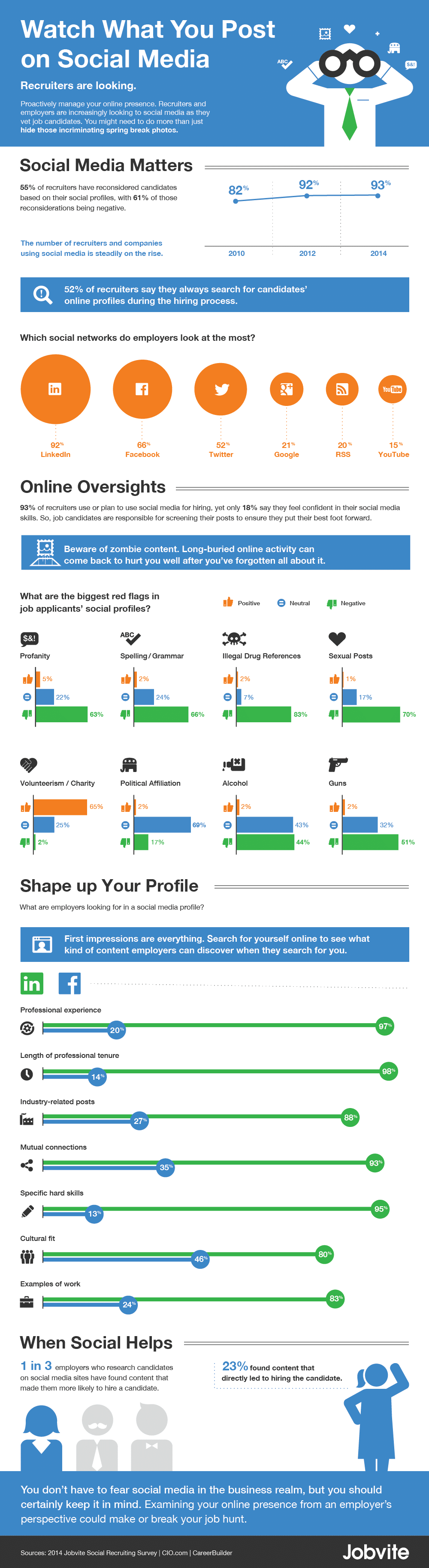
On the flip side, companies continue to give high marks to volunteerism efforts. It was interesting to see that 1 in 3 organizations have found information about a candidate on social media that made the candidate more favorable. I would expect that number to continue to increase as more recruiters utilize social media.
So as fast as the working world is moving, there are some things that stay the same. Individuals should ask themselves, “Is this what I want to be known for?” because social media is part of your personal brand.
Related posts from HR Bartender:
![Reactions to Job Seekers Social Media Activity [infographic] – Friday Distraction](https://i.gr-assets.com/images/S/compressed.photo.goodreads.com/hostedimages/1428973635i/14509969.png) Reactions to Job Seekers Social Media Activity [infographic] – Friday Distraction
Reactions to Job Seekers Social Media Activity [infographic] – Friday Distraction
![Recruiters: Target Your Audience [infographic] – Friday Distraction](https://i.gr-assets.com/images/S/compressed.photo.goodreads.com/hostedimages/1428973635i/14509970.png) Recruiters: Target Your Audience [infographic] – Friday Distraction
Recruiters: Target Your Audience [infographic] – Friday Distraction
 Job Seekers Research Companies Before Applying – Friday Distraction
The post Companies Pre-Screen Candidates Using Social Media [infographic] – Friday Distraction appeared first on hr bartender.


April 2, 2015
If You’re Being Investigated by Human Resources – Ask #HR Bartender
During my human resources career, I’ve conducted more than my fair share of investigations. Some that turned out to be nothing and others that has serious consequences. Needless to say, investigations are not fun for anyone involved. Today’s reader question deals with handling the situation.
I was recently promoted to the top sales rep at my company!
Last week, I made a sale and submitted the paperwork for processing. Now the customer is stating we never met. In fact, the customer sent a letter to the accounts receivable department stating that we never met. The customer’s letter was sent to HR and now HR is questioning me. How do I handle this?
Obviously, we don’t know enough about the specific situation to know what the customer is thinking and/or doing and whether a policy or procedure was broken. That being said, it can be a serious shock when an employee finds out human resources is investigating something that involves them – whether they are the focus of the investigation or just that their name has come up in conversation.

Because investigations can have consequences, I asked a labor attorney to share his thoughts. Mark Neuberger is with the firm of Foley & Lardner. Mark has shared his expertise with us before. This post about the proper way to terminate someone is one of my favorites. (And please remember that Mark’s comments should not be construed as legal advice – you know the drill.)
Obviously, you work with human resources regularly during investigations. What should employees remember when they’re asked to meet with HR regarding an investigation (regardless of their involvement)?
 Every employee has a duty to reasonably cooperate with an employer’s investigation. For an at-will employee (no written contract) at a private sector employer, failure to reasonably cooperate with your employer’s investigation could be grounds for discipline or discharge.
At the same time, an employee should quickly assess whether they are being interviewed as a witness or as a target for wrongdoing. If the employee suspects they are the target of something that might constitute criminal conduct, they would be well advised to immediately consult with an attorney. However, contrary to popular misconception, a private sector employee has no federal constitutional rights against their employer and, therefore, no right to have an attorney present during employer interviews. Employees who work for any entity of federal, state or local government have an entirely different set of rules, because they, unlike private sector employees, have constitutional rights.
A big concern for employees when they speak to human resources is confidentiality. Can you share some insight into how confidential investigations are conducted?
No investigation will ever be 100 percent confidential. The person you talk to will eventually have to report it to someone else higher up in management. The question is whether management is taking reasonable steps to keep those in the know in a very tight circle. Shame on the company that doesn’t try to do its best in this regard.
As much as we in HR tell employees to keep a matter confidential, it seems like stories will start floating around the office. If an employee is approached by a co-worker and asked what happened during the investigation meeting with HR, is there something an employee can say?
In another job, I used to sit right outside of the HR manager’s office. Merely by watching who went in and out, I was sometimes able to figure out what was going on. So again, nothing will ever be 100 percent confidential.
The best thing employees can do is not gossip and speculate. I understand that saying that is much easier said than done. However, in the end it is most likely another employee and not the company that will be harmed by the gossip mill so try to respect your co-workers’ concerns.
Another concern for employees is retaliation. If an employee feels they are being retaliated against because they’ve spoken to HR, what can they do?
Whenever an employee is interviewed as part of any investigation, the employee should ask ‘If I am in any way retaliated against, who should I tell?’
In this situation, a customer is also involved. If an employee feels a customer isn’t telling the entire story, could they address the situation with their manager or HR? Wouldn’t that just come across as sour grapes or making excuses?
The employee should be candid with management. When a customer is involved, unfortunately many times, a business might tend to want to keep the customer happy to the detriment of the employee. When I worked in a supermarket during high school, the manager repeatedly told us ‘the customer is always right.’ What is almost always a bad idea in this situation is for the employee to pick up the phone or send off an email to the customer and start ‘mixing it up’ with the customer. That will almost always end badly for the employee.
Many thanks to Mark for sharing his expertise with us. Staying calm, cool and collected is a worthwhile strategy. If you want to get more insight from Mark and the other attorneys at Foley, be sure to check out their blogs.
Image courtesy of Sharlyn Lauby
Related posts from HR Bartender:
![Terminating Employees: How To Fire Right [free resource]](https://i.gr-assets.com/images/S/compressed.photo.goodreads.com/hostedimages/1428973635i/14509977.jpg) Terminating Employees: How To Fire Right [free resource]
Terminating Employees: How To Fire Right [free resource]
 Defining Employment at Will – Ask #HR Bartender
 Discrimination Against Parents At Work – Ask HR Bartender
The post If You’re Being Investigated by Human Resources – Ask #HR Bartender appeared first on hr bartender.


March 31, 2015
The Only 3 Reasons to Hold a Business Meeting
Business meetings are the bane of our professional lives. According to The Muse, managers spent between 35 – 50% of their time in meetings. That’s a pretty significant number.
You might be saying, the answer to this is get rid of meetings. But here’s the thing. I doubt that meetings are going away. The definition of meeting is “a coming together of two or more people, by chance or arrangement.” People will still get together to accomplish stuff. That’s a meeting.

Some companies feel the way to reduce the number of meetings is to attach rules or guidelines to them. For example, companies will abolish meetings on Tuesdays. I can’t help but think they’re in essence saying, “Schedule the meeting on Wednesday.” Meaning, they really aren’t impacting the amount of time in meetings. They’re just taking one day off the meeting schedule. Or what about the organizations that mandate 10 minute meetings. Aren’t they really telling employees, “Have all the meetings you want, just make them all 10 minutes long.”
These rules or guidelines don’t fix the real issue. The way to fix our problem with business meetings is to run better meetings. Starting with the reason a meeting should be scheduled in the first place.
I’ve never heard a person complain about a meeting that was essential. Granted they might complain about the way it was conducted. I’ll save that for another post. But as a general rule, people do not complain when the reason for scheduling the meeting is legit. And they will always complain if the meeting was called and could have been handled with an email.
In my experience, there are only three reasons to hold a meeting.
The first reason to hold a meeting is to provide information. Those regularly scheduled department meetings are a perfect example. The purpose of those meetings is to provide information. The reason they’re so dreaded is because, when there’s nothing to convey, the meeting still happens.
Same with networking meetings. These are useful, valuable opportunities that participants should covet. Despite what someone says, those synergy calls when one person talks the entire time are not networking meetings. They’re really sales presentations.
Brainstorming meetings are another type of meeting designed to provide information. Brainstorming often gets a bad rap because people use the time to also evaluate ideas, which is contrary to the whole brainstorming concept.
The second reason to hold a meeting is to create a mechanism for decision making. One of the most important decision making meetings in business is strategic planning. The organization is developing their goals and direction. Other types of decision making meeting are pitch meetings, where individuals or organizations are pitching their ideas and project meetings, where groups are tasked with accomplishing a goal or task.
The last reason to hold a meeting is to allow for feedback and discussion. Before you ask, I do view feedback a bit different than information. Feedback is a reaction to a product or performance used to ultimately create improvement. The first type of feedback meeting that comes to mind is the focus group. Whether it’s internal or external, focus groups are completely about providing feedback.
Employee coaching meetings are another form of meeting. It can be to tell an employee they’re doing well or to share concerns. But it is a meeting. There’s also training meetings. When training is done properly, it’s about creating a safe environment where individuals can learn, practice, and receive feedback.
There are only 3 reasons to hold a business meeting
Click To Tweet
One of the best skills to have as a working professional is the ability to run a good business meeting. Employees who have this skill will be able to gather groups and engage their talents. The first step is knowing when to call the meeting.
Image courtesy of Sharlyn Lauby
Related posts from HR Bartender:
 Getting Things Done On a Limited Budget
 Being Strategic and Creating Strategy Aren’t the Same Thing
 Is Transparency a Buzzword?
The post The Only 3 Reasons to Hold a Business Meeting appeared first on hr bartender.


Sharlyn J. Lauby's Blog

- Sharlyn J. Lauby's profile
- 10 followers

