
Ripley Entertainment Inc.'s Blog, page 471
July 13, 2016
“Dead Cat” Taken to GSPCA Was Less Than It Appeared
Featured in Ripley's Believe It or Not!

Let’s say you live in a small community, an island maybe. You’re driving around with the family one day when you see a dead animal on the side of the road. It’s not a raccoon or opossum, it looks more like a pet. It might have been someone’s furry friend, and they could be missing it, worrying sick about where their cat has been.
A lot of people would pass by and think nothing of it. But if you have pets of your own, chances are you know that fear and that worry all too well. Maybe you’d be more tempted to stop, and to collect the poor animal and take it to the nearest vet or animal shelter. While they might not be able to do much to change its status, there’s still always the possibility that the pet was microchipped, and maybe they could give the family peace of mind that way.
The GSPCA
This is what happened on the island of Guernsey. When someone came across a dirty, furry, animal that wasn’t moving, they did the only thing they could think of. They took it to the Guernsey Society for the Prevention of Cruelty to Animals.
By GSPCA
It’s easy to see why they would choose the GSPCA as the destination for this poor creature. The society has been doing amazing things for animal welfare. A few months ago, they rescued a sick and injured loggerhead turtle they’ve named Olivia. In just over four months, she’s gone from weak, hungry, and dehydrated, to happy, healthy, and thriving. And now it’s time for her to be sent to a climate where she can thrive. The team is currently accepting donations to help get her where she needs to go.
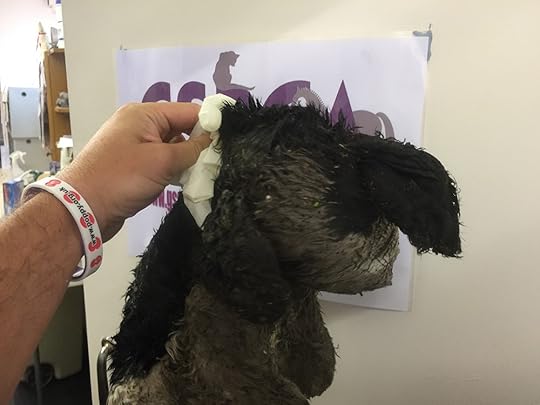
With that kind of record of service, of course someone who has found a dead pet would go right to the GSPCA facility. There was only one problem; the dead cat wasn’t an animal at all. It was actually a stuffed puppet, and even then it was a stuffed dog puppet.

By GSPCA
When the manager, Steve Byrne, took the muddy thing to the back to look for ID, he quickly noticed that it was just a wet and dirty puppet.
When I returned to say what it was, first there was disbelief, and then we had a very light-hearted moment and joked about it and was extremely relieved to find that they had worried over a cuddly toy.
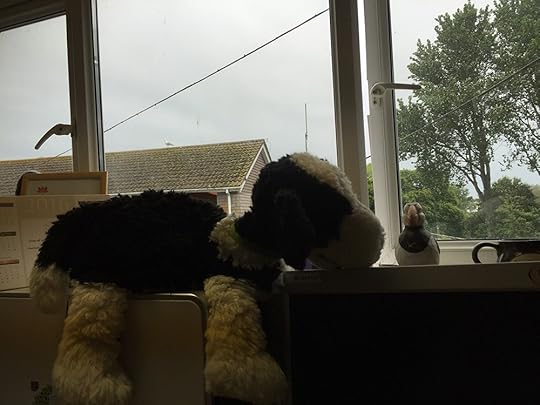
Byrne cleaned the toy up and gave it a forever home at his desk.
By GSPCA
Not the First Time
This story is strange in and of itself, but perhaps even more surprising is the fact that it’s happened before. People in Guernsey seem to love confusing innocuous objects for dead animals.
“A call to a sick seal on a beach was, in fact, a duvet.”
“Also a possible dead dog on a beach was another duvet.”
“A hedgehog rescue once turned out to be a pine cone.”


July 12, 2016
First Ever Real-Life Sighting of Ghost Fish
Featured in Ripley's Believe It or Not!
The Campaign to Address Pacific monument Science, Technology, and Ocean NEeds, or CAPSTONE for short, is a major science dedicated to studying the deepest parts of the Pacific.
Expeditions into some of the deepest waters in the Pacific have been going on this year. The scientists are hoping to gather more information about these ecosystems. Virtually no information has been collected from these places because of how hard they have been to get to.
But with advances in technology comes the ability to go farther and deeper than before.
Along with learning how these ecosystems function and what place each animal serves in them, the researchers have been able to discover new species.
The Ghost Fish

By I, Kmusser via Wikimedia
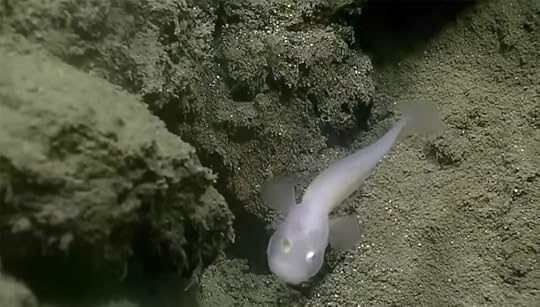
While the ghost fish isn’t a new discovery in the sense of animal life, this is the first time that one has been seen alive.
As a part of CAPSTONE, the National Oceanic and Atmospheric Administration ship Okeanos Explorer has been studying the Marianas Trench.
With a maximum-known depth of 10,994 m (6.8 miles), the Trench is the deepest part of the world’s oceans. It’s located off the coast of the Mariana Islands.
In the deep dark depths of the trench, the scientists are finding new animal life, and shining light, quite literally, on life they already knew existed.
The ghost fish is something that’s been seen before, but never has one been witnessed alive. They live so deep in the ocean that they get no sunlight. This fact probably accounts for their pale ghostly appearance. It’s a fish without scales, and its sunken in eyes completely lack pigment.
It isn’t the only ghostly finding since the beginning of CAPSTONE. In February, a new breed of octopus was discovered. Called Casper, this little guy is equally as pigmentary deficient as the fish.
There’s also the sea pig which tends to be translucent as well.
What will they discover next?

July 11, 2016
There’s Only One Ship in the Navy to Have Sunk an Enemy
Featured in Ripley's Believe It or Not!

The USS Constitution, or Old Ironsides, is the only active ship in the U.S. Navy to sink an enemy vessel in action.
Old Ironsides has held the title since the USS Simpson was decommissioned in September 2015
The ship was built in 1797
It’s seen action in many wars and battles
But since warfare has shifted away from naval battle, no one is sinking battleships anymore
Old Ironsides got its nickname after a fight in which its wooden sides were too hard for British cannonballs to puncture
The ship is still used by the Navy and it’s considered an honor to serve on it
MINI BION
“BIONs” – short for Believe It or Not – is the word we use at Ripley’s to refer to anything that is unbelievable and worthy to become part of Ripley’s lore and collection.
Source: There’s Only One Ship in the Navy to Have Sunk an Enemy
There’s Only One Ship in the Navy to Have Sank an Enemy
Featured in Ripley's Believe It or Not!
The USS Constitution, or Old Ironsides, is the only active ship in the U.S. Navy to sink an enemy vessel in action.
Old Ironsides has held the title since the USS Simpson was decommissioned in September 2015
The ship was built in 1797
It’s seen action in many wars and battles
But since warfare has shifted away from naval battle, no one is sinking battleships anymore
Old Ironsides got its nickname after a fight in which its wooden sides were too hard for British canons to puncture
The ship is still used by the Navy and it’s considered an honor to serve on it
MINI BION
“BIONs” – short for Believe It or Not – is the word we use at Ripley’s to refer to anything that is unbelievable and worthy to become part of Ripley’s lore and collection.
Source: There’s Only One Ship in the Navy to Have Sank an Enemy
The Dancing Plague: Choreomania
Featured in Ripley's Believe It or Not!

From my own experience, I can assert that dancing can indeed be contagious, but could there really have been an outbreak of compulsive dancing across small European villages in the 1400s?
Reports of dancing manias popping up in towns are widespread, ranging from Aachen, Germany, up the Rhine into the Netherlands and Belgium. Some called it St. Vitus’s dance, but it’s become most popularly known as choreomania.

Ripley’s Believe It or Not!
Patient Zero
The first case of dance fever in Europe was recorded in the 7th-century according to the Journal of History and Medicine.
In one case, the group of fervent dancers was made up entirely of children who were said to have traveled 12 miles dancing and leaping before eventually dispersing.
An incident in 1278 led a group of 200 people over a bridge, causing it to collapse. The survivors coincidentally recovered in a church dedicated to St. Vitus.
Why Saint Vitus?
Vitus was the patron saint of dancing in the Holy Roman Empire (now mostly Germany).
Some believed that the dancing plague was a curse cast by Saint Vitus, who would only end the madness if proper prayers were offered to statues made in his likeness.

Historians have drawn parallels between accounts of choreomania to stories about the Pied Piper of Hamelin, a flute player who would lure all the children out of town with a song
Symptoms
Reports of choreomania are varied, with some accounts claiming hundreds of people dancing for months and others merely affecting one person for a few minutes.
All accounts claim that the dancer is in some sort of unconscious fugue state, that makes them unable to control themselves.
Causes
Explanations for choreomania vary wildly, and none are really compelling. Tarantism, an Italian superstition asserts that dancing could separate the venom of scorpions and tarantulas from human blood. Though this could explain the dancing plague, many practitioners later admitted that they were not bitten. We can also attest dancing holds no such healing power.
Another possible explanation is a type of fungus that can grow on rye known as ergot. Ergot, under certain conditions, can produce a compound very similar to LSD. This psychedelic fungus has been claimed by some historians to explain choreomania.

Barley infected with ergot/CC Dominique Jacquin
Some think that dancing outbreaks were the result of mass epilepsy or the work of evil spirits. While historians regular encounter outbreaks of mass hysteria, the persistence of dancing mania makes it challenging to explain. Personally, I think dancing is just innately contagious.
Source: The Dancing Plague: Choreomania
The CIA Invented an Spying Insect Robot
Featured in Ripley's Believe It or Not!

In the 1970s, the CIA developed the Insectothopter, an unmanned surveillance drone disguised as a dragonfly.
The Insectothopter was the size of a dragonfly
It was painted to look like a dragonfly
It was powered by a small gasoline engine made by a watchmaker
And jets of gas were used to propel it forward
Because it was too difficult to control in even a slight crosswind, the project was abandoned
MINI BION
“BIONs” – short for Believe It or Not – is the word we use at Ripley’s to refer to anything that is unbelievable and worthy to become part of Ripley’s lore and collection.

July 10, 2016

Ripley Entertainment Inc.'s Blog

- Ripley Entertainment Inc.'s profile
- 52 followers

