
Ripley Entertainment Inc.'s Blog, page 119
October 31, 2021



October 30, 2021

October 29, 2021
Bringing To Life The Real Dr. Frankensteins
Featured in Ripley's Believe It or Not!

“It was on a dreary night of November that I beheld the accomplishment of my toils. By the glimmer of the half-extinguished light, I saw the dull yellow eye of the creature open; it breathed hard, and a convulsive motion agitated its limbs.”
That is the fictional account of Mary Shelley’s Victor Frankenstein bringing his monster to life.
When asked what inspired her to write her tale of gothic horror, Shelley often says she wrote her book in a frantic, waking dream. What gets oft forgotten is that she and her friends had spent that nightmare-filled night talking about the hot scientific horror of the time: galvanic reanimation.
Harnessing Bioelectricity with Galvanic ReanimationGalvanic reanimation was discovered by Luigi Galvani in the late 1700s. At this time in history, mankind had just begun discovering how to harness electricity. To most people, it was this invisible force, manipulated and understood only crudely by scientists, who were a few hundred years from being able to turn it into more understandable and useful things like light or even heat. Galvani thought electricity might be the key to unlocking the secrets of biology and made a startling, accidental discovery when his electrified scalpel caused a frog he was dissecting to twitch. This put Galvani down a long road of discovering how muscles worked and what electricity could do to animate them.
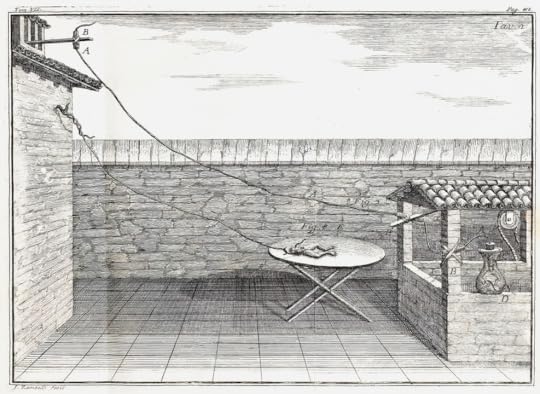
Late 1780s diagram of Galvani’s experiment on frog legs.
While Galvani’s discovery is credited with pioneering bioelectricity, it was his nephew who would take galvanic reanimation to a whole new level. Entering the world of scientific academia when he was a teenager, Giovanni Aldini learned much from his uncle. Where Galvani stopped with frogs, however, Aldini experimented on much more advanced animals and even humans.
As Aldini learned that he could stimulate different muscles with electric probes, his mastery of biology grew. Eventually, his demonstrations were turned to the public, and he would lug giant batteries from town to town to demonstrate the effects of electricity. Audiences would look on in awe and horror as he cut the heads off of dogs and oxen, then proceeded to make them spasm and twitch with the invisible energies of electricity.
His most famous experiment occurred in London, 1803, resulting in the notoriety that would make him the real-life scientist to inspire Shelley’s creation, Victor Frankenstein.
A Criminal ManipulationA man named George Foster had murdered his wife and child. After making a confession, he was sentenced to execution and dissection. Shortly after being hung, his body was carted in for a demonstration by Aldini. The scientist took to the project with ease, demonstrating his ability to manipulate the body. Here’s an account from the Newgate Calendar, 1803:
“On the first application of the process to the face, the jaws of the deceased criminal began to quiver, and the adjoining muscles were horribly contorted, and one eye was actually opened. In the subsequent part of the process, the right hand was raised and clenched, and the legs and thighs were set in motion.”
People witnessing the demonstration feared Foster would be returned to life. What if electricity was a tool of satanic powers or the energies of a divine creator wielded by mortal hands? Would Foster be the anti-Christ, returned to life?
Beyond spiritual fears, some pondered what that would mean for his death sentence. If Foster returned to life, was his death sentence already served? Would the criminal be free to go?
The Smile DoctorAll across the world, people considered the ramifications of reanimation, but Aldini wasn’t troubled by any of this speculation. Aldini knew he wasn’t bringing anybody back to life. He reiterated that his goal was not to meddle with the dead but to actually find ways to manipulate the living.

Demonstration of the mechanics of facial expression. Guillaume Duchenne and an assistant faradize the mimetic muscles of “The Old Man.”
Aldini would go on to work on electrotherapy, his work leading to modern treatments of muscle spasms, paralysis, and pain in which electricity is sometimes used today. Guillaume Duchenne would later refine this research — although photos from his studies are horrifying. However, all he was doing was stimulating different muscles in the face to make his patients smile.
Aldini definitely inspired the mad Victor Frankenstein, but the real man wasn’t pursuing the secrets of reviving the dead; those experiments actually came after Shelley’s literary warnings.
To find the grisly work inspired by Frankenstein’s madness, we have to fast-forward to Soviet Russia in the 1940s. Then, scientists endeavored in procedures documented in a film called “Experiments in the Revival of Organisms,” and fair warning, these experiments were gruesome.
Dabbling in Autojektor ReanimationEmpowered by Stalin’s Soviet party, Dr. Sergei Brukhonenko developed a device called the “autojektor,” which could artificially force the lungs and heart of a dead organism to begin working again.
In his experiments, Brukhonenko was able to reanimate a dog’s head using the autojektor to supply oxygenated blood. The Soviet doctor decapitated animals for his experimentation and could keep them alive for hours using his techniques. Though the realities of the film remain dubious, there are accounts from Americans claiming to be present for the procedures and who maintain the machines worked.
Brokhonenko was awarded the Lenin Prize after his death and is credited for developing procedures for open-heart surgeries. As for the autojektor, a version meant for humans remains on display at the Bakulev Center of Cardiovascular Surgery in Russia.
So, what do you think of these actual Frankenstein-esque doctors? Grisly horror? Curious science? Or maybe a bit of both? Share your thoughts in the comments below!
EXPLORE THE ODD IN PERSON! Discover hundreds of strange and unusual artifacts and get hands-on with unbelievable interactives when you visit a Ripley’s Odditorium!Hong Kong Bus Tour Company Puts Passengers to Sleep
Featured in Ripley's Believe It or Not!

Do you struggle to get a good night’s sleep? Let the motions of the open road lull you to bed aboard Ulu Travel’s five-hour bus ride to nowhere!
Inspired by a friend’s sleepless struggles, Ulu’s marketing and business manager, Kenneth Kong, dreamed up the perfect solution for stressed and sleepless patrons. The Bus Sleeping Tour gives patrons the unique opportunity to catch some Zs aboard the city’s longest bus route, a 47-mile journey around the Tuen Mun highway and North Lantau Island.
“When we were brainstorming new tours, I saw a social media post from my friend saying that he was stressed out by his work, he couldn’t sleep at night,” Kong told the Associated Press. “But when he was traveling on the bus, he was able to sleep well. His post inspired us to create this tour that lets passengers just sleep on the bus.”
The Low Cost of a High-Quality NapSleeping in style doesn’t come free, but it does come cheap, with ticket prices ranging from $13 to $51. This double-decker bus features four different cabin types, including the “Zero-Decibel Sleeping Business-Class Cabin” and “VIP Panorama Cabin” on the upper deck, with the “Zero-Decibel Sleeping Economy-Class Cabin” and “Extra-legroom Cabin” on the lower.
However, if you’re expecting a bed set up on the bus, you’ll be disappointed. The VIP Panorama Cabin offers one reserved seat per passenger, while the other three are first-come, first-served, with passengers getting a comfy two seats per person. All options do come with a Free Bus Sleeping Gift Set, complete with an eye mask and earplugs!
Hong Kong tour company launches 5 hour/47 km bus ride, just for passengers to sleep on the bus.
The company noticed patrons falling asleep on its buses and launched the tour for people who can’t sleep at night. Tickets range from $13 to $51 per person. pic.twitter.com/Lu4oIcRx06
— Thos Major (@ThosMajor) October 27, 2021
All tours to Snooze City begin at a restaurant, where sleep-deprived passengers prime themselves for the nap of a lifetime with a two-course “food coma lunch.”
While passengers in the Zero-Decibel cabins are encouraged to cruise and snooze for the duration, the tour also offers stops at various scenic sites, including Butterfly Beach, Inspiration Lake, and “very secret sights,” for those hoping to see more than their inner eyelids.
Sleepless in Hong KongThis isn’t the first time Hong Kong has drummed up a special encounter for insomniacs. In 2018, SLEEEP became Hong Kong’s first licensed capsule hotel, offering sleepy city-dwellers eight wooden pods outfitted with beds and ambient lighting to get some shut-eye in.
Embed from Getty Imageswindow.gie=window.gie||function(c){(gie.q=gie.q||[]).push(c)};gie(function(){gie.widgets.load({id:'fz4mAEvwRiBONSWqzcja4Q',sig:'duxqw_g2jCO1phZ47CiLB0YGqY_yrVysJhwKCnvMxaM=',w:'594px',h:'382px',items:'1092991258',caption: true ,tld:'com',is360: false })});
According to a 2020 poll conducted by the Chinese University of Hong Kong, almost 7 out of 10 citizens surveyed had insomnia resulting from a mix of pandemic, social unrest, and work-induced stress.
With a population of 7.4 million people and only 1,000 kilometers of land, Hong Kong’s density has resulted in tiny apartments, long commutes, and hoards of citizens running on fumes.
Additionally, the city is one of the most light-polluted places globally, making the night sky glow about 1,000 times brighter than average and resulting in excess artificial light that reduces sleep quality.
Considering that last Saturday’s inaugural ride sold out, we’d say this tour may be what Hong Kong sleepy citizens’ dreams are made of!
By Meghan Yani, contributor for Ripleys.com
EXPLORE THE ODD IN PERSON! Discover hundreds of strange and unusual artifacts and get hands-on with unbelievable interactives when you visit a Ripley’s Odditorium!
October 28, 2021
Return Of The King (Of Pudge) At Katmai’s Fat Bear Week
Featured in Ripley's Believe It or Not!
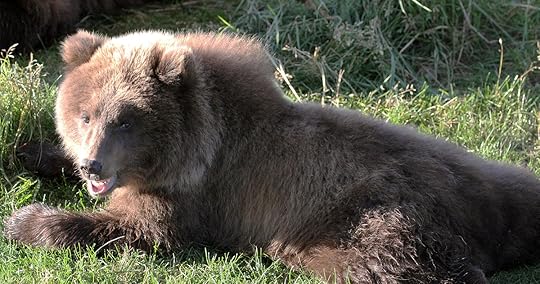
Every year, Katmai National Park and Preserve in Alaska hosts a one-of-a-kind competition, and it’s not for the faint of appetite. Aptly titled “Fat Bear Week,” it involves identifying the roundest, most rotund, and rapacious brown bear in the park. And because the bears spend their time gorging on 4,500-calorie salmon, these teddies can get downright portly.
The ursine feast results in critters exceeding 1,000 pounds as they prepare for hibernation and the ultimate winter slumber fest. People from all over the world watch the competition’s progress via the internet, and a lucky few get to see the events unfold in person.
This year’s winner has proven an unlikely competitor, 480 “Otis.” Despite three previous wins, he showed up thin and late this year. Many of his teeth were missing or worn down, and yet he still gobbled up the win.
Here’s what you need to know about this fascinating competition, how it started, and what to look for in future events.
Junk in a Furry TrunkGetting ready for months of hibernation during Alaska’s notoriously frigid winters isn’t an easy task. It requires dedication, determination, and even talent. No bear better exemplifies this spirit than 480 “Otis,” who showed up for this year’s competition downright gaunt. (We’re talking countable ribs.) But he, like his ursine compadres, quickly made up for the situation, devouring salmon obsessively to reach unfathomable body masses approaching a belly-busting 1,500 pounds!

2021’s Fat Bear Week winner 408 Otis on July 26 and September 16. Courtesy N. Boak and C. Spencer.
Unlike many humans who agonize over gaining a few pounds or inches around the middle, bears must embrace the weight gain. After all, getting fat, and we mean really fat, is key to their survival. And to do this, bears must hone their fishing skills. That’s how a bear with the odds against him, like Otis, can make up the difference. He’s both patient and quick, which translates into a daily sushi feast and the fast route to chub-town.
How the Hefty Competition StartedHow did the whole Fat Bear Week get started in the first place? The inaugural event took place in 2014 as a single-day event — Fat Bear Tuesday. (Move over, N’Awlins!) But organizers soon realized the concept proved so captivating it required seven full days, according to the Washington Post. With more fat bear fanfare and content, Katmai National Park soon realized they had a ballooning (along with the bears’ waistlines) phenomenon on their hands.
Park officials have titled the event a “celebration of success and survival,” and they invite people to “fill their brackets” and vote for fat bear favorites from the end of September through the beginning of October. According to Katmai, roughly 2,200 bears live in the region. Which, needless to say, makes for some hefty competition. But the park’s location helps competitors tremendously, boasting one of the “largest, healthiest runs of sockeye salmon left on the planet” (via NPR).

Bear fishing at Katmai National Park and Preserve. NPS/Lian Law
New to 2021, the competition has added an extra category for competitors: Fat Bear Junior. This event let four “chubby cubbies” get in on the fun, too. The inaugural winner was Bear 132’s spring cub, who won over the internet with their extreme fluffiness.
The attention surrounding the event has caused tremendous growth in the pool of voters the park attracts. This year, the park received nearly 800,000 votes, attesting to the power of adorable animal pictures. The immense success of Katmai’s Fat Bear Week has the added bonus of raising awareness about the plight of salmon and brown bears in Alaska.
By Engrid Barnett, contributor for Ripleys.com
EXPLORE THE ODD IN PERSON! Discover hundreds of strange and unusual artifacts and get hands-on with unbelievable interactives when you visit a Ripley’s Odditorium!Source: Return Of The King (Of Pudge) At Katmai’s Fat Bear Week

October 27, 2021

October 26, 2021
From Cretaceous To Famous: The Story Of Big John The Triceratops
Featured in Ripley's Believe It or Not!
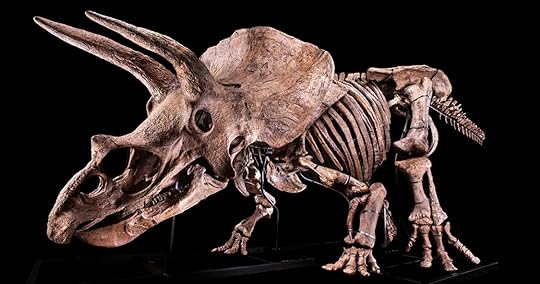
Sixty-six million years ago, real-life monsters roamed the Earth, including Triceratops. Although many people discount them as peaceful herbivores, a confrontation with one of these heavily armored and spiked creatures wasn’t for the faint of heart. According to famed paleontologist Bob Bakker, “Without doubt, the most dangerous devices for active defense among the Dinosauria emerged in Triceratops.” Think rhinoceros on steroids.
But while many portions and pieces of Triceratops skulls and skeletons have been discovered over the years, few have captured the public imagination like Big John. The largest known Triceratops ever recovered, here’s what you need to know about this marvelous monstrosity.
The Resident of LaramidiaThe life story of any fossil begins with its death. In the case of Big John, his bones turned up in South Dakota’s Hell Creek Formation in May 2014. According to The Science Times, Big John lived on Laramidia, an island continent “formed during the late Cretaceous era when shallow seas flooded most of the central North American region.” What sets Big John apart from other Triceratops remains?
With a body measuring 26 feet long total, Big John’s skull alone spans 6 feet 7 inches wide and 8 feet 7 inches long. His two most prominent horns come in at a whopping 3 feet 7 inches long and nearly a foot wide at the base. What’s more, they could withstand 16 tons of pressure. That’s one giant lizard! Beyond his impressive size, this iconic Triceratops also represents one of the most complete sets of dino remains ever unearthed, roughly 60 percent whole. Paleontologists have recovered more than 200 bones, including a nearly complete skull.
Embed from Getty Imageswindow.gie=window.gie||function(c){(gie.q=gie.q||[]).push(c)};gie(function(){gie.widgets.load({id:'YoSu6k4TQV1bGaflGadteQ',sig:'Xx5wN_U-8g08MLeRDaWWGEVArCu9caHAbKAuf3a88wM=',w:'594px',h:'396px',items:'1234976408,1234976564,1337454527',caption: true ,tld:'com',is360: false })});
Of course, all of this begs the question. What sent Big John to his grave? The answer to this question is something scientists continue to wrestle with.
Bones That Tell a Dramatic StoryResearchers hypothesize his death occurred about one million years before the great extinction that punctuated the Cretaceous Period when a massive asteroid struck the Earth. Although scientists can only speculate about what ultimately killed the beast, they know that a blanket of mud swept over his corpse. Followed by successive layers of river sandstone, these sediments made Big John a well-kept secret for tens of millions of years.
Besides knowing where Big John died, his skeletal remains speak of a challenging and hard-won existence. Evidence of superficial trauma abound on his remains, including puncture wounds and scars to the right side of his skull. He also bears a bony lesion on the right side of the collar, which researchers believe came from the horn of another Triceratops. Whether they fought for food, territory, a mate, or something else, we’ll never know. But based on Big John’s size alone, researchers think his competitor likely fared far worse.

Triceratops such as Big John represent an incredible feat of bioengineering. Over the millennia, they developed the girth, armor, and weaponry necessary to survive in a world populated by some of the deadliest predators ever. (Hello, T. Rex!) It’s little wonder that a magnificent specimen like Big John continues to fascinate the public today. After all, he used his stone-hard horns, shield-like head, and unparalleled size to overcome enemies, assert his dominance, and stay alive.
The news that this mighty lizard was up for auction had the rare collections community all abuzz. Although by no means the first specimen to hit the auction block, the excitement that was created over the Cretaceous king was palpable. The attention surrounding Big John highlights a fascinating and recent intersection between the natural world and the art world. Collectors from New York to Paris, Tokyo to Hong Kong are investing in these ultimate status symbols, creatures of imposing size and millions of years of age.
Of course, Big John checks all the right boxes. Though he was estimated to sell for $1.4 to $1.8 million, the Triceratops left Paris’s Drouot auction house at a price tag of $7.7 million. Managed by the specialist auctioneers Giquello, the winner of Big John remains a private, anonymous U.S. buyer.
A representative for the buyer, Djuan Rivers, said “It’s being acquired by an American collector… absolutely thrilled with the idea of being able to bring a piece like this to his personal use.”
By Engrid Barnett, contributor for Ripleys.com
EXPLORE THE ODD IN PERSON! Discover hundreds of strange and unusual artifacts and get hands-on with unbelievable interactives when you visit a Ripley’s Odditorium!Source: From Cretaceous To Famous: The Story Of Big John The Triceratops
Going Sky High On Slovenia’s Trampoline Bridges
Featured in Ripley's Believe It or Not!

Nine years ago, an idea spread like wildfire across the internet, a trampoline bridge over Paris’s River Seine. Although the concept soon went viral, it remained unrealized until 2021. That’s when the guys at Dunking Devils (DD) Squad decided to run with it, and then some, in Slovenia. Not only did they officially build the first trampoline bridge, but they clinched the record for the world’s biggest trampoline, too.
Their construction didn’t stop there, though. They added three professional trampolines to the mix, setting the stage for an entertainment spectacle like none other. Here’s what you need to know about these record holders and the incredible freestyle trampoline competition that showcased their one-of-a-kind efforts.
Bouncing Around LjubljanaPeople flock to Slovenia for many reasons, from the delicious wines of the Vipana Valley to the relaxing thermal baths of Dolenjske Toplice and the ethereal caverns of Postojna. In 2021, tourists added the trampoline bridges of Ljubljana to these postcard-worthy activities. So, how did this Slovenian metropolis clinch a construction project intended initially for Paris? Like France’s famed “City of Light,” Ljubljana is renowned for its many bridges — 25 to be exact — spanning the width of the Ljubljanica River.
These bridges provide access to various parts of the city for bikers, pedestrians, and drivers. Some of these structures also prove picturesque, like the Triple Bridge of Jože Plečnik, considered the highlight of a visit to Ljubljana. Despite all the bridge action, only two bridges have ever permitted individuals to bounce as high as 35 feet in the air. These temporary enormous bridges sat next to one another, inviting regular folks and free-flying performers alike to reach new heights on August 20 and 21, 2021, during the Bridge Bounce Ljubljana.
The Bridge Bounce Ljubljana in 2021To bring the Bridge Bounce Ljubljana event together, the DD Squad joined forces with the event agency Extrem. Their goal? Creating an event that would not only amaze and thrill vast crowds but allow them plenty of opportunities to hop along. Akrobat, a Slovenian trampoline maker, brought the technical aspects of the project to life, and the tourism boards of Ljubljana and Slovenia threw in their full support along with many smaller partners.
Constructing two trampolines proved essential to achieving the joint goals of entertaining the masses and enticing them to participate. The first trampoline measured 75 feet long and invited spectators to get in on the jumping. For two days, more than 5,000 people took advantage of the bouncing structure, logging more than 80,000 jumps. As for the second bridge, this larger professional structure contained Olympic-grade trampolines, including a freestyle trampoline and something called “the Supernova,” a behemoth unmatched on the world stage at 42 x 42 feet. It took five days to erect both structures. What’s more, it involved 1,600 square feet of trampoline bed, ten metric tons of aluminum, and 15 cubic yards of safety padding.

Just a few of the thousands who jumped across the trampoline bridge. Image courtesy of The Dunking Devils.
The World’s Best Freestyle Trampoline ArtistsRemember that iconic line from Field of Dreams: “If you build it, they will come?” Turns out that old-school wisdom isn’t just for dead, shoeless baseball players. Building the most impressive trampoline setups in the world attracted the world’s best freestyle athletes. People came from Sweden, the Netherlands, Austria, Denmark, and many other nations. Think of it as the trampoline equivalent of the “Small World” ride at Disneyland. Besides the draw of record-breaking trampolines, these competitors wanted to show off their skills and win big.
Craziness ensued as the competitors hit the bridge, ready to thrill and astound the thousands of spectators in attendance. Intricate moves included everything from triple and quadruple flips to massive jumps that launched participants upwards of 35 feet into the atmosphere. Who came out top dog? Jože Plečnik of DD Squad dominated the Supernova Best Trick competition. And Sebastian Wennmalm of Sweden rocked the freestyle trampoline competition as well as the highest jump despite being just 15 years old.

The Dunking Devils catching some major air. Image courtesy of The Dunking Devils.
The Future Looks High for DD SquadThe Dunking Devils have made their reputation on innovation coupled with adrenaline-spiking performances. But what do they have planned for the future? They would like to take the concept behind Bridge Bounce Ljubljana to other nations around the world. DD Squad has already started eyeing Paris’s Eiffel Tower and the Dubai Foundation Walk Bridge in front of the Burj Khalifa. Although plans have yet to firm up, one thing’s for sure: The future looks high for this cutting-edge and entertaining crew of trampoline aficionados!
By Engrid Barnett, contributor for Ripleys.com
EXPLORE THE ODD IN PERSON! Discover hundreds of strange and unusual artifacts and get hands-on with unbelievable interactives when you visit a Ripley’s Odditorium!Ripley Entertainment Inc.'s Blog

- Ripley Entertainment Inc.'s profile
- 52 followers

