
Greg Mitchell's Blog, page 13
May 25, 2012
First Look--RIFT JUMP!
Behold!

This incredible piece was digitally painted by Marvel Comics colorist Thomas Mason. Thomas never ceases to amaze me with his ability and eye for detail. Visit him on his Facebook page. Befriend him--he does commissions!
Michael and Sara--the heroes of Rift Jump--have been with me since I was a meek and gangly high schooler, doodling comic book superheroes in the margins of my homework. To see them come to life like this is a dream come true. It's one of those moments when I wish I had a time machine to take this back to my younger self and give him something to look forward to.
The novel comes out in July from Splashdown Darkwater. It's a bit of a departure from The Coming Evil Trilogy, but I hope everyone gives it a look. Expect a rip-roaring ride of angsty teen romance, bizarre creatures, and comic book-style action! In the meantime, I direct you to my initial announcement of the book where you can get further details on this crazy new adventure through the multiverse!


May 4, 2012
Endnotes: Dusty Duck
DUSTY DUCK
Following many setbacks and a seemingly exceptionally long waiting period, the What's the Story feature returned to StarWars.com with the winners of Round 6. Having been very frustrated with the waiting process (and griping quite a bit about it, I'm a bit embarrassed to say :p) I was just happy and relieved to see that an update had been posted at all. When I saw that the first entry was dubbed "Dusty Duck", I looked to my wife and said, "Oh, they used my name for the ship". Imagine my shock when I realized that the judges had, in fact, used my entire entry!

I was really excited to see that 99% of my entry was used, word for word. There was only one "story change", but we'll get to that later.
Here's the breakdown--excerpts are taken from the original Dusty Duck databank entry:
Aneesa Dym was a Pa'lowick born and raised by her smuggler father on Nar Shaddaa.

Although I wasn't the most well-versed guy when it came to the Expanded Universe that encompassed all the games, novels, movies, cartoons, trading cards, comics, etc--I hadn't really heard of a lot of Pa'lowick characters. Pa'lowicks, as you may or may not recall, first appeared in Return of the Jediin the form of Sy Snootles, a space-y lounge singer for Jabba the Hutt. I can count the number of Pa'lowick characters that exist in Star Wars on one hand--and most of those followed in Sy's footsteps of being singers. I hadn't discovered any Pa'lowicks who were smugglers, so I thought it would be a nice change and break the species stereotype.
Nar Shaddaa originated in the pages of the Dark Empire comics and is a rough place for a kid to grow up--a far cry from the small agricultural community of Lowick (where most of the other Pa'lowicks in the galaxy are born and raised).
She helped him pilot a ship of his own design that he had dubbed the Dusty Duck, named partly for the waterfowl of Naboo and for the ship's penchant for coughing to a halt in space and coming in for a rough landing on many barren worlds. "Duck's not meant for flying," he'd often say. "At least, not for too long."
The idea of naming a ship "Dusty Duck" was hilarious to me. I guess that's just a throwback to pirates having ridiculous names for their ships in movies or something. I wanted a name that was personal and warm and not a typical ship name like "the 85LZ-Whatever". Also, I noticed a trend. There was the Millenium Falcon. The Moldy Crow. The Ebon Hawk. So, I wanted something that had the same structure as these names, just...well, silly. And, since ducks are kind of a running gag throughout anything George Lucas touches, I thought "Eh, why not?" The only problem was coming up with a reason to name a ship after a duck. I came up with this little quote to, not only (hopefully) deliver a laugh, but show that the father loved this ship, despite its flaws, which is a recurring theme in this story...
When Aneesa's father was stabbed in the back by an angry customer, Aneesa became the sole crewer for her late father's gigantic jalopy and scoured the galaxy for the scum that left her an orphan. Her search led her to many backwater planets but time and again her hunt would come up empty.
So the father dies and Aneesa is left with the family business. It's a scary position to be in, but she tries her best. Though...she could use a little help.
Then bounty hunter Rango Tel entered the picture. Tel heroically cornered the murderer of Aneesa's father in a cantina and bested the villain in combat, collecting the bounty. With this act of bravery, Tel stole the heart of Aneesa Dym. She offered him her piloting skills and the Dusty Duck and, together, the duo set off across the galaxy in search of Tel's next bounty, Kam Nale.
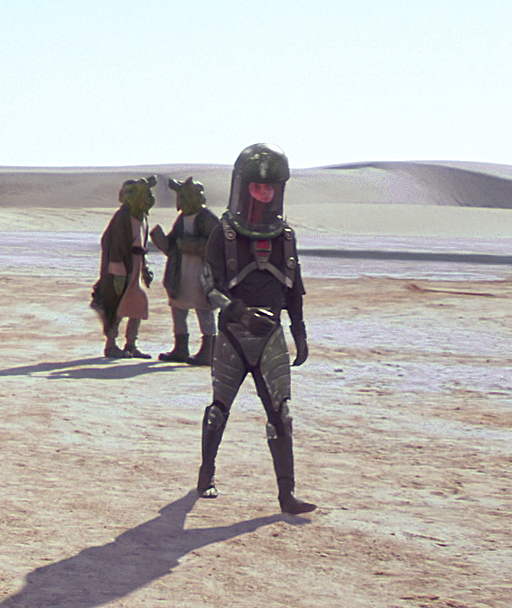
When I decided on the silly name for this ship, I knew I had to have something equally silly to go along with it. Enter: Rango Tel. Many Whatsthestoryists try to tie into each other's creations, building a mythos within a mythos, as it were, and I'm certainly no different. Rango Tel was actually one of the earliest entries picked for What's the Story and was instantly likeable. The tale of the bounty hunter wannabe was personable, funny, but ultimately tragic and I remember his creator Aaron Sinner upset that he had created this great character but killed him off his first time out, thereby ending any hope he had of any further EU adventures.
Well, this one was for you, Aaron.
I talked about the theme of this entry before and here's where it really kicks in:
Everybody needs somebody. No matter how much of a dork you really are, you need a friend who will love you in spite of that. Luckily, I have an amazing wife, two beautiful daughters, and great, loyal friends who all love and support me, despite my craziness. Rango Tel was a bumbling kid who got a lucky shot and had ill-fated delusions of grandeur because of it. However, to Aneesa, he was brave. To her, he was a hero. As you can guess, the "villain he bested in combat" in this entry is the same guy he "inadvertently score[d] a bounty on" in Aaron's original entry. I saw Aaron's entry as the true version of the facts, but wanted to write my entry through Aneesa's rose-colored view of this man who avenged her father (however accidentally), which accounts for Rango sounding a lot tougher in this entry than he really, probably, was.
Rango and Aneesa are kind of in the same boat. They're both young and lost, looking for something to do with their lives. Now, they've found each other and have decided to take that journey together. So, Rango's got a faithful friend who adores him and a rickety ship, ready to begin his life as a "daring" bounty hunter.
Their search led them to Tatooine. Aneesa drop-landed the Duck just outside Mos Espa and waited onboard for her valiant defender to collect the head of Nale, as her newly purchased DUM pit droids tended to much-needed repairs on the ship.
However, while Tel was away, an image of the Dusty Duck was captured in the dying camera eye of a Sith probe droid destroyed by a fleeing Qui-Gon Jinn and Anakin Skywalker. Darth Maul, the probe's owner, followed the trail to the Dusty Duck and boarded, demanding a very startled Aneesa to tell him where the Jedi was. A confused Aneesa had no answer for the fierce Sith Lord.
This is where we get to the Dusty Duck's appearance in The Phantom Menace deleted scene. Rango Tel heads out for his big job (from which he'll never return) and Aneesa stays behind to watch the ship.
 I love Darth Maul. I think he's one of the most underused baddies in all of Star Wars, so racking up one more kill for him was a great thrill for me. In the deleted scene, Qui-Gon strikes down the probe droid following he and Anakin back to the Queen's ship. Darth Maul only sees them fleeing and thinks they are headed for the Dusty Duck, which accounts for why he's a bit behind the duo and almost misses his opportunity to make a good first impression when we see him in the movie.
This is also the only part of my story that was actually changed. Originally, Maul enters the ship and demands to know where "the boy" is, meaning Anakin. Aneesa thinks he's referring to her friend - the brave and dangerous bounty hunter - and refuses to give up that information in order to protect Rango. Maul cuts her down for her insolence. The changes were made and, yeah, Aneesa might not have gotten her heroic death but I can see that my claiming Maul was really on Tatooine looking for Anakin was overstepping my boundaries so I can live with the decision to change it to Maul just looking for "the Jedi" (though, now that I think of it, I think I nicked that idea from the New Essential Guide to Chronology written by Dan Wallace to begin with).
Darth Maul cut her down. The Duck remained abandoned and became the talk of local ghost stories. The pit droids remained, operating on their last command and rebuilding the ship to perfection. However, sadly, it never flew again.
It's a sad ending. But Rango got a sad ending, too, so it's sort of poetic, if not grim. I actually thought it might be harder for Aneesa to have lived withoutRango, so, in the end, their friendship was not broken. They entered death together.
Having the Duck being a local ghost story is a real treat for me, as a horror writer and fan. I love a good urban legend and being able to add one to the Star Wars galaxy was pretty cool. I can almost hear all the little Tatooine kids daring each other to sneak up and touch the underside of the Dusty Duck.
Most recently, the Duck popped up in Ryder Windham's outstanding The Wrath of Darth Maul book. Will we see the old bird again one day? I hope so. If I have any regrets about the entry, six years after it entered the hallowed halls of canon, it's that I never gave Aneesa's poor father a name! I offered a possibility (Neeamesh), in a completely UN-official short story I wrote for the Star Wars Outsider fanzine, but it would be lovely if some Star Wars author took pity on me one day and gave Papa Dym a proper name :)

May 1, 2012
Interview with Robert Liparulo--Author of "The 13th Tribe"!
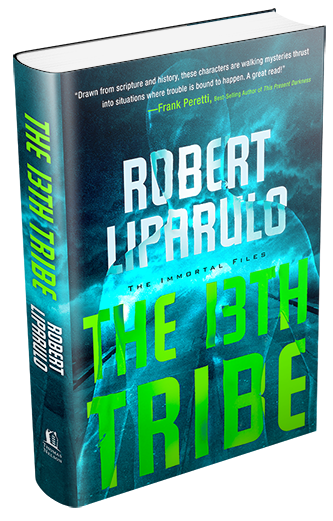
Greg Mitchell: So we’ll start off with an easy one. Who are you and what’s The 13th Tribe all about?
Robert Lipraulo: I’m a former journalist, who worked in the fields of celebrity profiles, business writing, and investigative reporting. I wrote my first novel, Comes a Horseman, eight years ago. The 13th Tribe is my eleventh novel. I’m also a screenwriter. I wrote the screenplay for Ted Dekker’s Blessed Child; I’m contracted to write the scripts for several of my own books; and I’m working with Andrew Davis (director of The Fugitive and The Guardian) on an original political thriller.
The 13th Tribe can be summed up in two words: Immortal vigilantes. A group of people who were “cursed” with immortality because of their transgression at the golden calf are trying to regain God’s favor by killing sinners. Now they’ve targeted a major city, and only one man can stop them—if he can overcome his own brokenness and anger at God.
But, really, it goes much deeper. It explores our struggle to grasp God’s holiness; our stubborn belief in “earning” God’s favor, though we know better; and how even our good intentions can be twisted when we insist on abiding by our own limited logic instead of God’s righteous wisdom. All of this in a story filled with the action, cutting-edge technology, and complex characters my readers have come to expect.
GM: Now this is the first of a series. How many do you have planned? Do you have a sort of overall story you’re trying to tell or this more in the vein of a “series of standalones”?
RL: Right now, I’m planning on three books in the series, with the possibility of more. I’m writing them as standalones, but the characters continue through all of them—the ones who survive, anyway. I recommend reading them in order to get the full picture.
GM: Where did you get the inspiration for The 13th Tribe?
RL: Some time ago, I started thinking about vigilantism, frontier justice. I think most of us would say we’d do something to stop, for example, a child abuser, even if we have to go outside the law to do it (assuming all other recourses have failed). But what are the ramifications of that . . . to society? To our souls? It’s a scary door to open. The best way to examine a topic is to exaggerate it, or look at how it functions under extreme circumstances. I wanted to look at vigilantism that way: an exaggerated reason to be a vigilante . . . how far could you take it . . . what do you become if you practice it over a long period of time?
You can’t think too deeply about taking the law into your own hands, about hurting people before they can hurt others, without eventually getting around to thinking about the nature of forgiveness and grace. So now there’s God, filing off the edges of my story, shaping it into something bigger than it was before.
GM: One of the things that really sticks out to me about the story is your, I guess, “embellishment” of a Biblical account—in this case you’ve given a twist to the story of Moses returning from Mount Sinai to find that Israel has turned into a bunch of cow-god worshipers. I think it’s really cool, but I could see where some might see this as crossing a line, theologically speaking. How do you address that? Do you feel that there is a line that can be crossed, or is it all up for grabs in fiction?
RL: Well it is fiction—speculative fiction, at that. I consulted a lot of theologians about the incident at the gold calf. Many of them have theories about the details of what happened at the golden calf, based on what we know about the Israelites and the culture back then. The line for me was that I didn’t want to contradict scripture in any way. For example, if scripture says a biblical figure died, I didn’t use that figure as an immortal. The embellishments at the gold calf are all supported by scholars’ theories; they could be real. We just don’t know, but they don’t contradict what we do know.
GM: You have an incredible resume with your previous novels and The Dreamhouse Kings series finally wrapped. Did you learn anything about series-writing, in particular, that you’re bringing from DK to The Immortal Files? How to keep the tension going from book to book, tying up loose ends, etc?
RL: The Dreamhouse series and this one are structured very differently. I saw the Dreamhouse story as one long story broken into six books. Going from one book to the next, is very much like flipping from one chapter to the next. The Immortal Files, on the other hand, are each complete stories. Each book, while retaining some of the same characters, locations, and the “world” created in the first one, has its own story, its own problem and resolution. What I learned from Dreamhouse was how to cover a bit of backstory without boring readers who already know it, and how to continue character growth by building on what came before.
GM: You’ve said before that your previous work, while in the CBA, hasn’t been what some would consider “blatantly Christian”. In fact, I’ve heard you talk about some people even asking you what’s “Christian” about your books. But, with The 13th Tribe, you’ve taken a different route—writing something more extroverted when it comes to its themes of faith. I find this really interesting as it seems to me that more authors want to go the opposite way. That is, they’re billed as “Christian Fiction” writers, but they start trying to pull away from that market to go mainstream and less obviously Christian. Was this a conscious decision on your part, or was it one of those things that just happened?
RL: I’ve always tried to follow God’s leading in how I tell my stories. When I started Comes a Horseman, I prayed and fasted about how much overt Christianity to put into it. One morning, I was looking at Pikes Peak and I heard God speaking to me. He said, “Do you see me in that mountain.” I said, “Of course, I see you in everything.” He said, “Do you see my name carved into it?” “No.” “That’s how I want you to write your story.” So, I believe God is in my earlier books in ways that I could not have possibly written Him into them. And readers have responded, telling me that scenes comforted them and got them thinking about God—and none of it was intentionally written into those scenes. In fact, if the Holy Spirit weren’t pointing it out to them, readers wouldn’t have seen it at all.
When I was preparing to write a book about vigilantes, I heard God telling me it was time to be more overt about the spirituality. Following His calling, the story exploded into an examination of faith and justice and grace, and the idea of the Tribe fell into place. But despite the faith elements becoming more prevalent, I’m still a thriller writer, so making The 13th Tribe a Christian thriller felt very natural.
I don’t think Christian authors should necessarily try to fit into a particular market, whether that’s Christian or mainstream. They need to follow their hearts, where they feel God leading them. If that means having strong spiritual content or addressing faith more subtly, then that’s what they should do.
GM: I very much agree. Do you feel that there’s a stricter standard with fiction that falls under the “Christian Fiction” category? Do you feel that it’s judged harsher by its readers and/or its detractors? Do you feel that there should be a higher standard?
RL: There are different categories with different standards. Until recently, the standard for the quality of writing in Christian fiction was lower. It used to be that pastors and theologians composed the bulk of “Christian” novels, and the emphasis was on the message, not the writing. But can you imagine the quality of work Jesus put into his carpentry? I wouldn’t doubt that the things he made are still around today. I’m glad to see that the overall quality of writing is getting better in Christian fiction.
As writers writing about Christian things, we better have our own theology down pat. In that sense, we are held to a higher standard when representing Christian belief, as we should be.
There will always be detractors of all things Christians. No author likes negative reviews, but I tend to chalk up the ones that blast the fact that there are spiritual aspects in my stories to people who don’t have the eyes to see. It’s a part of writing in this field, with the label “Christian,” that will never change. I try to take those kinds of hits in stride.
GM: What drives you from book to book (other than paying the bills, I’d imagine!)? Do you ever feel like leaving writing behind and striking out on your own in television repair or refrigerator installation? What keeps you coming back to this job?
 RL: I’ve been writing and publishing since I was twelve. I know, without a doubt, that this is what God made me to do, how He wired me. I told my wife before we married, “Financially, we may always struggle, but I will always write. That’s what I do. I can’t do anything else.” Thankfully, she accepted that and has been my biggest supporter for twenty-five years. There was one time early on when I was tempted by an offer of big money to go into another field. I prayed about it and decided I would never stray from my calling. I think God has blessed that decision.
 GM: Thank you so much for taking the time out of your crazy promotional tour to talk with us. What’s next up for Bob Liparulo?
RL: Thank you for doing this, Greg. Wonderful questions! The sequel to The 13th Tribe is in the can, and I’m onto the third book. I’m also working on the first book of my next YA series, called Hunter. When I have a spare moment (ha!), I’m pushing the scripts I’m committed to writing a little further down the pike. It’s all great fun, really.
GM: That's all we have time for now. Thanks to everyone for stopping by, and be sure to go check out The 13th Tribe--in stores now!

April 30, 2012
Endnotes: Silya Shessaun
SILYA SHESSAUN
 Silya Shessaun was a Senator, originally appearing in
Star Wars Chronicles: The Prequels
and later in a deleted scene from Episode III: Revenge of the Sith. Had the scene remained, you would have met her in the funeral scene for Anakin Skywalker's star-crossed counterpart Padmé Amidala. Her name is a tuckerization of Lisa Shaunessy, the Lucasfilm publicity assistant who cameoed as her in the film.
Silya Shessaun was a Senator, originally appearing in
Star Wars Chronicles: The Prequels
and later in a deleted scene from Episode III: Revenge of the Sith. Had the scene remained, you would have met her in the funeral scene for Anakin Skywalker's star-crossed counterpart Padmé Amidala. Her name is a tuckerization of Lisa Shaunessy, the Lucasfilm publicity assistant who cameoed as her in the film.I was at my in-laws' house, eating supper with my wife, and had somehow convinced them all to play Star Wars Trivial Pursuit Saga Edition with me (oh yeah, I smoked them). I took a break from the festivites to check to see if the latest round of What's the Story winners had been selected. My wife was looking over my shoulder as I checked...and then I saw my name at the bottom of Silya's entry. I sat there for long moments, elated and relieved.
"Though she was extended an invitation to the Delegation of 2,000, she declined. She felt that undermining the Supreme Chancellor during such trying times was tantamount to a Separatist act." (taken from the original Silya Shessaun databank entry, 2006)
With those words, I became a Star Wars "author" and Silya Shessaun's life took a dramatic turn.
My contribution to this character is comparatively small. To the best of my knowledge, Hyperspace member Twi'LekEntertainer did the bulk of the work, laying the groundwork and creating the heart and soul of Silya while fellow members ShadowCultist, Master Starkeiller, and I (writing as "HedecGa") got to add moments in the senator's life that shaped her fate.
Nevertheless, discovering that I had a hand in creating this character was a defining moment for me.
For my part of the entry, I wanted to show a Senator who, in her heart was prime Rebel Alliance material and who, in fact, had many good friends who had already joined, yet she was unable to for very real, ethical reasons. Was she right in standing by the Republic during hard times? Could she have made a difference from within, or was rebellion utterly necessary? One of my favorite exchanges in Episode III is when Padmé is confiding in Anakin that she wonders if they're fighting on the wrong side of the Clone Wars, and Anakin tells her that she's "starting to sound like a Separatist". I thought that was a really intriguing paradox and wanted to explore that in my small portion of Silya's story. Silya was faced with a tough ethical question with no easy answer.
 Also, it always struck me as a bit unfair to assume that all good, noble, just senators joined the Delegation and formed the Rebellion and all who sided with Palpatine were crooked, conniving evil senators. The focus of my original submission for Silya was that she was good and noble but sided with Palpatine. Not because she liked the guy, but because she felt the Delegation wasn't the right way to end the war. I'm very happy that that aspect was selected for the final entry.
"Winning" Silya is a moment that still gives me chills. I am very thankful to God and the WTS judges for allowing me to be a small part in her life. At the time, I was fully willing to kick back and rest on my laurels, and had all but given up on ever contributing to that galaxy far, far away again. But little did I know that, in a few short months, I would see my dreams further realized.
Stay tuned for Part 2...

April 24, 2012
Interview and Book Giveaway
In the meantime, I have been hard at work on editing Rift Jump, my newest book to be released by Splashdown Darkwater this summer! It's grueling work and I hope that you all enjoy meeting Michael and Sara and following them on their wild ride through the multiverse :)

April 16, 2012
Completed "Dressler Cycle" Live at Avenir Eclectia!
Thanks to Grace for the opportunity to play in her universe. I imagine I'll write more AE someday, but it was important to me to finish Dressler's story and present it to you all.
Episode One: Bedtime Stories
Episode Two: Only the Strong
Episode Three: Dark (FLASHBACK)
Episode Four: Contact
Episode Five: Gettin' Crazy
Episode Six: Separation
Episode Seven: Making the Run
Episode Eight: On the Eve of the End
Episode Nine: The Last Fight (Part I)
Episode Ten: The Last Fight (Part II)
Epilogue: More Bedtime Stories
Want to know more? Take a peek behind-the-scenes of the creation of the Dressler Cycle over at the Inside Avenir Eclectia blog:
Inside "Bedtime Stories"
"Bugs! Giant Killer Bugs!"
Thanks to those who followed along on Dressler's harrowing voyage, and to those about to make the trip for the first time :)

April 13, 2012
"Enemies of the Cross" Commentary (Part V)
Part II
Part III
Part IV
Happy Friday the 13th or, what I call, Jason Voorhees Day! (:p) Here we are--our final installment in the commentary for Enemies of the Cross. By now you should know to beware of spoilers but today's topic covers a HUGE spoiler, so I stress:
MAJOR SPOILERS BELOW! READ AT YOUR OWN RISK!
...still here?
You sure?
Okay. Don't say I didn't warn you.
Today we tackle a controversial topic. In The Coming Evil, it's already been established that faith (yes, specifically, the Christian faith--this is a "Christian Fiction" book) is the only weapon that will defeat the enemy. In The Strange Man, that was demonstrated by Dras quoting Scripture as a sort of ward, but, as with everything in Enemies, we crank that thought up a couple notches. We've got Isabella quoting verses and this light bursts forth from her--at one point, she literally breathes fire!
When my editor read those passages, he said, "Greg, you have to be careful, or else this is going to look like magic." A valid point I suppose, but my response went something along the lines of "Yeah. Pretty cool, huh?" Faith is not "magic"--but then again, isn't it kinda? Isn't real-life faith our connection to a supernatural being? Isn't it by faith that God can accomplish miracles through us, channeling His divine Earth-forming, dead-raising power to achieve His will? "Magic" is an ugly word because people connect it to the occult, but isn't faith a kind of "good magic"? Well, that's a point to debate for another day, and would probably just devolve into worrying over wording, but here's how I look at it. It's two-fold:
The "in-universe" explanation is this: The invisible is being made visible in Greensboro. Demons are appearing in physical form, either bound in leather or as hordes of tiny, hairless gremlins. Sin, itself, is making an appearance as a viscous black goo that consumes people. Doesn't it stand to reason that the things of God would also start manifesting in visible form? This is like the End Days for Greensboro--all the stops have been pulled out and it's a time of miracles and terror. So don't look at it as "magic" (if that offends you), look at it as the unseen being made seen. The veil separating the two worlds has been pushed aside.
The "real world" explanation is this: In spiritual warfare novels like this, we always heap gobs of cool special FX type stuff on the demonic--why can't the holy have just as cool, exciting, and dynamic visuals? If Christians confess that "our God is an awesome God", why can't we show that in the same type of creative ways we show the demonic? My longer answer to my editor went something like "Why does the devil get all the cool stuff? God should have cool special FX too."
I want this trilogy to be a summer blockbuster with lots of effects--but effects on both sides of the spiritual war, hence fire-breathing Christians.
The other heavenly aspect I added to the mythology with Enemies was angels. Yes, Christopher Perdu is an angel. "Perdu" actually means "out of sight"--meaning he was invisible the whole time. That's why you never see him eat, no one talks to him but Hank, and he has to scoot out of people's way when they march in his direction.
 Unfortunately, Enemies is coming out after a show called Supernatural and their trenchcoat-clad angel Castiel. I fear folks will think I ripped it off, especially considering I've gushed about that show a time or two on this very blog. But, in fact, the idea for Christopher dates back--like most everything else in The Coming Evil--to 1998. I wrote a short film that I was hoping to shoot (yeah, that didn't happen) called "To Serve and Protect". It featured a quartet of plainclothes angels that operated like cops. They did wire tapping, had cell phones, wore trenchcoats, etc. Again, those were meant to be symbolic representations of what was going on in the heavenlies--in other words, our minds perceived a cell phone, as an analog to some angelic power we couldn't naturally comprehend. At the time, I really liked that script and liked the idea of these "working class" angels, shuffling around on Earth, fighting the battle, but in a quiet, super-spy kind of way.
When Enemies came around, I knew I wanted to bring angels into the mythology, so I created Christopher very much in the same mold as the "To Serve and Protect" angels. In fact, I'd go so far to say that they all know each other :)
 My inspiration for Christopher beyond that goes back to my old favorite The Twilight Zone. In the episode "Nothing in the Dark", Robert Redford appears as a nice young man with an angelic secret.
I love Robert Redford. The Way We Were is a perfect movie and Sneakers is one of my favorites. He's got such an easy-going, suave, natural quality about him. So, not-very-subtly, that's why everyone comments that Christopher looks like Robert Redford :p
We'll be seeing even more of the heaven-side of the spiritual war going on in Greensboro in The Coming Evil, Book Three!
But, for now, this concludes our commentary for Enemies of the Cross. Some of you might be saying "What? That's it?" Alas, I could write a seemingly endless array of commentaries on all the themes and elements of Enemies. I think there's a lot to this book that's worth discovering--but part of the fun is discovering for yourself. I'd love to hear your thoughts about what you uncovered in this book: what themes or characters or ideas spoke to you?
Nevertheless, if you still have burning behind-the-scenes questions you need to know, feel free to visit our comment section and I will do my best to answer! Or perhaps you've yet to read the book, but now your interest in piqued. The book is available at your local bookstore as well as Amazon, Barnes & Noble, Kindle, and Nook!
Thanks for reading our commentary. We'll reconvene when The Coming Evil, Book Three: Dark Hour takes over the world! In the meantime, I leave you with a fond Friday the 13th farewell. Here's the teaser trailer for Jason Takes Manhattan. A wonderfully terrible film, but this trailer was my very first exposure to that lovable hockey-mask wearing lug--and it scared the crap out of me!

April 12, 2012
"Enemies of the Cross" Commentary (Part IV)
Part II
Part III
SPOILERS BELOW
Welcome back to the penultimate installment of our Enemies of the Cross commentary!
Today we discuss the black goo.
After reading the previous installment of our commentary, you might be thinking that I just totally ripped off the X-Files by having a secret conspiracy covering up a mysterious outbreak of mutating black goo. Not so! That's actually an amazing coincidence.
The origins of the black goo predate The Coming Evil entirely and was inspired by a surprising source.

Back in the early '90s, I was big into Spider-Man comics. One character that really jumped out at me was the villain Venom. For those who haven't read a comic, Venom is actually an alien symbiotic goop-thing that bonds with some poor dolt and corrupts his mind. I remember reading a comic where Spider-Man is attached to this thing (actually, to be fair, I think it was Carnage--Venom's eviler twin or something, but it's the same idea). This sticky goop was whispering to Spidey to "Kill. Kill. KILL!"
Flash forward to that Sunday in church and the pastor's talking about "the flesh" that we struggle with, meaning our own evil desires. Our base impulses. We struggle against "The Old Man"--our old selfish ways of thinking before we come to Christ. The way he kept describing "The Flesh", it almost sounded like this separate, sentient entity. With Venom still fresh on my mind, I juxtaposed the two and considered being covered in this second skin--a flesh--that whispers in your ear to cut loose and do all the things you don't figure you're supposed to do as a "good little Christian".
Since I was but a wee tot, the werewolf has been my favorite monster. The Incredible Hulk was my favorite hero. Both deal with the duality of man--our evil impulses and that other Voice that urges us to do good.
I really liked my Venom-as-sin concept and years later even used it as an example in teaching Sunday School classes to our Youth Group :p When The Coming Evil finally came about, I realized I wanted to introduce more types of monsters into this series--but not just traditional monsters. I wanted whole new breeds of creatures that are unique to this series. Thus, we have what happened to Ray McCormick.
The goo is simply sin in its purest form, corrupting everything, telling us to do terrible things. It's something we all struggle with. Jeff's feelings in this book are so personal to me. I have a terrible temper that I keep bottled up inside and it comes out at strange times and I'm instantly ashamed. Like Jeff, I can relate to having a beast inside, wanting to be loosed. Perhaps that's why I've always identified with the Wolf-Man and the Hulk. I understand the duality of man all too well.
In the struggle, though, I think we find some incredible stories. I've grown so fond of the "sin goo" concept, that it's become a factor in my larger mythology. We'll certainly deal with it some more in the concluding chapter of The Coming Evil Trilogy, but--much to my surprise--it's already crept up in one other story. I love the battle of good versus evil--and what greater battle is there than what wages in the heart of Man?

April 9, 2012
"Enemies of the Cross" Commentary (Part III)
Part II
SPOILERS BELOW!
It was the summer of 1998, I believe. By request of my friends, I entered the theater to see a movie that would have a massive impact on me.
Behold:

Of course I knew what X-Files was. Everyone in the '90s "knew" what X-Files was, but I'd only seen a handful of episodes. I understood the premise, but didn't know anything about Skinner or the Lone Gunmen (I have since been enlightened). I didn't want to watch the movie because I was for sure I'd be lost--but I went anyway. And I had a spectacular time.
"Trust No One", conspiracies at the highest level of government, eyes everywhere watching you, even your closest ally could be against you--exciting! I loved the moody paranoia.
It was this atmosphere that would eventually seep its way into The Coming Evil mythology in the form of the Committee.
The Committee didn't appear in the earliest drafts of the story. They actually originated in a short-lived sequel concept I had that would have taken place after the entire trilogy. Originally, the Strange Man would have shoe-horned his way into Greensboro. For the sequel I had this idea that one of my surviving cast would move to another town and, lo, the Strange Man is there too.
Yeah, it wasn't very original. It was a fairly dreadful script. But the twist for that script was, what if the Church simply stepped aside and allowed the Strange Man to enter? I thought that was a powerful statement on how the Church concedes on so many battles and compromises so many convictions, that we--by our inaction--allow Evil to march in and take over. I trashed that script, but liked the idea of the Church essentially inviting the Strange Man. It struck me, "Why save this for later? Let's just use it in the trilogy!"

I don't think I was purposefully channeling the X-Files when I wrote them. But, that amazing day in 1998 when I had my mind blown by the movie (and what an incredible score and soundtrack!), crept into my writing. It wasn't until my wife looked at me and said, "You do know you just wrote the X-Files." that it became clear what I was doing. Oh. Well, okay. After that, I just embraced it.
One draft saw even more betrayal--I had briefly considered Jeff's own father, Jack, being a member of the Committee, but quickly ditched that. There is so much corruption in Greensboro, including within Jeff's own heart, that I wanted to keep someone as the beacon of light in town. I needed that person to be Jack.
When reading Book One, some people commented on things they saw as logic flaws. "How come the deputies nearly beat Dras to death over a suspicion? Isn't that overreacting a bit?" "How come the Rave Scene is still open, even though the sheriff declared a curfew?"
Well, the answer is simply: The Committee. It's my hope that people will re-read Book One in light of the Committee's involvement, paying special attention to the scenes with Leonard Fergus. The scene where he witnesses the gremlins passing down his street (and the particular words he says) were always designed to retroactively hold new meaning now that Readers know the truth of Fergus' alliances at that point.
I've come to understand that the entirety of The Coming Evil Trilogy is about youth. Book One was about being a young kid just beginning to mature (as evidenced by Dras). Enemies of the Cross is about adolescence. The loss of innocence. The beginning of rebellion against the status quo. When we're small children, we think that adults know everything and can always be trusted--when we become adults ourselves, starting with our teenage years most times, we begin to think no one has any idea what they're doing. We're all just struggling to carve out our path.
That's ultimately what the Committee represents: the mistakes of the previous generation and a charge to Youth to decide how they are going to do things differently...and seeing if they can stay to that path.
In our fourth installment we'll explore the origins of the mysterious black goo!

April 4, 2012
"Enemies of the Cross" Commentary (Part II)
SPOILERS BELOW
In our second installment, we meet Danny Carpenter--the new addition to our cast.
 Ideally, I always saw Danny as played by Norman Reedus. In a lot of ways, Danny is a sort of Dras v2.0--which is subconsciously why Jeff wants to help him. He's a dreg of society, a fool, someone that everyone has counted out, and nobody would suspect he'd ever rise to a heroic occasion.
But Danny proves them all wrong.
I've known a lot of Dannys in my life. Drug addicts that have struggled with their demons and have bouts of tremendous faith and courage and decency. Sometimes they have stayed the path, other times they've fallen back into their addictions. I've known them to hit their wives, neglect their children, break their father's heart--but I've also seen them care for the innocent, stand up for the rejects, and fight for their beliefs. I've never known them to just be "bad people", but rather conflicted people. I think they can be capable of great things if given the chance, and that's what Danny represents.
He is not a good guy. He's a drug dealer, a wife beater, and general blight on the face of society. But Jeff befriends him and, through that friendship, Danny begins to want to change.
I took a little bit of flak for The Strange Man with Dras. Dras spent the earlier part of the book as a drunk (though I never envisioned him an alcoholic--just a young partyer) and layabout. Some saw his mid-book turnaround to devil smasher unconvincing. Some said "There's no way he'd turn into a good guy so fast." Well, to that I say "phooey". First off, Dras had a solid Christian upbringing. He strayed from that in his young adulthood, but he had that foundation to return to.
Danny had that upbringing to a lesser extent (being partly raised by his grandma), but I've seen his kind of change happen in real life. I've seen a hardcore drug dealer turn their life around in a single night. Yes, the shadows of their old life linger and they struggle with it for the rest of their lives, but they can change. They do change. It can happen.
Plus, in both the cases of Dras and Danny, I think people discredit their experiences in the book. They are learning that flesh and blood demons are real and in their world and butchering innocent people. I don't care what kind of addictions they suffer from or what kind of attitude they have--most people are going to respond to that. They're going to want to fight that. Fear and righteous anger are strong motivators for change.
What I love most about Danny is that he spends most of the book living more honorably than Jeff--the pastor! Ultimately, that's what Danny is there to show. That we Christians can get so caught up in ourselves and our self-righteousness that we behave shamefully, while "heathens" like Danny Carpenter are actually responding in more Christ-like ways. I've been shamed in my own life by those whom I thought were "not as good" as I was. Also, there are plenty of stories in the Bible of pagans behaving more godly in a situation than some of God's own people. Each time that teaches a lesson and keeps us humble.
Danny inspires us to not count out those we deem as unworthy, but to search our own hearts to see how we have failed, ourselves. All need forgiveness. All need Christ.
In our next installment, we'll peel back the curtain and learn more about those shadowy figures working towards Greensboro's destruction: The Committee!!


