Tsana Dolichva's Blog, page 4
November 2, 2011
Weird Worlds: Kepler 14b
This post follows the same theme as last week's: planets in binary star systems. Last week's planet, Kepler 16(AB)b, orbited two stars which closely spun around each other. This week's planet, Kepler 14b, orbits one star, which in turn orbits another star at a further distance. This paper, by Buchhave et al (2011), is the main source of my data on Kepler 14b.
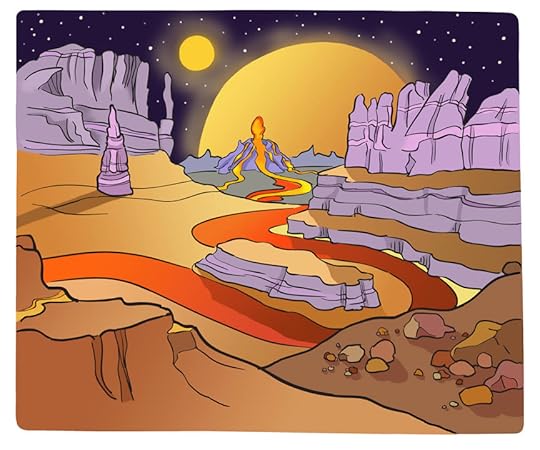 Kepler 14b is unlikely to have any sort of solid surface.
However, the two stars could look something like this. Maybe.
Honestly, I think...
 Kepler 14b is unlikely to have any sort of solid surface.
However, the two stars could look something like this. Maybe.
Honestly, I think...


October 26, 2011
Weird Worlds: Kepler 16
I have talked about the Kepler exoplanet-finding mission in the past (planet spotting, Kepler 11, KOI 730). Today I'm going to look at a planet Kepler has found in a binary star system: Kepler 16(AB)b and next week I'll talk about Kepler 14b which is also in a binary system but in a different configuration.
A binary star system is where two stars are close enough together to be in orbit around each other, instead of individually orbiting the centre of the galaxy. Instead they orbit the centre ...
A binary star system is where two stars are close enough together to be in orbit around each other, instead of individually orbiting the centre of the galaxy. Instead they orbit the centre ...
October 21, 2011
Bunch of links, mostly outdated
First up, square Earth anyone? Forget realism, let's just have a think about what an Earthlike planet would be like if it were a cube. Puts me in mind of the planet builders in Hitchhikers' Guide to the Galaxy. Brought to you by Discovery News.
Second, the Planetary Habitability Laboratory talks about brightnesses of the various planets in the solar system and also of exoplanets. An interesting read, particularly if you enjoyed my old How Bright is the Night? post.
Martian moons eclipse the sun...
Second, the Planetary Habitability Laboratory talks about brightnesses of the various planets in the solar system and also of exoplanets. An interesting read, particularly if you enjoyed my old How Bright is the Night? post.
Martian moons eclipse the sun...
October 19, 2011
Propulsion: Not just rocket science
Spaceships: something's gotta make them go. Even if you have made up a nice way of going faster than light -- wormholes, warpdrives, hyperspace, improbability drives -- there are going to be bits when your characters have to travel more mundanely. You can't go into orbit when you're travelling faster than light. Unless you happen to be inside the event horizon of a black hole, but then you have other problems.
This post is about relatively non-relativistic (yeah, I did that on purpose, so shoo...
This post is about relatively non-relativistic (yeah, I did that on purpose, so shoo...
Propulsion: Not just rocket science
Spaceships: something's gotta make them go. Even if you have made up a nice way of going faster than light -- wormholes, warpdrives, hyperspace, improbability drives -- there are going to be bits when your characters have to travel more mundanely. You can't go into orbit when you're travelling faster than light. Unless you happen to be inside the event horizon of a black hole, but then you have other problems.
This post is about relatively non-relativistic (yeah, I did that on purpose, so sh...
This post is about relatively non-relativistic (yeah, I did that on purpose, so sh...
October 12, 2011
Astronavigation
 Rimmer from Red Dwarf. He went mad in his
astronavigation exam and wrote "I am a fish"
four hundred times. It's not actually that hard.If you want to include space travel in your story, then at some point, some of your characters will need to know about navigating through space. Even if a computer/AI does the actual controlling of the ship, someone probably needs to know the basics. Unless, of course, you want all your characters to fail astronavigation (repeatedly) like Rimmer from Red Dwarf. ...
Astronavigation
Rimmer from Red Dwarf. He went mad in his
astronavigation exam and wrote "I am a fish"
four hundred times. It's not actually that hard.
If you want to include space travel in your story, then at some point, some of your characters will need to know about navigating through space. Even if a computer/AI does the actual controlling of the ship, someone probably needs to know the basics. Unless, of course, you want all your characters to fail astronavigation (repeatedly) like Rimmer from ...
October 7, 2011
Winds of Change finally available for (online) purchase

As the title suggests, it is now possible to purchase Winds of Change, the latest Canberra Speculative Fiction Guild anthology, featuring my short story "Time Capsule". There is a PayPal/credit card button on the CSFG website here.
Table of contents and book trailer are also at that link, and I've blogged about them before here and here, respectively.
 [image error]
October 5, 2011
Let's talk seasons
Depending on where you live, you probably experience two or four seasons a year. Does this have to be the case on planets other than Earth? What causes Earth's seasons and what else might cause seasons on other planets? Read on!
Tilting
Earth spins about an axis that runs approximately from the North Pole to the South Pole. It completes one rotation per day (and, indeed, a day is defined by the period of rotation). the degree of tilt of the axis never changes. This is because one of the fun...
Tilting
Earth spins about an axis that runs approximately from the North Pole to the South Pole. It completes one rotation per day (and, indeed, a day is defined by the period of rotation). the degree of tilt of the axis never changes. This is because one of the fun...
October 4, 2011
More on Terra Nova
I had a few comments on my last post (and a surprisingly large number of hits--who knew writing about something so topical would be so popular?). Although I addressed the questions in the comments section there, I'm not convinced anyone will see them, so I thought I'd repost and expand my responses here.
Stars, not moon
The first comment pointed out that geeky girl in Terra Nova blamed the expansion of the universe for the stars in the sky being in different places, not the moon. My mistak...
Stars, not moon
The first comment pointed out that geeky girl in Terra Nova blamed the expansion of the universe for the stars in the sky being in different places, not the moon. My mistak...