
Jennifer Wilson's Blog, page 5
January 9, 2012


About Mentors
I'm a big believer in finding mentors, and tucking under their wing to learn what they've got to teach you. Usually, this happens organically, when you find yourself paying closer attention to someone's ideas that you admire.
I'm not even sure how I found Jon Franklin's book Writing for Story: Craft Secrets of Dramatic Nonfiction by a Two-Time Pulitzer Prize-Winner. But somehow, I unearthed a very, very old copy of it, and it ended up in the box of the few precious books we took with us to Croatia.

In general, I'm not crazy about books that talk about writing. Mostly because when I find myself reading about writing or talking about writing (or blogging about writing), the further I get from actually writing. But Franklin's book is an exception. It's a crazy miracle that it made its way into the very few possessions that I toted with me across the sea—I'd never read it before, and just threw it in on a hunch. But the clear-thinking ideas he writes about really guided me during the writing of Running Away to Home.
So here's to the people that show us their stuff, so that we can improve our own. For me, that's been Jon Franklin, but also people as far-flung as Stephen King, Seth Godin, Anthony Bourdain and Ann Jones.
It's worth it to seek out those who model a better way. They help us become more connected to that essential spark that fires the doing of what we care about most. Who are your mentors? How have they changed you?
In other news, I'm starting a series of giveaways on the Facebook Fan Page of Running Away to Home. We'll be giving away stuff like free signed copies of the book (this weeks' prize) or a batch of Jim's mom's oatmeal peanut butter chocolate chip cookies. Get on over there and join the fun!
January 3, 2012
Muffy's Story
[Editor's Note: The Secret Lives of 19th Street Hens is an occasional series on this blog. No chickens were harmed during the making of this story. Unless you count an accidental stepping-upon, which just happens sometimes.]
It all began with four tan walls and a bright light. Consciousness was abrupt, jarring. We all hail from Texas, and just two days after the egg cracked en route to a feed store up north, I was cracking, too. There was the press of all that peeping fluff. The uncertainty of our ultimate destination. Giant hands grabbing, always grabbing. We arrived at a post office in Iowa: a box of terrorized chicks, compulsively eating. Some of us were lost in the mail. The trip to the feed and garden store where we'd be sold like chattel was grim.
In this whirl of chaos and uncertainty, my art spirit was born. From the first moment I could form thought, this one never faded: I am a painter.
I calmed when I understood my calling. I remained steady but watchful until one hand grabbed, and it did not let go. This, I have come to know, is The Main Hand. The Main Hand set me inside the tan walls. I was chosen for this life. The light came later.

My prison is my emancipation.
I was joined by five others. They know my work, but they don't necessarily get it. But as Sherwood Anderson wrote in his masterpiece, Winesburg, Ohio: "You must try to forget all you have learned. You must begin to dream. From this time on you must shut your ears to the roaring of the voices."
And so I shut them. So tightly, in fact, that black tufts of feathers have grown from the sides of my head, and it would appear to the ill-informed that I am wearing earmuffs. I am not. But I am painting. Every day. Using the only medium that is amply available to me: Poop, spread with a piece of straw, upon any surface I can reach. That usually means under the walkway to the laying area. I can think there. Plus, the other chickens are usually on the roost above me, and they leave a great deal of "medium" within easy reach.

Walking the yard and seeking inspiration. If you ever meet my mother, please show her this photo and assure her I am fine.
I do live in fear that The Main Hand will discover what I do. Each morning, before we are allowed out of the coop, I erase evidence of my toils. These paintings are so utterly private, only for us, and we view each piece quietly right after dawn. It's easy to view, discuss, and erase before the day begins to warm—The Main Hand is not an early riser. I paint so that the others can make sense of our existence here. I know they need it, as much as they misinterpret it. I try to act natural as we hustle into the yard.

They'll never know my demons.
What would happen if The Main Hand discovered this subversion? I hope she will understand. I feel that she would: The Main Hand does not peck me like the others do. She throws me sweet things to eat: vegetables, corn, avocado husks. The different foods color the medium, and allow my paintings the depth I seek. So she's in on it, in a way.
Still, I am careful. Every movement outside the coop causes me to fret quietly. If it's not The Main Hand that causes my apprehension, it's the other creatures I've come to know through her names for them: That Damned Cat, The Fucking Squirrel, How Can You Not Love Them Jim.
When the strain becomes too much to bear, I turn to my straw brushes.
A true artist endures.

Dance like no one's watching. Because they probably aren't.
December 28, 2011
A different kind of White Christmas
The first Christmas I spent with Jim's parents in Mason City, I was shocked by the pared-down holiday meal of these quiet Nordic people. I was used to giant platters and casserole crocks strewn over every surface near or in the kitchen of my relatives' homes, and a cavalcade of aunts and uncles stampeding for massive heaps of food, hastily eaten, poorly digested. Mary Ann and Corman Hoff didn't roll that way.
There was baked cod, flaked into a crystal dish. There was hand-made lefse, sort of like a crepe made of potatoes and cream. There were riced potatoes. There was a modest bowl of green bean casserole, heavy on the mushroom soup. To finish, there was kringla, which is a doughier version of a simple sugar cookie. Sometimes it is buttered. The mostly-white food was even arranged in a spare manner: On a white tablecloth, in a darkened dining room, with candles.
After Christmas Eve dinner, Jim's mother gave me a tidily wrapped package containing a pair of black leather Isotoner gloves, which I still wear. Everyone got one modest gift. Later, we went to Midnight Mass.
No, this wasn't the balls-to-the-wall Christmas of my youth. But I was pretty sure by that time that Jim and I were together for the long haul, and so I set about trying to figure out the quiet ways of his startlingly mellow family.
I think the Christmas meal illuminates the Hoff family best. It is relaxed. It is steady. The offerings stayed the same over the years. It is welcoming, even to loudish outsiders who roll in bearing bottles of wine and overdressed for the occasion and wondering where the heck all the food is. Mary Hoff sat with me that night, and we drank just a little of my wine, and she asked me questions and told me about herself. She was very glad I was in her son's life, and that was a first for me among boyfriends' moms. For that, I loved her immediately and wholeheartedly.
That first was the only Christmas Eve dinner I shared with Corman, who died in 1998, the year after I met Jim. He was a quiet man with large hands, tall and smiley, an accountant for the IRS with a dry and intelligent sense of humor. I shared a few more with Mary. Her last Christmas Eve dinner in 2000 was the same menu as always, though she was sick with cancer. Upon her request, Jim and I bundled her up in blankets and drove her around to look at people's holiday lights after we ate. That was as fancy as we ever got on Christmas Eve.
The Hoff Christmas Eve meal was the first time I started really thinking about how food is a connection to where we're from, and to who we are. Corman's family was from Imsland, Norway, originally. We know this because the graves of his immigrant ancestors are in Roland, and it is written on them. Mary was the cook in the house, but Corman always made the cod (the lye-preserved stinkmess of ludefisk was never an option, thankfully). It was his connection to his parents, and Mary honored that. The simplicity of the meal was all Hoff, though. A few good things, done nicely, in a consistently good-hearted spirit.
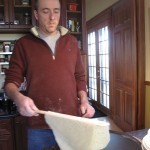
The year Jim's parents were both gone, I bought him a traditional kit to make his own Norwegian lefse. He spent a whole night on the painstaking, hours-long process. Since then, it always seems Jim ends up alone in the kitchen, flipping dough onto a special griddle in silence. Though we eat the meal together, it always seems to work out that it's just Jim and his memories in that kitchen.
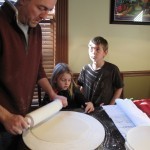
This year, I swore to myself that Jim wouldn't be manning the lefse grill solo. I had a talk with the kids, and we mutually promised Christmas Eve meal preparation would be a group venture. On that day, we gathered in the kitchen and made the lefse together. As usual when you mix grown-ups and kids, there were moments of impatience and gigantic messes, but once we got in a groove, we made a good team. The lefse was more fresh than ever this year–made and eaten on the same day. Hopefully someday, our kids will remember Christmas Eve as a time for simple gratitude and genuine connection, shared in the memory of the good people who have gone before us.
December 22, 2011
Chicken current events
So I bet you're wondering about the chickens.
The chickens are doing great!
All six of those big girls are hale and hearty, though a chickenhawk did try to fly off with the Rhode Island Red last week. She fought the good fight and won, and came away with only a little blood on her comb. I made a few adjustments on the chicken run that Jim and I built, and they've been safely cooped up since.

The black ones are smartest. Red is lucky to be alive.
Yes, you heard that right. Jim is now down with the chickens. The man who swore he had no interest in raising layers was caught last week hand-feeding them his own homemade bread. I am not embellishing this story. I think Jim finally realized they weren't going anywhere, and gave in.
In the past month, we moved the coop to a better windbreak in the yard, put up winter insulation, and built that chicken run. My dad just built some laying boxes for us, because those birds will be laying within the next month (if they know what's good for them). This is the only thing that Zadie has consistently included on her Christmas list. "For the chickens to lay eggs!" in 7-year-old scrawl. Let's hope Santa (and all 6 chickens) deliver soon.

Zadie models Grandpa's laying boxes.
In case they don't get the picture of what they're supposed to do with the laying box, I put a few golf balls in there.

Mother: Just trying to be helpful
I hope it's not a bad sign that this morning, one of those golf balls was all the way across the chicken run, as if it had been physically thrown out of the coop.
December 21, 2011
Up for Air!
Baaaah! Big intake of air! … I've returned from the murky depths of trying to get the word out about Running Away to Home. It's good to be back on the keyboard again. Once you write a book, it seems, all you do is talk about yourself and not write.
Talking about the book for interviews, and pitching to editors and producers, sort of reduces the whole beautiful endeavor to a few brief talking points. "It's about how my family and I sold our stuff and went to the Croatian mountain village of my ancestors" … "We never did get that recipe for rakija, but you can figure it out if you watch YouTube and can speak Bulgarian" … or, my personal favorite, "Well, not everyone can have a cow on the first floor of their house." That was Jim, on CNN American Morning hosted by Christine Romans.
Christine and I went to college together, and we helped run the Iowa State Daily when we were students. She was an enthusiastic interviewer, and made it easy for the two rubes on the couch with her. At one point, when we were in the green room (which is not green), I slipped out to hit the bathroom after my fourth cup of free coffee. When I returned, Jim was talking to Deepak Chopra about the morality of drone missiles. Of course, Jim had no idea who he was speaking with. Here's an excerpt of the conversation:
Jim: "Aren't you nervous?"
Chopra: "No. I do this every day."
Jim: "Ha! Me, too."
So that's doing press for a book. I've posted the CNN interview on the press page for this site. Photos from the weekend in New York with my sweetheart are here. I've posted other various interviews, including Talk of Iowa and All Things Considered, also on the press page, in case you wonder where the hell I've been for the past few months.
What I like best is meeting actual readers face to face. I've done several book signings, and those rock. People ask questions and talk about what resonated for them. Some show me old pictures or books or family keepsakes from Mrkopalj. Some complain that the book is too expensive, and I agree with them. I bring (storebought) rakija and I share, whether they think the book is too expensive or not. Some just want to say thanks for writing it, and I swear those words travel back in time to sustain the sweaty midnight writer who was just putting the finishing touches on Running Away to Home one year ago right now.
It's pretty special to meet your readers, and to know that this thing you did was truly appreciated. It fills up the tanks in a way I've never experienced before.
November 9, 2011
The chickens are all "WTF?" about snow.
What, what, WHAT?
Today is the first snow of the new winter. It's all sparkly and sunny, and the fresh coat of white makes me think of how nice it'll be to kick back and enjoy the holidays. Unlike last year, when I was sweating the deadline for Running Away to Home, among other things.
In addition, today is the very first snow of the chickens' lives.
And they are freaking out.
I let them roam the yard during the day, so they're used to getting out in the morning after I drop off the kids. I like them outside rather than in the coop, though it means I spend a significant portion of each afternoon hosing off things the chickens have pooped upon. My theory: Happy chickens, yummy eggs. We'll see if this theory holds true when they start producing within the next few months.
So anyway, yesterday it was all rainy and gross and I didn't let them out. They really complained when I closed the coop after freshening the food and water, rather than standing back so they can show off for me and fly a few feet on their way out for the day. Chicken bitching sounds a little like saying the word "berk" in a really low voice, without moving your lips.
Try it now.
Yeah, kind of like that.
Today, it was snowy, but my friend Eve assured me that chickens can walk in snow. I did the food and water and stood back. They started to fly out, then, upon landing in snow, they began screaming. Chicken screaming sounds like saying the word "mack" in a really high-pitched voice, without moving your lips.
Uh huh. Like that.
The Ameraucanas, who are by far the biggest show-offs (though a little standoffish), flew too far and got stranded by the fence.
[image error]
Save us from the white devil carpet!
They were so frozen in fear that they even let me pick them up and return them to the flock, which had returned to the coop in a panic.
They've been standing at the coop's threshold ever since.
I felt pretty bad for them, because try as I might, I can't talk to the chickens and explain snow. So I tossed them a bunch of old bread from the book-signing at Eden the other night. Carbs are soothing, right?
Plus, I know how they feel. Everything involved with this first book experience feels so fresh and fascinating (and sometimes terrifying). I'm kinda standing here at the threshold, too, digesting the past month.
Thanks to you, my earliest and best readers, for tossing out those soothing carbs—the many private notes of encouragement and shared excitement, the public words of affection for the book and me. It's all made this brand-new experience less intimidating and more like a monthlong party.
Hey, I'm going to go see if the chickens are still standing in the same spot. It's been 3 hours now.
Yep. They are. I'm sure they'll get used to it all soon enough, and barrel into the next new thing.
November 1, 2011
Interview this author
Tomorrow I'm diving into my first Tweet chat. It's basically an interview with the author, but you do it on Twitter, and anyone who wants to ask me a question about Running Away to Home can do it. It's crazy how readers can connect in so many ways with authors now, and I'm glad to be part of the era. Just today, I tweeted Michael Ruhlman, and he Tweeted back. Twice! I've always liked Ruhlman, whose quiet Midwestern seething makes his friend Anthony Bourdain look like a chipper dandy. Jim says: "He'd make a better Bourdain, and I like Bourdain a lot." Jim's even bought kitchen product from Ruhlman, and Jim hasn't even bought a new shirt in the past year that I know of.
So please join me out there in the social media ether for the Running Away to Home author interview, brought to you by the fine folkstress at Biblio-Files. Ask me whatever you want, really. What does sheep brain taste like? Does Jim have an older brother? Did I really end up liking Mrkopalj? I shall be candid.
You can find the full invitation here, including instructions on how to do it. E-see you tomorrow night at 7 p.m. Central Standard Time!
October 26, 2011
Love on the radio.

Nerdy! And proud. Photo by John Pemble.
It's been pretty cool telling people about Running Away to Home over the course of the past few weeks. I'm really proud of my book. In it, I got a chance to tell a story the way I've always wanted to: As if I were speaking, relatively unedited, to a good friend. That's some fortunate stuff for a writer.
During the publicity blitz, I got a chance to be on public radio. When I was in high school, I was a weekend disc jockey for local Big Band radio station, KCOB/KLVN Newton. I really loved that job, even though the kid got all the crappy hours, eating a Big Mac on Christmas Day in the control room, trying really hard not to feel sorry for myself as the Andrews Sisters sang in the background. I loved reading the news. I loved announcing the weather. I loved telling what little history I knew about the music — "Too Fat Polka" was my favorite song. Maybe a Croatian thing?
I loved working on the radio so much that I would clean the whole first floor of the station during my shift, just so they'd want to keep me there until I left for college.
So being on Iowa Public Radio was a return to this thing that I forgot how much I loved. Have you ever done that? Loved something when you were young, then just sort of forgot it as the years passed by? I loved that hot, close control room. I loved taking a real quick sip of coffee during breaks. (I stole the mug. Sorry IPR.) I didn't feel awkward or self-conscious–which is always the sign that you're doing something right. I've never succeeded in a job or a friendship or a relationship of any kind when I felt overly aware of my shortcomings.
Good friendships, good love, and good job fits always seem to have that sense of ease about them, even though you're working your heart out underneath it all.
October 22, 2011
(Not) making moonshine.
We're using these to make apple vinegar. Or apple cake. Maybe applesauce.
There's a passage in the book where I try desperately to get the village recipe for rakija, the clear-as-water Mrkopalj moonshine that, toward the end of our stay, kick-started my days with my neighbor ladies. (Don't judge. It's purely a digestive.)
No one would give me that recipe. And seriously? We talked about everything together. Everything–except for that recipe. I only knew that in Mrkopalj, it was made from apples. And it tasted like fruity paint thinner. And, as Baka Ana assured me, "Rakija helps a mother through the days."
So, it's been driving me nuts, during peak apple season here in Iowa, that I don't have that rakija recipe.
But there sure is a lot of information on the Internet about making fruit brandy.
It's really not all that hard.
Though, it being a federal offense at all, I would certainly not make it.
Still, it gets a woman wondering. And there sure are a lot of apples around here. …



![[image error]](http://www.jennifer-wilson.com/wp-content/uploads/2011/11/IMG_0922.jpg)
![[image error]](http://www.jennifer-wilson.com/wp-content/uploads/2011/11/IMG_0934.jpg)
![[image error]](http://www.jennifer-wilson.com/wp-content/uploads/2011/10/IMG_77061.jpg)