
M.B. Mulhall's Blog, page 25
April 3, 2012
Guest Post: Marketing, or how I proved the existence of Hell
 Please enjoy this guest post by Justin Ordoñez, author of the YA novel (for 18+ readers), Sykosa. Then read on to learn how you can win huge prizes as part of this blog tour, including $550 in Amazon gift cards, a Kindle Fire, and 5 autographed copies of the book.
Marketing, Or how I Proved the Existence of Hell.
Self-publishing requires either A) no skills and being totally deluded as to the reality of success in the book market, or B) no skills and the reality you're going to have to learn a lot. And that's a simple fact. Between writing, editing, formatting, choosing a printer, choosing retailers, web development, content generation, typesetting, book trailers and the fifty other things I'm forgetting, you're certain to encounter a challenge for which you are in no way prepared, and not only are you not prepared, your desire to become prepared hovers somewhere near the axis of zero.
I discovered mine on January 11, 2012–Marketing.
Marketing's an entirely deceptive term. When a thing is so multi-dimensional and other-worldly abstract, we expect it come coupled with tongue-tying terminology. I mean, who would touch marketing if it was done by someone called a, "Surpurgodunintrihumanthofeelemo-ologist?" (Stands for: "Surveyor, purveyor, and Godlike understander of all intricate human thoughts, feelings, and emotions.") No one. And that's just the beginning! As it's really only one aspect of marketing. You not only need to communicate with the potential book buyer, but with the many marketing channels available, i.e. book bloggers, book reviewers, book recommendation sites, book social networking sites, and many, many more. Essentially, in order to succeed at marketing, when you're not busy being a social butterfly, expanding your pool of contacts and showing a legitimate interest in people's lives, you need to be a socially reclusive, type-A, mega-jerk who produces the stuff that gets sent to all the people who are now your contacts.
As this is seriously an enormously enormous undertaking, I did what I'd advise any author do. Write Novel Publicity and get some help. Now, I know what you're thinking: Problem solved, right? How could it be that marketing is such a huge undertaking you cannot count on Novel Publicity alone? Unfortunately, while Novel Publicity is your access to the market, you are still your own personal generator of content. Guest blog posts, interviews, all manner of interactions still come from you, and they're a perspective reader's introduction to your writing, your style, your passion, and ultimately if they're interested in your work.
These are elements I'm fine with.
Or…
These are elements I thought I was fine with.
After all, it can't be that hard, can it? Blog-post-smog-post. Promotional-images-smosional-images. You're a brilliant author who wrote an entire novel, what can this world throw at you that you can't beat back with your bare fists? Well, a lot, and way more than you think, too. Do you know how to use Calibre? HTML? Gimp? Neither did I, but thanks to our good friend YouTube, I was able to spend a what-would-be-hilarious-if-it-weren't-so-depressingly-true amount of time learning them. And it was going fine—sure, I was underslept, over-sugar'd, and had begun to scratch myself so frequently I was breaking skin in more than one or two places, but aside from all that, I was a marketing genius! I was…lying to myself. I was scratching my head frequently, and I was encountering a new, unforeseen challenge at every corner. (Novel Publicity would gladly have helped me, but I wanted their time to be used for, you know, generating publicity, not a grade school-style education seminar for me). Then, it finally happened, I realized what I had needed to realize since the beginning.
Children are evil.
No, seriously, they are. Stay with me on this one.
It happened while I was working on the image below.

Let me preface the story like this.
Being an adult means your time getting screwed over on the playground is over. Well, it's not really over. Adults are as catty as children, but it's different. Adults are so covert, so pathological, and so politically calculating in their screwing over of others that it trumps all human understanding. Kids simply call you a name and move on, so I suppose I mean to say that, as an adult, your days of outright mockery are over. No longer will you be subject to a choir of second grade girls singing, "Jus-tin, bus-tin, the big fat…" as the song dies since they had called you fat, there was nothing obvious to rhyme it with, and there was no reserve hatred left in them, and since they're not total nut job psychotics like grown-ups, they move onto the sensitive boy who loves to draw unicorns and hearts.
As you may have guessed, I was talking about myself.
And I was wrong.
My days of outright mockery had only begun!
Why, you ask?
Because I decided to self-publish my novel, and because I lacked skills. The image above did not make itself. In fact, I'm only 20% certain of why it turned out the way it did. Much like a child, I bought in on total faith that the directions I was being given would work, then knocked this "learning comprehension" business aside. And why do I use child in that example? Well, being such an amateur, you won't know how to correctly ask Google for answers. For instance, in the text up top, a professional knows to type, "How do you create text with a radius of so-and-so so it appears like an arch?" You, on the other hand, type, "How do you make text look like a rainbow?" That's right. You're gonna ask as if you were a six-year old, so guess what? You're gonna get search results from midget-geniuses who're so young they're struggling to lose that lisp one gets when learning English.
With your earphones plugged it, that little voice starts at you in much the way that girl (or boy or still girl given your gender and sexual orientation) looked at you when you innocently sat next to her on the bus, that look of, "Who are you and what makes you think you don't have to maintain fifty feet of distance from me at all times?" "Okay, guys, like, this is simple, like, first thing we're gonna do is create a path." Click-click-click-click-click-click! "Okay, looks nothing like what you want, but that's fine, we'll fix it later." Click-click-click-click-click! "Okay, here we go, we color to alpha, create a new layer, color to alpha again." Click-click-click-click-click! "Take the path tool, debate buying a shotgun now that I've convinced you you've failed at life, then change the angle, now, if you want to change the color, you use the select tool, but not like you're used to using it, I'll now proceed to click around the screen like a swarm of hornets attacking an intruder and not explain a single step." Click-click-click-click-click-click-click-click! "Alright guys, wasn't that simple? Make sure you submit your humiliatingly easy questions so my buddies and I can laugh at you before we record the next lesson."
How long did it take you to read that?
Divide that by four, and that's how fast the kid said it.
(Blood pressure…rising).
In a way, it's not the kid's fault. Children have brains that learn everything quickly, effortlessly, and with no respect for it. It's not till you're a teenager when you hit places where, despite your effort, you're not gonna learn it. Rationally, I understand this. But, as a human being, in a dark corner of my favorite local eatery, constantly pausing/playing/pausing/playing/pausing/playing while I toggle between Firefox/Gimp/Firefox/Gimp/Firefox/Gimp in an ever-failing attempt to emulate this six year old Einstein, I realize: It's kind of amazing such a young kid knows this stuff. Still, I don't know if I admire this child or I want to punch him in the face. That's what this child had done to me. That thin line between love and hate, he has blurred it and I can no longer tell the difference between unconditional love and righteous hatred.

"Wow, mister, I've never met anyone as dumb as you before!"
So I add an addendum to my original statement: Children are evil, and so is marketing. And by that I mean: Marketing is responsible for all evil on the planet Earth. I'm serious. It's hard at its every level. There's no way to just be "good" at marketing, and nothing will diminish the fact that literal blood, sweat, and tears will be lost to its cause, which ultimately ends up at what we call the "marketplace," or as I've recently been referring to it, "The Death-Vacuum that Took the Giant Black Hole at the Center of the Milky Way and Said, 'Wow, You Look Like a Tasty Candy Bar.'" I hate to use sports analogies since not everyone likes sports, but the only thing more infuriating than marketing may be consistently hitting a baseball.
In baseball, if you hit 30% of the time, you're a legend.
In marketing, I'm gonna say if you hit 5% of the time, you're a legend.
Sykosa, my new YA novel for which all this marketing is being done, is a work of love, but more than a work of love, it's a good book. I went to fantastic lengths to ensure this. Like any good character should be, Sykosa is indescribable, but because we have marketing in this evil world, I'm going to do it anyway. Sykosa's a sixteen-year-old girl who's struggling to reclaim her identify after an act of violence shatters her life and the lives of her friends. She's also kind of a riddle, but that's alright, because you'll know—in your gut—this is exactly the decision she would make, even if you can't articulate why. She likes a boy she probably shouldn't, except you're not going to think, "Why is she dating this guy?" because you'll know—in your gut—this is exactly the guy she would date, even if you can't articulate why. She's bright and could do a lot with her life, but she's letting it slip past her, and you're not gonna get upset with her, you're gonna empathize, because you'll know—in your… Egh, I could go on and on. Sykosa is special, I'm telling you she is, and I'm working this marketing game—which fits me like the worst fitting glove imaginable—to get her an opportunity.
I don't say that to illicit sympathy. This is marketing, after all.
As I've learned, if I wanted sympathy, I woulda joined the military.
Comparatively, they treat you nice there. (I jest).
Still, perhaps you can imagine… What's it like to watch this child's mouse clicking about the screen, thinking seven things at once, and me in my chair, unable to eat my entire plate of French fries cause my metabolism won't allow it, confused cause, as an adult, you need things presented to you sequentially, and logically, and, like, yes, you need people to take at least one breath between sentences! I mean—seriously, when do children breathe? Does it ever happen? Is this one of those things you don't have to do until you're grown up?
(Count to ten, Justin. Count to ten… He's just a child. Nothing more).
Anyhow, Sykosa came out this week, and now she's finishing her Whirlwind tour. I'm writing this all before it's happened and I think, I hope, I've survived it and things are looking good for the future. For now, all I can say, in my most evening news-ish marketing voice, "Please visit Sykosa.com for lots of Sykosa related stuff, like character profiles, sketches, funny diagrams, a video question and answer blog, and a forty page excerpt." But, I wonder if it that message can be heard, if amongst this open array of electrical impulses large enough to capture the entire human imagination, and small enough molecularly to be stuffed into box so tiny we lack the technology to even build it, is there room for Sykosa?
Can she break through the mist? Do you hear her?
She's trying to say, "What's up!"
 As part of this special promotional extravaganza sponsored by Novel Publicity, the price of the Sykosa eBook edition is just 99 cents this week. What's more, by purchasing this fantastic book at an incredibly low price, you can enter to win many awesome prizes. The prizes include $550 in Amazon gift cards, a Kindle Fire, and 5 autographed copies of the book.
All the info you need to win one of these amazing prizes is RIGHT HERE. Remember, winning is as easy as clicking a button or leaving a blog comment–easy to enter; easy to win!
To win the prizes:
Purchase your copy of Sykosa for just 99 cents
Fill-out the simple form on Novel Publicity
Visit today's featured social media event
BONUS: Leave a comment on this post*
Leave a comment, win $100:
One random tour commenter will win a $100 Amazon gift card. Just leave a comment on this post, and you'll be entered to win. For a full list of participating blogs, check out the official tour page. You can enter on just my blog or on all of them. Get out there and network!
About the book: YA fiction for the 18+ crowd. Sykosa is a sixteen-year-old girl trying to reclaim her identity after an act of violence shatters her life and the lives of her friends. Set at her best friend's cottage, for what will be a weekend of unsupervised badness, Sykosa will have to finally confront the major players and issues from this event, as well as decide if she wants to lose her virginity to Tom, her first boyfriend, and the boy who saved her from danger. Get it on Amazon.
About the author: Sykosa is Justin Ordoñez's life's work. He hopes to one day settle down with a nerdy, somewhat introverted woman and own 1 to 4 dogs. Visit Justin on his website, Twitter, Facebook, or GoodReads.





March 29, 2012
Script Frenzy

Since I discussed procrastinating on Tuesday, I figured I'd let you guys know I'm totally procrastinating on finishing the rough draft of Near Death's sequel, Staying Alive. How am I doing it? I'm taking a month off to write a script!
"A script?" you say.
"A script," I reply.
"What the hell for?" you ask.
"Because I can," I say.
Script Frenzy is April's version of NaNoWriMo. It's a 30 day challenge to write one hundred pages of a script for TV, theatre, webcast, graphic novel, etc. While I don't really have any plans of turning my script into a short film, I think it's good to spread my wings and stretch my boundaries. Certain things I know I wouldn't be good at writing, like poetry, but I think I could pull out a decent script. I recently made a friend who is involved in film and whatnot, so who knows, maybe we can work on making something of it if it comes out good. I also have another friend in the industry who would probably give it a look and tell me if they think I have any talent for it.
 I've been reading scripts and seeing how they differ from novel writing, and I think I can do it. I'm excited to give it a try and hopefully it'll get the creative juices (which is always kind of a gross term to me for some reason…) going again so after I can finish the other novel. Here's to hoping!
Anyone else going to give it a try? It's not to late to sign up and give it a go!





March 27, 2012
Procrastination Station
 If there's one thing I'm known for, it's procrastination. For example, I came up with this topic on Saturday, yet I'm only settling down to write this on Monday night after 9 pm and as I'm writing it, the T.V. is on and I'm flipping back and forth to check email, Fark and Facebook. I'll probably write another couple of sentences and then maybe go play a couple rounds of Bejeweled, check my Amazon standing and OH! I have to check-in on Get Glued to get my "The Voice" sticker for this week! Can't forget to do that.
If I can find something else to do, to keep me from writing, there's a good chance I'm going to do it. It's not that I don't like to write, because I love to! I'm just a procrastinator my nature. Why do today what I can put off 'til tomorrow?
What I need to do is give myself deadlines, which as an indie writer can be difficult. If you're deadline oriented like I am, here are some ideas to help you keep on it and get it done. If you use Gmail, Google's email program, you have access to their calendar program. Pick a deadline and have email and pop up alerts set to remind you that the deadline is looming. Also, set up contests and giveaways. If you commit to a contest and don't follow through, you're going to make some other people quite unhappy. Goodreads is a good place to set up those contests. Not only will the deadline help get you writing but running the contest will get the word out about your upcoming book. Then you'll have people pining for your amazing story and if you don't hit the deadline, think of all the people you'll be letting down! You don't want to do that, now do you?
Another good idea is to join a writing group, whether it's online or not. If you know you have to do a reading at some point, you better have that stuff done! There will be no mercy and no passing when it comes time to read! If you have an online writing partner or group, they can pester you and kick you in the ass as well. My writing partner Patty has made her own group called "Are you writing now?" where you make monthly goals that you're accountable for by the end of the month.
Whatever path you choose, make sure you choose something or you may be like me and just keep putting things off. Then those novels and sequels and blog posts will never get done and a whole lot of people will be sad they can't read (more of) your work.





March 22, 2012
Suspend Disbelief
How important to you is it that the stories you read make perfect sense? Are you one of those nitpickers who read a book and think "they never  could have gotten there in time" or "oooh sure, she just happened to be turning the corner when he was about to give up on ever finding her"? Do you find you can't stomach fantasy or sci-fi stories? That a paranormal tale is ludicrous because there are no such thing as werewolves and vampires?
In my opinion, when it comes to fiction, one needs to be able to suspend disbelief in order to really enjoy a story. That's not to say if you're reading a contemporary romance and an alien comes down and swoops up the villain, that you shouldn't be all annoyed thinking "WTF is going on here?!" I'm talking about the little things, like timing and the fact that someone didn't suffer the right kind of kickback from using a specific kind of gun. Well, I'm talking the big things too, like dragons and fae and whatnot, but if you're picking up those books to read, you're already suspending your disbelief.
People need to remember fiction is fiction and the author controls the story. While outcomes may seem unlikely or fantastical, they are written for entertainment purposes. They're written knowing the reader will have to just play along for the sake of a good story.
Have you ever read anything that was so unbelievable that you couldn't take it? Did you have to put it down without finishing it or did you suffer through just to get to the end? I have one book that comes to mind (which I won't mention). I did finish it and then I reviewed it discussing its flaws. That's not to say I didn't mention the good parts, because I think even the worst book can have a redeeming quality in there somewhere. Sometimes you want to believe, you want to enjoy the story, but the author pushes things so far that it's just not possible. Thankfully, I haven't run across that situation too often. Hopefully things will remain that way.





March 20, 2012
A picture's worth a thousand words

They say a picture is worth a thousand words, and as a writer, you should be pretty quick to agree with that statement, but how many of you ever use pictures to help your writing?
When I'm not banging out words, I am often taking pictures. I love the colors captured, the textures, the "feeling" or mood of the shot. These are all things that can be translated into my writing when I look back at the image. Now I admit, I don't look back at them all that often when I'm sitting down to write unless I'm stuck and really trying to work out a description. Still, even without looking, I can think back and remember little details to add, like the veins on a leaf, the waxy shiny texture of the top as compared to the dull flatness of the underside. It makes for a more realistic, more vivid picture in the reader's mind.
Challenge yourself. Take a picture (the one above or link one in your response) and write at least a paragraph worth of description on it. Really look close at the image. Imagine you were describing it to someone over the phone or in a letter. Make it so they can see it in their mind's eye. Post it here (along with the image or if you're using the one I've posted, say so) and I'll randomly pick a contestant who will win an ARC copy of Tears of a Clown (which I admit is NOT ready yet, but should be shortly, so you'll get a surprise in the mail at some point! ^_^). I'll leave the contest open until the end of the week, Sunday March 25th, 8pm EST.
I'll post my own attempt so you have an idea of what I'm looking for:
Framed by a series of branches, one budding bloom stands apart from the rest. Like an explosion, the slender white petals erupt. Still caught in the shadows of the mid-morning sun, there are only a few that the sun's rays hit. Those few are blinding white against the lapis lazuli colored background of the cloudless sky. A couple of the reaching petals curl, as if the weight of the world bends them. The gray-green of their former prison is covered with silky cream colored hairs that would tickle the touch. Many of its neighboring brethren have yet to join in the escape from their pod captives, but it's only a matter of time until they join in the celebration of the Spring sun.





March 15, 2012
A Middle Grade Discussion
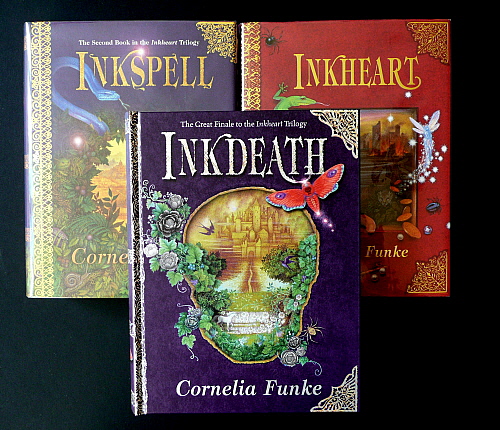 I've been talking a lot about Young Adult literature lately but thought I'd stop and take some time to dig a little deeper into Middle Grade and help explain what it is and some series I enjoy.
Some people out there may be scratching their heads about now saying "What the heck is Middle Grade literature? Books for middle grade students? Novels with sub par writing?" No, it's not either of those two thing.
Middle Grade (MG) literature, often grouped with YA lit, are novels that are aimed at  readers aged 9 to 12. While there is no set word count to a typical MG novel, they do tend to be shorter than YA work geared towards the older teen. I could mention (and probably will further down) several series where that is not the case.
One of the main differences between the MG and the YA is that the MG protagonist is more inward thinking, coming to terms with themselves, focusing on coming puberty, etc. whereas YA lit has their main characters trying to fit into the world and how they are affected by external situations rather than internal.
I don't believe any novel with sexual content are allowed to be considered MG. Violence is more acceptable but it won't be graphic or in detail. Think of the type of violence portrayed in the Harry Potter books. It's there but not described as all blood and gore. Middle Grade novels can have a romantic aspect, but it won't be central to the plot like it often is in YA literature. It'll probably be more in the form of a crush and hand holding. The protagonist will be young, but probably slightly older than the average MG reader. I also think, unlike YA lit, you'll find that parents will be more visible in many of the stories.
Some of my favorite MG literature (Check it out for yourself or your kids!):
The Inkheart Trilogy – Cornelia Funk
Gregor the Overlander – Suzanne Collins
Dragon Slippers series – Jessica Day George
Leviathan , Behemoth & Goliath – Scott Westerfeld
Zombie Tag – Hannah Moskowitz
Percy Jackson series – Rick Riordan
The Kane Chronicles – Rick Riordan
Young Samurai series – Chris Bradford
Bartimaeus Trilogy – Jonathan Stroud
The Hallow Kingdom – Clare B. Dunkle
Also, here are some other great articles about what MG is and the difference between MG & YA:
How to write Middle Grade fiction by Karen Pokras Toz who is the author of the MG Nate Rocks series.
Middle Grade, what is it?
It's a thin line between Middle Grad and Young Adult
Dale Robert Pease author of the MG Noah Zarc series, recommended a bunch of great vlogs from Literary Agent Kristen Nelson:
The difference between Middle Grade and Young Adult Literature
Talking Middle Grade
Please feel free to share your knowledge of Middle Grade and any great books/series you enjoyed.





March 13, 2012
March 8, 2012
Eep! I've lost the flow!
 I've stated in a couple other posts that I had a really long period of time, years in fact, where I didn't write. I claimed writer's block and pretty much gave up. Things were different then. Life was in another place and I had other things going on like school work and failing relationships, etc. Once my writing picked back up, I decided I wasn't going to let such a long period of time go by again without writing.
While I don't write everyday (other than emails, status updates and tweets, which I don't really count) I do, as you guys have realized by now, write at least twice a week. Yes, I consider my blog posts to be part of my writing habit. It may not be fiction, but I'm still writing something to inform or advise and it can't be just gibberish or completely half-assed. I think a lot of you would call me out on that kind of behavior, no? I'm also normally editing, if not writing, four or five days a week. So no, it's not a daily writing habit, but it's plenty of times during a week.
Last week I was at a point where one work was being sent out to a friend to have some editing done leaving me with "nothing" to do until I get that manuscript back. I realized, "oh hey! I can get back to Staying Alive!" (which is the sequel to Near Death, which was already 51k+ words in). Fabulous! Let's get this knocked out and finished so I can start the editing process on that as well. It had been several months since I worked on it, December probably being the last, so I needed to re-read to get back into it and remind myself of all that had gone on. This is what happens when you're a pantser and not a plotter.
With that done, I was ready to go (and somewhat impressed with what I had already written. Don't you like when that happens?). I packed up my stuff and headed to my favorite writing spot, the local Starbucks.Booted up the good ole Word document and just sat there staring at the screen. Mind blank. No idea where to go. I panicked a bit and re-read the previous chapter. That should help right? Normally it would, but not this time. I sat there for an hour or two, procrastinating, checking email, tweeting about anything but writing. I think I wrote a couple of paragraphs. It was pathetic.
Why was I stuck? I'd been writing other things all along. I enjoyed the story when I re-read it and could recall some of the things I had planned for it, yet getting the words to come out was like trying to coax a kid to take some nasty tasting medicine. I put it aside for a couple of days and instead filled my downtime by watching seasons 1 and 2 of Sherlock (which is awesome and you all should watch it).
By Wednesday I decided I couldn't keep putting it off. This is a story that deserves to be finished. People want to know what happened to my little gang of friends who are now college aged. I couldn't let all the work I had done on it already go to waste! I grabbed up my things and headed back to the Starbucks. Determined!
I decided to just start writing. Even if it was mundane actions for my characters. Anything to get the flow back. Things could be changed or deleted later, right? Type.Type. Typity. Type. I found my mundane actions taking a turn into something interesting. My characters started to lead me to a place I hadn't quite expected and it worked out very nicely, referencing the previous book and making one character aware of things they hadn't known in the past. The words started to rush out again and I ended with about 1,200 words for the day. Not too shabby for someone who could barely do 200 a few days prior. Huzzah!
The moral of this story? Don't give up! This was a strange circumstance for me. Normally if I'm stuck, the re-reading and the regular writing schedule help me to get back on track. Not sure why this time was different, but it reminded me that it's okay to just write for the sake of writing, to get back into the game, so to speak. This is not my final draft and things can be removed later. Take any avenue you need in order to get yourself back into the story. Giving up is not an option!





March 6, 2012
What's the right age for YA?
I've been involved in a lot of discussions lately about what YA literature is and what should and shouldn't be included in it. Topics I've discussed  before and am rehashing over on Novel Publicity and Emlyn Chand's website in the very near future. One topic that I haven't covered much, that deserves to be addressed, is age regarding young adult readers.
A loose definition of Young Adult literature is stories involving teen characters aimed at readers aged 10 to 20. That's right, 10 to 20. Stop and think about that. Think about how different you were between those two ages. Think about all the things you went through. The situations, the emotional state, the maturity level between those two ages. Huge difference from one to the other, right? When I think of young adult, in any aspect other than literature, I'm thinking of someone around 15 or 16 years old and up. Someone who's starting to do more adult things like learning to drive, looking into choices for colleges and other areas of further education, possibly having more steady romantic relationships, or having a part time job and learning to save or manage their money. Those are adult type situations that kids aged 10 to 14 are probably not dealing with, hence why they are referred to as pre-teen or teenagers and not young adult.
So why does the Young Adult literature category cover such a broad span of ages? Some might say it's because Middle Grade literature is considered a part of the Young Adult category. This may be true, but why not break it out into it's own category. I'm not sure many people even know such a thing as Middle Grade literature exists. I have a feeling when people think of books for kids, they think only of Children's lit and Young Adult lit. Nothing in the middle. Right now Middle Grade literature is supposed to be aimed at readers between the ages of 10 and 12. Only a two year span. I think if the industry made more of a definition between the two and marketed Middle Grade lit up to age 14 or so and started the Young Adult category at 15, parents would be better aware of what might be covered in the books. That's not to say if your mature 13 year old is an avid reader and can handle some more difficult situations and/language that they shouldn't be allowed to read a Young Adult novel. I was reading adult literature at age 13 and was able to handle it, but at least my folks knew what I might be encountering in the books I was reading.
There are many Middle Grade series that have great writing and are enjoyable and entertaining to both younger teens and older alike. Heck, even as an adult I can come up with several series I've read in my 20s and 30s that I've enjoyed. Some of my favorites are: Gregor the Overlander series by Suzanne Collins (of Hunger Games fame), the Percy Jackson and The Kane Chronicles series by Rick Riordan, the Dragon Slippers series by Jessica Day George and The Inkheart Trilogy by Cornelia Funk. There are tons more, plenty to keep a young reader interested and engaged until they're ready to handle more difficult topics.
I don't know that the industry will ever look to adjust the ages or the definition when it comes to "Young Adult" literature, but I wish they,along with bookstores and libraries, would start separating Middle Grade from Young Adult more definitely. I think it would help parents and young readers alike to know what they can handle and what's acceptable. Again, there will be exceptions to the rule but the parent would have the choice and make it easier on their kids when allowing them to pick out suitable books for themselves.
What is your take on the huge age span covered by Young Adult literature? Do you think they should keep it to one broad category or should it be broken down into Middle Grade and Young Adult? What would your opinion be in having a rating system of sorts on books? Not one that would restrict someone from buying a specific book, more just for informational purposes.





