David Gullen's Blog, page 15
November 30, 2017
The Girl from a Thousand Fathoms, Chapter 1 – Midnight
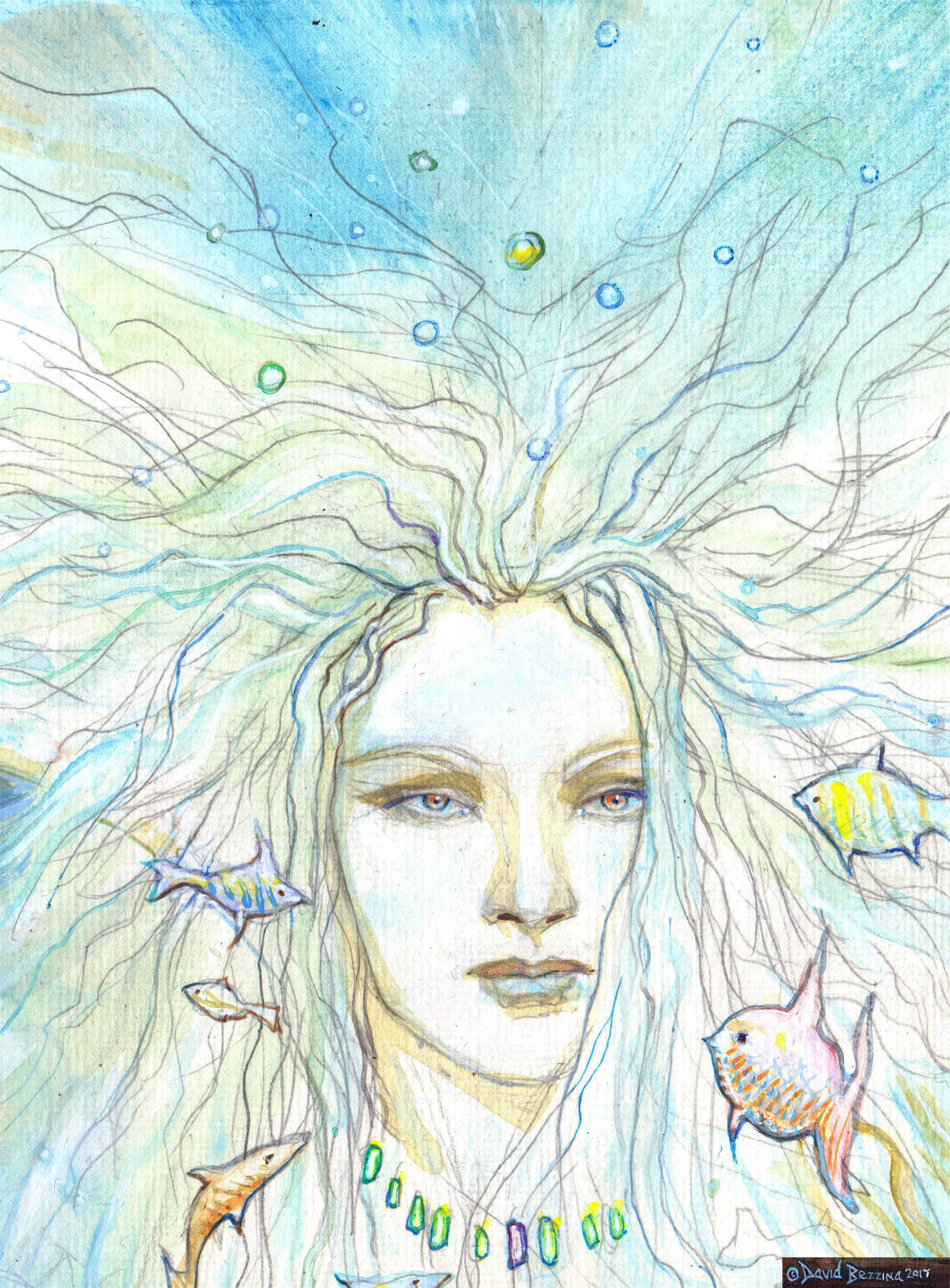
Close to midnight a mermaid came ashore at the bustling resort town of Brighton on the south coast of England. Swimming strongly, she entered the half-mile of water between the town’s two piers. The one to the east blazed with light, life, and fairground music. The other was a storm-battered and fire-wracked skeleton of bare girders, the post-apocalyptic roost for a thousand starlings.
Drifting on a lazy swell she listened to the surf push and suck at the shingle beach. The waters of the English Channel were cold but they lacked the chill of the distant Atlantic swells, and their wild dangers.
Weary from her days-long swim she coasted under the ruined west pier and looked up past the limpet-encrusted legs into clear night sky. She had made it, she had escaped and now she was free. A pang of intense sadness welled inside her. She was alone, but she was free.
Light from a quarter moon glinted on her bare skin as she knelt at the waterline. She hesitated and touched the shell-crusted purse on the kelp-string tied around her waist. It contained everything she possessed: her comb, a handful of pearls, a handful of octagonal gold coins.
No turning back. She reached across the collapsing wavelets and placed her hand palm down on the shingle beach. Her body formed a conduit between the elements of sea and land. She felt their power, the eternal tension. She spoke the shoreline words her mother taught her long ago:
This child of oceans is not changing sides,
Not abandoning one for the other.
I know my origin, gifts, and graces.
Land and sea, you agreed
We may cross your war grounds
In our own times of need.
I know, I am asking for a strange thing.
I do not expect you to understand
I wish to walk as a child of the land.
The waters behind her flattened and the wind died. The mermaid shivered. Neither of these were calm things, they were the stillness of sudden attention, of great strength held in check.
Out of the flat water six heavy waves rolled towards the shore one by one. As they broke they pushed up the shingle into a platform of sea-built land. At the same time an angry wind came off the shore, tore spindrift from the wave tops and flung it away into the night.
This far, the wind said. This far, and no further.
No turning back. With her heart in her mouth the mermaid hauled herself onto the shingle mound.
A seventh wave came. Power thrummed up from the water through the skeleton of the old pier. A thousand starlings shrieked up into the night air as the sea surged forwards.
The wave roared across the platform and lifted the mermaid up. A staggering wind shoved back. The wave could not break. The mermaid hung inside the water behind a glassy salt-water wall, her long fair hair fanned about her.
Wind-snatched shingle flew off the beach, land hurled into the sea. Each stone slammed into the wave-wall and carved bubble-streaked trails deep into the water.
Her but not you, land told the sea.
This far and no further.
You and your tricks.
The sea briefly held, but water like wind cannot stay still for long. The land-wind whirled and roared and shoved. The wave burst apart in spume and spray and crashed down to nothing.
Salt spray swirled, the wind died. A simmering mist settled to reveal a barefoot woman dressed in a sky-blue blouse, a knee-length green skirt, a matching jacket. A pair of flat shoes lay at her feet beside a small shoulder bag. Strange things, she would get used to them.
Her own purse was already starting to dry and crack. She emptied the contents into the new one and saw the front was decorated with a cat face in silver sequins.
The Elements had kept their word, but the Land had a dry sense of humour and the Sea’s was rather salty. Only later did it occur to her that the image was a warning.
She picked up the shoes and crossed the shared ground, the littoral that turn and turn about was land then sea. Further up the slope of the beach a scattered row of dried seaweed, scruffy feathers and frayed rope formed a ragged and wavy tide-line. She took a deep breath and stepped across the tide line.
Dry land.
Bright sounds from the other pier ebbed and surged on the night wind, the air tinged with the aromas of chip oil, candy floss, curry and beer.
Those gangs of mermen could not reach her here. Her old life was gone and along with it her old name. One night she had surfaced behind a South American cargo tramp. High on the stern was the ship’s name, below it the country of registration. She liked what she saw and took it for herself. Now, for the first time in her life, she felt safe. She could fit in. She must.
Up on the boardwalk she slipped on her shoes and climbed the wide concrete steps to the King’s Road. She crossed the deserted neon-lit street and entered the winding side streets of Brighton town.
Some yards behind her a rather beautiful cat dropped soundlessly out of the shadows. Tail held high it trotted after her.
To be continued…
~
Illustration Copyright David Bezzina, 2017


The Girl from a Thousand Fathoms – a Fantasy Novel
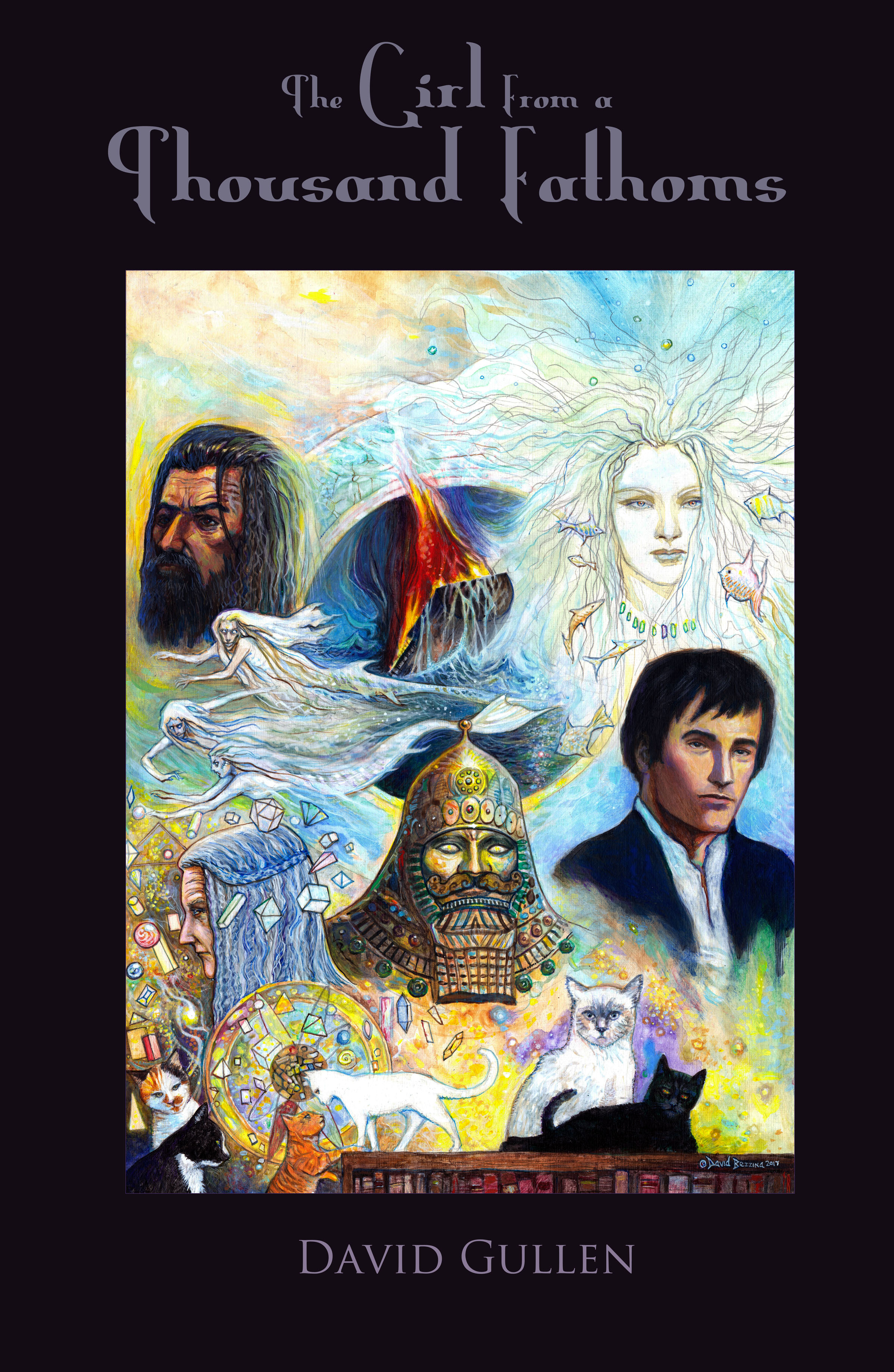 I wrote a fantasy novel called The Girl from a Thousand Fathoms, some time ago. There was little interest from mainstream publishing and I put it aside. Earlier this year I took another look at it, fell right back in love with the story and characters, and decided to rewrite it. So I did, completely. It still didn’t feel ready, so I rewrote it again.
Then the fantastic (and probably fantastically brave) Gaie Sebold, Helen Callaghan, and Andrew Wallace read it, and told be what they thought. So I rewrote it again. Thanks, guys, seriously.
Meanwhile I asked the brilliant David Bezzina for the cover art you can see here.
Now it’s ready I’ve decided to give it away. I’ll be posting it chapter-by chapter on WattPad, and here on my blog. If you like what you read, please subscribe to my blog, follow me on Twitter, Facebook, or just do the WattPad thing.
The first few chapters will come daily, until I’ve caught up with my line edits, then it might slow down a bit. If all goes to plan I’ll do eBook and a print versions later.
The first chapter is in my next post. Meanwhile, please imagine you’re reading the back cover, because here’s the blurb:
~
Tim Wassiter, P.I. isn’t an old-school detective with a cynical outlook and a bottle in the desk, he’s the new-age holistic version with chickens, tea – and a little bit of magic. His ex-partner scoffs and the old lady down the road just wants him to find her missing cat.
Finally, he’s got a real case. But what sounds like easy money isn’t as simple as it seems. Dolores Vogler, the mysterious woman who hired him, has dangerous friends and they’re rapidly losing patience. Tim needs to discover what’s really going on, and fast. But soon there’s an even more mysterious woman, a series of increasingly strange events, and a great many more cats.
As things get more violent, more bewildering and more utterly weird, Tim begins to realise that this case goes far deeper than he could ever have imagined. Everything is connected to the new case and everyone is looking for a girl who almost certainly does not exist. And magic isn’t just real, it’s probably going to get him killed.
~
November 21, 2017
Weasel Words & Their Allies
I have fulminated about weasel-words at least once before. I’ve been doing a fair amount of critical reading recently and while my opinions on many things have changed over the years I find the same words – these weasel words – still bug me for the same reasons. Here are a few of them and why they rattle my cage.
Almost, Seemed, Appeared
Pwimula Nesbytt pulled the saddle from Bismarck, her faithful battle-mole. She seemed to be upset about something.
Only seemed to be? And only about something. Do we care, do I need to worry? Either Pwimula is upset, or she isn’t. If she isn’t, don’t mention it. If she is, then you should say so, say why, and describe how she is upset – angry, tearful, irritated. Not doing so creates a false tension that for implies the author, rather than the characters, is uncertain about what is happening.
Pwimula brushed away a tear as she unsaddled Bismarck. She laid her head against the side of her faithful battle-mole and listened to its faltering heart.
There’s a place in language for all words in the same way there is a place in the kitchen for everything that belongs in the kitchen. However, you don’t keep the milk in the oven or the iron in the fridge.*
I don’t like words like ‘seemed’, ‘appeared,’ ‘almost’ because they make action and emotion imprecise, and introduce uncertainty or doubt. That’s not to say they don’t work well in the right place:
‘How was she?’
‘She seemed to be upset. Then she laughed. I didn’t know what to make of it.’
He and She
I once became frustrated with the opening of a book because the main character was introduced as ‘She’. Page after page the novel wore on, and She did this and She did that. If the author had been in the room I’d have been begging on my knees, ‘For God’s sake, just tell me her name.’
This is an example of deliberate withholding for no good purpose. Another example of false tension. There’s something the reader needs to know and it doesn’t create drama, mystery or tension not telling them. In fact you’re doing your own story a disservice by not saying. The effect is distancing. And for me it is annoying.
Very rarely should the anonymous ‘He’ break the catch and slip through the window. It should at very least be the assassin, the randy lover or the desperate messenger. If it’s the hero of the story just tell us his or her name. Give the reader something to work with.
Of course ‘he said.’ And ‘she said.’ are almost always the best ways to tag dialogue.
Words ending ’ing’
There’s a place for these words (inflected verbs) but I try not to use them because I think they stifle description and flatten tone towards passive.
He was writing, he looked out the window and saw it was raining.
You can’t get away with writing ‘It rained.’ as easily as you can say ‘It was raining.’ You need to qualify ‘It rained’ with description, sensation. How was it raining? Falling like soft mist or stinging whips?
A good exercise is to go through a piece of writing, remove all your ‘ing’ words and replace them with more sense-driven phrases.
Bogus accents
There are two main ways of doing this, both horrid. They are character speech and writing style, often over-seasoned with rampant anachronism:
Buboe sprang from his artful hidey-hole. ‘Gis ‘e’ ‘ere yer blimmin’ fancies, posh boy.’
‘Avaunt, blaggard, step thee kerb-wards, pronto!’ expostulated Fontleroi.
Cod formalism and mangled speech are not how you create texture and tone. And it’s, like, completely bogus, dude.
So these are some of the things that bug me, and I try to avoid them. I’m sure you have a few of your own.
~
*If I have in fact been getting this wrong all my life, please let me know.
October 11, 2017
Two Book Reviews: The Fountain in the Forest, and The Capinga Questions
Once again the books I’m moved to review are fitting neatly into pairs. Here are two novels set against backgrounds of recent political history. Both have rather broken policeman as the focal character. In almost all other respects they are very different, and very good.
The Fountain in the Forest, Tony White
This engaging and absorbing story starts as a classically police procedural – crime scenes are described in close detail, and the police methodology feels as authentic as the attitudes and banter of the police themselves. DS Rex King of the Metropolitan Police is an outsider of a cop, a man who doesn’t fit in. He’s the perfect person to investigate the murder of an unknown man found hanging and mutilated in his friend’s theatrical studio.
Except he’s not. He has a deeply awkward relationship with some officers, his education and background keep him at arms-length with the rest. He’s not popular. He treads on toes. He gets the job done.
While the crime may have been committed in the present the roots to the case lies in the past. White interleaves the two narratives skillfully. The investigation and King’s own life move forwards while the origins of the murder are revealed in another place and time, and in another country – the Fountain in the Forest.
The politics of the Thatcher era are integral to this book. White clearly wants to write about the prices paid there, the brutality and the loss of a kind of innocence. For Rex King and many others the ripples from those times still spread out today, wider and wider.
DS King is not an easy character but he’s hard to dislike. While I found the level of detail description in the early parts a little too much, White’s writing is vivid, his characters complex and original, the structure just the right side of ambitious. Tony White is always interesting, occasionally experimental, sometimes bold. This was a compelling book and it still lingers in my mind.
The Capinga Questions, Damian P. O’Connor
This is the second of O’Connor’s ‘Smithy & Mostert’ books of set in apartheid South Africa.
There’s plenty of dirt when you’re fighting an illegal and secret war in Namibia. When one of the enemy camps is destroyed by SA forces, international accusations of chemical weapons use means an investigation is required. Smithy is the right man for the job. Because this is a military crime he’s assigned Trudi Mostert, a savy, intelligent female officer.
The relationship between these two characters is core to this riveting book. Mostert is smart and brave, as a female Army officer she needs to be. She deftly fends off Smithy’s inept attentions; he’s outclassed in so many ways.
Needless to say, the true reasons they are sent to investigate the alleged gas-bombing, and the answers that are really wanted are different things entirely.
Sergeant Smith is more cunning than smart, a reactionary by upbringing, pitiably naïve and morally unilluminated. He’s young but he’s made terrible mistakes and done very bad things. One slow step at a time he’s dragging himself out of the mire of prejudice and violence that defines the apartheid state – and him. The deeds haunt him, the consequences will never let him go. The Bureau for State Security (BOSS) know what he’s done and it won’t let him alone either. As a result when the dirty jobs need doing Smithy is the man they send for.
The era of apartheid South Africa is one that needs writing about, it needs fiction to help tell the stories of a brutal, murderous time of intolerance and hate. In The Capinga Questions O’Connor writes about some of them in direct and accessible ways. What’s it like to be a state-sanctioned murderer, a gay man in that state’s army, the child of a monster, a human being?
It bemuses and frustrates me that a writer as good as O’Connor doesn’t get more recognition. His story-telling is compelling, the stories themselves are outstanding. The world he describes feels utterly authentic. You can feel the dust on your teeth, the action is riveting, the revelations – well, you’ll need to find out for yourself.
~
Both these books are bout things that happened in the past, and the cost. I can think of no better way to put it than O’Connor’s own prelude:
‘It’s easy to ask questions. The hard part is listening to the answers. And the hardest part of all is asking the right questions and then listening to the hard answers.’
The Fountain in the Forest, Tony White, Faber & Faber – Available Jan 2018
The Capinga Questions, Damian P. O’Connor – Out now
September 5, 2017
Two Book Reviews – Hotsuka’s Story, and A Wizard’s Henchman
Hotsuka’s Story, by JF Mehentee
Hotsuka, an immortal being, falls in love with a mortal woman. In punishment he is banished, imprisoned, tortured, and finally stripped of his powers and made near-human himself. Despite this he is still intimately involved in a great power-play among the ruling immortals because he has changed that game. As a result of his affair there is a child, half human and half god.
While some immortals want to destroy Hotsuka, others protect him. As he lives his life as a human Hotsuka begins to understand the great harm he has done to the mortal woman he loved, and the risks to his child.
This is a highly readable, engaging and smart story of becoming aware of consequences and living with them, and how sometimes amends cannot be made. Set in a richly detailed world Hotsuka’s Story is an original and imaginative tale. If you are looking for intelligent and beautifully written fantasy in an Asian/Eastern mythological setting I strongly recommend this book.
Hotsuka’s Story is the first of six books in the Dragon Pearl series. I read this as an ARC.
~
A Wizard’s Henchman, by Matthew Hughes, PS Publications
Erm Kaslo is smart muscle for hire, a highly competent and rather dangerous man. Yet the world, indeed the universe as he knows it, is about to change in a catastrophic way. Along with computers, guns and spaceships all his skills and special equipment will soon count for nothing. Kaslo is a survivor. He attaches himself to a man currently thought to be eccentric, if not mad, but soon to become a power-player beyond imagination – a magician.
If you enjoy the works of the great Jack Vance (and I do), then there is a very good chance you will like this book a lot. Hughes writes a very close pastiche of Vance’s mannered, witty and slightly baroque style. His humour is dry, his observations mordant.
Yet Vance was a romantic, almost all his books included matters of the heart. There’s nothing of that here – if you’re looking for female characters you will find them only in minor supporting roles. And Kaslo at times can be brutally cruel. Hughes is not Vance and it’s wrong to expect him to be. He’s clearly a huge fan and this book is a wonderful and near-perfect homage. It and the others in this series are set in the universe as it might have been before the Dying Earth novels.
It’s wrong to judge a writer – especially one as good as Hughes – by a single book. For me the gender omission is the only obvious flaw. I greatly enjoyed A Wizard’s Henchman and will be reading more of Hughes’s work soon.
~
July 28, 2017
Why Every Writer Should Join the ALCS
 ALCS, the UK Authors’ Licensing and Collecting Society, collects secondary royalties on behalf of writers for work published in the UK, and campaigns and lobbies on writers’ rights at national and international levels. The society is now in its 40th year and to date has paid £450 million to its 90,000 members.
These royalties come from photocopying & scanning by business, education and other organisations, overseas library lending, re-transmission, and several other sources. There’s more detailed information on their website.
Not every writer knows the ALCS exists. Everyone should be, and everyone should join. Lifetime membership costs only £36.00 GBP, deductible from your first royalty payment. In fact if you are a member of the Society of Authors or one of a few other organisations, membership is free.
I wasn’t sure of membership is open to all nationalities so I contacted the ALCS and they confirm that is the case – anyone can join.
So why should you join? Well, why shouldn’t you? If you have had any magazine articles, short stories, novels, scripts, etc published, you may well be owed money and the ALCS will collect it for you .
I’m by no means a widely-published writer but my payments are worth having – my last payment was just under £150.00. Honestly, I have no idea where this comes from and am very grateful to the ALCS for their collection efforts! So far, year by year, this has slowly grown. More successful writers payments are quite substantial.
Once you’ve joined all you need to do is register existing work and add new publications as they come along. Then, once a year, you can look forwards to some extra income from your hard work.
Which reminds me, I need to update my publications.
~
Save
Save
July 21, 2017
Dodged a Bullet
It’s time to ‘fess up: I’ve been putting off that thing I had been meaning to do for too long. As a consequence I woke up yesterday to find my Amazon account had been hacked.
So instead of spending the day writing I started by cancelling my credit card, talking to Amazon, and then doing my high-tech version of bolting the stable door after the horse had gone – moving all my passwords over to a secure password manager. In my case, LastPass.
I’m not a security expert but I am tech-savvy. I’ve been working in IT for 30+ years, I try to be cautious online and I don’t feel I’m complacent about the risks. Even so, it wasn’t enough, they got me. The Bastards.
The thing is, I knew it. I’ve learned with my writing not to ignore the little voice in my head that says ‘You can’t get away with that’ about some aspect of the story. I had a similar voice about this. ‘Oh, I’ll get around to it,’ was my invariable response. Not only should I not have ignored it, I knew it too.
People – don’t ignore this. Make a start now. It’s a mild pain to go through the process, but once you’re done it’s done. In the end it is a change of behaviour and it will help keep you safe online.
I browsed reviews on tech sites for an hour and then picked LastPass. DashLane is also an excellent choice. Both operate the freemium model, the DashLane Pro version is more expensive.
There are also several other well-reviewed and highly rated password managers. Most work on the popular browsers and operating systems. Here’s a review and comparison of LastPass & DashLane, including a feature chart of other products.
LastPass is reasonably easy to use. It does tend to accumulate duplicates of sites where you have changed a password but that’s easy to spot and manage. On FireFox I noticed a ‘feature’ where your list of sites blanks and you have to log out/in again, also not really a big problem.
Password managers work transparently for most sites, once you’re set up they log you in without keystrokes. LastPass can run a password strength audit, and will generate secure long random passwords for you too (You can view these if you need to.) Sites that ask for characters selected from a keyword or similar will still need some action from you however.
In the end for me – no harm done, just some stress, worry, and wasted time and inconvenience. It’s a pain to be without a credit card for a week, but the bank was immediately helpful. Amazon were also great – they froze my account, reversed the transactions the hacker had made, and returned the account to me all within the day. Once I had my account back I set up a secure password and deleted the credit card info on the account.
The only thing that was hard was finding out how to contact Amazon without an active account. All the contact info is behind the account login wall. A quick Google for ‘Amazon telephone’ returned 0800 279 7234 though obviously that may change with time.
So, lesson learned. People, please learn from my mistakes and make a start now. Today if possible. Right now. Then, like Jimmy in my flash piece below, you’ll get away with it.
~
Jimmy Checks Out
Pow!
He’d caught a bullet.
Snatch! Just like that.
He’d seen it coming he told them later. He’d snatched that motherfucker right out of the air. Burned his palm but that was OK. Anyways, it wasn’t a real bullet, it was a copy. Nice one, too.
How did Jimmy know? He knew because you couldn’t do that with real bullets. You couldn’t catch ‘em.
Jimmy flipped the bullet, caught it, and slipped it into his pocket. Guy who fired it wouldn’t mind. Guy like that, he’d have a whole bunch of bullets. He could spare a few.
July 13, 2017
Loss of Privilege
It’s been hard for me to make sense of UK politics ever since the start of the Leave and Remain campaigns for the Brexit referendum. Some politicians lie, we have always known that. After all, people lie and politicians are people too. We saw this type of behaviour in spades during those referendum campaigns of half-truths, fear and wilful deception.
Yet it feels like something else is going on since the June election, the triggering of Article 50 and the start of the Brexit negotiations in earnest. Among all the obvious political examples of the Peter Principle*, the blatant U-turns and ship-jumping to maintain personal or party advantage over the interests of the country that became almost established party policy in Cameron’s time, I think there is something new. If I’m right it is something that will profoundly affect us all for generations, whatever our political views or position in society. I think it is this – Loss of Privilege.
For the first time in decades the UK is no longer negotiating on the world stage from a position of authority and power. We’re not even negotiating from a position of equality. This has cut the ground out from under the established assumptions of what our current government can do or say and how everyone else will react. (I’ll say now I have little confidence Labour would cope any better, they too are a party that is used to power and the ways of behaving with power. Possibly only the Liberals and/or the Greens could cope in this new world, they are parties used to junior partner status and used to the realities of what kind of deal can be made when you have limited influence.)
The result of this loss of privilege is that the assumption that when the UK speaks the world listens is gone. The business as usual principle that a deal, a compromise no matter how good or bad, enlightened or grubby and self-serving, however good or bad in short or long terms can be made on the international stage and sold to the electorate as some kind of win no longer holds. What used to work no longer works. Our government has no idea what to do or say. It lacks the self-confidence to lead. It no longer knows how to behave.
Which is why we have ‘Brexit is Brexit’, ‘No deal is better than a bad deal’, and all the other empty bluster, culminating in Johnson’s recent petulant baby-tantrum the EU can ‘go whistle’ for money owed.
I’ll reverse a little here. We didn’t actually lose those privileges, we gave them up. We gave them up when we decided to leave the EU and try to become a plucky little nation forging its way through the international seas led by the spirit of Drake, or Churchill, or Christmas. Whatever. Sure, it’s our national right to do that, just as it was my dad’s right to spend half his pension on gold-plated sixpences from the Franklin mint. It doesn’t mean that behaviour was wise, in our best interest, or entirely rational, we’re free to do it. I know it continues to make some of us very happy just as it made a part of him happy – for a while.
Michel Barnier’s response to Johnson’s ‘whistle’ rhetoric is the perfect example of how far away and how fast that privilege has now gone. ‘I am not hearing any whistling,’ he said, ‘just the clock ticking.’
If my love of history has taught me anything it’s that change can happen very fast and be very unexpected. When it does happen leadership flounders, collapses into indecision, and a series of ‘palace coups’ introduce a period of chaos. Societies recover, the sense of self as a nation is a powerful thing. Most of the rich stay rich, institutions and business keep running, people work hard, the lines of wealth and health drawn through the population move up and down.
I think we’re in the transition from being the United Kingdom with all her garnered privileges from Empire and Power to being just another country on the world stage. A county with huge assets and cultural, artistic, intellectual and scientific resources, but just a country after all. We’ve probably been that for quite a while but the inertia of international status-quo means that the rest of the world have only just sat up and noticed. And that only happened because we made them. I think it’s going to hurt. Long term I think this loss of undeserved privilege will be a good thing.
~
*Peter Principle – Promotion is based on performance in the current not future role. Managers therefore rise to their level of incompetence. Laurence J. Peter, 1969
July 7, 2017
Science for Fiction 2017
Yesterday and the day before (6/7 July) I was in the audience at the annual Science for Fiction event at Imperial College London. This is organised and presented by the brilliant Dr David Clements, astrophysicist and SF writer.
There were 6 presentations over the two days:
– The Square Kilometre Array and the Epoch of Reionization: Dr Emma Chapman
– Titan and Cassini: Dr Ingo Mueller-Wodarg
– Ending the Universe: Prof Arttu Rajantie
– Visiting Mars: Prof Sanjeev Gupta
– Extremophiles and Synthetic Biology: Dr Robert Weinzierl
– Forming Stars & Planets: Dr Tom Haworth
Everything was brilliant, the presentations were fascinating, exciting, and on more than one occasion mind-blowing. During and after each talk we had many questions and moments of enlightenment. One highlight was the VR demonstration of Mars. Yes it was VR, but I walked on Mars!
Here, in approximate order, are just a few of the things I learned:
1. The Square Kilometre Array (SKA) is one of the next great big-science projects – a radio-telescope comprised of thousands of small dishes and aerials with a total collecting area of 10^6 square metres. The data rate from the finished array will be hundreds of gigabits/second. This is about 10x current global internet traffic and it will need to be processed in near real-time. That will need supercomputers more powerful than any that yet exist, equivalent to one hundred million 2013-era PCs.
2. Titan is the only other place in the solar system known to have precipitation and open liquid on the surface. Large lakes of liquid methane and ethane, about the same size as the North American Great Lakes, lie towards the north. Elsewhere mountains of solid water ice rise up to 3.5 kilometres high. All this at -180C under a chemically active atmosphere of nitrogen and methane 1.4 times as dense as ours.
3. The Higgs field gives mass to particles. Unlike other fields energy does not rise steadily as field strength rises, it dips then rises again. Higgs particles repel each other until extremely high energy levels (10^10GeV), when they attract. This attraction could lower the field strength to below zero. If this does happen, and as more Higgs particles are spontaneously produced from vacuum, a bubble of negative energy would form and expand at the speed of light annihilating everything it touches, destroying the universe!
Fortunately we can’t make particles of that energy – yet. Unfortunately quantum tunneling could allow a Higgs particle to tunnel under the high energy curve of the field to the low energy zone beyond and kick-start the annihilation process! Even more fortunately this is unlikely. Quantum mechanics is probabilistic, the probability of this happening is in the order of 10^600 years, longer than the life of the universe.
4. A significant problem of looking for life on Mars is the likely places for life are banned for exploration because of the risks of contamination. Manned missions and all they imply with regards to organic contamination will pose a severe problem.
5. Archae are a new kingdom of life unknown until about 40 years ago. Externally they resemble bacteria, internally their biochemistry is more like multicellular life. Many are extremophiles, living in very salty, high temperature and pressure environments (up to 120C and 200 atmospheres).
Archae and bacteria are the earliest living life forms. As the earliest forms of both archae and bacteria are thermophiles (heat-loving), it suggests life originated in a very hot environment.
6. It’s currently believed around 50% of stars have a super-earth type planet (one to a few earth masses). Most planets discovered so far are very big and orbit close to their sun. Free-floating planets do exist, in unknown numbers. An earth-analogue planet has not yet been discovered and neither has a solar system similar to ours. One reason for this is the detection methods used, based on the dimming of a star as a planet passes in front of it. Multiple events are needed to confirm a planet and the orbits of planets in our system are too slow, or the planets are too small, for current survey methods.
My thanks to Dave Clements for organising the event, and also to Emma, Ingo, Arttu, Sanjeev, Robert, and Tom, for their time and sharing their expertise and knowledge. My apologies if I made any mistakes transcribing the information above. If you want to know more I suggest you follow their links and check out their websites, publications and other notes. Science for Fiction 2017 was inspirational, informal and great fun. I am really looking forwards to next year’s event.
~
December 23, 2016
Another Year of micro-Loans
This year I continued making micro-loans to people all around the world through Kiva. Although it wasn’t as easy as in previous years I still managed to grow my fund – plus birthday and Christmas contributions from friends and family – Thank You!
If you’ve not heard of Kiva, it’s a way to help finance loans to people around the world who have no access to other forms of borrowing. Often they need help with basic things I take for granted such as a sanitary toilet, access to clean water, electricity, schooling, or medicine. When they repay the loan I can lend it to someone else. Obviously there are losses – if there’s a hurricane in Haiti that loan you made is probably not going to come back in full, or maybe at all.
I really like the idea of helping people to help themselves, and that by adding a little each month I can actually begin to contribute in a useful way.
I started lending through Kiva in 2012 and by the end of that year I’d made 30 loans. This year it was 203. This month I’ve lent money to farmers in Kenya, Myanmar, Colombia and Tajikistan, households in Vietnamese and Cambodia, market traders in Toga, Philippines, Pakistan and Liberia, and a Mexican needing medicine. It feels good.
~