
Sean Platt's Blog, page 18
January 29, 2014
Is Your Life a Cliché?
 This morning, I woke at 5:45am, brushed my teeth, turned on the coffee pot (which I’d filled and prepped last night), then sat in my office to noodle this blog post and check a website or two.
When my coffee was finished brewing, I poured myself a cup (cream and sweetener; I can drink it black, but it’s early and I deserve something foo-foo), closed my office door, put on my headphones and started some music (Eminem’s Recovery).
I blacked out my screen other than one window, and started typing what you’re reading now.
That’s not how it works every morning, though. Some mornings, I noodle a novel instead of a blog post. Some mornings, I listen to different music.
I’ve got a pretty great life, but it’s not always filled with thrills and variety. This time of year, the days don’t change much as one follows another. Despite attempts to flee, I still live in Ohio. The technical term for what’s going on outside right now — the phrase the meteorologists use — is that the world is shitting down on us out of an icy asshole. It’s a claustrophobic existence. My world, during the work day, is this room. In the evenings, I expand into a larger experience that includes my family, my living room, and my bed.
There’s a whole world out there, but over the past few years, as I’ve scrambled to build our empire of words, I’ve seen little of it. That will change, but for right now, my world is this room. This house. And the same handful of stores and restaurants over and over again.
Sometimes I wonder if I’m in a rut.
But then I look around at the larger world, and I feel better. I see that if I’m in a rut, most people are at the bottom of a canyon.
They wake up.
 They get in a box, then drive to work and sit in a box all day.
They come home, eat dinner, watch TV.
Repeat.
Day after day after day, until they die.
Part of me wants to see it as sad, but I’m ambivalent about whether or not it actually is. On one hand, there’s more to life than scuttling from one place to another and making numbers add up (salary, expenses, miles per gallon, the number of unwatched shows on the TiVo), but on the other hand, I suppose it’s none of my fucking business.
Sometimes I wonder if we’re all living cliches. Then I wonder if it’s a cliche to expect to break out of cliches.
It reminds me of the opening lines from Shakespeare’s As You Like It:
All the world’s a stage,
And all the men and women merely players.
I don’t know how literally Shakespeare meant those lines, but they express a notion Sean and I have returned to again and again while writing our books: what we assume to be the entirety of existence might really be the area in front of the curtain — and therefore might be at home with cliches, conventions, tropes, and the occasional deus ex machina … so long as they serve the larger plot.
You’re given a part. Then, you forget it’s a part, and play it out as if it were real.
Standard questions chase the thought: Why are we here? Why do we do what we do?
Are we merely acting out parts in a cosmic play? If we are, when the performance is finished, will we all high-five backstage and laugh about the good, bad, and ugly of all that just happened — events which, in and of themselves, didn’t actually have the dire implications we could have sworn they had when we under the the heat of their lights?
 Hey Tom, remember how scared you were about that bankruptcy, as if it were a real thing?
Hey Betty, remember how much you cared about the “career” from your script?
If the world is a stage, maybe we’re playing our parts for a larger reason. Maybe we’re living a big story beyond us, past the scope of our own tiny pieces within it. If that were true, I’d be a character and you’d be a character, and the details of what happened to us would matter little … as long as the overall story kept moving forward.
This may sound like a lot of metaphysical mumbo-jumbo, but I figured I’d explain anyway because it also happens to be why we write about unicorns.
Stupid Epic
Sean and I have this annoying frustration we know you’ll relate to. We wrote an enormous western/fantasy mash-up epic about an asshole unicorn and a gunslinger whose pistols belch pink smoke … but when we tell people about it, motherfuckers don’t take us seriously.
All of this — the existential pondering, the sense of fatalism, the magical alternative universes — has been on my mind lately because Realm & Sands is coming up on its first anniversary, and that means it’s time for us to revisit the story that started it all.
Unicorn Western was the first book Sean and I wrote together. It’s the universe that’s home to The Realm and the Sands. And it’s the first time we realized that when Platt and Truant combine forces, not even the stupidest stories can just sit or play dumb. We think too much, and too big.
Even the simplest ideas are bound to open a can of unicorns.
Right now, Sean is outlining the second season of The Beam. Next week, I’ll start writing it. Shortly after that, we’ll start work on the third and final piece of the Unicorn Western story: Unicorn Apocalypse. We couldn’t be more excited.
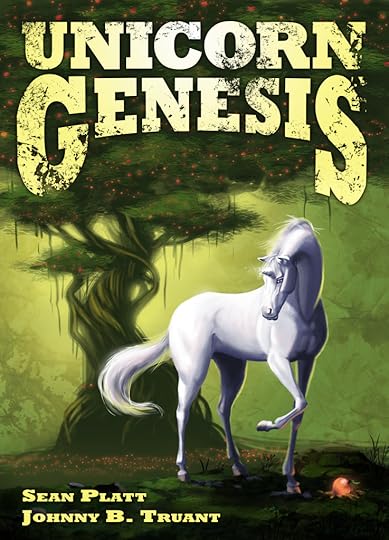
The 9-book Unicorn Western saga tells the middle of our epic tale: Clint and Edward’s journey from the edge of the Sands to the detached, unfindable city of The Realm, which sheared off when the worlds shattered. Unicorn Genesis, which we released in early November, tells the beginning: how the worlds formed, how they were breached and weakened by the incursions of humanity, and what happened during the Grand Cataclysm.
But Unicorn Apocalypse? Well, that will tell us how everything ends.
Endings are tricky because they carry so much of the load. We have all sorts of sayings about endings: “All’s well that ends well.” “The ends justify the means.” And in just about every game show, the bonus round at the end makes all of what happened earlier totally irrelevant.
In essence, the end of a story validates (or invalidates) everything else. A good ending tidies loose ends and clears final questions from the queue. It also lends new meaning to events that occurred at the very beginning. That tiny thing that happened on page 3? Well, that mattered because of what was explained on page 803. It gets more complicated when the story sprawls across multiple books — or, in the case of the Unicorn Western universe, when it sprawls across multiple phases: Now, Before, and After.
I’ll tell you a secret: there’s a little bit of the author’s soul in every story they write. Even when the tale is fictional, a large part of that fiction is still true for the author. By the time we were done with the ninth Unicorn Western book, we’d hidden a lot of ourselves beneath a dusty world filled with magic and strangers.
By the time we’d finished Unicorn Genesis, we’d forged an infrastructure under our world that, although fantastical, was braided with strains of our most pressing real-world questions.
In Genesis, we sowed the seeds for Apocalypse. And I’ll tell you now, those seeds are fat.
We have a difficult task with Apocalypse. How we handle the final trilogy will illuminate not only Apocalypse itself, but Western and Genesis as well. And because we’ve put so much of ourselves into Western and Genesis, what we say in Apocalypse is bound to change how we think about the cliches, ruts, and plot lines within our daily lives.
In other words, we’re dangling from our own cliffhanger. The ten books we’ve written so far in this fictional universe have opened metaphorical wounds in what we think, suspect, wonder, and wish about our own universe.
Our task, when we write Apocalypse, will be to find ways to close those wounds — and to tell ourselves what it all means.
A Dream Within a Dream
Maybe you don’t care about Unicorn Western. Maybe you’re about to tune out, or already have. I suggest you don’t, though, because even if you ignore the ghoulem and turkey pie, you’ll find a lesson here.
As authors, we have a neat way to try on our philosophies without too many people suggesting we’re blowhards. In grand Shakespearean fashion (in quote if not in style), we simply create our own world as a stage, with our own men and women and creatures as players. Through the peculiar magic that occurs while writing, those characters then take on their own lives and personalities, and “creating” a story begins to feel more like simply observing and writing down what happens.
 Clint Gulliver is an exiled marshal of The Realm.
Edward is a unicorn, born with magic, who is bound to Clint until one of them dies. There’s a reason he’s such a jerk. It has to do with events in his past (as explored in Genesis), not with a character sketch on my hard drive.
Both Clint and Edward have their own personal history. Each has memories. Each does things for his own reasons — not reasons they’d ever suspect have anything to do with me and Sean working behind the scenes, pulling their strings. Within their universe, things are simply occurring, and they’d never suspect there’s a plan that they cannot know of, or claim any control. In fact, Sean and I will spend a few days at the South by Southwest conference in March specifically to outline Apocalypse. But Clint and Edward, to my knowledge, have no clue we’re doing it.
In other words, neither have any idea that they’re characters in a story.
Clint could wake up one day, boil himself some coffee, then get out a piece of parchment to write the Sands equivalent of a blog post. In it, he might quote someone (probably someone with a dusty beard) as saying that all the world’s a stage, and that all the men and women are merely players upon it.
Now, I can predict what you’re going to say at this point: Clint is fictional, and we’re not.
But your life was forged by influences in your past, few of which you can consciously recall. The winds of the future will nudge you forward, and you won’t always know what impacts you, where it came from, how, or why.
So how is it all that different?
Resonance
This is the part where I backpedal and explain that we’re not actually trying to unfold the mysteries of existence with our ridiculous unicorn story. It doesn’t read like a dense tome, and we’d never want it to. Nor, for that matter, would we want to beat you over the head with themes that surfaced as we wrote it.
In case you don’t know, Unicorn Western started as a joke. In a discussion on our Better Off Undead podcast (somewhat NSFW audio) Dave protested Sean’s desire to write a western, complaining about how much research it would require. He told Sean that he’d get things so wrong, he’d “put a goddamn unicorn in it.” That was the spark that got me interested in co-writing with Sean for the first time. Because hey — if our gunslinger rode a unicorn instead of a horse, research was moot. We could do whatever the hell we wanted.
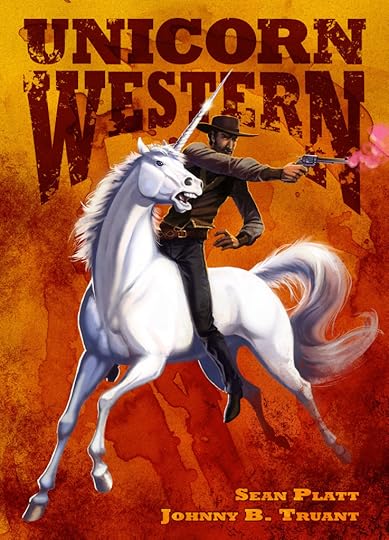
The first book, based on the Gary Cooper western High Noon, is a fun yarn about a marshal and his unicorn. What happens in Unicorn Western 1 isn’t complex. We wrote it without curse words so our kids could read it, and all of said kids (aged 8-11 at the time) zoomed through it. Our wives and fans read it too, and enjoyed it. Even so, there was a problem.
If we’d stopped after that relatively simple first book, Sean and I — as creators — would have been unsatisfied.
So we wrote another, and another, and another. We kept the series kid-friendly, but we let it grow in the way the Harry Potter books grew, and the readership began to skew toward adults. It was still appropriate for our children, but very quickly the tales stopped being merely about what happened. If you looked deeper as you read, you might also start to wonder why.
Sean and I don’t want to create plot-only fiction. There are books out there that lead you through a series of events that occur as inevitably as toppling dominoes, but for us, those stories tend to be as unsatisfying as a too-rich dessert. Yes, the action in “this-then-that” tales will get you through a plane ride… but when you close those books, you’re unlikely to ever think of them again.
We prefer to create resonance in our stories, because we like it when stories resonate with us as readers. When I finished Everyday this summer, the story followed me around for weeks like persistent mist. Catch-22’s narrative flipped so suddenly that it hit me like a below-the-belt punch. And after I finished House of Leaves, I felt like I was being stalked by a ghost, unsure of my footing.
You can read Unicorn Western as an adventure. But when you close the 9-book epic, we want you to be thinking. We want those characters and adventures to move into your brain, and stay with you for a while.
We want our characters to be real.
We want them to be relatable. We want you to understand them, to know them, and to recognize parts of them in yourself.
Which is why we don’t usually run from cliches in our fiction. Cliches are cliches for a reason, and life is filled with them.
Gunslingers really did carry dusty pistols on their hips.
Lawmen really do fight bad guys.
And people really do wake up and go about their standard business day after day after day — be it cleaning the chambers of a seven-shot magic revolver, or brewing coffee for the daily commute.
There are cliches in stories because life is thick with them. It’s not good, bad, or ugly. It’s just how it is.
No matter how free we might sometimes feel, we’re all living inside our own handmade boxes.
Fact and Fiction
 I’ve been blogging for a few years now, and one idea that keeps coming up in my posts is that of “living consciously.” For example, last week I asked if we were too dependent on modern technology.
There’s no right answer; the decision to be highly connected or not is yours. The key is that whichever way you lean, you must choose to do it consciously.
Living in a rut (or a routine, or a cliche, or even inside a box) isn’t bad. Doing it by default is bad. Doing it because someone else put you there is bad. Doing it because your mother told you that you could never break out is bad. It’s volition — not circumstance — that matters.
So if all the world really is a stage, the trick is to realize that the stage exists. Which play are you a part of? Whose story are you acting out? And if you realize that you don’t like your story, can you see clearly enough and be courageous enough to move into a new one?
I don’t like spoilers any more than you do, but I can’t help but share this relevant question that’s raised in Unicorn Genesis:
What if the lines between fact and fiction — or, if you prefer, between one story and another — weren’t so hard and fast?
Throughout Western, we referred to “worlds,” in the plural, but we never specifically enumerated them. In Genesis, we did. There are worlds with humans and worlds without them. There are worlds populated by creatures. There are worlds very much like our own — frighteningly like our own, you might say. And there are worlds that seem familiar for other reasons, because they are home to what we, in our narrow-minded way, would call “stories.”
After the Grand Cataclysm, barriers softened between the worlds. One spilled into the next. Tunnels were built below the surface. Cracks formed, allowing things to leak into worlds that once considered those things to be fictional. The lines between fact and fiction began to blur.
This doesn’t actually sound far from reality to me. When I’m writing, our characters are often surprising. I literally do not see some things coming, even though I’m supposed to be the one with my hands on the wheel. I’ve had characters fight, turn on each other, make love, and kill without my foreknowledge. It’s almost as if they were out there in some alternate world, living lives of their own.
In my more whimsical moments, I wonder what it would be like if someone, somewhere, was watching me, telling a story about a man who breaks out of his shitty lab job and decides to live his dream as a writer. What challenges would that man face? And how have I, as a conscious being, addressed those challenges?
It’s ironic. I spent so much of my blogging career urging people to wake up, to see the walls of their box, and choose whether or not they wanted to stay once fully conscious.
And here I am, writing about unicorns and pink gunsmoke, saying the same exact thing.
Break Out
Stories are just allegory, reflecting the world back so that it can see itself and learn … or refuse to learn. That’s it. Stories always have a lesson. You may not be aware of the lesson; you may not care about the lesson; you may not agree with the lesson; the author or storyteller may not even have intended for the lesson to exist. But it’s there, truer than true.
You don’t have to care at all about any of our books to get the message. In my shoes, you soon begin to wonder which came first anyway. Do we create the stories? Or do we tell the stories that were already there? Stephen King said he believes that stories already exist, out there in the world, as buried fossils. The storyteller’s job isn’t to create so much as to excavate them. I tend to agree. Nothing we write is new, and nothing doesn’t grow and evolve as we roll it back and forth between our hands.
You don’t have to read anything we write to know that your life is someone’s story, in addition to your own. It may be your children’s story. It may be your father’s story. You may be in your own box. And you may, like any good character, become self-aware, grow, and choose to emerge from that box.
These aren’t new concepts. They were always there, and they are simply the raw materials I pick up each day at 5:45, when I sit in front of my keyboard with my coffee beside me.
Maybe Sean and I are just scribes, writing what’s happening in other worlds.
Maybe we’re cobblers, assembling found pieces into finished puzzles.
Maybe the reasons we see cliches in fiction is because those things are happening for real all around us.
And so the question becomes: Will you choose to be one of them?
Thank you for reading …
Johnny (and Sean)
CLICK HERE TO START READING UNICORN WESTERN #1 FOR FREE
CLICK HERE TO READ UNICORN GENESIS
(IF YOU REVIEWED THE FULL SAGA OF UNICORN WESTERN BEFORE THIS POST WAS PUBLISHED AND SENT US A LINK, YOU SHOULD HAVE BEEN SENT A COMPLIMENTARY REVIEW COPY OF UNICORN GENESIS ALREADY.)
We want to share what we have with you. If you’re not already an Outlaw, you should be. Outlaws are on this adventure with us. Yes, you’ll get special deals and reader freebies, but you’ll also be swimming out from shallow waters into a deeper part of life. It’s free (except for your email address) and comes with your choice of Realm & Sands titles (as long as it’s $4.99 or less).
Did you enjoy this post? Please help us write more! You don’t have to do anything other than help us grow, and that’s easy to do. Simply click on the share button below that would make the most difference (don’t forget to use the email button — if you think this post will make a difference to someone you know, it probably will).


January 23, 2014
What’s Controlling You?
 I once competed in an Olympic triathlon. Then, over the next 60 days, I followed with a cycle century, a half-ironman triathlon, and a marathon.
When he was 20, Sean trimmed his body fat to 8%.
In high school, I memorized Edgar Allan Poe’s, The Raven. It wasn’t for a school assignment. I just did it.
Sean memorized every word of the Marshal Mathers LP.
Every day, I fast until dinnertime.
Sean hasn’t had a gram of sugar through February’s 28 days since 1999.
And in the last quarter of 2013, Sean and I wrote and published every single one of the books Realm & Sands had originally planned to complete for the year … before deciding to add Write. Publish. Repeat. and a few other projects to our plate.
That meant writing nearly a half-million words in three months.
There was no deadline, other than the one we arbitrarily decided to set for ourselves, but we both knew we had to meet it anyway.
I’m not telling you these things to plant a flag in our awesome. I’m telling you because I’m haunted by a need to prove that at the end of the day, we control ourselves.
That sounds simple, but it isn’t. Humans do a tremendous job of dressing in smiles and civilized clothing, but we started as animals … and sometimes I wonder if we’ve really come that far.
Are we truly in control? Or are we jerked about like a marionette from strings we can’t see?

The Rat and the Lever
In the 1950s, scientists James Olds and Peter Milner did an experiment wherein they inserted electrodes into rat brains to stimulate the limbic system — what’s since become known as the brain’s “pleasure center.” Rats were able to press levers to activate the electrodes, thus stimulating their own brains in a way that felt good.
The rats rather enjoyed this small side benefit of being in their cages, and pretty much sat on the levers, often pressing them around 700 times per hour.
The rats were so preoccupied with delivering pleasure that they preferred to self-stimulate rather than eating or drinking, and eventually died of exhaustion.
I’ll pick up my iPhone every few minutes when idle, to check and see if I have new email. I usually don’t answer; I just want to see if it’s there and give it a read. The eggheads say I’m getting a dopamine hit in my brain, and the burst of pleasure that follows.
So many of us are living our lives like rats pressing levers.
We’re being trained, both overtly and accidentally. If your phone gives you audible alerts for fresh mail, it’s training you to respond like Pavlov’s drooling dogs to ringing bells.
Every time we get something fast or something’s made easy, we’re trained to believe that all desire should be instantly satisfied, that there’s no need to wait for gratification.
Have you ever gotten angry that your Internet is slow?
Have you ever been annoyed when you can’t watch a movie on demand?
Does it feel like a crisis when the power goes out for more than a few hours?
When those things happen, do you think about how amazing it is to have the Internet, to have movies at your fingertips, or to be able to flip a switch and banish the shadows? Or do you instead think about what you believe you’re entitled to, but aren’t being given?
It’s not really about entitlement. It’s about stimulus and response. Habituation. Conditioning. If we’re all being conditioned — by ourselves, by our circumstances, and deliberately by marketers (not to mention game makers who actually study the art of creating addiction) — then are we losing the ability to retain control of ourselves?
We don’t practice deliberate acts of discipline and self-denial because we’re trying to be awesome. We know willpower is like a muscle: if it isn’t challenged, we might lose the use of it.
 If we lose the ability to deny ourselves pleasure, we might starve our lives to nothing while we continue to press that lever like a rat wasting its existence in a cold corner of our self-inflicted cage.
I Want it ALL, and I Want it NOW
When Sean pitched me on the idea of writing our serial The Beam, I was mediocre on the idea. For one, he pitched it as theBEAM, all run together like that, and explained that the only capitalized words in his 2097 story world were “Noah West,” father of the Beam network. In its original conception, the story had a lexicon complicated enough to require a glossary. But it wasn’t the wording conventions that threw me so much as what they seemed to imply: that this world would be all buttons, gizmos and whiz-bang glitz, which is exactly what I never liked about a lot of sci-fi.
When we finally started writing The Beam — and eliminated those original linguistic doodads — I remember calling Sean and asking him if it was cool that the story didn’t seem especially “futurey.” The characters I’d created from his wireframes were, really, just people. Yes, Micah and Isaac Ryan looked 30 despite being in their 80s thanks to nanobot treatments, and yes, prostitute assassin Kai Dreyfuss had an artificial implant in her eye … but beyond that, they mostly looked, spoke, and behaved as we would today. We added a few hovering cars because that’s what you do in sci-fi, but people also walked and wrote on paper, and temperamental wives still threw heavy objects at their do-nothing husbands when they were being assholes.
It was fine that The Beam wasn’t all lasers and knobs because another term for sci-fi is “speculative fiction” — or, as we started to call it, “future history.” Our job wasn’t to fill the world with flashing lights and jetpacks. Our job was to predict — to speculate — about what might happen in the future, given what we know today.
And what did we know about our world of today?
We knew that people love their gadgets.
We knew that the world is obsessed with having more and more information at its fingertips.
We knew that first-world nations were spoiled; too many people thought more about what technology could give them next than what it already had.
We knew that in those same first-world nations, all but the poorest of the poor would stop paying rent before they’d stop paying their cell phone bills.
We knew that humanity’s dream could increasingly be summed up in a sentence: I want access to everything, everywhere, at all times.
 So that’s what we gave our characters. In the world of The Beam (and in greater detail in its companion piece Plugged), network connectivity expanded and humanity increasingly learned to think as one massive hive mind.
Accordingly, when a global ecological catastrophe smashed the planet in 2026, those countries able to restore their networks survived while the others, unable to think collectively, decayed into chaos.
In our world, it was the North American Union — Canada, the US, and Mexico — who made it.
The rich got richer while the poor got poorer. Internet connectivity had saved the NAU, so its obsession with that connectivity only increased. That old desire — I want access to everything, everywhere, at all times — was answered by Crossbrace, a location-aware network that tracked users, knew the details of all connected environments, and pretty much let people access whatever they wanted, whenever they wanted to.
Later, Crossbrace was supplanted by The Beam, which did that job even better. The Beam was run by artificial intelligence, so it grew on its own, always anticipating what its users wanted most. Companies developed implantable cybernetic enhancements and nanobots that could be injected into the body. The line between humans and computers blurred, but it didn’t matter because everything was so much easier. If you wanted to call someone, you tipped your head to activate an implant. If you wanted to remember something, factual data from the brain could be uploaded to the cloud.
The Beam always knew where you were, what you were doing, and what you probably wanted or needed.
We detailed a fictional world of an imagined future, but here’s why you care:
Given how often most people check their smartphones, is it so hard to imagine that innovations like Google Glass might soon make that information available at all times on a body-worn heads-up display?
Once the technology is available, doesn’t it then make sense for a corneal implant — or maybe a smart lens — to put it right on the surface of the eye … quite literally accessible in a blink?
Given how some people wear Bluetooth ear dongles 24/7, do you think the general population would adopt a communication device that could be surgically implanted in the ear?
 Given our society’s obsession with online social interaction and services like Foursquare, might some folks enable a feature that tracked them at all times so that they wouldn’t have to bother manually inputting their status updates?
Pretty cool, right?
And, when you think about it, maybe inevitable.
A Slippery Slope
The Beam isn’t really about the future. In the ways that matter most, it’s about right now.
We worry about Pandora’s box. It’s already open and will not be willingly closed… so what’s going to follow?
Writing The Beam and Plugged, in part, is our way of asking what might come next — if we continue down what may or may not turn out to be a rather slippery slope.
People, like rats, aren’t good at self-denial. If it feels good, we tend to do it. If we discover that we can do something, we don’t always ask if we should.
It’s pretty neat, in the cell phone age, to be able to speak with someone wherever you happen to be. But when you can be contacted at all times, there’s less peace. You can be tapped on the shoulder whether on a quiet hike or playing with your kids. And sure, you could ignore those calls or leave your phone out of sight and auditory range, but how often would you?
How often do we have the willpower and self-discipline, even if we want to?
Every time we think, “I’ll just take this one call,” we half-justify the next one.
Every time someone uses a cell phone inside a restaurant, it gives a whiff of permission to the rest of the diners.
Every time you check Facebook for inane updates at the dinner table, it becomes that much less of a violation.
Sometimes it almost seems as if the only way we might ever regain the sanctity of certain situations — the purity of silence, the ability to explore while getting intentionally lost — would be if our precious technology disappeared.
Because even if we can control ourselves, can the same be said of the seven billion others sharing our world?
 And hey, I’m no hero. I’m just as guilty as anyone. I’ve checked my phone under the table at a restaurant, hopefully out of sight but probably fooling nobody. I’ve refreshed Internet pages I’m watching when I run to the bathroom while I’m out with my family.
Secretive. Furtive. Total addict behavior.
Sometimes I feel like one of those anti-porn crusaders who wants to eliminate smut because they themselves can’t resist its lure.
Please, someone take this iPhone away from me before I hurt myself!
That’s what’s happening right now. Today, in 2014.
What happens in 2024?
What happens in 2034?
And to come full circle, what happens in 2097?
Most of The Beam’s inhabitants don’t see their hyperconnectivity as tragic or anything to worry about, but we (sitting complacently back in 2014) would argue that that’s precisely the problem. It has become normal.
Yet by 2097, The Beam acts like the average person’s sixth (and seventh, and eighth) sense. It’s their memory. It’s their connection to their friends and family. It’s their constant companion. It’s their guide and tutor. Some people are so connected that they refuse to come out into the real world, living their everyday lives through visors and walking simulations. When there are outages, everyone feels a loss — not unlike the frustration we feel today when the power goes out or we can’t get cell or Internet service. When it happens in our future world, there are always rashes of suicides.
But hey, that’s fiction. That sort of thing doesn’t actually happen.
Yet.
The Tipping Point
 Borrowing shamelessly from Malcolm Gladwell, Sterling Gibson (our fictional, future author of Plugged; think of him as me and Sean wearing monocles) argues that in the year 2097, humanity has reached a “tipping point.”
The Beam network has made us damn near superhuman. The downside is that we’re so dependent on the network, we almost can’t live without it. We’ve offloaded so much mental heavy-lifting to technology (we have trouble remembering without cloud storage, communicating without the tech as a go-between, and solving problems without crowdsourcing the “hive mind” baked into our everyday experience) that we’re crippled without it.
In other words, by 2097, humanity becomes more powerful by the year. Nanotechnology has increased brain function. The ability to upload minds seems to be on the horizon. All of that is great … but only so long as the network continues to function.
85 years into the fictional future, we must tip in one direction or the other: either become fully digital beings untethered by our mortal bodies, or rediscover the trick of living as normal humans whose brains work fine when isolated.
The only way out of that rather tricky dichotomy, Gibson argues, is to learn restraint.
Self-discipline. Control. Willpower.
And that, we would argue even outside the guise of Sterling Gibson, is the same lesson we’d do well to learn today.
We have a challenge for you, and a challenge for us.
Test yourself. See if you’re truly addicted. If you own a cell phone, turn it off for a day or three. See how it feels. Go camping, in a primitive setting, without so much as a GPS.
For bonus points, hike out to camp, leaving your car behind. Get lost in a city and don’t use anything other than your mind — or stopping to ask for directions — to extricate yourself.
Go to a friend’s house and knock on the door without calling, texting, or emailing first.
Send a letter and wait for a reply.
 We’re not suggesting we eschew technology and head back in time … but we are suggesting that we determine if those old ways are still possible, because the worst addictions are the kinds we can’t see.
Let’s say this is a slippery slope. For the sake of argument — and we’re not saying this is true, mind you — what if we really are on a path to dystopia?
If that’s so, maybe we can learn how to control ourselves.
But what happens if the rest of the planet can’t?
Thank you for reading …
Johnny (and Sean)
CLICK HERE TO READ THE BEAM EPISODE ONE FOR FREE
We want to share what we have with you. If you’re not already an Outlaw, you should be. Outlaws are on this adventure with us. Yes, you’ll get special deals and reader freebies, but you’ll also be swimming out from shallow waters into a deeper part of life. It’s free (except for your email address) and comes with your choice of Realm & Sands titles (as long as it’s $4.99 or less).
Did you enjoy this post? Please help us write more! You don’t have to do anything other than help us grow, and that’s easy to do. Simply click on the share button below that would make the most difference (don’t forget to use the email button — if you think this post will make a difference to someone you know, it probably will).
January 15, 2014
Is Revenge Ever Justified?
 Sean once told me a revenge story from back when he worked in his father’s flower shop. This story even makes me angry, hearing it third-party and years later.
The shop — which was called Rainbows; insert your rainbow-farting Sean joke here — based a large part of its business on regular orders from a small black book of recurring customers. Those orders formed the backbone of their reputation and profit.
One day, two Rainbows employees decided to leave and open their own shop. They leased space a block away and initiated an aggressive attempt to drive their former employer out of business. A key part of this strategy was to call the Platts’ best customers one by one from a list they’d spent 15 years gathering, offering to undercut the price those customers had been paying.
POOF! All of the shop’s best clients vanished.
This betrayal would not have been possible had Sean’s father not stepped away from the shop for the first time in forever… not for a vacation, but for a hernia operation that kept him in the hospital. The girls used his convalescence as an opportunity to steal.
He returned after a very short time away to find that his business was mostly gone.
All of this positively infuriated Sean, who was very involved in running the family business and couldn’t help but take it all personally. He was an 18-year old bag of fury at the time. He was also the savvy businessman he is today, and just as ambitious and driven. And he wanted revenge.
 He didn’t just want to restore the store’s business; he wanted to take his enemies down. It wasn’t enough to make sure Rainbows was busy. He had to expand and expand and expand, opening more stores so he could control ALL the local business and snuff the girls from existence.
They had wronged his family and had to pay.
This was around the time he met his wife, Cindy. She called him, “The Godflower.”
Did the other shop win? Did Rainbows lose?
Did the ex-employees win? Did Sean lose?
Were Sean’s actions justifiable attempts to right a wrong… or the tantrums of an angry kid, amounting to nothing?
Before we get into that, I’d like to take a bit of a detour.
Moral Realism
I have two college degrees. On paper they’re wasted, but given how things turned out — with me a writer, mining my brain for things to say — I figure I’m using both if I’m using either. The first is in molecular biology. The second is philosophy. (That’s the fun one.)
Kids, if you’re in college or are about to go, consider a philosophy degree as a second major or a minor. (Don’t make it your only major. Or if you do, apologize to your parents in advance for wasting all of their money.)
Philosophy is great. At most schools, the philosophy department owns the rooms with the most comfortable chairs and couches. Your job, as a student, is to fill those couches, sip coffee, and learn to spout off like a pretentious asshole. Berets and scarves are optional.
When I was at Ohio State, I spent plenty of time in those rooms. We discussed famous thought problems like the Ship of Theseus (a question of identity, or “ontology” as we call it), the nature of knowledge (hint: the argument starts with the posit that knowledge is “justified true belief” and gets weirder from there), Guy Fawkes (for a reason I can’t recall), and many others. Some of these issues have already appeared in our work (primarily The Beam). More will, I’m sure, rear their heads over time.
 Philosophy is great because there are no right or wrong answers — only well-defended and poorly defended arguments. If you want to write a paper on why the Flying Spaghetti Monster makes the universe run by playing checkers with Hitler’s ghost, you’ll get an A+ — as long as you’ve structured your thoughts in a way nobody can disprove.
(Science doesn’t count as “disproving,” by the way, because philosophy lets you say things like, “But what if we’re all just brains in vats and science doesn’t apply?” You can say it while wearing a scarf and beret.)
I remember writing two pretentious papers for college philosophy courses. The first proposed that maintaining a consistent identity over time was impossible, and that we were all compilations of “time stages” rather than single people persisting day after day. (Incidentally, we have a story coming later this year built on this premise, so stay tuned and watch as we turn that nonsense into reason.)
The second paper was on a doctrine called “moral realism.” The idea is that rather than morality being subjective, certain actions are objectively “right” while others are definitely objectively “wrong.”
You don’t have to believe papers like this when you write them. You just have to be jingoist enough to present theories with a straight face, then back them up with the mental hoop-jumping that passes for philosophical logic. I wrote that latter paper as an exploration, not really believing that anything was clearly right or wrong even in the unknowable big picture.
But as we started work on a morality piece last year, I found myself revisiting my old college argument:
Is there a true right? Is there a true wrong?
Is there objective good and evil?
Or is it all a lot of relativity and opinion?
Enter Amit, a monk who had no such conflict when he started to remove a man’s skin.
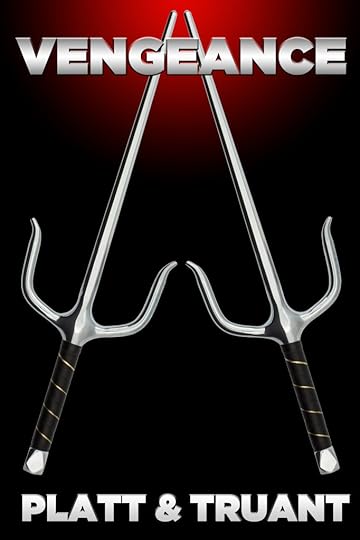
Vengeance
 Sean had been wanting to write a revenge book for a while. He’s obsessed with Kill Bill — and, if I may go all Freud for a second, probably wants to mentally settle the score over that whole flower shop debacle. I have no true revenge fantasies (sometimes I fear I’m not damaged enough for my job), but thought the project sounded fun.
We all have something we’re angry about — some wrong we feel has been perpetuated, on the world if not on us personally — and writing about revenge is a great outlet and less messy than shooting up a Denny’s.
Written revenge is tidy. Because the writer is more or less in charge, you can make sure that things work out exactly how you want them to. Real life is seldom so considerate.
In real life, the best-laid plans usually fail and your cool one-liners (Sean: “I brought you a bouquet … OF JUSTICE!”) always sound stupid. For both of us, the idea to write an idealized revenge story seemed a delightful sort of catharsis.
Our job lets us kill people and no one gets hurt or thinks us mentally ill. It’s a fantastic racket.
Of course, revenge has been done to death, so we crafted Amit to differentiate our story. Amit is from an order of elite “shadow monks” called Sri who train all day to turn their bodies into ultimate killing machines — which, under their Zen community’s moral code, they are forbidden to use to do violence.
The Sri sit in their compound and mediate on the nature of existence; they chant and stroll garden paths while pondering their karma and dharma; they undergo excruciating training to hone the smallest, should-be-involuntary muscles to optimal function. They learn about killing techniques and perfect them on dummies … “for the practice of discipline, because training the body trains the mind.”
That’s an interesting hook, but not the full reason we created Amit. We did it because our monk is a moral realist.
Amit knows all the reasons to avoid violent retribution after a heinous wrong is perpetrated against someone he loves, but because he believes in objective morality, he calmly determines that his order’s decrees no longer make sense… and hence prepares to get his hands dirty. The Sri believe in nonviolence and restraint, but as he muses: “Restraint is to sharpen a sword against a grinding stone every day for the mere act of sharpening it … and then to stand back to admire that useless sword’s sheen while you are subdued by bandits who hold sticks as weapons.”
As we grew to know Amit, we noticed something that was almost troubling.
It’s one thing to motivate a character to do something terrible. It’s one thing to make that character angry, so that he or she will feel compelled to do what is required by the narrative. In the tradition of storytelling, those things make sense, and they give both readers and author permission to step back and essentially say, “I’m along for the ride, but not complicit. This is just one angry guy’s opinion.”
With Amit, we had a character who’d calmly meditated on everything he was about to do, and had considered every angle.
With Amit, we had someone who’d decided — after extensive, non-emotional thought — that the universe demanded he take action, whether he himself wanted to or not.
That bothered us a bit, because it put us right back in the center, in a position where if we weren’t careful, we’d be agreeing that revenge was A-OK.
Still, when we got right down to it, the first part of Amit’s story (which is self-contained, with a neat reverse-chronological narrative, and is available for free as Vengeance) was fun to write.
It’s not like we believed the doctrine of objective rights and wrongs — meaning we could claim that even Amit’s well-reasoned arguments smelled like vapor to us. At that point, it was enough that Amit believed it. As storytellers, we watched and recorded his actions. And Amit did plenty.
 Vengeance is a fun romp, if you like things that are incredibly violent and have no mercy. We made Amit engaging and charming (I gave him the jovial personality of the Dalai Lama Tenzin Gyatso, then added a healthy dose of murderous zeal).
Throughout Vengeance, he’s sort of funny while committing atrocities. We made his opponents a bunch of asshole hoods who’d be judged “bad” even by the non-moral-realist reader, and gave Amit a strong, unarguable reason for his pursuit. We wanted to feel good about Amit, you understand … and in order to do that, there had to be no question about whether or not we agreed with his actions, regardless of whether we’d do the same ourselves.
But we couldn’t expect our readers to keep up with the reverse chronology (think Memento) forever, and could only maintain Vengeance’s hyper-violence for so long before it grew tiresome. So when we continued the story in the second part of the larger novel Namaste, we had to give Amit new challenges. For a while, that meant new people to kill. We gave him additional “big bosses” to dispatch in the name of revenge — or, in Amit’s mind, in the name of karmic realignment.
Then we hit a wall, because the body count had climbed disproportionately high.
Worse: we realized that not only were we starting to question the righteousness of Amit’s quest … but so was Amit.
Journey
Just like that, the simple elegance of our revenge thriller was gone.
Sean, when he writes with Dave, has a constant complaint. Sean wants to write a book here and there that’s fast and fun, but Dave complicates every storyline. His complaint with me must be similar. I can’t write anything in a straightforward way.
Unicorn Western was supposed to be a stupid ditty about a gunslinger who rides a unicorn and shoots pink smoke, but it became a sprawling fantasy epic that questions the fabric of reality and the balance of good and evil.
Robot Proletariat was conceived as “Downton Abbey with robots,” but evolved into a tale of insurgence that explores the natures of consciousness and the soul.
 And Namaste — which was supposed to be a kick-ass, adrenaline-fueled martial arts thriller where one man gets bloody revenge in grand cinematic fashion (and without undue moral qualms) — started to feel conflicted. It started to make us both wonder the question that heads this post:
Is revenge ever justified?
From the start we wanted our killer monk to kick unholy ass, take names, and get the satisfaction he deserved. And we wanted to be firmly on his side while he eviscerated his victims. That meant keeping the bad guys bad and the good guys good, just like the old McDonald’s McDLT.
For a while, that’s what we did. You understand why Amit does what he does. You want him to get his revenge. But a full novel is a long time to keep one man slitting throats without thinking too much about it, and when we continued Namaste, that truth punched us hard in the face.
Yes, Amit had lost someone he loved. Yes, it had happened in a manner that was incredibly cruel. But by the time Amit had stacked up a dozen hoods like cordwood, we began to feel like maybe enough was enough.
An eye for an eye … but not 20 for one.
Amit started to wonder:
Am I doing this for karma?
Am I doing it to right a wrong?
Or am I doing it for myself, because I want to?
That’s the sticky question about revenge. Does it actually right the wrongs? Does it ever change anything?
About halfway through our story, our rampaging Zen monk wonders if he’s a moral realist after all. Maybe he’s just another thug, following his own desires rather than the path of the righteous.
Maybe his victims have their own sides of the story. And maybe in doing what he’s done, he’s created widows and widowers and orphans — all of whom will feel differently about things than the killer.
Maybe, Amit starts to wonder, he’s not really that different from those he’s seeking revenge against.
What You Want
Once, in college, I was visiting London during some trouble in Afghanistan. Entering a small store, I ran into an Afghani shopkeeper. He asked if I was American. I told him I was. He said, “I like Americans. Your government? Not so much.”
Just like that, something clicked in my mind. We’re told to hate people because of the country they live in or the group they belong to, but people are people. Even between warring nations, citizens from both could sit to share a pleasant meal. The problem is, that realization raises a question I’d honestly rather not consider. Even if I conjure the worst people I can fathom from the most evil factions doing the most evil deeds, it’s chilling to wonder how much their experience differs from mine.
It’s chilling to wonder, if I were in their shoes, if I’d feel the way they feel, and consider the actions that they consider.
Maybe and maybe not. But if you’re very brave, ask yourself if it’s possible that those who seem wrong and evil might, from the other side of the coin, look like righteous pilgrims to others. Someone like Amit, beset upon by circumstance, on the trail of what feels like righteous revenge.
I no longer believe in moral realism (If I ever did). I defended it “philosophically satisfactorily” in the paper I wrote in college, but even then the idea tasted like sawdust. What we do and believe, we do and believe inside the bubble of our own experience. When something happens, we filter it through our own disposition, past, and prejudices.
Little in this world is ever black and white.
Sean never did drive that other flower shop out of business. It only hurt him, because he wasn’t really trying to right a wrong. He was doing what he felt was right to him — something he wanted, for his own satisfaction. He opened in five stores in three years and eventually had to go back to one. Revenge was just too expensive.
Was the decision to pursue revenge worth it? If it had succeeded and he’d conquered his foe, would it have been?
 I won’t take sides. I can’t bring myself to weigh in on any individual question of revenge. If, like in an old western, someone kills your Pa, is it “right” to pursue his killer? Possibly. Possibly not. Regardless, you’d be doing it for yourself — not for Pa, not for the universe, not for widowed old Ma.
You. Revenge is only (and always) for you.
We love Amit, but still don’t know if we agree with the heinous things he does. I’m not even sure, when all is said and done, if we’re on his side. We tried not be moralists, because morality isn’t objective. It’s subjective, and its meanings cast in shades of gray.
In the end, I think that all we can do is what we always do:
We do our best.
+++
We want to share what we have with you. If you’re not already an Outlaw, you should be. Outlaws are on this adventure with us. Yes, you’ll get special deals and reader freebies, but you’ll also be swimming out from shallow waters into a deeper part of life. It’s free (except for your email address) and comes with your choice of Realm & Sands titles (as long as it’s $4.99 or less).
If you’re already an Outlaw, please help Realm & Sands grow by sharing this post through any of the social channels you see below.
January 8, 2014
What defines you?
 A long, long, long time ago — I’m talking as long as six or nine months ago, like way back — I was a fairly well-known blogger. I wrote posts with what my podcast co-host Dave calls “goth titles,” like The Universe Doesn’t Give a Flying Fuck About You. Those posts were my unique breed of motivation and inspiration (yes, “You Are Dying and Your World Is a Lie” was supposed to be inspirational).
The idea was to kick readers in the ass for their own good. Basically, I had a lot of non-sugarcoated things I wanted to say, and blogging was my outlet. I wrote things I thought the world should hear, but that few people seemed willing to say — such as the fact that life is hard, and that if you want to take advantage of the one you’ve been given, you have to stop being a pussy and grab what you want with both hands, rather than waiting for someone to come along and save you.
When I transitioned to writing books last year, I found myself wanting to spend my words telling stories, not writing blog posts. As I spent more and more of my time doing the former, I did less and less of the latter.
By the end of the year, I thought my blogging days were finished. Writing blog posts was that, I reasoned, and now I was doing this. Sean and I saw them as two separate things with no intersection.
We were wrong.
Blogging and fiction, for Sean and I, aren’t really that different. Readers crave meaning; what I once delivered with my posts, I now articulate through story. Sure, it looks different … but all I’ve really done is trade literal statements for allegorical tales.
The Realm & Sands stage hosts the same themes, but now the players are grizzled gunslingers and their abrasive unicorn partners, robots searching for the meaning of life, and citizens of a dystopian future.
Stories Define Us (Whether You Believe it or Not)
 When you’re a fiction author, you’d better be a fan of your own work or you’re going to be miserable a lot of the time (cue joke about our friend Dave, who hates his own work and is miserable a lot of the time). That’s because you spend many hours staring at your own stuff, massaging the story, making it better, reading for flow and coherence.
I write rough drafts based on Sean’s ideas and outlines, then send them back for a few rounds of editing and post-production. Because of this, I often don’t see the finished stories before publication. When we write sequels to our work and need to re-familiarize ourselves with a narrative, I get to read my own books again in the same way any reader would.
It’s an odd experience. We write so much that I forget entire storylines, and barely remember getting all those words on the page.
Last month, I began reading Season One of our sci-fi political thriller The Beam in preparation for writing the second season, which we’ll release in late March or April. The Beam takes place in the year 2097, but its history — always in the background, never fully explored — spans back to semi-contemporary times. So for instance, in 2019, a revolutionary radio telescope is established on the dark side of the moon, and the world surges with optimism and purpose. Then, in 2027, an unforeseen ecological catastrophe slams the planet and goodwill is vapor; people resume looking out for number one as the world burns. The US, Canada, and Mexico (the “North American Union,” or NAU) pool their efforts and eventually thrive, but the rest of the Earth isn’t so lucky … so in the 2040’s, the NAU erects a permeable dome over the continent — the so-called “lattice” — to keep the “Wild East” from coming to steal their Lucky Charms. What ultimately saves the NAU is its willingness to embrace the connectivity (and hence potential for cooperation) offered by the old Internet … which evolved into a better technology called Crossbrace… which in year 2062 became the intuitive, everpresent, AI-driven network that our characters, in 2097, know as The Beam.
So why do you — you, sitting there and reading this — care?
It’s all a bunch of stuff that we made up, right?
Well, that’s what Sean and I thought at first. But as it turns out, the most important things in The Beam — and the rest of our stories — aren’t made up at all.
Look past artificial intelligence and nanobots for a moment, and instead think about the very core of what’s above. If you do that, you’ll see it for what it truly is at base: people facing situations. Situations that, absent bells and whistles, any of us might face ourselves.
When disaster threatens, people do whatever they must to survive.
There are always people who have more, and others with less. Those who have less will almost always wish for more… and might be willing to fight to get it.
Even in our hyperconnected world of 2097 — where those wanting to maximize what The Beam offers (assuming they can afford it) have enhanced their minds and bodies with technological add-ons — people are people, who want the same things we want today: to be fed and sheltered, to be loved, to feel comfortable, to have security and power, and to have the freedom (and the wealth) to do as they wish.
The characters in The Beam could be you.
Or to put it more accurately: They are you.
You Can Never Escape the Truth
 The Beam has a companion book, Plugged: How Hyperconnectivity and The Beam Changed the Way We Think. It’s written by a made-up author (Sterling Gibson) who pens his books from a made-up future — and yet, Plugged might be the most chilling, dead-honest “epic blog post” I’ve ever been a part of.
Plugged tells the story of how we got from where we are today to where characters in The Beam find themselves in 2097. To write that book, Sean and I had to make many inferences based on (wait for it) logic and truth and the facts of human nature — which means the core of Plugged is true to all of us today.
While future events in the book were made up, events from the past (such as Dennis Hope’s claims of owning the moon) are all very real. Mankind’s choices in Plugged, based on both past and future events, are all real choices we believed people would make. Technology’s evolution had to make sense based on today’s technology and how people use it. And as a result, writing that book forced us to step through modern society’s logical trajectory, as we imagined it unfolding in the future.
I could have written one of my “goth” epics (possibly called “Your Smartphone is Ruling Your Life — and Also, Santa Hates You”) and talked about how we’re addicted to technology and how our forward path is a slippery slope.
Instead I co-wrote Plugged, which makes that same argument so much better.
Don’t let the fact that stories are fictional lull you into believing that they aren’t true.
Stories are Trojan Horses
 Great storytellers bury truths inside fabrication so readers won’t see them coming. In the past, I made a career from speaking my mind and preachifying about harsh realities. But you know what? Some of my best posts were answered with crickets because people didn’t want to hear those harsh realities. But if we hide our messages inside of stories? Then BOO-YAH, suddenly the world is perked.
Think about it: Not many people want to hear that all things — even good things — have an expiration date, so you’d better grab onto them before they inevitably slip away. Yet that’s theme of The Bialy Pimps (about a bunch of Clerks-style assholes who work in a rogue bagel deli), and that deeper, more sober meaning sneaks up on you while you’re distracted by all the idiocy.
It would be hard to sell people on a blog post about the idea that evil is as vital to the world as good. But throughout the Unicorn Western series, that’s precisely what we whisper to our reader.
Who wants to hear that dependence on our beloved technology might be robbing us of our humanity? We don’t necessarily make that argument in Plugged, but we sure as hell ask the question … and hence trick readers into mulling it on their own, whether they want to or not.
Ditto questions about the balance of “what we’re taught” versus “who we are” (Robot Proletariat), compulsion versus morality (Cursed), the righteousness or fallibility of revenge (Namaste), conformity (Fat Vampire), or blind consumerism (Greens). Even our non-attributed collaborations with erotica author Lexi Maxxwell like The Future of Sex carry epic-post-worthy themes in the midst of all the explicit action Lexi adds to our prose. For example: If we allow a single group to become powerful and influential enough, that group might be able to change the very nature of humanity (and desire) in the name of profit.
Stephen King said the most important job of a storyteller is to tell the truth, so that’s what we do. We put people into situations, then tell the truth and see what happens next.
We work to untangle life’s thickest knots by exploring them through our stories. But to do that, we need YOU.
At least if you are who we think you are.
 You can go through life like an automaton, or stay curious about the world around you.
You can live a script, or discover what truly moves you.
You can live unconsciously, or live every day with your eyes wide open.
You might not be the Realm & Sands sort (not everyone is), but if you want to understand life through story, and live a better one when you’re off of the page, we want you here with us.
We’ll keep asking questions while telling our tales, hoping you’re here to help us answer.
When we wrote Namaste (and its baked-in for FREE!) pre-story Vengeance, we asked, “Is revenge ever justified?”
When we wrote Unicorn Western we asked, “Does everything happen for a reason?”
When I wrote Fat Vampire, I asked, “Can a man change his nature … even if what he sees in the mirror never can?”
When we wrote Cursed, we asked, “Is a person defined by his fate?”
When we wrote The Beam and Plugged, we asked, “Are we too connected?” “What is the nature of consciousness?” and “If we can do something, are we truly capable of asking whether we should?”
And when we wrote Robot Proletariat, we asked many, many questions … including one I can’t bring myself to include here because without context, I’m afraid it’d be far too inflammatory.
We want to discuss those questions here, with you, because we suspect you’ve asked yourself many of the same questions.
I don’t know that we’ll find any true, objective answers. The best questions are fated to remain just that — but we as humans we long to explore them, and make sense of our world.
Sean and I are lucky — our work allows us to constantly know ourselves better. Knowing ourselves better helps us to live our best possible lives.
We want to share what we have with you. If you’re not already an Outlaw, you should be. Outlaws are on this adventure with us. Yes, you’ll get special deals and reader freebies, but you’ll also be swimming out from shallow waters into a deeper part of life. It’s free (except for your email address) and comes with your choice of Realm & Sands titles (as long as it’s $4.99 or less).
If you’re already an Outlaw, please help Realm & Sands grow by sharing this post through any of the social channels you see below.
Until next week …
Johnny (and Sean)
December 22, 2013
What You Want Most
Tell us what you’d love to see most for Realm & Sands in 2014.
Our writing schedule is booked for the first quarter, but we’d love to hear what you want most. Something old, something new. A romance? A thriller? An extra season of The Beam? Unicorn Apocalypse? Robot Proletariat (please, please say Robot Proletariat!). Another book by Sterling Gibson? Something no one’s ever thought of before?
What kind of reader are you? Let us know.
Use the comment box below to tell us what kind of stories you’d like most, or what would make you happy as a reader. “I feel your books suffer for their lack of dinosaurs,” and “I would like to see more children in jeopardy, like what they do over at the Inkwell,” are equally welcome. We want to know. Even “I will only like you when you are giving me something for free” is cool for being honest.
Let us know what you want most as an Outlaw below!
December 11, 2013
Thank You! (And Welcome)
What a long, wonderful week.
This last few months have been insane. It’s been so much fun writing these stories for you (we’re baking the final batch now!), but in addition to our fiction, Johnny and I took some time out to work on Write. Publish. Repeat. — our nonfiction book about writing (mostly) fiction.
We launched Write. Publish. Repeat. last week and it did very well. A day after release it was the #1 Marketing book in the world. So exciting.
If you were a Realm & Sands reader before last week, thank you so much for reading. This year has been wonderful in large part because of you. Johnny and I owe you a lot.
If you found Realm & Sands because of Write. Publish. Repeat., welcome, we are glad you’re here with us, and promise to make you a very happy reader.
 As you probably guessed by the badass cover to your left, Namaste (the full novel) is finally out.
I’d say that Namaste is our most unique title, but hell, it really isn’t. We do have unicorns and sexbots after all.
Amit is a shadow monk, trained body and mind to the peak of human ability. When everything is taken from him, he decides that turning the other cheek is no longer an option. Amit’s epic quest for revenge will see wrongs righted and kick major major ass from first page to last.
However, Namaste is the most violent thing Johnny and I have written so far, and the tonal opposite of Unicorn Western. It does have everything: mystery, suspense, mysticism, murder, love, and bloody, bloody revenge, and since it’s Realm & Sands, you know the action is good (because Johnny wrote those scenes rather than me) and the soul is deep. But if you thought the stuff with the Orion in The Beam was too hardcore, this book is definitely not for you.
 If you think you might like Namaste but aren’t sure, you can try Prelude for free. Prelude is the first bit of Namaste. If you like Prelude, you’ll love Namaste.
If you don’t like Prelude, please don’t buy Namaste. You won’t like it, and we want you to love everything you read.
BUY NAMASTE ON AMAZON US
BUY NAMASTE ON AMAZON UK
TRY PRELUDE FOR FREE ON AMAZON US
 Our werewolf (chupacabra) story, Cursed also went free yesterday.
We’ll have the sequels up soon — immediately following Robot Proletariat (sexbots, YAY!) — but if you’ve not read it yet you can check it out now for free:
I just published some really amazing children’s books. If you have kids, I’ll have some free reads for you really soon.
Until next time!
Sean (and Johnny)
P.S. We have retired Genesis: Origins. It seemed slightly confusing to our readers, and with the price matching taking longer than we would like we didn’t want to chance readers spending money on something they already had. Unfortunately, this has stripped early Genesis reviews, so if you’ve read it and enjoyed it, we would love a review! You can review Genesis here. THANKS!
December 5, 2013
LOL (You Deserve to Laugh this Hard!)
We love everything we write.
As long as you’re a happy reader, there’s not a single world we wouldn’t love a return to.
But man, I hope our comedies really take off. EXPLODE. Because they are FUN to write. Imagining ridiculous scenarios then bringing them to life is magic. Laughing our way through it makes creation fun, knowing others will laugh as hard while they’re reading makes it rewarding.
We love all three of our comedies. We wrote them so it would be like reading your favorite sitcoms on your e-reader. Each is currently free on Amazon (US only, sorry UK — we’re working on it!).
We’re so excited that they are all finally free. It makes it so easy for you to try them.

Greens
Greens: In Retail and life, Green is God
You think working at a gas station is bad? Fast food? Those are the jobs Greens employees wish they had. It’s intolerable for Dylan.
Just because the Fed decided his online marketing career was “illegal,” he’s been forced to work at the lowest of the low: an organic health food store in one of America’s poorest, most dangerous neighborhoods.
Can Dylan supply the neighborhood with what it craves, while climbing the corporate ladder?
 Space Shuttle: You’ve Never Seen Your Favorite Aliens Like This (They’re All in Here!)
Sloan is your average trashy American with no dreams or future until suddenly he’s whisked away into an international conspiracy of laziness, ineptitude and sloth.
Forced to work for the abusive (and somewhat familiar) owner of the Space Shuttle company, Sloan will have to take fares of many faces (or face-like appendages) across the galaxy if he ever hopes to make it back home.
Fans of sci-fi who like to laugh will love this hilarious space comedy.
 Everyone Gets Divorced: It’s Like How I Met Your Mother and Always Sunny in Philadelphia had a baby on your e-reader
Join Archer as he explains how his perfect, fairy-tale marriage slowly started to crumble before the “I dos” were exchanged. In addition to Archer, you’ll meet his fiancee Hannah, and five repugnant friends.
Everyone Gets Divorced will have you laughing hard, and wondering how anyone can stay together at all.
Because we wanted each comedy to feel like a favorite show, we gave them titles to fit.
GREENS
1. Ninja Gaiden
2. Kemosabe
3. A Man and His Bird
4. Beware the Jaberwocky
5. All-Inclusive Ingredients
6. A Big Opportunity
SPACE SHUTTLE
1. The One With the Xenomorph
2. The One With the Glork
3. The One With Sentinel Ultimate
4. The One With Bulbous the Fat
5. The One With the Wormhole
6. The One With Warp Drive
EVERYONE GETS DIVORCED
1. The Proposal
2. The Engagement
3. The Wedding
4. The Quarantine
5. The Scare
6. The Double Date
Each comedy is free to try. Each comedy also comes in a season, with six episodes for $3.99.
 The best deal is the LOL Comedy Bundle that has all three shows (18 episodes total) for $5.99.
Click on the one that’s best for you!
Try Greens For Free
Try Space Shuttle For Free
Try Everyone Gets Divorced For Free
Buy Greens Season One
Buy Space Shuttle Season One
Buy Everyone Gets Divorced Season One
Buy LOL Bundle (all 18 episodes for $5.99)
NOTE: If you send a link to your Amazon or Goodreads review for the first episode of any comedy to seanmichaelplatt@gmail.com, we will send you a review copy of that comedy’s full season.
Thanks for reading!
Sean (and Johnny)
November 18, 2013
What We’ve Been Up To (LOOK AT ALL THE COVERS!)
Hey there Outlaw!
It’s been a busy, busy month. This year’s three most difficult writing projects were probably Plugged, Unicorn Genesis, and Write. Publish. Repeat (due for release on 12/5). All three titles are trying to do something truly different, and as taxing as the trio would have been anyway, they were written back-to-back-to-back. We can’t wait to tell you about the rest of the year, but before we do — you have to hear about Unicorn Genesis.
FIRST UP: Unicorn Genesis is finally for sale!
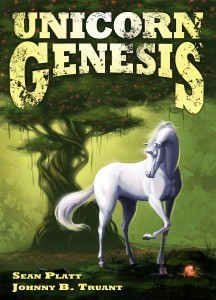 Genesis is very special. If The Beam is our smartest work to date, Unicorn Genesis is probably our sweetest. Johnny and I stopped twice while writing to untangle our story. We had to get all the elements in place. We could tell a story with Adam, Eve and Noah set in the same worlds as the Big Bad Wolf, but only if the story was awesome. We could have a Seven Nation Army, but it couldn’t be a joke. We could deliver our take on oral tradition, but only if we wrote a story worthy of oral tradition itself.
I love what we wrote, and how it does a different job than what either of us expected. Genesis had an enormous job to do: bridge the time from the very beginning to just before the first Unicorn Western. We knew that, and not much else. We also knew our prequel would explore the nature of stories. We weren’t sure past that. Genesis would be shorter than Western, but its original conception was a series of nine book, slightly shorter than Western’s.
Unicorn Apocalypse, coming next year, is ambitious. We decided Genesis should be lean to balance some of the sprawl that Apocalypse will need. What we found, more than a story about stories, was a story about how Edward became the unicorn we know.
This is Edward’s story. We thought we were telling the tale of The Realm and Sands and how they came to be. And while that is all a part of this story, the narrative belongs to Edward. Genesis is different than Western, and different from what we expected. We’re so glad that it is. Here’s the product description:
UNICORN GENESIS
The Book Edward Doesn’t Want You to Read!
Unicorn Genesis starts in the Farback, as Edward’s Grappies spin yarn of life as the first unicorns, Adam and Eve, of the time before the Great Flood that tore the worlds apart, before The Realm, before the Sands, and before Marshall Clint Gulliver. Join Edward and Clint as the world’s favorite (and surliest) unicorn tells the gunslinger about his days as a unicorn colt, and how all life (in all worlds) began, as he comes of age in worlds both real and make-believe.
Unicorn Genesis is another epic tale in the Unicorn Western series exploring oral tradition, the stories we love, and what we all believe to be true. The events in Unicorn Genesis take place before the events in Unicorn Western, but for the best possible reading experience, you’ll want to start with Unicorn Western first. You know how there’s that other really great series with the prequels that came out later, and if you had seen those first you never would have cared as much about the original trilogy? This is a little like that, except that Unicorn Genesis is way, way more awesome than those other prequels. You don’t need to Western to understand Genesis, and reading Genesis won’t really spoil anything when reading Western, but reading them in the order our stories were written will give you the best possible reading experience.
Get Unicorn Genesis on Amazon US
Get Unicorn Genesis on Amazon UK
Get Unicorn Genesis on Kobo
NOTE: The previously released title that used to be called Unicorn Genesis: Book 1 (Now known as Unicorn Genesis: Origins) is comprised of the first few chapters of the newer, longer, full book now called Unicorn Genesis. If the “Unicorn Genesis” you’ve read is around 18,000 words, you don’t have the full version. This new, full version is around 95,000 words.
 Next up: Other cool shit!
The rest of the year looks fantastic. Realm & Sands had a wonderful year thanks to our readers. We have some amazing projects lined up for 2014, but by the end of this year (and at a steady drip until then) we’ll have delivered on every promise we’ve made so far. First up: our comedies.
So check out our new covers! Everyone Gets Divorced (on the right over there) is the first cover I (Sean) ever designed myself (David Wright did the work).
 All three of our comedies are finished and are now in final edit. They’ll all be be available soon, and all are worthy of the “LOL” name we’ve given to the full bundle that we will offer of all three together. (Our very first comedy, Space Shuttle is Johnny’s favorite. Gun to head, mine is Greens, but I love all three.)
They’re so different. Space Shuttle (which is about an intergalactic taxi service and which seems to be spoofing just about every space movie ever made) is zany as shit. We had a TON of fun writing Space Shuttle, so I totally see why it’s Johnny’s favorite. His enthusiasm definitely trumpets through the words.
Everybody Gets Divorced is like How I Met Your Mother meets Always Sunny in Philadelphia. It could also be “Asshole Friends.” It tells the story of one man’s divorce under the influence of his idiot cohorts.
Greens is a ridiculous marketing spoof: Weeds meets Breaking Bad. I think Greens is my favorite because it went in the most unexpected direction.
We do have single episodes of all of them online, and we’ll be releasing the full seasons of all three comedies in the next few weeks. Right now only Space Shuttle’s first episode is available for free, but we’re trying to get the first episodes of Everyone Gets Divorced and Greens free as well. That way you can try and of the pilots to see how much you like them. They all get funnier as they progress.
When we do publish the full seasons, each of the three comedies will be available in 6-episode seasons for $3.99 per season. Or, if you want to save some bucks, you’ll be able to get the “LOL Comedy Bundle” (the full seasons of all three shows bundled together) for $5.99. The LOL Comedy Bundle will be available on November 29 (Black Friday in America).
Full season review copies are available for anyone who has reviewed a comedy pilot on Amazon or Goodreads. Please send Sean an email with a link to your review and we’ll send you the full season to check out and review.
If you’ve read the comedies yet and haven’t yet reviewed them, please review your favorite title here:
Everyone Gets Divorced
Space Shuttle
Greens
But wait! It gets even more awesome from there!
Following the comedies, we’ll be releasing something that is their opposite: The full-book version of Namaste, which is the most violent thing we’ve written.
This is a great revenge story. If you enjoyed the pilot (previously just called Namaste and now called Namaste: Prelude — a partial/full situation analogous to what we did with Unicorn Genesis: Origins and the newly released Unicorn Genesis), you will go apeshit for the full novel. It is balls-out. Definitely our best action, but so much more. We can’t wait to see what you’re going to say about this one.
Namaste is a full novel, about the length of Unicorn Genesis. Prelude, the first part of Namaste, was written as the pilot and can stand on its own to setup the rest of the story (but is also included in the full book, just as with Origins for Genesis).
Read Namaste Prelude for free here!
 Following Namaste, we will be releasing the first full season of Robot Proletariat.
This is an extremely well-balanced Realm & Sands story. Probably the most measured story we’ve told so far. It’s not hard sci-fi (future history) like The Beam, but it isn’t in any way campy. It’s serious and funny, well-blended, and definitely has something to say.
We wrote the first parts of Robot Proletariat, Namaste and Chupacabra Outlaw as pilots for serials. But once we decided to greenlight all three, we had to figure out the best way to tell each story. Namaste made most sense as a novel. Chupacabra you’ll read about in a second. Robot Proletariat just felt like a serial. And as we started writing it, that’s exactly what it wanted to be.
Really great stuff. If you liked the pilot, you’ll love the season.
So here’s what’s up with Chupacabra Outlaw, since we just mentioned that…
 Chupacabra Outlaw got a new name. The finished story for Chupacabra Outlaw in no way fit the tone of its original campy, gonzo tile. So now the title is something much more appropriate: Cursed.
Cursed will be a series of novellas, the first of which (simply called Cursed, rather than something like “Cursed #1″) is out now. The next three Cursed books will be out before the end of the year. Namaste is more violent than Cursed is, but Cursed is far darker. Lonelier. More beautiful. If you enjoyed the spareness of the first Cursed, you’ll love the next three.
We’re working to get the first episode of Robot Proletariat and the first book in the Cursed series free, and will let you know as soon as they are. If you’ve already read them, you can review them now for a review copy of the full season/sequel titles when they are available (the more reviews we have on them before they go free, the better that title will do in the post-free bump, so we would LOVE your help in getting those reviews!)
Thanks for reading!
Sean (and Johnny)
November 11, 2013
The Disassociation Paradigm II
The following is an excerpt from Sterling Gibson’s book, Plugged, published November 2097.
SARAH LANGDON IS 43 AND looks very old.
In reality, Sarah looks how 43 is supposed to look. In her community — a small Organa settlement outside District 6 in Ontario, not far from the consolidated Great Lake — aging is considered beautiful and a badge of honor. The Organas believe that Sarah’s 43 years are an achievement, and that she should wear the small wrinkles and few gray hairs in her otherwise dark-brown pony tail with pride. Not that 43 is old even among the Organas; life expectancy of an Organa child born today, barring accidents or violence, is still in the low 90s. But if 43 is an achievement worthy of a few wrinkles, 75 is a larger achievement worthy of many more wrinkles and much more gray hair. And 95, like the settlement’s grand dame, Mama Beatrice? Well, that’s a four-star general’s worth of honor, making even her creaking bones something like a trumpet flourish.
The reason Sarah looks so old isn’t because she is old; it’s because we’ve grown used to a new standard of age. Even if you’ve never gone into a rejuvenation clinic for a bolus of scavenger and repair nanobots, you’re still getting a few in every glass of fortified milk, in every yogurt that claims “active cultures and repair,” and with every vaccine. Anti-dust mite nanos, standard in any Beam-enabled house built after 2075, clean their home’s owners as well as the floors and walls, keeping them healthier and younger looking. And if your home has a HEMA filtration system (which it almost certainly does even if you live far below the line), that system is removing countless floating pathogens and bugs while constantly moistening your air to tighten and smooth your skin. No one questions any of this; 30 today is 30 is 30 is 30, and we accept it in the way we know that cobalt is blue.
But compare photos of 2097 NAU citizens to year 2000 Americans and you’ll find that today’s 65 (even without rejuvenation treatments) looks virtually identical to 2000’s 45. When you add in the fact that most above-the-line citizens today get at least a nanoinjection or two in their lives, the chasm widens. Then there’s those higher on the ladder, who can afford more comprehensive treatments and better nanobots. Many of the richest 80-years-plus men and women today look like they’re in their late 20s by year 2000 standards, and the clock hasn’t even had time to prey on those folks yet. Given that telomere lengthening treatments seem practically capable of pausing aging (rather than simply making it look that way), we may yet see life expectancies of upper-class citizens reach 200 or greater. If those folks ever get around to dying, it’s possible they’ll do it looking mid-40s when they do.
When I say that Sarah looks very old, I mean that she looks like a 43-year-old woman is supposed to look. She looks like any other Organa woman her age — very close to how a 43-year-old woman would have looked in the year 2000 or how she’d look today outside the NAU.
“Most people don’t get our way of living, and that’s kind of the point,” says Sarah. “Kind of a cliché, but true: one of the ways we know we’re on the right track is if we’re living opposite of the average person.”
What Sarah doesn’t really understand, though, is that even the Organa’s “opposite” way of living — mostly disconnected from The Beam, in basic shelters with few amenities, clustered in communities that work cooperatively and ride horses for transportation — still relies heavily on technology. Sarah, for instance, likes early-century punk rock music, which she says carries many of the same anti-establishment overtones of the modern Organa movement. But although she doesn’t play that music through a Beam canvas as it streams from her cloud cache, she’s still playing it on an old 44.1 kHz device called an iPod because there is simply no truly non-electronic way to listen. The music itself was created with bits and electricity, even though if they’re almost 100-year-old bits and electricity. Many Organas don’t have Beam IDs, but they still sometimes send mail, and mail has to come from an address … which, of course, identifies the sender. And what about mail? There are orthodox Organas who shuttle paper back and forth like they did in the 20th century, but paper has gone from “the way things are” to almost a luxury. Papery delivery is nearly impossible unless you want to box and ship it, so the orthodox either waste money or hand deliver their missives. And if they’re hand-delivering letters, why bother sending them at all?
The Organa face the same dilemma as every fringe group in history: They want to live outside of society, but society surrounds them. The whole world doesn’t live as they do, so unless they want to cut themselves off entirely, the choice isn’t whether to “sell out” or not; it’s how much they can sell out and still look themselves in the mirror each morning.
“So, fine, we live under a big, protective dome,” Sarah said as we sat on hand-built wooden chairs in her commune’s meeting room. “And we’re safe from Wild East incursions like the rest of you. We have controlled weather, because we can’t help it. And yeah, sometimes we have to ride mag trains to get where we want to go. We communicate with other groups like ours using mail, and when we get sick, we visit non-commune doctors, sometimes, when we’re scared. But that’s how it is, and we don’t want to just shut the 10 or so of us here inside our own dome and live like cavemen. Because that wouldn’t be true to our ideals, either. It’s no more natural or right for people to cut themselves off entirely than it is to have implants in their eyes that let them record their lives, or have other implants that let them receive mail straight to their brains. We’re like the Quakers or Amish used to be, driving buggies to mainstream construction jobs where there were electric lights and power tools. We do our best, and sacrifice where we must.”
The Organa get plenty of criticism — people say they’re just a fashion and that “listening to music on old devices” is hardly a sacrifice worthy of someone committed to her ideals — but it’s hard to not be swayed by their thoughts on what happened during the early 2030s. I happened to mention what I’d observed with Victor Salieri to Sarah. She had an immediate answer. So immediate, in fact, it had the feel of a foundation principle — of something the Organa have spent time discussing.
“He disassociated,” she told me. “Like everyone.”
The Organa movement took form after the fall in 2026 and through Reconstruction. It seems to have popped up from nowhere, but Sarah claims that one of the largest rallying points that Organa had through its inception was how the Internet created a “culture of indifference” in the pre-NAU. The reason I couldn’t find anyone to tell me about the early ‘30s with any true emotion, Sarah says, is because the Western world immediately scrambled to put screens between themselves and reality in 2030 when networks came online.
“They needed that distance,” she says, a touch of understanding percolating through her disgust. “Mama Beatrice lived through that period, and swears she was no better than anyone. It’s her greatest point of shame — the reason she’s the most orthodox among us today. She had lived through four years of absolute horror. Mama Beatrice lost her entire family — most in a storm and the rest in a civil uprising outside Washington D.C. — and had to make her way across the country with a small band of travelers, always on the move to stay away from highwaymen. Every time they stopped somewhere, bandits saw their nightly fires and raided. She was robbed more times than she could count, raped three or four times, and nearly killed twice. When Chicago came back online, she was nearby. Lights suddenly came on in a house where her group was hiding. There was an old iPhone Ruby plugged into the kitchen. She heard it beep and ran for it — ‘like I used to run for food’ is how she puts it.”
I later spoke to Mama Beatrice, but she was less helpful than Salieri had been. She’d been so traumatized by her time in hell that the familiar charging beep of that mobile was like the clucking of a mother hen. She took the phone with her and looked at it constantly, charging it when she found electricity. For the longest time, all she did was play games installed by the previous owner.
“The others searched for food, and I played something called Angry Birds,” she said with a sorrowed chuckle, her wrinkled, arthritic hands shaking atop the curve of a polished wood cane. “Like I was in a trance.”
It’s possible she was; psychologists estimate that in 2030, as much as half the U.S. population was suffering from undiagnosed and untreated post-traumatic shock. What pulled Mama Beatrice from her bird-flinging game and back into reality was the day the Ruby’s display indicated the presence of an open network. There were still paid networks before the Second Black Thursday, but the Doodad revolution had opened free access to anyone who didn’t care about voice telephony. Once that access was back, Mama Beatrice jumped on it. She describes it as a breath of fresh air — much better than her games from a forgotten age because it proved there were still other humans in the world. Good people who lived in cities, who had consolidated enough to share, and were calling the rest of them home.
Beatrice describes her relationship with the Ruby as being like that between a drowning woman and her life preserver. Even after she’d settled in Chicago — even after she found herself clothed, fed, cleaned, and sharing a roof with seven other friendly refugees — she couldn’t break away. She got herself a mail account and managed to track down surviving friends and relatives halfway across the country. As the Internet came back up, she followed first damage from the disasters, then the progress of recovery. Millions upon millions had died; weather had grown hotter and harsher; once-great rivers had run dry. Over 10 percent of the world’s population had lived near the coasts, and by the time the ice caps were gone, the coasts had vanished and all of those people (those who lived, anyway) had moved inland. Drought had taken over from there, killing much of the world, starting with its crops.
As horridly as Beatrice had clung to negative news, she soldered herself to any shred of possible positive news as well. Cities rebuilt, then reached out to those in surrounding areas once stabilized. The government was fragmented, but had grown past its ego and was working so closely with Canada and Mexico’s governments that the three might as well have been one. Refugees began coming from other countries, and the U.S. took them. Earthquakes had shattered vast areas and caused worldwide tsunamis, but the U.S./Canada/Mexico, at least, had already developed fairly reliable prediction systems that could tell people when they were likely to strike in time to get out. Strategic use of explosives along fault lines had allowed the earth’s plates to “break where and when we want them to,” relieving the pressure. People began taking charge. Lights stayed on in Chicago. Police patrolled the streets. People felt safer by the day. Clean water was available, piped from the lake. Food wasn’t a problem.
Above all, the network continued to thrive. I’ve found some unconfirmed indications that this was deliberate — that those in charge realized how starving citizens like Beatrice were for any opiate to move their mind from troubles. No one was making new videos in the early ‘30s, but old ones were available in abundance. By early 2031, it was possible for citizens in Districts Zero through 10 (Two sprang from Chicago) to sit around for most of the day and simply watch vidstreams and Internet news. Many did; Beatrice was among them.
It wasn’t all entertainment. Quickly, news of the world’s plight began to surface. This is how we know of the terrible events that occurred between 2030 and 2034 or 36 — the “blackout” period during which I could find no good sources. I asked Beatrice to fill me in, and found her information as plain and emotionless as Victor Salieri’s. The difference was that while Salieri thought he was giving me the straight dope, Beatrice knew that what she had to offer was, in her own words, “a heap of indifferent bullshit.”
Here’s an excerpt from Mama Beatrice’s book, Callous. Amazingly, this account is handwritten on paper in a single holographic manuscript, seemingly as penance:
We turned our heads. We looked away. We watched the world fall apart, but did it through the screens of our Doodads and smart phones and computers and televisions. Watching it that way gave us the illusion of caring — because hey, we were paying attention, weren’t we? — without any of the connection that marks genuine caring. We had distance when we watched everything happen through a filter. It felt like a movie, or maybe a video game. Video games looked every bit as real as that footage. In fact, video games seemed more real because at least we knew they were games, and that was how we could explain what we saw. The footage of the Wild East, by contrast, was too terrible for us to really believe without imagining it as a game dreamed by some sick mind.
At the beginning, all air traffic overseas had shut down, so everything we saw came to us from the Easterners themselves. They were using whatever power sources they had and whatever networks they had managed to get back up specifically to put the footage online. It was a call for help. They were reaching out to us — or to any of the other global brothers they’d so recently clasped hands with to solve the world’s problems. They were begging for help. Just a few years earlier, the entire planet had come together in harmony. But when the chips were down — when we’d begun to recover and they hadn’t — old ties vanished. We watched their cries for help through our screens as if they were another entertainment stream, not terribly different from the old Friends reruns sharing screen space. The rest of the world died and shouted for their brothers to help them. We lay back on our couches with our bellies full and said, “That’s YOUR fucking problem.”
October 25, 2013
This is the end
Sean let me, Johnny, write this week’s email/post. So here we go!
I first started writing fiction for real a year ago with Fat Vampire, a book about a lovable guy named Reginald who’s turned into a not-quite-Twilight-style vampire, and has to learn to use his non-physical abilities to get by after being turned.
Today, the saga’s final volume – Fat Vampire 6 – is available. This book marks the end of the series, and the end of Reginald’s journey.
You can pick up your copy of Fat Vampire 6 here:
This book is the end. Of everything. If you read Fat Vampire 5, you know how much Reginald’s world has changed. You know what’s happened to the planet. And you’ve probably got a lot of questions, too.
But I’m not one of those guys who will string a series out forever when it should be concluded, and again, this is the end. That means that all of those loose ends get tied up in this book, which is the longest volume in the series. All of your questions will be answered.
One final thing to note: in order to get as many people as possible on board with this series now that it’s concluded, I’ve temporarily put the “Fat Vampire Value Meal” (which contains ALL FOUR OF THE FIRST BOOKS in the series) on sale for 99 cents. So if you haven’t gotten that yet, grab it now:
ONLY 99 CENTS UNTIL TUESDAY
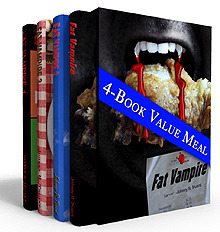
And please, if you like Fat Vampire, tell your reader friends who you think might enjoy the series. Post it on Facebook or share it on Twitter. Whatever and wherever. It’s only a buck, and it’ll only stay a buck until Tuesday.
(Oh, and Fat Vampire 5 is also on sale, to round things out. So that’s the entire series.)
But remember… the price of all of the Fat Vampire books will go back to their normal prices on Tuesday, so be sure to grab your copy of Fat Vampire 6 or the 99 cent “books 1-4″ box set now if you want them!
I hope you like how I concluded Reginald’s journey. He was a hell of a lot of fun (and excitement) to write about.


