David F. Porteous's Blog, page 3
December 10, 2014
Wanted: Artistic Collaborator(s)
Most years I make my own Christmas cards. Some years I draw the images on the cards and write very short stories to accompany them. Other years I find an image that inspires me on an existing card and a write the story behind that image.
Last year I thought about collecting all of these stories into one bundle and doing something with them – if for no otherreason than to let everyone see what I’d written for other people. But I was in the middle of writing that difficult third novel (it’s coming, it’s coming) and nothing happened.
Next year I want to make this collection a reality with the help of crowdfunding and collaborators. I’m a writer first and an illustrator seventh – so my own artwork needs some support.
Is there an artist amongst my readership who’d love to work with me on this project? Do you know someone who might be interested? I’d like to have a chat with you about what might be involved in this project, but I’ve outlined roughly where my thinking is at the moment – in the style of Kickstarter reward tiers – so you can see where artist(s) might fit into this.
Tier one – my love, signified through a tweet. Possibly the love of any artists too, but it seems very forward for me to promise that.
Tier two – A digital download of the short story collection in aformat of your choosing (text only). Plus tier one.
Tier three (there may be multiple of these for the same valuefor different art / stories) – A set of ten Christmas cards bearing a single illustration on the outside and the short story on the inside. All cards will contain a link so that the person who receives the card will be able to download their own copy of the full short story collection. Plus tiers one and two.
Tier four – a quality hardback book with the illustrations and stories presented together in full colour. Suitable as a gift for a friend or as a sturdy weapon to kill an enemy. Plus tiers one and two.
Tier five – tier four plus tier three. Plus tier one and tier two.
Tier six – signed print of the artwork. Plus tier five.
Tier seven – signed original artwork. Plus tier five.
Also as I’m in the process of recording an audiobook forSingular at the moment, possibly an audio recording could make its way into that list.
Looking to put this out to crowdfunding in the middle of 2015 and deliver in time for Xmas 2015 (which really means November 2015).
Happy to share a story with anyone who contacts me to give an indication of the style. Fairly grim, alternative stories, magical, otherworldly and funny is where I’d see the project going.
Please use the contact form or hit me up on social media in the first instance if you’re interested.


December 16, 2012
Guns & Laws & Opinions
As a writer, I often have my characters do terrible things and I try to understand the world - as I'm sure many of us do - through the lens of my art; because understanding why things happen is important to make us feel safe - even if safety is an illusion - and help us prevent the same incident occuring again. Although it seems that such events, at stark angles to our normal lives, are becoming increasingly common.
I want to talk about four different things, but three of them only briefly. Access to guns, mental health, the media and some of the opinions around gun control in the United States. Access to Guns The United States has the most famous pro-gun policy in the world. At the heart of its constitution, right after the guaranteed right to freedom of expression, is the Second Amendment, which says:
"A well regulated Militia, being necessary to the security of a free State, the right of the people to keep and bear Arms, shall not be infringed".This law has been generally interpreted as meaning that an individual in the United States should be allowed to own and carry a gun. This is, of course, not what the amendment actually says. The requirement is for a well regulated militia and the purpose is for the security of a free state - while war with Britain and France (and Spain and Mexico and the Native American Nations, etc.) was still a likely prospect it was a sensible precaution to ensure that militias could be formed and would be effective.
I think it's worth pointing out that after the US won its independence from Britain, Congress disbanded the army, such was their distrust in standing armies. Instead their intention was that militias would protect the United States. The wars with the Native American Nations prompted the United States to finally create a standing army, but it's fair to say that this was not their first choice. It is in this context which the Second Amendment needs to be viewed and in this context it's clear - to me at least - that the law's intention was not to put a gun in every waistband in perpetuity.
But that is a moot point because, as I said, the interpretation of the law for at least the last fifty years has been to guarantee individual rights to weapons.
I've been to America several times now and have visited nine states for varying lengths of time. During one trip to Pennsylvania I was taken to a gun store. A warehouse-sized building just outside of Pittsburgh, the variety of guns on display was impressive. These were not simply devices for killing - their was craftsmanship and artistry involved in making some of the weapons and the wooden boxes that held them.
After looking through many of the displays, I was taken downstairs to a sound-proof room where I was given ear protectors and was talked through and shown the correct way to load, hold, aim and fire a gun. (Normally there would be protective goggles as well, but my glasses were sufficient). Then I picked my target sheet from a range of imaginative designs including aliens, muggers and animals - I chose five bulls-eye targets - and bought fifty rounds.
As it turns out I'm a pretty good shot - if I had a gun, and I could see you, and I wanted to kill you, then you'd be dead. That's how guns work. The movies show hundreds of shots being fired and almost nobody ever getting hit - that's what happens in a war zone, when the other guys are firing back and everybody's hiding behind a rock. Otherwise, it's easy to shoot something. You don't need hundreds of hours of practice to be lethal - I'm not even good at 'Call of Duty'.
The experience solidified for me a very simple belief - people shouldn't have guns. I enjoyed the shooting range, I found the gun itself to be a palpably powerful thing; an extention of my will that almost became alive when fired - it was visceral. As a result I have never been more keenly aware of how incredibly dangerous both guns and the experience of using guns are.
A gun is the simplest, easiest way for an unstable individual to actualise their insanity. I'm not clear that it's terribly useful for anything else. Certainly widespread gun ownership doesn't make the general population safer.
More guns equals more murders using guns. Fact. The Harvard Injury Control Centre's review of studies on the subject concluded:
"A broad array of evidence indicates that gun availability is a risk factor for homicide, both in the United States and across high-income countries... We found that states with higher levels of household gun ownership had higher rates of firearm homicide and overall homicide. This relationship held for both genders and all age groups, after accounting for rates of aggravated assault, robbery, unemployment, urbanization, alcohol consumption, and resource deprivation." - The Harvard Injury Control CentreMore guns = more murders with guns.
Frequently the argument against gun control is that there are only estimates of the number of guns in the United States. Millions of guns are registered to individuals, but that isn't all of them (by the way, most mass murders have been committed with legally-owned weapons). How would those guns be recovered from a population that doesn't want to give them up?
The answer to that question comes down to political will. And the answer should be: one at a time, if necessary.
I want to talk about some broader but related themes, but I felt it was necessary to begin with this. The facts say that the more guns in a society, the more of its people will be murdered using guns. I do not ask this question rhetorically - why isn't that enough for the US to ban guns? Mental Health The blogosphere produces an abundance of material in the wake of all these incidents. Grief. Outrage. Fear. Hate. Human emotions made digital broadcast media - doing credit to neither human emotion or digital broadcast media.
But while I strongly believe that reducing the number of guns will reduce the number of deaths caused by guns, there are also undeniable mental health issues that need to be discussed. I do not know if we have more people today who have mental health problems, or if we are only now recognising the breadth of the human condition, but in either case our approach to managing mental health issues needs to be rethought.
Just as we would promote exercise and healthy eating for long-life, we should also promote positive behaviour that affects our minds and our societies.
"For fifty years we've aimed relentlessly at higher incomes. But despite being much wealthier, we're no happier than we were five decades ago. At the same time we've seen an increase in wider social issues, including a worrying rise in anxiety and depression in young people. It's time for a positive change in what we mean by progress." - Action for HappinessAction for Happiness highlight the growing problems of society and promote individual and collective behaviours to address these. Now, I'm a solid red socialist, so I think societies with really poor people and really rich people are inherently unstable - I believe that we need to make the poor richer and the rich poorer and that everyone would be happier living in that society. But Action for Happiness wants to promote different ways of thinking about our society other than just income - and support their goals.
In addition to general, social unwellness, there's the issue of how you deal with the individual. How do you prevent a child with mental health issues growing up to become a murderer? This is a question of self-interest as much as altruism. And answering that question must involve money.
A blogger calling herself "The Anarchist Soccer Mom" wrote recently and vividly about the problems of raising a son who has not so far been treated effectively for his mental health problems. A short excerpt, then the link below, the full piece really is excellent.
"I live with a son who is mentally ill. I love my son. But he terrifies me. A few weeks ago, Michael pulled a knife and threatened to kill me and then himself after I asked him to return his overdue library books. His 7 and 9 year old siblings knew the safety plan—they ran to the car and locked the doors before I even asked them to. I managed to get the knife from Michael, then methodically collected all the sharp objects in the house into a single Tupperware container that now travels with me." - Thinking The Unthinkable, The Anarchist Soccer MomMental health is no longer something we can ignore. As we all live longer and managing dementia becomes a universal concern, as more of us are living alone and in virtual worlds rather than real communities, as the number of young children recognised as having mental health problems increases - we need to be explicit about what our strategies are for dealing with this. What are our 'five a day' for mental health? How do we, as a society, deal with children like Michael? If we don't have a plan, we probably need to build a lot more prisons. The Media The media get blamed for "sensationalising" mass murder. Now, I don't believe there is enough news to justify 24-hour news channels and I don't think those news channels do enough to explain real news issues in a way that is useful for society - there are exceptions, but that is the rule. However the specific charge I've seen put is that mass murders are made famous by the news and this encourages further murderers.
We've all heard of copy-cat crimes - so we know that some crimes do prompt others to change their behaviour. Whether it actually makes people commit crimes or just changes the nature of the crimes they would commit anyway is hard to say. But it seems to me that there was a conscious decision made by the murderer in Connecticut (whose name I chose not to write) to leave the house, after killing his mother, to achieve some other goal. Perhaps he simply wanted the world to acknowledge his existence at all - speculation.
It seems that we gain nothing by promoting a particular killer's brand and there is some logic to the notion that forming a league table of mass murderers, filling the airwaves with stories about mass murderers, writing gruesome stories and making films about mass murderers - all this surely must have an effect.
This view, which is only that: I present no data, is controversial. In particular the computer games industry denies that violet games make children violent. The film industry denies that their product sexualises children. Producers of content wish to be divorced from the consequences consumers of interpreting content - is that possible? Ideas have set countries on fire - history is full of examples - and while sometimes those ideas are liberty, egality and fraternity, sometimes they are about the rise of a master race. Children are, apparently, having sex younger than ever before. And those kids who used to be on a PlayStation in their bedroom are now the ones piloting drones. Is there a defined end to individual responsibility? And if not, as an advocate of free speech, how do I square that? Opinions on Gun Control Since 1993 the Pew Research Centre has been tracking opinions about guns - asking respondents whether it's more important to control gun ownership or protect the rights of Americans to own guns. In 2000, 66% of Americans said gun control was more important - the highest the suvery had ever recorded. However, since around 2010 those feelings have been about equal - it would seem that the US is divided on the issue.
Ezra Klein's excellent Washington Post Wonkblog post cites Pew and a number of other sources and is well worth reading. Pew's research is matched by the GALLUP poll which Klein references on whether Americans favour a) stricter gun control or b) same / less strict gun control. Most Americans now appear to favour the same / less.
I'm pretty sure that most Americans don't know what current gun control law is. And I think that because a) the massive opposition to gun control laws has meant the law has been specific rather than sweeping, state-by-state rather than national and thus obscure - and b) most people don't know what the law says on anything. Have you ever played monopoly with a group of strangers and argued about what happens when you land on Free Parking? Imagine that, but with fifty different sets of rules depending on where you're sitting in the room - that's gun control legislation in the US.
What I think has changed over the polling periods of both these surveys is what people believe gun control law is. The rhetoric of the pro-gun lobby (while the people at Fox News bang every drum, every box, every tin and trash can just because they like the noise) has made people think that every democrat candidate is poised outside of their door, ready to steal their guns at a moment's notice, then release a gang of angry black men to ravage the nation's white haired grandmothers. In fact a huge amount has been talked about gun control, but very little has been achieved.
When people are asked about whether they support specific measures, rather than more measures, the responses are different:
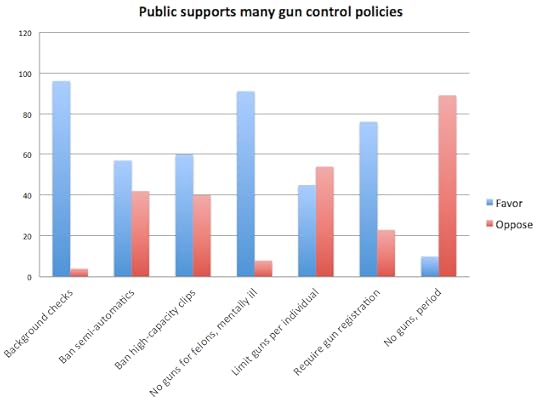 (I've taken that graph directly from the Wonkblog. I'm not entirely sure what the law is on copyright - though I'm fairly sure we need more of it, or possibly less - so let me know if citing the source and linking back isn't enough.)
Firstly, I'm curious about the ~7% of people who want to give guns to convicted criminals and the mentally ill. Are 7% of Americans criminals and / or mentally ill? Because that's the only way that makes sense.
But what's clear from this is where an actual policy has been seriously discussed (and implemented), the majority of people are in favour of it. I think progress on the gun control issue needs to be framed in the form - "there's really not all that much gun control" and then "here's some specific things we think need to be done".
I'm glad people are being polled on the issues, and I understand that most Americans feel owning a gun is a right. I don't believe most Americans understand that owning guns makes them less safe, rather than more. I don't believe most Americans know what current law is. And I think that there will come a spasm of knee-jerk reactions motivated by fear and divorced from reason. (Let's make sure all teachers carry guns, let's give children gun training to make them safe from bullets).
Finally I think there is some collective responsibility that everyone needs to take for this. One man always has his finger on the trigger, but every man emerges from a time in which he wasn't a killer, where perhaps he was a child with undiagnosed or untreated medical problems, and at that time perhaps a better community or a better society could have changed his path.
Newtown Youth & Family Services is a local non-profit directly assisting the families involved in the Newtown shootings. You can donate via their website using paypal.
November 11, 2012
FREE BOOK(S)
If you're still reading, then let me tell you more, because there's more.
I want to give you the entire Gods and Monsters series of books for free. All of them - though admittedly I don't know how many that's going to be yet (but it's at least three). I don't want to hook you with book one, which is great, then insist you pay for all of them in a lump sum at the end to find out what happens - I want to give all of the books to you for no cash whatsoever.
What I want is for Gods and Monsters to reach the largest possible audience and to do that, frankly, I need you're help.
You might not know it, but in the last ten years, then number of books published every year has gone up ten times - from around 300,000 to 3,000,000 books per year. The number of people reading books and the number of books that are actually sold has not enjoyed similar growth.
The challenge for writers now isn't to get a publisher, it's to raise awareness of their work.
I'm committed to releasing every book in this series for free online - regardless of how successful it becomes - so long as people keep downloading it. If enough people want the next installment, they can have it for free.
If book one gets 10,000 free downloads, then book two will be free as well. So if you like it and you want to read more of the story, tell people. Here's the download link again. Please use the twitter and facebook buttons below to share this - it'll cost you nothing, it'll make a big difference to me and your friends get something for nothing too.
Thanks for reading this, I hope you enjoy that.
David.
October 18, 2012
Words
A good word means only one thing and means it only once – he is focussed in one direction and means to expend himself in one purpose. A good word is a punch and should carry all your weight; the lean, the step-in – elbow up!
A good word is something better than fearless: a good word is brave.
Vasily Smyslov, the Soviet Grandmaster, used to twist his chess pieces after moving them, screwing them into the board, daring his opponent to take them; putting up a palisade of oblique bishops and cardinal rooks. And the ambition of anyone who would call themselves a writer must be to put words down with equal conviction. To dare time – our enemy – to take their meaning.
But the brave words perish first. The unexpected. The portmanteau. The found sound. Time melts their faces. And the ones that remain are the reworked words, like train timetables – all gloss and promises that won’t be kept in this country. Survivors, with all the guilt of the colaborator.
Words.
Almost every word you ever read was a coward.
September 30, 2012
Release Day!
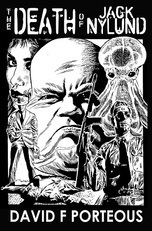 It's release day for The Death of Jack Nylund. If you've been waiting to get your hands on it - or you want to know what you can do to help spread the word - then this post is for you.
There's a simple 3-step plan:
1 - Buy it :)
Jack Nylund is available in paperback, kindle, nook, ePub and for iPad, so whatever your preferences you can get a copy.
In the UK, you can buy it from Amazon. And you can also buy it in the US from Amazon.
2 - Rate / review it
Wherever you buy it, please go back and post a review of what you thought of the book. Reviews help attract other readers, which is good for me (and I like to find out what you think too).
3 - Add it / review it on GoodReads
GoodReads is a major platform for building readership. If you post a review on any other site, it would be great if you could also add it on GoodReads.
Jack Nylund has been a labour of love for me and I'm very proud of the result. I hope you all enjoy the book.
September 20, 2012
Thoughts On Independently Publishing Paper Books
The pre-publication giveaway on GoodReads is still going on for another couple of days, so if you want a chance to win a signed copy, head over there. The blog tour to support the release of the book will begin on the 1st of October, hosted by Bewitching Book Tours. There are a lot of other things going on I won’t bore you with, but suffice to say with my second book I’ve got all my ducks in a row.
Except one.
And that brings me to the subject of this blog. The most difficult, most opaque aspect of independently publishing a book is the availability of paperback copies.
With ebooks it’s a matter of hours in many cases before the text of a book can move from my desktop to an online retailer’s searchable catalogue to your Kindle or Nook. With print copies all the parts I control can happen quickly, but getting the information onto Amazon – which is done by the “publisher” and, presumably by Amazon themselves – takes an unknowable amount of time.
The date of availability is important because I don’t want to run promotional activities for a book that isn’t available yet. The number of sales received for new books is also part of Amazon’s secret recipe for deciding how far up the charts a book goes – and this can have a huge impact on sales. If the release and the release publicity are mistimed then you’re starting at a disadvantage.
There’s another aspect of working through intermediaries and across multiple markets, and this is price. With an e-book I set the price – there’s a little widget I go into and (excepting VAT or sales taxes) I say what the price is you pay at the checkout. Physical books? I wish I had that kind of control.
I set a price with Lulu – the UK publisher – which is £7. Bargain, I hear you cry – and you’re right to do so. The Kindle price is £1.96 – an odd price because of that pesky VAT – or $2.99 in America, but for the UK price of £7 you get an actual bit of dead tree with Rob Moran’s great cover. I digress.
Lulu sells the book to a number of other distributers as well as Amazon, but those distributors from time to time also put their information onto Amazon and those distributors include a mark-up. All of this must happen automatically with machine spirits doing the work, because no rational human being would bother. The result is that the first print copy of Jack Nylund went on sale on Amazon in the UK a few days ago for £112.84.
You read that right.
If anyone actually bought one of those – and I’d bet they didn’t – the amount that I’d get from that sale would be somewhere north of £1, south of £111 (in the same way that Captain Scott’s expedition could be said to have faltered somewhere north of the South Pole, south of the North Pole). That’s a minor issue really, but confusing, bewildering and bereft of reason.
What I’m more concerned about is the US price. I had been planning to use Lulu as the US publisher as well – because I know some of you are Americans, Canadians or Australians and therefore you use Amazon.com to buy books rather than the .co.uk site. Going that way – with a UK-based publisher for US sales – results in a reasonably fair cost; the UK price of £7 is multiplied by the exchange rate, “plus something else”; so we arrive at $11.21.
That price isn’t unfair, but I didn’t have any control in what it was – and I’d much rather it was a round figure. I’m currently working to get the US print edition out using a US-based publisher for a little less than this, but again, if you’re really price-sensitive it’s on Kindle for only $2.99.
I think the next innovation in independent book publishing needs to be more creator control this final link in the chain between “us, the creators” (which may include you) and “you, the readers” (which may include me, and definitely includes some of “us”).
In the same way major publishers can set a release date for maximum marketing effect, I should be able to do this easily at the same time as assigning an ISBN. In the same way I can specify my Kindle price in Italy, Germany and India (if I wanted to), I should have the same control over print prices in major markets. Though I’m not hugely interested in the Italian price of Singular, since nobody has ever bought a copy in Italy (for shame, Italy – for shame).
And all of this is a preamble to saying, very quietly, that if you really, really, really wanted a copy of Singular now... well, you know, you could get one. But if you wouldn’t mind hanging on another ten days, I’d appreciate it.
Graduation Speech
It's my belief that after submitting this, Maureen blocked me on Twitter.
It was either this speech or the pictures of me wearing only a confused expression.
In either case, here it is. Pitiful humans,
I have watched you prepare, these last four years, for the war that is to
come. And I am not impressed.
I, who have laid waste to worlds more ancient by far than the tarnished
bauble of this [check note cards] Earth, have seen great civilizations train
their young in a thousand ways. Yet none, I think will prove as inadequate as
yours.
Knowing as you must that our attack shall come from the edge of space –
where, even now, our mighty fleet assembles – you must surely realise that your science, your engineering, your mathematics are woeful by comparison to ours. Your study of the history of art seems pointless; almost a parody of reason.
Your art we shall burn – except for the items you have already burned as
artistic statements – these we shall reassemble using advanced technology and put on display. You shall all be made to see these displays. Tickets will be expensive. And the lines shall be long.
Only your swim team seems prepared for the psychological warfare we shall
unleash on you, when our timed-release penis-shrinking drugs kick-in, just
before the Fourth of July weekend.
You believe that because you have endured these scant four years that your
works shall be proud and that in this glorious summer the sting of death will
not touch you.
You are mistaken.
We shall deprive you of all those things you hold most dear. Holiday sales at
electrical goods stores, the beach, apple pie – including combination fruit pies
that contain apple, really good drugs, Dancing With The Stars and almost all
brand-name restaurants.
The only place left to eat will be Wendy’s – and not the good Wendy’s, the
other one.
And once we have crushed your spirits, we shall install a Vichy government to rule you harshly – as is our tradition. To prevent any feelings of sympathy,
this government will be made up entirely of another species. In Earth’s case,
rule of the planet will be ceded to the bees, and their powerful stings shall
keep you in fear, because that thing about bees only being able to sting you
once and then they die? That’s bullshit. Most bees can sting you as much as they like.
And they like to do it a lot.
Also, the bees who rule you will be Africanised.
Now please stand while Danny plays your new national anthem on the kazoo.
August 31, 2012
Win The Death of Jack Nylund on Goodreads
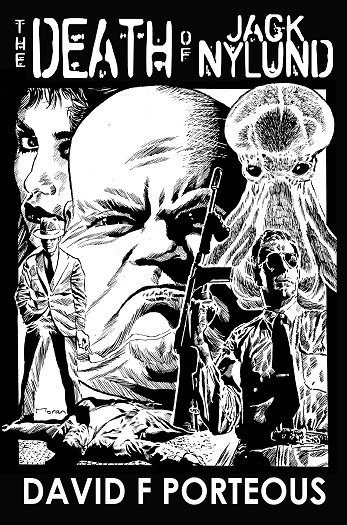
 In preparation for the official release of Jack Nylund on 1st October and the tour that will accompany it (more details to follow), there's a
new page on the website
.
In preparation for the official release of Jack Nylund on 1st October and the tour that will accompany it (more details to follow), there's a
new page on the website
.But more importantly - I wanted to do a quick post to let everyone know that for the next three weeks you can win one of six signed copies of the book through a competition on Goodreads . (Scroll down the page to see the competition).
And if you're entering the compeition, be sure to add the book to your to-read shelf.
You can also downloand / read the first four chapters of the book on Goodreads.
July 6, 2012
Jack Nylund - Cover & Blurb
The Goodreads page for The Death of Jack Nylund has been created showing the fantastic cover designed Rob Moran and the full blurb outlining the story. A dedicated page on this website and some preview chapters will follow in the coming weeks, but I added it to Goodreads first so anyone interested can add it as a "to read" book and reviewers can rate it in advance. Would love to hear your feedback.
Release date is still the first of October. Expect more :)
June 1, 2012
Emotionally Intelligent Communication
“What’s emotionally intelligent communication?” I ask myself rhetorically for your benefit. Well let me set the scene.
If you’ve driven any length of highway in the United States you’ll have seen advertising billboards. Constructions three storeys high encouraging you to buy fried chicken or visit Yosemite or seek the services of a local attorney-at-law – in case you’re using said highway to flee from imminent justice.
In Britain we don’t have those. Sometimes you’ll see a generic green sign advising you that at the next turn-off there will be “services”. And by services we mean fuel, dead flowers and charcoal briquettes – we almost never mean dry cleaners, undertakers or even vehicle mechanics. The road signs in Britain are a model to be envied and if all you did was drive from John O’Groat’s to Land’s End (the top bit to the bottom bit) you’d boggle at our minimalist efficiency and think we’d lost the war to both the Germans and the Japanese (but not the Italians).
However, the workplaces, city centres, corner shops, residential streets, parks, beaches, woodlands and farmlands of Britain are dominated by instructional signs. Easily the most infamous and ridiculed is “Keep Off The Grass” or “KEEP OFF THE GRASS” or the very strangely capitalised “Please Keep off the grass” shown below.
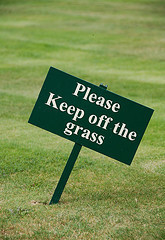 PKotg is a solid example, but just a few of his chums are included in the little gallery below - all sourced from Flickr.

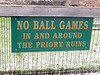
 That middle sign in particular seems rather mean-spirited since the priory is already in ruins. Unless the priory was destroyed by a ball game that went way too far, this sign is overkill.
What's interesting about some of these is they aren't providing information. For example - dog fouling and fly-tipping are crimes for which you can receive substantial fines. Even on private property you wouldn't be allowed to say "Dump your old couches here and if you're dog's full up, it can poop too." These signs are the equivalent of putting up a notice that simply reads "DON'T BREAK THE LAW."
They may be well-intentioned, but as Derren Brown showed in one his specials, continually stressing what people should not do (negative reinforcement) makes them feel compelled to do it. The surest way of plunging a country into anarchy is to erect a sign in every street that commands people "DON'T BREAK THE LAW."
Luckily, while Britain is the only country in the world that really understands how to queue, we have an equal level of expertise in irreverence. We like the Queen. And if the Queen asked us not to walk on the grass we'd probably respect that. Anyone else and we'd be swarming over that manicured lawn doing our best Ministry of Silly Walks just to demonstrate the totality of our disregard for the instruction. Leaving the public realm and going into private enterprises, Barbara T Armstong writing in Forbes calls this kind of signage "Workplace Graffiti" and claims it can be detrimental to the way organisations operate. For me the office signs placed by irate or over-zealous co-workers are clear attempts to control the universe by fiat, to substitute good planning and understanding of human behaviour for mechanistic control. And because they don't work as intended, they only serve to create further frustration for their authors.
I've worked in local government for almost a decade and I've found that all the problems of local government fall into four distinct groups: people doing things they shouldn't; people not doing things they should; disproportionate or misdirected anger; and indifference. And the way local government has tried to influence these things for two generations is through forbiddance (the signs above) and denial (for example - speed bumps, parking wardens, ASBOs). It's only quite recently that we've seriously attempted persuasion of anyone who isn't an unruly teenager - and that's where emotionally intelligent communication comes in.
EIC differs from other kinds of communication in that it seeks to change understanding, and thereby behaviour, through empathy. This may be by making it clear to the person receiving a message that the broadcaster understands and empathises with them, or it may be by making the person receiving the message consider the emotions of others.
If you've seen an Innocent advert, or bought one of their products then you've experienced a much more engaging, much more human tone than you'd fine with most brands. Innocent have a gallery of their packing online and it's well worth a look. The overall effect is to generate empathy and I - while fully comprehending that this is the company's intention - genuinely believe that Innocent are more ethical and just nicer than their competitors. As I result of this belief, I view their products more favourably.
They know what they're doing and they do it well, but Innocent aren't alone in attempting to engender empathy. Daniel H Pink - from whom I first learned about emotionally intelligent signage several years ago - collects examples on his blog. Amongst those examples are a growing number of municipal authorities using EIC to prevent speeding, littering, promote care for the environment, cross the road safely and generally just encourage people to be good to each other.
This is a growing phenomenon and it's growing because it works. Okay, so what? Let's start with why we aren't already considering the emotional impact of the messages we send out. Well, I think that's probably because we're not used to doing it.
The most appealing of local government communications tends to be "COME ALONG AND HAVE FUN AT OUR COMMUNITY EVENT." The people who write it really do want others to come along and have fun - but it's still an instruction and it doesn't create any emotional attachment.
Even writers, who should know how to craft a message for effect, set up their Twitter accounts to endlessly spam "READ MY BOOK" messages. Or the far worse "READ MY FREE SHORT STORY" messages. (I'm now personally committed to never reading a short story I haven't paid for. You did this, Twitter authors. Congratulations).
However, as much as it is due to habit, I think empathic messages can make us (the broadcaster) feel weak and it puts us at greater risk of feeling foolish than an authoritarian message.
For local government in particular that's an issue - to the extent that it's easier by far to communicate Message A (which appears consistent with a corporate voice, but won't work) than to communicate Message B (which deviates from the corporate voice, but will work). Anyone who works in local government in the UK will tell you the same issues are occurring around staff access to social media where the corporate centre still has the illusion of control over communications in an age where a local authority is a creature with ten thousand mouths.
The effectiveness of EIC relies on lowering shields. In local government we're often instinctively defensive and writers - especially new writers - are urged to seem professional. The structures we've relied on previously are the ones which are now limiting our reach and effectiveness because they provide so little impetus for others to engage with us.
The reasons for not using EIC are real.
The reasons in favour of using EIC are better. EIC can generate action, it can create attachment and it can increase perceived value far better than authoritarian broadcast messages can. And if nothing else, it must be helpful to us all to stop, before we communicate to our customers, and consider what the emotional impact of our messages will be.
(Though this will not necessarily stop me drunk-tweeting). Okay, now what? At this point I could give some advice about how to make your messages more appealing using EIC. I've been working on some pratical projects for a while that I could talk you through. I think both of those would be interesting. But what I'd really like is to get feedback on how people feel about this and conduct a small experiment.
Over the next week I'll send out two different tweets with links to this blog post. One link will come with an emotional appeal, while the other will be more traditional - reflecting what I see as the way Twitter is often used by authors to communicate at the moment.
Using Hootsuite I'll monitor the number of click-throughs for each message and in a week I'll come back and share my results. (Unless there are no click-throughs, in which case I'll delete this post and we'll never speak of it again. Never). At that point I'll also present some tips about how to improve the emotional appeal of your messages using EIC.
If you liked this post and want to read more, you can help by retweeting both links to your own Twitter followers.
Thoughts and comments in the box below are very welcome.