Erika Mitchell's Blog, page 4
July 13, 2017
The Definition of a Successful Author
I was chatting with a fellow author this afternoon and she told me something that was pretty cool. According to her brother in law, who’s a literary fiction author, the incredible sense of camaraderie and accessibility that’s become one of the hallmarks of the thriller writer community is somewhat of an oddity in the publishing world. He told her the literary fiction world is considerably more cutthroat, and that we should be grateful to be in our genre.
I don’t think this is because of our genre. I think the reason for the ongoing buddy comedy that is most of the author friendships I’ve observed and made here at the conference are only made possible because of the ITW (International Thriller Writers). The organization’s founders specifically built mentorship and service into the mission of the ITW. This has resulted in a vibrant, friendly, and empowering support network.
I’ve attended three ThrillerFest conferences so far, and every single one has been a well-oiled machine. I’ve never felt like there was any sort of separation, implied or overt, between the Big Name Authors and those of us who can count our book sales using a child’s abacus.
Last night, I was invited out to have dinner with some of the presenters from the conference and it was a blast. They were welcoming, gracious, and made me feel like one of the group even though I’d only met one of them before. The most important thing I took away from those conversations (which went on until very late last night) was that no one’s career rises in a straight line. You never know which project of yours will take off, which means you just need to keep moving forward and try not to look back too much.
This morning, I attended a panel discussion featuring authors whose book sales can be measured in the millions. The moderator asked, “What is the definition of a successful author?”
The overwhelming consensus is that a successful author is one who gets it done. Writes a book, gets it out, writes another, gets it out, writes another, etc. No one mentioned sales or reviews. It was all about the writing. Each book you write promotes the books you’ve written before, which means the best thing you can do to sell books is, duh. Write more.
It was exactly what I needed to hear.
Man, I love this conference. I’m going to be sad when it’s over. And then I’m going to sleep. You guys, I’m going to sleep so much.


July 12, 2017
A Quick ThrillerFest Update
Today was the first day of the conference for me, and as always I’m exhilarated, exhausted, encouraged, intimidated, hopeful, and despondent. The trick to surviving a conference where you’re breathing the same air as the people who brought Rambo and Jack Reacher to life is to realize you will never, ever sell as many books as they have. Once you accept that simple truth, a healthy amount of hopelessness sets in and you’ll be right where you need to be.
Let’s see, this morning I attended a class on autopsies, learned how to structure a thriller from one of my favorite legends in the field (the incomparable Gayle Lynds, who is articulate and pleasing to listen to), and learned more about the ATF than I ever thought I would.
It’s been a long day (my first session was at 8 AM, and I’m only now sitting down for a break at 6 PM) but I have one last event tonight before I can collapse in an introvert coma. Cocktails and networking, here I come! And then? There’s a pillow with my name on it.
July 11, 2017
Greetings from the NYPL
 I’m writing this from the Reading Room of the New York Public Library. It’s really, really quiet and really, really pretty in here. My friends who know the city really well recommended this to me as a good place to get some writing done and after seeing it for myself I heartily agree.
As you may have surmised, you clever reader, you, I am in New York City. I flew in yesterday afternoon and only felt a little like dying from jet lag when I woke up this morning. So far since entering the city proper five hours ago, the following things have happened to me:
A very nice man insisted on carrying my suitcase up the stairs at Grand Central Station, and wouldn’t hear of my carrying them. It occurred to me how easy it would be for him to just take off running with all my stuff, but thankfully he did no such thing and no flying tackles were carried out by me or anyone else.
I ate a late breakfast at a surprisingly affordable hole-in-the-wall diner called Scotty’s Diner that I immediately loved deeply and with all my heart.
A man tripped while walking past me and, when we collided, my immediate suspicion was that he was trying to pickpocket me because that’s one of the oldest tricks in the book. It turns out that 1) there wouldn’t have been anything to pickpocket even if he had been a scoundrel and 2) he was just clumsy and seemed very embarrassed by the whole incident. It’s possible I’ve been writing thrillers too long.
I walked past the Chrysler Building, Empire State Building, Grand Central Station, and the New York Public Library, all of which were as exciting to me as if I had crossed paths with actual celebrities.
Stopped for a cold beverage break with a famous kitty. #thereisonlyzuul
A post shared by Erika Mitchell (@parsingnonsense) on Jul 11, 2017 at 10:07am PDT
And now, after a quick catnap in my hotel room, I’m back at the library writing and revising. I can’t believe people get to see these spaces every day because it seems like there’s something astonishing on almost every block. I’ve now fallen hopelessly in love with this library and will find it difficult to leave.
ThrillerFest, the conference I’m in town for, begins tomorrow. It’s one of the only times a year all of us come crawling out from behind our keyboards to mingle and learn. I reckon by the time I need to be articulate tomorrow morning I’ll be mostly over my jet lag and ready to network with the best of them.
Until then, I still kind of feel like I don’t know what day or time it is but what I do know is this: You shouldn’t walk in puddles in NYC, there are some people who can walk in high heat and humidity wearing skinny jeans and not sweat like they’re stuck in a sauna, and sometimes nice people just want to carry your bag for you.
(By the way, I’m updating my Instagram feed quite a lot this trip, so check it out if you feel like visiting Manhattan vicariously through my pictures.)
July 6, 2017
Onward, I Say!
Wow. I mean, right? Whoosh. Welcome to the other side of the book launch. It probably just looked like a lot (maybe too many) social media posts from your side, but over here it was like spinning ten plates with two hands. Except for yesterday. Everything leading up to yesterday was spinning plates. Yesterday? Actual launch day? That was something different.
As opposed to the frantic pace of promotion and marketing, yesterday was a nice, quiet retreat into Revisions Land on BAI TREASON.
What’s that? you cry. You cheated on TAKE THE BAI ROAD on its birthday?!
 Not really. I’d just done everything I could do to spread the word about TAKE THE BAI ROAD, and the only thing left to do was let it happen (or not happen) and figure out what’s next. For me? What’s next is BAI TREASON, which is shaping up to be twisty and unexpected and fun in all the right ways.
I’m channeling Edna Mode from The Incredibles, darling, and there isn’t anything you can do about it.
I’ve always wondered if launching something is the same for movie stars as it is for authors. You work on this massive creative endeavor for months, then it’s out of your hands getting cleaned up and polished, and then, right when you’ve started working on something else, you’re supposed to get all excited to talk about this project you finished working on ages ago.
That’s not to say I’m not stoked about TAKE THE BAI ROAD. I totally am. It’s a fun book and I don’t even feel bad charging people money for it because it’s worth a few bucks and will definitely spice up your summer reading time (I recommend reading this one with a nice, cold beer under a shady tree when it’s really hot outside). I’m all for the Bai Road, so to speak, I’m just trying to make sure I don’t drown in promoting one project at the expense of doing what I love (writing a new project).
So here’s to TAKE THE BAI ROAD, which you can find here (among other places). May it find a happy place among the literal and digital bookshelves of the people who purchase, borrow, steal, and are gifted it.
Now onward, I say! To a mystery! To Ukraine! To BAI TREASON!
July 5, 2017
Behold, My Newest Baby!
Not many of you will remember this, but once upon a time I was a mommy blogger. I got my start in blogging by venting about my intolerable boss on an old Blogspot blog, and eventually moved up to the WordPress big leagues where I currently (happily) reside.
When I had the first of my two children, I shared pictures and tales from the new mother trenches. Doing so was a ton of fun, but when I was published for the first time I realized I’d really rather keep my children’s privacy in mind so I stopped posting baby pictures and started posting book covers, instead.
Posting book covers is as close as I come to publicly sharing photos of my progeny, and the two are not as different as you might think. For example:
Both a child and a new novel take WAY longer to produce than you’d like.
They both require research and intellectual flexibility.
I’ve been sleepless with worry over the fates of both my children and my books.
I’m inordinately proud of my kids and my books. They’re my best offerings to the world.
They all make me laugh when I’m least expecting it.
[image error]So to that end, will you please help me welcome my newest addition? Weighing in at 832 KB and a length of 242 pages, please welcome TAKE THE BAI ROAD to the book family, born today on July 5, 2017.
What can you expect if you buy this book? Well, in this way kids and books are different because I can tell you exactly what to expect from my book whereas my kids? Giant, goofy question marks.
TAKE THE BAI ROAD puts smartass Chinese-American spy Bai Hsu on the trail of the elusive Ghost Cartel, a shadowy organization moving product through cartel-controlled Mexican trade routes. It’s his most dangerous mission to date, pitting him against warring cartels without cover, resources, or backup. It’s an assignment that will test him, make him question himself, and put him at risk of losing everything that’s ever mattered to him.
According to Kirkus Reviews, ““Mitchell’s winning tale…is constantly in motion, taking Bai from one perilous predicament to the next…Fast-paced, invigorating, and entertaining.” (Click here for the full review, it’s awesome.)
Jeff Ayers, who reviewed the book for Suspense Magazine, had this to say: “What makes this series so pleasurable to read is Bai himself, his somewhat snarky attitude and self doubt make him more than the mere superhero jumping into the chaos to save the day.”
If you’d like to read a sample chapter before you buy, please click here.
If you’re sold, you can purchase your copy of TAKE THE BAI ROAD at any of these fine online retailers:
Amazon
Kobo
iTunes
Barnes & Noble
Lulu (currently the only place to buy a print copy!)
Thank you for supporting my writing by reading my work. I hope TAKE THE BAI ROAD gives you many enjoyable hours of entertainment!
June 29, 2017
Would You Look at the Size of this To-Do List?
Things have been quiet on the blog front lately because I’ve been living it up in southern California with my family. I limited myself to just checking in on emails sporadically because I knew July was coming soon and I’d need a break before things went into warp-speed.
What’s happening in July? you ask. Oh, just a few things:
TAKE THE BAI ROAD is coming out July 5, 2017. (It’s actually available for pre-order already on Kobo! Click here to put cartels, conspiracy, and chaos into your summer reading rotation). Cue much promotion and marketing.
CLOSE TO THE BONES anthology is coming out July 15, 2017. The story I wrote for it, The Spy Who Came in From the East Coast, takes place after the events of TAKE THE BAI ROAD and deals with what happens when Bai goes home for the first time since he started working for the CIA. You’ll get to meet his family, learn what his actual name is, and see what happens when a spy tries to be a good son. The rest of the stories in this collection are a worthy addition to any beach reads list. Cue much promotion and marketing.
ThrillerFest in NYC, baby!!! I’m leaving July 10 for the East Coast, where I’ll be hanging out with friends, family, and fellow authors while I roam New York City and try not to faint from the heat and humidity.
BAI TREASON is in progress, and my goal is to finish revisions on it before the end of the summer (which really means I have to finish it in July, because August is crazy busy).
None of this mattered while I was on a beach watching my kids play in the waves, but now I’m home and WOULD YOU LOOK AT THE SIZE OF THIS TO-DO LIST?!
Would you do me a favor, oh faithful reader? Please buy my book and take it with you to a peaceful, shady location. Put your feet up, sip a cold beverage, and read my stories. It’ll make me really happy to know that somewhere, someone is relaxing with the stories I’ve put so much work into.
Wish me luck, friends. It’s been nice knowing you!
June 15, 2017
The Exploding Envelope Series: Beware the honey pot
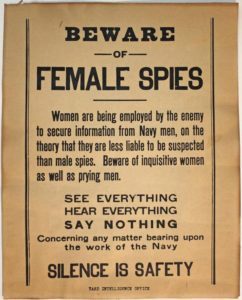
Came across this gem courtesy of the International Spy Museum. It’s WWI-era from the Naval Historical Center.
Leading up to the release of Take the Bai Road, and the re-release of Bai Tide, I’ve started a blog series about various espionage terms. Today’s installment? The nefarious Honey Pot!
A Honey Pot is one of the oldest, and, I would argue, most successful, espionage tools in existence. Essentially, it’s an attractive woman whose job is to seduce people into giving up information or access they would otherwise not part with.
In any industry, and especially in Intelligence, operational security and nondisclosure are a major concern. “Loose lips sink ships,” is true, because they have. Executives and key personnel in major corporations receive training to keep them from inadvertently giving away trade secrets, and nondisclosure agreements are standard once you get to a certain level.
This goes double (triple? quadruple?) for Intelligence work. Literal lives are at stake in this arena, which means the information alphabet people (what I’m calling CIA, FBI, NSA, DOJ, HS, DEA, ATF, etc. employees) are working with can be used to directly harm people. This fact is drilled into their heads each and every day of training, and is likely re-emphasized on a regular basis throughout the year.
Okay, so now we know why alphabet people need to keep their mouths shut. Now imagine you’re an enemy operative who’s been sent to trawl for information (this also works for American operatives working in foreign countries). How’re you going to get it?
You could wait for some random government worker to walk into your country’s Embassy and offer to spill his/her guts, but that could take awhile and your superiors are likely to get impatient. Plus, you’re likely to get bored.
So what do you do? Well, if you’re a hot woman, you work what your mama gave you and use liquor and lust to get a man who knows better to make a mistake. This strategy is the Honey Pot, and it’s effective. If the guy is married, so much the better because now you have influence and leverage.
And in case you’re wondering, yes, this also works the other way around. Men can be used as Honey Pots, too. Lonely women who work too much and don’t get hit on very often make excellent targets.
And just in case this seems like a nostalgic throwback to Cold War-era spy tactics, the former head of the CIA’s National Resources Division claimed that China in particular was focusing very aggressive spying efforts on the U.S. Chinese spies are mostly after specific pieces of intellectual property, and you better believe a good number of these operatives are using feminine wiles on unsuspecting white-coats and developers.
The former head of the House Intelligence Committee stated last year that there are currently more foreign intelligence operatives in the U.S. than there have been at any point in American history, including the Cold War (reference).
According to a retired senior CIA operative, there are thousands of Russian operatives at work in America. Each operative’s chance of success is so small, Russia is improving their chances of success by sending as many people as they can to try to ferret out as much information as they can about anything they can.
Espionage is alive and well, my friends. Operatives are taught how to leverage vulnerable people into giving them what they want. It’s dangerous out there, which is why posters like the one above were used as helpful reminders of one simple fact: Beware of inquisitive women and prying men!
Did you enjoy this post? If so, be sure to order a copy of one of my books for more in-depth looks at the fascinating world of espionage!
June 12, 2017
The Exploding Envelope Series: What’s in a name?
 Leading up to the release of Take the Bai Road, and the re-release of Bai Tide, I’ve started a blog series about various espionage terms. Today’s installment? Uncovering the all-important Cover Identity!
If you’re a fan of spy fiction (in either written or film form), you’re familiar with the outset of a mission. Your favorite undercover operative receives a thick dossier of materials, one of which is a shiny new forged passport with a different name on it. A fake name, or cover identity, is absolutely critical for a field operative, not just for their own protection, but for the safety of their friends and loved ones as well.
The Clandestine branch of the CIA employs the officers who are responsible for recruiting sources (a.k.a. agents), performing covert missions, and collecting intelligence.
These employees are typically assigned to overseas posts with what is known as “official cover.” Official cover is a legitimate job that justifies their presence on foreign soil and grants them diplomatic immunity. In some cases, these posts are fairly public and the officer becomes well-known in local diplomatic circles. Others, usually in a subordinate role, avoid attention as much as possible while they cultivate assets and collect information.
As you can imagine, any area with information worth collecting will be rife with people trying to collect it. Spies on top of spies on top of spies (sometimes literally, wink wink). This means the best protection for an operative is a fake name with a fake background, a sham identity that will hold up under casual scrutiny and keep the operative’s true name (and employer) a secret.
Why? Well, imagine you’re a very powerful government and you’ve just caught someone snooping in your backyard, trying to drum up information they can use to cripple and/or hinder your aims. What is the first thing you do? Figure out who sent the snoop, and what they want. You can’t just ask the spy (they lie for a living), so you try to look them up.
If they won’t talk, all you have is a suspected nationality and a fake name. If, somehow, you had the person’s real name, imagine what you could do with it. If you were a ruthless sort of person, it wouldn’t be difficult to apply pressure to said snoop by threatening friends, family members, pets, former teachers, etc.
If, however, you end up capturing someone with diplomatic immunity who’s there with the permission of your own government and has a perfectly legitimate reason for being there? Well, you’re kind of out of luck. The best you can do is politely insist they leave.
There are four levels of cover:
No cover. Publicly acknowledged employees of the CIA. Think upper management, recruiters, and government liaisons.
Light cover. Their friends and family might know who they really work for, but for anyone else the answer is vague at best and usually given as a harmless division of the government. This kind of cover requires no work, and will not stand up after even the most casual digging. Think analysts, scientists, and other headquarters-based employees.
Official cover. See above. Essential for all overseas employees. To “out” someone’s official cover is actually a felony so, um, don’t do it. (Bai utilizes this kind of cover in Bai Tide, and in Blood Money).
Nonofficial cover. Dangerous stuff. NOCs (pronounced like knocks) are the most covert operatives. These spies operate without diplomatic immunity, which means, if caught, they risk disownment by their own government and are left at the mercy of their captors. Inciting insurrections, recruiting guerilla fighters, breaking laws on foreign soil to get the job done, etc. would all be performed by NOCs. (Bai will have be a NOC in Take the Bai Road and, yes, it’s really freaking dangerous).
So when James Bond goes brooding around bars telling everyone his real name because he’s cool like that and just doesn’t give a damn? Well, in reality he’d be doing his brooding while posing as an Embassy liaision or something, with a perfectly ordinary name like Charles Montgomery.
“Montgomery. Charles Montgomery,” doesn’t have quite the same ring to it, though, does it?
Pick up Bai Tide today to find out what ridiculous name Bai picked as his cover name for his supposedly easy assignment…
Did you enjoy this post? If so, be sure to order a copy of one of my books for more in-depth looks at the fascinating world of espionage!
June 8, 2017
The Exploding Envelope Series: Agents vs Spies

Image courtesy of seanmciny.
Leading up to the release of Take the Bai Road, and the re-release of Bai Tide, I’ve started a blog series about various espionage terms. Today’s installment? Discussing the difference between an agent and a spy.
This post is near and dear to me because this is one aspect of the spy world that almost everyone gets wrong. Laypeople, movies, TV shows, books, etc. all make this same mistake, and I suppose it’s only a matter of time before the definitions of these words is changed to accommodate the popular understanding of them, but still. For now, y’all are wrong but if you keep reading, you’ll soon be right.
You’ve all heard the term “Secret Agent,” correct? James Bond is a secret agent, Austin Powers is a secret agent, Jason Bourne is a secret agent, right? WRONG.
In espionage, an agent is actually a source of information! So yes, there really are secret agents, but they’re not who you think they are. They’re the informants, not the rakish spies in tuxes. Don’t believe me? Check it out:
The International Spy Museum has a really cool list of spy terminology and defines agent as, “A person unofficially employed by an intelligence service, often as a source of information.”
So what do we call those roguishly charming operatives who steal secrets and woo vulnerable and lonely people of importance? A case officer. A case officer is the trained operative who’s out in the field cultivating and managing agents, running operations, and reporting everything back to their station chief.
Granted, agent sounds a lot cooler than case officer. When you’re talking espionage, though, the devil is in the details (sometimes literally) and it’s important to get it right.
Fun fact: There are agents working for America, in the FBI, ATF, DEA, Homeland Security, etc. So we do have agents, just not collecting information for the CIA.
For an example, in Blood Money (remember my first book from waaaaaaay back in 2013?) CIA case officer Bai Hsu was stationed at the American Embassy in London under diplomatic cover. He was the case officer, and his job was to manage CIA agent Azzam Abdullah, who was informing on his boss, the terrorism financier. Make sense?
Now that you know, you can’t not see this error crop up all over popular media. You’re welcome?
Bonus fun fact #2: When my brother and I were little, we LOVED watching Austin Powers movies. For the longest time, my brother thought the “Secret Agent Man” song was, “Secret Asian Man.” Maybe that’s why my main hero is Chinese-American. Discuss.
Did you enjoy this post? If so, be sure to order a copy of one of my books for more in-depth looks at the fascinating world of espionage!
June 5, 2017
The Exploding Envelope Series: CIA Headquarters
Leading up to the release of Take the Bai Road, and the re-release of Bai Tide, I’ve started a blog series about various espionage terms. Today’s installment? An exploration of CIA Headquarters, which are actually pretty cool.
You know what’s annoying? The CIA won’t give authors a tour of their building. Wait. Scratch that. They will, if you’re a major headline-type author (I happen to know that several of the instructors at the 2014 ThrillerFest I went to got to go on a tour after the conference), but regular schmoes need not apply. I’ve asked the CIA’s entertainment liaison, just to confirm I’m not a big enough deal, yet. That’s a good goal, right, guys? To be a big enough deal as a writer to merit a tour of CIA Headquarters?
Anyway, the CIA’s Headquarters in Langley, Virginia are pretty cool. Not much of Bai Tide takes place there, but parts of Blood Money do, as do parts of Take the Bai Road. Here’s what you need to know about one of the more secretive workplaces in the country.

This is the Old Headquarters Building (or OHB for those in the know). It’s a feat of 1950’s architecture, the designers of which worked off DCI Allen Dulles’ vision of a college-like campus for officers to work in. It contains a whopping 1,400,000 square feet of space.
I’ve had to use a little creative license to imagine how that space is utilized. The CIA is understandably cagey about the layout of their building, but they do share some aspects of it. Like this awesome tile inlay on the lobby floor:
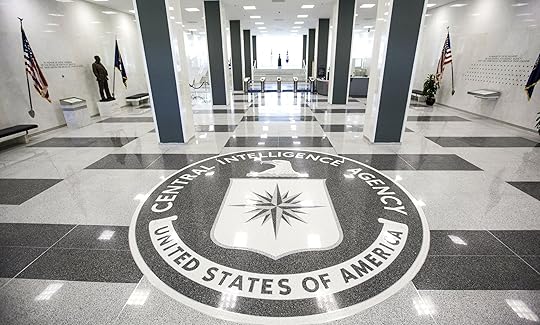
This seal is made of granite and measures sixteen feet across. The symbology of the seal is as follows: Eagle (Our national bird, it stands for strength and alertness) Sixteen-point star (Represents the convergence of intelligence data from around the world that all meets at a central point) Shield (Defense)

This is the Memorial Wall, which is on the north wall of the OHB lobby. Each of the 125 stars represents an intelligence officer who gave his or her life in service of the U.S., The criteria for inclusion on the wall is strict: “Inclusion on the Memorial Wall is awarded posthumously to employees who lose their lives while serving their country in the field of intelligence. Death may occur in the foreign field or in the United States. Death must be of an inspirational or heroic character while in the performance of duty; or as the result of an act of terrorism while in the performance of duty; or as an act of premeditated violence targeted against an employee, motivated solely by that employee’s Agency affiliation; or in the performance of duty while serving in areas of hostilities or other exceptionally hazardous conditions where the death is a direct result of such hostilities or hazards.”
That book you see in the middle of the Memorial Wall? It’s the CIA Book of Honor. It lists the names of 91 officers who died in service, and 34 stars to represent the lives of those whose identities must, even in death, remain a secret. Can you imagine passing this every day on your way in to work?

Also in the OHB is the CIA Library. It’s extensive, and makes a prominent appearance in Take the Bai Road. Imagine every research tool you’d need to understand or investigate something from a different part of the world and you’ll find it in there.
The OHB is also home to several thoughtful memorials, a portrait gallery of directors past, a gallery of U.S. presidents, a museum filled with important items from the CIA’s storied past, and an art collection. It’s massive, and from what I’ve read, each new employee gets a tour their first day.

Now this is the New Headquarters Building, or NHB. By the 1980’s the CIA was bursting at the seams so they built this. It is two six-story office towers built into a hillside behind the OHB and the entrance is actually on the fourth floor.
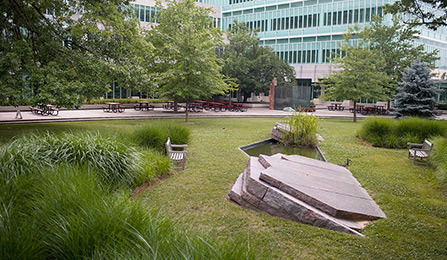
They weren’t kidding about the college campus. The entire Headquarters property occupies 258 acres of land, and much of it is landscaped like this.
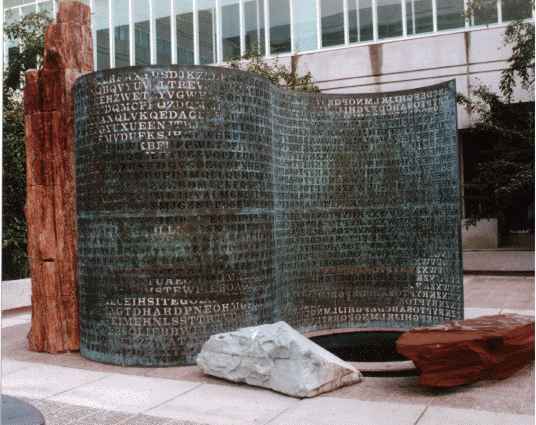
This is just one of many art installations on the CIA campus. It’s called Kryptos. Found at the entrance of the NHB, it contains complicated codes that apparently still have not fully been cracked.

Believe it or not, there actually is a Starbucks in CIA Headquarters. The first chapter of Take the Bai Road takes place there, as a matter of fact. Don’t believe me? Read this article on “Store Number 1.”
If you want more, the CIA’s website has a photo tour of their headquarters that’s a lot of fun. Feel free to take a look and let me know what captured your interest!
Did you enjoy this post? If so, be sure to order a copy of one of my books for more in-depth looks at the fascinating world of espionage!