Meredith Allard's Blog, page 40
August 22, 2012
Feed Your Reader Giveaway
It’s time for the Feed Your Reader Giveaway. This is an e-book only giveaway, so if you have an e-reader, this is the giveaway for you! Thanks to I am a Reader, Not a Writer and Books: A True Story for hosting.
I’m giving away 10 e-copies of either Her Dear & Loving Husband, Her Loving Husband’s Curse, Victory Garden, or Woman of Stones. If you’re not familiar with the stories, check here. You must be a follower of this blog to enter. Just fill out the form below and you’re entered!
[contact-form]
Check here if you’d like to see the great e-books over 100 other sites are giving away.
Filed under: Giveaways Tagged: Feed Your Reader Giveaway, Giveaways, I am a Reader Not a Writer


August 16, 2012
Writing an Old War Story for a New Generation
While I’m finishing the final edits for my Civil War novel, My Brother’s Battle, I wanted to share this essay I wrote many moons ago. Portions of this post appeared in The Paumanok Review and The Copperfield Review. My Brother’s Battle was originally published in 2000 through Xlibris, but I was never happy with the results and now it’s being rereleased through Copperfield Press next week.
It is well that war is so terrible, or
we should grow too fond of it.
~Robert E. Lee
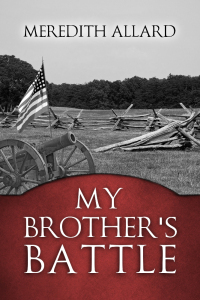
The new (and much improved) cover for My Brother’s Battle from LFD Designs.
In writing my novel, My Brother’s Battle, I attempted to bring the epic story of the American Civil War to readers in a way that is meaningful to present-day sensibilities. Gone With the Wind will always be a favorite Civil War novel, but its views on issues such as slavery are difficult for many readers today to swallow, and its lack of war scenes doesn’t endear it to Civil War enthusiasts who prefer novels like The Killer Angels, Shiloh, or Gods and Generals. My Brother’s Battle has a little of both—life in a stately southern manor house as well as the war-time battlefields. While it might seem an odd shift in setting, the contrast makes sense as we follow Benjamin Honeysuckle on his search for freedom, for himself and for those he loves.
I spent years researching the American Civil War, and in writing the novel I paid particular attention to the discrepancies between how people think things were and how things really happened. It’s not that easy to say the North was right and the South was wrong. There were mistakes on both sides, both on and off the battlefield.
My Brother’s Battle was born from a sentence in the Ken Burns’ Civil War documentary on PBS. Like millions of viewers, I was caught up in the all-too-true images of war while watching that brilliant series, and I was intrigued when the story turned to how the War Between the States became a battle between brothers. What could cause brothers, who grew up in the same family, with the same values, in the same society, to stand for opposing ideals? That was the germ from which this novel grew. It wasn’t long before the character Benjamin Honeysuckle appeared to me. Benjamin is the son of a Georgia planter who, for many reasons, leaves behind the genteel world he knows to fight for the Union Army. His story is the classic hero myth. He journeys into the world to fight his battles only to discover he always had the strength within.
Through my research, my question became larger than a curiosity about brothers. The holding of slaves in the United States was a national travesty, but the white slave holders wouldn’t let go of slave labor and its resulting higher profits without a bloody war. The life of a slave, I learned, was horrible, and suddenly Phoenix became more than a lady’s maid. She became a symbol of all that was good and courageous in the African-American slaves who managed to maintain their culture and a sense of self-worth despite the inhumane circumstances of their lives. Phoenix stands tall in the face of her own inhumane circumstances, and she commands our respect, not our pity.
Suddenly, the story began to breathe on its own, as fiction will do, and writing this novel became a life-changing experience for me. I had to confront my own fears of leaving behind a comfortable life and making my own particular way in the world. I had to realize that I, too, have always had the strength within. I had to face the reality of prejudice in American society, a prejudice still strong, still fueled by the fear from generations ago when slaves were bought and sold without regard for their humanity. Writing this novel was more than stringing words into sentences for me. It was my attempt to weave together truth and fiction in a way that gives voice to the most important truth of all—we are more like each other than we are different from each other.
Filed under: My Brother's Battle, Writing Tagged: Copperfield Press, historical fiction, My Brother's Battle

August 3, 2012
Introducing the Woman of Stones
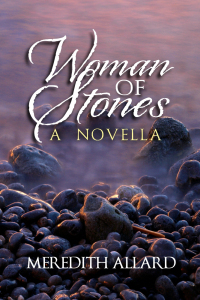
Another amazing cover from Dara England for LFD Designs for Authors.
I’m nearly done with the final edits for Woman of Stones, and it should be ready for release next week. I know it seems like I write fast, but the novels I’m releasing now have been finished for years, sitting around on my hard drive collecting cyberdust. I had some time this summer—around researching and beginning the final book in the Loving Husband Trilogy—to get them cleaned up and pretty-like so I could share them with you.
If you think Victory Garden is a change of pace from the James and Sarah books, then Woman of Stones may as well be written in Greek. In fact, if it was written during the time it takes place—2000 years ago—it would have been written in Ancient Greek.
It might seem odd to discover I’ve written a novella set in Ancient Jerusalem with a story from the New Testament as the inspiration. For me, that’s one of the glorious things about writing fiction—inspiration can come from anywhere at any time in history. My inspiration for the Loving Husband Trilogy came first from reading the Twilight series and then watching True Blood on HBO. My inspiration for Woman of Stones began when I read Anita Diamant’s lyrical historical/Biblical novel The Red Tent. I was blown away by that book, so much so that as soon as I finished it I began reading it again. I loved Diamant’s poetic prose, her stream-of-consciousness storytelling, and her creative imagining of a Bible story from a woman’s point of view. A Bible story from a woman’s point of view? I loved the idea, and I loved the way Diamant made Dinah’s story come to life in the novel.
I don’t come from a religious family, so I didn’t grow up reading the Bible. I’ve read it in bits and pieces over the years, and like many people, I find a lot that’s inspirational there. One of my favorite stories from the New Testatment has always been the story of the woman dragged before Jesus, caught in the act of adultery. The woman’s accusers mean to teach Jesus a lesson, but Jesus is too wise for them and he makes them go away with a few pointed words: whoever of you is without sin, cast the first stone. The men dwindle away, and Jesus sends the poor woman along, telling her to sin no more.
Who was this woman, I wondered? How did she come to be at that place at that time? Having read The Red Tent, I decided to imagine a story for her. That’s all the novella is—my imagination piecing together a story for the woman who was dragged before Jesus as a sinner. I began writing in 2002 and I finished in 2004, five years before I started Her Dear & Loving Husband.
For me, Woman of Stones is a study in memory. I’m fascinated by memory, how we remember things, what we want to remember, what we choose to forget. I also wanted to tap into the stream-of-consciousness narration I found in Diamant’s novel, and I love that fluidity in a lot of Toni Morrison’s novels too. The novella became a first person narration from the Woman of Stones herself. We follow her as she remembers what happened to her in the Temple courts, how Jesus saved her, how she came to live in Jerusalem, why she wanted to live there, what her lover meant to her. She isn’t perfect, but who is perfect? This is probably the most “literary” work I’ve written because it focuses very much on the Woman of Stones and her telling of her story the way she remembers it. Sometimes she remembers in linear order, and sometimes she doesn’t. Mainly, I’ve broken one of the oldest Creative Writing 101 rules with this novella: Show me, don’t tell me. There is a lot of telling in this story, but I’m all right with that. To me, it fits the fluidity of the woman’s memory as she struggles to make sense of what happened to her. Plus, at 37,000 words it’s only a novella, so the telling format works better with this shorter story. I wouldn’t like it so much for a full-length novel.
After Woman of Stones is released, I’ll be finishing the revisions of a book I originally published in 2000 through Xlibris—My Brother’s Battle. I’ll have more to say about that one soon.
Filed under: News, Woman of Stones, Writing Tagged: Woman of Stones, writing, writing historical fiction

July 24, 2012
Finishing the Final Edits
Victory Garden is now available from Amazon and Smashwords. I thought I was going to get it out early, but then I stopped everything else to study for my Revised GRE General Test, which I passed with a 162 out of 170. I read that’s a competitive score, so whoooo! It was definitely worth it to concentrate on studying, but then it took me longer than I thought it would to finish the final edits of the book.
I have a funny way of doing my final edits for a book. I like to upload the book onto Smashwords and Amazon, download a couple of copies, and then I’ll unpublish it because it isn’t ready to be seen yet. I like to read it in both Kindle and Nook formats because I like to see what readers are seeing when they read it. To me, the language flows differently on the small-size screen of a Kindle or a Nook than it does on the computer when I’m writing. Some of the mistakes I caught were silly typos. I type about 100 words a minute, but I also make mistakes along the way. He looked at his watched. Huh? Unfortunately, as we know, spellcheck doesn’t catch that because watched is spelled correctly. One of the funnier mistakes I caught was the name of the movie theater where Rose spends a lot of her time. There were two main movie theaters in New York City during 1917-1921 when the story takes place—the Rialto and the Rivoli. The first time I mentioned the theater I said it was the Rialto, and then for the rest of the book I called it the Rivoli. I did some research on the Internet, and I discovered Rose would have had to visit the Rialto since the Rivoli didn’t open until December 1917 and the story begins in April 1917.
Sometimes, it’s a matter of whittling the sentences down, as I’ve discussed before. For example, if I have a sentence that reads “He had remembered that the door she had left open was never closed” my whittle finger would chop it down to “He remembered the door was never closed.” Unless the “she had left open” was necessary to understanding, it can go. Besides, if the door was never closed, obviously it’s open. Nine times out of ten “that” can go. Seven times out of ten “had” can go. I have what I call my No Extra Words rule, and if a sentence can do without a word, or words, they go. I’ve learned to be precise, slicing extra syllables away with a butcher knife and laughing the whole time like a Benihana chef, but I hope I have stronger sentences because of it.
Now, GREs and Victory Garden done, with the first draft of Book Three of the Loving Husband Trilogy under my belt, I’m onto the final edits of a 38,000 word novella called Woman of Stones, which is based on a Biblical story. I began that story about ten years ago, and I’m thrilled to be able to share it with you soon.
Filed under: Victory Garden, Writing Tagged: editing fiction, Victory Garden, writing

July 23, 2012
Winners of the No Strings Attached Giveaway
Thank you so much to everyone who participated in the No Strings Attached Giveaway. Over 750 people entered. I think that’s a record!
Here are the winners:
Paperbacks:
M. Jay Wilson
Claire Dora
Becca Bradley
$10 Gift Certificate to Amazon.com:
Gina R. Gibbs
I’ll be back on August 23 for the Feed Your Reader Giveaway. If you have an e-reader, this is the giveaway for you. See you then!
Filed under: Giveaways Tagged: Giveaways

July 16, 2012
No Strings Attached Giveaway
It’s time for the No Strings Attached Giveaway. This one is simple. All you have to do is leave your name and e-mail address and that’s it! Thanks to I Am a Reader, Not a Writer for hosting.
I’m giving away three paperback copies of either Her Dear & Loving Husband or Her Loving Husband’s Curse (your choice). There’s also one $10 gift certificate for either Amazon.com or BN.com (your choice).
Fill out the brief form below and you’re entered into the drawing. Good luck!
[contact-form]
Filed under: Giveaways Tagged: Giveaways, I, I am a Reader Not a Writer, No Strings Attached Giveaway

July 9, 2012
Writing Historical Fiction: Planting a Victory Garden
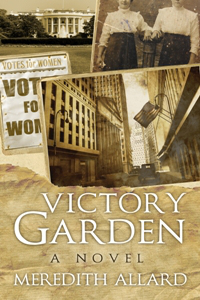
Another amazing cover from Dara England for LDF Designs for Authors.
I’ve been burning the midnight oil getting Victory Garden ready for public consumption, and it seems to be working. The novel should be ready for download in a couple of days, a good two weeks ahead of schedule. I’ll post here, on FB, and Twitter when it’s ready.
For those of you who are enjoying the first two books of the Loving Husband Trilogy, you’ll find Victory Garden to be a change of pace. There aren’t any vampires, witches, werewolves, ghosts, or other paranormal elements. Both Rose Scofield and Adam Bell are fully human. There’s no complicated plot twisting between the past and the present—the whole story takes place between the years 1917 and 1921. It begins at the beginning and ends at the end, all told in first person narrative from Rose’s point of view.
In fact, Victory Garden predates the Loving Husband Trilogy by a full thirteen years. Rose Scofield’s story was inspired by a news report I saw on television during the 1996 presidential election where it was said women were voting in small numbers. Being the history buff I am, my thoughts immediately turned to a story I read years before (it may have even been in elementary school) about women who were arrested and force fed for fighting for the right to vote. Have we come so far in 76 years, I wondered, that women no longer want to vote when their grandmothers and great-grandmothers went to jail for that right? After kicking the idea around for a while, Victory Garden was born. I began writing it in 1997 and finished about a year later.
The novel is slightly on the short side at about 70,000 words. As I was getting the book ready for publication I thought about making it longer, but then I decided I didn’t want to add words just for the sake of adding words. Though the story is concise, it’s complete. In many ways, it’s a coming of age story for Rose as she struggles to navigate her own path in a time when women were expected to be subservient. She works for the suffrage movement, doing her part to make votes for women a reality, and in her determination to be strong she denies what she really wants—vaudeville actor Adam Bell—for fear it will make her weak.
Nearly everything I write is romantic in one way or another. While I can’t call my stories romances because they don’t follow the romance formula, they’re all romantic. I’m fascinated by how people fall in love. Not how they fall in like, attraction, or lust. Those are all wonderful in their own ways, but as a writer I’m more intrigued by the ever elusive love, true love, the kind that sticks for lifetimes and, in the case of James and Sarah, beyond. Sometimes, like James and Sarah, we accept true love with an open heart when it appears. Other times, like Rose, we fight it because we can’t see our own truth even when it’s staring us in the face. The destination is the same—falling in love—but the journey to get there is different for everyone.
For those of you hoping for more of the same as you see in the Loving Husband books, you’ll find history, romance, and that literary crazy-style you’ve come to expect from me. But even though Rose’s story is different from James and Sarah’s, I hope you’ll still enjoy it. Rose, in her fight for women’s rights, in her struggle to live on her own terms, shows us how far we’ve come as women, and how far we still need to go.
Filed under: News, Victory Garden Tagged: historical fiction, Victory Garden







July 2, 2012
It’s Amazing What a Little Amazon Free Can Do…
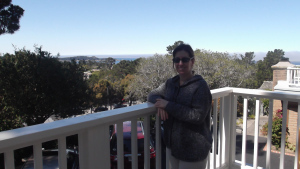
It’s hard to see from the picture, but that’s the ocean over my shoulder in Carmel. That’s one thing I don’t miss about living in California–the bad hair days!
I just returned from a fun time in San Francisco and a relaxing time near the coast in Carmel, California. It was nice to get away for a few days, and except for a few e-mail checks on my phone, I managed to stay unplugged, which was nice. I had never been to Carmel before and I have to say that was one of the prettiest beaches I’ve seen. There’s something about living in the desert that makes me need to see the ocean every now and again. That’s not to say the desert isn’t beautiful because it is in a different way, but there’s something calming about the ocean I love.
Now it’s back to Vegas and the real world, which isn’t so bad at all. Her Loving Husband’s Curse begins its virtual book tour today through Bewitching Book Tours, and throughout the rest of July and into the beginning of August you’ll be able to catch both books on various sites with promos, reviews, and interviews. Check here for the tour schedule, and I’ll be tweeting the various stops as they go live.

The view from the beach in Carmel.
It’s amazing what a little Amazon free can do. Since Her Dear & Loving Husband went free on Amazon on 6/20, more than 56,000 copies have been dowloaded. It was number one in both the free literary fiction category and the free historical fiction category for about a week, and since then it’s been fluctuating between the 1, 2, and 3 spots in both categories. As of right now, it’s number one in literary fiction and number three in historical fiction. People keep asking me how I feel knowing I’m not making any money from the downloads, but I’m happy to give away 50,000 free copies, 100,000 free copies, a million free copies if that will help get my books into the hands of people who otherwise might not have read them. Meanwhile, Her Loving Husband’s Curse has been hanging out at around #5 and #6 in its paid categories.

The pagoda in the Japanese Tea Garden in San Francisco’s Golden Gate Park.
I’ve seen a huge increase in the number of people visiting this site since the book has been free on Amazon, so welcome to any new friends stopping by. Many of you have been kind enough to drop me a line either through my Contact Me page or by posting in various places on the site. It means so much to me to learn there are others who have been as touched by James and Sarah’s story as I have been. I’ve also had a lot of inquiries into the whereabouts of Book Three. Believe me when I say I’m hard at work on it this summer! Unfortunately (or fortunately, depending on how you look at it), I don’t write as fast as some other writers so it takes me a little more time to finish a book. Partially, it’s because I write historical fiction so I have a lot of research to do. Partially, it’s because I have to spend some time thinking through the plot before I start writing so I have some sense of what this darn story is I’m trying to tell. Partially, it’s because it takes time to revise the language until I’m happy with it. I compare it to a woodworker with a chunk of wood in one hand and a knife in the other and he whittles away and whittles away until there’s a carved statue in his hand. Michelangelo used to say the statue was already in the marble and he had to carve away at it until he revealed what was already there. That’s how I feel about writing, but it takes time to whittle away until it’s just right.
It’s a good thing summer isn’t close to being over since I still have a lot of work ahead of me. As I said, I’m working on Book Three, and I also have two more books (unrelated to the Loving Husband Trilogy) coming soon. Victory Garden will be out first, on Tuesday, July 24, and then Woman of Stones will be out in late August. I’ll have more to say about those soon.
Once again, welcome to any new friends, and I hope you’ll join me on the virtual book tour for Her Loving Husband’s Curse. I’m looking forward to the ride.
Filed under: Her Dear & Loving Husband, Her Loving Husband's Curse, News Tagged: Amazon, Bewitching Book Tours, Her Dear & Loving Husband, Her Loving Husband's Curse







June 27, 2012
An Interview With Author Erica Manfred
What books did you love as a child? Why?
There were so many, it’s hard to choose—or remember. I do remember adoring Green Mansions. Hardly anyone remembers that one. I loved the intersection of fantasy and reality – I also imagined myself as Rima, the bird girl, living in the forest away from the miseries of school and parents.
Who are your favorite authors? How did they influence your writing?
Keeps changing depending on what I’m reading at the moment. Right now I adore George RR Martin and Diana Gabaldon on Audible.com. As for influence I can’t say either of them influenced me. My writing is humorous and I’ll have to say my idol in that area is the late, great Nora Ephron. I also love Augusten Burroughs, Carl Hiassen and Dave Barry.
When did you decide you wanted to be a writer? Why did you decide to write?
I got fired from my job as a caseworker in the 1970s and wrote a mystery novel, Get Off My Case based on my experiences at the New York State Division for Youth. You can find it on Kindle.
What are the joys of writing for you?
The joy is in focusing on something outside myself. I love that sense of being transported to another time and place, or just forgetting my problems and worries. Writing gives me that feeling of “flow” where I’m totally involved and engaged. Feels good.
What are the obstacles of writing? How do you overcome them?
The biggest obstacle for me is getting started. Once I start I keep going. It helps to have a deadline. That’s about the only way I get to work.
What is your favorite genre to read in? Write in? Why?
I really love writing personal essays. Give me a 1,000 words and I’ll wow you. Give me a 100,000 and I struggle. Don’t know why I keep writing books—probably because I like the continuity of them.
How would you describe your writing style? How did you develop it?
My writing style is funny. I didn’t develop it, it developed me. I just naturally think that way, talk that way and so write that way. If I had another life I’d like to be a stand-up comic.
What was the inspiration for your book?
Interview with a Vampire by Anne Rice of course. I started thinking of a way to parody it, and voila, Interview with a Jewish Vampire.
What do you wish someone had told you about writing that you learned the hard way?
Discipline comes from within. I didn’t start writing until later in life because I thought I had no discipline—that I’d have to have someone standing over me with a whip to write. I had no idea that writing was a joy in itself, and the discipline comes from loving the process. A shrink told me that, over and over, until I finally believed it. That’s when I wrote Get off My Case.
What is your next project?
I’m working on a sequel to Interview with a Jewish Vampire entitled True Kosher Blood. In this book Rhoda will rescue Sheldon from the clutches of the Vampire Bureau of Investigation, the VBI.
What are you reading now?
I mostly listen to books on Audible.com. Right now I’m listening to The Scottish Prisoner by Diana Gabaldon who never ceases to amaze me with the intricate details of the time period she writes about. I mean how the hell does she know all this stuff.
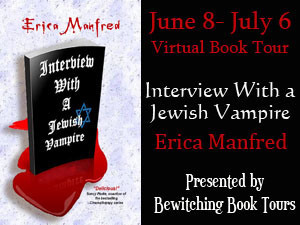
Interview with a Jewish Vampire
By Erica Manfred
About the Story:
The last thing zaftig middle-aged journalist, Rhoda Ginsburg, expected when she signed up for JDate was to fall in love with a vampire. But when she meets drop-dead gorgeous Sheldon, a Hasidic vampire, she falls hard. She rationalizes that he may not be alive, but at least he’s Jewish.
She learns that back in the nineteenth century Sheldon was a rabbi who was turned into a vampire by Count Dracula, an anti-Semite who got his kicks from turning Orthodox Jews into vampires because then they’d have to drink blood, which isn’t kosher.
Soon after she meets Sheldon, she discovers her beloved mother, Fanny, is terminally ill, so she comes up with the crackpot idea of getting Sheldon to turn Fanny and her friends, known as “the goils,” into vampires.
Once she becomes a vampire, Fanny tires of her boring life in Century Village, Florida, and, seeking thrills, she goes clubbing and disappears into the nightlife of South Beach in Miami. When Fanny and her goil posse “go rogue” and start preying on the young, Rhoda and Sheldon must track them down to keep them from killing again.
Interview with a Jewish Vampire turns vampire lore on its head, proving that not all vampires are young and beautiful and it IS possible to be undead and kosher.
About the Author:
Erica Manfred is a freelance journalist, humorous essayist, and author. Her most recent book is the novel Interview with a Jewish Vampire. She’s also authored two non-fiction self-help books, including most recently He’s History You’re Not; Surviving Divorce After Forty. Her articles and essays have appeared in Cosmopolitan, The New York Times Magazine, Ms., New Age Journal, Village Voice, Woman’s Day, SELF, Ladies Home Journal, and many other publications. Erica lives in Woodstock, New York with her Chihuahua, Shadow, and her daughter, Freda. Brought up by Jewish parents who spoke Yiddish but avoided religion, she got her Jewish education at the Woodstock Jewish Congregation which welcomes Jews from all backgrounds, from atheist to Orthodox to vampire. Her website is www.ericamanfred.com or visit www.jewishvampire.com.
Filed under: Guest Authors Tagged: Bewitching Book Tours, Erica Manfred, Interview With a Jewish Vampire, interviews







Winners of the Midsummer’s Eve Giveaway
Thank you to everyone who entered the Midsummer’s Eve Giveaway! Here are the winners:
E-Books:
Latisha D.
Larissa B.
Tracy J.
Veronika B.
Donna
Paperbacks:
Rolanda B.
Endina E.
Victoria H.
Amazon.com $10 Gift Certificate:
A.D. Dulling
I’ll be back on July 17 with the No Strings Attached Giveaway. That one should be fun since all you have to do is leave your e-mail and you’re entered.
Filed under: Giveaways Tagged: Giveaways