Quinn McDonald's Blog, page 24
October 26, 2014
Practice Safe Vex
This weekend, some people I follow on Facebook were involved in a kerfuffle. A lot of small things went wrong, and it made a big mess. No names are mentioned in this story, because who said it is not important. How it was handled is important because a lot went wrong that didn’t have to.
 Here is the bare-bones story: Person X, well-known in X’s field, was on an airplane. X was seated next to an overweight person. X and the overweight person had a discussion (not a happy one) about who could use what part of the armrest and seat. X is slender and took, then posted photos on Facebook of the overweight person taking up more than her seat and added some unhappy comments.
A few early comments took X’s side, making harsh statements against overweight people. Then, the tide turned. The comments fell into different areas:
criticizing someone’s weight and blaming them for it
putting a person’s photo on Facebook without permission
defending the privacy of a timeline on Facebook
the idea that “you can say what you want in your own space on Facebook”
Lessons to learn from this embarrassing story:
We live in a public world. It’s hard to avoid being photographed, quoted and posted on Facebook, Tumblr, Instagram, Twitter, Reddit, and a hundred other social media sites. You have every right to stand up for yourself and not allow yourself to be photographed. I understand that if you are in a public space, you don’t have an expectation of privacy, but this is not a legal matter, it’s an ethical one.
Legal and ethical are not the same. There may be no law against doing  something, but that doesn’t make it right or good. It’s just not illegal. It could be hurtful, cause embarrassment, or crush someone’s spirit. Now we are in ethics.
Some basic social media rules:
Don’t photograph private people in a public space and post those photos without the person’s permission.
Posting anything on Facebook makes it public. Even if you post it just to your friends and family, they can re-post it and make it public. That’s how “going viral” starts.
Everyone has biases. They are best kept to yourself. Once you air those biases, you have labeled yourself. People have amazingly long memories about gaffes and biases.
Person X apologized by saying she had not thought the incident through. And she said she should not have posted the photos.
Many people replied that she could post whatever she wanted on Facebook, since it was on her own timeline. They seemed to have missed that what you post on your timeline winds up on other people’s news feeds. And can be passed on.
And about that freedom of speech thing? Every privilege comes with a responsibility. Yes, you can say what you want. But every post, every spoken sentence carries a consequence. You can say what you want, but people will also say what they want. So don’t expect to get nothing but support just because you are expressing your opinion.
If you are angry, do not act in anger. Think through the story and how it will appear to others. In other words, practice Safe Vex.
—Quinn McDonald knows a lot about putting your foot in your mouth. She’s had a lot of practice. She also knows that fat people are the last group that can still be victimized as a group sport. That’s cruel.
Filed under: Coaching, In My Life, Opinion Tagged: anger and social media, biases, privacy and social media, social media behavior



October 25, 2014
Growing Without Pushing
The biggest surprise over the last dozen years of owning my business is—just like real life—you can’t force things to happen. For most of my adult, corporate life, I thought that’s how you got things done. Pushed against resistance till the resistance collapsed and you “won.” Negotiate hard until the opposition caved and I “won.” I sure wasted a lot of time doing that.

Not every skirmish needs to be turned into a war that must be won.
An example: I’m a good writer. Experienced, nuanced, clear. After decades of writing, I should be. I deserve to be paid for that ability and expertise. When a client says, “We’re not paying you what you asked for, we’re paying you half. We pay our other writers less, you shouldn’t be asking for that much,” I no longer force back by piling up my experience and subject knowledge. Nope.
Instead, I nod and say, “I understand your budget can’t stretch to cover my fee. I wish you every success on the job with another, less expensive writer. Thank you for considering me,” and head toward the door. Notice it’s a statement of fact, not anger or threat. I rarely make it to the door before I’m called back. “Maybe we can arrange something.” Good, let’s talk.
Another example: Occasionally, I’m asked to speak to new coaches on choosing a niche. I’m supposed to explain how I chose my niche, and how others can choose theirs. There is no secret. I didn’t sit down and think over what niche I would develop. It worked the other way around. I looked at the people around me, the ones naturally present already, and built by offering what they needed from what I could do.
It’s an easier life if you don’t have to put your shoulders down and bull your way through. It’s far more rewarding to work with your natural gifts, with people who are already around you. By heightening talents you have in situations that present themselves, there is less damage to your spirit and more building of your strengths. Less grinding, more polishing. Less spinning, more weaving. It’s a good life.
–Quinn McDonald is a writer who teaches writing. She’s also a life– and creativity coach who helps people when they are stuck. She can’t help everyone, and doesn’t fight it.
Filed under: Coaching, Creativity, In My Life Tagged: don't force life, go with your strength, negotiating


October 24, 2014
Driving Ahead
Driving across the Navajo Nation. It’s early evening, and I’ve crossed the orange cliffs and am on the mesa with scrub brush and easy hills. Not a house in sight. Not a store, gas station, or even a fence to create boundaries. Not in the last 4o miles.
I’ve spent the last two weeks in big cities, on airplanes, flying over sparkling cities late at night. And now, this. Silence. Space. A big sky.

Suddenly, on the right, a group of horses gallop across the landscape–running parallel with my car. Where did they come from? They are well kept and strong. Two paints, one gray, several browns and two gorgeous chestnuts with black tails and manes. They run parallel to my car, and I imagine that they are having fun, running because they can. It doesn’t matter where they wind up, it is all their space.
Night is coming on. It feels peaceful and easy to be here, heading to teach. I feel grounded when I teach writing. So personal, so connected to culture and history and your own spirit. It’s like translating life into action.
 The sun begins to set, and there is fire in the clouds. Part of this sun-struck cloud looks like the Phoenix–born from ashes to soar. Navajo Mountain appears on my right, and the sun sinks below the horizon. The echo of life stays with me as I roll deeper into the Navajo Nation.
-–Quinn McDonald is a creativity coach who teaches writing for businesses and personal growth.
Filed under: Nature, Inside and Out, The Writing Life Tagged: Navajo Nation, Page, sunset, Teaching


October 22, 2014
Controlling the Tricky Muse
Cesar Millan may be the Dog Whisperer, but his method works well for the

From Laura Maris’ Pampered Pups website.
unruly, leash-tugging creative urge we call a Muse, as well. You know that creative Muse–the one you desperately want in your life, but that disappears around the corner and won’t come when called. When it does show up, it runs you ragged. You are off to buy materials and supplies, while your Muse stays at home, piling choices on your studio table, and running you ragged with ideas, projects and commitments that you can’t manage.
You are in charge of your own creative output.
The Dog Whisperer has a formula. If you’ve watched the show, you already know what it is. It’s on his website: “Through my fulfillment formula exercise, then discipline, and finally, affection. As the human pack leader, you must set rules, boundaries, and limitations and always project a calm-assertive energy.”
 The “calm-assertive energy” comes first. It’s not about being a control freak, it’s knowing that you are the calm leader of your creative energy and your studio. If you are in control, the studio is not running you and you aren’t searching for pieces of a project. You aren’t forever using the excuse that you have a coupon and heading out to the craft store. You are centered and know your project.
You set the rules, boundaries and limitations for your studio. Here are some good ones to start with:
Know what your project is.
Know what your project is not. If you are going to create a journal page, don’t worry about creating the whole journal.
Leave the studio set up so you can begin. Nothing saps energy faster than having to spend an hour cleaning the studio and another finding what you want to work on.
Put extra materials away. It’s distracting to see unfinished project lying around.
Set a time to start and be there to start the project.
If you have an appointment, set a timer to remind you when to stop. You can’t work deeply if you keep having to check on the clock.
Keep a paper and pencil around to take notes as you work. Once you get to the studio, you will immediately think of “work” that needs to get done before you start. Stay in the studio, make a to-do list. The laundry will still be there when you leave.
The rest of Millan’s ideas work just as well: exercise, discipline, affection.
Exercise is a way to burn off tension in your body. It makes room for creative ideas. While you are exercising, a part of your brain is problem solving. That’s good for your brain and your body. Allow that to happen often, and you will approach a project with eagerness, without a lot of the adrenaline energy that’s exhausting.
Discipline is not punishment. Discipline allows space and time for deep, meaningful work. Discipline allows you to turn off the phone, shut the computer off and head for the studio. Discipline is a set time to work without guilt or fear. Discipline is consistency–knowing what is going to happen. It’s not a wild streak of cleaning the studio one day and spending three hours looking for just the right piece of paper. Discipline is an approach to creative time that includes knowing what will happen–you will work meaningfully, for a set amount of time, on a regular basis.
Affection is allowing yourself to feel good about yourself and your work. Affection is allowing yourself to try and fail, to try something different, to follow a thought or idea until it works or until you know why it doesn’t. Affection for yourself is allowing your growth at your own rate, not at your best friend’s rate. It’s taking the “just” out of your vocabulary, as in, “I just painted this scene.”
Just as Cesar Millan projects a calm, assertive pack-leader image to his dogs, you can project a calm, assertive creative leader image to your muse and your studio. You’ll be surprised at how well it works.
–Quinn McDonald is a certified creativity coach who works with visual and performing artists to help them find, manage and develop their creativity.
Filed under: Coaching, Life as Metaphor Tagged: handling your muse., muse


October 21, 2014
Book Page Wreaths
Book lovers, avert your eyes. I’m about to rip up books (again) and turn them into something else. But first, a note to all of us for whom books are sacred and for whom the thought of damaging one is tantamount to a violent act: the books used in these wreaths are books that are headed for the shredder. Having them serve in an act of beauty is much better, at least in my studio.
So, book page wreaths. Three styles built on three different backgrounds. You’ll need to gather some materials:
Wreath base, straw or styrofoam
Scissors
One or two inexpensive, small paperbacks. I like to use romance novels because the paper is porous and ages quickly.
White glue
Stapler
Ink stain in a dauber bottle. Tim Holz Distress Stain is a common brand.
Spray ink with shine or glitter. Tattered Angels Glimmer Mist is a common brand.
Straight pins, plain or with colored heads.
Selection of colored papers
Spray bottle (plain water)
paper clip or clothes pin (optional)
gold stamp pad (optional)
Choose the size of wreath you want. The bigger the wreath form, the more pages you need. The size depends if you want to use the wreath to hang on a door, lie on a table, or from a mantel.
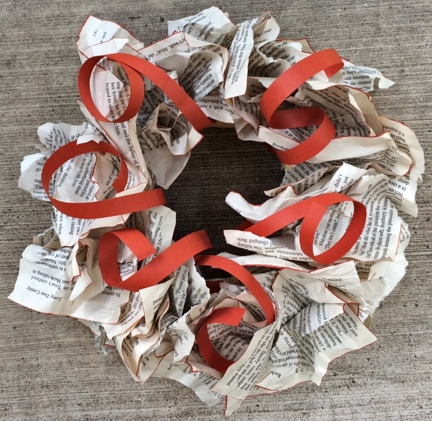 1. Ruffled page wreath on straw base. A straw base is wonderful because you do not have to cover it or paint it to hide the “raw” look. Most of these wreaths come wrapped in plastic, which you can leave on. It stops shedding.

Straw wreath with plastic removed. You can leave it on to avoid shedding.
Take a paperback and hold it closed. Rub the ink dauber along the closed pages, on all three sides of the book. (The spine side is where the cover is attached, do not remove the cover).
Be generous with the ink. Cheaper paperbacks work well for this, the ink will soak into the paper nicely. The pages also look aged quickly. Allow the book edge to dry completely. Don’t use paint–use ink. Paint will glue the pages together.

Pages have been partially painted with ink to show method.
Open the book and fold back the cover to the first page completely covered with type. Rip out pages, one at a time. Keep them intact–if a small corner rips off, fine, but if a big chunk rips off, discard it.
Crumple the page as if you were going to throw it away. Squeeze it hard enough to leave wrinkles that stay.
Find the center point of the crumple, pinch it between your fingers to form a “stem” and insert a pin through the open center (not the piece you are pinching).
Push the pin into the straw wreath. Repeat until the wreath is generously covered. Add enough to have it look fluffy and full.
Cut thin pieces of colored paper to match the season. I’ve used orange for Autumn. Spray the paper with plain water and clip it with a clothes pin or paper clip. Allow to dry. It will be curly when you release it. You can also use ribbon for this step. Pin the ribbon ends to the wreath and wind the long end into a pleasing shape.
2. Tailored wreath on styrofoam base. This wreath works well flat as well as hanging on a door or window. The wreath base is white, 8-inch styrofoam:

Dye the edges of the book as in the wreath above. If you want a gold edge, use a stamp pad and rub it against the edges of the book.
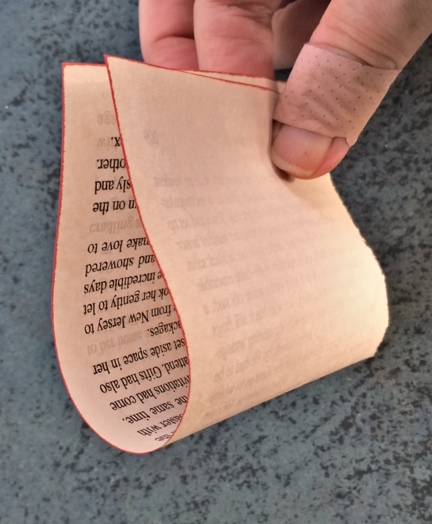 Tear out pages and fold the page so the two short ends meet. Do not crease. Fold the colored edges back on both sides so the page looks like a Z.
 Staple the bottom. For the first row around the back of the wreath, press the folds closer together. Do not crease sharply. Place the pieces of paper so no spaces show between them.

Wreath, back view. On this model, a blue and white hanging string is already attached.
Turn the wreath over. Press it flat. Repeat the folding and pinning on the front of the wreath. Allow the fold to be a bit uneven, and this time allow them to be open and fuller.
 When the wreath is covered all the way, make sure the pins are secure. Take about six more pages and roll them into a cone. Staple the bottom and pin it around the inside of the wreath. Glue the top to the existing page beneath it.
Spray lightly with Glimmer Mist. You can also spray lightly with a spray glue and sprinkle glitter on the wreath.
In the photo above, look at the 3-o’clock position and you will see a page added after the wreath was completed. If you decide to add pages, make sure you tuck them under both the existing pages and the row of cones.
3. Leaf wreath on green 3-D styrofoam ring. The advantage of the ring over the circle is that you have more space and depth. If you use long pins, they will poke through the circle.

Wreath back was photographed when the front was complete.
If you don’t want the color of the ring to show through, paint it first. You can also cover it with burlap strips or foil.
You do not need to edge the pages for this project. Tear the pages out of the book carefully. Cut ovals the length of the page using scissors. You really don’t need to make a leaf template. Make sure at least one end comes to a point.
The leaves will look better if they are not all the same size.
 Take an oval, pinch the bottom together to help the leaf form a cupped shape. Staple. Take a pin and starting at the top, with the leaf facing down, pin the leaf to the frame. Repeat from the 12 o’clock position to the 6 o’clock position on the right side. Then repeat on the left.
Once the big leaves are in, tear more pages out of the paperback. Fold the page in half, short end to short end. Cut out two smaller leaves, making sure they are not connected. Fold, staple, tuck and pin the shorter leaves in with the large ones. This gives the wreath fullness and visual interest. You can also cover the sides and back for a really full wreath to hang in a window.
Use construction paper or scrapbook paper, or just about any kind of colored paper to make the wreath look holiday-appropriate. You can also make the wreath entirely of construction paper, but use 2/3 in one color and 1/3 in another. If you use even numbers of leaves, the wreath will look unbalanced.
Common-sense warning: Keep candles, incense, lighters, and anything else that burns away from these wreathes. They are paper and will burn.
—Quinn McDonald is a recycler of books. And just about anything else she gets her hands on.
Filed under: Art in Progress, Creativity, Links, resources, idea boosts, Tutorials Tagged: altered books, holiday wreath, using book pages, wreath tutorial


October 20, 2014
Difference Between a Visual and Commonplace Journal
There’s been some interest lately for the Commonplace Journal. Yes! Nothing against visual journals, I wrote two books about using visual journals, and I love them both.
But after two books, I want to go back to the Commonplace Journal because it is my idea book. It’s not to show around the table, it’s not a sketchbook, it’s a book that helps me capture who I am today so I can see where I’ve been and how far I’ve come. (Here’s a great post about Commonplace Journals from Kaisa Mäki-Petäjä, sketcher, naturalist and journaler.)
And here’s an example of an ancient one, because the Commonplace Book has a long history–going back to how guild apprentices learned their craft.

Page from a Commonplace Book, from “Belly of the Whale,” from the website Fierce and Nerdy: http://bit.ly/1t1OXa8
A Commonplace Journal (or book) is a place for ideas and pieces of stories, quotes, classes I want to develop, and maps. I love maps and making them helps me put things in perspective or just remember where I’ve been–both geographically and emotionally.
A visual journal is more of a sketchbook, with planned pages. You may start with randomly applying layers of color, then going back and creating a page. But a visual journal is planned, often with an image on every page or every spread.
Not so the Commonplace Journal. It’s a way to capture what you may need in the future, and because you don’t know what that is, each book is a compendium of what you come across in your life–quotes, book titles (those you like and those you make up in case you want to write one), song lyrics, overhead conversations.
I’ve written about 10 ideas to use in your commonplace journal, but here are some not-so-private pages from mine. Warning: it’s not gorgeous, not sketches, and not layered. It’s about memory and ideas and development.
At the beginning or end of some months, I put in a calendar page. It helps me see what happened in that month at a glance. Each date is not filled in, and some days take up a lot of space. It varies a lot.
Here’s one from March, several years ago:

The first one generally mentions the sunrise and sunset times at the beginning of the month, because I am a naturalist, which means a lot of my journal is nature-based. Notice that there are just vague lines separating the days, and not every day is covered.
And here’s one from this past September:

More complete and more defined lines. This is the page in progress. You can see that I penciled in all the lines for the dates, and then inked in those I used. This page isn’t finished yet. I need to erase the lines and maybe add more detail. I can do this because there are other pages in the book that remind me of what I did. Here’s an example:
 We went to the Phoenix Art Museum and saw an exhibition on Antonio Berni. I didn’t take my journal to the museum, so I just put a quick note of the two exhibits we saw–Japanese pottery and an Antonio Berni exhibit.
I happened to have a piece of Asian-inspired paper that a friend had sent, so that got put on that page along with the ticket.
Another page (not shown) is a detailed report about the Antonio Berni art. Berni is an Argentinian artist who invented two characters who populated his assemblages. Berni was deeply distressed by the social issues of his day–how industrialization changed the opportunities for people to grow and advance, how poverty affected the lives of families, and how politics governed cultural changes.
Berni invented two characters, Juanito Laguna and Ramona Montiel, and created entire stories about them using assemblage. The work was mesmerizing and I have several pages describing the sculptures, assemblages, found objects and colors he used as well as interesting words–he called shantytowns “misery towns.”
I received a huge surprise gift from far away on my birthday. It was handmade,  which always means so much to me. The person who sent them (who is not mentioned because I didn’t ask for permission) uses some great quotes, which I wrote on the page.
Even the stamps delighted me, so I included those. The back of the page details the gift and what I know about its production.
Ideas for art, classes and articles are all hidden in the pages, waiting to be distilled out.
Then there are maps. Maps are how we connect locations, but they also work for emotional journeys we take.
 The first few times I went to Tucson from Phoenix (about 2 hours) everything along the way seemed new. That’s the best time to write down what I saw and thought. Sometimes I just jot down notes and put them in when I have a chance to sketch a map. The maps are not meant to be in scale, just remind me about what caught my interest. This map was detailed weeks after I did the first sketch.
The one above is about a trip I took to Las Cruces, New Mexico.
 It’s a beautiful drive, and it has inspired several poems. The map helped me remember what I saw and when. This map was done quickly at a rest stop. It was all I needed and I didn’t add more detail.
This is a lot and it’s long, but I think that there is a place in today’s world for Commonplace Books, and I’d like to help people get back to using them and creating them. By hand. From the brain and through the heart.
—Quinn McDonald is a creativity coach and a naturalist who keeps a Commonplace Journal.
Filed under: Art in Progress, Journal Pages, Links, resources, idea boosts, The Writing Life, Tutorials Tagged: commonplace book, commonplace journal, difference between visual journal and commonplace book, idea book


October 19, 2014
Handmade Dreams
This is a re-run of an article I wrote several years ago. I’ve been having a lot of vivid dreams lately, and I remembered an older blog post. Thought you’d enjoy it again, too:
Dreams are important. They are more than just random processing of the day’s events. Sure, some parts of dreams are recycled parts of experience. But dreams are also our very personal stories, given meaning by our deep personal connections.
In a dream, we recognize the yellow tricycle we passed on the sidewalk earlier in the day. That doesn’t strip it of meaning. To wrangle meaning out of dreams, we have to sit with the ideas our dreams give us and untangle the complicated links to ourselves.
Put down the book that “explains” dream images. You create the message and you can understand it. It’s yours to explore for meaning. A few nights ago I had a dream about a toaster cozy. Unlikely, yes. At first.

Sadly, this old-fashioned toaster cozy is no longer available on Etsy.
The Dream I was in a class of women, and we were all making kitchen-appliance cozies. You may remember those–covers for toasters, blenders, coffee grinders. Cozies were very popular in the 1950s and early 60s. I think the purpose was to
unify the look of the kitchen, although it’s possible women wanted to “hide” the machines that did the work for them while they wore pearls and shirtwaist dresses. There was a lot of conflict in housewives’ minds about having “women’s work” made easier. It was more noble to do everything by hand, but a lot faster to use a machine to help.
In my dream, I was in a sewing class, learning to make a toaster cozy. The other women in the class were making their cozies really fast, sewing machines humming. Most of the cozies in my dream were crayon-colored prints, with contrasting piping. (In my waking life I’m not attracted to crayon-colored prints and piping.) Some women were quilting theirs in traditional quilting patterns.
My toaster model was a vintage, rounded, 2-slicer with the big bakelite black handle. The instructor kept stopping by, fretting. I was making a cozy out of Tyvek, the material FedEx envelopes are made from, and was adding a stuffed sculpture on top. The instructor was worried, and said, “This isn’t really the shape everyone is working with.” I nodded, but kept working.
The instructor, who in my dream was a home ec teacher, asked to see it on the toaster, but I shook my head. I didn’t speak, just kept working. Finally, when other women were putting their neat, tidy, perfectly sewn toaster cozies over their toasters, I put mine on the toaster–it used the toaster as a base, and the whole cozy was about two feet high.
On the top of the cozy was a tiger, rearing up on two hind feet, claws out, snarling. The teacher was horrified and asked me why I did that. I said, “Because I needed to.”
The interpretation: Here is what I knew but didn’t say to the teacher–the toaster was fear and the cozy was anger, a reaction to fear. I was covering fear with a show of anger. Tyvek can’t be torn or ripped. It would stand up to a lot of angry treatment.
I did not feel a need to explain myself to someone who didn’t understand me. That’s a great feeling, to stand up for yourself without explanation.
Showing strength and anger keeps people from seeing we are just a toaster. Because being a toaster is not enough, in our heads. And yet, we buy toasters just for that ability–to toast bread.
The question: How do you need to appear in the world to keep your balance underneath? How do you stand up for yourself?
–Quinn McDonald is a writer and a certified creativity coach.
Filed under: Creativity


October 18, 2014
Airport Art When You Are on the Run
Lately, I’ve been up in the air. A lot. Dallas. Denver. Houston. Change flights in Chicago (note to self: never do that again. Ever.)

Photo: Joel Kramer
There is amazing art in many airports. And then there is just weird art in some airports. Phoenix has a suspended bi-plane that looks like it might be crashing in Terminal 3. The plane is a SPAD XIII, one of the most successful fighting planes of World War I.
Above it is a stained glass window designed by Ken Toney. I thought it was related to Frank Lloyd Wright (whose winter home was in the area), but no. The colors reminded Toney of the Southwest.
Dallas-Fort Worth airport (which is a nightmare of navigation problems) has an ice castle in it. Well, it’s a sculpture of an ice mountain castle.
 I’m not sure, but I think Dallas has no mountains. Still, it’s fun to walk by it–or in my case, run by it.
Atlanta has a sculpture of a flying ear of corn. I haven’t been in Atlanta lately, so I borrowed this from the Gizmodo site. It’s too good not to share.
 The sculpture, part of the vegetable series by Craig Nutt, includes an air traffic control tower that’s a carrot. Sometimes an ear of corn is just an ear of corn.
Travel between the B and C Concourses at Chicago and you will be in a light show. Luckily, you can hang onto the rail of the moving sidewalk while you gawk.
 “Sky’s the Limit” has more than 450 neon tubes and there’s music playing. It’s overwhelming, but so is the Chicago airport.
Denver airport has a huge blue sculpture of a mustang in front. Not to put too

Photo: Len Borden
fine a point on it, but it is anatomically correct. Which I almost didn’t notice because the beast has glowing red eyes, too. Dubbed “Blucifer” by the locals, there are many dramatic photos of the beast. One of the best is here, complete with dramatic weather in the background.
A lot of scary stories surround “Blue Mustang”, too. The sculptor, Louis Jimenez, was killed when a section of the sculpture fell on him, severing an artery.
When I travel, I love to see the local art, especially if it’s in the airport. I don’t know how the art is selected, but you know that people argue over how to represent their city. Sometimes art wins. Sometimes the committee does.
And then, I’m happy to come home to some simply gorgeous gifts of nature. The clouds on the evening I came home:

Photo: Quinn McDonald
And a cactus in bloom–more so this year than any I can remember in the last few years.

—Quinn McDonald travels a lot. She is glad to see the world and always happy to come back home to the desert.
Filed under: idea boosts, In My Life, Links, resources Tagged: airport art, desert flower, travel


October 17, 2014
Anonymous Doesn’t Count
The age of anonymity is upon us. We lurk on the internet; we can be anybody or nobody. But the anonymity of the internet is not about privacy, it’s about cruelty.
Without having to identify ourselves, we can become emotional snipers. Under the guise of privacy, we become cruel, even vicious. If you have never experienced this, read any Yahoo “news” account, then read the comments. They vary from mildly hurtful to hate speech.

“Because none of us are are cruel as all of us.”
When I hand out evaluation blanks in my writing classes, the question always floats up, “Do we have to sign our name?” Well, why not? Have a complaint? Let me know and sign your name. Tell me your truth. Write in a conversational tone. Tell me what didn’t work for you. I can’t be the perfect instructor for everyone, and I’m always interested in hearing an opinion that helps improve the class. I’ve learned from many an eval.
I have no power of reprisal in your company. I am an outsider, a freelancer.
A signed comment makes you an adult with a comment worth reading. When I hear, “We can’t be honest unless it’s anonymous,” I wonder what kind of honesty requires anonymity. What kind of remark would you not say to my face but would be happy to repeat behind my back? Nothing helpful.
I’ve written my share of complaint letters, and I’ve signed every one of them. Adding my name made me careful of grammar, clarity, and asking for what I want. More often than not, I get what I asked for. Without a name, how will the person know how to respond, or to whom?
Be proud of your opinions. They are your experiences. They are your truth. But the word whispered behind the hand, the emotional sniper with venom and anger–that’s not something I’m going to care about or do anything about.
Take a stand for your own character. You’ll be surprised at how good it feels.
—Quinn McDonald can offer more help if she knows who to offer it to.
Filed under: In My Life, Life as Metaphor Tagged: anonymous comments, being heard, speaking up


October 16, 2014
Wabi-Sabi and Your Journal
Wabi sabi is a Japanese esthetic most often associated with the history of the tea ceremony and a philosophy that not only accepts imperfection, but finds wonder in it.
Wabi sabi is exactly what your journal needs. Wabi sabi honors the beauty of the impermanent or incomplete. Leave a page blank because you don’t know what comes next. Just like real life.
 wabi sabi writing