Chris Karlsen's Blog, page 4
September 30, 2015
I’m on The Books Machine!

For free, on deal or as a gift, for readers who love good stories.
The Books Machine
The Books Machine is the place where you will find the best collection of books to read. By signing up just with your email and in just one step, you will receive a daily selection of free Kindle books and deals and one thing that only our site offers:
Good books to read that are paid on other sites, specially gifted to you straight from their authors through The Books Machine.
Read them on your Kindle, iPad, iPhone, Android, Samsung, PC, or any other compatible gadget.
While you’re their, check out my books too!


July 15, 2015
The Worthy Opponent
The Worthy Opponent
Silk is a big departure from the historical romances I usually write. I never thought I’d want to write a story where the protagonist is a police officer. As a retired police detective, I never wanted to relive my career through my characters. That said, I do enjoy reading a good cop story. My favorite authors in the genre are Connelly, Sandford, and Wambaugh. I do have two books that are romantic thrillers. Those involve nautical archaeology and artifact smugglers. But I’d never done a true suspense/thriller.

Silk had an unusual origin for me. I had the idea for a killer in my head. I didn’t want him to be a slasher brute of a killer but one more cunning. I used the Phantom of the Opera as general concept. I wasn’t doing a tragic figure like Andrew Lloyd Webber’s but a man who doesn’t start out a killer or wanting to kill. But, he’s a man capable of killing. I wanted to show his descent into madness.

I started on the story and after a few weeks put it away in a drawer. I needed someone who possessed exceptional logic and perceptiveness to counter the killer’s cunning. The story needed a protagonist capable and determined to overcome any obstacles to catch him. While writing Knight Blindness, one of my historical romances, Detective Inspector Rudyard Bloodstone came to me. He popped into my head with such a strong presence. I knew everything about him before I put one word on the page. It is rare (for me anyway) to have a character that powerful in my head from the beginning. Normally, they evolve into these crystal clear characters as I write.

William Everhard, the killer in Silk, is a man of wealth and influence, a man who is on friendly terms with Queen Victoria. Both Bloodstone and Everhard had to be equally interesting in their own right and equal in intelligence for the cat and mouse aspect to work. Det. Bloodstone doesn’t have Everhard’s power or noble station. Instead, I made him a war hero. Where Everhard is friends with the queen, Bloodstone is the recipient of the Victoria Cross, the highest medal a soldier could receive. It was, and is, the equivalent of the Medal of Honor. Named for Victoria, the queen awarded it for ‘Extreme valour in the face of the enemy.’ Whereas Everhard is an arrogant man, Bloodstone is a humbler man. He doesn’t view himself as a hero. To him, he was simply doing what was necessary in time of battle. Where the wealthy Everhard is elegant and a man who always presents himself as a noble, Bloodstone is a rough around the edges type of man. He’s a man who won’t look for a fight but won’t walk away from a challenge either.
To play off Everhard’s deceptive nature, I wanted the reader to walk the crime scenes with Bloodstone to see what he keys on and have a sense of his analytical thought process.
I used both men’s POVs. I wanted the reader to get insight into what motivated the two men and also see how they viewed the world around them. To me, it was important to give each a life with friends, associates, likes and dislikes. Characters don’t live in a vacuum so fleshing them out in this way IMO is important to this story and to thrillers in general.
To me the best thrillers are those where the protagonist and antagonist are well matched. Professor Moriarty and Sherlock Holmes or Auric Goldfinger and James Bond are perfect examples of worthy opponents. The reader is also given access to the personal lives they lead.
July 13, 2015
Upcoming Events for 2015
Cover Contest for Silk
August 9th on StoryFinds

Featuring on…
Suspense Theme Week

Starting August 9th
on StoryFinds

August 15 2015
Featured spot on StoryFinds
September 28, 2014
Join us & you could win!

CONTEST TIME!
ALL YOU HAVE TO DO IS ANSWER ONE QUESTION & YOU COULD WIN
a $5 Amazon gift card, a boxed set of Knights in Time (digital), and a swag bag, which I will ship international.
 ARE YOU READY… LET’S BEGIN!
My question is:
What is your favorite period of time,
(Bronze Age, Greco-Roman, Medieval, Elizabethan, Victorian, Now)
And why?
PUT YOU ANSWER IN THE COMMENT BOX BELOW AND CHRIS KARLSEN AND I WILL CHOOSE THE WINNER BASED ON THE BEST ANSWER TO HER QUESTION.
DON’T FORGET TO LEAVE YOUR E-MAIL ADDRESS, THAT WAY IF YOU WIN WE CAN CONTACT YOU:)
THANKS, AND GOOD LUCK!
September 17, 2014
Writing the Hero and Heroine from Different Cultures
I found when I mention writing protagonist(s) from diverse cultures, particularly the hero and heroine; readers view the issue from a predominantly geographic POV. He’s from Italy, she’s from India or he’s from Brazil and she’s from Japan. My writer friends are curious as to how the differences are handled.
Regional/geographic contrasts are only a few factors that come into play when writing the story. Some may not appear as obvious at first. For example: when the characters are from the same country but different times. In Knight Blindness, book three of my paranormal romance series, the hero, Stephen Palmer, is a medieval English knight who’s come forward in time to the modern world. The heroine, Esme Crippen, is a contemporary English woman. When they’re first introduced, she shakes his hand. He’s never had a (lady) greet him in this manner and is taken aback by it. He responds by bowing and kissing the back of her hand, as he did in his time. She’s never been greeted in this way and is charmed by the “old worldliness” of the gesture.
Early in their acquaintanceship the man she’s dating picks her up at the hero’s cottage. The man doesn’t come to the door for her but merely sits in his car and honks for her to come out. The hero is appalled and follows her out to the car where he proceeds to express his disapproval of such behavior. The confrontation turns ugly and the heroine must try to explain this commonplace behavior to a man from the Age of Chivalry.
In my Dangerous Waters romantic thriller series, my heroine, Charlotte Dashiell, is an American nautical archaeologist from Chicago. In book one, Golden Chariot, she’s part of the recovery team working a shipwreck off the coast of Turkey. Atakan Vadim, the hero, is on the same team and her dive partner. Atakan is Turkish and a trained archaeologist who is a government agent working for the Ministry of Culture. **Field reps from the Ministry are assigned to all legitimate archaeological sites in the country. They oversee the integrity and safety of the sites and relics.
Over the course of the story, Charlotte and Atakan’s professional relationship grows as does their personal attraction for each other. We Americans tend to speak our minds and we enjoy teasing one another. Turkey is a patriarchal society, where in the main; women are less likely to be as outspoken as they are here or in much of Europe.
When bringing this hero and heroine together, the first concern has to be for the reader. Who is your audience? For mine, I needed to write this culturally different man in a way that appealed to a, for lack of a better word, more liberated female reader. After visiting Turkey several times and interacting with men and women in various professions, plus often reading their online, English language paper, especially the Op-Ed page, I had a good idea how to craft Atakan’s attitudes towards the different situations.
He is well educated, sophisticated, and lives in a cosmopolitan city with a diverse population that he interacts with. But, he grew up in a quieter region of the country. Although his home province draws many tourists, his family lives in an area that doesn’t see as much tourist activity as the rest. His parents are very traditional, especially his mother. She’s a contemporary woman in some respects but in many others her attitude is rather old fashioned.
To be fair to the reader and to him, I blended those two elements that shape him: the worldly, well-educated, city man with the reserved, and to an extent, traditionally influenced man. I strived to do this in the sequel, Byzantine Gold, also.
The opportunity to bring this couple together with their mix of cultures was great fun at times. I enjoyed giving each moments to show how they differ. In Golden Chariot, we see Atakan rattled by Charlotte’s bold teasing about his sex life. In Byzantine Gold, the reader is privy to how his traditional mother’s views of their relationship affect Charlotte. Through the character arcs in both stories, the important result is the reader sees how much the two are alike in vital ways: there is love, trust, humor, and respect, in spite of their differences.
As I discussed in the beginning, cultural differences can come in many forms, not just the east meets west or north meets south type of situation. If you’ve ever planned a trip to the United Kingdom and are researching places to stay or visit, check out how many inns, hotels, and historic sites claim to be haunted. From the ghost of Anne Boleyn walking the grounds of the Tower of London, to Catherine Howard’s at Hampton Court, or the lady seen passing through walls at the Angel and Royal Hotel in Grantham, or pirate ghosts at the Mermaid Inn in Rye, and let’s not forget the ghosts hanging around the Witchery in Edinburgh. The people embrace their spooky, earthbound spirits.
Think of the long list of writers from England, Scotland, or Ireland who have entertained readers with tales of ghosts, or the paranormal and metaphysical. Shakespeare, Sir Arthur Conan Doyle, Dickens, Henry James, Abraham “Bram” Stoker are but a few. Now try to think of a list of French writers of ghost stories. That’s a tough list to comprise. Guy de Maupassant is the only one who immediately comes to mind.
How does this apply to the topic at hand? Let’s use a vacation for example. After you plan your UK trip, plan your next trip to France. Check how many places offer a “ghostly” experience of some kind. By comparison there are far less listed: the Palace of Versailles, the Pere Lachaise Cemetery, and the Paris Catacombs are the ones most mentioned. Why is the paranormal experience so much more limited in France than the UK? Perhaps it’s because their authors are not so inclined to write on those subjects. I’m speculating, but perhaps as a result of the limited literature, the paranormal has never been of a great influence on the people as a whole.
Knowing the difference in attitudes, say your heroine is an English ghost hunter and your hero is a French scientist. Not only is he a man who probably didn’t read stories of the occult or paranormal growing up but as a man of science, he’s likely not given to belief in what cannot be factually, positively proven. Can you as an author turn this into a humorous, delightful source of conflict? Yes.
While writing the more obvious differences between your characters backgrounds, don’t forget the little things like language and slang. Your English heroine will call the elevator the lift and probably call the bathroom, the loo. My hero Atakan is fluent in English. That doesn’t mean he’s so familiar with American slang. I had fun letting him get some expressions close but not quite right.
In conclusion, I would again say, keep your audience in mind when creating a character from a different culture. But, be fair to the foreign character and his or her background and beliefs. Balance is the key.
September 16, 2014
Writing the Foreign Setting—You’ve Never Been To.
If you’re writing sci-fi or fantasy, or a similar genre where you do the world building, you have unlimited leeway with creating setting…or so it seems to me. When your hero and heroine land on Mellifluous, your imaginary planet a million miles from earth, they can encounter almost any environment and/or creature. The choices are only limited by you, the author’s, imagination. Your couple can drink from lavender colored creeks and the foliage on the trees might grow on the bottom while the tops are the rough tangle of roots. Who’s to tell you that’s wrong? Who’s to say that’s not the color of creek water on Mellifluous, the planet of your own creation?
Outside of the world building genres things are much different. If a story is set in Chicago, and the hero and heroine are driving from O’Hare Airport to the Loop, to say they are admiring the majestic mountains ringing the city will bring a tsunami of emails. As a Chicago girl myself, I can attest to the flatness of the area. They can admire the “steel canyons” that the skyscrapers of the Loop form, as I once heard them described. But snow-capped peaks rising thousands of feet encircling the suburban spread…no.
Researching most American cities when you’ve never been there is fairly easy. I’ll stay with the Chicago setting. The internet is loaded with pictures taken from different parts of the city, the historic sites, and the museums. Finding some of the favorite foods of Chicagoans, or which actors or authors come from the city isn’t difficult information to obtain. A small town USA setting might require additional research, but it can be done.
Things get a bit dodgier when the story moves to a foreign country. Common settings like England, Scotland, France, and much of Europe, especially Western Europe, have almost any piece of information you need available and generally requires little time to locate. You may not have been there, or know anyone who has, or know anyone from there. But chances are, thousands of readers have visited or were born and raised in whatever country you’re using. They’ll not hesitate to correct you if you get even a small detail wrong. Have the heroine describe a squirrel. If that type of squirrel is not native to the country, readers will tell you. Information of that sort is very accessible.
But this doesn’t necessarily apply if you choose a more exotic setting than Europe or America. Let’s say you want your couple in Turkey, for example. Now, it gets a bit trickier. You want to give the reader the feel of Istanbul, the mix of Byzantine and modern architecture, the smells and sounds of the Spice Market, the opulence of Topkapi Palace, or the sight of the ferries crossing the Bosphorus from the European side of the city to the Asian side. Where do you begin to find this information?
For my book, Byzantine Gold, the early chapters are set in Paris and Istanbul. When my hero and heroine are assigned to work the recovery team of a Byzantine shipwreck, I wanted to use an Eastern Mediterranean setting for the wreck but not necessarily Turkey. Since the hero, Atakan, is an agent for the Turkish government, I needed a locale where he still had jurisdiction. I chose Northern Cyprus, or to be more specific, the Turkish Republic of Northern Cyprus.
I’ve been to the Eastern Mediterranean but never to Cyprus. A number of sources helped me create a realistic setting. I started with the online official tourism sites. They’ll give you everything from weather, regional and town maps, historical sites, popular spots for various sports, hotel and car rental listings to important information regarding government documentation and requirements.
For other details, I used travel books. In the past, I’ve used Fodor’s. This time I liked Rough Guides Cyprus. In there I found descriptions and pictures of the flora and fauna native to the region. Since my setting was near Famagusta, I looked at the websites of restaurants around there that were mentioned in the book. The websites all listed their menus. I picked several of the dishes they served for those my characters ordered. The book also contained tidbits of local information that helped to paint a picture of the environment. One of the areas mentioned was the Kokkinokhoria or Red Soil Villages. This area is famous for its potato fields, which it’s said are some of the finest grown in Europe. That tidbit is such a small piece of info but when tied to the heroine in a personal way, it gains in meaning.
Another source to consider, depending on the nature of your story, is online English language newspapers from the country. For example, your Syrian heroine might have fled the civil war there and is currently in a refugee camp in Jordan. If an English paper exists, (the Jordan Times is one,) read a few copies. They can give insight to the political climate and how the people of the country feel about the camp and/or the refugees. Say the hero is a Jordanian doctor treating the refugees. Would she be welcomed if she chose to leave the camp and make a life in Jordan? The Op-ed pages are often very enlightening and where you’ll see a cross section of opinions.
Another source available online is the CIA World Factbook. It contains maps, economic information, population statistics, and all sorts of useful material. There are a number of think tanks who specialize in threat assessment regarding various organizations and geo-political situations and who publish their findings. (Globalsecurity.org, Janes.com, washingtoninstitute.org are a few) Google Earth is another source where you’ll find a general overview of an area along with photos.
I use foreign settings for both my series. I picked countries I love, England and Turkey. I enjoy learning more about them with each story. Even when I ventured into Cyprus, my unfamiliar setting, I enjoyed “discovering” the different aspects of life there. For many, you’re the reader’s tour guide.

June 3, 2014
Journey in Time Giveaway
Here we go again … want your chance you win a print copy of book two in the Knights in Time Series? Here it is. Head on over to Goodreads and enter.
Goodreads Book Giveaway
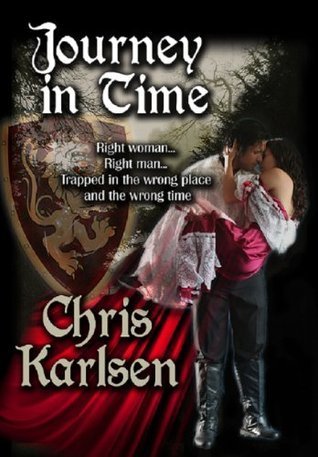
Journey in Time
by Chris Karlsen
Giveaway ends June 25, 2014.
See the giveaway details
at Goodreads.
May 19, 2014
Knight Blindness is on TOUR !
Gliterary Girl Book Tours presents Chris Karlsen’s KNIGHT BLINDNESS Blog Tour!

 ABOUT KNIGHT BLINDNESS
Given a choice between the pleasant life you knew centuries ago or the possibility of all you want in an uncertain new world, which would you choose?
Two men torn through time find themselves in the modern but alien world. Old enemies, one hunting the other, one discovering love, both fighting private battles to survive.
Book 3 of The Knights in Time Series
Ready for battle, Medieval English knight, Stephen Palmer, charges into the French enemy’s cavalry line. Heeding a warning given months before, he hesitates as he comes face-to-face with the knight in the warning. Struck down in the year 1356, he finds himself landing in the year 2013. Grievously wounded, he’s taken to a nearby hospital. Confused by the new world surrounding him, he attempts to convince the staff he’s from another time, only to find they think him mad. Rescued by friends, who, to his surprise, have also come through time, he must find a way to function in this odd modern England. He is quickly enchanted by the kind Esme Crippen, the young woman hired to tutor him. She too is enchanted by him. Tempted to deepen the relationship, she hesitates thinking him adorable, but mad. He must discover the means for getting her to believe the truth, all the while, unknown to him, he didn’t come forward in time alone. The enemy knight has also traveled to 2013. French noble, Roger Marchand, doesn’t question why the English knight who charged him hesitated. That fraction of a pause gave him the advantage needed and he brought his sword down upon the Englishman’s helmet hard, unhorsing the knight. He moved to finish the Englishman off when the world changed in a rush of sensations as he is ripped through time. Seeking a reason for the terrible event, he enters a nearby chapel. There, thinking God has chosen him for a quest to turn French defeat that day in 1356 to victory, he sets out to find the English knight. The man he is convinced holds the key to time. If he returns to the day of the battle, he can warn his king of mistakes that snatched victory from them.
Purchase your copy of KNIGHT BLINDNESS on:
Amazon | Barnes and Nobles | Books To Go Now
 ABOUT Chris Karlsen
I was born and raised in Chicago. My father was a history professor and my mother was, and is, a voracious reader. I grew up with a love of history and books. My parents also love traveling, a passion they passed onto me. I wanted to see the places I read about, see the land and monuments from the time periods that fascinated me. I’ve had the good fortune to travel extensively throughout Europe, the Near East, and North Africa. I am a retired police detective. I spent twenty-five years in law enforcement with two different agencies. My desire to write came in my early teens. After I retired, I decided to pursue that dream. I write two different series. My paranormal romance series is called, Knights in Time. My romantic thriller series is, Dangerous Waters. I currently live in the Pacific Northwest with my husband, four rescue dogs and a rescue horse.
Stay connected with Chris Karlsen at:
Website | Amazon | Facebook | Goodreads | Twitter | Pinterest | Blog
In appreciation to her fans, Chris will have each participating blog give away a copy of her ebooks HEROES LIVE FOREVER and JOURNEY IN TIME. Please check out each blog and enter the giveaway on each blog’s website.
KNIGHT BLINDNESS Blog Tour Schedule:
Monday, May 19th
Tuesday, May 20th
Wednesday, May 21st
Thursday, May 22nd
Friday, May 23rd

May 16, 2014
May 13, 2014
Antagonist Series Part 3
I also gave the contract killer a POV. The reader sees him exactly for what he is: a man who kills for profit. He doesn’t moralize about his business or try to justify his actions. He is what he is, most of the time. In addition to POV, I gave him moments of surprise for the reader. There is one scene where he performs a random act of kindness, totally unexpected for the amoral and generally cruel man.
In another scene we see him at home. Through the eyes of the heroine, we see his taste in furniture, in music, in something as simple as fine crystal. It is easy to forget the antagonist has a mother, possibly siblings, food he/she likes, a certain style of décor or clothing. Those reveals can pull a reader closer to the story. The enemy isn’t an indistinct, vacuous man or woman who is just evil. They have personality and that personality can go many directions.
This same killer returns in Byzantine Gold, the sequel to Golden Chariot. For that story, I took him a step further and gave him a love interest. This is by no means a man who desires love or even has the capacity to give it in any deep way. As mentioned, he is amoral and without the warmth of character. That doesn’t mean there isn’t a woman who finds a way to love him. In this book, he finds himself attracted to a young woman and he chooses to let her travel with him. They share moments where he is true to his nature and brutal to her. There are other moments where he has the opportunity to show an unexpected kinder side of himself.
Byzantine Gold also has a political terrorist who shares the role of antagonist. As horrifying as terrorism is to us, to him, his cause is righteous and he will do anything he must to achieve his goal.