Colleen Anderson's Blog, page 32
December 13, 2011
Brushes With Poverty

Creative Commons: psd via Flickr
Because CBC recently continued its program about poverty in Canada, or those of low income, I thought I would also continue to talk about how poverty has affected me in the past. I'm also extremely busy at the time with several freelance projects so this will be in point form.
There are single parents, single people and even couples with children who struggle to survive and keep a roof over their heads and food on the table. I've never been dirt poor but I have often lived one paycheck away from being on the street. That's scary enough, and with the rising costs of everything from rent to gas, the future is a place of scary possibilities of which I hope I won't have to visit.
As a child I never had a bike. I'm not sure if it was for some other reason or that around the time I would have got one my parents divorced. All of my other siblings had one. So I can barely ride one to this day.
With the divorce, my vindictive father cut my mother off from all medical, which meant the kids as well. I should have had braces and now have a few resultant and expensive problems because of it.
When there were field trips or trips for skiing in school, I and only a few others could never go nor afford to learn how to ski. It helped make us outcasts.
While my friends had cars (albeit used ones) that their parents had bought them, I eventually bought a very used one from my friend's parents for art college.
I put myself through college as there were no savings that my single parent mom could give.
I paid off a rather small student loan over an exceedingly long time because I ended up on unemployment and welfare in the first recession.
Welfare was a demeaning situation and I only survived because I shared a house with three other people.
Food banks are not nutritionally balanced. You are lucky to get any vegetables, which would be limp at the best of times. At one point all of us in the house were on welfare because there were no jobs (50 applications a month).
The most income tax I ever paid was when I was on welfare. The second most I ever paid was when I was on unemployment, which coincidentally is taxed, as if you're getting a huge income.
I stopped buying food so I could pay my income tax while on welfare.
I worked under the table, as a means to make enough to survive upon because welfare wanted to deduct everything from what they gave, which does not encourage people to even work a few hours or more and get established.
As I wrote about before, I was expected to turn in my $3,000 RRSPs before getting $300 from welfare, so that in the end I could tax the system more when I was elderly.
I seriously had to consider prostitution to make ends meet, which no one should have to do. Of course, stealing things could be an option as well.
I have lived in pain for months on end because I could not afford the extended healthcare to get the problem looked at.
I have lived with broken teeth and cavities because I could not afford dentistry.
I have watched friends go on vacations while I had a staycation.
I have literally, sold my secondhand goods on a street corner so that I could go to India, borrowing money from a friend for a flight and paying her back over a year. That's ingenuity and not everyone can travel but it meant scrimping because of low wages.
I mention this last because while I have been poor I have always managed, sometimes just. I have not yet had to live on the streets, or forego eating for long, or go cold. Many people in India live in dire destitution, as do some people here. But I mention these things because I have experienced aspects of poverty and doing without. I'm doing okay now but the realities of such a future are so close it takes my breath away with fear at times. And don't think I'm not trying to find ways to cushion the future. I work more than one job. I make my own lunch, I save frugally so I can have some nice things, and as my brother once said, I could get money from a stone. I've learned ways to conserve and use everything. If I cook a chicken I always make chicken stock. If I buy lipstick, I use a brush to get to the last of the tube. I don't change my clothes with every season's fashion picks. There are ways to survive but still, there are those who do not have those ways.
Everyone should probably experience poverty (and third world countries) so they come to appreciate and understand the freedoms they do have. But being impoverished wears the soul down and there are too many people worrying themselves into stress-related illnesses because they're not sure how they're going to make ends meet. Every civilization falls and if we're not careful, ours could just be around the corner.
Filed under: consumer affairs, Culture, environment, health, life, people Tagged: Culture, fear








December 2, 2011
The Apocalypse Diet
In recent weeks, there has been some focus on poverty and CBC Radio One has a special on today about it: We are the 10%. I have been there more than once and grew up in a lower middle class home, which meant I had clothes, a roof over my head and food, but there are many who don't even have those essentials. Last week I posted a piece titled How I Almost Became a Prostitute where I talked about the terrible state of our welfare system. It degrades and humiliates; and the general public has this perception that only drug addicts, lazy and stupid people become welfare bums, when really, the system perpetuates the problem. In my article I talked about spending no money on my food and living off of what I had in the house.

One form of apocalypse food from http://www.livingwithbloodlust.com/zo...
It got me thinking. If the world ended tomorrow, the zombie virus took hold, the axis shifted, the bombs dropped or some other worldly apocalypse happened to cut supply lines, how long could I really survive on what I have in my home?
So, I've decided to start an experiment on January 1. I won't say it's a diet to lose weight but January is the month to tighten the belt, trim the fact, pay off the bills and think frugal. So what better way than trying to see how long can I survive on the food in my kitchen before I I have to resort to drinking alcohol and eating condiments?
If I really had no way of buying food, how long would I go before having to eat my fellow human, my cute and pudgy cat or hunt wild rutabagas? Because this is an experiment, I won't stock up before the planned date. I'll just go with whatever is in my place. My cat will not have to follow this regime (in case she decides to eat me). And should I go out, well, I won't quite keep myself to this regimen in a restaurant, slavering all over my friends as they eat. However, for lunch at work, I can only bring food from home. I'll take supplements if I need to and record it, since I really don't want to get scurvy.
Now, I'm predicting I'll be fine for at least the first month. Then the veggies will run out and I'll resort to the frozen foods. I have a fridge but no separate body-sized freezer packed with a full deer. I imagine I'll start to get bored in the second month and by the third month I'll be creative, and maybe crazy. But maybe I won't last that long, because really, the apocalypse hasn't happened and I can step outside without fear of zombies munching my toes.
I will post my results here as a diary, but I'll probably do it on a weekly basis so as not to fill up the blog with short but inane food comments.  Be prepared, the Mayan calendar ends in 2012. Perhaps I'm just foreshadowing the doom around the corner when the world ends. Stay tuned…if you can.
Filed under: Culture, food, health, humor Tagged: apocalypse diet, apocolypse, diet diary, dieting, food, Mayan calendar, poverty, scurvy, starvation







December 1, 2011
Traveling in Europe: Den Haag
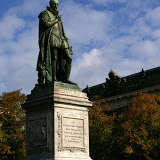
Europe 2011: Den Haag
Known as The Hague to us Westerners, I prefer the Dutch version of Den Haag. While staying in Delft, I decided to go to Den Haag, thinking I'd need to catch a train but from my B&B in Delft it was an easy 20-minute tram ride. Very convenient. The weather, for late September, was off and on rainy but overall very nice and warm. I arrived close enough to the Binnenhof, the seat of the Dutch parliament to walk around the central area.
I'm not sure how interested I would have been in the Binnenhof's interior but as it was there were no tours that day.

The Binnenhof neogothic fountain
There was a lovely and ornately wrought iron and gilt fountain and the details on the buildings, some of the dating to the 15th century. Mauritshuis was close by and I took it in. Here is where you would see Johannes Vermeer's Girl with the Pearl Earring among others. In fact the building was full of paintings in various rooms. Once the home of Prince John-Maurice, there are four major rooms on two floors and each has a fireplace and paintings on all walls, There are works by Holbein, Potter, Brueghal, Rembrandt, Steen , Hals and many others. Of course in all the best galleries you can't take pictures so you absorb as much as you can and hope you can retain some of it. The benefit of seeing the actual painting as opposed to a picture in a book is that you can appreciate how the light actually works with the paint, as well as its thickness, the texture and the details. The Dutch were masters of shipping and masters of the painted canvas in the 17th and 18th centuries.
Besides wandering around the Binnenhof's courtyard, staring at the buildings and going to Mauritshuis, I had time to go to the Prison Gate (just) called Gevangenpoort. This is the jail, which was in use for over 400 years before it became a museum in the 1400s. It was dark and thick-walled, and thick barred. I couldn't use a flash and the tour was in Dutch so I only gleaned a bit. Though the guide was willing to answer some of my questions in English I didn't want to ask during his descriptions in case I asked

The Binnenhof and the Court Pond
for something he had just said. It seems that there were different types of torture and only some of it was actually considered torture. This was done in the lower cells, where as the room depicted in my pictures was for those who were either to be executed or have information extricated from them. There was a gallery of art too so it was a rather full day of paintings.
This took up my day in The Hague and I went back to Delft for dinner and to wander along the pretty canals. So in truth I saw a very small section of Den Haag, which only took up a few blocks. Still, that was rather enough for one day.
Filed under: art, Culture, history, people, politics, travel Tagged: Den Haag, Dutch masters, history, Holland, Mauritshuis, neogothic fountain, painters, politics, Prison Gate, The Hague, the Netherlands, torture, travel







November 29, 2011
Traveling in Europe: Delft in White and Blue
These posts on Europe will come sporadically as I have to digitally fix the photos for web viewing and it's a busy season for me right now. To view my full album of Delft, click here (or as soon as Picassa fixes the missing link).

Delftware was named for the city which made it famous
After Amsterdam, I took a train to Delft. I was stunned at the thousands of bikes at the station. I doubt if you gathered all the bikes in Vancouver that it would even equal this number. People commute by bike and train a lot. Because there had been some confusion in email as to the dates I was staying at the B&B I ended up doing last-minute couch surfing for my first night. Robbert had just finished his university and was still in a student apartment. He was helpful in giving me directions to get to his place and the next day into Delft central. He tried to teach me some Dutch and pronunciations but some forms are so foreign in English I just had problems getting them to sound close.
Delft is small, when you're looking at the medieval center. The next day I waited for the B&B owner to show. When she never did, I walked back to the tourist information center, always a good place to visit in any major city. Delft is small enough that they know of all the B&B's. They tried calling both lines;when they couldn't reach her they advised me to find someplace else. They ended up helping me find something in my price range (52 Euros) with someone who had just called in. (98 Plantages–not available through any sites) was run by Liesbeth and was beautiful, clean, updated and close by. Liesbeth was an excellent host, giving me some ideas of restaurants to try and directions into Den Haag.

Delft's picturesque canals have lilies and waterfowl.
Delft was by far the prettiest town I visited in Holland, with Den Bosch a close second. The clean canals were picturesque with lily pads, swans and ducks. I even ran into a heron on the walkway beside one canal and got within two feet. The streets in the old town are cobblestone and shops line the streets. Delftware, that famous blue and white china, is not cheap but plentiful. I saw a guy on a scooter where the front design was the Delft blue and white.
My first day after the screw-up with B&Bs left me with enough time to see the old and the new churches. (Throughout Holland and Belgium all shops close by 5. There is no evening shopping.) They were rather plain in the style of the no-fun Protestants who had pulled down statuary, removed paintings and white washed churches so that one would only concentrate on god's glory, not on what humans had made. The one, ironic, concession to ostentation was the tomb of William of Orange, assassinated at the Prinsenhof (a convent he had taken over for a residence).

William of Orange's tomb was so big that it was hard to photograph it all.
The Dutch started later than some countries in instituting royalty and pretty much voted in the best merchant. At least that's what I could tell . William's grand tomb is the central design of the church. Before this date the royal family was buried in Breda but it was still under Spanish rule, so they began putting the royals in Delft, where they are entombed to this day (the dead ones that is). I was beginning to think after Amsterdam's two and Delft's churches that I was getting churched out, partly because they were rather bland in a gothic cathedral sort of way. The focus became the pillars, the gothic arches (which are impressive) and the black floors, carved with names, dates, arms and symbols of those who had passed on before. I wrote a rough set of poems here that I call triptych, after the style of religious paintings (that have three panels) used in many churches of the period. These will be polished at a later date.
I took in the Prinsenhof on my third day. The bullet hole in the wall from William's assassination is framed and stands out. There are works of art such as paintings, sculptures, silverware and Delftware for which the Dutch are famous, plus the story of William's life. I believe the new church, starkly plain had many partitions that told the story of the royal family from its beginning to its present day. Like England, they have had a queen since WWII (and before). But reading about all the royals and who killed who or succeed whom was mind numbing after a while. I just enjoyed walking along the canals of Delft and would definitely go back here.
Filed under: art, Culture, history, poetry, religion, travel Tagged: Amsterdam, canals, Culture, Delft, Delftware, Dutch, history, Holland, Prinsenhof, travel, William of Orange







November 23, 2011
My Other Creative Brain

Mermaid's Dream pin
Creativity comes first, then creating in a specific field second. While I write and that is my main creative venture, I have also acted, I bellydance and I create jewellery. Sometimes when my brain stalls on the writing front, working with my hands loosens the thinking muscle. After a while I was making so much jewellery and not wearing it that I had to do something with it.

Clay, bone, vintage wood beads, glass
So, today, I'll just post a few pictures of that side, since I'm preparing to do a craft fair in a few weeks and it's the only side of my brain getting any exercise. I do beading and try to make unique designs, something slightly unusual. These are one-of-a-kind, and I use a mixture of vintage beads, glass, crystal, wood, bone and crystal. I don't use plastic unless there is a particularly unique bead and I just try to think on the nonclassic lines. There are enough high-end semi-precious stone and silver necklaces out there, which are beautiful but why glut the market.
If you're in Vancouver on Dec. 3 or 4, stop by the Imaginarius Fantasticusat Tinseltown, where my goods will be on sale, under the name of Haul of the Mountain King. The theme is fantasy, fairies, goth, steampunk or renaissance.
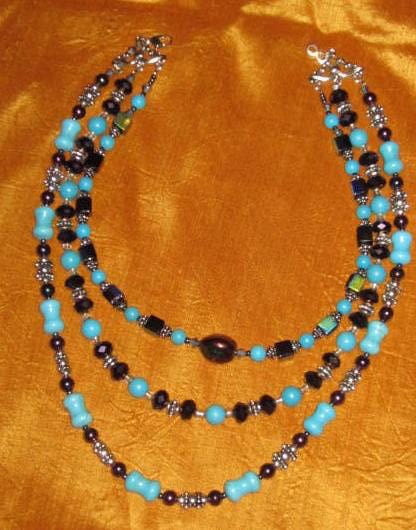
Three tier turquoise & purple

Under the Sea bracelet

Lampwork or vintage glass and silver/pewter.

Hematite, glass, pewter, triple tier necklace

Lampwork beads, silver, pewter

Filed under: art, consumer affairs, Culture, fairy tales Tagged: Bead, Craft, craft fairs, fantasy, Imaginarius Fantasticus, jewellery, Jewelry, Necklace, steampunk







November 18, 2011
How I Almost Became a Prostitute

Creative Commons: Diego3336 Flickr
The Occupy Movement has got me thinking about we, the little people, those who drudge out our days to pay the bills, with very little extra and sometimes having to choose if it will be getting a tooth fixed or getting tires on the car. How voiceless are we in how things run? Well, we vote in our representatives, if we vote, but many of us know that you can't represent all of the people all of the time. In fact, most political systems break down after one-two hundred people. We have no true democracy and while we all have a vote we are definitely not heard nor represented equally.
One example of being the voiceless 99% was when I ran up against bureaucracy while trying to be trained in a presumably more lucrative position. I had a three-month full-time course in an apprenticeship program to be a script supervisor in the movie industry (that's overall continuity and more). Apprenticeship programs were paid for by the government so I had no course costs. However, I couldn't really work during that time. All of the other people in the course (around 16) had either a spouse to support them or they could get unemployment. I couldn't because I'd been freelancing for years, where the federal government doesn't let you pay into unemployment insurance. My freelance income just paid my monthly bills; hence why I was taking this course.
I had very little saved money but as a freelance copyeditor there were two publishers in New York for which I would edit one to two manuscripts a month for them. With one from each of them I would have just enough money to get by while I finished the course.
Three months doesn't seem a long time but halfway through the first month, the first publisher changed their focus and went into videos. The second publisher went into receivership at the end of that month. Suddenly I had two months to go and no money. I scraped through the second month but December was coming and I had no way to pay rent, let alone buy much food. I instituted the end-of-the-world diet. I didn't buy any food at all and used up the stores in my place. In a way it was interesting to see how long could I survive on fresh produce, then frozen foods, then canned and dried goods.
But I still couldn't pay the rent. So I went to Welfare. Now I had once before in my early 20s been on welfare when the economy dived, I couldn't find work and times were dire (and I had roommates). It was no fun whatsoever, and slim pickings. So here I went, down to the office, filling in forms galore to see if I could get $300 to pay my rent (my rent was more but that was what I needed to pay the rent). It turns out, because I had about $3,000 in retirement savings plans I was not allowed even $300 that I said I would repay. Instead, the brilliant of our government is to have you use up al of your retirement savings now so that when you hit old age, you can go live under a bridge, become ill and run up more costs for the government.
Not only is there no such thing as a free lunch but there's no help for the self-employed. I'd have to be a full-on welfare recipient, unable to work and possibly dealing with addictions to get the money. So what could I do? I had no money to pay my bills, my car payment, my rent or for food. I was trying to finish the course and not drop it. I was desperate and seriously thought of prostitution as the only way I could make ends meet. I had no job, no recourse. I determined where I could stand; I wasn't far from the area where they stand, I could dress badly and where little. I could charge…something. Maybe I could be a call girl, have them pick me up, place an ad in the paper. I imagined scenarios in cars and back alleys. And…I just couldn't do it.
Lucky for me I had good friends and family. Without ask, people sent me money and my landlords gave me a half month's rent as a Christmas gift. I bought no one a present that year, but somehow I made it through. And no help to a bureaucratic government that sees everyone on welfare as a welfare bum and if they're not, then they will be by the time they're completely destitute and degraded. It was humiliating.
I can see why the 99% (through really it's probably 20%) are complaining about the 1%. Government and corporations, more than individuals, are the 1%. And we hear over and over again of the plights of the common people, denied this or that, dying in the streets, succumbing to illness, being humiliated because they just don't have a voice made of money. Do I trust my government? No. And it's too bad but I need to see more faith in helping humanity first. In the meantime I remain wary.
Filed under: Culture, life, people, politics, security Tagged: 99%, government, poverty, prostitution, welfare







November 14, 2011
Occupy…What?

Focused Capture: Creative Commons
Many cities have seen the Occupy movement taking up residence for the last month or two. When it started I was in Europe and had no clue what was going on. I wasn't reading news while traveling. One friend posted that, hey while you were gone the Occupy movement started. I asked, Occupy what? I never got an explanation.
In the weeks since I've been back I've listened to the news and I know kind of what's on the mind of the Occupy movement, or what was once the goal. It was to show that the voice of the little people should be heard and that we're tired of letting the 1%, the rich corporations (really, more than individuals) run everything without us having a say and without them having to pay. I came across this site that lists some of the movement's concerns much more clearly than I've heard through the media, which is sometimes out for sensationalism and not out for facts.
But… but, we're in this era of constant protest, where every large event has the anarchistic element for anarchy's sake. Or arguing for argument's sake and playing devil's advocate. I'm more than a little skeptical when a tent city goes up on the art gallery's lawn and people light a fire in direct antagonism to the fire marshal's order of no fires, and then they call it a sacred fire. Oh, if we bring in religion and spirituality they don't dare interfere with our fire. Haven't we seen this before? Sacred how? What rites and rituals are going on and for how long?
The hockey game brought on riots in Vancouver, and why? Because anarchistic yahoos wanted a good time and to give it to "the man." The riots in England; because government is bad, yeah, real bad and we're gonna do this because they can't stop us. That's what some of the interviewees have said. I feel like it's more of "here we go again." A small vocal, possibly violent group of anarchists gather to be a thorn in the foot of government. And–they deflate any real protests that get eaten by the hungry media monster that loves conflict.
But… but, I know there are those idealists, the pure hearts who believe they're fomenting change, that they're being effective as they vote at their general assemblies to do this or that. But they have no central voice, no true leader and therefore the message gets lost in the noise. And yes, I agree that we don't have enough voice in what goes on. And this lead to me being in a hard situation once when I needed welfare and was denied it because of silly rules. So what happens, we have a few people who entrench themselves downtown but theh message of Occupy for 99% gets lost and then these people are the 1% as well; just a different 1%. And I guess I'm just cynical enough to believe that the message won't get across and won't change anything.
Yet, maybe some of these people will tr to get into politics and one things is for sure: if you're American you need to be a millionaire to run in US politics, but that's not true here. Some of the best ways to foment change is from the inside. But then do you become the beast you're fighting? Possibly, but I just don't feel Occupy with actually last long. It's more like a nasty wart on the ass of the corporations. But soon it will be excised and forgotten about.
Filed under: Culture Tagged: 99%, Anarchism, politics, Protest, riots, tent city


November 9, 2011
November 8, 2011
Traveling in Europe: Amsterdam

Bikes are everywhere in Amsterdam
Amsterdam was a place of contradictions. It was large, in terms of things to see and do, and small in terms of area, though I still managed to walk a good seven hours one day, getting lost on the wrong side of canals. It was cosmopolitan but kind of dirty because of so many people, the sidewalks and streets sporting numerous stains and dead gum and just general grime. I find that cities of this size end up with the group mentality issue. Like mob mentality, this massive city entity is one of mindless automatons, people all trying to get to where they're going, without willing to move or adapt or politely let someone by. I cannot stand crowds for this reason; not because there are a lot of people but because there are a lot of people being mindless and self-absorbed and not trying to work with the whole. Drives me nuts.

One of Amsterdam's trams
But…I maneuvered through the flight to the train and from the train station to the tram, even though the police gave me the wrong directions. There are plenty of trams and buses, and getting around is easy, as long as you watch out for bike lanes. I did blunder twice into a bike lane and nearly got smeared. Even so, the Dutch never swore at me (that I understood) and moved out of the way and I apologized profusely. Holland is the land of bicyclists, probably only second to China. At train and tram stations I saw thousands of bikes parked in racks. On the narrow, medieval cobblestoned streets there are often trams, cars, scooters, bikes and pedestrians. A sidewalk might exist and might also be very narrow. A painted line in most cases is all that separates the bike lane from the sidewalk or road. And sometimes you just have to scoot around a parked car or someone moving items in and out of a building.

Dutch buildings are tall, narrow and lean
The buildings, ranging in years from four-five centuries to recent, are narrow and tall. The windows are likewise very high. It seems back in the 16-17th centuries people were taxed by the width of their houses so they built up. Of course they were probably taxed on width because the land was reclaimed foot by painstaking foot from the sea, and most of Holland is below sea level. In fact, if I ever wanted to build anything near or on water I would hire a Dutch hydraulic engineer; they've been doing this for centuries.

A good example of fancy gabling and the hook for moving items in through windows.
As all the buildings are high and thin, it means there are many many narrow stairs, in fact too narrow to move furniture up. So they built hooks on the top end of the buildings by which to pulley items into the structure, and they're still used to this day. Because of this way of moving furniture the buildings indeed lean out into the streets,because a perfectly perpendicular building would have its windows and facade smashed in a move. The buildings have several different types of gables, (step, bottle, etc.) which were popular for distinction as well as design at the top window. Before street numbers, shops had plaques that differentiated them or what they did or sold.
And of course, everywhere there are canals. Before coming to Holland when I thought of canals I thought of Venice. How was I so ignorant? Holland is truly the land of canals, everywhere. Some areas have more than others but they are like the veins of the land. The land between the agricultural canals is called a polder and the Dutch manipulated every aspect of building below sea level. Not only do the canals provide irrigation, they also work as routes for delivery and transportation as well as being a way to maintain the land. Theywork as a bleed-off when the water levels rise and save many structures from flooding. Truly amazing when you think about it. Now days, sewage is not dumped directly into the canals and they are pleasant, with numerous boat tours or houseboats.

One of many picturesque canals

This building sat all by itself.

These houseboats are often 100 years old.
The streets are a mixture of cobblestones and modern paving, just as the buildings go from modern to five centuries old. There is not grid in a medieval aged city as the streets grew organically out of the center. In this case the Amstel River played a role in forming Amsterdam's streets, which horseshoe out. Wandering up and down these streets and canals and just looking at the buildings that people take for granted was as interesting to me as going into a historic cathedral or a museum. Canada's oldest buildings might only be one and a half centuries old (especially the west coast), established by people moving into natural geographic areas and planning out their towns. The sheer age of European cities gives a much more organic and haphazard growth.
There is actually enough to talk about with Amsterdam that I'll do a second post on some of the other historic aspects.
Filed under: Culture, history, travel Tagged: Amstel River, Amsterdam, bicycles, bikes, canals, cobblestones, Dutch architecture, history, polders, the Netherlands, travel







November 7, 2011
Writing Update

Creative Commons: http://dancurtis.ca/2010/07/
I haven't done one of these in quite a while so here is an update on the writing front. "Obsessions," a long poem came out in the gothic anthology Candle in the Attic Window through Innsmouth Free Press. It is available online and you can read the online interview about the poem here. I received my copy right before Hallowe'en.
"A Book By Its Cover" came out a few months before this in the Mirror Shards anthology, a collection of stories about augmented reality. This story was not written for the theme and needed little adaptation to fit in. There are a couple of reviews at agrippinalegit and thenewpodlerreviews.
Across the pond in England, "Tasty Morsels" came out this summer in Polluto #8. I haven't seen any reviews of this magazine so I have no idea how well-known it might be even over there. The story, "It's Only Words," written specifically for Horror Anthology of Horror Anthologies also came out in the summer. Publishing and writing dynamo, Des Lewis has worked hard at getting various reviews for the anthology. There will be an interview with him coming up in the next issue of Black Static and it will also highlight this anthology.
As reviews go, my story isn't mentioned in many of them. So it goes that sometime you're not noted for a particularly good or bad story. Some reviews really aren't reviews, but just a recapping of each story. And one reviewer decided to only read a few of the stories by the authors he knew. Again, since I'm not British I got no reviews. Seems an odd and narrow way of reviewing stories. Why not expand the horizons and learn about other writing voices? Still any review is better than none.
Other writing news is pretty slim at the moment. I'm working on a freelance editing project and that's been taking a lot of time. I still have one German steampunk story in the works but I'm stuck on how to get my protagonist out of her tight spot. Overall, I quite like the plot. I just need a good way for the resolution to work. That's it for this time around. Following are the Horror Anthology's reviews.
http://adamscantwell.blogspot.com/
http://thegingernutcase.blogspot.com/2011/09/starting-this-week.html
http://ismspress.wordpress.com/2011/09/22/the-horror-anthology-of-horror-anthologies/
http://wwwbillblog.blogspot.com/2011/10/kind-of-face-you-slash-day-6-dust-that.html
http://horrorworld.org/hw/2011/10/the-horror-anthology-of-horror-anthologies/
http://www.amazon.co.uk/gp/product/1447757351/ref=cm_cd_asin_lnk
Filed under: art, entertainment, fantasy, horror, myth, poetry, Publishing, science fiction, Writing Tagged: Black Static, horror, Innsmouth, Innsmouth Free Press, It's Only Words, Mirror Shards, Obsessions, poetry, review, reviews, Tasty Morsels, Writing