Evan Tabak Atlas's Blog: Mapping with Atlas, page 3
February 4, 2024
Songs for Extreme Lovers
My last post was about different forms of extreme love. This is just a little something extra for premium subscribers: A playlist which conveys themes such as limerence, amigeist, love as divine madness, and more. Enjoy!
 Photo by David Marcu on Unsplash


January 28, 2024
Essence of Extreme Love
This essay will elaborate several forms of extreme love from a perspective of metamodern, metaphysical naturalism. In other words, I will prioritize forms of extreme love which I think are most coherent with present-day science, metaphysics without gods, and the general ethos or way of feeling which is unique to metamodernity.
I am also approaching this from the metaphysical orientation I call optimism. Which, in my usage, is a philosophical system originating from the first principle called the...
January 1, 2024
Two Faces
Welcome to a new year! To celebrate, this post contains a menagerie of mythical figures who convey past and future, endings and beginnings, and oppositional double-natures.
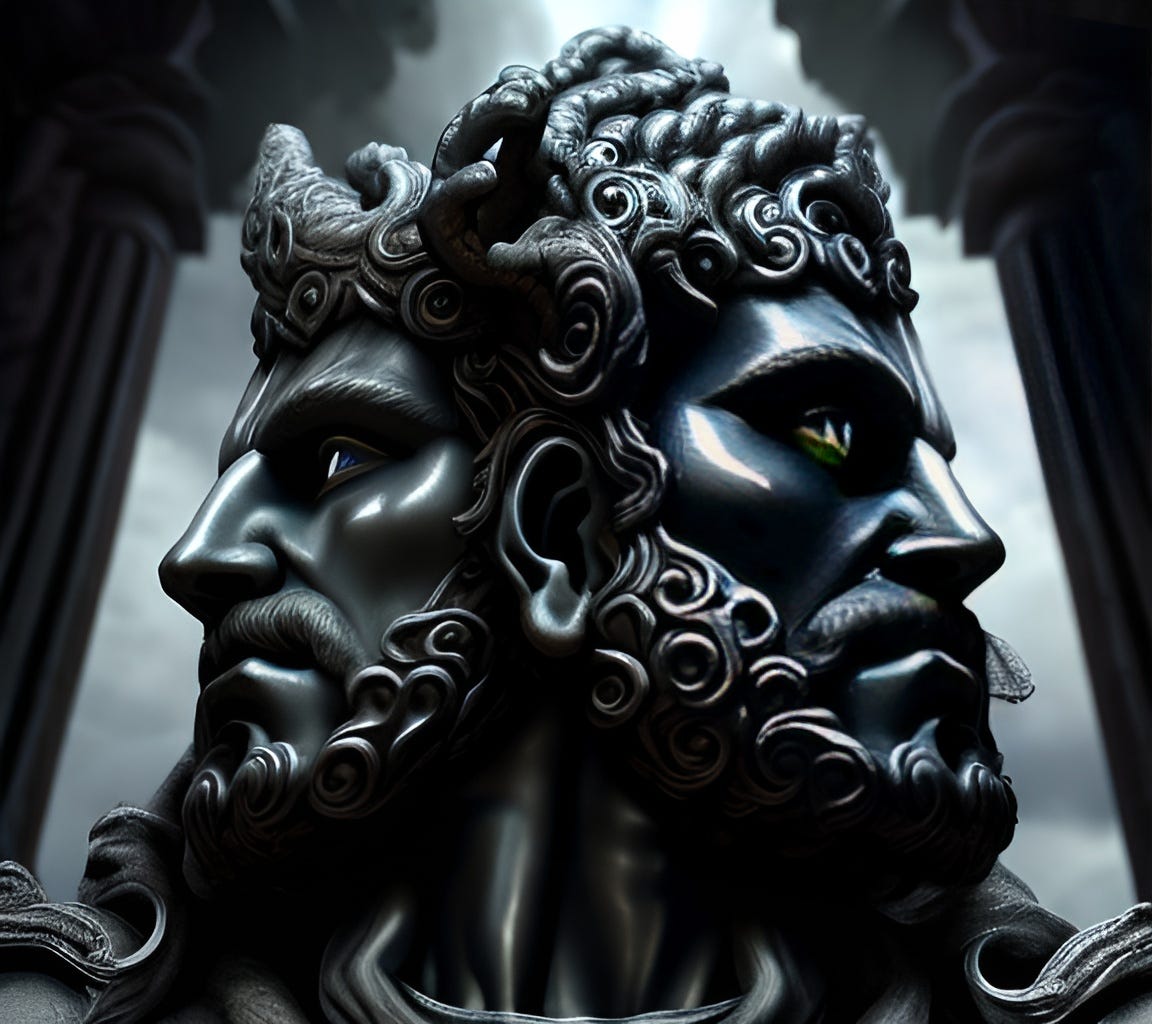 JanusJanus
Janus is the Roman god of beginnings and endings, and the origin of the name “January”. His two faces look towards the past and future, as he himself is situated in the present moment as mediator of the two. Related to these themes, he is thus also known as a god of doorways (physical points of transition) and is often depicted holding a key.
Arthur Koestler calls him the god of holons—his term for an entity which is both a “part” and a “whole”. As in, a person is whole, but also part of a city. And a city is whole, but part of a country. Holons therefore have two Janus-like faces which lead them simultaneously to express their partness and wholeness—sometimes harmoniously and sometimes catastrophically.
“This implies that every holon is possessed of two opposite tendencies or potentials: an integrative tendency to function as part of a larger whole, and a self-assertive tendency to preserve its individual autonomy... Under favorable conditions, the two basic tendencies...are more or less equally balanced, and the holon lives in a kind of dynamic equilibrium within the whole—the two faces of Janus complement each other.”
I think from a human perspective, Janus symbolically stirs us to action, and inspires us to value both our drive towards individuality and towards community. When the two drives are balanced, one transcends oneself through benevolent participation in the good of everyone, while remaining essentially oneself—knowing that only true individuals can form communities, while those who lose themselves to something suprapersonal can only form herds and mobs.
Janus is one way to imagine the oppositional tendencies within us—which, in turn, helps us strive towards their dynamic balance.
AkerAker is an Egyptian god depicted as two lions guiding the setting sun (or solar god) as it descends into the night.
“The solar god…is surrounded by the eternal serpent that bites its tail, standing on the double-lion god of the horizon, Aker… The lion looking towards the West alludes to yesterday and death; while the one facing the East alludes to tomorrow and resurrection.”
Aker seems fitting for our metamodern epoch, which is not erasing the past, but including it in something new which both embraces and transcends what has come before.

As “yesterday” and “tomorrow”, Aker awakens us to the idea of an arrow of time—an irreversible flow from past to future. These two faces could therefore also be interpreted as energy and entropy, which, together, give us a measurable, objective way to tell yesterday from tomorrow.
“Energy is called ‘mistress of the world’ because everything that happens in the world does so via changes of one form of energy into another... The other forms of energy—potential and kinetic, thermal and chemical, electrical and magnetic—are the direct sources of the work carried out in nature and technology. Work is done when one of these forms of energy is transformed into another... Entropy is called ‘the shadow’ of the mistress of the world because it can be used as a measure of the depreciation of energy, if we understand the value of energy to lie in its availability for transformation into useful work.”
This January, let’s remember to keep looking forward and behind. May we remember that which we left in the past, and cherish that which is still ahead.
ThothA lunar god of great importance in ancient Egypt—Thoth is frequently depicted as an ibis (or human-ibis hybrid), a baboon, or the moon itself.
“Some myths cast Thoth as the actual moon, and in others he is the moon’s guardian… Because of the waxing and waning of the moon, one of Thoth’s many titles was the ‘Measurer of Time.’”
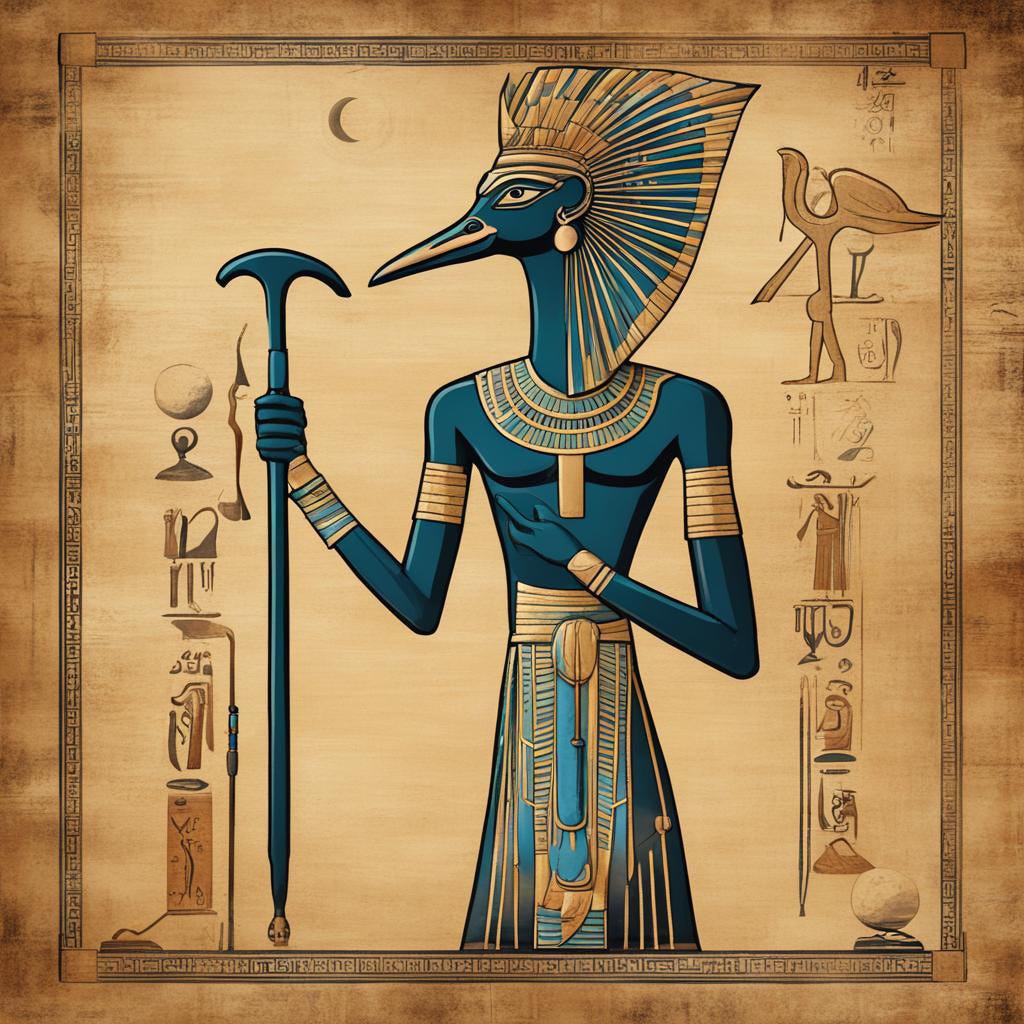
Thoth was widely known in Egypt as a god of language, knowledge, magic, and death—these themes being more closely entangled than a modern reader might think.
“Thoth as ‘lord of the sacred words’ gave to the Egyptians the knowledge of how to write by picture symbols, hence hieroglyphs could always possess a magical force... Thoth represented to the Egyptians the embodiment of all scientific and literary attainments, being in command of all ‘the sacred books in the house of life’.”
This makes him one of the earliest figures who represents the dual-nature of benevolence and malevolence, or the “above” and the “below” which (like Hermes from Greek mythology) he unifies. Philosophically, this may also be interpreted as striving to be in touch with the best and worst of our potential as people. We attempt to grasp a transcendent and absolute perfection and make our actuality its faithful image. And we do so, like Thoth and Hermes, by also engaging our shadows and our genius for good and evil.
“To confront a person with his Shadow is to show him his own light. Once one has experienced a few times what it is like to stand judgingly between the opposites, one begins to understand what is meant by the Self. Anyone who perceives his Shadow and his light simultaneously sees himself from two sides and thus gets in the middle.”
While Thoth does not, like the Janus or Aker, literally have two faces, he stands as an early example of how symbolic/mythological representations of cosmic principles can help us reconcile our own double-natures.
In this way, Thoth also reminds us to confront the unknown bravely but cautiously—since the very valuable and very dangerous are often neighbors.
“The pairs of opposites (being and not being, life and death, beauty and ugliness, good and evil, and all the other polarities that bind the faculties to hope and fear, and link the organs of action to deeds of defense and acquisition) are the clashing rocks that crush the traveler, but between which the heroes always pass.”
This heroic mediation of opposites shares similarities to the idea of a challenge, as described by Francis Heylighen. A challenge unifies the ideas of “problem” (negative), “activation” (neutral), and “opportunity” (positive). And a figure such as Thoth enshrines the moment prior to differentiation into one of these categories. It is a “Schrödinger’s cat” type of moment where multiple possibilities are incubated. May we always stay aware of the decisive moment when we solidify our actuality from nebulous possibility, and appreciate the unidirectional series of actions which create more or less perfect futures.
Baba YagaBaba Yaga is one of the many mythical figures who personifies a double-nature specific to mythological women or, more broadly, the feminine aspect of the universe. This tradition and its literature are vast: The snake surrounding the cosmic egg; the sea as a simultaneously creative and destructive force; the Morrígan as wartime messenger of either victory (new life) or defeat (death); the Ciguapa who faces forward but walks with backwards feet; mermaids and sirens as either sources of salvation or doom; even the modern femme fatale trope; or any number of triple goddess figures—for when two faces just aren’t enough.
 “Baba Yaga…[is] good or evil according to the manner in which she is approached.” - Joanna Hubbs
Yaga, as the elder aspect (or crone) of the feminine archetype, contains the multiplicity of the “maiden” and “mother” aspects which compose the typical feminine trinity. This triune structure inherently relates to a cycle of birth, death, and rebirth. She is typically associated with symbolic imagery, such as a mortar and pestle, which amplifies these themes.
“Baba Yaga…is a spinner; her house is sometimes represented standing on a spindle… The embroidery goddess is the patron of woman as spinner. In folk belief, spinning is associated with birth-giving and nurture. It provides the visible basis for a cosmology suggesting the continuous creativity of the divinity spinning all living things out of her own body. Yaga is like the withered flower pod brimming with new seed. She is the expression of realized potential, the fulfillment of the cycle of life associated with woman… In her the cycles of feminine life are brought to completion, and yet she contains them all… [And] the symbolism of the mortar and pestle is both complex and deceptively simple: It is used not only to grind grain but also to prepare the flax which women use in spinning cloth. Mortar and pestle are the instruments of destruction and of nurture and protection (clothing). In their symbolic form, they represent the human sexual organs, womb and phallus. Birth, generation, nurture, and death are all conjoined here.”
I think, rather than approaching actual women as walking embodiments of a cosmic double or triple-nature (which is only advisable in very rare circumstances!), Baba Yaga has us meditate on ambiguity in all of its forms. Her imagery and mythos animate us to attempt a synthesis of opposites within ourselves—unshaken by the knowledge that we will fall short. The ego, as Jung would say, always fails in the complete individuation of the self, but should always seek that distant-yet-close point on the horizon.
“In nature the opposites seek one another—les extrêmes se touchent—and so it is in the unconscious, and particularly in the archetype of unity, the self… The self, however, is absolutely paradoxical in that it represents in every respect thesis and antithesis, and at the same time synthesis… Without the experience of the opposites there is no experience of wholeness and hence no inner approach to the sacred figures.”
When we reach towards perfection, every step is beautifully coherent, and it doesn’t end up mattering that we never arrive at the end. Contradictions persist, and that’s ok.
“The result is not a synthesis, but a unity‑in‑contradiction, an identity of opposites.”
As we go forward into the new year, I think it would benefit us to do so with openminded fluidity. A situation which at first looks threatening may reveal great treasures to those who confront the storm. Lines between nemeses may blur and transform into something generative of growth, beauty, and love. January connects the death of a past year with the birth of a new one. Let us be present with both.
December 12, 2023
Shouts of Liberty, Shouts of Freedom
Picture this: You’re at a political rally with over 50,000 people in attendance! Everyone seems to care a lot about “freedom” and “liberty”. You want to fit in but don’t know what to yell in order to endear yourself to your angry brethren. Don’t worry. I got you.
 On Liberty
Liberty is a measure of available possible actions, affordances, or optionality!
Liberality is the ethos of allowing within a system the maximum possible liberty while maintaining the viability of that system!
Liberty is a bird in flight!
What does Ashby say? Only variety absorbs variety!
The average complexity of regulators in a system determines the degree of hierarchy which is needed for survival!
Liberty may expand or contract with changes of hierarchy; the chalice or the blade—which do we seek?
On FreedomThe Good as first principle makes freedom bonocentric!
Liberty relates to means, while freedom relates to ends!
Freedom is a flower in bloom!
“What is” implies “what ought” to be; the closer the former to the latter, the more free are we!
The autopoietic complexification of monads tends towards the perfect freedom of Monas Monadum!
The eternal ideas are within me; the absolute and relative are inseparable; this is freedom’s key!
November 2, 2023
A Natural String of Fate
Let’s explore the concepts of fate and entanglement in a metamodern context. My goal is to add to the overall picture of love I’ve been developing in other recent posts. The fundamental questions will be: Is there a way to understand “fate” in a way which is scientific/naturalistic, non-nihilistic, and palatable to those in the metamodern age? What is the nature of our entanglement and how is it determined? Can this connective “string” of fate be broken?
I’ve chosen to focus on the specific subset of cases in which a kind of fateful, soulmate bond attaches two people who are otherwise mutually antagonistic. Because love and freedom have so much to do with fulfillment of purpose and mutual exaltation, an interesting paradoxical connection sometimes comes about. I’m talking about “enemies as lovers”—not to be confused with the “enemies to lovers” trope, although there are similarities between the two. And so this post is not about fateful love overcoming the initial hatred of enemies, but rather love-filled connections which run concurrently with hateful or rivalrous connections.

The idea of fate is ancient. And from the very beginning it seems to be understood as something which, from a god’s-eye-view appears absolutely orderly, but, from a person’s view often feels rather arbitrary, indiscriminate, or blatantly cruel. My sense of the concept of fate is that it is a belief in an underlying purpose for every connection—even if the exact nature of this purposeful connection is unknown.
The symbolization of fate as a red string began in Chinese folktales with the god named Yue Lao, “The Old Man Under the Moon”. He was said to carry a book of fate—a comprehensive list of all those who were destined to marry each other—along with a bag full of red strings to actually get the job done. The imagery of strings, as the key part of this mythology, has persisted to this day—especially in anime other Asian media.

“[In “Your Name”] Mitsuha…and Taki…discover that they sometimes switch bodies when morning comes. This connection is symbolized by Mitsuha's hair ribbon, the thematic imagery alluding to the Red String of Fate.… The gods themselves have connected these two people by fate, and though the string may become tangled, it will never break… Whether or not there is one person out in the world who you are destined to meet and be with, the Red String of Fate is a fitting image for the sometimes tangled relationships you find in everyday life.”
-
Perhaps even more evocative is the case in Killing Eve. The resilience of the red string is stretched to its limits with the two main characters of this show.
 Eve and Villanelle
This sets a precedent where fate is part of theistic worldview, and will be rejected along with other religious claims by most of those attempting love in our present day.
But there is a version of fate which we can rescue from the trash bins of history. I think the visualization of fate as red strings is still useful and evocative, even if we reject the hypothesis that their origin is supernatural. Instead, something akin to fate is implied by a non-nihilistic worldview which says that value, meaning, and morality are objectively and absolutely real. Their absoluteness, while conveying transcendence of relative phenomena, does not imply anything supernatural. There is “nowhere else”, as Iris Murdoch said—the “beyond” is here with us.
Following from this metaphysical realism, we can see that perfection is possible and that our actuality tends (imperfectly) towards it. Due to this, any action, down to its quantized minimum (Planck’s constant), shapes the universe into more or less perfect versions of itself. This gives us a minimalist conception of fate resting on scientific principles. Namely, entanglement begins at the quantum level, and increases in complexity as these quanta self-organize into dynamically ordered systems.
“Entangled systems have some properties that cannot be reduced to properties of their parts. And entanglement is ubiquitous: The Schrödinger dynamics generally entangles systems that interact, and since everything in the universe has interacted if you go far enough back (to the big bang), it looks like the state of the universe is a giant entangled state.”
This can be measured exactly with entanglement entropy.
“How much a measurement of B reduces your ignorance about A is called the entanglement entropy, and like any type of information, it is counted in bits. Entanglement entropy is the main way physicists quantify the entanglement between two objects, or, equivalently, how much information about one is stored nonlocally in the other.”
Further, there is a thermodynamic fate binding us all: If value is real, it must be embodied in energy, and will become more or less perfect through transformations. And possible perfection is the telos of actual value—i.e. every action has a moral demand to actualize the most perfection. Thus, at the human level, the striving towards universal perfection might locally appear as the paradoxical lovers-as-enemies phenomenon. This is why we say that fate is real, and that its power is displayed quite clearly when it strings together two who are otherwise enemies.
The idea, in general, is that fate does not necessarily connect people who are perfectly suited as romantic lovers in the traditionally understood sense. Love, as I’ve said, can feel like a disorienting madness. But, like breaking through into daylight from a dark forest, perseverance is rewarded in the end.
Let’s explore some examples of enemies as lovers—those who are most likely to feel that fate is a sadistic joke of cosmic proportions. Yet, at the same time, they are profoundly (and often positively) transformed by the particular knot that fate has tied them in.
Others might not get it. They think you have either taken “love thy enemy” way too far, or have completely misinterpreted in. Maybe they think you’re a lousy villain who can’t seal the deal. They’ll ask questions like: “If you’ve got a time machine, why don’t you just go back and kill Austin Powers when he’s sitting on the crapper?”
There would be no pleasure in that. This delightfully dangerous dance of opposites is meant to be savored.
And you will fiercely defend your fateful enemy-lover even as you promise to kill him. Never will another take what is yours! Vegeta, in the Dragon Ball Z series, feels this for Goku.
This reminds us that those engaged in this kind of complex bond will truly feel like nemeses, even as they fuel each other’s passions to be the best versions of themselves.
And from its ancient origins, the word “nemesis” itself bears the etymological marks of a concept which is more nuanced than “enemy”. Early uses of the word were accompanied by a goddess, Nemesis. And it is clear that she symbolizes a form of divine justice and, in general, a principle of balance.
Michael B. Hornum: “The word [nemesis] is related to the Greek root…meaning to allot or distribute.”
Glenys Lloyd-Morgan: “One of the earliest references to her can be found in two lines of Hesiod's Theogony, dated to the end of the eighth century BC: ‘Then deadly night gave birth to Nemesis, that pain to Gods and men.’”
Elizabeth Riefstahl: “The Greeks had noticed that prosperity and pride were often followed by reverses, that the gods were likely…to punish terribly any kind of excess.”
Tim Wittenberg: “[So the goddess Nemesis] acts as a balancing, regulating power in the interplay between fortune and misfortune, between prudence and arrogance, or generally between order and disorder.”
Nearly the entirety of Venture Bros. centers on the “nemesis” theme. In this fictional world, there is a legitimate profession called “arching” (as in, to be someone’s arch-nemesis). There are even "trade guilds”—implementing such rules as the “Equally Matched Aggression Level”, which assures that a protagonist and antagonist are well-suited for each other. The show focuses on the nemesis-relationship of Rusty Venture and The Monarch, but the dance of love and hate defines many of the interactions within this show’s universe. And in many cases the characters provide, like the goddess Nemesis herself, a necessary balancing of each other.
This show beautifully showcases how rivals-in-love need each other. One might even get jealous when someone tries to steal your nemesis. However negative and hateful the attention, one feels stabbing pangs of jealousy when it is directed at a nemesis other than you.

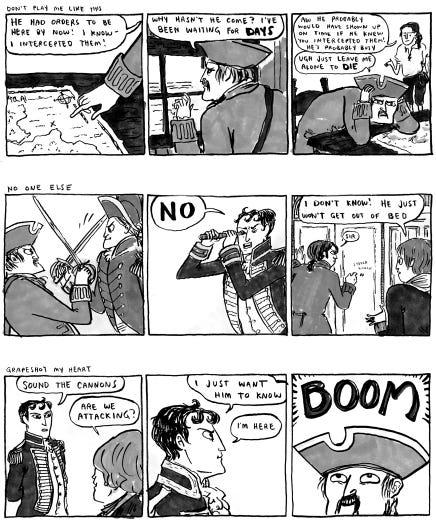 Nemesis, by Hark, a vagrant
We even find this complex form of love in video games such as Pokémon. This game has a move called Perish Song, which binds the fate of the two Pokémon engaged in battle. The game describes it as “a malevolent melody that causes both the user and the opponent to faint in three turns.”
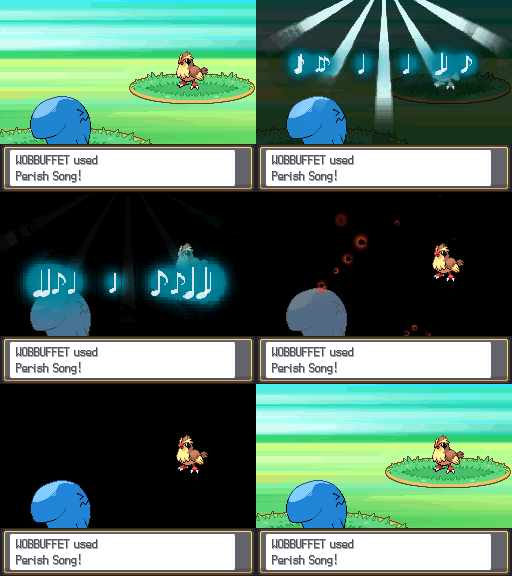 Wobbuffet used Perish Song!
I guess it’s not just humans who sometimes feel unable to live “with or without you”.
And it is not always fiery, ecstatic imagery which is needed to communicate the experience of love. Fateful love, whether it’s pleasurable or not, seems to provide something utterly obligatory for life and growth to carry on.
“My love for Heathcliff resembles the eternal rocks beneath: a source of little visible delight, but necessary.”
Two people can be perfect for coaxing perfection of purpose from each other, even if those purposes are diametrically opposed. That underlying dynamic of being suited for one another is the kind of “fate” which still makes sense in the metamodern era. It can be explained naturalistically, and it is only metaphorically a “string”. Although it truly does bind and entangle us as if it were physically there.
In a previous post, I mentioned the concept of soul-leading (psychagogia), and I believe it is important here as well. The idea, in short, is that one of the central characteristics of love is the process of lovers leading each other towards more perfect and pure forms (or objects) of love.
This process progresses towards philo-sophia, a love of wisdom. And so it should be said that another reasonable and naturalistic way to interpret fate is as a thread of continuity and kinship of minds. Alchemists, for example, have seen themselves as links in a Golden Chain, stretching back to ancient and semi-mythic figures like Thoth and Moses. And, as we’ve said, this kind of fateful linking of souls is sometimes on display most clearly between those who are in opposition rather than agreement.
Nietzsche’s nihilistic critique of Plato’s realism is something I disagree with, but find value in nonetheless. The two, if they had lived contemporaneously, surely would have been philosophically rivalrous. Yet their work is connected in a non-arbitrary way and, in a sense, Nietzsche progressed the work of Plato through his attempts to dismantle it. Plato’s work has survived assassination attempts, and is stronger because of it. Lincoln seemed to grasp these concepts of fruitful disagreement when he constructed his team of rivals.
All this is to say that while links in a Golden Chain may provide incremental progress, a philosophical foil may induce powerful, nonlinear changes in the journey of ideas. In both cases, fate remains a natural phenomenon, and can be described as a kind of stigmergy.
“Many of our actions leave traces in the shared environment and can inform others of what has been, could, or should be done… As agents create traces, they trigger behaviors in other agents who subsequently create more traces themselves. For instance, more people using an emerging path will make this path more usable, thus more people will choose the same path over less developed paths in the future.”
- Sabine Topf & Maarten Speekenbrink
In fate, we find (1) actions which (2) leave traces in (3) a shared medium and (4) stimulate further actions, leading to (5) the accumulation of natural entanglements of purpose. Such entanglements are emergent attractor states which act causally (or fatefully) on future actions.
And this kind of fateful entanglement may elicit both joyful inspiration and a burdensome sense of obligation. On one hand, it is exciting to be spun together with those gigantically influential minds of the past: A living but fragile fire has passed into your guardianship.
On the other hand, the continuation of some kind of Great Work across many generations and geographies is not to be taken lightly. Again, a reasonable and scientific justification can be given for this philosophically-binding string of fate.
Part of the present point is that metamodern worldviews can contain something called “fate” and defend it using only naturalistic claims. As an analogy, one can appreciate how the natural law/realism traditions differ from positivism. In this case, the natural law theorist would say that all of our mundane, earthly laws are hierarchically nested within unchanging, eternal laws. This claim irresistibly leads to non-relative claims of moral duty—for one is a center of activity and consciousness who, by understanding natural laws, may reject them. Similarly, then, a fateful attachment between two people who may be separated by centuries of time or continents of space is something which, if ignored, is an antimoral act.
In contrast, a theorist of positivism would say that our laws do not reflect any higher order, and can convey some relative version of reasonableness, but will never approach anything absolute called Reason. And a nihilist, opposed to natural law, would say there is no fateful thread of connection between philosophers who are soul-leading each other towards perfection. In that view, there would only be human animals engaged in ultimately meaningless and overly elaborate displays of power.
Hopefully it is now obvious that I reject that latter view and side myself with those who believe in a natural string of fate.
October 10, 2023
A Game in the Garden
Evolutionary game theory for elementary school students. I know there’s a market for this, but I have not found it yet.
September 23, 2023
To Possess a Metamodern Heart
As with one of my previous posts, which dealt with love as “madness” or being in a state of head over heels disorientation, this post will explore metaphysical principles of love, with some surprising conclusions. This will also loosely follow from my recent series of posts including: Anti-Anthropocentrism, No One to Love, and my Nihilism playlist.
So: What is “possession”? What do modern and metamodern worldviews say about possession in the context of romantic relationships? Is it necessarily a part of love? And is it a good or bad thing?
 Art by Wombo
To begin, let’s give a definition of possession from the modern and metamodern standpoints. Modern possession can be thought of as: To own; to have in one’s control; to be an autonomous and conscious agent in a unidirectional, power-based relationship with an object, or an objectified person.
“1a: to have and hold as property : OWN
b: to have as an attribute, knowledge, or skill
2a: to seize and take control of : take into one's possession
b: to enter into and control firmly : DOMINATE
c: to bring or cause to fall under the influence, domination, or control of some emotional or intellectual response or reaction.”
Similarly, “possessiveness” is often characterized as a negative trait of relationships in our current menagerie of worldviews. It seems to float in a word-cloud which contains others like “jealousy”, “codependence”, “control”, and “distrust”.
“The quintessentially individualistic act…[is] the claim that one has, by ‘possession,’ separated for oneself property from the great commons of unowned things.”
 “The lion is…a symbol of passionate devouring, the power drive, not only in the narrow sense of the word, but generally the desire to possess.” - Marie-Louise von Franz
We are going to focus on possession in a romantic context. But it is, undoubtedly, a concept contextualized by our ideas about possession in other areas, along with adjacent “modern” ideas—namely those involving power, freedom, and property. Let’s explore why that is, and how it contributes to an unfavorable attitude towards possession in romantic love.
To fall madly in love, in today’s world, is to plant an aesthetically beautiful but economically unproductive garden. The garden is surrounded by properties with owners who would love to expand into the space occupied by the garden. Even the two lovers are tempted to replace their intrinsically rewarding landscape with something profitable. The lovers are essentially pitted against each other due to the wider context in which their romance is situated. The default is a utilitarian and often ruthless will-to-power; and selfless and self-sacrificial romance has been deemed an antinomy.
This immediately sets up possessiveness as a trait connected to ownership and power. The ontology of a worldview tends to, one might say, possess everything within its own idiosyncratic hierarchy—a power ontology will hungrily reframe love and beauty in its own terms. Possession, in that case, is thought of as an attempt to control and, ultimately, objectify another individual—to make land of someone, and do what one wishes.
“The term land necessarily includes, not merely the surface of the earth as distinguished from the water and the air, but the whole material universe outside of Man himself, for it is only by having access to land, from which his very body is drawn, that Man can come in contact with or use nature. The term land embraces, in short, all natural materials, forces, and opportunities.”
In other words, modern possessiveness is the tendency to objectify and instrumentalize another person (or the planet as a whole). Modern possession in romance mirrors our broken and antimoral relationship to land. It is rightfully scorned.
All in all, “modern” lovers are immersed in a culture which rewards those who are ultra-individualistic, and they will be opposed to possessiveness for the same reasons they must seek power over all else. The general attitude towards love, dating, relationships, sex, and so on is one of contempt for any signs of possessiveness, because it is antithetical to the power-ontologies which form the foundation of many modern worldviews. In particular, these nihilisms will tend towards despising anything which threatens one’s individual sphere of power. And worldviews which include power-ontologies are essentially opposed to love, and so must be opposed to possession.
In other words, nihilism says that power is both the first principle and the purpose (or telos) of everything. It says there is no real value, meaning or beauty in love, because all of these are ontologically recast as faces of power.
“The traditional opponent of moral realism is the nihilist...who denies that there are moral facts or true moral propositions or, as a result, any moral knowledge... The nihilist thinks that moral predicates such as ‘good’, ‘fair’, and ‘wrong’ fail to refer to real properties.”
Possession, in that case, would be just another ploy—under the guise of what the nihilist considers morality-clothed power—to maximize one’s control by absorbing another person. This is a good enough reason to justify the negative attitude towards the strawman version of possession which is set up by nihilistic metaphysics. And, it’s necessary to note, this version of possession is used in lieu of a much stronger, more inescapable, and more benevolent version of possession. We can tentatively call the latter “metamodern possession” to distinguish it, and allow it room to take on more positive connotations, which follow from its basis in natural law and dominion under absolute perfection.
As a general theme, metamodernism does not overwrite its cultural precedents, but rather enfolds them as systems within a newly-formed metasystem—as a city is to the people who compose and animate it. This means, particularly, that we are not ignoring the actual concern of possession’s negative face. It is obviously possible to possess in a way which harms a relationship, whether that relationship exists between two people, or a person and a planet, or a state and a population. In suggesting a more positive connotation of what it means to possess, in its metamodern context, it should be taken for granted that the pitfalls and dangers of possessiveness are included and not forgotten. Eros is, after all, a hunter. Whether or not metamodern possession is more positive than its predecessor, it is not arbitrary that the Greek god of love was also dangerous, and even reckless.
“Diotima's mythical description applies simultaneously to Eros, Socrates, and the philosopher. Of needy Eros, Diotima says: ‘He is always poor, for he is far from being delicate or beautiful, as people think. On the contrary, he is rough, dirty, barefoot, and homeless; he always sleeps on the ground, in the open air, on doorsteps and in roadways… He sets traps for noble souls, for he is hardy, brazen, and tough; he is always trying to come up with some trick; he wants to be clever and resourceful… He is a fearsome sorcerer, a magician and…a dangerous hunter.’"
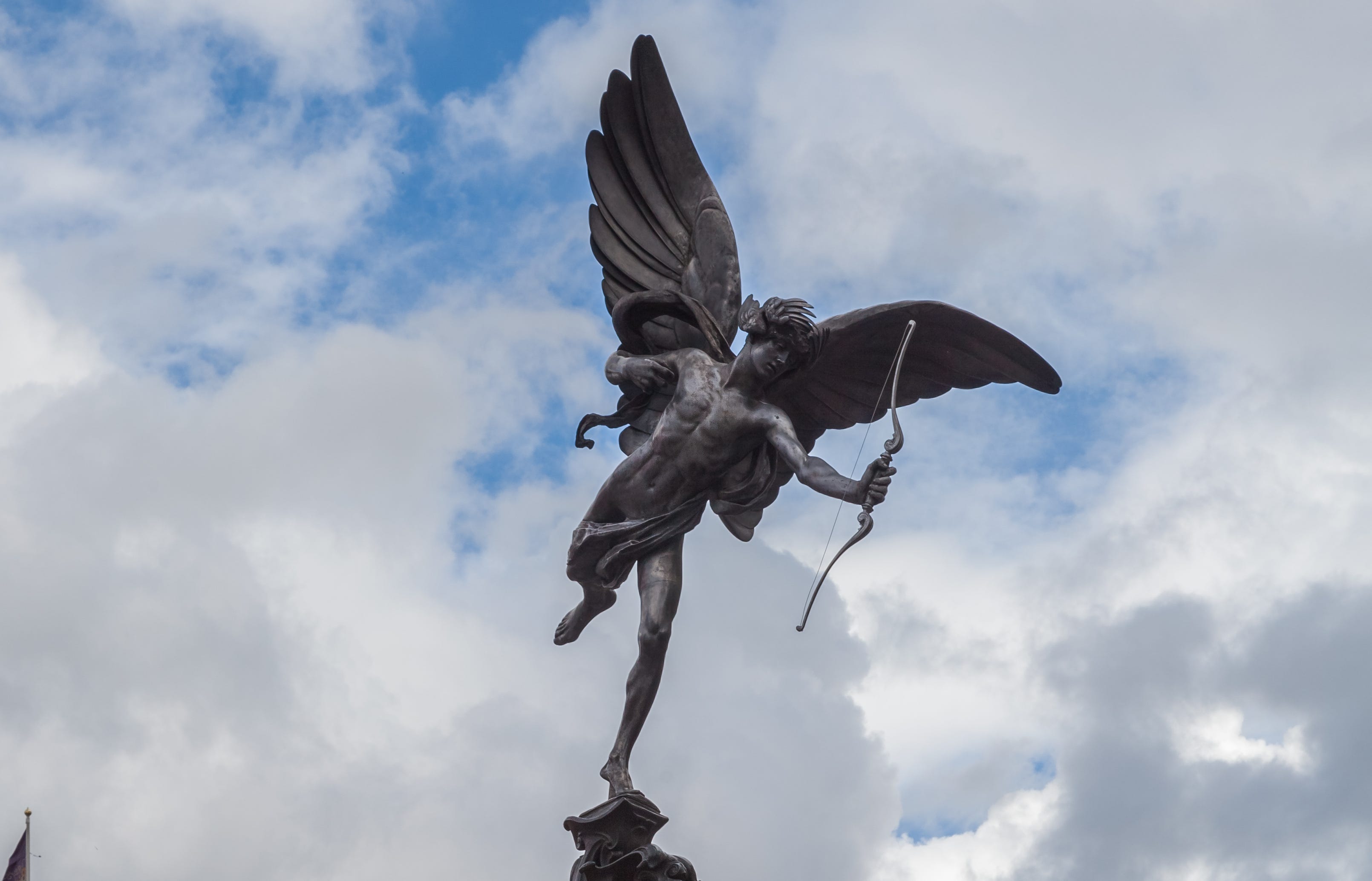 Statue of Eros - photo by Diego Delso
In contrast to the modern, power-centric understanding of possession, I would define metamodern possession as: The action or process of taking on the qualities of one’s beloved.
“I am yours
However distant you may be
There blows no wind, but wafts your scent to me
There sings no bird, but calls your name to me
Each memory that has left its trace with me
Lingers forever as a part of me.”
In contrast to the lion-like love of most modern metaphysics, the symbol of metamodern love is surely the unicorn. Famously untamable, allegorically interwoven with Christ and his impossible-yet-worthwhile challenge for us (Imitatio Christi), and beguiling all beguilers, the unicorn exemplifies bidirectional possession. Any attempt to trap or control the unicorn leads to the trapping of the trapper.
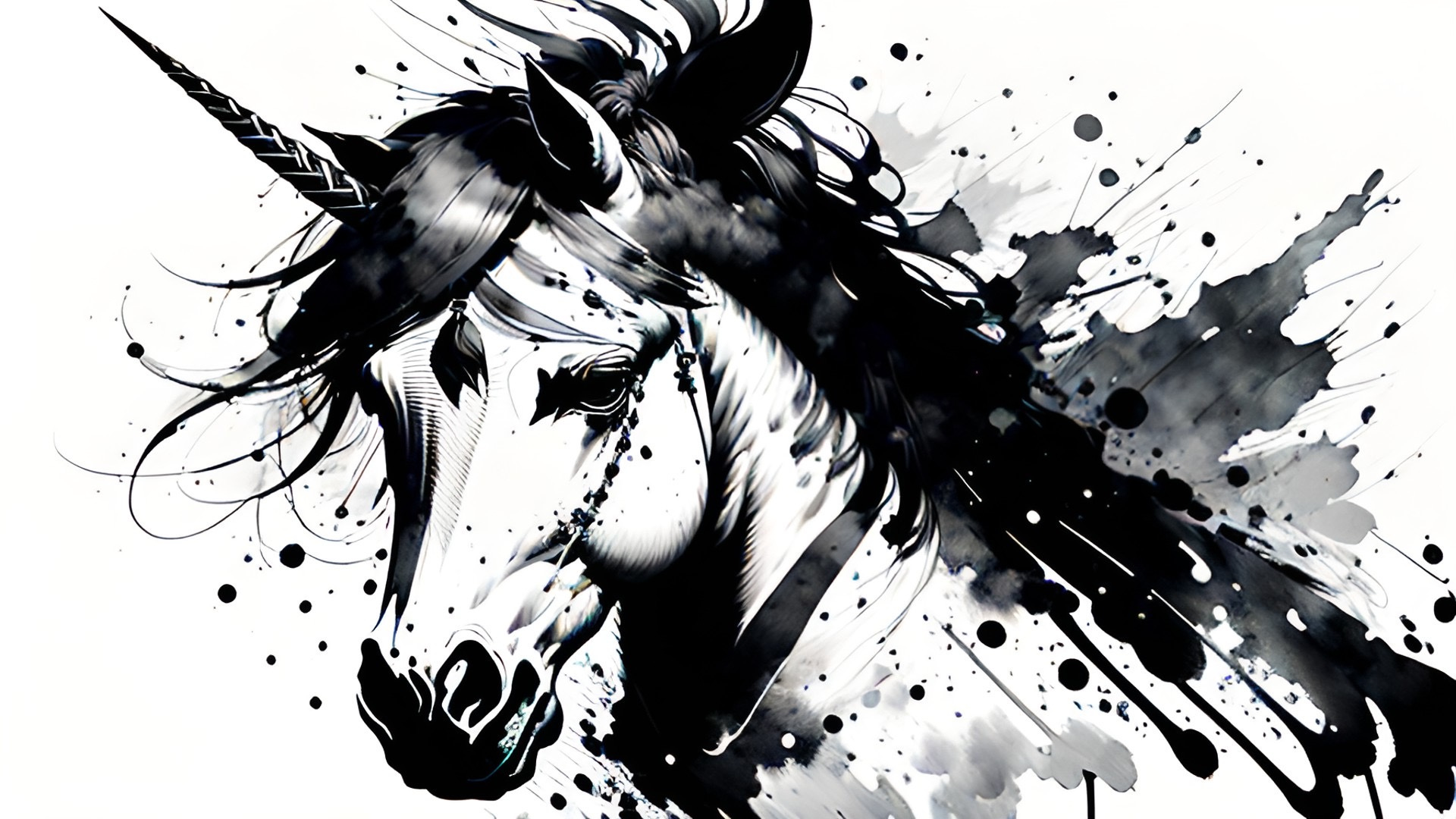 “Supposedly no hunter could capture the animal by force.” - George Ferguson
In Iris Murdoch’s “The Unicorn”—a book I have already mentioned in two other posts and which is apparently bottomless in the depth of its insights—a character named Hannah is our unicorn. She is physically confined in Gaze Castle (a male-domination symbol par excellence), and yet the story unfolds around a cast of characters who are possessed by her. Possessing Hannah rather literally in a castle nonetheless makes her especially vorticial in her possessive pull. The others in the story place all of their attention on her, and largely find her to be a helpless woman in need of rescue—a woman who is, in fact, entranced:
“Marian: It sounds to me as if she were really under a spell, I mean a psychological spell, half believing by now that she’s somehow got to stay here. Oughtn’t she to be wakened up?”
- Iris Murdoch
Murdoch seemed to love turning perennial narratives on their heads—in this case through love stories which feature mutual possession, rather than the unidirectional possession which is far more common in literature.
“Metamodern lovers” arrive at different conclusions from modern lovers due to a metaphysically distinct point of departure. Symbolically, I call this the shift from lion to unicorn. One significant change entailed in this is the movement beyond nihilism—which I have been exploring in my recent work. Starting from a place of metaphysical nihilism will naturally make one resistant to a kind of love which involves such things as madness, obedience, and possession. All of these threaten power.
But one might notice at this point that even modern love does not refute the presence of possession, but only warns against it. The same was said about the ‘madness’ of love.
Metamodern love, situated as it is in worldviews which do not grant ontological supremacy to power, has different ideas about romantic possessiveness built into it. In the budding new worldviews of the metamodern epoch, I see a potential rebirth of value-ontologies. Or, in other words, lovers will tend to believe that Value per se (or the Good) is the most basic, first principle of reality. Max, another character in The Unicorn, gives voice to this view while conversing another character, Effingham:
“Effingham: Do you believe in God, Max?…
Max: I believe in Good. So do you.
Effingham: That’s different. Good is a matter of choosing, acting.
Max: That is the vulgar doctrine, my dear Effingham. What we can see determines what we choose. Good is the distant source of light, it is the unimaginable object of our desire. Our fallen nature knows only its name and its perfection. That is the idea which is vulgarized by existentialists and linguistic philosophers when they make good into a mere matter of personal choice.”
- Iris Murdoch
And, because of this, the purpose or telos of love is not power, but mutual exaltation in the light of an absolute Good. To possess a metamodern heart, desire that the greatest possible perfection should reach that heart—as if it were your own. This makes Leibniz sound quite metamodern, though he wrote before the postmodern era had even begun.
“There are two ways in which one can desire the welfare of another: the first, that of the scheming man, because it will lead to his own welfare; and, the second, the way of the lover, as if it is his own welfare.”
This, too, resembles Plato’s metaphysics of love. Notably, he says that love (and consequently philosophy and rhetoric) are modes of “soul-leading”. This concept, like love as a skillful hunter, depicts love as having bivalence: It is the best thing in the world if you can survive it; it is dangerously transformative and can be used for more or less moral ends. It is possession in all its multicolored meanings. At best, however, it can be seen as part of the metamodern landscape of love—that part which says that souls always possess each other, and to be moral is to use this “magical” and pervasive persuasion for the good of the other rather than good for oneself. Or, in other words, soul-leading is how philosophers turn others into philosophers—which, for Plato, is equivalent to saying that love may be used to lead others towards more perfect love.
“Psychagogia, literally ‘leading of souls’, is a word used to mean persuasion, with some implication of deception or enchantment… Elizabeth Asmis gives citations and a helpful brief history of the word: ‘The earliest attested meaning of the compound psychagog- is that of ‘conjuring’ or ‘evoking’ souls of the dead. From this use, there evolved the notion of influencing the souls of living people, with the connotation of ‘alluring’ or ‘beguiling’ them'… A wise leader can use her disciple's erotic desire for beauty as a tool by which to lead him to philosophy.”
Combined with the ideas we explored previously regarding madness and obedience, this can create a significantly different attitude towards possessiveness. In metamodern love, possession is not a feature of ownership, control, property, or power; rather, it describes spiritual entanglement. If you are mine, and I am yours, possession is a word describing the inescapability of love’s tendency to unify. And it might be most accurate to say that we are both, as lovers, possessed by love—just as we are “driven mad” in a process which involves relinquishing our own power or sense of control. Metamodern possession is a mutual affair; it is sacred participation in the archetype of Love itself.
“When we are in an archetypal situation, we are effectively under the influence or compulsion of a god or daimôn. Most archetypal situations have two poles, the subject, in which the archetype has been activated, and the object, often another person, which has activated it. The subject has been seized by the archetype, and we may say they are ‘possessed’ by the god or daimôn. That is, they are…frenzied or inspired. The other pole, the person, group, object, and so forth, at which the archetypal relation is directed, is perceived as especially significant, or numinous, and the subject projects an archetypal role onto it. The most familiar example of possession and projection occurs between lover and beloved: the lover is possessed by Eros or Aphrodite; the beloved is perceived as a god or goddess incarnate.”
This, as mentioned above, is brought to life in the figure of Eros. It is also personified in Hannah—the unicorn of Iris Murdoch’s tale. The others need Hannah, and she needs them; it is a story of mutual (or metamodern) possession.
“Hannah: It was your belief in the significance of my suffering that kept me going. Ah, how much I needed you all! I have battened upon you like a secret vampire… I needed my audience, I lived in your gaze like a false God.”
- Iris Murdoch
Love, and the metamodern possession I suggest it entails, is dangerous; but not loving at all is still more dangerous. Vulnerability is its own kind of armor—it protects one from the zombie-like condition of appearing to live, yet being fundamentally empty.
“Love anything and your heart will be wrung and possibly broken. If you want to make sure of keeping it intact you must give it to no one, not even an animal. Wrap it carefully round with hobbies and little luxuries; avoid all entanglements. Lock it up safe in the casket or coffin of your selfishness. But in that casket, safe, dark, motionless, airless, it will change. It will not be broken; it will become unbreakable, impenetrable, irredeemable. To love is to be vulnerable.”
As Lewis indicates, impermeability is the sign of a squandered soul. Metamodern possessiveness is the tendency to be truly open to love, and accepting of the changes it inevitably stokes. Becoming obedient to love sets us free; love’s madness enlightens us; and possession is the interdependence which unavoidably accompanies love as a reciprocal uplifting—something which leads towards a theoretically perfect fulfillment of our individual and collective purposes.
Among the major differences in these versions of possession, it seems to be especially important that modern possession is unidirectional, and metamodern possession if bidirectional. The former is an expression of one center-of-power overpowering another, and transforming them from a conscious agent into an object. In other words, the idea carries the notion that possession is something which moves power in one direction—depleting one person while enlarging another. But the latter says otherwise, emphasizing instead how possession moves “something” in two directions, between both lovers, at once. And in this case, it is not about the transfer of power, authority, or ownership at all. Metamodern possession involves a qualitative osmosis which makes a mixture of formerly-separate bodies. And, like madness, it is an aspiration.
Possession ceases to be (at least entirely) negative or threatening once we realize that we can’t romantically possess another without them possessing us. The reciprocal nature of metamodern possession makes it a necessary part of romantic love, and not something to be avoided. It is to be used wisely; and the irreversibility of an arrow from the bow of Eros must be taken seriously.
“Have you remembered Gaspara Stampa sufficiently yet, that any girl,
whose lover has gone, might feel from that
intenser example of love: ‘Could I only become like her?’”
In love, I am yours, because every moment I love you, you become a bigger part of me. In incremental degrees, I take on (or possess) bits of you; or, in another sense, love, the alchemist, possesses us and makes something new using a blend of both.
August 24, 2023
Fast Car
These driving tips are compliant with the 2023 NYS driving examination, and there are no philosophical implications hidden within them… Or are there??
 A. Leaving Curb
The greater part of your first battle involves an acclimation to moving faster than humans were meant to move. Cars really threw everything off, didn’t they? A deer’s instinct to freeze and then dart away worked great against its natural predators, but now their headlight-seduced gaze is synonymous with catastrophic indecision.
I say this because you have much to learn about driving, and we will get to it all. But before we even leave the curb, I want to talk about a couple of things.
First, the body has many reactions to stress—potentially including rapid, shallow breathing. This panicked state is no good for anyone. So if you feel your heart thumping with uncomfortable urgency, there is a specific breathing technique which can get things under control. It’s called box breathing—and the rules are quite simple: Breathe in for 4 seconds, hold your breath for 4 seconds, breathe out for 4 seconds, hold your breath for 4 seconds, and repeat.
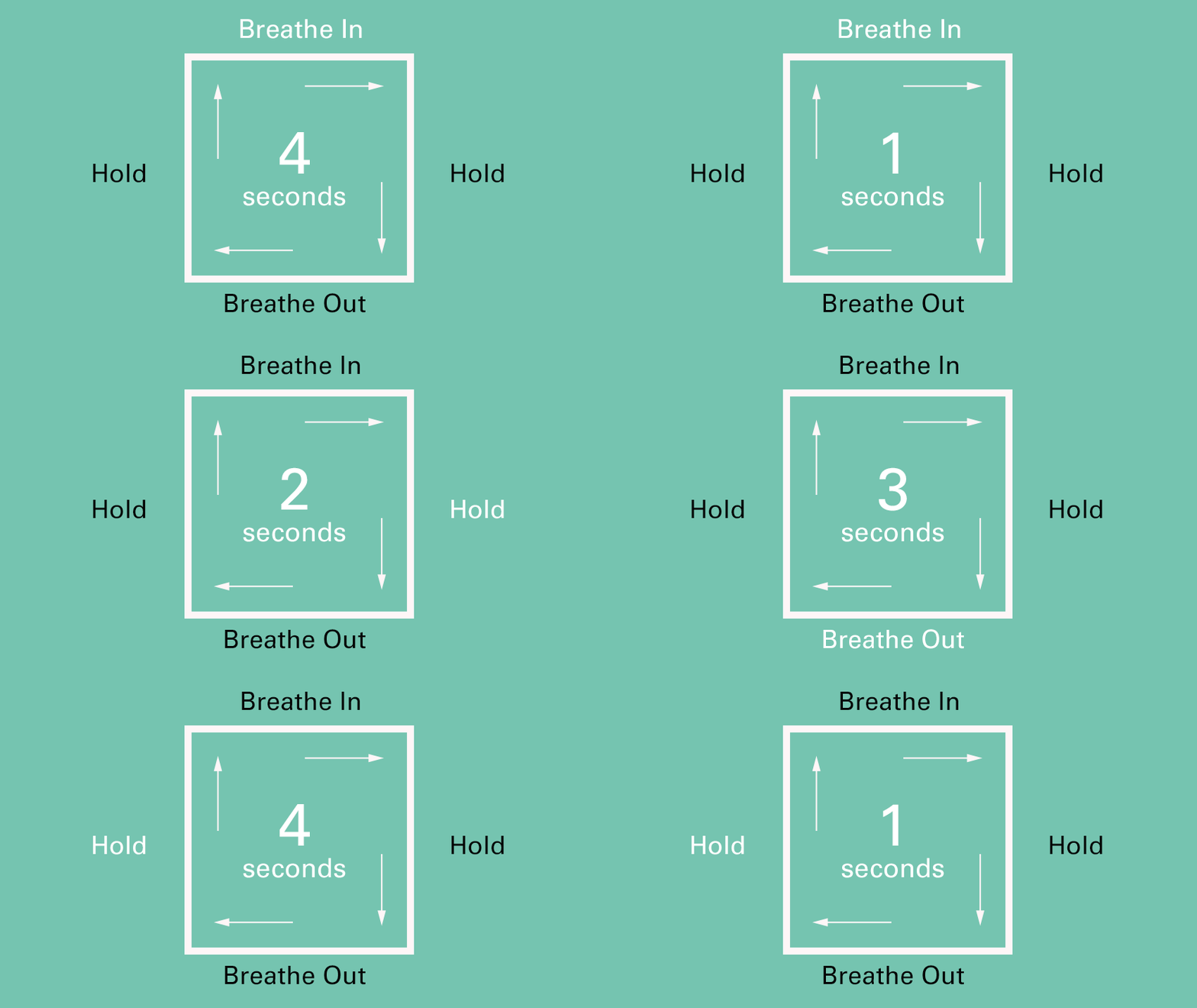 Box breathing technique
Now, as you get ready to drive off, I want you to know that it’s also ok to feel overwhelmed. Box breathing might help mitigate some of the natural reactions we have to scary new experiences like this, but ultimately it is only patient practice which will make driving as easy for you as walking.
That practice, I should mention, creates a specific effect called “chunking”. Let me read you an insightful quote.
“[Chunking involves] taking ‘small’ concepts and putting them together into bigger and bigger ones, thus recursively building up a giant repertoire of concepts in the mind… Experienced chess players chunk the setup of pieces…into small dynamic groupings defined by their strategic meanings, and thanks to this automatic, intuitive chunking, they can make good moves nearly instantaneously and also can remember complex chess situations for very long times… I speculate that babies are to life as novice players are to the games they are learning—they simply lack the experience that allows understanding (or even perceiving) of large structures, and so nothing above a rather low level of abstraction gets perceived at all, let alone remembered in later years. As one grows older, however, one’s chunks grow in size and in number, and consequently one automatically starts to perceive and to frame ever larger events and constellations of events.”
So you see, you are as a player who is brand new to a game. Your moves lack fluency because you are arduously attending to minutiae. But, via what we generally call “practicing”, and what is more specifically “chunking”, you will slowly start to find relaxation techniques like box breathing unnecessary. You will find instead a calmness resulting from having chunked many “small concepts”, like checking your mirrors and using your turn signals, into larger concepts like “pulling away from the curb”.
B. Turning & IntersectionsYou know, this is going pretty well. We’ve been driving for a few minutes and we’re still alive!
We’re coming up to a 4-way stop. Remember, it’s “FIFO”—first in, first out.
Well, yes, I realize we can see that there’s nobody else at the intersection, nor anywhere nearby. But that won’t always be the case.
I see why you’re tempted to just zip through the intersection, seeing as how nobody is around, but all actions are interactions, no matter how isolated they may appear. Consider a slightly different scenario: You are driving up to an intersection with stop signs in all directions, and you see another car coming up on the perpendicular road. You see the car slowing and getting ready to stop at the intersection. And so you can predict with great likelihood that the other car will stop and that you can safely pass through the intersection without stopping. This will save you time, and even money since it’s less gas-efficient to come to a complete stop and then accelerate again. Would you do it?
This constitutes a kind of “dilemma” of the kind found in game theory—as in the famous Prisoner’s Dilemma. In our intersection example, each driver may reap one of the following payoffs corresponding to each possible interaction:
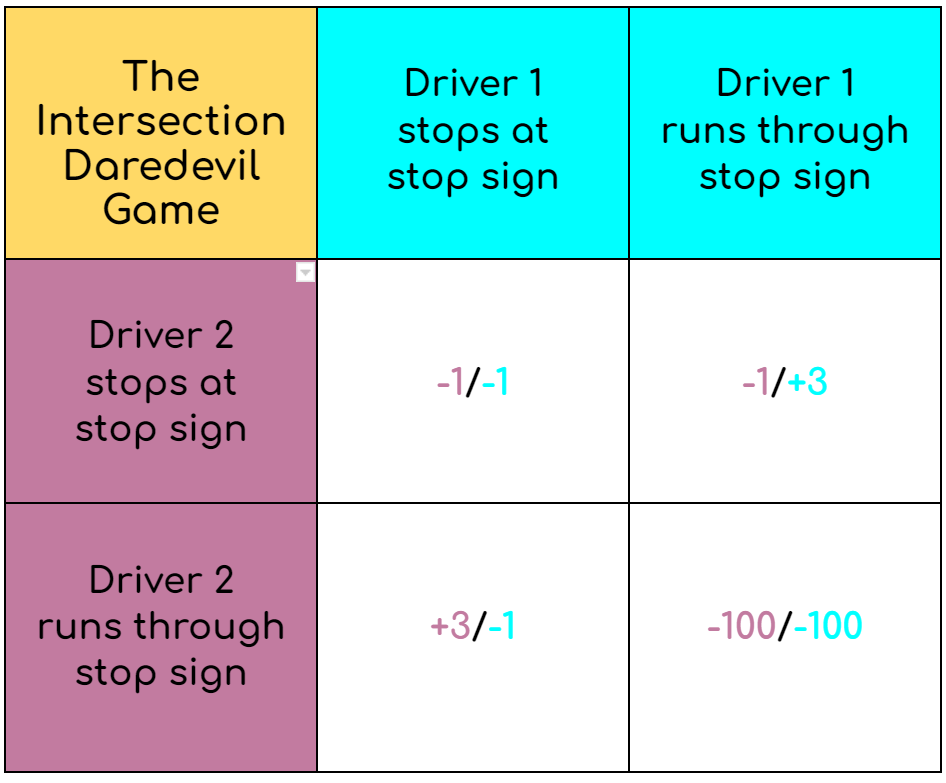
As you can tell, running through a stop sign carries a small benefit—as long as you are the only one to do it. Not knowing what the other driver might choose is what turns this situation into a dilemma. Given the danger of a collision, most will choose to stop at stop signs, even when they are pretty sure they could get away with running through them.
This is a many-sided subject, don’t you think? When I stop because you stopped because you expected me to stop because I expected you to stop, it is our reciprocal dance of counterfactuals which pushes the whole system of drivers towards an “always stop at stop signs” attractor state instead of the much more dangerous and unstable “always run through stop signs” attractor state.
Would we have roads at all were it not for those critical moments when we choose avenues of cooperation? The Free-rider Problem states that actors in a system of interaction (a game) will tend to accept opportunities to extract value from the system without contributing what is necessary for that very system to survive. The reason for this is that it only takes, for example, 95% participation to maintain a given system, so everyone in the remaining 5% may share in the wealth without putting in the work. Similarly, we often perceive that we have an incentive to steal from the future (the truth of this tradeoff is more complicated). This is known as discounting.
Something related happens with the carbon emissions being released from the exhaust of this car. We are paying for the market value of gas, not the long-term costs associated with burning it up.
“Gas contains an amazing amount of energy. You would need to bundle 130 sticks of dynamite together to get as much energy as a gallon of gas contains... Gasoline is also remarkably cheap... In addition to milk and O.J., here are some things it is less expensive than, gallon for gallon: dasani bottled water, yogurt, honey, laundry detergent, maple syrup, hand sanitizer, latte from Starbucks, Redbull energy drink, olive oil, and the famously low-cost Charles Shaw wine that you can buy at Trader Joe's grocery stores. That's right, gallon for gallon, gasoline is cheaper than ‘two-buck Chuck’.”
There was an economist named Arthur Pigou who suggested a solution to this. He wanted to tax “externalities” so that we would always be accounting for the full price of our actions. Markets are not oriented towards recognition of such complex webs of interconnected value—which span quantitative, qualitative, and temporal horizons. And so we end up with situations like the one described above, in which the cost of a gallon of gas is comically underpriced (at least in a more “holistic” view).
To stop or not to stop may seem less momentous than these other cases, but in each we can see similar underlying patterns. At every moment, we reach consequential forks where we must make irreversible decisions. And if you consider how running a stop sign is like “defecting” in the Prisoner’s Dilemma, it is not hard to see that we are dealing with patterns of profound importance.
All of this is to say: I’m glad you stopped at that intersection back there, and I hope you continue to do so.
C. Parking, Backing & U-turnI’m not going to sugarcoat it: That was not the best parking job I’ve ever seen. But you’ve never done it before, so that’s to be expected. Let’s review how you can improve.
It’s all about a feedback loop involving prediction, and action, sensation—together known as free-energy minimization. Making predictions is one of the most fundamental undertakings in life. And failure is an illusory shadow aspect of a gradient ascent towards the value which prediction scries.
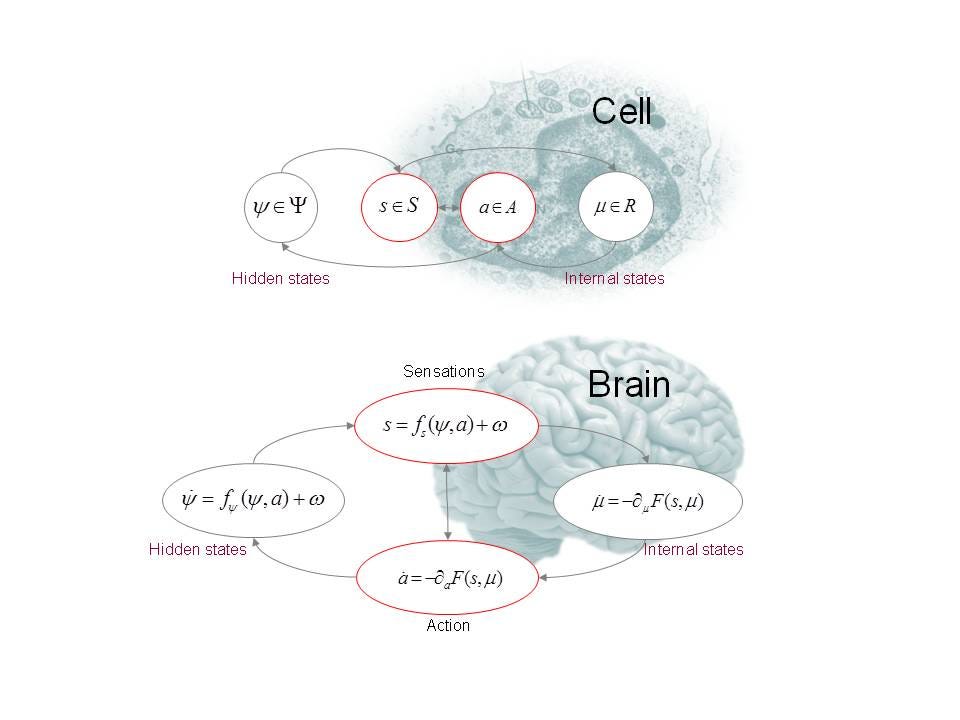 Markov blanket, by Karl Friston
So that terrible attempt at parking just now can be seen as an action stemming from bad predictions. The sensation and integration of that data comes full circle and informs the next prediction. Today was therefore a success, because it was a necessary step in a process which minimizes surprisal and, equivalently, maximizes expected value. There are many forms of value to which this cycle may be oriented. Today, it was set on good parking. Your predictions were off, but they’re getting better on each attempt.
D. Driving in TrafficHappy to be moving on from parking and K-turns? Those repetitive exercises can certainly strain one’s patience.
You’re doing great on this road, but the speed limit is 30MPH here and you’re going 36MPH now. Numerically, it’s not such a huge difference, and you may wonder why I’m pointing it out at all. For one, I’m trying to help you pass your test, and speeding is a quick way to lose points. But there’s another important reason that so many towns and residential areas have a 30MPH speed limit.
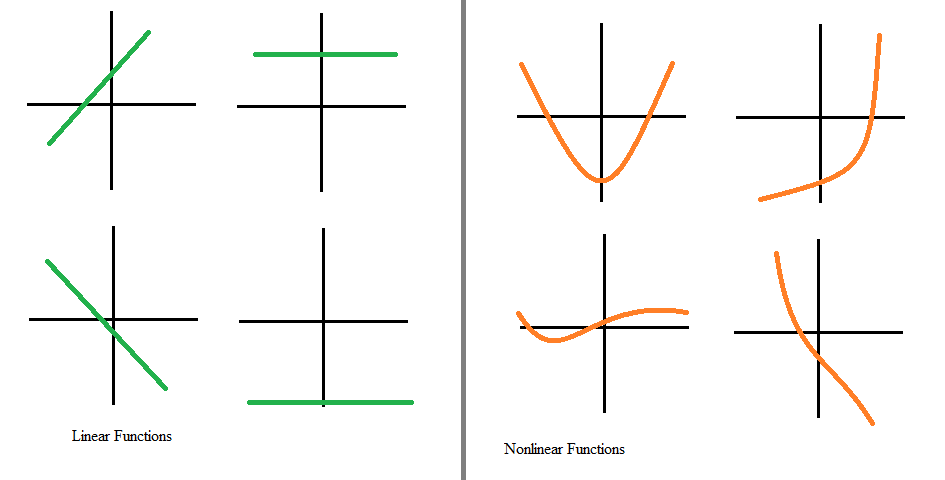
This might sound grim but it has to do with fatal accidents. At 30MPH, there is only around a 20% chance that a person struck by that car will die. But at 40MPH, there is about an 80% chance. And something peculiar happens on this journey between 0 and 40MPH: it takes the first three-quarters of this amount to produce a 20% fatality rate for accidents, while the rest of the 80%-rate comes during the comparatively short leap of the final quarter. Our world is full of these nonlinear dynamics.
 Linear vs nonlinear functions
Small changes can sometimes produce huge effects. This relates to the famous idea of the chaos butterfly. Drive with care, and know that even a seemingly minuscule decision can have disproportionately far-reaching consequences.
But really, every choice you make as a driver is heavy with obligation. An action need not be associated with a nonlinear effect to be considered significant. To understand what I mean, I want you to picture ants. Did you know they have highways and bridges, too? They achieve great things by working together, even though not one of them knows exactly what they’re working on.
 Ant bridge, by frank29052515
I know, it’s amazing! And it all happens via a process called stigmergy, which is a coordination mechanism driven by indirect (mediated) interactions: An action leaves a trace in a shared medium, and that trace is picked up by another actor who is influenced by the traces left by previous actions.
“The concept of stigmergy has been used to analyze self-organizing activities in an ever-widening range of domains, including social insects, robotics, web communities and human society… Stigmergy enables complex, coordinated activity without any need for planning, control, communication, simultaneous presence, or even mutual awareness. The resulting self-organization is driven by a combination of positive and negative feedbacks, amplifying beneficial developments while suppressing errors. Thus, stigmergy is applicable to a very broad variety of cases, from chemical reactions to bodily coordination and Internet-supported collaboration in Wikipedia.”
A bridge may be beyond an ant’s understanding, and so can only be constructed through simple, locally-coherent actions—which, though lacking a structured thought-process of if-this-then-that causality, are nevertheless the alphabet of magnificent emergent behaviors. Is the creation of a pencil really so different?
As we continue down this road, which we daily take for granted as a feature almost as fixed as the dirt and trees which surround it, perhaps we can appreciate it in this new light. You may swerve the wheel haphazardly to the right, and carve your own path through the woods—although I’d really prefer if you don’t, and can assure you that you will not pass your driving test if you do. The paved road guides and suggests and nudges, but it does not necessitate. That is the nature of stigmergy. The asphalt, as trace, acts upon the shared medium of space, and rather strongly invites us to drive between certain lines, but not others.
E. Vehicle ControlHave you seen any of those classic martial arts movies like the ones with Bruce Lee?
I know there’s a lot going on right now and you’re trying to focus, but I see you focusing in a way which could actually be detrimental. And so I promise my question about karate is relevant. I’ll make it quick so I don’t distract you any more than necessary.
You’ve heard the phrase “tunnel vision” of course. It is an overly-narrow focusing of one’s field of vision at the expense of the periphery. When you’re driving, it’s crucial that you take in your whole surroundings, and not just whatever is directly in front of the car.
A narrow gaze is a common problem with new drivers, and the martial arts have something to say about the solution. You see, there’s no way Bruce Lee could fight off multiple opponents at once without what is sometimes called “soft eyes”—which is essentially the opposite of tunnel vision. Compared with, for example, focusing on that sign up there to read what it says, soft eyes would make that sign seem a bit fuzzier, but the amount you are taking in with the rest of your vision is enhanced.
“An important neurological state for healthy driving is soft-eyes. In a relaxing way it allows one to see the whole picture, rather than hard-eyes — staring or fixing the eyes at the car or road ahead, with higher body tension. Soft-eyes allows for the comfortable scanning of a wide angle of vision in front, the easy glance in rear and both side mirrors, including peripheral vision, helping to increase visual awareness all around.”
Less literally, I think the “hard” and “soft” gazes share much in common with two modes of thinking: analysis and synthesis. The hard, narrow focus is like the tendency to reductively analyze something based on its most elementary parts. While the soft, broad focus is like the synthesis of elementary parts into a coherent whole. The two can be at odds, or they can be complementary. Our goal is to use the right tool at the right moment—knowing when to harden and when to soften one’s eyes.
Driving HomeAlright, turn left. That road will take us back the way we came.
I have the perfect song for the ride back. No more lessons for today. Let’s just listen to it and enjoy the drive.