Marie August's Blog, page 23
May 6, 2013
Comic: Page 90
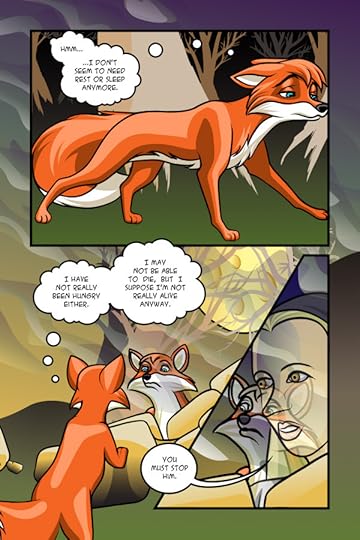
If you liked the page, please support the comic by voting for The Fox and The Firebird on topwebcomics.com.


May 5, 2013
Book Review: My Lunatic Life by Sharon Sala
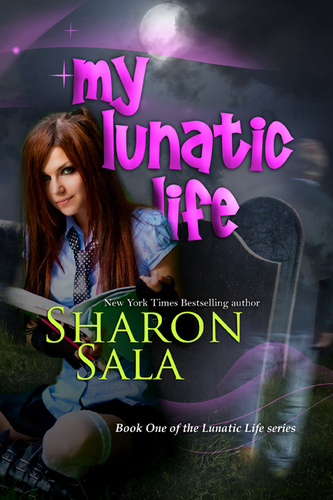 Fun, young-adult, paranormal mystery
My Lunatic Life by Sharon Sala

Reading Level: Young Adult
Release Date: August 31, 2011
Publisher: Bell Bridge Books
Pages: 156 pages
Source: Net Galley
Reviewed By: Kate McMurry
Seventeen-year-old, high-school senior, Tara Luna, was orphaned when she was a year-old baby and has been raised by her Uncle Pat, an unconventional, "hippie" type who loves to move around. Tara is even more unusual than her uncle. Her two closest friends in her wandering life are ghosts. Millicent can move people and things and can physically materialize, but mostly she takes a form that looks like smoke. Henry doesn't materialize, and he doesn't talk much, but when he is peeved, he lets it be known by hiding things. In addition to seeing and speaking to ghosts, Tara can read the minds of living people. Between the traveling, the ghosts and the mind-reading, Tara has never tried to make friends with living people because it seems pointless. Even if anyone could relate to her, she's always moving on. But suddenly, in this new school, the whole pattern of her life changes. An angry, dangerous, teen-girl ghost demands that Tara solve her murder--and she's hard to ignore because she inhabits Tara's home. A beautiful cheerleader who has persecuted Tara is in danger, and only Tara can save her. And a gorgeous, bad boy named Flynn proves more irresistible than any guy Tara has ever known.
At 156 pages, this is a fast, entertaining read suitable for YA readers ages 12-15, though older teens and adults will enjoy it too.
I was a big fan of the TV series, Medium , and Tara is kind of a teenage Allison Dubois. Like Allison, Tara has the powers of precognition through instant intuitions of people and situations, touching something a person owns and going into her perceptions, dreaming about someone and getting information, and obtaining vital information from ghosts. Also like Allison, these gifts run in her lineage. But Tara has an additional power that Allison does not--she can read minds.
I really liked Flynn, and Tara's budding romance with him is one of my favorite parts of this book.
Anyone who enjoyed the Dead Is books by Marlene Perez won't want to miss this fun new paranormal mystery series.
I rate this book as follows:
Heroine: 5
Subcharacters: 5
Fantasy World-Building: 5
Writing: 5
Mystery Plot: 5
Romance Subplot: 5
Overall: 5

Book Review: Make Me (Demon Underground, #4) by Parker Blue
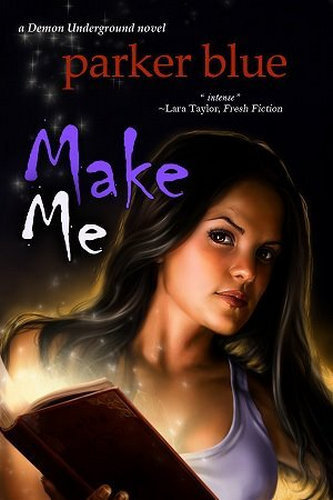 Book 4 in an exciting "New Adult" urban fantasy series with a "kick-ass" heroine
Make Me by Parker Blue

Reading Level: Young Adult
Release Date: March 13, 2012
Publisher: Bell Bridge Books
Pages: 224 pages
Source: Net Galley
Reviewed By: Kate McMurry
In this fourth book in the Demon Underground, New Adult, urban fantasy series, "kick-ass" heroine, 18-year-old Val Shapiro, is hiding a dangerous secret. After losing her virginity to her handsome, demon boyfriend, Shade, her slayer powers vanished. She had hoped that as the latest guardian of the Encyclopedia Magicka, these enormously powerful books would offer her new magical abilities to replace those she'd surrendered for love, but so far, that has not happened. These books take away more than they give, because there is a price to pay for using any spell they offer.
While Val is still floundering without any magical resources to protect herself or anyone else, her roommate Gwen and her mentor Micah, the incubus leader of the San Antonio Demon Underground, are kidnapped by a rogue demon, who commands Val to surrender the Encyclopedia Magicka to him as the price for her friends' lives. As Val contemplates the nightmare such an exchange would produce, the gorgeous, succubus leader of the Austin Demon Underground arrives, insisting that the deadly books be destroyed to prevent their falling into the wrong hands. She also employs her succubus powers to bind Shade to her, and a devastated Val can do nothing to prevent it.
Meanwhile, demons and vampires begin disappearing in San Antonio, and Val is torn between the needs of the vampire and demon communities. The vampires of the New Blood Movement demand that Val uphold her oath to work for them as they search for the perpetrator of these threats, but there is dangerous turmoil in the Demon Underground without Micah in charge. As if all that weren't enough, Val's best friend and sidekick, Fang the talking hellhound, chooses this moment to unaccountably betray her.
Val, as always, is a valiant, determined, very active protagonist, and she has plenty of exciting, scary problems to deal with in this latest action-filled installment of the Demon Underground series. Val inhabits a compelling, magical world, and I thoroughly enjoy reading about that world and experiencing the many intriguing subcharacters inhabiting it.
Poor Val can't ever seem to catch a break in the romance department, but since this is not a series that focuses a great deal of attention on romance as an end in and of itself, I won't downgrade my score for this novel for not delivering a strong paranormal-romance subplot. Instead, I am giving it a high score for a great deal of success in its main focus: relentless warrior, Val, giving her all to the goal of defeating scary villains against impossible odds.
Disclosure: I received a review copy of this book through Net Galley.
I rate this book as follows:
Heroine: 5
Fantasy World-Building: 5
Writing: 5
Action-Adventure/Thriller Plot: 4
Overall: 5
April 29, 2013
Comic: Page 89
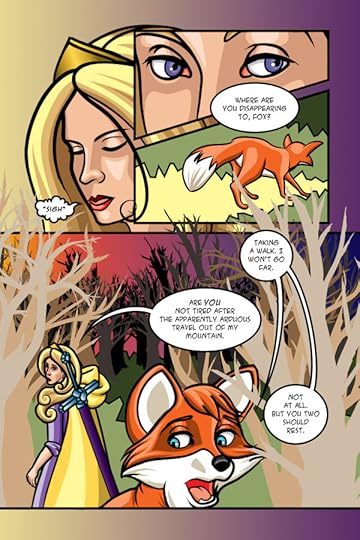
If you liked the page, please support the comic by voting for The Fox and The Firebird on topwebcomics.com.
April 22, 2013
Comic: Page 88
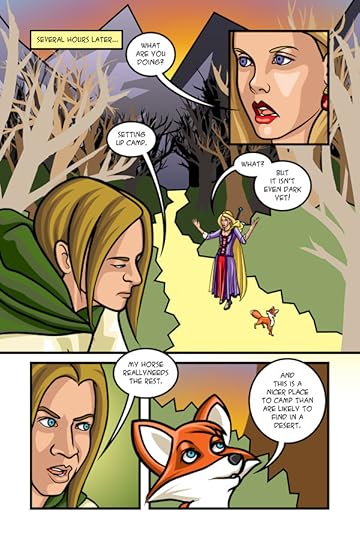
If you liked the page, please support the comic by voting for The Fox and The Firebird on topwebcomics.com.
April 21, 2013
What Is Urban Fantasy?
Many reviewers and publishers use the term "urban fantasy" (UF) to describe a book set in our recognizable, modern world if it has any amount of fantasy elements inserted in the story. I personally don't consider that a book merits the descriptor, UF, unless there is an extensive amount of magical world-building. In most books that I consider true UF, a magical universe exists side-by-side with the normal, modern world. The story's magical creatures purposely keep their world, in varying degrees, hidden from ordinary humans in order to avoid constant battles with frightened, angry mortals. In such stories, humans also consciously and unconsciously collude to keep the existence of the magical creatures secret in this manner: When magical events impinge on the mundane world, if the humans directly involved don't refuse, on their own, to believe anything magical could possibly have happened to them, authority figures such as police, spy agencies, the military, and politicians intervene. They use lies and, if necessary, force, to cover-up magic's existence, their standard excuse being, "to avoid chaos."
In UF, two crucial sources of conflict occur in virtually every story, secrets and lies. These are, of course, staples in every genre of fiction, but they have these unique twists in UF:
(1) The protagonist carelessly, or because she/he has no other choice to protect others from harm, displays magic in front of humans and gets into major trouble for it with magical-world authority figures, as in Hex Hall by Rachel Hawkins.
(2) The protagonist is forced to deal with the fallout of magical villains carelessly or purposefully causing damage to humans with their magic, which occurs throughout Harry Potter series .
.
(3) The protagonist is either part of or closely connected to a species of magical creatures who have recently "come out of the closet," allowing humans to know that they exist. The magical creatures are struggling to construct a détente with humans in the midst of many humans trying to wipe them off the face of the planet. Famous non-YA examples of this are the Sookie Stackhouse series by Charlaine Harris and Patricia Briggs's Mercy Thompson series
 .
.
(4) In UF stories which focus almost entirely on magical beings, with the only non-magical humans existing as relatives, friends, or employers of magical creatures, the main focus in the story is often a power struggle between warring factions within the magical world. Examples of this include the Dresden Files by Jim Butcher in adult UF, and in YA UF such series as Mortal Instruments
 by Cassandra Clare, Raised by Wolves
 by Jennifer Lynn Barnes, the Svatura
  by Abigail Owen, and the Witch duology
 by Carolyn MacCullough.
The tone of UF is usually dark, and if they start out funny, they usually end up grim, as does the Hex Hall series mentioned above. One rare example of a YA UF that is comic in tone throughout is Oh. My. Gods. by Tera Lynn Childs.
When a story is set in our recognizable, modern world but magic intrudes in a limited way, reviewers and publishers often use the generic labels "paranormal" or "fantasy" to describe them rather than UF. By limited magic I mean that there is only one type of magic in the book. For example, the heroine sees one or more ghosts (Drawing the Ocean by Carolyn MacCullough), or she encounters something or someone magical which/who grants her wishes (Wish
 by Alexandra Bullen, My Fair Godmother
 by Janette Rallison, Coffeehouse Angel
 by Suzanne Selfors, As You Wish
 by Jackson Pearce), or she gets struck by lightning and now has a magical power she did not have before (1-800-Where-R-You
 by Meg Cabot, and the adult Harper Connelly series
 by Charlaine Harris). All of these examples are set in the recognizable present and, thus, each is a "contemporary paranormal/fantasy."
When a paranormal/fantasy is set in any period of the recognizable, historical past other than medieval times (the classic setting for "sword and sorcery" and "epic" fantasy), it is a "historical paranormal/fantasy"--except when the magic involves an a-historical form of technology. In that case, the term most often used to describe it is "steampunk," for example, the YA series The Infernal Devices by Cassandra Clare. An example of a YA historical paranormal series is Poison Diaries
 by Maryrose Wood. An example of YA sword-and-sorcery is the Graceling Realm series
 by Kristin Cashore.
What I personally enjoy most in UF, along with great world building, is a protagonist who is committed and loyal in his/her personal relationships. I believe this quality is absolutely essential for a great UF book for this reason: In any kind of action/adventure story, which most UF is, the protagonist needs to be both sympathetic (a decent person), empathetic (taking actions which are well-motivated and relatable), and above all, active (vs. listless and passive). Something that accomplishes all three in one fell swoop is to make the protagonist a terrific best friend and/or loyal mate or family member who will stop at nothing to protect, defend and rescue people (or magical creatures) she/he cares about. In addition, this type of protagonist will never stand by and let a bully prey on someone weaker, and if the weaker one is a child, look out! The protagonist will "charge hell with a bucket of water," as the saying goes, in order to save that child from harm.
This kind of protagonist inevitably, as a UF series progresses, gains an ever-growing network of magically powerful friends who owe the protagonist big time for saving their lives. Often, the protagonist will call in those favors not for him/herself, but for someone else the protagonist cares deeply about whose life is in danger. This serves to create a continuing thread of never-ending, dramatic action and over time builds the protagonist's appeal—both to readers and characters within the books of the series—to near mythic stature as a noble, sympathetic hero.
Two adult UF authors who accomplish this hero requirement in spades are Jim Butcher in the Dresden Files and Patricia Briggs in her Mercy Thompson series and Alpha & Omega series. The YA Raised by Wolves series by Jennifer Lynn Barnes does a very good job of that as well.
Another segment of the science fiction/fantasy market is the dystopian. This is a subgenre of science fiction because of the way the world building is done. The UF world is filled with magical creatures. Dystopians are set in apocalyptic futures where the protagonist lives in a burned-out landscape littered with the dregs of advanced technology. The protagonist is resourceful and often employs a mixture of pre-industrial survivalist skills in combination with the ability to jury-rig remnants of advanced technology from the destroyed civilization of the past. An example of this is the YA dystopian Vulture's Wake by Kirsty Murray and, of course, the most famous YA dystopian series of all, The Hunger Games series
 by Suzanne Collins.
Though the dystopian world is different than that of UF, because dystopians, like UF, almost always have action/adventure plots, they have the same primary requirement for ultimate success as UF: a high-caliber protagonist as described above. I believe The Hunger Games series is a massive bestseller because the heroine is exactly that kind of protagonist.
What Is Urban Fantasy? by Kate McMurry
In UF, two crucial sources of conflict occur in virtually every story, secrets and lies. These are, of course, staples in every genre of fiction, but they have these unique twists in UF:
(1) The protagonist carelessly, or because she has no other choice to protect others from harm, displays magic in front of humans and gets into major trouble for it with magical-world authority figures, as in Hex Hall by Rachel Hawkins.
(2) The protagonist is forced to deal with the fallout of magical villains carelessly or purposefully causing damage to humans with their magic, which occurs throughout the Harry Potter series.
(3) The protagonist is either part of or closely connected to a species of magical creatures who have recently "come out of the closet," allowing humans to know that they exist. The magical creatures are struggling to construct a détente with humans in the midst of many humans trying to wipe them off the face of the planet. Famous non-YA examples of this are the Sookie Stackhouse series by Charlaine Harris and Patricia Briggs's Mercy Thompson series.
(4) In UF stories which focus almost entirely on magical beings, with the only ordinary humans existing as parents or mates of magical creatures, the main focus in the story is often a power struggle between warring factions within the magical world. Examples of this include the Dresden Files by Jim Butcher in adult UF, and in YA UF such series as Mortal Instruments by Cassandra Clare, the Raised by Wolves by by Jennifer Lynn Barnes, the Svatura by Abigail Owen, and the Witch duology by Carolyn MacCullough.
The tone of UF is usually dark, and if they start out funny, they usually end up grim, as does Hex Hall series mentioned above. One example of a YA UF that is comic in tone throughout is Oh. My. Gods. by Tera Lynn Childs.
When a story is set in our recognizable, modern world but magic intrudes in a limited way, reviewers and publishers often use the generic labels "paranormal" or "fantasy" to describe them rather than UF. By limited magic I mean that there is only one type of magic in the book. For example, the heroine sees one or more ghosts (Drawing the Ocean by Carolyn MacCullough), or she encounters something or someone magical which/who grants her wishes (Wish by Alexandra Bullen, My Fair Godmother by Janette Rallison, Coffeehouse Angel by Suzanne Selfors, As You Wish by Jackson Pearce), or she gets struck by lightning and now has a magical power she did not have before (1-800-Where-R-You by Meg Cabot, and the adult Harper Connelly series by Charlaine Harris). All of these examples are set in the recognizable present and, thus, each is a "contemporary paranormal/fantasy."
When a paranormal/fantasy is set in any period of the recognizable, historical past other than medieval times (the classic setting for "sword and sorcery" and "epic" fantasy), it is a "historical paranormal/fantasy"--except when the magic involves an a-historical form of technology. In that case, the term most often used to describe it is "steampunk," for example, the upcoming YA, Infernal Devices by Cassandra Clare. An example of a YA historical paranormal series is Poison Diaries by Maryrose Wood. An example of YA sword-and-sorcery is the Graceling Realm series by Kristin Cashore.
What I personally enjoy most in UF, along with great world building, is a protagonist who is committed and loyal in his/her personal relationships. I believe this quality is absolutely essential for a great UF book for this reason: In any kind of action/adventure story, which most UF is, the protagonist needs to be both sympathetic (a decent person), empathetic (taking actions which are well-motivated and relatable), and above all, active (vs. listless and passive). Something that accomplishes all three in one fell swoop is to make the protagonist a terrific best friend and/or loyal mate or family member who will stop at nothing to protect, defend and rescue people (or magical creatures) she/he cares about. In addition, this type of protagonist will never stand by and let a bully prey on someone weaker, and if the weaker one is a child, look out! The protagonist will "charge hell with a bucket of water," as the saying goes, in order to save that child from harm.
This kind of protagonist inevitably, as an UF series progresses, gains an ever-growing network of magically powerful friends who owe the protagonist big time for saving their lives. Often, the protagonist will call in those favors not for him/herself, but for someone else the protagonist cares deeply about whose life is in danger. This serves to create a continuing thread of never-ending, dramatic action and over time builds the protagonist's appeal—both to readers and characters within the books of the series—to near mythic stature as a noble, sympathetic hero.
Two adult UF authors who accomplish this hero requirement in spades are Jim Butcher in the Dresden Files and Patrician Briggs in her Mercy Thompson series and Alpha & Omega series. The Raised by Wolves series by Jennifer Lynn Barnes does a very good job of that as well.
Another segment of the science fiction/fantasy market is the dystopian. This is a subgenre of science fiction because of the way the world building is done. The UF world is filled with magical creatures. Dystopians are set in apocalyptic futures where the protagonist lives in a burned-out landscape littered with the dregs of advanced technology. The protagonist is resourceful and often employs a mixture of pre-industrial survivalist skills in combination with the ability to jury-rig remnants of advanced technology from the destroyed civilization of the past. An example of this is the YA dystopian Vulture's Wake by Kirsty Murray and, of course, the most famous YA dystopian series of all, The Hunger Games series by Suzanne Collins.
Though the dystopian world is different than that of UF, because dystopians, like UF, almost always have action/adventure plots, they have the same primary requirement for ultimate success as UF: a high-caliber protagonist as described above. I believe The Hunger Games series is a massive bestseller because the heroine is exactly that kind of protagonist.
April 20, 2013
Dearly, Beloved (Gone With the Respiration, #2) by Lia Habel

Exciting book 2 in a steampunk, dystopian trilogy
Dearly, Beloved (Gone With the Respiration, #2) by Lia Habel

Reading Level: Young Adult
Release Date: September 25, 2012
Publisher: Del Rey
Pages: 496
Source: Amazon Vine
Reviewed By: Kate McMurry
This book is the sequel to Dearly Departed (Gone with the Respiration #1) by Lia Habel. It is book 2 in a dystopian trilogy, pitched by the publisher as "steampunk romance meets zombie thriller." The publishers also bill this book as a story of "star-crossed lovers," which it certainly is. You don't get a much bigger romantic conflict than that the male lead is suffering from "the Laz," a disease that is slowly turning him into a zombie, one of the "walking dead." I myself view this series as "Beauty and the Beast" meets steampunk meets zombie apocalypse.
This story takes place in 2195. A hundred and fifty years prior, the Americas endured a civilization-crushing convergence of man-made and natural disasters, including plagues, volcanic eruptions, rising seas and a civil war in the U.S. in which both sides nuked each other. The small fraction of survivors in North and Central America surged as displaced refugees far into South America and warred with its inhabitants for control of their land and natural resources. Years later, the victors, many of whom were presumably native speakers of Spanish and Portuguese, decided along with their English-speaking compatriots that the most desirable society to form out of the rubble of a destroyed world would be an English-speaking one that reinstated the customs of Victorian England of the late nineteenth century, including hot, cumbersome clothing worn in a tropical climate and a highly stratified social order. They chose to emulate this time and place in history because they admired its "conservative" values--with the notable exceptions that lesbianism (and presumably male homosexuality) were not frowned upon, and little girls were allowed to play, unchaperoned, with little boys who were not members of their family.
In book 1, Nora Dearly, who is somehow immune to the Laz, the infection that creates zombies, was kidnapped by non-evil zombies, led by her father, whom she had thought was dead but is alive and leading the zombies. She also fell in love with a young zombie, Bram (Abraham) Griswold, a captain in a zombie company called, naturally enough, company Z. This book continues a couple of months after the previous book. New London has endured a zombie plague and been forced to realize that people can survive the disease and retain their intelligence and moral compass. A vaccine against the Laz seems to work, but unfortunately a new strain has emerged. In addition, Nora is threatened by a rejected suitor; her best friend is in danger, and she is dealing with the social reality of dating a zombie.
There is no sexual activity in this story (much as in Twilight) because it is dangerous to Nora to exchange bodily fluids (much like AIDS) with Bram. This forces the author to create a strong romance entirely based on unconsummated sexual tension--not a bad thing at all.
This story is told from multiple points of view, but there is no confusion because chapter headings make clear whose head we are in. I personally enjoy having various perspectives to broaden the story. There is mystery, action, and strong romance--something for readers of all ages.
I rate this book as follows:
Heroine: 4
Hero (Bram): 4
Subcharacters: 4
Fantasy World-Building: 3
Writing: 5
Action-Adventure Plot: 4
Romantic Subplot: 3
Overall: 4
April 10, 2013
Book Review: Blue Violet (Book #1 of the Svatura Series) by Abigail Owen
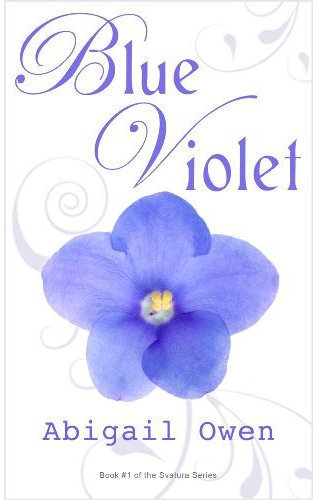
Terrific YA, urban fantasy, paranormal romance with a dynamic heroine
Blue Violet (Book #1 of the Svatura Series) by Abigail Owen

Reading Level: Young Adult
Release Date: September 17, 2012
Publisher: CreateSpace Independent Publishing Platform
Pages: 250
Source: Copy from Author
Reviewed By: Kate McMurry
Ellie Aubrey looks like a teenager, but she and her brother Griffin have been around since the Civil War. Though her paranormal race, the Svatura, live preternaturally long lives, Ellie's family and most of the Svatura on earth have been exterminated by their mortal enemies, the Vyusher. The Svatura need each other to thrive, but when more than two of them are in a particular place, they draw the Vyusher upon them. For that reason, Ellie and Griffin have been living lonely, isolated lives since they were actually in their teens. Then Ellie realizes she has a chance to unite with other Svatura. At great personal risk and over Griffin's strong objections, she moves to Estes Park, Colorado, and enrolls in the local high school in order to find and connect with them.
There are a lot of young-adult novels these days which are labeled "paranormal romance," but as a long-time fan of "traditional" romance (one love interest), I was delighted that the romance plot in this book is undiluted by a romantic triangle. I was also very happy that the heroine is strong (vs weak), dynamic and resourceful (vs passive), and that she and her love interest are equals (vs grossly unequal in personal power).
This urban fantasy has everything that good urban fantasy needs to have--whether for adults or teens: a sacrificial, powerful Warrior protagonist who gets into trouble because of personal integrity (rather than immaturity, narcissism or downright stupidity), a loyal cadre of friends (AKA a family of affiliation) who look out for each other, strong villains who provide plenty of conflict for the protagonist, and excellent fantasy world-building.
The romance plot in this story also has everything a good romance requires--whether for adults or teens: sympathetic romance protagonists who are clearly "made for each other" and are equals with the potential to make a viable mated partnership, a strong conflict keeping them apart that stretches the length of the book, and a well-communicated sense that their lives would be blighted forever if they were unable to be together.
The writing in general in this book is excellent, and I particularly enjoyed the fact that the author employed close-third with multiple points of view (POV) rather than the first-person POV used the vast majority of the time in YA fiction. While first-person has its advantages, in urban fantasy that is not an offshoot of the mystery genre (such as the Dresden Files and Mercy Thompson series
 ), close-third, multiple POV gives an added depth and breadth that can't be offered by first person. It is also a long-standing tradition in the adult romance genre to offer the male POV as well as the heroine's, and I am always grateful to YA authors who are willing to draw on that tradition to enrich their romance plots.
For those desiring to read the Kindle version of this book, it is well designed and well edited.
All in all, I found this book a pleasure to read, and I highly recommend it. I am very much looking forward to future books in this series.
I rate this book as follows:
Heroine: 5
Subcharacters: 5:
Fantasy World-Building: 5
Romantic Plot: 5[image error]
Action-Adventure Plot: 5
Writing: 5[image error]
Overall: 5
Disclosure: The author contacted me to review her book because I am a top reviewer on Amazon. I rarely accept such requests because I don't have a lot of time, but in this particular case I am very glad I did.
April 8, 2013
Book Review: Babe in Boyland by Jody Gehrman
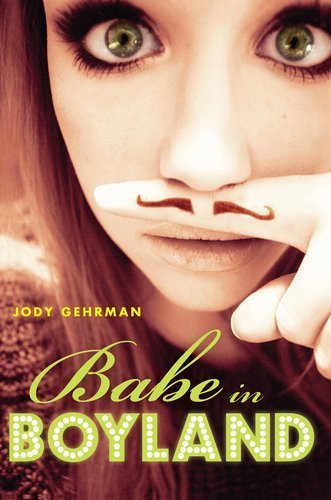 Excellent YA chick-lit comedy
 Babe in Boyland by Jody Gehrman

Reading Level: Young Adult
Release Date: February 17, 2011
Publisher: Dial
Pages: 304
Source: Copy from Author
Reviewed By: Kate McMurry
Natalie writes an advice column for the school newspaper under a pseudonym, and though the students love her column, her editor and his assistant treat her like a joke. Her pride on the line, Natalie decides to write a truly significant piece of investigative journalism in order to win an important writing contest to prove her worth as a writer. She goes undercover dressed as a male, calling herself Nat, as she infiltrates an all-boys school with the help of a brilliant preteen hacker.
This is a fast, entertaining and often very funny read. I love the heroine's sharp, snarky voice and, in general Natalie is an engaging heroine with a lot of spunk. There is a terrific romantic interest who is very sympathetic.
For people who enjoyed this book, you may also appreciate:
A Match Made in High School The Oracle of Dating (Harlequin Teen)
 The Oracle Rebounds (Harlequin Teen)
 As You Like It
 Triumph of Love
 She's the Man (Widescreen Edition)
 Just One of the Guys
Disclaimer: I received a review copy from the author, who contacted me as an Amazon top reviewer.
I rate this book as follows:
Heroine: 5
Subcharacters: 5
Writing: 5
Comedy Plot: 5
[image error]
Romantic Plot: 5
Overall: 5