
Yael Zofi's Blog, page 5
December 19, 2013
Introducing YaelZofi.com
Where you will want to look now for expert advice on Virtual Teams Management is YaelZofi.com.

I’m pleased to announce the launch of my new branding site full of resources to read, download, purchase and contact.
Through encouragement from clients and colleagues, I’ve designed an accessible and immediate site rich with content on my more than 20 years of experience as an HR professional, researcher and consultant. Over the course of the New Year, you will hear more about my work with virtual teams and the leaders and managers entrusted to guide them. I will rely heavily on the new site to provide this detail to you. New content will also be announced and shared through our social media venues including this blog and the AIM Strategies® Newsletter, so you can stay up-to-date via your preferred information source.
I won’t go into detail about the site here; instead, I encourage you to read the latest AIM newsletter and visit www.yaelzofi.com. Let me know your thoughts about the site as I hope to drive content based largely on your requests.
In addition to the new site, you may notice starting in January a few enhancements to this blog as a way of linking the multifaceted interests of our readership.
Here are a few highlights:
Virtual Teams – Virtual Teams is a hot topic for everyone and more relevant now than ever. We will continue to bring you the latest news, highlights and trends.
Featured Interviews – People who make a difference intrigue everyone and we will highlight those who impress us most.
Tech Talk Tuesdays – We want to know what’s out there, what companies and teams are using, and how you can access it.
Guest Authors – We have a lot of friends and some may surprise you.
Troubleshooting 101 – A new series that combines a case study-like feel with do-it-yourself suggestions full of tips and best practices all in a fast-paced and fun narrative.
Special Reports – Business moves fast and we want to be the source you turn to for insights on current events.
Newsroom Updates - Information on Yael’s speaking tours, interviews and workshops.
For great virtual team advice, check out Yael’s book, A Manager’s Guide to Virtual Teams.


November 19, 2013
Virtual Conflict Mediation – Part Three
Conflict Mediation in Virtual Teams
As a consultant I am always listening for overall themes or concerns that affect many of my clients. What I hear repeatedly, through my consulting work and from many interviews I conducted for my book, is that virtual managers need to get better at mediating conflict. Maybe that’s because in the virtual workplace these situations often have to be resolved by telephone. While it’s far better to conduct a sensitive discussion in person, the phone does allow real-time verbal communication.
Picturing the Three Aspects of Conflict
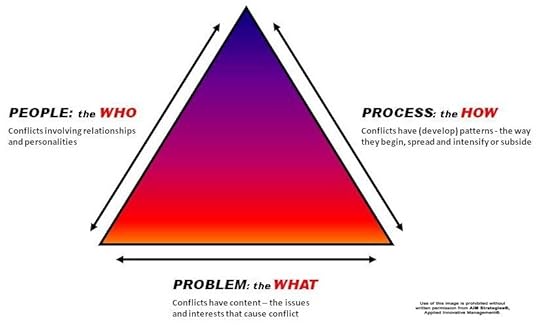
Before approaching a mediation call head-on, I advise taking a bit of time (a minute or two) to consider the three aspects of any conflict situation. I call this Picturing the 3 P’s of Conflict, which can be visualized below:
Virtual Mediation Techniques
Once you have thought about the 3 P’s, choose the best virtual mediation technique for that situation. Keep in mind, your role is a moderator assisting people to reach their own solutions. You can provide a valuable service in helping to prioritize next steps and creating alignment between actions and goals. Here are the necessary steps to take in any mediation …
1. Establish Your Role
Clarify your role as moderator
Clarify your expectations
2. Set Ground Rules
Deal only with realistic issues that are solvable.
Have everyone accept their own part in creating, promoting, or allowing conflict.
Request that participants openly and honestly express their feelings and thoughts without exaggeration.
State that labeling or insulting is off-limits.
Do not allow anyone to multitask during the session.
3. Guide the Process
Open the discussion by stating that the goal is to solve the issue, not to assign blame to any one individual.
Get input from everyone and acknowledge all ideas.
Present and compare ideas to foster discovery/dialogue.
Specify actions and gain commitment from all participants to the plan, going forward.
Remember to pay extra attention to your tone of voice and listen for inconsistencies in others (e.g., Do you detect uncertainty in their voice? Is anyone saying yes too quickly?). Following these few steps will lead to positive rewards. Not only will it help you better understand your team, but it will strengthen communication overall.
For more tips on resolving conflict hear Yael speak on the topic or visit Amazon to purchase a copy of her book, A Manager’s Guide to Virtual Teams.
October 29, 2013
The Price of Conflict Fallout

Last week I shared with you some tips for relationship management during conflict. This week I will cover common reactions in the workplace. As you know, conflict is an important issue that can divide or integrate a team. In the virtual workplace, it is even more prevalent, and that is why I dedicated an entire chapter to it in my latest book.
The Price of Conflict Fallout
Conflict takes its toll emotionally, physically and financially, especially when left unresolved. The key is to manage it immediately and purposefully as we covered last week. However, we must first understand our individual response before we can deal with the effect it has on our teams.
Common Reactions To Conflict
Common reactions include feelings of betrayal and missed expectations or a simple avoidance of dealing with the issue—any of which may lead to decreased productivity. Virtual employees might avoid a conflict because they do not know how to constructively handle it or they may be afraid of what confronting conflict would do to their reputation.
While conflict avoidance seems the easier choice, I’ve seen many negative consequences in the long-term when that happens. Sometimes employees become disengaged and don’t speak up, or they wait until things escalate to the boiling point. Subtle examples of conflict avoidance include hitting the mute button and multitasking while on a conference call; not paying attention when a question is asked; and, finally, total disengagement. These actions often result in loss of work quality and indifference; however, the greatest cost is the human cost.
Morale and energy suffer because employees are angry and frustrated. Still other reactions can come highly disguised and, like water, seep into team dynamics before anyone realizes it, corroding hard-earned bonds and destroying trust.
As a manager, it is critical to understand all levels of conflict and to identify the warning signs in individuals. This way you can respond quickly to restore balance. For more information, I recommend two books: “Business Ethics” by Richard De George and “Hot Buttons – How To Resolve Conflict And Cool Everyone Down” by Sybil Evans and Sherry Suib Cohen.
For more tips on resolving conflict, hear Yael speak on the topic or visit Amazon to purchase a copy of her book, A Manager’s Guide to Virtual Teams.
October 21, 2013
Hurt Feelings Can Hurt Business
Quick Tips For Conflict Resolution
 I have given many relationship management presentations where I show a picture of a man and a woman seated at a table. Then I ask participants, “What is your reaction to this picture? Is it good or bad conflict?” Invariably I get a mixed reaction. Some participants view conflict in a positive light because they see two individuals engaged, while others view it more negatively, seeing a struggle. Conflict is not good or bad; it’s how you approach it that matters.
Why is it important to manage conflict?
Differences in opinions are common. Some level of disagreement is healthy because it can generate ideas. However, misunderstandings can contribute to more serious conflict issues. When stress levels are high (as they often are in the virtual environment), conflicts are more likely to arise. Virtual team members often feel indifferent toward each other unless they previously took the time to explore commonalities and begin the process of team bonding.
How can you prevent paying the huge price of conflict and instead reap the benefits of a productive work environment? The first step is to lower barriers by learning how to turn conflicts into problem-solving opportunities.
The following are helpful tips for productive conflict management:
Accept conflict as part of organizational life. Observe and acknowledge what has happened. Make it a point to notice what is going on.
Encourage employees to speak up and ask for help in resolving conflicts. Coach them to understand their coworker’s point of view.
Prepare employees for conflict; invest in training so that employees will be ready and willing to take ownership of their conflict situations.
Take care not to confront someone in public (during a conference call, for instance). Address conflict in private with the appropriate individuals first.
Above all, choose your battles carefully. Don’t let the urgency of a request push you into giving an emotional response. Stay in control of yourself and calmly evaluate requests.
Excerpt from “A Manager’s Guide to Virtual Teams” by Yael Zofi.
For more tips on resolving conflict hear Yael speak on the topic or visit Amazon to purchase a copy of her book.
September 24, 2013
Managing Virtual Teams Successfully
Yael Zofi Interviewed on BlogTalkRadio
Tune in BlogTalkRadio, Wednesday, September 24 at 1:00 p.m. CST for a free podcast featuring Yael. The interview by Virtual Work Team LLC owner, Shilonda Downing will focus on a popular topic these days, Managing Virtual Teams Successfully.
Yael will lend her 20+ years of consulting and behavioral science techniques experience to this lively discussion on transformational initiatives to enable stronger human connection in the virtual workplace. In addition, she will share tips she’s learned in the field coaching global managers and their teams, as well as highlights from the interviews with 150 executives she conducted for her book, A Manager’s Guide to Virtual Teams.
During the podcast, listeners will have a chance to call in and speak with the host by dialing (714) 583-6872.
If you miss this podcast, the recording will be available via You Tube in the near future. Contact AIM Strategies at: mailings@aim-strategies.com for the latest information about this and other appearances.
September 11, 2013
It’s Your Virtual Hub: Is Your Team Connected?
 You can answer that question by asking another… Does it matter where my colleagues are as long as we get deliverables out the door? With technology enabling new paths of communication and data flow it becomes less important where you and your colleagues sit. By now, most of us know that the pace of change and innovation quickens, and we have to adapt to succeed in our competitive environments. If you are comfortable operating in a global environment, you’re ahead of the game.
Connected to … each other in a way that encourages people to rise above their differences and connect at the human level to achieve results. Successful organizations embed connection and a global approach at every level.
“It doesn’t matter whether or not you are a global manager, and it isn’t important if you don’t have a global assignment – you are global.”
Wise words from one of my favorite clients, a virtual team manager for a medical device manufacturer. He understands that today, whether or not you hold a leadership position, you need to practice a set of behaviors I call GlobaLeadership (GL). For more information, see Future of Leadership.
Think of yourself at the hub of a wide network of connections that enables your team to achieve competitive advantage. Since it is virtually impossible for one individual to excel at all dimensions, successful virtual leaders link team members who embody these seven dimensions:
Vista – leadership
envision the future business environment while being grounded, but not stuck, in the present
Innova – leadership
seek new ways to achieve competitive advantage by drawing on and expanding resources
Adapta- leadership
move in any direction at any time in any situation
Diversa – leadership
understand people’s cultural differences and leverage those differences as business strengths
Communi – leadership
foster open channels of communication and debate in every direction
Collabo – leadership
believe that people accomplish great things through collaborating with other talented people.
Edu- leadership
develop your best talent, with appropriate activities that enhance the individual and the organization.
For more information about the 7 Dimensions of Global Leadership, see a video where Yael discusses Future Leadership Trends on the ‘Global Resources Hub’, ‘Future Trends’ section of her website.
August 22, 2013
Back to Work – Get Things Done, Deliver Results!
DELIVERABLE MANAGEMENT LEADS TO HIGH PERFORMANCE
Results, results, results. Delivering on what is promised is what teams are all about. And managing that process successfully is an art as well as a science. When your team (or project) members are out of sight, how do you know if they are actually on the right path to get those results?
Really, the difference between ‘good’ and ‘great’ team / project management is in the delivery. Ask yourself, “What can I do to make sure my virtual team meets our milestones and completes the project?”
If you are responsible for delivering projects you’ll surely do your share of talking – but that’s not the whole story. You’ll have to get involved in the listening, questioning and coordinating. And this means cultivating three behaviors:
Aligning: Make sure everyone shares an understanding about expectations, and is committed to the same goals. Without alignment productivity can suffer … So make sure each and every colleague faces the same direction. Hint: keep things specific, clarify when something is due and keep communicating!
Tracking: Successful teams differ in their workflow, but they all engage in these four steps: establish standards, create measurable metrics, produce requirements documentation and hold regular status check-in meetings.
Establishing Frequencies: Once deliverables are aligned, and tracking / reporting mechanisms are set up, you’re ready for this final step. How often do you need to connect with our team, and how are you going to do so? This is the lifeline that allows you and your team to stay connected and equipped to deliver.
Lots of coordination goes into top-notch delivery, and if you stay focused on these three behaviors, your team will have a great shot at hitting every milestone. Coordinating deliverables is like conducting an orchestra. Virtual managers, like orchestra leaders, take a long, deep view of their resources and apply that knowing touch to get the desired result.
August 1, 2013
July 23, 2013
The 4 Managerial Styles & What They Mean To You…
 Employees who work effectively with their managers are sensitive to their boss’s work style while fully recognizing their own needs and styles. You cannot change your boss’s style, but you can become aware of what it is about him/her that facilitates a good work relationship. Through this understanding you can establish a way of working that makes you both more productive; in addition you can adjust your style in response to your boss’s preferred style.
What are these four styles? Although there are four primary categories of managers – TOPS: Trendsetter, Outgoing, Perfectionist and Stable – I said in my interview that “most humans are complex creatures who can have a little of each quality. Once you’ve figured out your boss’s style, you can come up with an appropriate approach.”
Most people would probably agree that managers don’t have to be liked or admired; however, it is your responsibility to manage your boss because s/he is your resource for achievement, and a major stumbling block who can thwart success.
Characteristics of The Four Manager Styles
Below are some characteristics that depict each style. It shouldn’t be too hard to recognize not only your manager, but yourself. (Remember, everyone has a combination of four styles; however, within the work environment, one style is usually more predominant than the other three.)
1. Trendsetter
Willing to experiment, likes change, is a risk taker.
Acts with self confidence.
Prefers variety and challenges to a routine job.
Takes on leadership roles. Is competitive and controlling.
2. Outgoing
Prefers flexibility, little control by others.
Communicates easily with many people.
Responds well to recognition; values helping people.
Loses focus and wastes time with too much talking.
3. Perfectionist
Wants everything to be right, in compliance with laws, standards, policies and procedures.
Dislikes chaos or unpredictable working environments.
Overly critical and demanding of self and others.
Always wants to find a better way to do something.
4. Stable
Avoids surprises.
Works/communicates well in a small group.
Works steadily on routine tasks; is neat and organized.
Needs detailed directions.
For additional details about how to develop a better relationship with your manager as well as practical strategies for working with each style please see TOPS™ Managing Up.
Yael Zofi
July 16, 2013
Why Managing Up Matters More Now Than Ever?
 Managing Up was always a sensible approach to one’s professional growth. With today’s economic conditions, heightened competition and evolving technology creating uncertainty and potentially fewer opportunities in the workplace, nurturing this key relationship becomes even more important.
You may consider yourself a reliable employee who produces high quality deliverables within budgetary and time constraints, but an uncomfortable relationship with your manager can work against your advancement. Even if you enjoy a good working relationship with him/her, there are always areas which you can improve, such as ways of communicating and handling differences.
Essentially, Managing Up is about creating a more successful working relationship between you and your manager. It is not about flattery or politics; it is about cooperating and building trust so that individual, shared and organizational goals can be achieved. More specifically, it involves being sensitive to the preferred work styles of your manager and adjusting your behavior to better facilitate a smooth working relationship.
Failure to “manage” this important work relationship can lead to missed opportunities to demonstrate skills, lost promotions, damaged reputations and even forced resignations.
For more information, check Yael Zofi’s book, TOPS Managing Up.



![[image error]Your Situation: You have too many projects on your plate. Your manager just gave you a new one which shares the same due date as another high profile project.Your manager’s preferred Behavior Pattern: TRENDSETTER 3. Your manager’s actions: Because the business unit became responsible for a new product, your boss assigned each team member additional various tasks required to meet the release date.Your actions (to date): You started working on it knowing that you have a full plate.Your planned strategy: Knowing he is a Trendsetter, keep him informed about the relative difficulty of sourcing supplies for the product (some went out of business overseas – complex instruments needed, with only 3 available suppliers). So you need to set up relationships with other vendors, and hopefully you can network across the organization to get practical insights.Your planned actions: Inform the manager – in his/her style – brief, direct – need to find new suppliers and establish quality control! Key Pointers: Think about what your manager says/does in specific situations and how you react.Then strategize/plan for ways you can manage him/her in these recurring situations.Be specific – think of a potential verbal response and or concrete action for each behavior exhibited by your manager.‘Managing Up’ effectively is a continual process where you work towards developing and maintaining relationships that are mutual. It’s not a one time fix. Yael Zofi](http://aim-strategies.com/blog/wp-content/uploads/2013/08/27_2520419.jpg)