Barbara Gregorich's Blog, page 7
April 30, 2023
Strange Appositives
It is passing strange that in my time as a blogger, I find myself writing about appositives twice. I mean: Really? How many people even know what an appositive is? And why do I end up writing about them twice?
But before I answer those questions, I absolutely must address my deliberate use of the expression “passing strange.” These words come from Shakespeare’s Othello, where the word passing is an adjective meaning exceedingly. So something that was passing strange was exceedingly strange. J...


April 14, 2023
The F Words: Quoting Myself

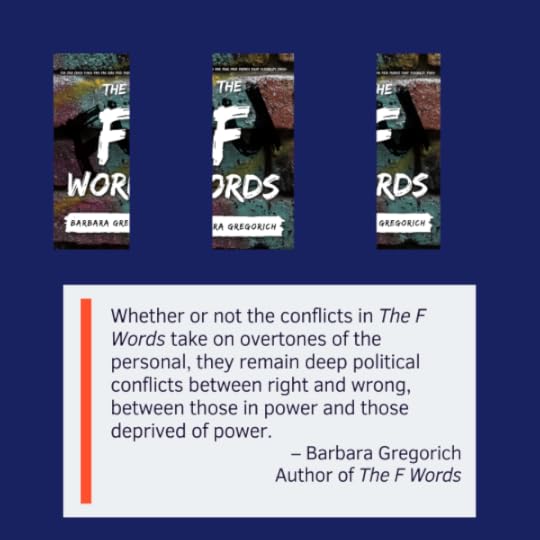
Authors are often called upon to come up with quotes. This is especially true if somebody (a fellow author, an institution, a journal of some kind) wants a testimonial or a capsule summary of something. I have often given such quotes, which are usually pithy (50 words or so) statements about whatever the subject matter happens to be.
But these statements are written or spoken right then and there, for that particular occasion or need. For example, a library might request, “Could you g...
March 31, 2023
My Writing Life: 12
In My Writing Life: 10 I said that I started a blog in 2014 and promised that I would write about it later. And so here I am, concluding this series on my writing life by talking about my blog, “Much to Write About,” on WordPress.
I started this blog because writer-illustrator-designer friend Robin Koontz kept encouraging me to do so. She pointed out that, unlike Facebook or Twitter posts, blogs live forever out there in cyberspace, and that search engines pick them up when people are researc...
March 14, 2023
The F Words: Framing Device
In literature, a framing device is a story that surrounds another story. That is, a novel begins with a story, and that story is interrupted by another story, told to completion. And after the inner story ends, the novel returns to the starting story and finishes that. Some examples of frame stories are Joseph Conrad’s Heart of Darkness, Mary Shelley’s Frankenstein, and Geoffrey Chaucer’s The Canterbury Tales. I call this the Hard Frame because it’s clearly two different stories, one within the ...
February 28, 2023
My Writing Life: 11
During the period from 2016 through 2020, I did more self-publishing, though not at the same rate as I had done in the first five years. In the first half of the decade I published nine books. In the second half, I published six books: three originals, and three compilations of already printed materials.
2016
I published no books in 2016: a welcome rest. That is the year that I decided to write my first YA novel, The F Words. I wouldn’t start on it until late 2017, but I definitely conceived i...
February 14, 2023
The F Words: The Freedom of Silence
For many writers, possibly most, the second chapter of a book is a big problem. One of the main reasons for this problem is that writers spend an inordinate amount of time perfecting their first chapters, this in order to grab an editor’s attention and make a sale. After all that energy and rewriting, one is exhausted and has no idea what to do with the second chapter.
Some writers really love flashbacks and secretly long to start their stories with this device. But it’s usually better to sta...
January 31, 2023
My Writing Life: 10
The 2010s were a new and very different time for me as a writer, in three important ways.
First, I dipped my toes into the world of self-publishing . . . and then I jumped into the enterprise head-first. Because I’ve blogged about most of my self-published books before, I won’t dwell on them. But I will quickly recap the ones I published in the period 2010-2015.
2010
The first of these was She’s on First, which I reprinted in February 2010. And then, in the fall of 2010 I published an exper...
January 14, 2023
The F Words: Anglo-Saxon Origins
When I see high school students raising protest signs and chanting in support of their teachers, as in the strike (earlier this year) by the Minneapolis Federation of Teachers, I’m heartened. And when I see that the student chants are poetic in form (We ain’t shy./We ain’t timid./We are angry./We are livid.) I’m more than heartened: I’m delighted. Students are using their knowledge and understanding, as well as poetry, to fight for what’s right. This definitely reminds me of my student days duri...
December 31, 2022
My Writing Life: 9
When the new century arrived, I was busy working on children’s books, both fiction and workbooks.
The fiction consisted of two early readers, Waltur Buys a Pig in a Poke (Houghton, 2005) and Waltur Paints Himself into a Corner (Houghton, 2006). Early readers, as I’ve written about before in “Early Readers: A Short Phase,” are one of my favorite levels of all children’s books, and I was delighted to have my stories illustrated and published. In addition I enjoyed the school visits I made to ta...
December 14, 2022
The F Words: Following the F Words
It stands to reason that, before I sat down to write a YA novel titled The F Words — in which a teen who tags his high school wall with the F word is required to write two poems a week, each about a word that starts with the letter F — I would make a long list of F words. So that when teen main character Cole Renner writes his F word poems, I would have a large supply of such words to draw on.
And it further stands to reason that — even though Cole attends a multi-cultural working class high...