
Sarah Cawkwell's Blog, page 6
December 10, 2015
Dear Mum (2015 Edition)
Dear Mum
And around it comes again. Fifteen years since we lost you, fifteen years that have gone by both in a rush and which have dragged. So many changes, so many good times, so many lows.
Life, they say, goes on after you lose someone and that’s certainly true. But the pain – whilst it may fade – never really goes away. When Jamie collected his GCSE results, when he did so well, I was heartbroken that you weren’t there to share in his success. I was sad that you will never get to meet him as he is now: a nice, sweet, kind young man with a wicked sense of humour not so far removed from yours.
I have been quite low these past few days with the build-up to today. I know it’s a self-fulfilling prophecy to make myself sad before the event, but I’ve woken up this morning and after a moment of reflection have realised that I’m actually OK today. OK doesn’t mean I don’t miss you, I miss you several times a day, every day. What I wouldn’t give for an opportunity to talk rubbish on the phone with you again. But I learned a long time ago that lingering on ‘I wish’ won’t help the healing process.
Struggling to find my Christmas head this year. However, as it’s… Today… the tree will go up tonight. I suspect that may help me locate some of my Christmas cheer. It’s for you. It’s always for you, and Jamie always insists on having that little fibre-optic tree you bought for him the year you died. He puts it up in his room and in his own words, ‘it’s like having a piece of Nanna with me’. For a boy who wasn’t even two when you died, that’s immensely touching.
This year’s not been without its highs and lows, but when you do an annual letter, you start to realise that’s not so unusual. I’m hoping it’ll end on a high, because I’m quite fed up of being sad. Some stuff happened over the last twelve months that’s really dented my sense of self-confidence and it’s a hard thing to come back from… but I’m trying.
Fifteen years.
Gosh.
But… I will put a smile on my face and work through today, as I’ve done every year since December 10th, 2000. For the people around me it’s just another day, and that helps to put things into perspective. But for this moment of heart-pouring, of letter writing and communication with memories, it’s just you and me.
Love you, mum. Always did, always will.
Happy Christmas!
Sarah
xxx


March 13, 2015
Sir Terry Pratchett – 1948-2015
���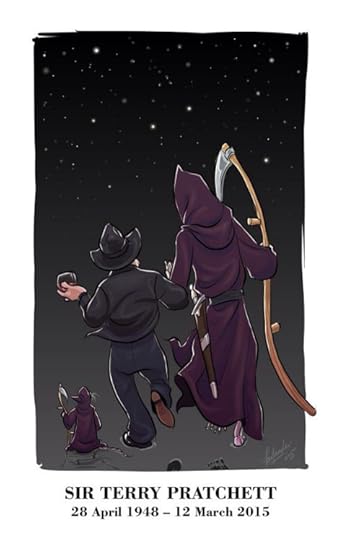 ���
���
It was my extraordinary privilege to meet Sir Terry Pratchett (or just ���Terry��� as he was then) several times during the course of my late teenage and young adult years. Each one of those meetings was extraordinary for different reasons. Each memory of those meetings is precious, even more so in the wake of his death.
Not long after the publication of ���Equal Rites��� Terry[1] was signing copies at the local bookshop in Crawley. He was not really a household name at this point and a small trickle of people came up to him and got their books signed. I had read his previous works and in a twist of annoying fate, had purchased my copy of ���Equal Rites��� a week before, down in Chichester whilst at college. Being an impoverished student, I asked him if he wouldn���t be offended if I got him to sign something else rather than buy another copy of the book. Honesty, I reasoned, was the best policy.
He laughed warmly and signed the only thing I happened to have at the time ��� the inside sleeve of a set of photographs I���d just had developed in town that day. We started chatting. Easily, without it being forced or in any way false, we discussed Discworld, my love of reading and writing and a plethora of other things.
���Don���t start writing until you���re in your thirties or forties,��� he told me. He was like a wise Buddha giving me a life secret[2]. ���Live a little. Have some Experiences.��� Terry Pratchett was the only person I ever met who could effortlessly pronounce capital letters.
Some years later, at the first ever Discworld convention, I met Terry again. I caught him at the bar when we were ordering at the same time. We exchanged a quick word ��� like you would ��� and I bought his drink for him. He was delighted. So was I. I don���t ever deny there was a bit of fangirling going on.[3]
Later on in the weekend, there was a series of short scenes acted out by various delegates from the books. Myself and a few others engaged in this wholeheartedly and we were assigned the ���job fair��� scene from the beginning of ���Mort���. But we were one character short. We needed someone to play the boy who gets selected to be the idiot.
In a rare moment of assertiveness, and on seeing a familiar hat walking through the door of the room where we were creating this theatrical masterpiece, I decided there and then that I would ask Terry if he fancied being an idiot.
���You can���t do that!��� My companions were aghast.
���Watch me.���
I could. I did. And with great joy at being involved, Terry put on a beret, rolled up one trouser leg and stuck his tongue out in Benny Hill style for our little scene. Somewhere, I have a photograph of that. I must locate it. It was stupendously hilarious. And rather than accept our gratitude for his involvement, he gave us his ��� for involving him and letting him have a moment to ���give back��� as he put it.
The third meeting was when he, his wife and daughter were attending a performance of ���Guards! Guards!��� when it had first been adapted for the stage. I don���t even remember where that was. Reading? Somewhere like that? Lovely little theatre and it was alarming to realise that the Pratchett family were sitting right in front of us.
There was easy joy in watching him laugh at words he had written himself and which were being brought to life with fantastic effect on the stage. At one point, he turned to his wife and said ���Did I write that? I was on form that day!���
Every time I met Terry, he was warm and delightful. There was such wit and intelligence in his words and his observations. The cruelty of the illness that robbed the world of his talent was a nasty, spiteful irony. An embuggerance, even. But he didn���t give up. He never gave up. He fought against it. He raged against the machine. He championed the cause of assisted suicide. He gave so much of himself and his time and his talent to raise awareness and then��� well, I can only assume that he simply outgrew this life. Wherever he���s gone, their lives will be enriched in the same way ours were.
It���s easy ��� and true ��� to say that he was ��� and will remain ��� one of the most inspirational people I have met during my lifetime. His long-ago words of wisdom, his willingness to participate in something verging on the ridiculous[4], his laughter at the sheer comedy of his own words left a great impression on me. I am immeasurably grateful for both the gift of his works and the pleasure of having met him those few special times.
I will miss him, but whilst I have his books on my shelves, he���s still there and he always will be.
His final Tweets, posted in the wake of his death by his assistant were both delightful, sad and very, very Terry.
AT LAST, SIR TERRY, WE MUST WALK TOGETHER.
Terry took Death���s arm and followed him through the doors and on to the black desert under the endless night.
The End.
Rest very much in peace, Sir Terry. And make sure you get that curry.
[1] I���m sure he wouldn���t mind me calling him Terry. If he does, somewhere he���s searching for a pointy stick with which to poke me.
[2]A wise Buddha in a hat and with a devilish twinkle in his eye.
[3]At least it wasn���t like the first time I met Graham McNeill and utterly embarrassed myself with an unintended and yet decidedly mega double-entendre that sent me as red as a post box.
[4]Unlike a virgin on the ridiculous, which is something entirely different.


December 10, 2014
Dear Mum – 2014
Dear Mum
Well, here we are again. Another year’s gone by and if I’m honest, there’s not all that much that’s changed. You’re still not here and fourteen years later, that still makes me alternate between sad and angry. I didn’t sleep well last night; the wind was lashing the rain against the windows and I could only lie awake thinking of you. This means I’ve woken up feeling a little on the gloomy side. I have to spend a day at work and I’m fairly certain it’ll only take one person to observe that I’m ‘a bit quiet today’ for it all to come out. I’ll try not to, though, there’s a colleague who lost her own mum earlier this year in that same sudden way we lost you. It’s far more raw for her than it is for me and I try, at least, to be considerate.
What has happened this year that’s worthy of note? Well, I’ve had two more books published, including the Plantagenet one I mentioned to you last year, and another Space Marine tale. I’ve decided to take a writing break, though. I essentially wrote four novels back-to-back over a two year period and tying that in with a day job means I was pretty wiped out.
Ben and I went back to LRP this year. I still can’t get over the warm welcome – people’s genuine pleasure and kind words made me a little tearful. It was great to go back without the pressures of trying to please all the people all the time (when it’s a fact that when it comes to LRP folk, you can’t please any of the people any of the time). I had fun.
Jamie took his first GCSE in the summer: Core Science, for which he got an ‘A’ grade. I was pretty proud of him, I can tell you. He has the rest to look forward to in 2015; and he’s received his conditional offer of a place in sixth form to do his A Levels. He has plans to go to University and study biomedical engineering and I believe he will completely do that. He’s that type: sets his mind to something and *bang* achieves it.
He’s sixteen in February. Practically an adult.
I took up a twelve-month secondment which I started in September. I’m hoping wholeheartedly that it becomes permanent, because whilst my previous job was pretty enjoyable, this one is better suited to my skillset. However, it will be what it will be and in the current economic climate, it’s good to have a job at all. I’m grateful for that, and the fact that I can provide a roof over our head and feed us every week.
There’s been some bad stuff this year as well. None of it as bad as this day fourteen years ago: I consider that the benchmark for ‘bad stuff’, but some of it so hard to deal with that I cried for days. I’m still pretty sad over some of those matters, but I think I’m coming out the other side. The short version is that the lessons learned from various things that have happened this year are: I should learn to trust my instincts, I should say how I’m feeling sooner rather than later, and that there will always be people who don’t give a damn about how their behaviour might affect others.
Back to the good: we have good friends in Lincoln and we spend lots of time with them and they spend lots of time with us. I’m starting to think that, once Jamie goes off to University and I’m no longer tied to the North East, I might well start giving thought to a relocation. Again, it will be what it will be – the housing market isn’t exactly a seller’s place just now, but I’ve been in this house for ten years (this week!) and I know that my mortgage statement should be a pleasant surprise this year.
We’ll be putting the Christmas tree up later, the ritual of the last fourteen years that I have come to insist upon. I’ll pop by the supermarket and get mince pies and we have a bottle of mulled wine in the house. Tonight, I will remember you – although I do that all the time anyway – and be grateful for the fact I got to spend so many years with you.
For the first time in a few years, I’m getting a little bit teary as I write this. I think it’s probably my cue to stop and go to work. I will be thinking of you and missing you.
Always love you, mum.
Sarah


November 24, 2014
The Restless Dead – Part One
I should quit smoking.
They were strange words to be thinking when he was running for his life down the river path, the pounding of his pursuer loud in his ears, but there they were. Random, pointless words that had absolutely no right being in his head. He should quit smoking. Because then, he wouldn’t feel as though there was a raging inferno burning in his lungs and he might – might – just be able to run that little bit faster.
He could hear a variety of sounds behind him, each individual one conjuring up a greater overall vision of abject terror. His imagination, healthy and very active, thank you very much, had already gone into overdrive. And yet he knew. He knew categorically that the reality would be far, far worse. He wasn’t going to turn around to verify it though, oh no. He wasn’t going to fall for that old chestnut. He’d seen enough horror films to at least have an inkling of what he was doing. Turning around to see what was chasing you never ended well.
The snarls that left his pursuer’s throat were wet in tone, made thick with drool and saliva. The sound of claws scrabbling against the dirt and stone of the rough river path most certainly belonged to massive paws. But probably the worst thing of all, the most horrendous contender for ‘noise of the night’ was the panting. It wasn’t the panting of a dog attempting to cool down. It was the panting of a creature hungering for his flesh, blood, bones and probably a few internal organs as appetisers.
The moon, full and bright, disappeared behind a cloud and the river path fell into complete blackness. The sounds of pursuit slowed, all six running feet reducing their speed momentarily. Without the light of the moon, both hunter and hunted were temporarily blinded. The difference, the running man knew, was that he wasn’t gifted with a supernatural sense of smell. It wasn’t going to be him who adjusted to the new levels of light in the space of a few heartbeats.
Adrenaline pushed past the screaming in his lungs and gave him a new burst of speed as he willed his legs to pump harder, to run faster, to carry him to safety.
I really should quit smoking.
Six Hours Earlier
‘Afternoon, Mister Flanagan.’
Ed looked up from his newspaper and grunted acknowledgement. He looked back down for a moment, then realisation kicked in. He raised his head again and there was something almost pleading in his eyes.
‘Dennis? It’s not that time of the month again already is it?’
‘You really would benefit from a calendar,’ said the customer in a light, scolding tone. ‘Or get yourself one of these new fangled electronic thingies. An Orange, or a Banana. Some sort of fruit, anyway.’
The irony of you saying that…Ed coughed suddenly, not entirely sure that he had not just said that out loud. But his customer didn’t appear to be deeply offended and carried on with his little lecture. “I’ve heard that those electronic doo-hickeys do just about everything short of making the tea for you.’ Ed folded his newspaper and took his feet off the counter.
He had seen four customers all day. Three of them had come in thinking he sold video games. He had briefly attempted to engage their interest in outdoor pursuits but that had resulted in the kind of looks that could slay nations. It had also invoked a slew of expletives that he had never known at that age. With the infinite patience of a man dealing with People Like That all the time, Ed pointed them up the stairs to the market. Then he returned to contemplation of the tabloid rubbish that so entertained him.
‘Well, this is nice,’ said Dennis, taking one of the fly fishing rods from the wall and bending it to test its suppleness. He was a mild, unassuming-looking man. The sort of man who, in books, would likely be described as the type who wouldn’t say ‘hello’ to a goose – never mind ‘boo’. Receding sandy hair formed a near-halo around a high forehead and his myopic green eyes blinked at the world through thick glass lenses. He was heavily set, the evidence of too much enjoyment of pie and peas at the weekly darts matches he played.
Ed knew Dennis very well. He was forty nine years old, married to an equally unassuming, yet remarkably angry woman called Barbara. He had two children. Ed didn’t know their names. Dennis had told him once, but he was so infernally dull that without really meaning to, whenever he spoke, Ed had sort of tuned him out. When Dennis spoke of his home life, Ed heard white noise.
Dennis flexed the rod a few more times, then put it back carefully on the rack. It teetered there precariously for a moment or two before promptly falling off. A second or two later, the others followed. They fell to the floor one at a time with a surprisingly loud noise until the carefully laid-out display was strewn across the dusty concrete of the shop floor. Dennis blinked down at the chaos he had wrought and took out a handkerchief. He removed his glasses and anxiously cleaned them. ‘Ah, sorry. Should I just…?’
‘Don’t worry about it, Dennis. I’ll sort it.’ Ed unfolded from his lounging position and moved across to recover the fallen items. He was tall; lean and rangy with whipcord muscles honed from the hours of training he put in. Dennis blinked up at him, then perched his glasses back on his nose. He hesitated a moment or two, then spoke.
‘I’ve got it, this time,’ he said, lowering his voice surreptitiously. ‘I know exactly what I need to catch the blighter.’
‘You said that last month, Dennis.’ Ed grinned in a friendly sort of way. He knew, deep down, that he really shouldn’t humour the man, but he couldn’t help it. Dennis was so set on making the catch of his life. ‘And the month before that. In fact, you’ve said this to me every month for the past two years.’
‘I mean it this time,’ insisted Dennis. He nodded sagely and peered up at the lanky Irishman. ‘But I’m going to need your help this time.’
He took out a brown envelope from inside his tweed jacket pocket and slapped it down on Ed’s counter. There was a faintly triumphant expression on his face which lost some of its impact when the envelope knocked over Ed’s mug of tea. In a few brief seconds, the fishing flies that Ed had been tying that afternoon were swimming forlornly in a brown, murky puddle as though trying to attract some kind of lesser-known tea trout.
‘Oh, I’m sorry… should I just…’ Dennis made a move as though he would clean it up, but Ed held his hand up to forestall him.
‘No,’ he said, wearily. ‘No, Dennis, it’s alright. I’ll sort it.’ He picked up the envelope, saving it from certain tannin doom and peered into it. He pulled out the contents and studied them thoughtfully.
‘Please tell me this isn’t the money you were putting aside for your second honeymoon, Dennis?’
‘Of course not!’ Dennis was almost comical in his indignant rage. ‘Do you think Barbara would…’
‘Dennis?’ Ed had a hard edge to his soft Irish brogue that was all business. ‘Is this the money you were putting aside for your second honeymoon or not?’
The little man seemed to sag visibly. ‘Yes,’ he said, sadly. ‘It’s that money.’
Ed shook his head and put the cash back into the envelope. There was a lingering sense of regret; he could have used the money, certainly. But he had limits and incurring the wrath of the terrifying spectre known as Barbara was way over the line. ‘I can’t take it. I’ve met your wife, Dennis, and of all the ravening monsters and terrors I could imagine, she’s by far and away the most unnerving. No.’ He put the money back in the bag. ‘Go on your second honeymoon, Dennis. Walk across the sand at sunset. Sip tropical punch beneath the shade of a parasol…’ Something faintly wistful came into his tone. Once, he had promised to take his wife to the Caribbean when he could afford to.
‘I don’t know that you can get tropical punch in South Shields, actually, Mr. Flanagan.’ He paused. ‘Although, there is that new curry place. Maybe…’
Ed sighed and held his hand up again, forestalling another tangential diatribe.
‘Tell you what, Dennis. How about we worry about the money later? And as for the tropical punch. Let’s not even go there. Tell me what your plan is, Dennis.’
Dennis told him.
In hindsight, Ed should never have asked. If he’d just said ‘no’, he wouldn’t, six hours later, have been running for his life along the banks of the River Wear.


October 21, 2014
All Work…
Well, this has been quiet for a while, hasn’t it? This is in part due to a combination of real life pressures, general apathy and a lack of anything remotely interesting to discuss. But there’s something that I was talking about yesterday that’s prompted me to write an entry.
First of all, as I’ve mentioned in passing on my Facebook and Twitter feeds, I’ve decided to take a step back from writing projects for the time being. After writing four novels in less than three years, three of those practically back-to-back, I found that I was pretty exhausted. With a full-time job, a family and other external pressures, it’s been hard to throw myself into it as fully as I might otherwise have liked. So a rest is kind of welcome. I even sat there the other night reading a book for the pleasure of it and it feels like ages since I last did that.
I also returned to LRP this year and realised just how much I missed both the fun and the people and it’s that, in part, that I want to talk about in this entry.
I had a physiotherapist appointment yesterday and Greg, my very nice (and exceptionally brutal) physio asked if I had any energetic hobbies. So I said ‘Live Action Role Playing’ and, joy of joys, he knew what it was. For once, I didn’t have to try to explain it. I’ve heard people use all sorts of ways to try to summarise it:
1) Cross-country pantomime;
2) ‘Like paintball, but with swords and stuff’;
3) Lord of the Rings-style… thingy
For me, the phrase I prefer most of all is my own. ‘Let’s Pretend for grown-ups’.
I have long held to the belief that grown-ups should have playtime. When you are at school, they encourage that break from the grind to let you run around aimlessly letting off steam in whichever way you prefer. When I was at primary school, this ranged from playing ‘Red Rover’, or skipping, through to the summer joys of handstands, cartwheels and ‘British Bulldog’ on the school playing field. On quieter days, I loved nothing more than lounging beneath the beautiful big tree at the top of the field and creating pictures in the clouds.
At secondary school ‘playtime’ became ‘breaktime’ and once we hit thirteen or so, largely consisted of groups of Trendies gathering together in secretive knots that never untangled to let me in. For a handful of us misfits, bullied and awkward, breaktime meant freedom from the torment and a hiding in the drama studio where we picked scenes from plays and did little lunchtime readings. Or talking about the Trendies in the safe knowledge that the drama studio wasn’t a Cool Place to Be.
I remember well the games of ‘Let’s Pretend’ I had as a child, mostly played out with my neighbours-but-one, Darren and Lindsay. Over the years we created stories and characters of startling complexity when you look back at it. Sometimes we acted as characters from favourite films of the time, but mostly we just created our own characters. We were always a family, the two sisters and the brother. Our playground was the patch from the back path of our terrace down to the alleyway and it was variously an ocean, a mountain range, the plains of the Western USA… the year we slid into the farmer’s field beyond the copse and built a castle out of grass cuttings still lingers in my memory.
Now there’s houses being built on that field, just as there are houses on my old school playing field. My tree is still there, though, and that gladdens me.
When you become an adult (according to the conventions of society), and enter the world of work, you get a lunchbreak. You usually take it at your desk whilst still working. Sometimes, I gaze out of my window at the clouds. I still paint pictures in the sky. (As I type this, there’s an elephant out there). What happens to playing?
Those of us who engage in roleplaying games of any kind, tabletop or MMO or LRP are given a connection to our creativity that is horribly stifled in adults. I had missed the freedom of being someone else for a few days, not just in thought, but in action and body. Sarah would never dream of being as adventurous and daring as Morwenna Kerrow turned out to be. Sarah would never have thought she could stand in a ritual circle and be a part of an exceptional success ritual for which the preparation was ‘we need to do this ritual, off we go’. But Morwenna didn’t think twice. Sarah would never have put complete trust in a strange priest of an unknown heritage. Morwenna didn’t think about anything but her drive to obtain a greater understanding of the world.
It’s an escape of the best kind: a freedom. An unspoken acceptance amongst like-minded people. A playground.
I still firmly believe that if workplaces had playgrounds, the grown-ups would be out there on the hopscotch in a flash. There’s all these soft-play centres for kids opening up in industrial units, where are the soft-play centres for adults? I’d go. And I bet most adults, if given the chance, would do the same. (Case in point – adults on bouncy castles. ‘Nuff said).
Why does society expect us to just switch off the need to play? Well, guess what, society? I’m pinging an elastic band in your face.
(The elephant-cloud’s gone. There’s a giant lobster up there now).
So… go outside and play.


August 6, 2014
Batteries Not Included (GotG)
Little Guardians of the Galaxy vignette. Not particularly spoiler-heavy, but with at least one plot detail that those who haven’t seen the film or who know nothing of the back story might wish to avoid. Hence… Cut.
Batteries Not Included
Adaptability. If pressed, he knows he probably couldn’t spell it, but he knows what it means. It is something he is going to have to start demonstrating pretty soon.
Peter isn’t sure how much time has passed since he has found himself… wherever he is. A few hours, perhaps. There is no night or day in this place – and even if there were windows for him to look out of, all he would see are the stars. So judging time is something he can only gauge. Hours? A week? Perhaps. More? Who knows.
He is still not convinced that this isn’t all some weird-ass dream. For several hours after he was “beamed up”, possibly by Scotty, all he has been able to do is lay on the hard, uncomfortable bed in the tiny room he’s been thrown in. He speaks to nobody. Not that anybody comes to speak to him. Left to his own devices, he has convinced himself that this is some kind of hallucination brought about by the shock of his mother’s death. It will pass, he keeps reminding himself. In a minute, you’ll wake up, face-down in the grass. Grandpa will be there. Everything will be fine. Apart from Mom. She’ll still be gone.
That alone, Peter Quill establishes early on, is reason not to want to wake up.
He hasn’t seen a single face since his abduction. He’s heard voices on the other side of his room, but they are quite literally alien to him. Languages have never been his strong point. He has hammered against the door, screaming childish threats, all to no avail. He refuses food, despite the gnawing hunger in his gut. Dreams, he asserts to nobody, because nobody listens, don’t give you food. Even if they do, the stuff is probably poison. Look at it.
He looks at it, innocuous on its tray in the corner of the room. They – whoever the hell they were – pushed the food through a small opening in the (very locked) door. Words were spoken. He didn’t understand them, but they were probably ‘food’s up’.
The ‘food’ that’s left for him three times a day, piled neatly on small trays, look like cubes of Jell-O. It even has the same texture. He knows. From time to time, he pokes at it. It wobbles back at him. Peter loves Jell-O, but this is poison. Alien poison. He won’t have any part of it.
He is hungry.
He has, much to his shame, cried. Quite a lot. But in his misery, he justifies it rationally. He is only a kid. His mother has just died. He has just been snatched out of the life he knows by person – or persons – as yet unknown. He’s not seen the face of the (presumably) aliens who have taken him from Earth. They took his backpack away from him and that, he knows, is the worst thing of all. Everything he has left is in that bag. He has never wanted his assorted treasures so much as he does right now.
He wants Awesome Mix # 1 back.
He wants his mother.
He cries again.
In the end, the tears dry up and a child’s curiosity takes over. Deep down – very deep down – there is a grudging sense of excitement. If this isn’t a dream, then he is on board an alien spaceship. That is… well, frankly, that’s pretty cool. He pokes around the small room. There is a bed, the table on which the Jell-O cubes currently sit and a panel on the wall that defeats him. He presumes that it can somehow turn lights on and off, or maybe launch nuclear weapons, but nothing he does to it seemed to make it function.
Further exploration reveals a small room accessed through a sliding door where he finds facilities to clean himself up and deal with other necessary bodily functions. Bathrooms, it appear, are of a near-universal design. He has been raised on a diet of science fiction TV shows, and like any other healthy kid, he has always wondered what aliens did when they were caught short. Now he knows.
They go to the toilet.
It is a bizarrely crushing disappointment. It will be the first of many such disappointments over the course of young Peter Quill’s life, but he doesn’t know that at this stage.
And so the cycle goes on. Food appears three times a day and by his calculations, he is into the fourth day before he finally caves and tentatively eats one of the cubes. It looks like strawberry Jell-O. It tastes like cardboard. But after he’s eaten it, he doesn’t feel quite so weak and scared any more. He eats a second cube. That one tastes like wallpaper paste.
Over the next two days, his tastebuds adapt. The cubes start to taste like things he imagines they should taste like. First of all, there is a hint of sweet, artificial strawberry flavour. Then one cube tastes like tomato soup. Another has a definite hint of French fries. But no matter how hard he wills it, they never taste like hot dogs.
On the seventh day, Peter is eating the food cubes with relish. It is also on the seventh day that he first comes face to face with Yondu Udonta.
When the door to his cell slides open, Peter’s instinct is to run. He doesn’t get past the vice-like grip of the blue-skinned alien who stretches out an arm to grab the child’s arm. The man says something Peter can’t understand and he struggles, crying and lashing out. The things he promises he will do to his captor would be amusing… if they spoke one another’s language. But sometimes, words are not needed. The alien holds onto the struggling boy for a while longer before reaching into a pocket.
He is wearing a coat that looks to be made of leather, but mismatched and patchwork: many different colours, many different textures. Many different creatures that he has killed, skinned, tanned and stitched into this outfit. Despite himself, Peter is intrigued. The alien is humanoid in shape, maybe five nine, five ten, with clearly discernible eyes, ears, nose… the other facial features that Peter knows. A distinct lack of razor-sharp teeth and/or tentacles.
Small mercies.
Peter stops struggling, realising the utter futility of it. Besides, he has seen what the alien has taken out of his pocket. It is his Walkman.
“That’s mine, you son of a…” he begins to say, but the alien just smirks at him. He hands the machine over and Peter snatches it, running back to his bed. He clutches the Walkman to himself protectively, crooning at it like he would over a returned pet. “It’ll all be OK now,” he murmurs. “It’s all OK.”
Defiantly, he jams on the headphones, raising his head to glare at the blue-skinned alien who is watching him. There is a faintly amused expression in the blood-red eyes and Peter finds this incredibly irritating. He presses down the play button.
Nothing.
The batteries have gone flat.
He is only a kid, but the following thought races through his head.
I’m in the depths of space, on board a ship of aliens I can’t understand, with no hope of rescue, and my Walkman’s all out of power. I’m no expert, but I’m thinking that asking for four AA batteries isn’t going to cut it.
Wait. They’re aliens. They have a spaceship. They’ll have some sort of method of powering it. I just need to ask. If they don’t eat me first.
He presses the stop button. He takes off the headphones. He looks up at the alien. The blue-skinned man takes a step towards him. In his other hand he holds what looks like some sort of gun. He shows it to Peter, then he raises it to his neck. He pulls the trigger. There is the tiniest crack noise, but the alien does not keel over. Neither does his head explode. Peter is just a little disappointed.
The alien holds it out towards Peter, a questioning look in his eyes. He opens his mouth and speaks, the alien language confusing and disorienting. Peter shakes his head.
“I don’t understand you,” he says. “I want to go home to my Mo… to my grandpa. I want to go home.”
Even as he says it, he knows two things with absolute certainty. They won’t take him home. And he doesn’t really want to go home. His mother was his life. Without her, he has nothing worth going home for.
More alien gibberish. The alien waves the gun-thing at Peter and there is an understanding that he is expected to take it and shoot himself.
In the neck.
With an alien’s gun.
What the hell, thinks the child. This can’t get any more weird. And what’s the worst that could happen?
He takes the gun and he shoots it into his neck, just as the blue alien did. There isn’t any pain, but his vision briefly swims out of focus. As it sharpens up, Peter realises that the man – it’s easier to think of him that way – is still talking. Only now, he’s making sense.
“…translator chip. Can you get what I’m saying yet, kid?”
Peter stares at the gun. He stares at the alien. He stares back at the gun.
“Are you dumb? Stupid? Either or both? C’mon, kid, I know you can understand me now.”
He does understand the alien, but he doesn’t understand how, or why. Peter Quill begins to realise that he is entering a world where asking the questions ‘how’ and ‘why’ are likely to get old really quickly. He decides not to ask. To be nonchalant. To pretend he knew all along that all he needed to break the language barrier was to inject himself with alien technology.
“You Peter Quill?” The alien knows his name. Of course the alien knows his name. It’s stitched into the inside of his backpack. He nods, warily.
“Yeah.”
“Good. We got the right kid. Name’s Yondu Udonta. We’re taking you to see someone who’s very interested in you. Co-operate, and we’ll treat you just fine. Play up, act like a spoiled brat and…” Yondu shifts aside the coat for a moment and Peter catches a glimpse of what looks like an arrow in a holster at his waist. “…we won’t.”
He smiles, a slow smile that is anything but friendly. But Peter is a smart kid. He adapts fast.
“Yeah, you know what? I think I’ll behave,” he says. The snarky response brings a short, barked laugh forth from Yondu Udonta. It’s progress and Peter gets brave. “But I want something. Actually, I want a couple of things.” Yondu’s nearly invisible eyebrow quirks.
“Makin’ demands already? I like the way your head works, kiddo.”
“I want my stuff back.”
“Sure. There was nothing of value in there anyway. Brought you that thing…” Yondu points at the Walkman. “…because we thought it was maybe your personal translator. Ketchu listened to it for hours, but couldn’t understand what was being said. Although now he keeps claiming he’s a Ch-Ch-Ch-Ch-Ch-Ch-Ch-Cherry Bomb.”
That’s why the Walkman had stopped working.
“What else d’you want, kid? Food? Money? Clothes? I admit you’re the first Terran I’ve ever met, so I ain’t sure we can cater much for you. But you seem smart. You’ll adapt. What d’you want?”
Peter smiles. He holds up the Walkman, brandishing it like some kind of trophy.
“What do I want? I want four AA batteries. It’s the least you owe me.”
There is silence and Peter’s smug. He’s confused the alien. It feels like he’s scored a point. He experiences yet another moment of disappointment when Yondu smirks at him.
“Not a problem,” he says. “Four AA batteries. To power your Cherry Bomb, right?”
“Right,” he says, and lowers the Walkman. “You know what they are?”
“Sure I do,” says Yondu. “We took ‘em out of the thing in the first place. Here’s your first lesson, kid. Whenever you come across somethin’ new – you learn fast. You can have that one for free. We’ll rig you up a power unit that’ll do the job. In return, you can tell us more about Terra. And if you behave, we’ll teach you a few things. And I will make sure the crew doesn’t eat you.” Yondu’s smile is only slightly less terrifying than before?
“Deal?”
Peter pauses. Then he nods.
“Deal,” he says.
It appears that young Peter Quill has a lot to learn about the universe and his lessons are starting right now.


July 1, 2014
Help Wanted – Apply Within
I haven’t updated the blog much of late. Or even remotely recently, if I’m honest. But for once, I find a subject that motivates me to flex my ranting muscles just a little.
Let’s talk about PUGs, you and I. I’m not referring to those stupid dogs, no no. I’m talking about random groups formed in MMOs to run through dungeons and/or raids. Pick Up Groups.
It is no secret that I’m a bit of an online gamer. I cut my teeth on World of Warcraft, upped sticks and moved into Star Wars: The Old Republic, dabbled a little in Guild Wars 2 and Rift and most recently have plundered, looted and grinned my way around the early levels of Wildstar. All of these games have things that I’ve liked and haven’t liked. Some have fallen by the wayside, one eats up most of my spare time and there’s one thing that can be said for them all.
PUGs are the stuff of nightmares.
I was first introduced to the concept of group finder whilst playing WoW. I see a sweet, green-behind the ears new MMO player when I queued to join a group to go through my first ever dungeon. Rather innocently I presumed that all the faceless people I met there would be like me – people who enjoyed the fun of the game and wanted to experience content.
Boy. Was I wrong.
Wrong.
And then some.
With a few notable exceptions, every time I found myself in a PUG on WoW, they completed the dungeon at lightning speed, never allowing me to read the quest stuff. (That happens in SW:TOR sometimes – whenever I see someone say ‘skip’, I don’t. Out of spite.)
Usually, the PUG would remain silent. Not even a cheery ‘hello’. It was eerie. I was booted several times in the early days for – and this is a direct quote – being a noob.
Well, yes. It’s the first dungeon of the game. I haven’t been playing the game since I was in utero like some of you, and I know this is a tough one, if you cut me, I don’t bleed MMO.
I have seen the same in SW:TOR and Wildstar (although SW:TOR does seem less inclined to attract that kind of PUG aggression). I’ve used PUGs in Wildstar to complete Adventures and they’ve been mostly fine (but again… Silence! Silence is WEIRD! Say hello to your fellow adventurers for goodness sake!) I’m only level 25 now but could have gone to the first dungeon at level 20. I haven’t dared.
I have joined a guild, but despite being an incredibly lovely bunch, they are also veterans and super hardcore PVP players – all knowledgeable and great gamers – and I’m a bit anxious about asking for a hand-hold through a dungeon.
Which leaves the PUG option.
And I can’t. I just can’t. The thought of Nexians booting me for being a noob is too horrible to contemplate.
I even read the strategy guide for that dungeon and I know that if I can just get in a couple of learning runs all will be well. I learn quickly.
Maybe a Wildstar personal add?
WANTED: PUG for casual gamer who really, really doesn’t mind learning-by-wiping. Ability to not take things insanely seriously preferred. Also, capacity to at least say hello would be welcomed. Patience of saint would be added bonus.
Wouldn’t it be nice if you had an additional button you could tick when queuing for a PUG that indicated this was your first time through content? Or that you were experienced and happy to help new players learn? Hell, I would go for both those things. I’ve often found myself the one explaining tactics in SW:TOR flashpoints and ops. I’ve led ops runs and they were great fun.
FUN! That’s the thing that PUGs seem to suck out of these games. If you don’t do seventeen gajillion DPS in one hit, out you go. If your gear is the wrong shade of blue, out you go. You are a novice and not welcome here. Get thee hence to Kiddy Corner and play with the water.
I may be feeling a little strongly about the matter.
On the flip side – Wildstar is so much fun just on a levelling and questing front that it’s entirely possible I will level cap without ever seeing the dungeon content. By then, I’ll join the ranks of old timers leaning against their virtual fences, nodding sagely and saying ‘I remember when this was all just fields…’
OK. Maybe not.


March 27, 2014
Extract 4: ‘Heirs of the Demon King: Uprising’
Charles Weaver sat at the desk in his study, his head bowed over the ledger, his hand writing the reports from the week’s activities in his beautiful slanted script. The Welsh prisoner had yielded nothing of note, but there was time yet for him to break. At his side was a tray bearing his choice of sustenance: bread, cheeses and a few slices of home-cured meat. The simple repast would serve him well enough. A bottle of wine was uncorked and stood before him. But Charles Weaver neither ate nor drank. To do either required the removal of his mask, and until his personal servants retired for the night, he would not take it off. Even then, he had become strangely reluctant to do so.
The reports came in on a regular basis and not all were pertinent. Here there was an account of possible evidence of magic use in a distant English backwater village. There, details of attempts by magicians to receive the support of the Church. So many of these ended without the intervention of the Inquisition, overly-dramatic scenes of self-martyrdom by the desperate and unofficial elevation to sainthood in the eyes of their faithful followers. All these Charles Weaver read, and more. Wherever there was a hint of unusual activity, the Inquisition would follow up the leads.
So many reports. Weaver growled quietly as he read. A plague upon the people of this country. Nothing seemed to get through to them. Threats that were made and carried out served as little more than a temporary bump in the unholy road they persisted along.
‘My lord?’ There was a tapping at the study door and Weaver raised his head.
‘Enter.’ He set down the quill and leaned back in the heavy oak chair. One of the staff he had brought from his country estate to work in the Tower as his personal servants entered the claustrophobic office.
‘Forgive the disturbance, my lord, but this arrived moments ago. The bearer stressed its importance.’ The servant, a faceless serf whose name Weaver had never bothered to learn, held out an ivory scroll case. Rising to his feet, Weaver moved the bulk of his huge body round to the front of the desk. He took the scroll case, recognising the seal instantly.
‘It’s from the King, isn’t it, my lord?’ It was presumptuous of the servant to speak without cause, and as the metal face turned on him and he saw the glint in the eyes beneath, he wished he’d remained silent.
‘You may leave now,’ the Lord Inquisitor replied stonily. He watched the servant scuttle out of the room, taking a quiet satisfaction in the obvious discomfort he had caused. When the door shut, he stepped across to it and turned the key in the lock. He would not be disturbed again.
He opened the scroll case, slid out the parchment within and unfurled it. He leaned against the desk, holding the paper taut as he read the missive from King Richard. It did not take long. There were several lines that discussed the logistics of what was to come, but Weaver’s eyes were drawn to the words at the very bottom, above the flourish of Richard’s signature.
We will go to war.
You will lead them in my name.
Beneath the mask, Weaver began to laugh, a sound entirely devoid of humour.
Finally, it was going to happen. Finally, the moment he had been waiting for had arrived. He would sweep across France, then Italy. Spain and Portugal. All the countries who wore the badge of magic on their breasts would be crushed. Magic would be driven from the shores of the continent and a new British Empire would be born in the twin lights of science and reason.
‘We will go to war,’ Weaver repeated aloud.


March 26, 2014
Extract 3: ‘Heirs of the Demon King: Uprising’
Isaac Bonnington knew that the Indomitable was unlike any other vessel in the King’s Fleet. The fact gave him great pride. He had brought the initial designs to court and stood, visibly trembling, whilst the King had pored over them in mute reflection. Isaac was not a brave man, but he knew how to build gunships. He understood the workings of black powder weaponry with fine precision, and when he had come to choose his career, he had wavered between becoming a shipwright and taking an apprenticeship at the Hall of Science. The apprenticeship had won out in the end, and in time, the position of Royal Engineer had come to him.
But ships had ever been his first love, and it was the shipyards of the south coast that were now his home. He was a quiet, intelligent man in his late forties, with a balding pate and a rat-like face that was incapable of concealing emotion. Women and children had entirely failed to feature in his life, and so he devoted every waking moment to his craft and, of late, to the Indomitable. When she was launched, when the French fleet felt the bite of her cannon and broke before her prow, the world would know of Isaac Bonnington’s work. This ship would immortalise his name.
Who knows, he thought with uncharacteristic bitterness, he might even get paid. He was certain that if he approached the King and asked for an advance, he might find himself replaced with someone King Richard considered more patriotic and less materialistic. Others had ended their days in the Tower for less.
Since he had taken the throne of England, Richard the Unyielding had proven himself to be a man gifted with drive and determination. Blessed with a fierce intellect that grasped the principles of construction and engineering, the King possessed knowledge of the sciences quite beyond the most gifted scholars. Heavy industry had flourished in the cities of England. The cannon of the Indomitable had been cast far from Portsmouth and transported down from Liverpool by ship, while the plates that armoured her hull were beaten in a forge in Manchester.
There was no shortage of bodies to work the furnaces, swing the hammers and dig the mines, as criminals and the homeless were pressed into service. Shackled work gangs toiled in shifts to pull iron, copper, tin and coal from the earth and feed the fires of industry. Labourers and artisans worked the forges and foundries to produce the wonders of Richard’s kingdom. It was dangerous work, but not without its benefits. Those free men and women in service to the Crown were well paid for their efforts, though it was argued by some that the risks outweighed the rewards. Richard did not tax his vassals heavily, but he taxed them all. Farmers, once exempt from the need to present their annual accounts, now had to employ the literate and numerate to control their spending. Failure to provide to the Crown guaranteed a stint in a work gang.
Freedom was a thing long forgotten in England. But Isaac didn’t mind. He was happy in his little office with its tiny window that let in the reek of the port. The odour of the shipyards clung to him; the constant smell of tar, metal and brine. He had grown so accustomed to it that he no longer noticed it, although it was the first thing his visitors noticed.


March 25, 2014
Extract 2: ‘Heirs of the Demon King: Uprising’
There was a sudden shifting in the air, something both Mathias and Tagan recognised. It was like an inward rush of a breeze, or of water in a sudden eddy in the stream, and with it came the metallic scent of magic. Where the stocky man had stood was a second dog; also a wolfhound, but that same bright shade of copper that his hair and beard had been.
‘Mathias!’ Tagan was staring. There had been no gradual transformation. No extending of limbs, or changing of the face. No sprouting of fur and a tail. There had been a man, then there was a dog. There had been, in fact, a shifting of shapes. Tagan had never seen such powerful magic. Unable to hold back the reaction, she clapped her hands together, delightedly, like a little girl.
The two dogs romped around in circles for a few moments until the female finally stopped and sat on her haunches, her tongue lolling and her mouth open as she stared at Mathias in the most unnervingly human laugh he had ever seen from an animal.
Another rush of air, another inexplicable sense of the world bending inwards, and the red dog was gone.
‘I am Warin, called the Red.’ He made this pronouncement as though daring them to dispute it. ‘Welcome to my home.’ He stamped a little way away from them, then stopped and turned around. ‘Well? Come? Stay? Makes little difference to me.’ He continued striding away, the wolfhound trotting along beside him. Warin rested a hand on the dog’s neck and scratched affectionately as he walked. He didn’t cast a single backwards glance to see if he was being followed.
Tagan and Mathias exchanged glances and followed him. It didn’t seem as if they had a lot of choice in the matter. Their fingers interlocking once more, they moved deeper into the woods, to the very depths of the forest where a true silence reigned supreme. Here and there, bright flowers tried to force their way through the needles; hardy little things that grasped weakly at the wan light.
After a while, the tantalisingly familiar scent of wood smoke joined the mingled scents of earth and pine. Warin walked a little further, pushing aside branches with effortless ease. He didn’t once stop to ensure that his companions were following, and several times Mathias had to duck as tree limbs sprang back in his wake. The great dog loped along at Warin’s side, occasionally dropping back behind the two stragglers, herding them along. Once, Mathias attempted to engage the stout man in conversation. It was not particularly productive.
‘Where are we going?’
‘To talk.’
‘Where are we?’
‘You are in my land now. The lands of the Teuton.’
That, it seemed, was that. Mathias pressed on, his thoughts churning with the impossibilities of the past few hours. Days. Months… It had occurred to him that he had no idea just how long it had taken for him and Tagan to get wherever they were now. One thing seemed right, though. Warin was the one they had come here to find. That was without doubt. The Shapeshifter, Wyn had said, and they had witnessed Warin’s magic. Exactly what his intentions were remained to be seen.


Sarah Cawkwell's Blog

- Sarah Cawkwell's profile
- 46 followers

