Tony Peak's Blog, page 9
March 14, 2019
Flat Earthers: A Snowballing of Ignorance
Recently I watched a National Geographic clip on YouTube featuring Flat Earth conspiracy theorists (source: https://www.youtube.com/watch?v=06bvdFK3vVU) called Flat Earth vs. Round Earth. The title is overly generous since there is no contest in the Earth being a sphere, something that has long been well-established fact. Even discussing it is a moot point, like debating whether or not fire burns. The clip features what you would expect: Flat Earthers proclaim their idea, offer poor explanations for believing it, and, when shown simple proof that they are mistaken, disbelieve the evidence and continue on with their conspiracy theory. And it IS a conspiracy theory; in their mind, the lie is perpetuated because the people in power wish it to be. Of course it is.
Aside from the sheer lunacy here, I’d like to know who would gain from such a lie. Globe manufacturers and cartographers? Holy shit, what morons. I never would’ve dreamed we’d be dealing with such rampant, easily disproven ignorance in the 21st century.
The Flat Earth movement is just one part of the current rise in anti-intellectualism and assault on science in this country. That isn’t a conspiracy theory. Nearly every day one reads about lawmakers trying to shoehorn Creationism into schools to be taught as fact, or the anti-vaccine crusade that is having real consequences as seen in renewed measles outbreaks. Peddling ignorance and pseudoscience has always been profitable but now it is affecting those of us who don’t subscribe to such nonsense. It continues to build among a minority of the population who still believes in a god but doubts the findings of evolution, doubts that humans walked on the Moon, or refuses to accept that our universe is 13.8 billion years old.
It’s become like a snowball rolling downhill, growing larger with each year despite humanity possessing more access to knowledge than at any time in history. And in the Unites States of all places, which despite long-term downward trends remains the powerhouse of science and education in the world.
On one hand it could be just another harmless trend. On the other, it could be representative of a segment of the population who refuse to accept modernity even while enjoying its benefits. The very act of using a mobile phone or anything utilizing GPS technology should invalidate their Flat Earth fantasies right there, but it doesn’t. It’s like driving a car but denying that the laws of thermodynamics or magnetism work. But there’s a deeper disconnect going on here. Some people cannot process that the universe is infinite, at least in human terms. Some cannot reconcile their current form, homo sapien, with evolution and our genetic relation to practically every living thing on this planet. Like one Flat Earther said in the YouTube clip, they believe it’s flat because they’re not just monkeys running around on the surface. Another proclaimed that the Sun and Moon are much smaller and the stars are mere motes of light in the sky. That there is nothing else out there. I suppose all of those Hubble images are just psychedelic art.
I’ve encountered young children with more complex fantasies than this.
What I see here is fear. Fear of the unknown, fear of not being able to process such revelations, some of which have been in our corpus of knowledge for decades, if not centuries. The modern world continues to change at a rapid pace and these people are unable to deal with it. It’s little more than a cult that loves to be the misunderstood underdog, and that fetishizes perceived victimhood (they resent the rest of us thinking they are idiots). It’s also incredibly lazy, creating a comfort zone for those who cannot or will not comprehend the vast universe around us. Expressing such a belief is ultimately a denial of what our species has achieved. Our civilization has managed to launch humans into space and these endeavors have in turn returned irrefutable proof that we dwell on a sphere. But all of those achievements are denied as fakes, lies created by those who don’t want us ‘to know what’s really going on’. I’ve got news for them: there are no powerful masterminds controlling the world. One look at our current travesty of a president is proof of that.
I’m willing to bet many of these Flat Earthers believe other irrational things as well. I wonder how many of them are religious fundamentalists, how many are anti-vaxxers. How many of them deny climate change. I’m not a betting man, but I’d guess the probability is high. You can’t convince these people, either. Engagement with them is pointless. The more evidence they are given, the more they mentally dig in, the more persecuted they feel, and the more they think you’re part of the big cover-up. This is true of any conspiracy theory advocate, from dedicated UFO believers to right wingers in fear of the so-called ‘Deep State’. There is no meaningful discussion to be had.
If that comes across as intolerant, so be it. I’m not in the mood to tolerate such idiocy any more. Fools should never be suffered lightly. I’m reminded of when Bill Nye debated Kenneth Ham about Creationism vs. Evolution. I admire Nye but he shouldn’t have bothered. To debate them is to give them credibility. These people have every right to believe whatever they want, but I have every right not to listen to it or give it any credence or respect. The media needs to stop giving these ideas a platform.
And that leads to the real danger of these movements: humanity faces its greatest challenge thus far in climate change. It is no longer something to worry about in some distant dystopian future, it is affecting our lives now. More than ever we need science and the strength of our knowledge to help find a solution to this issue. The problem is more societal than technical, true, but science is how we learned about it in the first place, and science will play a significant role in how we deal with and hopefully survive it.
Ignorance such as that displayed by the Flat Earth movement is a serious handicap to our society. It is intellectual poison. In the years to come this movement will only hinder the rest of society as it deals with rising temperatures and worsening weather. They will only spread fear, a fear born out of ignorance. The snowball will grow larger, adding more extreme fringe movements that could make Flat Earthers look rational. Movements that will undercut public trust in science and reason to a degree that our society will rot from within. Like the National Geographic interviewer told the Flat Earther in the clip, their ideas could move us back to the Dark Ages. This is not hyperbole.
The sad part is that these people claim to be in search of the truth…but they are lying to themselves. Especially since they have been shown the truth, over and over. They make me think of infants who are afraid to leave the crib because the outside world is too big, complicated, noisy and scary for them.
It’s time we melt that damn snowball before it grows larger. The best way to do that is to remain steadfast in our democratic institutions, to support science education and research. To advocate reason over hysteria.
To stop being afraid of what we do not understand and engage with it instead.
Aside from the sheer lunacy here, I’d like to know who would gain from such a lie. Globe manufacturers and cartographers? Holy shit, what morons. I never would’ve dreamed we’d be dealing with such rampant, easily disproven ignorance in the 21st century.
The Flat Earth movement is just one part of the current rise in anti-intellectualism and assault on science in this country. That isn’t a conspiracy theory. Nearly every day one reads about lawmakers trying to shoehorn Creationism into schools to be taught as fact, or the anti-vaccine crusade that is having real consequences as seen in renewed measles outbreaks. Peddling ignorance and pseudoscience has always been profitable but now it is affecting those of us who don’t subscribe to such nonsense. It continues to build among a minority of the population who still believes in a god but doubts the findings of evolution, doubts that humans walked on the Moon, or refuses to accept that our universe is 13.8 billion years old.
It’s become like a snowball rolling downhill, growing larger with each year despite humanity possessing more access to knowledge than at any time in history. And in the Unites States of all places, which despite long-term downward trends remains the powerhouse of science and education in the world.
On one hand it could be just another harmless trend. On the other, it could be representative of a segment of the population who refuse to accept modernity even while enjoying its benefits. The very act of using a mobile phone or anything utilizing GPS technology should invalidate their Flat Earth fantasies right there, but it doesn’t. It’s like driving a car but denying that the laws of thermodynamics or magnetism work. But there’s a deeper disconnect going on here. Some people cannot process that the universe is infinite, at least in human terms. Some cannot reconcile their current form, homo sapien, with evolution and our genetic relation to practically every living thing on this planet. Like one Flat Earther said in the YouTube clip, they believe it’s flat because they’re not just monkeys running around on the surface. Another proclaimed that the Sun and Moon are much smaller and the stars are mere motes of light in the sky. That there is nothing else out there. I suppose all of those Hubble images are just psychedelic art.
I’ve encountered young children with more complex fantasies than this.
What I see here is fear. Fear of the unknown, fear of not being able to process such revelations, some of which have been in our corpus of knowledge for decades, if not centuries. The modern world continues to change at a rapid pace and these people are unable to deal with it. It’s little more than a cult that loves to be the misunderstood underdog, and that fetishizes perceived victimhood (they resent the rest of us thinking they are idiots). It’s also incredibly lazy, creating a comfort zone for those who cannot or will not comprehend the vast universe around us. Expressing such a belief is ultimately a denial of what our species has achieved. Our civilization has managed to launch humans into space and these endeavors have in turn returned irrefutable proof that we dwell on a sphere. But all of those achievements are denied as fakes, lies created by those who don’t want us ‘to know what’s really going on’. I’ve got news for them: there are no powerful masterminds controlling the world. One look at our current travesty of a president is proof of that.
I’m willing to bet many of these Flat Earthers believe other irrational things as well. I wonder how many of them are religious fundamentalists, how many are anti-vaxxers. How many of them deny climate change. I’m not a betting man, but I’d guess the probability is high. You can’t convince these people, either. Engagement with them is pointless. The more evidence they are given, the more they mentally dig in, the more persecuted they feel, and the more they think you’re part of the big cover-up. This is true of any conspiracy theory advocate, from dedicated UFO believers to right wingers in fear of the so-called ‘Deep State’. There is no meaningful discussion to be had.
If that comes across as intolerant, so be it. I’m not in the mood to tolerate such idiocy any more. Fools should never be suffered lightly. I’m reminded of when Bill Nye debated Kenneth Ham about Creationism vs. Evolution. I admire Nye but he shouldn’t have bothered. To debate them is to give them credibility. These people have every right to believe whatever they want, but I have every right not to listen to it or give it any credence or respect. The media needs to stop giving these ideas a platform.
And that leads to the real danger of these movements: humanity faces its greatest challenge thus far in climate change. It is no longer something to worry about in some distant dystopian future, it is affecting our lives now. More than ever we need science and the strength of our knowledge to help find a solution to this issue. The problem is more societal than technical, true, but science is how we learned about it in the first place, and science will play a significant role in how we deal with and hopefully survive it.
Ignorance such as that displayed by the Flat Earth movement is a serious handicap to our society. It is intellectual poison. In the years to come this movement will only hinder the rest of society as it deals with rising temperatures and worsening weather. They will only spread fear, a fear born out of ignorance. The snowball will grow larger, adding more extreme fringe movements that could make Flat Earthers look rational. Movements that will undercut public trust in science and reason to a degree that our society will rot from within. Like the National Geographic interviewer told the Flat Earther in the clip, their ideas could move us back to the Dark Ages. This is not hyperbole.
The sad part is that these people claim to be in search of the truth…but they are lying to themselves. Especially since they have been shown the truth, over and over. They make me think of infants who are afraid to leave the crib because the outside world is too big, complicated, noisy and scary for them.
It’s time we melt that damn snowball before it grows larger. The best way to do that is to remain steadfast in our democratic institutions, to support science education and research. To advocate reason over hysteria.
To stop being afraid of what we do not understand and engage with it instead.


March 7, 2019
Science Fiction: A Mythology for the Future
“And what he greatly thought, he nobly dared.”
- Homer, The Odyssey
Science fiction at its core is the exploration of how technology affects humanity. How we deal with it, how it changes us for good or ill. Technology is a tool we use to protect, feed, entertain, and educate ourselves. We’ve also used it to take such things from others.
Two decades into the 21st century, technology has caught up to and in some cases surpassed the technologies that appeared in science fiction throughout the 20th century. This is especially true in the fields of communication, miniaturization, and medicine. Some key fictional technologies associated with SF—faster than light travel, cryogenic stasis, terraforming, and sentient artificial intelligence—haven’t been invented yet, and may never be. Now that our species is facing its greatest challenge in climate change, such far-fetched ideas may seem old-fashioned at first glance. Out of touch even, considering that none of them can be depended upon to save us from ourselves. In short, they have become a form of future mythology.
But it is not the purpose of myths to save, but rather to inspire.
“If science fiction is the mythology of modern technology, then its myth is tragic.”
- Ursula K. Le Guin
This is nothing new; traveling to the stars has long been SF’s most dearly cherished myth, just like heroic cowboys dispensing justice on the Western frontier was a cherished American myth. But while the latter has been easily invalidated via historical records and a reevaluation of American colonialism, the former has yet to be cast aside. Though interstellar space travel could happen if our civilization doesn’t destroy itself and continues to progress, it’s not a given. Yet the idea is still taken for granted, especially in SF circles. Even my own fiction features this element, in part because I find such stories fascinating and truly believe it is humanity’s likeliest direction, but also because it’s something I want to happen.
This is no different than a child reading a dime novel in the late 19th century and wanting to believe that his or her gunfighting idols really were heroes in the Old West.
No, I’m not calling space travel childish—neither its fictional status, nor its real world endeavors. But what are we really saying about ourselves by writing and reading such stories? They rarely are grounded in scientific fact (guilty as charged, here) and even more rarely take into account what is currently happening on Earth today. If climate change forecasts come true, even at a conservative rate, space travel won’t be able to save the entire human race. Neither will terraforming. The hubris of wanting to terraform another world, while we have nearly wrecked our own, is galling. There is plenty of SF out there now that is paying attention to what’s going on, but much of it is still built on what came before. Transhumanist ideas have become a new part of that future mythology, where uploaded/recreated minds dwell forever in digital cloud networks.
So is this future mythology mere wishful thinking? A fantasy to comfort us while the world literally burns down around us? Critics have long called SF stories just another form of escapism. Perhaps the escapism has been found in the proposed solutions detailed in those stories, not the stories themselves. Or is it little more than a collective dream?
Yes…and no.
I state these things because science fiction is more than entertainment or a passion to me. It is a hopeful medium where humanity can learn from its mistakes and create something better. The technologies that drive those stories—FTL travel, terraforming, super-intelligent robots, what have you—are mere placeholders that offer solutions to these problems. SF explores the ‘what if’ of how such changes could affect our species, our civilization. It is a parable that is meant to stimulate thought and maybe even action, a tool that allows us to both teach and to learn.
So what these stories say about us is that we know we can do better. That’s not myth.
Recently, some have termed such SF as ‘hopepunk’ but it doesn’t need a label. This genre has too many labels and subgenres already. Besides, SF doesn’t always need to be positive in order to illuminate something about ourselves and our future. Dystopian stories are a perfect example. They too fall under the category of future mythology, though, because so many people assume our society will collapse. Pre-millennial SF novels and films often focused on doom and gloom scenarios, particularly leading up to the year 2000. That reflected the uncertainty many had regarding the 21st century, especially in light of the horrors of the 20th century. The drivers behind that uncertainty—their consequences—are now at our doorstep and cannot be ignored.
I don’t see this as an excuse to give up hope. To give up on humanity.
I certainly don’t see it as an excuse to assume that SF can no longer inspire us.
Mythology remains with us because their narratives teach us something about the human condition. The names and players might change to reflect the current zeitgeist but the stories are essentially the same. Comic book heroes are certainly modern myths, but SF isn’t concerned necessarily with today, but tomorrow. We are at a crossroads where some of these myths—such as reaching the stars—could become reality. That is what separates this ‘future mythology’ from ancient or even modern myths.
So while SF serves the dual purpose of providing entertainment as well as allegorical thought experiment, it is unique in that its stories have inspired people to make those myths a reality. From the communicator on Star Trek rousing an inventor to create the mobile phone, to rocket engineers reading issues of Astounding that encouraged them to literally shoot for the Moon, SF has served, and will continue to serve, as a catalyst for what we can achieve.
I only hope that we don’t become myths ourselves in the process.
“Today, we're still loaded down - and, to some extent, embarrassed - by ancient myths, but we respect them as part of the same impulse that has led to the modern, scientific kind of myth. But we now have the opportunity to discover, for the first time, the way the universe is in fact constructed as opposed to how we would wish it to be constructed.”
- Carl Sagan

- Homer, The Odyssey
Science fiction at its core is the exploration of how technology affects humanity. How we deal with it, how it changes us for good or ill. Technology is a tool we use to protect, feed, entertain, and educate ourselves. We’ve also used it to take such things from others.
Two decades into the 21st century, technology has caught up to and in some cases surpassed the technologies that appeared in science fiction throughout the 20th century. This is especially true in the fields of communication, miniaturization, and medicine. Some key fictional technologies associated with SF—faster than light travel, cryogenic stasis, terraforming, and sentient artificial intelligence—haven’t been invented yet, and may never be. Now that our species is facing its greatest challenge in climate change, such far-fetched ideas may seem old-fashioned at first glance. Out of touch even, considering that none of them can be depended upon to save us from ourselves. In short, they have become a form of future mythology.
But it is not the purpose of myths to save, but rather to inspire.
“If science fiction is the mythology of modern technology, then its myth is tragic.”
- Ursula K. Le Guin
This is nothing new; traveling to the stars has long been SF’s most dearly cherished myth, just like heroic cowboys dispensing justice on the Western frontier was a cherished American myth. But while the latter has been easily invalidated via historical records and a reevaluation of American colonialism, the former has yet to be cast aside. Though interstellar space travel could happen if our civilization doesn’t destroy itself and continues to progress, it’s not a given. Yet the idea is still taken for granted, especially in SF circles. Even my own fiction features this element, in part because I find such stories fascinating and truly believe it is humanity’s likeliest direction, but also because it’s something I want to happen.
This is no different than a child reading a dime novel in the late 19th century and wanting to believe that his or her gunfighting idols really were heroes in the Old West.
No, I’m not calling space travel childish—neither its fictional status, nor its real world endeavors. But what are we really saying about ourselves by writing and reading such stories? They rarely are grounded in scientific fact (guilty as charged, here) and even more rarely take into account what is currently happening on Earth today. If climate change forecasts come true, even at a conservative rate, space travel won’t be able to save the entire human race. Neither will terraforming. The hubris of wanting to terraform another world, while we have nearly wrecked our own, is galling. There is plenty of SF out there now that is paying attention to what’s going on, but much of it is still built on what came before. Transhumanist ideas have become a new part of that future mythology, where uploaded/recreated minds dwell forever in digital cloud networks.
So is this future mythology mere wishful thinking? A fantasy to comfort us while the world literally burns down around us? Critics have long called SF stories just another form of escapism. Perhaps the escapism has been found in the proposed solutions detailed in those stories, not the stories themselves. Or is it little more than a collective dream?
Yes…and no.
I state these things because science fiction is more than entertainment or a passion to me. It is a hopeful medium where humanity can learn from its mistakes and create something better. The technologies that drive those stories—FTL travel, terraforming, super-intelligent robots, what have you—are mere placeholders that offer solutions to these problems. SF explores the ‘what if’ of how such changes could affect our species, our civilization. It is a parable that is meant to stimulate thought and maybe even action, a tool that allows us to both teach and to learn.
So what these stories say about us is that we know we can do better. That’s not myth.
Recently, some have termed such SF as ‘hopepunk’ but it doesn’t need a label. This genre has too many labels and subgenres already. Besides, SF doesn’t always need to be positive in order to illuminate something about ourselves and our future. Dystopian stories are a perfect example. They too fall under the category of future mythology, though, because so many people assume our society will collapse. Pre-millennial SF novels and films often focused on doom and gloom scenarios, particularly leading up to the year 2000. That reflected the uncertainty many had regarding the 21st century, especially in light of the horrors of the 20th century. The drivers behind that uncertainty—their consequences—are now at our doorstep and cannot be ignored.
I don’t see this as an excuse to give up hope. To give up on humanity.
I certainly don’t see it as an excuse to assume that SF can no longer inspire us.
Mythology remains with us because their narratives teach us something about the human condition. The names and players might change to reflect the current zeitgeist but the stories are essentially the same. Comic book heroes are certainly modern myths, but SF isn’t concerned necessarily with today, but tomorrow. We are at a crossroads where some of these myths—such as reaching the stars—could become reality. That is what separates this ‘future mythology’ from ancient or even modern myths.
So while SF serves the dual purpose of providing entertainment as well as allegorical thought experiment, it is unique in that its stories have inspired people to make those myths a reality. From the communicator on Star Trek rousing an inventor to create the mobile phone, to rocket engineers reading issues of Astounding that encouraged them to literally shoot for the Moon, SF has served, and will continue to serve, as a catalyst for what we can achieve.
I only hope that we don’t become myths ourselves in the process.
“Today, we're still loaded down - and, to some extent, embarrassed - by ancient myths, but we respect them as part of the same impulse that has led to the modern, scientific kind of myth. But we now have the opportunity to discover, for the first time, the way the universe is in fact constructed as opposed to how we would wish it to be constructed.”
- Carl Sagan
December 13, 2018
Captain's Log: GTFO 2018
Well, 2018 wasn’t THAT bad. But I’m ready to move forward—in more ways than one.
Here at year’s end I’ve been pretty busy. I always feel rushed due to the holiday season but to quote one of my favorite films, ‘a writer writes, always’. I’ve written a few new short stories and I’m gearing up for another new novel early next year (working title: REDSHIFT RUNNERS). Just recently turned in TRAJECTORY to my agent, my time travel UEA novel (with dinosaurs, yay!). I’m rethinking what I really want to say in the next draft of AFTERWORLD, my posthuman work. Audible rereleased SIGNAL after fixing some issues with the audio production. I renewed my dues to SFWA for another year.
Yeah, kinda busy.
For the first time in a long time I feel like a SF writer again. It’s easy to let depression, shitty reviews, and the current state of politics in this country bring me down. It’s even easier to give in to self-doubt and frustration and wonder why I’m still doing this.
But here I am, still writing, naysayers be damned.
The other hard part is to keep challenging myself. It’s all too easy to fall into a regular story formula. Once again I need to break out of the trope cocoon. But I’m stoked about my upcoming projects. I’d like to focus less on space operas such as INHERIT THE STARS and THE LAST ETERNITY and write more suspenseful stories. Plus I’ve written too many ‘chosen one’ plots that I don’t want to repeat that any time soon (or ever, really). Less pew pew pew, more WTF.
One more thing: I’m going to try and keep this blog updated on a regular basis. I’m not as witty as other writers out there—I’ll admit this blog could be more entertaining. Okay, stop yawning. Still considering the Patreon thing but I’m not sure it’d be worth my time. I’d be pressured to create content every month for it while working on my main projects, which I worry would cause both to suffer. I’m not simply posting trunk stories if someone’s going to donate moola to me every month. It has to be quality content or I’m not doing it.
Anyway. Here’s to a better year in 2019, with better stories to tell.
Here at year’s end I’ve been pretty busy. I always feel rushed due to the holiday season but to quote one of my favorite films, ‘a writer writes, always’. I’ve written a few new short stories and I’m gearing up for another new novel early next year (working title: REDSHIFT RUNNERS). Just recently turned in TRAJECTORY to my agent, my time travel UEA novel (with dinosaurs, yay!). I’m rethinking what I really want to say in the next draft of AFTERWORLD, my posthuman work. Audible rereleased SIGNAL after fixing some issues with the audio production. I renewed my dues to SFWA for another year.
Yeah, kinda busy.
For the first time in a long time I feel like a SF writer again. It’s easy to let depression, shitty reviews, and the current state of politics in this country bring me down. It’s even easier to give in to self-doubt and frustration and wonder why I’m still doing this.
But here I am, still writing, naysayers be damned.
The other hard part is to keep challenging myself. It’s all too easy to fall into a regular story formula. Once again I need to break out of the trope cocoon. But I’m stoked about my upcoming projects. I’d like to focus less on space operas such as INHERIT THE STARS and THE LAST ETERNITY and write more suspenseful stories. Plus I’ve written too many ‘chosen one’ plots that I don’t want to repeat that any time soon (or ever, really). Less pew pew pew, more WTF.
One more thing: I’m going to try and keep this blog updated on a regular basis. I’m not as witty as other writers out there—I’ll admit this blog could be more entertaining. Okay, stop yawning. Still considering the Patreon thing but I’m not sure it’d be worth my time. I’d be pressured to create content every month for it while working on my main projects, which I worry would cause both to suffer. I’m not simply posting trunk stories if someone’s going to donate moola to me every month. It has to be quality content or I’m not doing it.
Anyway. Here’s to a better year in 2019, with better stories to tell.
September 5, 2018
The Road to SIGNAL
After a year and half of work, SIGNAL has finally been published. This novel represents a change of style and hints at what’s to come in the material I’m currently working on. It also comes after what seems like a huge dry spell in my writing career—before this, I’d not sold any fiction for nearly two and half years. I’d turn over novel after novel to my agent, he’d submit them to publishers, and no one bought them. So it wasn’t for lack of trying. SIGNAL, regardless of how well it sells, is my second chance at this.
I wrote it during one of the most challenging years of my life. Not long after I started the first draft, I lost my job. A few months later, my wife and I separated. I was in a bad place emotionally and financially. But this isn’t a sob story. That information is context.
Despite those things, I persevered. I didn’t let anything stop me from writing.
Kinda like the characters in SIGNAL: they’re stuck in awful circumstances, they argue with each other, they sometimes doubt their sanity—but they do what needs to be done.
The idea began as a serialized piece I thought about posting to my website in 500-1,000 word installments. End every scene on a cliffhanger, try to keep the reader interested, and make the suspense relentless. I never wrote the serial but the idea transformed into what became SIGNAL. The original title was ADRIFT, which was changed by the publisher after it was discovered that another sci-fi book, with the same title, was being released around the same time. But I’m happier with the final title. SIGNAL fits perfectly.
I knew from the onset that I wanted more technical details in the story. More ‘Hard SF’ as it were. I researched space medicine, the experiences of astronauts in our own time, and tried to imagine where that field might be 150 years from now. I tried to keep the technology realistic without going gonzo like I have in my previous space opera work. I paid more attention to how variations in gravity and radiation affect the human body. It’s strange, but attempting to be more factual made me enjoy the work more.
Maybe I’ve finally found my niche at last.
Next I wanted a diverse cast of characters. If humanity is still going to be in space, much less exist as a species, in 150 years, then we need to get our shit together and get along. But humans aren’t perfect and I find future utopias unrealistic (I love Star Trek, but hey.) So I ventured into new literary territory once again: I made race (or the idea of race, since we are all one human species) and bigotry something the main character has to deal with. We might make technological leaps in the next century, but I have no doubt that racism and sexism will still, unfortunately, exist. Some will think I did this just to ‘cash in’ on current politics, but since that same nonsense still plagues our society, I’m vindicated in using such elements in my plot. People still write stories about greed and jealousy, two of humanity’s most undesirable traits, and no one blinks an eye. Mention bigotry, and all of a sudden you’re being ‘too political’. I call bullshit. If we’re ever going to progress as a species, we need to overcome such prejudices and hatreds.
I won’t spoil the plot, but I will say that the ending isn’t resolved by the death of a villain.
Lots of influences went into SIGNAL, like they do for any artistic endeavor. Some conscious, some subconscious. Examples:
Rendezvous with Rama by Arthur C. Clarke – I love this classic. I wanted a narrative where humans encounter something larger than themselves, and I kept thinking back to Rama. I didn’t initially set out to write a story in that vein, but after completion, I realized the similarities. Clarke is one of my favorite authors after all, so guilty as charged.
Aurora by Kim Stanley Robinson – Stanley’s portrayal of a generation ship made me rethink how I would present the story’s technical information. I liked how he did that without spending too long in doing so. He kept the narrative going while ensuring the technical aspects remained integral to it.
Writing the Other by Nisi Shawl and Cynthia Ward – Though not a fictional work, this book helped me to place myself in someone else’s shoes. The writing exercises were a real eye-opener in regards to how I tell stories about characters who are different than myself—different as in gender, ethnicity, religious beliefs, and so on.
The Third Planet from Altair by Edward Packard – A Choose Your Own Adventure book I read in my grade school years. I always liked the idea of things going awry while trying to explore a strange, mysterious planet. I also included an ode to this in SIGNAL: the module Aloha is named after the ship from this book; module Vivaldi is named after one of the characters in the story. There’s also nods to other CYOA titles: modules Seeker and Maray are named after vessels from Journey Under the Sea; module Luzinia is named after a character from Prisoner of the Ant People.
Musically, I listened to Com Truise’s album Iteration, Siddhartha Barnhoorn’s soundtrack to Out There; Brian Eno’s Apollo; and Goldfrapp’s Silver Eye. There were other artists, but these in particular provided the aural background while I wrote.
The art of James White, NeoWave Series (https://www.signalnoise.com/neowave-series) was a visual inspiration. Look and you’ll see why.
I rewatched The Right Stuff, Apollo 13, Gravity, and of course, 2001: A Space Odyssey. And, yes, I rewatched John Carpenter’s The Thing.
I want to thank my agent, Ethan Ellenberg; my editor, Steven Farber; the cast of the audiobook (Natasha Soudek, Allyson Johnson, Raphael Corkhill, and Fred Berman); cover artist Chris McGrath; beta readers Meredith Morgenstern Lopez, Ian Welke, and Juliette Wade; and anyone else who helped make this possible.
I wrote it during one of the most challenging years of my life. Not long after I started the first draft, I lost my job. A few months later, my wife and I separated. I was in a bad place emotionally and financially. But this isn’t a sob story. That information is context.
Despite those things, I persevered. I didn’t let anything stop me from writing.
Kinda like the characters in SIGNAL: they’re stuck in awful circumstances, they argue with each other, they sometimes doubt their sanity—but they do what needs to be done.
The idea began as a serialized piece I thought about posting to my website in 500-1,000 word installments. End every scene on a cliffhanger, try to keep the reader interested, and make the suspense relentless. I never wrote the serial but the idea transformed into what became SIGNAL. The original title was ADRIFT, which was changed by the publisher after it was discovered that another sci-fi book, with the same title, was being released around the same time. But I’m happier with the final title. SIGNAL fits perfectly.
I knew from the onset that I wanted more technical details in the story. More ‘Hard SF’ as it were. I researched space medicine, the experiences of astronauts in our own time, and tried to imagine where that field might be 150 years from now. I tried to keep the technology realistic without going gonzo like I have in my previous space opera work. I paid more attention to how variations in gravity and radiation affect the human body. It’s strange, but attempting to be more factual made me enjoy the work more.
Maybe I’ve finally found my niche at last.
Next I wanted a diverse cast of characters. If humanity is still going to be in space, much less exist as a species, in 150 years, then we need to get our shit together and get along. But humans aren’t perfect and I find future utopias unrealistic (I love Star Trek, but hey.) So I ventured into new literary territory once again: I made race (or the idea of race, since we are all one human species) and bigotry something the main character has to deal with. We might make technological leaps in the next century, but I have no doubt that racism and sexism will still, unfortunately, exist. Some will think I did this just to ‘cash in’ on current politics, but since that same nonsense still plagues our society, I’m vindicated in using such elements in my plot. People still write stories about greed and jealousy, two of humanity’s most undesirable traits, and no one blinks an eye. Mention bigotry, and all of a sudden you’re being ‘too political’. I call bullshit. If we’re ever going to progress as a species, we need to overcome such prejudices and hatreds.
I won’t spoil the plot, but I will say that the ending isn’t resolved by the death of a villain.
Lots of influences went into SIGNAL, like they do for any artistic endeavor. Some conscious, some subconscious. Examples:
Rendezvous with Rama by Arthur C. Clarke – I love this classic. I wanted a narrative where humans encounter something larger than themselves, and I kept thinking back to Rama. I didn’t initially set out to write a story in that vein, but after completion, I realized the similarities. Clarke is one of my favorite authors after all, so guilty as charged.
Aurora by Kim Stanley Robinson – Stanley’s portrayal of a generation ship made me rethink how I would present the story’s technical information. I liked how he did that without spending too long in doing so. He kept the narrative going while ensuring the technical aspects remained integral to it.
Writing the Other by Nisi Shawl and Cynthia Ward – Though not a fictional work, this book helped me to place myself in someone else’s shoes. The writing exercises were a real eye-opener in regards to how I tell stories about characters who are different than myself—different as in gender, ethnicity, religious beliefs, and so on.
The Third Planet from Altair by Edward Packard – A Choose Your Own Adventure book I read in my grade school years. I always liked the idea of things going awry while trying to explore a strange, mysterious planet. I also included an ode to this in SIGNAL: the module Aloha is named after the ship from this book; module Vivaldi is named after one of the characters in the story. There’s also nods to other CYOA titles: modules Seeker and Maray are named after vessels from Journey Under the Sea; module Luzinia is named after a character from Prisoner of the Ant People.
Musically, I listened to Com Truise’s album Iteration, Siddhartha Barnhoorn’s soundtrack to Out There; Brian Eno’s Apollo; and Goldfrapp’s Silver Eye. There were other artists, but these in particular provided the aural background while I wrote.
The art of James White, NeoWave Series (https://www.signalnoise.com/neowave-series) was a visual inspiration. Look and you’ll see why.
I rewatched The Right Stuff, Apollo 13, Gravity, and of course, 2001: A Space Odyssey. And, yes, I rewatched John Carpenter’s The Thing.
I want to thank my agent, Ethan Ellenberg; my editor, Steven Farber; the cast of the audiobook (Natasha Soudek, Allyson Johnson, Raphael Corkhill, and Fred Berman); cover artist Chris McGrath; beta readers Meredith Morgenstern Lopez, Ian Welke, and Juliette Wade; and anyone else who helped make this possible.
December 6, 2017
The Muse Strikes Back
This was a hard year for me on the writing front (well, all fronts) and damn it, I’m not comfortable with that. Stories have come hard and slow to me, and novel drafts I typically would have dashed out in under a month now take me twice that amount of time. I’m not short of ideas, and I have enough time in my schedule to get these things done. My agent says I am turning in my best work (such as ADRIFT, recently), with each manuscript getting better and better. But for the last several months, it has been as if the passion was sucked out of me. No amount of coffee, tea, or motivational viewings of 2001: A Space Odyssey could lift me from the funk.
I’m sure other writers go through phases where their output waxes or wanes; I know I have. But this time was different. The specter of quitting what I do has never haunted my thoughts, but self-doubt more than took its place. I even took to procrastinating when it came to writing, something I rarely did in previous years.
Either I’m losing my touch, or my mind needs more time to realize these stories on a subconscious level. We write stories based on our experiences in the real world, and I’ve been trying to tackle deeper, more ‘cerebral’ material instead of the action/adventure stories I typically write. Perhaps, in going for more depth, I’ve had to explore my own psychological depths. One would think that requires more gestation time for such stories. This isn’t an excuse for writing less this year: I haven’t lost any of my excitement for the craft, for science fiction and the genre at large, or for fandom.
I’m hoping this is part of my evolution as an author, and that I come out of it stronger and more focused. I intend for it to be.
As this year draws to a close, I’m roughly halfway through another first draft, AFTERWORLD. I wrote a synopsis as a guideline, and I have the overall plot envisioned. Pretty typical for me, since I’m a panster anyway. All I will say about AFTERWORLD is that it’s a ‘post-human’ story, set far into the future at a point where humanity is extinct. The main characters are all biomechanical. This has led me to think more about how we humans express ourselves, how we see the world, and the things we take for granted, more than ever before. Even though I’m well into the first draft, new ideas are still coalescing in my mind. Should I take this narrative route, or that one? I don’t find these questions to be obstacles, but they have caused me to slow my progress and ponder certain issues a little more before returning to the manuscript.
Before this year, I would have cautioned against such a thing. Usually, once I’ve started a new story, I don’t stop until it’s finished. For a novel, that meant not pausing to reconsider character motivations or plot maturation. I simply charged ahead. And that has always given me grief when revising my first drafts into second ones. Maybe now, I’m finally slowing down so that I can craft better stories, and get more of it right the first time around. If I were superstitious, I’d say this is my muse striking back, after I’ve sent her changing through the burning ruins of Pansterville for years.
Anyway. I plan to complete the initial draft of AFTERWORLD before 2017 finally ends. I’m excited for 2018. I’m ready for the muse to kick my ass from one globular star cluster to the next, because, even though I’ve slowed down for a while, I’m not giving up.
I’m sure other writers go through phases where their output waxes or wanes; I know I have. But this time was different. The specter of quitting what I do has never haunted my thoughts, but self-doubt more than took its place. I even took to procrastinating when it came to writing, something I rarely did in previous years.
Either I’m losing my touch, or my mind needs more time to realize these stories on a subconscious level. We write stories based on our experiences in the real world, and I’ve been trying to tackle deeper, more ‘cerebral’ material instead of the action/adventure stories I typically write. Perhaps, in going for more depth, I’ve had to explore my own psychological depths. One would think that requires more gestation time for such stories. This isn’t an excuse for writing less this year: I haven’t lost any of my excitement for the craft, for science fiction and the genre at large, or for fandom.
I’m hoping this is part of my evolution as an author, and that I come out of it stronger and more focused. I intend for it to be.
As this year draws to a close, I’m roughly halfway through another first draft, AFTERWORLD. I wrote a synopsis as a guideline, and I have the overall plot envisioned. Pretty typical for me, since I’m a panster anyway. All I will say about AFTERWORLD is that it’s a ‘post-human’ story, set far into the future at a point where humanity is extinct. The main characters are all biomechanical. This has led me to think more about how we humans express ourselves, how we see the world, and the things we take for granted, more than ever before. Even though I’m well into the first draft, new ideas are still coalescing in my mind. Should I take this narrative route, or that one? I don’t find these questions to be obstacles, but they have caused me to slow my progress and ponder certain issues a little more before returning to the manuscript.
Before this year, I would have cautioned against such a thing. Usually, once I’ve started a new story, I don’t stop until it’s finished. For a novel, that meant not pausing to reconsider character motivations or plot maturation. I simply charged ahead. And that has always given me grief when revising my first drafts into second ones. Maybe now, I’m finally slowing down so that I can craft better stories, and get more of it right the first time around. If I were superstitious, I’d say this is my muse striking back, after I’ve sent her changing through the burning ruins of Pansterville for years.
Anyway. I plan to complete the initial draft of AFTERWORLD before 2017 finally ends. I’m excited for 2018. I’m ready for the muse to kick my ass from one globular star cluster to the next, because, even though I’ve slowed down for a while, I’m not giving up.
October 7, 2017
Blade Runner 2049 review
Note: this review contains spoilers.
The original Blade Runner has long been one of my favorite films. I first saw it as the Director’s Cut, on DVD back in the late 90’s. Though it would be years before I finally watched the original theatrical version with the infamous voiceover, the excellent workprint, and my favorite version, the Final Cut, that initial experience blew me away. It was one of those films that didn’t need a sequel, and were one made, there was no way in hell it could live up to the original.
Blade Runner 2049 proves me wrong.
The new film is a work of art. The camera shots, the soundtrack, the acting, the story. There’s not a single weak link in this movie. It drew me in instantly, like sneaking into another person’s dreams. Like these were false memories being imprinted on my own mind, similar to what happens to characters in the Blade Runner universe. It’s that immersive.
The world is even more polluted and toxic than before. In some cases, entire cities have become irradiated. A few animals are seen, but I’m not sure if they are real or of the replicant variety. The dystopian cityscapes are still there, but even larger, more foreboding, and smokier than before. Giant holograms interact with and tease customers in addition to the gigantic billboards covering entire buildings. The population is still pluralistic in its ethnicity, languages, and culture, but mashed together in tighter spaces with less resources. It is future many of us now realize will likely come true. Thirty-five years ago, Blade Runner already knew what Hong Kong, Tokyo, and other cities would look like. BR 2049 gives a glimpse of how that vision is extrapolated, should we continue on the same destructive path. There’s an odd romanticism about such a dystopian world in the first film, but the new movie takes it to its logical conclusion. We are poisoning ourselves and our planet in exchange for fake realities, fake people. And often, those fake people are not the replicants, who desire life so much, but the real humans, who seem so determined to eradicate it.
Ryan Gosling plays a replicant Blade Runner named ‘K’ that knows he’s a replicant. He has to deal with the bigotry of humans (he averts his eyes when approaching other police officers, he’s called a ‘fucking skinjob’, someone wrote ‘fuck you skinner’ on his apartment door), and the loneliness of residing in a polluted, overcrowded metropolis is assuaged only by his holographic companion Joi, who is little more than an A.I. tailored to his personality and tastes. There’s affection between them, which fascinated me—a romance between two manufactured beings that are exploited and hated by their creators.
The opening scene is, for Blade Runner fans, a familiar one if you know anything about the original film’s various scripts. It’s based on an idea Ridley Scott and Hampton Fancher once discussed, of a Blade Runner visiting a desolate grub farm where soup is boiling on the stove. He’s there to retire a replicant. The scene in BR 2049 plays out the same, but this time it’s merely the tip of a very large iceberg. The replicant in question knew Deckard ad Rachael. He hid Rachael’s remains in a buried military locker beneath a nearby tree. The remains show signs that Racheal underwent a caesarian.
That means Deckard and Racheal had a child together.
The ramifications for this are massive, as a replicant revolution is building, and Wallace (a wealthy entrepreneur who bought Tyrell Corporation and is the current manufacturer of safer, more ‘docile’ replicants) wants that child so that he too can create replicants capable of procreation. The theme here, of control over creation, of life, is a strong one. It resonates heavily with the world today, where women’s reproductive rights are legislated by old white men. Politics doesn’t change simply because technology does.
I’m not going to detail the rest of the film’s plot, but suffice to say that it links very well with the original movie. There are visual and thematic callbacks to the 1982 classic that fans will recognize. Harrison Ford, though only appearing in the last third of the film, gives a nuanced performance. When he tears up upon hearing a recording of Rachael’s voice, then sees a clone of her—those moments alone are worth the price of admission. The ending is a beautiful one, but it leaves the plot wide open for another sequel. I’m not complaining—there’s so much more to tell and show in this universe, and if future films match the quality of BR 2049, I’m in.
The closing shot of K lying in the snow, seriously injured, while the Tears in Rain theme from the 1982 film plays, is perfect. I don’t think K dies, but it’s still a great way to end the film.
BR 2049’s music is epic, subtle, and overpowering at exactly the right moments. It practically scorches its way into the psyche while the images on the screen do the same. A wall of sound that underscores how small one is in the presence of towering structures on a dying world. Hans Zimmer and Benjamin Wallfisch have huge shoes to fill, as Vangelis’s music from the original film is one of cinema’s most gorgeous scores. They manage to do so. This new soundtrack is edgier, darker, but also laced with the same poignant melancholy. I already know I’ll be listening to it for years, just like the first one.
The action scenes are brutal but quick. Luv, played by Sylvia Hoeks, is a chillingly murderous replicant that is also hunting the child of Deckard and Rachael. Like Roy Batty, though, she’s a complex villain. The fight scene between her and K during the finale is great. I mention this because the early previews focused on action scenes, and I was worried BR 2049 would be just another dumb science fiction action flick. Thank goodness I’m proven wrong again.
I have one minor complaint: the offworld colonies aren’t shown. Like, at all. They’re mentioned, but since the replicant revolution doesn’t take place in BR 2049, I’m assuming that any future sequels will show these colonies and how replicants are used there. I loved those elements from the first film, even though they were implied rather than shown. But this movie is brilliant enough that my complaint doesn’t detract form it in the slightest.
Philip K. Dick would’ve loved this film. It plays with memories and reality the way he did in his fiction. Though he didn’t write BR 2049, I’m still reminded at how much PKD realized about human nature, and how that still influences science fiction today.
Just like the original film, BR 2049 asks questions we as a civilization—as a species—still cannot or will not answer. What rights do the created have? What constitutes a being or entity as human? Will we make the same mistakes from our past regarding slavery, abetting bondage in the name of ‘progress’? If something can feel, can hurt—can love—does it deserve the same rights, the same chance to live, as you and me?
Who is the real monster—the one created by society, or the society that created it?
Blade Runner 2049 asks this and more. It is a fever dream, showing us that despite our ignorance, greed, and the horrors created by them, we can still make something beautiful.
The original Blade Runner has long been one of my favorite films. I first saw it as the Director’s Cut, on DVD back in the late 90’s. Though it would be years before I finally watched the original theatrical version with the infamous voiceover, the excellent workprint, and my favorite version, the Final Cut, that initial experience blew me away. It was one of those films that didn’t need a sequel, and were one made, there was no way in hell it could live up to the original.
Blade Runner 2049 proves me wrong.
The new film is a work of art. The camera shots, the soundtrack, the acting, the story. There’s not a single weak link in this movie. It drew me in instantly, like sneaking into another person’s dreams. Like these were false memories being imprinted on my own mind, similar to what happens to characters in the Blade Runner universe. It’s that immersive.
The world is even more polluted and toxic than before. In some cases, entire cities have become irradiated. A few animals are seen, but I’m not sure if they are real or of the replicant variety. The dystopian cityscapes are still there, but even larger, more foreboding, and smokier than before. Giant holograms interact with and tease customers in addition to the gigantic billboards covering entire buildings. The population is still pluralistic in its ethnicity, languages, and culture, but mashed together in tighter spaces with less resources. It is future many of us now realize will likely come true. Thirty-five years ago, Blade Runner already knew what Hong Kong, Tokyo, and other cities would look like. BR 2049 gives a glimpse of how that vision is extrapolated, should we continue on the same destructive path. There’s an odd romanticism about such a dystopian world in the first film, but the new movie takes it to its logical conclusion. We are poisoning ourselves and our planet in exchange for fake realities, fake people. And often, those fake people are not the replicants, who desire life so much, but the real humans, who seem so determined to eradicate it.
Ryan Gosling plays a replicant Blade Runner named ‘K’ that knows he’s a replicant. He has to deal with the bigotry of humans (he averts his eyes when approaching other police officers, he’s called a ‘fucking skinjob’, someone wrote ‘fuck you skinner’ on his apartment door), and the loneliness of residing in a polluted, overcrowded metropolis is assuaged only by his holographic companion Joi, who is little more than an A.I. tailored to his personality and tastes. There’s affection between them, which fascinated me—a romance between two manufactured beings that are exploited and hated by their creators.
The opening scene is, for Blade Runner fans, a familiar one if you know anything about the original film’s various scripts. It’s based on an idea Ridley Scott and Hampton Fancher once discussed, of a Blade Runner visiting a desolate grub farm where soup is boiling on the stove. He’s there to retire a replicant. The scene in BR 2049 plays out the same, but this time it’s merely the tip of a very large iceberg. The replicant in question knew Deckard ad Rachael. He hid Rachael’s remains in a buried military locker beneath a nearby tree. The remains show signs that Racheal underwent a caesarian.
That means Deckard and Racheal had a child together.
The ramifications for this are massive, as a replicant revolution is building, and Wallace (a wealthy entrepreneur who bought Tyrell Corporation and is the current manufacturer of safer, more ‘docile’ replicants) wants that child so that he too can create replicants capable of procreation. The theme here, of control over creation, of life, is a strong one. It resonates heavily with the world today, where women’s reproductive rights are legislated by old white men. Politics doesn’t change simply because technology does.
I’m not going to detail the rest of the film’s plot, but suffice to say that it links very well with the original movie. There are visual and thematic callbacks to the 1982 classic that fans will recognize. Harrison Ford, though only appearing in the last third of the film, gives a nuanced performance. When he tears up upon hearing a recording of Rachael’s voice, then sees a clone of her—those moments alone are worth the price of admission. The ending is a beautiful one, but it leaves the plot wide open for another sequel. I’m not complaining—there’s so much more to tell and show in this universe, and if future films match the quality of BR 2049, I’m in.
The closing shot of K lying in the snow, seriously injured, while the Tears in Rain theme from the 1982 film plays, is perfect. I don’t think K dies, but it’s still a great way to end the film.
BR 2049’s music is epic, subtle, and overpowering at exactly the right moments. It practically scorches its way into the psyche while the images on the screen do the same. A wall of sound that underscores how small one is in the presence of towering structures on a dying world. Hans Zimmer and Benjamin Wallfisch have huge shoes to fill, as Vangelis’s music from the original film is one of cinema’s most gorgeous scores. They manage to do so. This new soundtrack is edgier, darker, but also laced with the same poignant melancholy. I already know I’ll be listening to it for years, just like the first one.
The action scenes are brutal but quick. Luv, played by Sylvia Hoeks, is a chillingly murderous replicant that is also hunting the child of Deckard and Rachael. Like Roy Batty, though, she’s a complex villain. The fight scene between her and K during the finale is great. I mention this because the early previews focused on action scenes, and I was worried BR 2049 would be just another dumb science fiction action flick. Thank goodness I’m proven wrong again.
I have one minor complaint: the offworld colonies aren’t shown. Like, at all. They’re mentioned, but since the replicant revolution doesn’t take place in BR 2049, I’m assuming that any future sequels will show these colonies and how replicants are used there. I loved those elements from the first film, even though they were implied rather than shown. But this movie is brilliant enough that my complaint doesn’t detract form it in the slightest.
Philip K. Dick would’ve loved this film. It plays with memories and reality the way he did in his fiction. Though he didn’t write BR 2049, I’m still reminded at how much PKD realized about human nature, and how that still influences science fiction today.
Just like the original film, BR 2049 asks questions we as a civilization—as a species—still cannot or will not answer. What rights do the created have? What constitutes a being or entity as human? Will we make the same mistakes from our past regarding slavery, abetting bondage in the name of ‘progress’? If something can feel, can hurt—can love—does it deserve the same rights, the same chance to live, as you and me?
Who is the real monster—the one created by society, or the society that created it?
Blade Runner 2049 asks this and more. It is a fever dream, showing us that despite our ignorance, greed, and the horrors created by them, we can still make something beautiful.
July 24, 2017
Valerian and the City of a Thousand Planets review
Note: this review contains spoilers.
I’m not familiar with the French comic this film is based on (Valérian and Laureline) but I am acquainted with director Luc Besson’s previous works. The Fifth Element, Lucy, The Professional, The Messenger—all of these and more are highly stylized films that often fall short on substance. Valerian is no different.
The film isn’t without its charms. Valerian is easily the best eye candy I’ve seen in the theater this year. Hell, since Avatar. There is literally so much to see in this film that one cannot possibly manage it in one viewing. But mere spectacle doesn’t make a story. There is a decent plot embedded amidst all the CGI wonders but it unfolds in convoluted fashion. What hobbles the film most is the wooden acting and poor dialogue, especially from the two leads (Dane DeHaan and Cara Delevingne). There was zero chemistry between them, zero sexual tension in what is supposed to be a romantic relationship. I often blame this sort of thing on the director because it is their trade to be able to see this from behind the camera, while watching dailies, and during the editing process. One look would have been all it took to realize ‘hey, this isn’t working’. With a little more direction I believe it could have. One reason this grated on me is that Valerian asks Laureline to marry him during their first scene in the movie. We the audience have just been introduced to them. That’s way too much, too fast. Let us get to know them first.
DeHaan’s portrayal of Valerian isn’t bad, but it’s dry. I think he and Besson were going for a professional agent’s demeanor, so perhaps that’s why. If the performance had been slightly more comical, it would’ve worked better. His trip through Big Market was fun, though. Delevingne comes across much better as Laureline because she easily has the funniest moments in the movie. Her rescue of Valerian, and her reaction to his trite peck on the cheek afterward, was quite enjoyable. And the scenes where the alien tries to convince Laureline to wear a certain dress before she’s served up for lunch are great. I loved it when she placed the clairvoyant squid on her head to find Valerian. The film really needed more moments like that.
The plot—Valerian and Laureline’s superior destroyed the Pearls’ homeworld years ago and has tried to cover it up—wasn’t what I was expecting, and that’s a good thing. It’s a simple story about doing the right thing. The moral thing. When Valerian agrees to trust Laureline to help the Pearls, that is when their romance actually gains some depth and meaning. Bringing justice to those who commit genocide, and allowing indigenous peoples to live their own way, are two themes that will always remain important.
The shape-changing character Bubble (played by Rihanna) was a fun addition and a clever way for Valerian to sneak in and rescue Laureline from a bad situation. But Bubble’s impact is cut short by her death right after their escape. Therefore she might as well have been cut from the narrative. Which is sad, because once it’s revealed she is a slave who feels like she has no identity—no existence past pleasing her master and his customers—I connected to her. It made her one of the more interesting characters in the whole movie. If she had to die, it should have been in the finale. But not this soon.
I liked the ending. It wasn’t overblown, save-the-universe sort of fare. Valerian and Laureline expose their commander’s crime, he is arrested, the Pearls depart Alpha on a ship that is a small recreation of their homeworld, and all is well. Only then does Laureline infer she’ll marry Valerian, and their kiss while awaiting rescue is a fine way to conclude the story. It reminded me of the old James Bond film endings, where Bond shares a fling with the femme fatale before returning to his duties. But in this case, this is more than a fling between Valerian and Laureline. They will remain together. They are each other’s partners, friends, and lovers, rather than a token sexual conquest.
Some have downplayed the film’s score composed by Alexandre Desplat. I like it. It doesn’t break new ground, and there’s no overall theme that is so catchy you’ll be humming it the next day, but the soundtrack is still good. ‘Pearls on Mul’ stands out for its evocative whimsy, perfect for the young Pearl princess walking through the surf of her homeworld, shyly smiling at young Pearl men with her pet converter on her shoulder.
Comparisons to Star Wars aren’t necessarily fair, as Valerian’s source material predates Lucas’s creation, and in turn, may have influenced it.
Pros:
Valerian has truly impressive, knockout visuals. The alien worlds felt so real I wanted to visit them. I didn’t consider it CGI overload given the setting or story. Mül, the planet of the Pearls, is absolutely beautiful with its seashores, nebula and planets in the sky, and the African influenced-dress of the natives. Big Market, a desert enclosure where one can see into another dimension via special glasses, is grungy, overcrowded, and filled with all manner of species. Alpha, the huge space station referred to in the film’s title, contains so many unique alien cliques as to make the cantina scene from Star Wars appear bland. The 3D version was well worth the extra ticket price. Not since James Cameron’s Avatar have I seen the format utilized so well.
There’s a childlike wonder to the film that doesn’t demand anything from the viewer. Valerian is meant to be a thrilling ride through fantastical future landscapes. If one sits back and enjoys it for what it is, Valerian is a positive experience. It’s not plagued with the abysmal plot holes and brain-numbing CGI of the Transformers franchise. It has a moral message without being preachy. Though flawed, it is certainly a work of art.
Cons:
The acting and chemistry between the two leads is simply off. Some dialogue is just as clunky as what George Lucas wrote for Attack of the Clones. The movie could have been aided greatly by snappier comedic lines and comebacks. This is also true of the supporting cast (though Ethan Hawke’s performance was a lot of fun).
Bubble should have lived, received more development, and played a part in the film’s finale. Otherwise, Valerian could have simply infiltrated the alien locale in a different manner and cut down on an already meandering narrative.
The plot needed to be streamlined. I get that Besson likes to take unusual paths to get from point A to point B, but this could’ve been done while cutting some things.
Two things the film needs: more comedy, more tension. Comedy as in funny dialogue. Tension as far as sexual and the deathly kind. Not tons, but a little goes a long way.
Summation: Valerian and the City of a Thousand Planets shoots for the stars but lands on the moon. It’s worth seeing at least once on the big screen in 3D. I’m willing to bet it becomes a cult film, with a dedicated fanbase who will enjoy it, warts and all. I’d like to see it again. I’s also like to see a sequel where the two leads are fleshed out better. It is also a reminder that, regardless of how expensive or beautiful a film is, without characters the audience can identify/sympathize with, it will likely fail. And that’s a shame, because Valerian deserves an audience.
I’m not familiar with the French comic this film is based on (Valérian and Laureline) but I am acquainted with director Luc Besson’s previous works. The Fifth Element, Lucy, The Professional, The Messenger—all of these and more are highly stylized films that often fall short on substance. Valerian is no different.
The film isn’t without its charms. Valerian is easily the best eye candy I’ve seen in the theater this year. Hell, since Avatar. There is literally so much to see in this film that one cannot possibly manage it in one viewing. But mere spectacle doesn’t make a story. There is a decent plot embedded amidst all the CGI wonders but it unfolds in convoluted fashion. What hobbles the film most is the wooden acting and poor dialogue, especially from the two leads (Dane DeHaan and Cara Delevingne). There was zero chemistry between them, zero sexual tension in what is supposed to be a romantic relationship. I often blame this sort of thing on the director because it is their trade to be able to see this from behind the camera, while watching dailies, and during the editing process. One look would have been all it took to realize ‘hey, this isn’t working’. With a little more direction I believe it could have. One reason this grated on me is that Valerian asks Laureline to marry him during their first scene in the movie. We the audience have just been introduced to them. That’s way too much, too fast. Let us get to know them first.
DeHaan’s portrayal of Valerian isn’t bad, but it’s dry. I think he and Besson were going for a professional agent’s demeanor, so perhaps that’s why. If the performance had been slightly more comical, it would’ve worked better. His trip through Big Market was fun, though. Delevingne comes across much better as Laureline because she easily has the funniest moments in the movie. Her rescue of Valerian, and her reaction to his trite peck on the cheek afterward, was quite enjoyable. And the scenes where the alien tries to convince Laureline to wear a certain dress before she’s served up for lunch are great. I loved it when she placed the clairvoyant squid on her head to find Valerian. The film really needed more moments like that.
The plot—Valerian and Laureline’s superior destroyed the Pearls’ homeworld years ago and has tried to cover it up—wasn’t what I was expecting, and that’s a good thing. It’s a simple story about doing the right thing. The moral thing. When Valerian agrees to trust Laureline to help the Pearls, that is when their romance actually gains some depth and meaning. Bringing justice to those who commit genocide, and allowing indigenous peoples to live their own way, are two themes that will always remain important.
The shape-changing character Bubble (played by Rihanna) was a fun addition and a clever way for Valerian to sneak in and rescue Laureline from a bad situation. But Bubble’s impact is cut short by her death right after their escape. Therefore she might as well have been cut from the narrative. Which is sad, because once it’s revealed she is a slave who feels like she has no identity—no existence past pleasing her master and his customers—I connected to her. It made her one of the more interesting characters in the whole movie. If she had to die, it should have been in the finale. But not this soon.
I liked the ending. It wasn’t overblown, save-the-universe sort of fare. Valerian and Laureline expose their commander’s crime, he is arrested, the Pearls depart Alpha on a ship that is a small recreation of their homeworld, and all is well. Only then does Laureline infer she’ll marry Valerian, and their kiss while awaiting rescue is a fine way to conclude the story. It reminded me of the old James Bond film endings, where Bond shares a fling with the femme fatale before returning to his duties. But in this case, this is more than a fling between Valerian and Laureline. They will remain together. They are each other’s partners, friends, and lovers, rather than a token sexual conquest.
Some have downplayed the film’s score composed by Alexandre Desplat. I like it. It doesn’t break new ground, and there’s no overall theme that is so catchy you’ll be humming it the next day, but the soundtrack is still good. ‘Pearls on Mul’ stands out for its evocative whimsy, perfect for the young Pearl princess walking through the surf of her homeworld, shyly smiling at young Pearl men with her pet converter on her shoulder.
Comparisons to Star Wars aren’t necessarily fair, as Valerian’s source material predates Lucas’s creation, and in turn, may have influenced it.
Pros:
Valerian has truly impressive, knockout visuals. The alien worlds felt so real I wanted to visit them. I didn’t consider it CGI overload given the setting or story. Mül, the planet of the Pearls, is absolutely beautiful with its seashores, nebula and planets in the sky, and the African influenced-dress of the natives. Big Market, a desert enclosure where one can see into another dimension via special glasses, is grungy, overcrowded, and filled with all manner of species. Alpha, the huge space station referred to in the film’s title, contains so many unique alien cliques as to make the cantina scene from Star Wars appear bland. The 3D version was well worth the extra ticket price. Not since James Cameron’s Avatar have I seen the format utilized so well.
There’s a childlike wonder to the film that doesn’t demand anything from the viewer. Valerian is meant to be a thrilling ride through fantastical future landscapes. If one sits back and enjoys it for what it is, Valerian is a positive experience. It’s not plagued with the abysmal plot holes and brain-numbing CGI of the Transformers franchise. It has a moral message without being preachy. Though flawed, it is certainly a work of art.
Cons:
The acting and chemistry between the two leads is simply off. Some dialogue is just as clunky as what George Lucas wrote for Attack of the Clones. The movie could have been aided greatly by snappier comedic lines and comebacks. This is also true of the supporting cast (though Ethan Hawke’s performance was a lot of fun).
Bubble should have lived, received more development, and played a part in the film’s finale. Otherwise, Valerian could have simply infiltrated the alien locale in a different manner and cut down on an already meandering narrative.
The plot needed to be streamlined. I get that Besson likes to take unusual paths to get from point A to point B, but this could’ve been done while cutting some things.
Two things the film needs: more comedy, more tension. Comedy as in funny dialogue. Tension as far as sexual and the deathly kind. Not tons, but a little goes a long way.
Summation: Valerian and the City of a Thousand Planets shoots for the stars but lands on the moon. It’s worth seeing at least once on the big screen in 3D. I’m willing to bet it becomes a cult film, with a dedicated fanbase who will enjoy it, warts and all. I’d like to see it again. I’s also like to see a sequel where the two leads are fleshed out better. It is also a reminder that, regardless of how expensive or beautiful a film is, without characters the audience can identify/sympathize with, it will likely fail. And that’s a shame, because Valerian deserves an audience.
July 18, 2017
Toxic Fandom
When I was in high school, I noticed my classmates had seemingly changed over the summer and entered the new school year as members of certain cliques. People who’d been friends were now too cool to speak to me. Not a fun place to be. In our society this is a part of growing up, unfortunately. Many people mature out of this phase—but many never do. That is how I see the toxic side of fandom.
I was never part of a clique. All I had other than a handful of friends were the science fiction and fantasy books I loved to read, Dungeons & Dragons, and heavy metal music. Little communities I felt part of, separate from those who shunned me in everyday life. I never felt others should be prevented from enjoying these things; the more people I had things in common with, the better. So even though, more than two decades later, I still read SF, still play tabletop RPGs, (my taste in music has since greatly expanded, thankfully), I reiterate that I was never in a clique. A clique is exclusive. It forbids entry to those it considers beneath them. It rescinds membership to any who might be interested but simply doesn’t understand every aspect of said clique’s minutiae.
Many of today’s fandoms contain people who view their favorite films, comics, games, or books as just another clique. To hell with the mundanes who assume they are fans. I know most fans aren’t like this, but enough are to become noticeable. Enough to make the rest of us look bad. They remind me of the cliques in high school that regarded themselves as superior to everyone else—with just as much maturity.
The current outcry over the 13th Doctor getting cast as a woman, the bitching about Ed Sheeran having a cameo in Game of Thrones Season 7, or the vitriol regarding Idris Elba portraying the Gunslinger in the new Dark Tower movie—it all sounds like a bunch of children squabbling over a pie they have always claimed is available to everyone. Star Trek fans say their fandom represents that future utopian society yet some complain when two women of color are cast in the lead roles for the new show Discovery. Star Wars fans love to imagine battling an evil empire in a galaxy featuring countless alien species, but some got butthurt when a POC was cast as a stormtrooper in The Force Awakens. And don’t get me started on the comics industry.
A lot of this can be blamed on simple bigotry and misogyny. Racism and sexism are alive and well in the 21st century, but often in places no one would have suspected. But the more I talk to other writers, the more I learn that this behavior has went on for quite some time. Since I wasn’t among those typically shunned from SF (women, people of color, LGBT people), I never realized how deep some of this went. It’s certainly made me rethink how I see the SF genre and the things I’ve enjoyed for years. How my interest and involvement in them has never been questioned, while the inclusion of others is.
Hey, I get it. You bonded with a certain movie, story, or character that helped you understand yourself and provided insulation from the horrors of the world outside. Something that seemed truly yours, that only you understood. This thing has been there for you when nobody else was. When you laid alone at night, shunned by all else, you still had this one thing that offered comfort and escape. There’s nothing wrong with that.
Telling someone else they can’t have the same thing is not only wrong, it’s hypocritical. It’s selfish. It reveals a lack of empathy, for if this one thing gives you comfort, you wish to keep others from feeling the same. Where you might have turned to fandom to deal with the sanctimoniousness of other cliques, you have contributed to the very same behavior. You assume this identity is yours alone, and all others are thieves, pretenders, or those wishing to use that identity to further a political agenda. But if you’re the one complaining, or trying to prohibit others from finding solace in what you like, you’re the one with the agenda.
The easy thing is to tell these people ‘you should live up to the ideals of your heroes’. That they missed the true message behind Star Trek, Steven Universe, Doctor Who, and others. Sometimes you block them on social media, and in some cases that can’t be avoided. But they never learn what their real problem is as a result.
The real problem is that they don’t understand—or accept—that their hero, their ideal, their one shining thing, can inspire and comfort someone else. Not just them. No single person, group, or community owns these fictional worlds and characters. They belong to all of us. It doesn’t matter if their gender or skin color changes. As long as these worlds and characters remain true to what they represent, what they inspired, then nothing has fundamentally changed. They are the new mythology and change with the times.
They change because we do. Because some of us need them to.
I was never part of a clique. All I had other than a handful of friends were the science fiction and fantasy books I loved to read, Dungeons & Dragons, and heavy metal music. Little communities I felt part of, separate from those who shunned me in everyday life. I never felt others should be prevented from enjoying these things; the more people I had things in common with, the better. So even though, more than two decades later, I still read SF, still play tabletop RPGs, (my taste in music has since greatly expanded, thankfully), I reiterate that I was never in a clique. A clique is exclusive. It forbids entry to those it considers beneath them. It rescinds membership to any who might be interested but simply doesn’t understand every aspect of said clique’s minutiae.
Many of today’s fandoms contain people who view their favorite films, comics, games, or books as just another clique. To hell with the mundanes who assume they are fans. I know most fans aren’t like this, but enough are to become noticeable. Enough to make the rest of us look bad. They remind me of the cliques in high school that regarded themselves as superior to everyone else—with just as much maturity.
The current outcry over the 13th Doctor getting cast as a woman, the bitching about Ed Sheeran having a cameo in Game of Thrones Season 7, or the vitriol regarding Idris Elba portraying the Gunslinger in the new Dark Tower movie—it all sounds like a bunch of children squabbling over a pie they have always claimed is available to everyone. Star Trek fans say their fandom represents that future utopian society yet some complain when two women of color are cast in the lead roles for the new show Discovery. Star Wars fans love to imagine battling an evil empire in a galaxy featuring countless alien species, but some got butthurt when a POC was cast as a stormtrooper in The Force Awakens. And don’t get me started on the comics industry.
A lot of this can be blamed on simple bigotry and misogyny. Racism and sexism are alive and well in the 21st century, but often in places no one would have suspected. But the more I talk to other writers, the more I learn that this behavior has went on for quite some time. Since I wasn’t among those typically shunned from SF (women, people of color, LGBT people), I never realized how deep some of this went. It’s certainly made me rethink how I see the SF genre and the things I’ve enjoyed for years. How my interest and involvement in them has never been questioned, while the inclusion of others is.
Hey, I get it. You bonded with a certain movie, story, or character that helped you understand yourself and provided insulation from the horrors of the world outside. Something that seemed truly yours, that only you understood. This thing has been there for you when nobody else was. When you laid alone at night, shunned by all else, you still had this one thing that offered comfort and escape. There’s nothing wrong with that.
Telling someone else they can’t have the same thing is not only wrong, it’s hypocritical. It’s selfish. It reveals a lack of empathy, for if this one thing gives you comfort, you wish to keep others from feeling the same. Where you might have turned to fandom to deal with the sanctimoniousness of other cliques, you have contributed to the very same behavior. You assume this identity is yours alone, and all others are thieves, pretenders, or those wishing to use that identity to further a political agenda. But if you’re the one complaining, or trying to prohibit others from finding solace in what you like, you’re the one with the agenda.
The easy thing is to tell these people ‘you should live up to the ideals of your heroes’. That they missed the true message behind Star Trek, Steven Universe, Doctor Who, and others. Sometimes you block them on social media, and in some cases that can’t be avoided. But they never learn what their real problem is as a result.
The real problem is that they don’t understand—or accept—that their hero, their ideal, their one shining thing, can inspire and comfort someone else. Not just them. No single person, group, or community owns these fictional worlds and characters. They belong to all of us. It doesn’t matter if their gender or skin color changes. As long as these worlds and characters remain true to what they represent, what they inspired, then nothing has fundamentally changed. They are the new mythology and change with the times.
They change because we do. Because some of us need them to.
July 14, 2017
Mass Effect: Andromeda - My Review
This game is the closest you’ll get to living your own space opera.
Mass Effect: Andromeda caught my attention due to its massive length and the mashup of space exploration/intense combat/character driven storylines. I wasn’t disappointed. It’s a smorgasbord of the best science fiction tropes with great characters and an engaging narrative.
I’m new to the Mass Effect series, and sort of new to the PS4. I’m an old school PC gamer (the original Deus Ex remains my favorite) but even impressive graphics aren’t enough to wow me. It takes great gameplay and an engaging story. Especially engaging characters. Plus, I’m a huge science fiction fan, and this game borrows from so many common tropes: exploration, colony ships, terraforming, artificial intelligence, and super intelligent ‘creator’ aliens. But it manages to balance them all in a good storyline where arks filled with thousands of people in cryostasis set out for the Andromeda Galaxy in search of a new home. I won’t spoil the plot, but it does tie in to the previous games. You’re allowed to play a male or female human, and the customizable appearance allows for a wide range of hairstyles and ethnicities. (I do wish they had allowed you the option to play a different species.) Your character is a Pathfinder, one tasked with finding worlds fit for colonization—as well as deal with hostile aliens, scavengers, raiders, and ancient robots trying to prevent that. You’re given a ship, the Tempest, which serves as your home. It’s to scale and looks great. You even have a spacious cabin where you can change outfits.
First, the gameplay: combat is fast and fluid. You’re allowed to carry up to four ballistic weapons (if you put enough points in the correct skills) and one melee weapon. There’s a wide range of biotic and combat abilities. Some let you lift enemies into the air, immobilizing them, or protect yourself with a shield that reflects energy back at attackers. Others let you blast them with sheer force or infect them with robotic parasites. The jump jet really helps you dodge and move around the field to outflank enemies. You automatically duck or take cover when moving behind crates and other battlefield obstructions. There’s some pretty epic fights in the story: battling the various Remnant Architects, raiding the Kett Fortress on Voeld, freeing the Asari ark Leusinia, clearing the Flophouse on Elaaden—you’ll want to replay the good ones.
Weapon selection focuses on pistols, assault rifles, shotguns, sniper rifles, and a melee weapon. There’s such a wide range of guns, and the ability to build custom versions, that even the pickiest gamer will find an arsenal they like. Armor is the same, with many different suits that you can also customize with mods. Of course, you can customize the colors of your armor, allowing for an even more unique appearance.
Visuals: Ignore all those complaining about graphics glitches and poor facial animations. If you’ve downloaded the latest patches, most of those issues are fixed, and happened so infrequently to me that it didn’t detract from the overall game. Yes, Bioware should have shipped a less buggy title. But enjoy the good things: the worlds, the equipment, the structures, the lighting—all look magnificent. Stepping onto Habitat 7 for the first time made my jaw drop—a sensation I haven’t felt since exiting Vortex Rikers in the original Unreal way back in 1998. This is a beautiful, detailed, immersive game.
Exploring: There are many solar systems to discover, each with worlds and phenomena like comets and derelicts to scan. Some of this activity earns you XP, Research Points, minerals, salvage, and even progresses a few quests. While there’s a only a handful of planets you can actually walk around on, this is still a neat feature and fits with the plot of seeking a new home in a strange galaxy. On the worlds you are allowed to set foot on, you can use the Nomad (a six-wheeled armored rover) whose paint job can be customized. Some character conversations can only be heard while driving in the Nomad, so it’s not a boring feature in the least.
Quests: There are a LOT, and some are character related (completing them gains you that squad member’s loyalty). Most of these quests fit the game’s theme of building a new home in Andromeda, though a few seem frivolous because of their ease of completion. But overall they are set up well, because the more you complete, the more viable you make the core planets for colonization and settlement. The character’s Loyalty Missions are some of the best in the game, and though each features combat, they fit with what that character holds dear.
Romance: Like previous Mass Effect games, you can romance certain characters. I played Sara, and romanced Peebee, which took some time compared to the other squad members. The relationship was well done and added an extra element to the game. I do feel like some relationship choices get shortchanged over others (some receive much better love scenes, such as a Scott/Cora coupling), and (before the patch release that allows Jaal to be romanced by either gender), fewer LGBT pairings. I also think there should have been more ‘fling’ relationships available, at least one per core planet, for either sexual orientation.
Research Points: This feature is cool but could have been so much more. I like that you’re allowed to research and build better versions of your weapons and armor, but you can play the whole game without ever using it. It’s wasted as a result. There should have been more quests that required you to research something in order to move the story forward (and not just developing a piece of pre-exiting weaponry, of which there are three different side quests). A great idea that falls short.
The Squad: You get six characters possessing a range of combat skills, and each (with the exception of Drack) can be romanced. Their personalities are well defined, especially as the game progresses. I advise talking to them as much as possible, and switching combinations to ride around with in the Nomad, because there’s some fun conversations to be had. Some reviewers have expressed dislike of these characters, but I call bullshit. They do represent archetypes, true, but you’ll find that in any fiction medium, especially a video game. Peebee, an Asari, is my favorite with her chaotic but curious personality. As an Angaran, Jaal’s unfamiliarity with your customs is well done. Liam, a fellow human, always cracked me up with that British accent and snide humor. Vetra, a Turian, is the most down-to-earth of the group. Cora, another human, seems all duty but has a soft side. Drack, a Krogan, is the cantankerous yet lovable elder of the group. I liked them all.
APEX Missions: I can’t comment much on this, as I have yet to delve into the game’s multiplayer side. What I have seen looks good, with exclusive missions and highly customizable characters. It might be a way to feed my Mass Effect hankering now that I’ve completed the single player game.
So all in all, I got more than my money’s worth in Mass Effect: Andromeda. I didn’t want it to end, and that’s after spending 143 hours to complete the game at 100%. Though I doubt it’ll happen since fan reaction was underwhelming, I’d love to see a sequel. Especially one that features the same characters. There’s several loose ends (like the missing Quarian ark and the Kett’s continued interest in the Heleus Cluster) and the impression is blatant that your mission has just begun. But until then, I’m willing to replay this from the beginning. It’s that good. Here's a gallery showing my stats, typical weapon loadout, game completion, a early game trophy, casual outfit, and the character I romanced.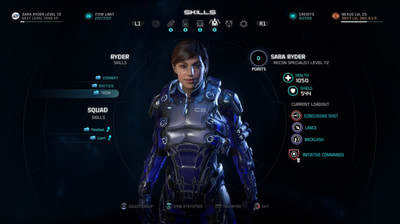
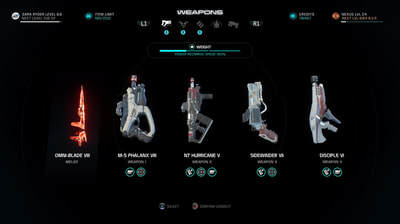
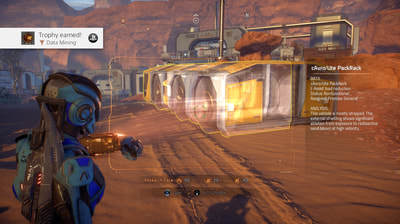
Mass Effect: Andromeda caught my attention due to its massive length and the mashup of space exploration/intense combat/character driven storylines. I wasn’t disappointed. It’s a smorgasbord of the best science fiction tropes with great characters and an engaging narrative.
I’m new to the Mass Effect series, and sort of new to the PS4. I’m an old school PC gamer (the original Deus Ex remains my favorite) but even impressive graphics aren’t enough to wow me. It takes great gameplay and an engaging story. Especially engaging characters. Plus, I’m a huge science fiction fan, and this game borrows from so many common tropes: exploration, colony ships, terraforming, artificial intelligence, and super intelligent ‘creator’ aliens. But it manages to balance them all in a good storyline where arks filled with thousands of people in cryostasis set out for the Andromeda Galaxy in search of a new home. I won’t spoil the plot, but it does tie in to the previous games. You’re allowed to play a male or female human, and the customizable appearance allows for a wide range of hairstyles and ethnicities. (I do wish they had allowed you the option to play a different species.) Your character is a Pathfinder, one tasked with finding worlds fit for colonization—as well as deal with hostile aliens, scavengers, raiders, and ancient robots trying to prevent that. You’re given a ship, the Tempest, which serves as your home. It’s to scale and looks great. You even have a spacious cabin where you can change outfits.
First, the gameplay: combat is fast and fluid. You’re allowed to carry up to four ballistic weapons (if you put enough points in the correct skills) and one melee weapon. There’s a wide range of biotic and combat abilities. Some let you lift enemies into the air, immobilizing them, or protect yourself with a shield that reflects energy back at attackers. Others let you blast them with sheer force or infect them with robotic parasites. The jump jet really helps you dodge and move around the field to outflank enemies. You automatically duck or take cover when moving behind crates and other battlefield obstructions. There’s some pretty epic fights in the story: battling the various Remnant Architects, raiding the Kett Fortress on Voeld, freeing the Asari ark Leusinia, clearing the Flophouse on Elaaden—you’ll want to replay the good ones.
Weapon selection focuses on pistols, assault rifles, shotguns, sniper rifles, and a melee weapon. There’s such a wide range of guns, and the ability to build custom versions, that even the pickiest gamer will find an arsenal they like. Armor is the same, with many different suits that you can also customize with mods. Of course, you can customize the colors of your armor, allowing for an even more unique appearance.
Visuals: Ignore all those complaining about graphics glitches and poor facial animations. If you’ve downloaded the latest patches, most of those issues are fixed, and happened so infrequently to me that it didn’t detract from the overall game. Yes, Bioware should have shipped a less buggy title. But enjoy the good things: the worlds, the equipment, the structures, the lighting—all look magnificent. Stepping onto Habitat 7 for the first time made my jaw drop—a sensation I haven’t felt since exiting Vortex Rikers in the original Unreal way back in 1998. This is a beautiful, detailed, immersive game.
Exploring: There are many solar systems to discover, each with worlds and phenomena like comets and derelicts to scan. Some of this activity earns you XP, Research Points, minerals, salvage, and even progresses a few quests. While there’s a only a handful of planets you can actually walk around on, this is still a neat feature and fits with the plot of seeking a new home in a strange galaxy. On the worlds you are allowed to set foot on, you can use the Nomad (a six-wheeled armored rover) whose paint job can be customized. Some character conversations can only be heard while driving in the Nomad, so it’s not a boring feature in the least.
Quests: There are a LOT, and some are character related (completing them gains you that squad member’s loyalty). Most of these quests fit the game’s theme of building a new home in Andromeda, though a few seem frivolous because of their ease of completion. But overall they are set up well, because the more you complete, the more viable you make the core planets for colonization and settlement. The character’s Loyalty Missions are some of the best in the game, and though each features combat, they fit with what that character holds dear.
Romance: Like previous Mass Effect games, you can romance certain characters. I played Sara, and romanced Peebee, which took some time compared to the other squad members. The relationship was well done and added an extra element to the game. I do feel like some relationship choices get shortchanged over others (some receive much better love scenes, such as a Scott/Cora coupling), and (before the patch release that allows Jaal to be romanced by either gender), fewer LGBT pairings. I also think there should have been more ‘fling’ relationships available, at least one per core planet, for either sexual orientation.
Research Points: This feature is cool but could have been so much more. I like that you’re allowed to research and build better versions of your weapons and armor, but you can play the whole game without ever using it. It’s wasted as a result. There should have been more quests that required you to research something in order to move the story forward (and not just developing a piece of pre-exiting weaponry, of which there are three different side quests). A great idea that falls short.
The Squad: You get six characters possessing a range of combat skills, and each (with the exception of Drack) can be romanced. Their personalities are well defined, especially as the game progresses. I advise talking to them as much as possible, and switching combinations to ride around with in the Nomad, because there’s some fun conversations to be had. Some reviewers have expressed dislike of these characters, but I call bullshit. They do represent archetypes, true, but you’ll find that in any fiction medium, especially a video game. Peebee, an Asari, is my favorite with her chaotic but curious personality. As an Angaran, Jaal’s unfamiliarity with your customs is well done. Liam, a fellow human, always cracked me up with that British accent and snide humor. Vetra, a Turian, is the most down-to-earth of the group. Cora, another human, seems all duty but has a soft side. Drack, a Krogan, is the cantankerous yet lovable elder of the group. I liked them all.
APEX Missions: I can’t comment much on this, as I have yet to delve into the game’s multiplayer side. What I have seen looks good, with exclusive missions and highly customizable characters. It might be a way to feed my Mass Effect hankering now that I’ve completed the single player game.
So all in all, I got more than my money’s worth in Mass Effect: Andromeda. I didn’t want it to end, and that’s after spending 143 hours to complete the game at 100%. Though I doubt it’ll happen since fan reaction was underwhelming, I’d love to see a sequel. Especially one that features the same characters. There’s several loose ends (like the missing Quarian ark and the Kett’s continued interest in the Heleus Cluster) and the impression is blatant that your mission has just begun. But until then, I’m willing to replay this from the beginning. It’s that good. Here's a gallery showing my stats, typical weapon loadout, game completion, a early game trophy, casual outfit, and the character I romanced.


May 22, 2017
Alien: Covenant Review
Note: this review contains spoilers.
I’ve been a fan of the Alien franchise since I was twelve. That was when I first watched the original, on a VHS rental. (I do NOT miss ‘fullscreen’.) While I love the first film and its sequel, Aliens, the following installments fell far short. (No, Alien 3 still isn’t a ‘nihilistic masterpiece’, and I’ve seen the extended cut. And though Jean-Pierre Jeunet is among my favorite directors, Alien: Resurrection is a subpar exercise in milking the box office.) Prometheus had its moments—it wasn’t great, but the hate it still receives is strange—and yet, I liked it. Plus, I was extra excited for this new installment, because it would be the first Alien movie I’d seen on the big screen.
I say all of this upfront, because the Alien franchise polarizes fans. The latest film in the series, Alien: Covenant, will be no exception. It will have its admirers and detractors.
Pros:
The film looks great, as you’d expect from anything Ridley Scott directs. Regardless of what you may think of his storytelling abilities, the man still has an eye for framing breathtaking shots. I like his quick cutting during the action.
The score by Jed Kurzel hearkens back to Jerry Goldmith’s soundtrack from the original film, plus a few cues from Marc Streitenfeld’s work on Prometheus. Kurzel’s music is fitting and not overdone (‘The Med Bay’ is a fantastic piece of horror scoring) and underlines the scenes well.
The cast is good, but like the previous film, Michael Fassbender’s presence dominates.
And, like Prometheus, the special effects are great. I’ve always loved Ridley’s take on future tech, and some of the exterior space shots must be seen on the big screen to be fully appreciated (like the solar sail repair sequence).
The action/kill scenes are scary, gruesome, and memorable. I’m not going to forget that neomorph bursting from Ledward’s back in the med bay, and what happens afterward. (HOLY SHIT that went south quick.) Nor will I forget Rosenthal’s decapitated head floating in that basin. And facehuggers never cease to be frightening.
Cons:
Echoing many others viewers, I felt the crew should have been wearing masks (hell, an entire spacesuit) when they disembarked on the unknown planet. Even if their scanners revealed that the environment was perfectly hospitable for humans, that doesn’t mean the place would be empty of pathogens, bacteria…and, as the films shows, the airborne variety is terminal. (I think Ridley did this because: 1. the script demanded it, and 2., Ridley seems to assume the audience takes certain things for granted—such as the crew already knowing, from their sensors, that the planet wasn’t poisonous—and cuts extraneous material out to keep the pace going. Me, I would have left that in. It makes the crew look dumb.)
Once again, Ridley leaves important questions unanswered. What happened to the Engineers? How do those eggs, in that Engineer starship, wind up on LV-426 in the original film? Why no xenomorph queen?
Another thing: the characters don’t receive enough development. There’s very little breathing space between the action/death scenes once the shit hits the fan. I like that sort of frenetic pacing, but AFTER we have learned enough about the crew to care about what happens to them. Though I will say, the fate of Daniels and Tennessee, after surviving that ordeal, was a real pisser, because they were easily my two favorite crewmembers. So maybe Ridley knew what he was doing.
I was perfectly okay not knowing who really made the xenomorphs to begin with, but, hey. If you’re going to keep making these films, you might as well explore that side of it.
Okay, now for the deeper stuff.
David, the android from Prometheus, and his hatred for his creators, is the centerpiece of the movie. He was a real bastard in Prometheus, nonchalantly infecting crewmembers, watching them die, like Ash’s evil cousin. Well, all of that makes much more sense in Alien: Covenant, because we see that David despises the species that created him. Small wonder, since his ‘father’, Peter Weyland, was a selfish, greedy asshole. And, by extension, he has no regard for humanity’s creators, the Engineers—he mercilessly annihilates an entire city of them with a bioterminator immediately upon arrival. He killed Shaw and studied/experimented with her corpse, then cultivated and perfected the xenomorph—which needs a biological host—that not only incubates inside his hated creators, but is tailor-made to hunt them down and eviscerate them. Its very appearance could be by design, intended to terrify the human psyche on a darker, primal level. In short, David, playing god, created the ultimate horror.
The themes of a ‘god’ and its creations are strong in this movie, as they were in the previous one. But David is the metaphorical Devil, dwelling in darkness, waiting patiently until someone arrives and his ‘children’ can be born. He even paraphrases a line from John Milton’s Paradise Lost when he asks Walter, ‘serve in Heaven, or reign in Hell?’. Fassbender plays the character as a cold, demented genius, akin to Hannibal Lector. I’m glad David survives the film, because I certainly want to see more of him.
Some criticized the ending for being predictable—David switching places with Walter, an android that shares his physical appearance—but I loved it. It’s one of those situations where the audience knows it, feels the horror of it, but can’t tell the characters as events unfold. The tear shed by Daniels inside her stasis pod was the coda of knowledge gained too late.
In summation, Alien: Covenant is the best movie in this series since James Cameron’s Aliens. It’s not a perfect film, and its faults could have been easily avoided, which makes them all the more noticeable. Plus, like an episode of Lost, it leaves some important things unanswered while creating new questions. I hope Ridley releases a director’s cut that reveals more. All of this aside, I still recommend the theatrical release.
I’ve been a fan of the Alien franchise since I was twelve. That was when I first watched the original, on a VHS rental. (I do NOT miss ‘fullscreen’.) While I love the first film and its sequel, Aliens, the following installments fell far short. (No, Alien 3 still isn’t a ‘nihilistic masterpiece’, and I’ve seen the extended cut. And though Jean-Pierre Jeunet is among my favorite directors, Alien: Resurrection is a subpar exercise in milking the box office.) Prometheus had its moments—it wasn’t great, but the hate it still receives is strange—and yet, I liked it. Plus, I was extra excited for this new installment, because it would be the first Alien movie I’d seen on the big screen.
I say all of this upfront, because the Alien franchise polarizes fans. The latest film in the series, Alien: Covenant, will be no exception. It will have its admirers and detractors.
Pros:
The film looks great, as you’d expect from anything Ridley Scott directs. Regardless of what you may think of his storytelling abilities, the man still has an eye for framing breathtaking shots. I like his quick cutting during the action.
The score by Jed Kurzel hearkens back to Jerry Goldmith’s soundtrack from the original film, plus a few cues from Marc Streitenfeld’s work on Prometheus. Kurzel’s music is fitting and not overdone (‘The Med Bay’ is a fantastic piece of horror scoring) and underlines the scenes well.
The cast is good, but like the previous film, Michael Fassbender’s presence dominates.
And, like Prometheus, the special effects are great. I’ve always loved Ridley’s take on future tech, and some of the exterior space shots must be seen on the big screen to be fully appreciated (like the solar sail repair sequence).
The action/kill scenes are scary, gruesome, and memorable. I’m not going to forget that neomorph bursting from Ledward’s back in the med bay, and what happens afterward. (HOLY SHIT that went south quick.) Nor will I forget Rosenthal’s decapitated head floating in that basin. And facehuggers never cease to be frightening.
Cons:
Echoing many others viewers, I felt the crew should have been wearing masks (hell, an entire spacesuit) when they disembarked on the unknown planet. Even if their scanners revealed that the environment was perfectly hospitable for humans, that doesn’t mean the place would be empty of pathogens, bacteria…and, as the films shows, the airborne variety is terminal. (I think Ridley did this because: 1. the script demanded it, and 2., Ridley seems to assume the audience takes certain things for granted—such as the crew already knowing, from their sensors, that the planet wasn’t poisonous—and cuts extraneous material out to keep the pace going. Me, I would have left that in. It makes the crew look dumb.)
Once again, Ridley leaves important questions unanswered. What happened to the Engineers? How do those eggs, in that Engineer starship, wind up on LV-426 in the original film? Why no xenomorph queen?
Another thing: the characters don’t receive enough development. There’s very little breathing space between the action/death scenes once the shit hits the fan. I like that sort of frenetic pacing, but AFTER we have learned enough about the crew to care about what happens to them. Though I will say, the fate of Daniels and Tennessee, after surviving that ordeal, was a real pisser, because they were easily my two favorite crewmembers. So maybe Ridley knew what he was doing.
I was perfectly okay not knowing who really made the xenomorphs to begin with, but, hey. If you’re going to keep making these films, you might as well explore that side of it.
Okay, now for the deeper stuff.
David, the android from Prometheus, and his hatred for his creators, is the centerpiece of the movie. He was a real bastard in Prometheus, nonchalantly infecting crewmembers, watching them die, like Ash’s evil cousin. Well, all of that makes much more sense in Alien: Covenant, because we see that David despises the species that created him. Small wonder, since his ‘father’, Peter Weyland, was a selfish, greedy asshole. And, by extension, he has no regard for humanity’s creators, the Engineers—he mercilessly annihilates an entire city of them with a bioterminator immediately upon arrival. He killed Shaw and studied/experimented with her corpse, then cultivated and perfected the xenomorph—which needs a biological host—that not only incubates inside his hated creators, but is tailor-made to hunt them down and eviscerate them. Its very appearance could be by design, intended to terrify the human psyche on a darker, primal level. In short, David, playing god, created the ultimate horror.
The themes of a ‘god’ and its creations are strong in this movie, as they were in the previous one. But David is the metaphorical Devil, dwelling in darkness, waiting patiently until someone arrives and his ‘children’ can be born. He even paraphrases a line from John Milton’s Paradise Lost when he asks Walter, ‘serve in Heaven, or reign in Hell?’. Fassbender plays the character as a cold, demented genius, akin to Hannibal Lector. I’m glad David survives the film, because I certainly want to see more of him.
Some criticized the ending for being predictable—David switching places with Walter, an android that shares his physical appearance—but I loved it. It’s one of those situations where the audience knows it, feels the horror of it, but can’t tell the characters as events unfold. The tear shed by Daniels inside her stasis pod was the coda of knowledge gained too late.
In summation, Alien: Covenant is the best movie in this series since James Cameron’s Aliens. It’s not a perfect film, and its faults could have been easily avoided, which makes them all the more noticeable. Plus, like an episode of Lost, it leaves some important things unanswered while creating new questions. I hope Ridley releases a director’s cut that reveals more. All of this aside, I still recommend the theatrical release.