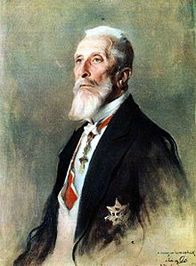
Albert Apponyi de Nagyappony (1846 – 1933) was a Hungarian nobleman and politician.
Count Albert Apponyi became a member of the Hungarian Parliament in 1872 and remained a member of it, with one short exception, until 1918. From the late 1880s, he was the leader of the “united opposition,” which consisted of all parties hostile to the Austro-Hungarian Compromise of 1867.
He was Speaker of the House of Representatives of Hungary from 31 October 1901 to 6 November 1903.
As Minister of Education he drafted the laws, sometimes called Apponyi laws, passed in 1907 in which the process of Magyarization culminated. Reading, writing and counting in primary schools was done exclusively in Hungarian for the first four years of education. Approximately 60Albert Apponyi de Nagyappony (1846 – 1933) was a Hungarian nobleman and politician.
Count Albert Apponyi became a member of the Hungarian Parliament in 1872 and remained a member of it, with one short exception, until 1918. From the late 1880s, he was the leader of the “united opposition,” which consisted of all parties hostile to the Austro-Hungarian Compromise of 1867.
He was Speaker of the House of Representatives of Hungary from 31 October 1901 to 6 November 1903.
As Minister of Education he drafted the laws, sometimes called Apponyi laws, passed in 1907 in which the process of Magyarization culminated. Reading, writing and counting in primary schools was done exclusively in Hungarian for the first four years of education. Approximately 600 Romanian villages were left without education as a result of the law. By 1917, 2,975 Romanian primary schools were closed.
After World War I, Apponyi's most notable public office was his appointment in 1920 to lead the Hungarian delegation to the Versailles Peace Conference to present Hungary’s case to the Allied and Associated Powers assembled there to determine the terms of the peace treaty with Hungary, which subsequently became known as the Treaty of Trianon. The mission was in vain as the Allies refused to negotiate the terms of the peace treaty.
Between 1911 and 1932, he was five times nominated for the Nobel Peace Prize by Hungarian universities, scientists and political groups, but never became a laureate....more

 Sign in with Facebook