
 Must be a group member before inviting friends
Robin Reardon's Blog: Robin Reardon: Speaking of writing..., page 7
November 15, 2015
A God Worth Worshipping

I can’t open my Twitter newsfeed or my Facebook page or, it seems, almost any other source of information, without seeing something new about a religious “Christian” extremist in the U.S. (especially those running for the GOP presidential nomination) who thinks his or her god condemns every LGBTQ individual on the face of the planet to hell.
Here are just a few recent examples.
Mike Huckabee says that as president, he would ignore Obergefell v. Hodges because, “there is nothing in the Constitution that gives the Supreme Court power to make a law.” Of course, he’s ignoring the fact that this case did not, in fact, make a law. What SCOTUS did was what the Constitution says SCOTUS is supposed to do: interpret existing law and issue a ruling about how it’s applied across the country. It’s difficult to tell whether Huckabee is ignorant of the Constitution, is ignorant of what SCOTUS did, or is lying through his teeth. But it has to be one or more of those things.
Dr. Ben Carson puts gays in the same general category with bestiality and NAMBLA (North American Man-Boy Love Association, which promotes adult men having sex with young boys).
The Mormon Church has issued an updated policy on their attitude toward gays, which not only disallows marriage equality, but also ostracizes gays who live life as it comes naturally to them, and keeps their children on the outside of that august body until they are eighteen, move out of their parents’ home, and receive special approval to enter the church.
Extremist pastor Kevin Swanson is one of many in this camp who recommend putting gay people to death. He’s blamed every catastrophe from hurricanes to fires to floods on gays, he’s convinced the Girl Scouts are producing lesbians, and he likes the idea of a Rose Bowl float on which a gay person is stoned to death. Oh, yes, and he insists God gave HIV/AIDS to gays as a gift, so they could die slowly enough to repent. (If you can stand it, here’s a long list of his ridiculous rants.)
Swanson was a chief organizer of the National Religious Liberties Conference that met November 6 in Des Moines, Iowa, at which Mike Huckabee, Bobby Jindal, and Ted Cruz spoke—yes, the same Ted Cruz who insists that as president, he would reverse marriage equality.
All these individuals, and others of their ilk, spew vitriol that they claim is supported by their scripture. Add to all this the Catholic Church’s position—that although homosexuality might not be a choice, participating in the lifestyle is, and it's a sin—and we complete the picture of a descent into madness.
Deep breath.
Here’s what these extremists have taught me: Their god is not a god worth worshipping. Any god who would program someone’s biology so that they are unavoidably attracted to people of the same sex and then say to them, “I’ve made you something I can’t love; fix it,” isn’t a god worth worshipping. And that god is by no means the God of Love that Christians claim to worship.
Christians who would worship a God of Love need to heed their own prophet, who said clearly (Matthew 22:37-40) that Love rules above Law. This means that when Law (i.e., Thou Shalt and Thou Shalt Not) conflicts with Love, it loses every time.
No god worth worshipping would expect every LGBTQ individual to remain chaste as some kind of test. That doesn’t mean there isn’t a test here, but here’s the thing: It’s not a test for gays only. It’s a two-part test. Part One: Kevin Swanson, Mike Huckabee, et al, must learn to love even those individuals who make them uncomfortable, even those individuals who (they believe) are breaking the Law. Part Two: LGBTQ individuals must learn to love Kevin Swanson et al, when when they fail their test.
And, man, are these hateful and supposed-Christians failing their test. Wonder what their fate will be.


November 7, 2015
Jurassic Park comes to Houston
The voters in Houston, Texas recently set LGBTQ rights back. The irony is that they didn’t do it because they have a problem with gays. Their problem? Bathrooms. The cause? Lizard brains.

This setback was the rejection of HERO, or the Houston Equal Rights Ordinance, which would have put in place state-based anti-discrimination prohibitions already covered by federal law, would also have prohibited discrimination based on sexual orientation and gender identity, for which there is no federal law. Religious institutions were exempted.
The primary reason why voters rejected HERO can be summed up in two words: lizard brain.
There is a part of our brains that is so primitive that we have it in common with lizards. The scientific term for it is the reptilian brain. It’s the seat of instinct. It’s non-congnitive and non-verbal. Bottom line: It doesn’t think. In fact, it’s impervious to reason. When something feels wrong to the lizard brain, it causes chemical reactions that result in the fight-or-flight response. No time for thinking. So it’s no surprise that, according to Buzzfeed, half of the people who voted against HERO had no idea it had to do with discrimination at all. They had heard the opposition’s baseless claims that the ordinance would allow men into women’s bathrooms, their lizard brains took over, and they became terrified.
The lizard brain is very powerful. It uses fear as its primary tool. Not only does it not wait for us to put our human brains into gear before forcing us to react, but also its effects are so profound that we seem unable to think for some time after it has its way with us.
This power was beautifully demonstrated in Houston. Many people believed the fear-based propaganda that the purpose of the ordinance was to allow men into women’s bathrooms and see naked women. Some believed it would pose a danger to women because of potential harassment or worse. All of this is thoughtless, mindless, lizard-brain-based confabulation.
Here are some facts. You remember facts? Those things that we should have in mind before we make important decisions about other people’s lives?
A transwoman is someone whose external appearance at birth (and throughout life, unless surgery is performed) was that of a male, but who has realized that there is a critical disconnect between who she is and what she looks like to others.The brain structures of men and women have observable differences, and an apparent male who identifies strongly as female almost certainly has the brain structure of a woman. This means that if HERO had passed, no one would have been allowing men into women’s restrooms. A transwoman is a WOMAN.There have been no reports of women or children being attacked or harassed in restrooms by men who are dressed as women. In fact, the likelihood is that it’s the trans individual who will be terrorized.The likelihood that a male predator would be willing to dress and act like a woman for any reason at all is probably below zero.Although HERO would have opened the door (as it were) for a transwoman to use a woman’s restroom, this aspect was a very small part of the ordinance as a whole.All the women’s restrooms I’ve ever been in are either for one person at a time, or they are lined with enclosed booths behind which women do their business. Even the women who are allowed to use there facilities don’t see each other’s body parts.There are some people who should be ashamed of themselves for making the lives of trans individuals harder than this disconnect already does. Mike Huckabee, with his disgraceful statements about how he would have showered with the girls as a horny teenager, is at least close to the top of the list, but it’s very long.
We also have people like Ben Carson who suggest that we need to create separate bathrooms for trans individuals. But this puts us right back into a situation where we’re mixing men and women in the same restroom, something that HERO’s detractors insist is wrong. It also forces trans individuals to acknowledge their trans status publicly, something no one should be forced to do.
The lizards in Houston who voted HERO down are entitled to their opinions. Or, they would be, if there were any evidence they had engaged the human parts of their brains.
October 31, 2015
Are you afraid of Pagans?

My upcoming novel, Throwing Stones, is a book that might challenge readers on a couple of fronts. First, like all my books, it revolves around a gay teen and, yes, his love interest. Second? Well, although all my books include some aspect of religion or religious practice—either metaphorically or front-and-center—this one will present some readers with a new challenge.
My dentist loves my books (no, he's not gay; he just loves my books), and his staff members know it. Last time I was there, his bookkeeper asked me what I was working on now. I said, "I'm writing a story about a teen who wants to reconcile his family and the people in his town with a group of Pagans who..." I stopped before I could finish my sentence, because her eyes had gone wide. Very wide. But not, I would have said, with interest. It was the kind of surprise that borders on fear. The word "Pagans" shocked her.
I live in eastern Massachusetts, an area known for progressive attitudes and where I would have expected that anyone I spoke to would perhaps be intrigued by the idea of a Pagan community. I did not expect fear.
Paganism is a world religion. Pagan worship and practice can take many different forms, as can Christianity, Judaism, Islam, Buddhism—that is, as can any religion. Adherents might practice Wicca or they might not. They might see their central figure as The Goddess or they might not. They might belong to a grove (or parish) or they might not. They might take the eight annual sabbats, or holy days, very seriously, or they might not. In other words, Pagans are people. And Paganism is a belief system—that is, a religion.
What Pagans are not is devil worshippers. In my research for Throwing Stones, I couldn't find any evidence that Pagans even acknowledge (let alone believe in) any concept that equates to the Judeo-Christian devil. What I found was an extremely diverse, autonomous collective of individual people whose credo, "An it harm none, do as ye will," is even more challenging to follow faithfully than the Christian Golden Rule ("Do unto others as you would have done to you."). The Pagan credo challenges members to understand others (and themselves, for they are not to harm themselves, either) as well as possible before taking action, or they can't know what harm might be done.
Also, modern Pagans (as well as earlier followers) are exceptionally accepting of different sexual identities and orientations. In fact, "accepting" isn't even the right word. It wouldn't occur to them that these differences are problematic. This article in the Sept. 24 issue of Patheos (the Pagan channel) talks about the sexual variations among mythical characters. It also discusses the dangers of viewing anything historical—from culture to religion to sexuality—through contemporary lenses. Said differently, many assumptions about life are not the same from one time period to another. But the bottom line is that Pagans see issues of sex as much more fluid than the Abrahamic traditions see them.
The holiday non-Pagans refer to as Halloween is a high-holy day for Pagans. They refer to it as Samhain (pronounced like Sowhen). It's the end (death) of one year and the beginning (birth) of the next. As the day draws near, the veil that separates the old and the new, the dead and the living, thins. Some Pagans (and some Christians who are closer to their Pagan roots) understand that the thinner the veil, the closer the living and the dead are to each other. For Pagans, this is not a time of ghouls and goblins. It's a time to reconnect with ancestors and loved ones who have moved on. And experiencing this thinness can be a way for the living to feel more at peace with what we all know about ourselves: One day, we will join those on the other side of the veil.
Throwing Stones throws one metaphorical stone right between the widened eyes of people who fear and condemn the "other," the "different," without making an effort to understand that other. This happens to Pagans. And it happens to gays. It needs to stop.
If you'd like to learn more about Paganism, here are a few links:
Patheos / Under the Ancient Oaks / The Four Centers of Paganism The Pagan Library The Eight Pagan Holidays (Sabbats) The Caldron (A Pagan Primer) Blue Moon Manor: Traditional Witchcraft of The British Isles The Witches' VoiceSubscribe to my blog
September 27, 2015
Write what you know, right? Well... no. Not necessarily.

It's a maxim authors hear all the time: Write what you know. While there's nothing wrong with writing what you know, what this advice doesn't say is that you should be always learning more. And sometimes you learn that "more" because you want to write about it.
I'm a good example. As I was starting to write my first story, a friend (someone no longer on my contacts list) told me I was crazy, writing from the point of view of a gay teenager. "Write what you know," she admonished me, as if she knew.
The story in that first book (A Secret Edge, 2007) revolves around a sixteen-year-old track star who's figuring out that he's gay and trying to figure out what that will mean for him.
A Secret Edge

The initial reviews were gratifying for two reasons: one, reviewers and readers really liked the book; two, whenever reviews mentioned the book's author, they used male pronouns. They had assumed I was a gay man. I took advantage of an early radio interview (1 in 10, Boston) to come out as a straight woman.
Since then, other reviewers have assumed I was a man. Once they've been disabused of this impression, some have asked me outright how I manage to write as though I were a gay, male teenager.
The truth is that I did have a few things going for me, in terms of what I knew before I started. One was that I had already figured out that my best fiction writing voice is that of a teenager. Another was that I had several gay friends, especially when living in New York City just as the AIDS crisis was getting going (I know; I'm dating myself, here), so I had at least a starting point of understanding what the stigma, the prejudice, and the lifestyle were like. Third, I'd grown up with all brothers. Three of them. They aren't gay, but I'm very familiar with the male teen gestalt. Fourth, I'd ran track, myself, in high school—short dash and relay, just as I had my protagonist do.
And, all right, there's one more advantage. It's one that would have helped me if I'd chosen to write about straight teenage girls, but I wanted a more open stage. And that advantage? I know what it's like to want a man.
So that's the sum total of what I knew. And to be honest, I didn't stray very far away from my base knowledge in that first book, and I think that was wise. I plumbed my existing knowledge of classical music, comparative religion, track, and classic film, weaving the topics into the story. So you could really say that for A Secret Edge, I mostly wrote what I knew.
But what about Thinking Straight, which follows a gay teen's days inside an "ex-gay" camp? Or A Question of Manhood, which features an important character who's an expert in dog behavior? (I'm a cat person, myself.) Or Educating Simon, which shows the effects that synesthesia and autism have on a teen and his family, throwing in the subculture of Straight Edge and the admissions process for Oxford University for good measure? I knew little or nothing about any of these topics when I started writing the books that feature them. But I know a lot more about them now.
I could have written more stories like A Secret Edge, which is a straightforward (no pun intended) romance, rather sweet, short, very accessible. All right, it opens with a boy's wet dream, but—hey, girls can have sexy dreams, too. And there would have been nothing wrong with more books like that one. But having written that story, I was warmed up. I knew I could run a more challenging race. And I started to pull in more and more of what I didn't know. Or, what I hadn't known, before working on each book.
The approach that has served me well, as I've included more topics I had to research, is that by the time I do the writing, I know much more about each of those new (to me) topics than I will ever include in the story. I do the research (thank goodness for the Internet!), collect information, sift through it for bits I want to use, go back and pull in other bits that fit into the plot as it was unfolding, and leave the rest behind. Or, leave it out of the story.
But those bits I don't use aren't wasted. If you look on the individual page for any of my books (other than that first one, or the one that isn't yet released), you'll see a section called Digging Deeper. This is adjunct reading for anyone whose imagination was caught by unusual topics I had included in the story. Sometimes, as I'm working on a Digging Deeper document, I find I need to do just a little more research to round it out and make it worth reading. That is, I need to know more.
So what kind of writing do you want to do? Are you happy turning out books whose story lines vary just enough to change the characters' names? Nothing wrong with that, and you can mostly write what you know. If you do it well, you'll have a good career in front of you. Or do you want to write stories that expand not only your readers' worlds, but also your own? If the latter, then start with what you know. But don't stop there.
Thinking Straight

Educating Simon
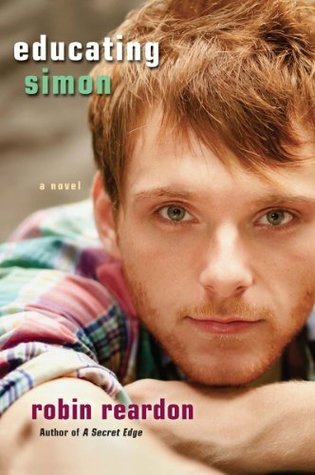
A Question of Manhood

September 20, 2015
God, or Mammon? Kim Davis must choose.

If Kim Davis and her knight in shining armor Mike Huckabee are to be believed, Davis has suffered “immediate and irreparable injury" because she was expected to perform the duties for which she was hired: that of Kentucky's Rowan County clerk.
Davis's attorney is saying that Davis “is facing immediate and substantial harm and consequences for exercising her individual constitutional and statutory rights.” And what right does she want to exercise? Her religion condemns homosexual activity, so she doesn't want to be required to issue legal marriage licenses to gay couples. She wants to perform only the parts of her job that don't, in her mind, conflict with her religious beliefs. Should she be allowed to do that?
We have a similar case in flight attendant Charee Stanley, a Muslim, who refuses to serve alcoholic beverages to passengers. Lena Masri, an attorney with Michigan chapter of the Council on American-Islamic Relations, says, "... no one should have to choose between their career and religion and it's incumbent upon employers to provide a safe environment where employees can feel they can practice their religion freely." And what does Stanley demand? Her religion bans the consumption of alcohol. She wants to perform only the parts of her job that don't, in her mind, conflict with her religious beliefs. Should she be allowed to do that?
Of these two women, I actually have more sympathy for Davis (though I am by no means exonerating her). In her case, even though the law has changed, she can truthfully say that when she took her current job, there was no legal basis for gay couples to be granted marriage licenses in Kentucky, and she could turn them away with impunity. But, in fact, the law has changed, and it's now her job to supply marriage licenses to all citizens, anyone's religion notwithstanding. Stanely, on the other hand, must have known very well what the job of a flight attendant entails.
What they have in common, however, is this: They have placed their secular jobs on a priority level at least as high as their religions.
Now let's look at another couple of examples, where the individual in question is actually being persecuted.
In trying to resolve child custody issues with her ex-husband, Holly Salzman was court-ordered into counseling and was sent specifically to one Mary Pepper. Salzman chooses to live without the crutch/comfort/whatever of an institutionalized religion. Pepper, on the other hand, claims to be Christian, and she proceeded to inundate Salzman with proselytizing brochures, verbal religious pablum, and Christian-based "homework" assignments. When Salzman protested, her sons were taken away from her until she subjected herself again to the ministrations of this religious extremist. Turns out the "Christian" Pepper was operating under the table, meeting clients in public libraries (a legal no-no), and insisting on secrecy and cash payments so her chicanery wouldn't be exposed. Um... these are Christian principles? And what about Salzman's constitutional and statutory rights when it comes to religion and to—oh, I don't know, keeping her kids?
Then we have high schooler Brianna Popour, a lesbian who wanted other gay kids to feel as though they could be comfortable with themselves, so she wore a T-shirt to school (not against school dress codes) with this message written on it: "Nobody knows I'm a lesbian." School officials labeled the message "disruptive, offensive, and distracting," and the girl was suspended. So, just for openers: What about Popour's first amendment rights?
In summary
1. Holly Salzman was forced by the secular court to be subjected to unwanted religious rantings and worse, in a situation that was illegal, and she had submit or lose her sons permanently. This is essentially not a choice.
2. Brianna Popour has been told that her very nature is "offensive," and she was told to leave school. She has no choice about being gay; all she wanted to do was be open and honest about that, and to encourage other gay kids to feel comfortable in their own skins.
3. The Kim Davises and the Charee Stanleys of the world have chosen their religions, and they have chosen their jobs. The law does not require Davis to marry a woman or Stanley to drink anything she doesn't want to consume. And if they're going to treat their jobs as though the jobs were as sacred as their religions are said to be, how seriously do we need to take their cries of religious persecution?
And, by the way, Mike Huckabee, why aren't you leaping to Stanley's defense as you did with Davis? What's that you say? Oh—sorry; I forgot for a minute, there. Christianity is the one true religion.
Sorry. Wrong.
Religious freedom and First Amendment rights are yours, as long as you're Christian? I see. So all this gnashing of teeth and tearing of hair isn't really about religious freedom, is it?
September 14, 2015
Wrapping My Mind Around Transgender
Educating Simon
Simon Fitzroy-Hunt very much wanted to write this post, considering his experience coaching Toby/Kay Lloyd for the Scripps National Spelling Bee a couple of years ago. Simon? You're on.
Thanks. As all of you know from reading my journal (yes, it was private, but I'm over that), I was shocked when young Toby Lloyd confessed to me, the first time we met, that "he" was a girl. I'd already seen "his" bedroom, which had the foundations of a little boy's room with a lot of pink overlay, so on one hand this made a certain amount of sense. But—was he biologically a girl dressed like a boy, or a biological boy with a girl trapped inside?
It was the latter. And the only benefit I can see to discovering that one is transgender is that one gets to choose one's own name. She chose Kay.
At first, talking about this afterward with my friend Ned, I admit I was a little flip about it. But Ned helped me see that I would have been livid if anyone had told me that I wasn't really gay because that made no sense to them. So, who did I think I was that I could second-guess what Kay knew in her own mind?
But I still couldn't make sense out of it. When I tried picturing myself in a girl’s body, my thoughts slipped away as though I’d tried to catch a fish with my hands in oily water. My mind felt more warped than wrapped. So, being who I am (that is, super intelligent, excellent at research and analysis), I dug into this transgender topic. Here's what I found.
It seems that brain scans of people like Kay show that their brain structures more closely resemble that of the gender with which they identify, rather than that of their external appearance. Google the phrase transgender brain structure if you want to read about this, in publications ranging from New Scientist to the Wall Street Journal.
Now that I have this information, what I can't wrap my mind around is how nature could get things so messed up. But also, now that I have this information, what irks me is that I had to have it. I mean, I was so busy categorizing people into gay/straight/bi, that when Kay threw me for a proverbial loop I couldn't just believe her. I had to have proof. It had to make sense to me. While this gives me a certain amount of empathy for straight people who need proof that homosexuality is natural and normal, I'm a little ashamed that I didn't just believe her they way I want people to accept that I know that I'm gay and leave it at that.
But even just believing a trans person began to confuse me. It didn't help when Caitlin Jenner came out as a woman and said that "when it came to attraction," she might still be heterosexual. But for her, that meant attraction to women. I've also heard about other trans women who say they're attracted to women, and they consider themselves straight. The only way this makes any sense to me is if these women didn't rid themselves of their male genitalia. And even that makes only a teeny, tiny bit of sense. To me.
But—why would these trans women even mention their sexual orientation? The answer is: WE ASK THEM. We ask them, and we sit there, heads tilted at a slight angle, hanging on every expected word, for an answer. Even if our intentions are good, even if we're asking because we're trying to understand, why do we think the answer will help? Why do we think we need to know it? And if they give us answers we can't understand, whose fault is that?
This question about what we look like naked hasn't been a problem (at least, not that I'm aware of) for people who belong to the L,G, or B part of LGBT. Although some gay men seem rather effeminate (Christian Siriano comes to mind), and although some lesbians seem quite masculine (K.D. Lang, anyone?), it didn't occur to very many people to ask about their body parts. We were all pretty sure we knew what they'd look like undressed.
Then came T.
I watch some American TV. For example, I find John Oliver amusing. In his June 28, 2015 broadcast, he showed clips of people who should know better—from Katie Couric to Barbara Walters—asking someone who's trans, on camera, about their genitalia. As Oliver chastised, "It's none of your [expletive deleted] business!"
So while many of us (including brilliant me) still struggle to complete our own transition—that is, the one in our heads—I'm thinking it's time we stop doing two things: 1. expecting that everyone we meet is going to fit neatly into whatever categories make sense to us; and 2. asking invasive personal questions of trans folks that we wouldn't ask of anyone else.
Maybe it's time we started just accepting each other. Are you with me?
September 5, 2015
Throwing Stones Cover Reveal!
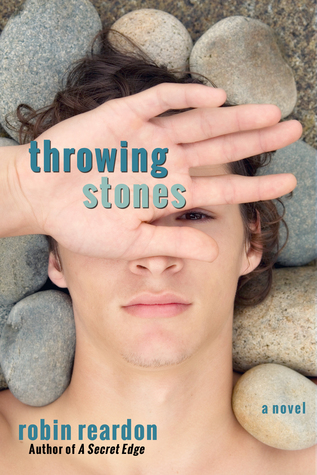
In my August 23 post, I promised you a glimpse at the cover of my new book, Throwing Stones. And here it is!
Throwing Stones release date is in November, on Friday the 13th—very appropriate for the subject matter! In an upcoming post, I'll tell you how you can pre-order your copy.
In case you need a refresher for what it's about, the synopsis is in my last post. The story hangs on the differences between people and what choices we make in responding to those differences.
Jesse Bryce and his family live in a fictional town in southeastern Oklahoma. It's a small town, with one high school, attended by townie kids and also by teens from "the village," a community of Pagans who live just south of the town.
For years, the attitude of most towns folks toward the village has been one of antagonism and even hatred. Jesse sees this play out in a number of ways, and finally he realizes what's at the heart of it: fear. Townies misunderstand Paganism, mistaking it for something it's not, for something they're afraid of. And their fear causes them to blame the village for everything from putting curses on townies to stealing babies and children and pets to directing tornadoes toward the town.
Jesse identifies with the village in many ways. He's gay. And he knows gay people are blamed for everything from the attacks on September 11 to the war in Iraq to Hurricane Katrina. And by getting to know his Pagan neighbors, Jesse figures out that it's fear making his own family respond badly to the fact that he's gay. Pagans, like gay teenagers, are just people, and if there's any reason to fear it has nothing to do with these labels. Anyone who's gay knows this. Anyone who's against gay people needs to know it.
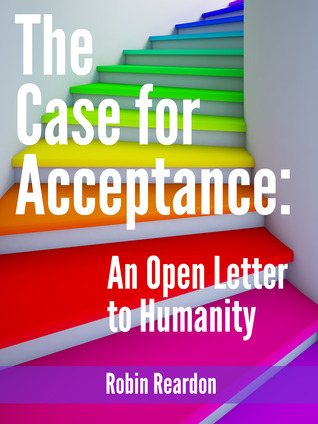
In my essay, The Case for Acceptance, I talk about the source of this fear. Summarized, it goes something like this. (Don't worry; Jesse doesn't go through all this analysis while telling his story.)
The Case for Acceptance: An Open Letter to Humanity
Of the three major divisions in the human brain, the most primitive (and the one also found in reptiles) is the R25, or reptilian brain, a.k.a. the lizard brain. It's the seat of instinct, which is not a thought process. It's responsible for your survival and the survival of your genes (that is, sex). To your lizard brain, you are the center of the universe, and what's right or wrong for you is right or wrong for everyone forever-and-ever-have-a-nice-day-amen. Because survival is—like—everything, the more paranoid the lizard brain is, the better it's doing its job. And the more paranoid, the more violent a reaction it causes to the different, the other, the not-like-us. And when that difference has to do with sex? You get the picture.
Your lizard brain doesn't think or reason or consider. It reacts. It reacts too quickly for thought. It reacts to something unfamiliar that's different from you, or something that appears before you too suddenly to identify, by shooting adrenaline through your system. And this is the point at which you feel fear.
We don't always recognize it as fear, and in fact the typical masculine response is a return in kind—that is, threatening, or striking. Often a homophobic man won't recognize his reaction to gays as fear. But that's what it is.
Without going through all this analysis, Jesse figures out that if the fear were gone, people would have a chance to get along much better. After all, he gets along just fine with his Pagan boyfriend.
August 23, 2015
My new book: Is it worth it?

I finished writing my new novel, Throwing Stones, a couple of months ago. And for the first time, I'm not going through a commercial publishing house to get my book into the market.
First, my eyes went kind of wonky browsing through screen after screen of cover-worthy stock photos, looking for just the right one. Then I began to research recommendations for how to launch a new book. And that's when I realized I needed a magic wand. Between the different platforms and the different formatting and the millions of different ways to get the word out (none of which are sure-fire) and—most challenging of all—how to get pre-release reviews, I thought I'd found my way into Oz or Wonderland, and not in a good way.
If I hadn't been really convinced that Throwing Stones was worth it, I would have stopped. But it is. I'm sure of it. See what you think.
Something is drawing seventeen-year-old Jesse Bryce toward the community of Pagans who live in "the village," just outside his rural Oklahoma town. Maybe it's that he has a crush on Griffin Holyoke, a tall, dark-haired boy with a tree tattooed all up his back. Or maybe it's that the Pagans accept Jesse for who he is, unlike his family—or his church, where he hears that being gay is a sin.
After a man from the village is murdered while trying to prevent an assault on a girl from the town, Jesse's confusion at the town's unsympathetic reaction inspires him to set a mission for himself: to build a bridge of acceptance between the town and the village.
As Jesse defies his parents and continues to visit the village, he witnesses mysterious rituals that haunt him with their beauty and intensity. And he falls in love with one enigmatic, mercurial Pagan who opens his eyes to a whole new world.
And regarding that cover... In my next post, I'll show it to you! Hope you love it as much as I do. Especially after all those screens of photos I went through.
August 18, 2015
A Word from Ethan Poe

The Evolution of Ethan Poe
I've heard that some of you are wondering what I've been up to since Max's big reveal toward the end of the book about me. First, I still love my tat.
Okay, I know you meant about Max and me. I'll tell you about that, though it's no big deal. Just warning you. But first I want to kinda talk about where I landed on this evolution and creationism—um, I mean, "intelligent design" business. (Like you couldn't tell by just looking at those quotation marks, right?)
I had one more year of high school after the story ended before college, which is where I am now. And I spent a lot of time with Raven. Remember Raven? My Siberian husky? The one with the widow's peak like mine? The more I worked with him, the way Etta taught me, the more it seemed like there was this love coming back from him for the love I was giving him. You might think that has nothing to do with evolution, but let me finish. Then you can argue.
Raven's a dog, I get that. And I'm not. But because of this love we share, and because I wanted to understand him as well as possible, I went beyond Etta. That is, I studied about wolves and wild dogs. Wrote a couple of papers during my senior year about this stuff, and one of them was about the evolution of canines and how domestic dogs came to be what they are today.
Then one snowy day while Raven was pulling me across the blueberry fields on a snowboard, I really, truly felt the presence of some... some one? some thing? Not sure what. But whatever it was, it wasn't there just for me. It was there for me, and Raven, and Etta, and Half, and—well, for everyone.
Getting to the miracle. You know those people back at home who couldn't take the idea that evolution could be true? They were terrified that if it were true, that would mean their scripture was wrong. And they couldn't take that. Because when you believe in scripture literally, everything about it has to be right. And if there's even one tiny flaw in it, it's kind of like the whole thing gets thrown into question.
But here's the thing. They're just limiting their own God. And they're limiting the miracles. Because if you believe there's a God who can perform miracles, why isn't evolution just as much of a miracle as anything else? When I look at where Raven's ancestors started out, it's a miracle he's like this today. And when I think were I started out, you know—cave man, and even earlier—it's a friggin' miracle that I'm like I am today. And if that's not enough, when I feel what passes between us when we look into each other's eyes, I can feel the miracle.
I think the literalist types have this idea that evolution is trying to lay claim to the origin of life, which to them would mean taking credit away from God. But that's not what evolution is. It's more about how life changed and evolved after it was created. So even if you think God created life, why couldn't God have used evolution as a tool to make it grow and change? How bored would God be if nothing changed, and if humans—with this brain that God supposedly gave us—didn't learn anything?
The Bible says God made the earth in, like, less than a week. And scripturally, the earth is now around six thousand years old. Science can prove that's not true, that the number of years is in the billions, but these literal types say they don't believe it. (News flash: Believing something doesn't make it true, and doubting something doesn't make it false.) But here's what I say: A miracle's a miracle, whether it takes six days or six thousand years or some massive number of millennia. A miracle is Raven's eyes and mine beaming love at each other.
Time to let go of literalism. Time to embrace the real miracles.
Now, about Max. By the time senior year ended, we had, too. Not it a bad way; we're still friends now. In fact, he's here at U of Maine Orono, like me. But he had a bit of an epiphany about mid-fall. He started going out with girls. And then he tried to come back to me, but not on an exclusive basis. That is, not even on an exclusively gay basis. But I said no, thanks, friends is enough. (I haven't found a good moment to ask what he tells girls about his tat...) Anyway, he says one day he'll probably fall really in love with someone, and he can't say whether that will be a man or a woman—he says it could be either, really—so he's decided he's bisexual. And that's cool. Because I got something started with Jamal. That ended, too, because he's at U Mass, but we had a good time.
Well, gotta run. Literally. Raven—yeah, he lives in my apartment with me and my roommate, Josh. Anyway, Raven convinced me that a daily run is good for both of us. Afterward maybe I'll see what my new friend Noah is up to. He's not my boyfriend, or anything. Not yet, anyway. See ya!
June 25, 2015
My story. Your play. Literally.
My novella A LINE IN THE SAND is now available as a stage script — FREE!
This story about two gay boys who meet during summer vacation on Hilton Head Island is ideal for the welcoming high school or other gay-friendly theatre troupe. The original novella, converted to a standard-format stage script, is now available free of charge.
If your group would like to consider staging the play, email me from the Contact page on my website (robinreardon.com), and I'll reply with an electronic copy of the script.
Robin Reardon: Speaking of writing...

- Robin Reardon's profile
- 181 followers

